Introduction
The pine wood nematode (PWN), Bursaphelenchus xylophilus, is the causal agent of pine wilt disease (PWD), which causes major economic and ecological losses by damaging pine trees worldwide (Mamiya, Reference Mamiya1983; Mota et al., Reference Mota, Braasch, Bravo, Penas, Burgermeister, Metge and Sousa1999; Braasch et al., Reference Braasch, Tomiczek, Metge, Hoyer, Burgermeister, Wulfert and Schönfeld2001). The PWN is transmitted to pine trees by pine sawyer beetles such as Monochamus alternatus that feed on pine branches. Once PWN infects susceptible pine trees, early nematode stages feed on the epithelial cells around the resin ducts followed by feeding on fungi growing in dead trees (Hasegawa and Miwa, Reference Hasegawa, Miwa, Zhao, Futai, Sutherland and Takeuchi2008). The PWN population in an infected pine tree is very low at the early infection stage (Kuroda, Reference Kuroda1991), but it quickly increases when the pine is approaching death, and air embolisms form in xylem tissue, which stops water movement and ultimately results in pine wilt (Kuroda and Ito, Reference Kuroda and Ito1992).
Ikeda and Oda (Reference Ikeda and Oda1980) reported that PWN-infected pine produced a large amount of volatile compounds such as ethanol after oleoresin leakage stopped; ethanol was later shown to have a stimulating effect on oviposition of PWN (Shuto and Watanabe, Reference Shuto and Watanabe1988). Oku (Reference Oku1988) reported that low concentrations of dihydroconiferyl alcohol produced by PWN-infected pines stimulated multiplication of PWN. In the nematode Caenorhabditis briggsae, low concentrations of ethanol significantly increased population growth (Lu et al., Reference Lu, Hugenberg, Briggs and Stokstad1978). These studies hint at a probable relationship between alcohols produced by PWN-infected pines and PWN reproduction, but the molecular mechanism of the influence of alcohols on PWN is still unclear.
Alcohol dehydrogenases (ADH, EC 1.1.1.1) are a group of dehydrogenase enzymes distributed in many organisms with the reduction of nicotinamide adenine dinucleotide (NAD+) (Reid and Fewson, Reference Reid and Fewson1994). ADH belongs to the medium chain dehydrogenase/reductase protein family (MDR) that contains the zinc-dependent ADH-Zn and related proteins (Persson et al., Reference Persson, Hedlund and Jornvall2008). As an important part of MDR, the ADH system, which catalyses the interconversion between ethanol and acetaldehyde, plays an important role in sugar metabolism including ethanol production and assimilation and cofactor balancing (Lin et al., Reference Lin, He, Wang, Lu, Li, Wu and Jiang2010). In Caenorhabditis elegans, the reaction rate for alcohol oxidation catalysed by ADH is more rapid with higher molecular weight alcohols as substrates than with ethanol (Williamson et al., Reference Williamson, Long and Theodoris1991).
Although it is controversial that bacteria associated with PWN are the casual pathogens of PWD, previous studies reported that the disease was induced by a synergistic effect of axenic PWN and pathogenic bacteria, and that pathogenic bacteria carried by PWN or axenic PWN alone could not induce PWD (Zhao et al., Reference Zhao, Wang, Han and Han2003; Nascimento et al., Reference Nascimento, Hasegawa, Mota and Vicente2015; Proença et al., Reference Proença, Grass and Morais2017). Pseudomonas fluorescens GcM5-1A, one of the pathogenic bacteria species associated with PWN, produces an antioxidant 1-cys peroxiredoxin and probably protects PWN from H2O2 damage in host pines (Liu et al., Reference Liu, Feng, Guo and Li2015). In the present study, we used transcriptome analysis to investigate the effect of P. fluorescens GcM5-1A on gene expression of PWN. The gene adh-1 of aseptic PWN encoding ADH was found to be upregulated by re-association with P. fluorescens GcM5-1A isolated from wild PWN (unpublished data). We hypothesized that adh-1 might have participated in regulating the interaction between nematodes and pathogenic bacteria. To further elucidate the roles of ADH in PWN, we cloned adh-1, characterized the recombinant ADH, and investigated the effects of expression levels of adh-1 on PWN vitality and reproduction.
Materials and methods
PWN and associated bacteria
PWN was isolated from wilted Japanese black pines in Nanjing, China and cultured on Botrytis cinerea (Guo et al., Reference Guo, Du, Qi, Zhang, Yue, Wang and Li2017). Pseudomonas fluorescens GcM5-1A (CCTCC No: M204065) was originally separated from wild PWN and maintained in Luria–Bertani (LB) medium (Liu et al., Reference Liu, Feng, Guo and Li2015). Aseptic PWNs were obtained according to a method described previously (Han et al., Reference Han, Hong and Zhao2003; Zhao et al., Reference Zhao, Tao, Ju, Wang and Ye2011). To prepare PWN associated with P. fluorescens GcM5-1A, about 5000 aseptic PWNs in 500 µL sterilized water were mixed with equal volume of P. fluorescens GcM5-1A culture (1.0 × 10⁶ cfu mL−1). The nematodes were cultured at 25 °C for 12 h, followed by inoculating them to B. cinerea growing on potato dextrose agar (PDA) medium. Psuedomonas fluorescens GcM5-1A carried by PWN was confirmed by re-isolating bacteria on LB medium.
Extraction of mRNA from PWN
Total RNA of PWN was extracted using Trizol reagent (Invitrogen, Waltham, MA, USA) and treated with DNase I (Cwbio, Beijing, China). Extracted RNA was measured using ultraviolet absorbance at A260/280 (TU-1810, Persee, China) and detected using electrophoresis on a 1.5% denatured agarose gel.
RNA sequencing analysis
Approximately 5 µg total RNAs extracted from aseptic PWNs and PWNs carrying P. fluorescens GcM5-1A, respectively, were used to construct RNA sequencing libraries with the TruseqTM RNA sample prep Kit from Illumina. The aseptic PWNs and PWNs carrying P. fluorescens GcM5-1A RNA samples were indexed with the adapters and sequenced on an Illumina HiSeq 4000. Sequence analysis and functional annotation of the differentially expressed genes (DEGs) were performed according to the method described previously (Liu et al., Reference Liu, Wei, Xu, Hao, Chen and Zhou2017).
Gene cloning and construction of expressing plasmid
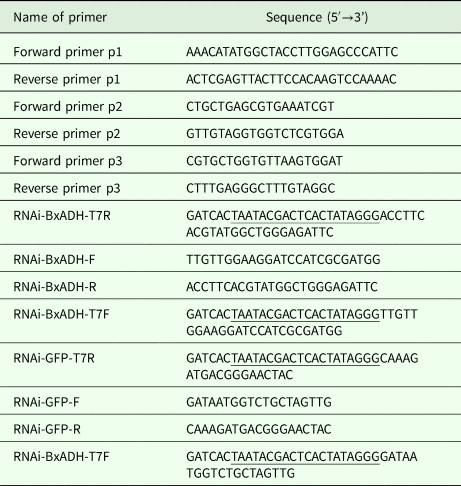
According to the sequence of adh-1 revealed by transcriptome analysis, the forward primer p1 and reverse primer p1 (Table 1) were used to amplify adh-1 by polymerase chain reaction (PCR) using cDNA reverse-transcribed from mRNA of PWN. The PCR program was as follows: pre-denaturing at 94 °C for 10 min, followed by denaturing at 94 °C for 50 s, annealing at 56 °C for 45 s and extension at 72 °C for 55 s. The resulting PCR product was digested by Nde I and Xho I, ligated into pET-15b (Novagen, Gibbstown, NJ, USA), and sequenced.
PCR primers used in this study

The T7 promoter sequences were underlined.
The ORF of adh-1 from PWN was analysed using the program ORF Finder (http://www.ncbi.nlm.nih.gov/gorf/gorf.html). The structural features of adh-1 were analysed using the PWN genome from WormBase ParaSite (http://parasite.wormbase.org/index.html). The computed parameters of ADH were obtained from ProtParam (http://web.expasy.org/protparam/). Bioinformatics websites were used to analyse the characteristics of predicted ADH protein including signal peptides (http://www.cbs.dtu.dk/services/SignalP-4.0/) and transmembrane helices (http://www.cbs.dtu.dk/services/TMHMM/).
Expression and purification of the recombinant ADH
Escherichia coli BL21 (DE3) (TaKaRa, Dalian, China) was transformed with the expression vector pET-15b-Adh to construct engineered bacteria. Expression of the recombinant ADH and collection of inclusion bodies were conducted according to a method described previously (Liu et al., Reference Liu, Feng, Guo and Li2015).
Inclusion bodies were dissolved in 10 mL lysis buffer (8 M urea, 0.1 mm phenylmethanesulfonyl fluoride, 20 mm Tris-Cl, 500 mm NaCl, 5 mm imidazole, pH 8.0), and the insoluble materials were removed by centrifugation at 10 000 g for 30 min under 4 °C. The resulting supernatant was diluted with refolding buffer (20 mm Tris-Cl, 500 mm NaCl, 5 mm imidazole, pH 8.0) to gradually decrease concentrations of urea from 8 to 1 M at 4 °C. Refolded recombinant ADH was purified using Ni-NTA affinity chromatography (Liu et al., Reference Liu, Feng, Guo and Li2015). The purified protein was analysed by SDS-PAGE with a 12% separating gel, and protein concentrations were quantified using Coomassie Brilliant Blue G-250 with bovine serum albumin as the standard (Bradford, Reference Bradford1976).
Characterization of the recombinant ADH
ADH activity of different substrates was assayed as described previously (Cho and Jeffries, Reference Cho and Jeffries1998) with some modifications. The reaction mixture contained 100 mm Tris-HCl buffer (pH 8.3), 5.0 mm NAD+, 50 µL recombinant ADH, 100 mm substrate and 0.05 mm ZnSO4, in a total volume of 1.0 mL. One unit of enzyme activity was expressed as the amount of ADH to increase 1.0 µ m of NADH per minute at 25 °C.
In the assay to investigate the effects of temperatures and pH values on ADH activity, the reaction was performed using 1-propanol as substrate. To determine the influence of temperatures on the activities of the ADH activity, reactions were carried out at 10–80 °C according to the method described above. To measure the effect of pH values on ADH activity, 100 mm sodium acetate-acetic (pH 4.0–6.0), Tris-HCl buffer (pH 7.0–8.0) and glycine-sodium hydroxide buffer (pH 9.0–10.0) were used and the reaction was carried out at 25 °C.
Expression analysis of adh-1 by quantitative real-time RT-PCR
To investigate the effect of ethanol on adh-1 expression, about 20 000 aseptic PWN were, respectively, treated in 0.1, 0.5 and 1.0% ethanol for 24 h at 25 °C. PWN incubated in sterilized water under the same conditions were used as a control. To study the effect of P. fluorescens GcM5-1A on adh-1 expression, approximately 20 000 aseptic PWN and PWN carrying P. fluorescens GcM5-1A were inoculated on PDA plates growing B. cinerea and incubated for 7 days at 25 °C.
Gene expression of the adh-1 transcript in PWN was measured using qRT-PCR with forward primer p3 and reverse primer p3 (Table 1) (Xu et al., Reference Xu, Wu, Ye and Huang2015). The PWN actin gene, a constitutively expressed gene, was selected as the internal control using forward primer p2 and reverse primer p2 (Table 1). The data were analysed using the 2−△△Ct method. There were three biological replicates for this experiment.
RNA interference of adh-1 in PWN
RNA interference (RNAi) was used to identify additional functions of adh-1. The DNA templates (248 bp) for synthesizing double-stranded RNA (dsRNA) corresponding to adh-1 were amplified by PCR using pET-15b-Adh as a template with two pairs of primers: RNAi-BxADH-F/RNAi-BxADH-T7R and RNAi-BxADH-T7F/RNAi-BxADH-R (Table 1). The DNA templates (248 bp) of non-endogenous gene gfp (the gene coding green fluorescent protein) were amplified by PCR using pET-15b-gfp as a template with two pairs of primers: RNAi-GFP-T7R/RNAi-GFP-F and RNAi-GFP-R/RNAi-BxADH-T7F (Table 1). The dsRNA was prepared using the MEGscript RNAi Kit (Invitrogen, Vilnius, Lithuania) and an RNAi soaking method was used according to a previous study (Xu et al., Reference Xu, Wu, Ye and Huang2015). Around 3000 aseptic nematodes were soaked in 50 µL adh-1 dsRNA solutions (1.0 µg µL−1) and then incubated for 72 h at 20 °C. Aseptic nematodes soaked in 50 µL sterilized water and gfp dsRNA solutions (1.0 µg µL−1) were used as double negative controls. qRT-PCR was performed to verify mRNA abundance of adh-1 after RNAi.
Influence of RNAi on ADH activity and alcohol tolerance of PWN
To investigate the influence of PWN after RNAi on ADH activity, about 8000 nematodes soaked in dsRNA solutions and sterilized water were collected by centrifugation at 3000 rpm for 5 min and then washed three times using sterilized water. The collected nematodes were suspended in 100 µL saline, and then ground using a grinding rod at 4 °C. The extract of PWN was centrifuged at 12 000 g for 30 min at 4 °C, and the supernatant was collected. ADH activity was assayed as described above, and the reaction was performed using ethanol as a substrate.
To further investigate the tolerance of nematodes to alcohol after RNAi, about 200 previously dsRNA-soaked PWNs were treated with 0.1, 0.5, 1.0, 2.0 and 3.0% ethanol for 24 h at 25 °C. PWNs soaked in sterilized water under the same conditions were used as a control. The survival rates of PWN were counted using a stereo microscope (SZX16, Olympus, Japan).
Influence of RNAi on vitality and reproduction of PWN
In order to understand the relationship between adh-1 expression and vitality of PWN, about 50 nematodes from each experimental group and control group were observed under a stereo microscope. Head thrashes per minute were used to evaluate the vitality of nematodes (Xu et al., Reference Xu, Wu, Ye and Huang2015).
To investigate the effect of RNAi of adh-1 on the reproduction of PWN, 15 pairs of female and male PWNs soaked in adh-1 dsRNA solutions, sterilized water (control) and gfp dsRNA solutions (control) were picked and transferred onto a PDA plate with B. cinerea. After cultivation at 25 °C for 8 days, PWNs were isolated using the Baermann funnel method and counted under a stereo microscope.
Influence of fomepizole on ADH activity of PWN
The ADH inhibitor, fomepizole (Oka, China), can be used to inhibit ADH activity (Battistella, Reference Battistella2002). To further explore the possible biological functions of ADH in nematodes, about 3000 aseptic nematodes soaked in 0.02 mm fomepizole solution were incubated at 160 rpm for 24 h at 25 °C. PWNs soaked in sterilized distilled water were used as the control. ADH activity for ethanol with or without 0.02 mm fomepizole was assayed as described above.
The number of head thrashes per minute was used to evaluate the vitality of PWN. To study the effect of fomepizole on PWN reproduction, 15 pairs of female and male nematodes soaked in 0.02 mm fomepizole solutions were picked and transferred onto PDA plates growing B. cinerea at 25 °C for 9 days; nematodes treated with distilled water were used as a control. The feeding of PWN on B. cinerea was observed, and then PWNs were collected from PDA plates growing B. cinerea using the Baermann funnel method and the nematodes were counted under a stereo microscope.
Data analysis
All of the experiments were performed three times. Data of repeated experiments were represented as means ± standard deviation (s.d.). Differences between control and experimental samples were analysed using SPSS 17.0 software (SPSS, Chicago, IL, USA). The statistical significance of the control and experimental samples was performed using Student's t-tests. A P value <0.05 was defined as statistically significant.
Results
Differentially expressed genes analysis of aseptic PWN and aseptic PWN carrying P. fluorescens GcM5-1A
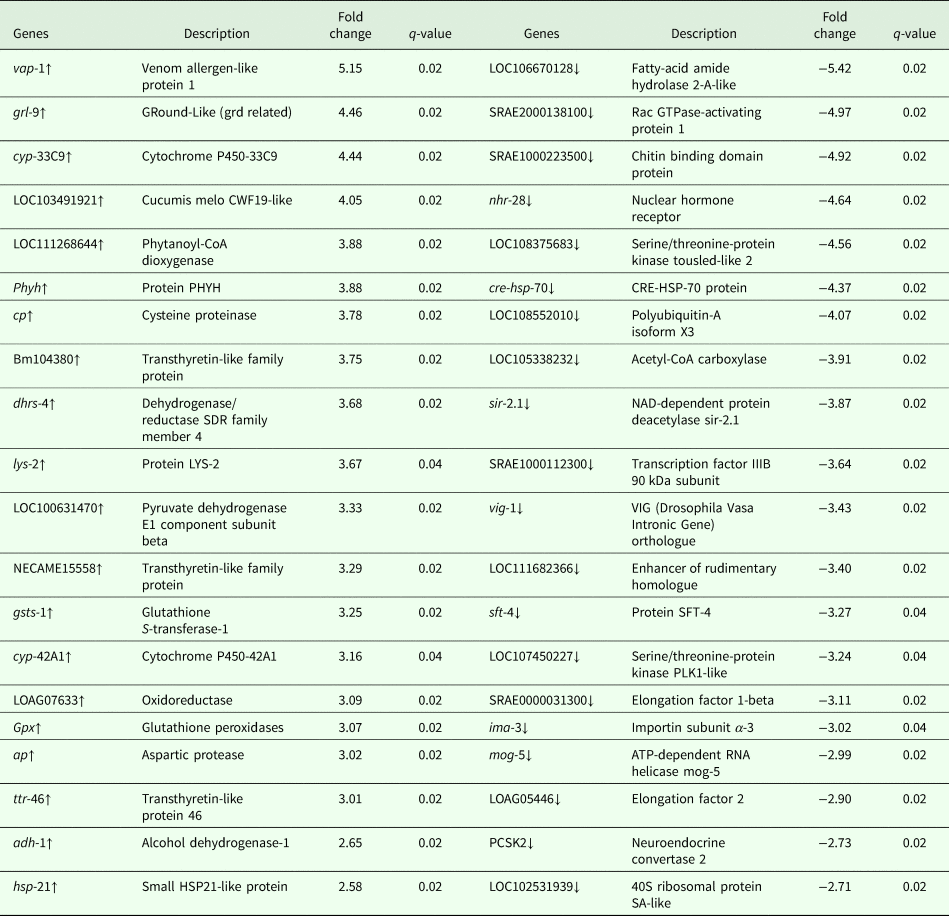
Pseudomonas fluorescens GcM5-1A could significantly affect the gene expression of aseptic PWNs. Transcriptome analysis indicated that 178 DEGs were obtained in PWNs carrying P. fluorescens GcM5-1A compared with aseptic PWNs, which included 47 upregulated genes and 35 downregulated genes with at least a 2-fold change at the expression level. A total of 68 DEGs were annotated using NCBI database, and the top significantly 20 up and downregulated genes from 68 annotated DEGs based on the fold change were described in Table 2. The gene adh-1 encoding ADH was one of the genes in PWN which was upregulated by the association of P. fluorescens GcM5-1A.
Top 20 up and downregulated genes in PWNs carrying P. fluorescens GcM5-1A based on the fold change

Up arrows were defined as upregulated genes. Down arrows were defined as downregulated genes. The significant DEGs listed had q-values ⩽ 0.05
Cloning and sequencing of the gene encoding ADH from PWN
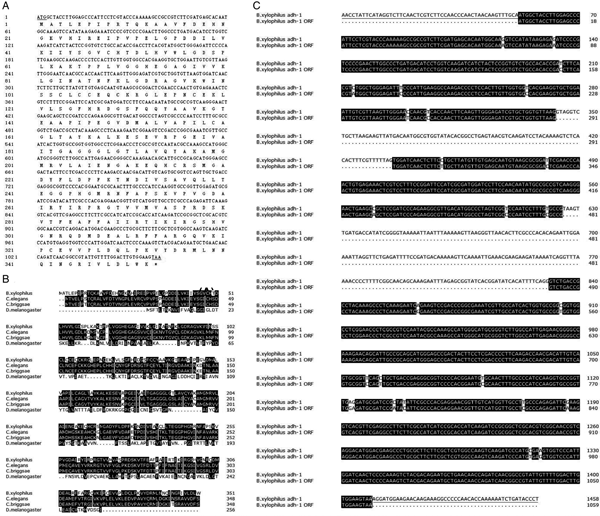
The coding sequence of adh-1 was amplified by PCR using cDNA reverse-transcribed from mRNA of PWN. Sequence analysis showed that the PCR product contained a 1059 bp open reading frame (ORF) which encoded a protein of 352 amino acids with a relative molecular mass of 39 kDa (GenBank accession no: KY670592) (Fig. 1A). Protein BLAST showed that the deduced amino acid sequence of adh-1 exhibited a relatively high level of identity with the ADH proteins of C. elegans (GenBank accession no: NP_505991) and C. briggsae (GenBank accession no: XM_002636504), with identities of 55 and 54%, respectively (Fig. 1B). The ADH of PWN also shared 11% identity with the protein from Drosophila melanogaster (GenBank accession no: NM_001032095). The theoretical pI of ADH from PWN was 8.65. Results from SignalP 4.1 and TMHMM server 2.0 showed that the deduced amino acid sequences of adh-1 did not contain a signal peptide sequence or transmembrane regions. Alignment of the ORF with the genomic sequences of PWN revealed that PWN adh-1 of PWN contained three exons of 291, 189 and 579 bp and two introns of 92 and 206 bp. Sequences of the introns corresponded to the ‘GT-AG rule’ for cis-splicing (Fig. 1C).
Open reading frame, amino acid sequence and gene structures of adh-1 from B. xylophilus. (A) Nucleotide and deduced amino acid sequence of adh-1 from B. xylophilus. The initial codon is marked by underlining and the stop codon is indicated by an asterisk. (B) Alignment of the amino acid sequences of ADH from B. xylophilus, C. elegans, C. briggsae and D. melanogaster. Letters in black boxes indicate conserved amino acid residues. (C) Structural features of adh-1 from B. xylophilus. 5′/3′ UTRs are marked by underlining. Letters in black boxes and open boxes indicate exons and introns, respectively.

Expression and purification of the recombinant ADH
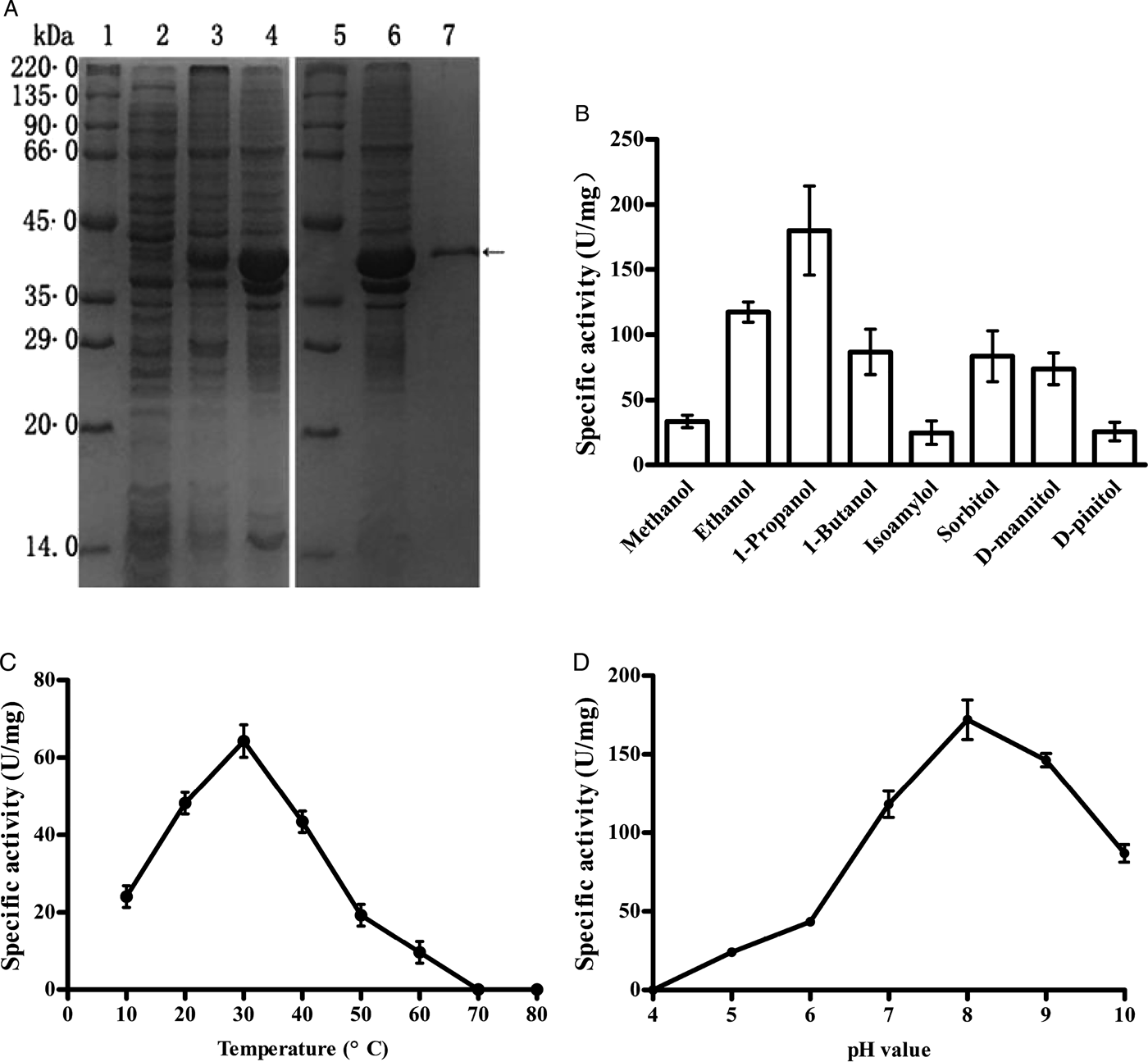
To study the characteristics of ADH of PWN, the ORF of adh-1 was cloned into vector pET-15b to construct pET-15b-Adh. The recombinant ADH was overexpressed in E. coli BL21 (DE3) harbouring pET-15b-Adh by IPTG induction at 28 °C. SDS-PAGE analysis revealed that the relative molecular mass of recombinant protein with a His-tag at its N-terminus was approximately 39 kDa (Fig. 2A), which conformed to the predicted molecular size.
Purification and characterization of the recombinant ADH. (A) SDS-PAGE analysis of the expression and purification of recombinant ADH. 1,5, Standard proteins; 2, total proteins of E. coli BL21 (DE3); 3, total proteins of E. coli BL21 (DE3) harbouring pET-15b-Adh; 4, inclusion bodies; 6, washed inclusion bodies; 7, purified recombinant ADH. (B) Relative activities of recombinant ADH on eight substrates. (C, D) Effects of temperatures and pH values on the activity of recombinant ADH.

The recombinant ADH appeared mainly in inclusion bodies which could be refolded by stepwise dilution with refolding buffer (Fig. 2A). The re-natured recombinant ADH with a His-tag was further purified using Ni2+ affinity chromatography, and the homogeneity of ADH was verified by SDS-PAGE (Fig. 2A).
Characteristics of the recombinant ADH
The refolded recombinant ADH was used to measure dehydrogenase activity using NAD+ as a cofactor, and methanol, ethanol, 1-propanol, 1-butanol, isoamylol, sorbitol, D-mannitol and D-pinitol as substrates. The results showed that the recombinant ADH of PWN could catalyse the dehydrogen reaction of the eight tested substrates, and the activity with 1-propanol was higher than with the other substrates (Fig. 2B).
Temperature and pH values had obvious influences on the activity of the recombinant ADH. The activity of ADH towards 1-propanol as a substrate increased with increasing temperature under 30 °C, and decreased quickly when reaction temperature reached 40 °C. The optimal temperature for the recombinant ADH of PWN was 30 °C (Fig. 2C). The recombinant ADH showed relatively good catalytic activity to 1-propanol over a broad pH scale from 7.0 to 9.0, and the optimal pH was 8.0 (Fig. 2D).
Induced expression of adh-1 by ethanol and P. fluorescens GcM5-1A
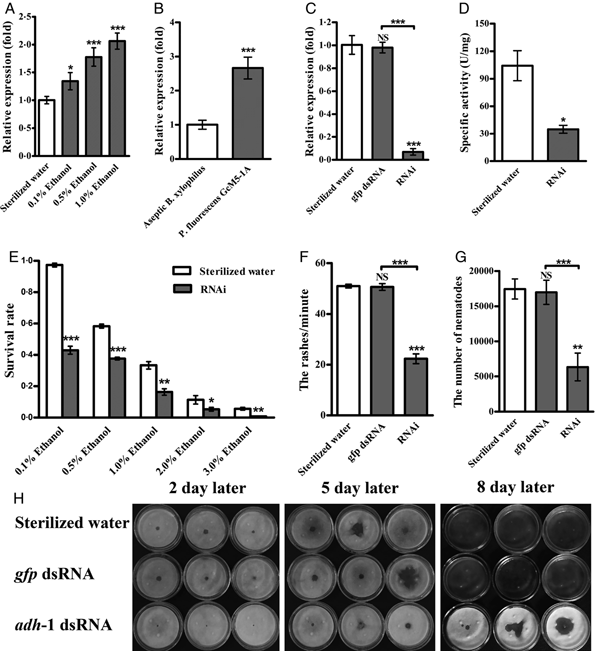
To investigate the effect of ethanol on adh-1 gene expression in PWN, qRT-PCR was performed. The result revealed that ethanol induced the expression of the adh-1 gene. Compared with PWN in sterilized water, the adh-1 expression level was upregulated 1.35-, 1.76- and 2.07-fold when PWN were treated with 0.1, 0.5 and 1.0% ethanol, respectively (Fig. 3A). This result suggested that the adh-1 gene had a close relationship with ethanol metabolism in PWN.
Expression and function analysis of adh-1 of B. xylophilus. (A, B) Expression of adh-1 regulated by ethanol and associated P. fluorescens GcM5-1A. (C, D) RNAi analysis by qRT-PCR and measurement of ADH activity of RNAi B. xylophilus. (E, F, G) Tolerance to ethanol, vitality and reproduction ability of B. xylophilus with adh-1 downregulated by RNAi. (H) The feeding of B. cinerea by RNAi-treated PWNs. Bursaphelenchus xylophilus soaked in sterilized water and gfp dsRNA solutions were used as double negative controls. Asterisks on top of the bars indicate statistically significant differences (*P < 0.05, **P < 0.01 and ***P < 0.001), and NS shows no significant difference.

To analyse the roles of adh-1 in association with P. fluorescens GcM5-1A to PWN, adh-1 gene expression of PWN was evaluated with qRT-PCR. Results showed that the expression level of adh-1 of PWN increased dramatically when aseptic PWN were subjected to inoculation with P. fluorescens GcM5-1A, and adh-1 gene expression level was upregulated 2.65-fold compared with aseptic nematodes (Fig. 3B). This result indicated that ADH of PWN might participate in regulating the interaction between PWN and its associated bacteria.
Regulation of ADH activity and tolerance to ethanol of PWN using RNAi
The effect of RNAi on adh-1 expression level was evaluated by qRT-PCR, and the 248 bp dsRNA sequences that contained conservative regions of adh-1 were used as interfering RNA. The expression of adh-1 of PWN soaked in adh-1 dsRNA solutions decreased significantly compared with PWN soaked in sterilized water (Fig. 3C). When the mRNA level of adh-1 in the control was 1.00, the level in PWN treated with RNAi was only 0.06. This result showed that the expression of adh-1 in PWN could be strongly inhibited by RNAi. The results of qRT-PCR also showed that the gfp dsRNA has no significant effects on the expression level of adh-1 of PWN compared with sterile water.
Compared with PWNs soaked in sterilized water, the specific activity of ADH in RNAi nematodes decreased significantly, to only 32% of that in control (Fig. 3D). This result indicated that ADH activity in RNAi nematodes was reduced.
The RNAi PWNs were treated with ethanol of different concentrations, and their tolerances to ethanol were investigated and compared with that of PWNs in sterilized water. The assay result revealed that mortalities of PWNs increased with increasing ethanol concentrations. The survival rate of RNAi PWNs significantly decreased compared with that of PWNs treated with distilled water (Fig. 3E), which indicated that adh-1 might be involved in the tolerance of PWN to ethanol.
Influence of vitality and reproduction ability of PWN by RNAi
To further analyse the influence of adh-1 gene on the behaviour of PWN, the RNAi PWNs were observed under a stereo microscope and their head thrashes were counted. Compared with PWNs in sterilized water and gfp dsRNA solutions, the RNAi nematodes moved much slower. The head thrashes of RNAi PWNs and those in sterilized water and gfp dsRNA solutions were 22, 51 and 50 thrashes min−1, respectively (Fig. 3F), which indicated that the vitality of PWNs was significantly reduced by downregulation of adh-1 expression. In addition, the results showed that there was no significant effect of non-endogenous genes (gfp) dsRNA on the vitality of PWN (Fig. 3F).
To investigate the effect of RNAi on PWN population growth, nematodes were inoculated on B. cinerea and cultured, and subsequently re-isolated and counted. The results showed that the population of RNAi PWN was significantly reduced compared with the nematodes in sterilized water and gfp dsRNA solutions, with populations of 6348, 17 450 and 16 981, respectively (Fig. 3G). Furthermore, there was no obvious difference for effects of gfp dsRNA and sterile water on the reproduction of PWN (Fig. 3G). The feeding rate of B. cinerea for RNAi-treated PWN was obviously slower than that of PWN in sterilized water and gfp dsRNA solutions. Almost all of the hyphae on the plates had been consumed by PWNs in the double negative control groups at 8 days, while only a small portion of the hyphae was consumed by RNAi-treated PWNs (Fig. 4H). Compared with PWN in sterilized water, there was no significant difference for effects of gfp dsRNA on the feeding of PWN (Fig. 4H).
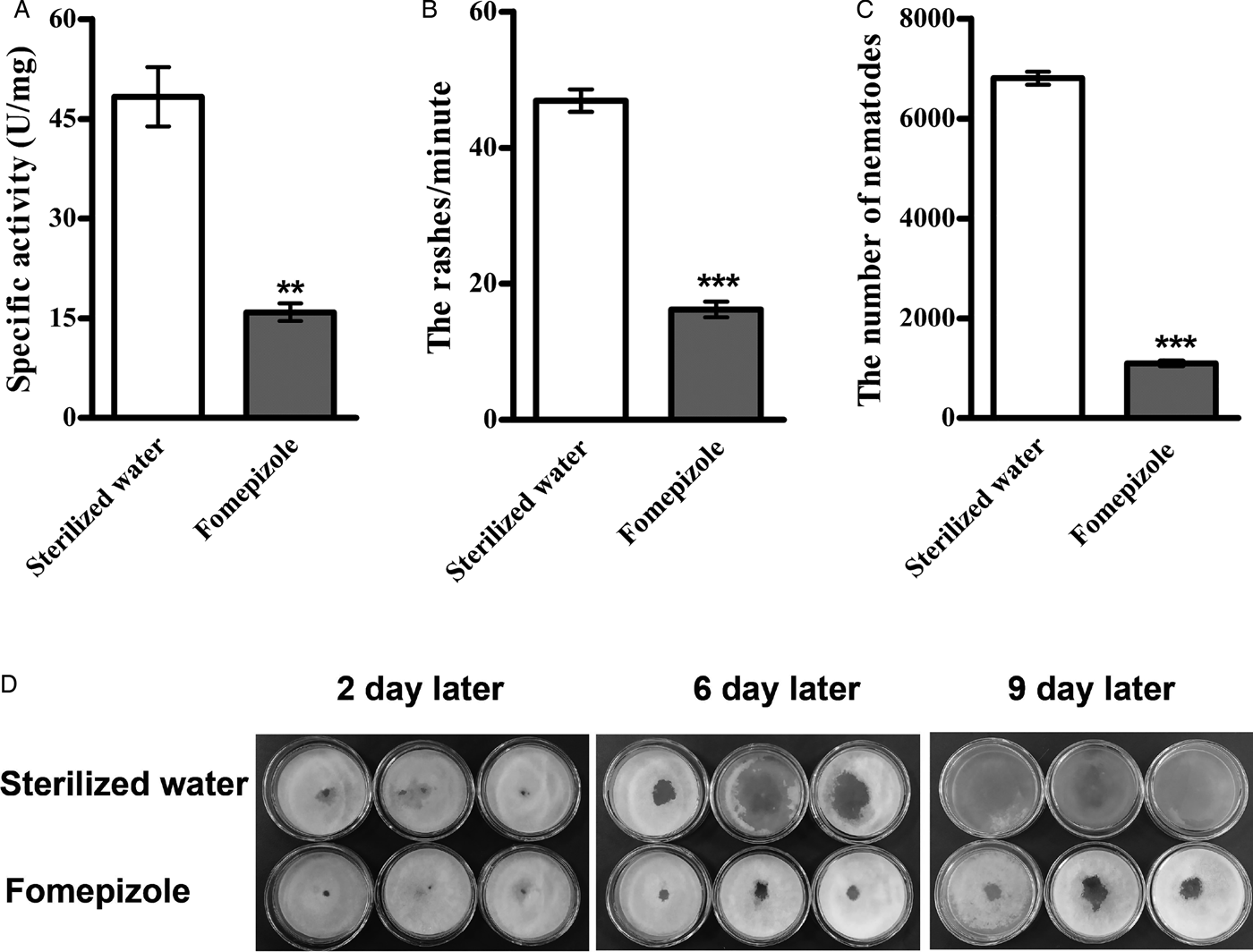
Influence of fomepizole on B. xylophilus. (A, B, C) ADH activity, vitality and reproduction ability of B. xylophilus treated with fomepizole. (D) The feeding of B. cinerea by B. xylophilus treated with fomepizole. B. xylophilus soaked in sterilized water were used as a control. Asterisks on top of the bars indicate statistically significant differences (*P < 0.05, **P < 0.01 and ***P < 0.001).

Influence of fomepizole on PWN
To further verify the functions of ADH in PWN, the ADH inhibitor fomepizole was used to assess ADH activity in vivo and thereby the influences on vitality and reproduction of PWN. The ADH activity of PWN pretreated with fomepizole solution was only 31% of that of PWN in control, which indicated that fomepizole effectively inhibited ADH of PWN in vivo (Fig. 4A).
Fomepizole-treated PWN moved more slowly than control nematodes. The number of head thrashes per minute for fomepizole-treated PWN was 16 compared with 46 for that in the control (Fig. 4B), which showed that the ADH inhibitor fomepizole significantly reduced the vitality of PWN.
To investigate the influence of fomepizole on PWN population growth, PWNs treated with fomepizole and distilled water were inoculated on B. cinerea and cultured for 9 days. The population of fomepizole-treated PWN was significantly reduced compared with that of PWN treated with distilled water, to only 16% of that in the control group (Fig. 4C). The feeding rate of B. cinerea for fomepizole-treated PWN was obviously slower than that of PWN in the control group. Almost all of the hyphae on the plates were consumed by PWN in the control, while only a small portion of the hyphae was consumed by fomepizole-treated PWN (Fig. 4D).
Discussion
PWD is a complex and destructive disease to most pine species and virulence of the PWN has a close relationship to the spread of PWD. PWN isolates from different resources show different abilities to damage pines (Mota et al., Reference Mota, Takemoto, Takeuchi, Hara and Futai2006), probably due to genome-wide variations (Palomaresrius et al., Reference Palomaresrius, Tsai, Karim, Akiba, Kato, Maruyama, Takeuchi and Kikuchi2015). Many pathogenesis-related genes of PWN, such as the pectate lyase gene (Qiu et al., Reference Qiu, Wu, Huang and Ye2016), dumpy genes (Wang et al., Reference Wang, Wang, Zhang, Wang, Liu, Hou, Huang, Xie and Cheng2016) and cytochrome P450 genes (Xu et al., Reference Xu, Wu, Ye and Huang2015), were verified to participate in cell wall degradation of many pine species, and to growth and development processes of PWN. Numerous novel detoxification proteins genes, such as the glutathione S-transferases gene (Espada et al., Reference Espada, Jones and Mota2016b) and effector genes (Espada et al., Reference Espada, Silva, Sebastian, Cock, Mota and Jones2016a), are important for mediating interactions of PWN with its host. In addition, some studies suggested that the bacteria associated with PWN also probably due to pathogenicity (Zhao et al., Reference Zhao, Tao, Ju, Wang and Ye2011), and bacteria benefited PWN by supplying nutrition or protecting PWN from oxidation stress (Vicente et al., Reference Vicente, Ikuyo, Mota and Hasegawa2013; Zhao et al., Reference Gao, Yuan, Li, Guo, Ju, Lin, Ye and Zhao2014). However, the exact molecular mechanism of PWN pathogenicity has not been fully elucidated.
In this paper, we reported an adh-1 gene encoding ADH from PWN and a method for preparation of the recombinant ADH. A biochemical assay indicated that the recombinant ADH had a broad range of substrate specificity, which could catalyse the oxidation of eight substrates including ethanol. Interestingly, the recombinant ADH displayed obvious activity with D-pinitol, a chemical component in pine trees such as Pinus taeda (Pullman and Buchanan, Reference Pullman and Buchanan2008). D-pinitol was reported to be selected first as a carbohydrate resource for growth by Leptographium procerum associated with red turpentine beetle. D-pinitol benefited development of the beetle larvae by avoiding competition for glucose, and this adaption was regulated by bacteria carried by this insect (Zhou et al., Reference Zhou, Lou, Wang, Xu, Cheng, Lu and Sun2016). D-pinitol was also reported to be an oviposition stimulant for the common grass yellow butterfly, Eurema mandarina (Mukae et al., Reference Mukae, Ohashi, Matsumoto, Ohta and Ômura2016). Whether D-pinitol could be utilized by PWN through ADH to stimulate oviposition is worth further study.
PWN infection causes pines to release a large amount of ethanol and other volatile compounds, which was especially obvious on day 10 when oleoresin leakage stopped (Ikeda and Oda, Reference Ikeda and Oda1980). Similarly, the population of PWN starts to increase explosively 2 weeks after infection (Kiyohara and Tokushige, Reference Kiyohara and Tokushige1971), which means that there might be a close relationship between the alcohols in volatile compounds produced by nematode-infected pines and PWN reproduction. There have been some reports showing that alcohols are related to nematode reproduction (Lu et al., Reference Lu, Hugenberg, Briggs and Stokstad1978; Oku, Reference Oku1988; Shuto and Watanabe, Reference Shuto and Watanabe1988). However, the mechanism of how alcohols promote reproduction of PWN is not clear. The results of RNAi of adh-1 and fomepizole tests in this study indicated that ADH encoded by adh-1 was associated with PWN reproduction. Alcohols might participate in regulating reproduction of PWN through ADH. In addition, our RNAi results indicated that adh-1 was involved in tolerance of PWN to ethanol, which might help us understand how PWN deals with alcohols in pine hosts.
Ethanol has been reported to have obvious influences on the behaviour of C. elegans. Ethanol could dose-dependently cause an acute depression of the nematode crawling on an agar surface, but the nematode could partially recover its locomotion speed despite the continued presence of the drug (Davies et al., Reference Davies, Blackwell, Raabe and Bettinger2015). Starvation induces collective behaviour in L1 larvae of C. elegans. This aggregation requires a small amount of ethanol or acetate in the environment and requires functional ADH encoded by gene adh-1 (Artyukhin et al., Reference Artyukhin, Yim, Mi and Avery2015). In this study, we found that the expression of adh-1 could be enhanced by ethanol treatment and inhibited by RNAi of adh-1. The vitality of PWN was significantly reduced after interference of adh-1 expression or if ADH was inhibited by fomepizole. This result means that adh-1 might be a key gene regulating the vitality behaviour of PWN. Furthermore, adh-1 in aseptic PWN was upregulated by re-association with P. fluorescens GcM5-1A, a bacterial strain carried by wild PWN. Previous studies showed that P. fluorescens GcM5-1A increased egg production, developmental rate, body length and diameter of PWN (Zhao et al., Reference Zhao, Liu and Lin2007). Other bacteria associated with PWN were also reported to be related to PWN virulence, and PWN isolates with different virulence possessed different bacteria and diverse carbon metabolism (Wu et al., Reference Wu, Yuan, Tian, Fan, Fang, Ye and Ding2013). Therefore, we hypothesize that adh-1 of PWN probably plays some roles in the interaction of PWN with its associated bacteria, and even with PWN virulence. However, the mechanism needs to be further investigated.
Data
Nucleotide sequence data reported in this paper is available in GenBank (Accession no: KY670592).
Acknowledgements
We gratefully thank Zhao BG and Chang C for critically reading the manuscript.
Financial support
This work was supported by the Key Programs for Research and Development of Shandong Province, China (No: 2016GNC110024) and National Natural Science Foundation of China (No: 31070575).
Conflict of interest
None.
Ethical standards
Not applicable.