Introduction
Improving the quality of dementia care, through early intervention and post diagnostic support, has become a global priority (Prince et al., Reference Prince, Bryce and Ferri2011). In England, national policy, via a dementia strategy (Department of Health, 2009) and a unique Prime Minister's Dementia Challenge (Department of Health, 2015) aims to improve post-diagnostic dementia care and reduce geographical inequalities in service provision. Although there is national guidance influencing the prescribing of “dementia drugs,” few non-pharmacological therapies are currently recommended largely due to a limited evidence base. One of the few exceptions is Cognitive Stimulation Therapy (CST) (National Institute for Health and Clinical Excellence and the Social Care Institute for Excellence, 2006), a specific approach to delivering cognitive stimulation in dementia care (see Box 1), which has been shown to be cost effective and lead to improvements in both cognitive function and quality of life (Knapp et al., Reference Knapp, Iemmi and Romeo2013). Its benefits are comparable to, but also occur independently of, anti-dementia medications (Woods et al., Reference Woods, Aguirre, Spector and Orrell2012; Knapp et al., Reference Knapp, Iemmi and Romeo2013). In addition, a combination of both drug therapies and CST leads to further improvements in cognitive functioning beyond therapy alone (Spector et al., Reference Spector, Davies, Woods and Orrell2000; Woods et al., Reference Woods, Aguirre, Spector and Orrell2012).
Key characteristics of CST
-
• CST is a structured, evidence-based program taking place over 14 sessions of 45 min group therapy; maintenance cognitive stimulation therapy (MCST) comprises a 24-week program of once weekly sessions (Spector et al., Reference Spector, Orrell, Davies and Woods2001; Spector et al., Reference Spector2003).
-
• It seeks to support and enhance a person's communication skills, thinking, and memory.
-
• CST adopted the principles of “Personhood” first put forward by Kitwood's model of person-centered dementia care (Kitwood, Reference Kitwood1997)
-
• Individual cognitive stimulation therapy (iCST) is a home-based program of CST which can be delivered via family carers (Orrell et al., Reference Orrell2012b)
-
• CST is explicitly recommended in three criteria of a standard for psychosocial interventions by The Memory Services National Accreditation Programme (MSNAP) (Hodge et al., Reference Hodge, Hailey, Colwill, Walker and Orrell2016)
-
○ People with dementia have access to a local program of age appropriate group CST (Type 1)*
-
○ People with dementia have access to iCST (Type 3)*
-
○ People who have participated in group cognitive stimulation therapy have access to an age appropriate maintenance CST program (Type 2)*
-
*Type 1 indicates that a failure to meet these standards would result in a significant threat to patient safety, rights or dignity and/or would breach the law. Type 2 indicates criteria that an accredited service would be expected to meet and Type 3 indicates standards that are aspirational, or standards that are not the direct responsibility of the service.
Qualitative research has also illustrated benefits of CST for people with dementia and their families; the cognitive improvement attained from CST can lead to important “real world” improvements in people's lives enabling them to continue with activities of daily living people with dementia have also reported other positive impacts in addition to memory improvements for example, a willingness to engage in conversation (Spector et al., Reference Spector, Gardner and Orrell2011). A cost-effective analysis within a multi-center randomized controlled trial of maintenance CST (seven weeks) (D'Amico et al., Reference D'Amico2015) showed CST to be cost-effective when looking at self-rated quality of life as the primary outcome at six-month follow up. CST has been shown to be more cost-effective than usual care for people with dementia (Knapp et al., Reference Knapp2006; Reference Knapp, Iemmi and Romeo2013).
Despite being recommended in both national clinical guidance (National Institute for Health and Clinical Excellence and the Social Care Institute for Excellence, 2006) and by the national Memory Services National Accreditation Programme (Hodge et al., Reference Hodge, Hailey, Colwill, Walker and Orrell2016), and high quality evidence demonstrating the efficacy of cognitive stimulation, integration into “usual care” in England, where healthcare under a National Health system is free to all. In the UK, it has been estimated that only around a third of community mental health services for older people use CST (National Audit Office, 2007; Orrell et al., Reference Orrell, Woods and Spector2012a). Such differences between theoretical “good practice” and “real world” care indicate a need to better understand the challenges to implementing and integrating CST into post-diagnostic dementia care. Using a well-established theoretical implementation framework, Normalization Process Theory (NPT), developed to understand and evaluate the processes by which complex interventions are embedded into routine practice, (May and Finch, Reference May and Finch2009; Murray et al., Reference Murray2010), the aim of this study was to critically explore the views and experiences of dementia care providers, those who were currently delivering CST or in the process of setting up this service, on the barriers and facilitators to the provision of CST in routine care.
Methods
Setting
Six participating dementia care organizations in the North East of England participated in the study. Purposive sampling was used to recruit participants from both NHS Trusts and voluntary organizations and with experience in either delivering CST or managing staff where CST was delivered or were interested in delivering CST in the near future.
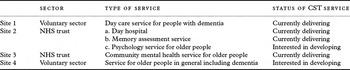
We approached potential participants by contacting managers of teams, where CST was being implemented or where there was interest in implementing CST. Information sheets were sent to managers of the service to discuss with staff and enable any questions to be answered before deciding whether to take part or not. All services we contacted about participating in the study agreed to take part. Participants gave informed consent and signed consent forms before taking part in the study. Table 1 summarizes the range of service providers who agreed to participate.
Characteristics of sites

Participants
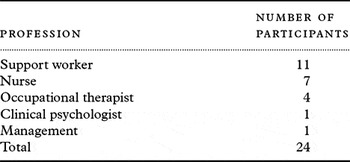
Participants with different roles and responsibilities in the CST groups, and from different professional backgrounds, were recruited; their professional backgrounds are summarized in Table 2. Some participants had a professional background in nursing or occupational therapy but their role in the organization was as a service manager
Profession of participants

Illustrative data included within the results are derived from the opinions and comments of service managers and CST facilitators. These include data from both preliminary interviews – the time CST had been implemented within the service – and subsequent follow-ups. The follow-up interviews took place between 8 and 9 months after the preliminary interviews to allow for participants to have delivered several CST groups which usually lasted 14 weeks.). Interviews were also carried out in services that had not implemented CST but were interested in doing so (n = 2). Recruitment continued until we reached saturation, i.e. until no new data were emerging from subsequent interviews. A total of 24 individuals participated in the interviews (see Table 1). All original 24 participants were approached to take part in follow-up interviews; only ten were undertaken as other participants had either left the service or were absent due to sickness or maternity leave. All participants were given an information sheet before agreeing to take part in the study and all signed a consent form. All interviews were carried out at the participants’ workplace.
Data collection
Qualitative interviews
Face-to-face interviews were carried out between December 2013 and April 2016 by three researchers (C.D., G.G., and Z.G.) experienced in qualitative research. Based on our previous experience of using NPT to explore the implementation of complex interventions into NHS care (Bamford et al., Reference Bamford2014; Finch et al., Reference Finch, Bamford, Deary, Sabin and Parry2014) semi-structured interview guides were developed incorporating topics of interest based on the constructs of the NPT framework. Interview guides were adapted throughout data collection to account for emergent themes elicited during the process. A modified topic guide was used with services that were yet to implement CST. Interviews explored participants’ perceptions of the CST groups within the service, including barriers and facilitators to implementation and sustaining delivery. In line with the NPT theoretical framework, particular emphasis was given to participants’ understanding of CST, their motivation to take part in delivering groups, structure and organization of sessions, and evaluation of CST. All interviews were digitally recorded with participants’ consent, transcribed verbatim, and anonymized. During the follow-up interviews participants were asked to reflect on changes that had occurred since the implementation of CST, and we explored factors or processes that might have contributed to the feasibility of running the CST groups over time. Ethical approval and appropriate data management governance was obtained from Newcastle University Ethics Committee (00669/2013).
Data analysis
Analysis involved two phases. This involved three researchers (C.D., Z.G., and L.S.) reading and re-reading transcripts for familiarization with the data. To facilitate data management, all transcripts were coded in NVivo, and initial thematic analysis was carried out (Braun and Clarke, Reference Braun and Clarke2006). After identifying key themes, these were grouped into overarching themes.
Phase two involved mapping the themes onto the four main constructs of the NPT framework (May and Finch, Reference May and Finch2009); “coherence,” “collective action,” “cognitive participation,” and “reflexive monitoring.” Coherence is concerned with how the practice is understood by participants and how they compare it to other practices. Collective action relates to the work that participants undertake to make a practice work and how activities are organized and structured. Cognitive participation is about what makes participants (in this case those delivering CST) take part in the implementation of a practice or initiative, and what keeps them motivated to continue taking part in the implementation. Finally, reflexive monitoring concentrates on how participants evaluate a practice and how a practice changes over time and what its effects are. Illustrative quotes from participants included in the results are referred to by the site context (Day Service) and type of participant (Manager, Facilitator).
The researchers had various levels of experience of CST; CD had undertaken training in CST provided by the national team who developed CST; CD and GG had observed CST groups in practice and ZG had no previous experience of CST.
Results
A total of 34 interviews were carried out with 24 staff from four sites in the North East of England. NPT has been used as a framework to present the findings of the study, which mapped onto the four theoretical constructs; “coherence,” “collective action,” “cognitive participation,” and “reflexive monitoring.”
Coherence – does CST make sense to people in dementia care services?
Coherence is concerned with how an intervention is understood by participants and how it compares to other ways of working. Participants described CST as an approach that made sense to their work in a number of ways. First, it was seen to fit closely to their current ways of working and overarching models of care for people with dementia, yet they were also able to make a distinction between elements of CST and other psychosocial interventions (i.e. CST was developed specifically for people with dementia). Second, it was seen to fit in with the goals of their service, or what they hoped to be the goals of their service, which included the provision of both drug and non-drug treatments; for some participants CST was just one of many valuable psychosocial interventions whereas for some participants CST was perceived to have added value.
Current models of care
Participants found CST easy to describe, with a clear overall purpose; to improve the quality of life of people living with dementia. CST was seen to fit in with person-centered care, an approach to care that shaped the work of many participants. Some participants discussed the difficulties of working within a medical service when they were trying to work from a person-centered care perspective and they hoped CST would help them to increase recognition of the value of psychosocial interventions:
I think if you work in a good person-centred organisation anyway, you should be working on that premise anyway. (P01, Manager, Site 1, Time 1)
We are a very medicalised model of intervention. I think psychosocial interventions, CST in particular, should be recognised as being as valuable and therefore as available. I think the difficulty is that its very resource intensive to deliver it, but then so is the cost of medication. . . . (P07, Manager, Site 2, Time 1)
Distinguishable from other psychosocial interventions
While participants felt that CST was a natural fit with existing ways of working, some had difficulty distinguishing it from other non-pharmacological interventions (such as reminisnence, post-diagnostic counseling, life story work). For some participants it was important to offer a range of psychosocial interventions, of which CST was just one option. Aspects of CST that participants felt distinguished it from other interventions included that it was developed specifically for people with dementia, it had an established evidence-base and was recommended by the National Institute for Clinical Evidence (NICE) for dementia:
I guess ever since the evidence has come out about effectiveness, it's something that we've felt would be a good thing to do but we've always been limited in terms of the resource that we had available to run them. That's been the major barrier. (P17, Manager, Site 2, Time 1)
As a treatment for people in the mild to moderate stages of dementia,it's a NICE recommended treatment. We have other psychosocial interventions taking place, both through the day hospital and through the memory service, but CST seems the obvious next step for us to consider delivering, there's evidence to support it. (P07, Manager, Site 2, Time 1)
As illustrated by the above quote, the fact that CST was recommended by NICE was seen to increase the profile of CST among clinical commissioners of dementia services, which was perceived by participants as important at a time when many services were vulnerable to cuts in funding.
Cognitive participation–do participants buy into CST?
Cognitive participation relates to the work that participants undertake to build up and sustain a community of practice around an intervention. In terms of CST, participants identified training as an important factor in generating their own and their colleagues’ interest in CST and thus ensuring all stakeholders were involved. Staff were further motivated to continue running the groups within their service through observing the direct beneficial effects of CST on clients.
Training
Staff were highly motivated to establish CST groups, take part in the practice and involve others. In particular, training was identified as an important factor in generating motivation among staff to become involved; it was a way of communicating to all staff what was involved and what the possible benefits were for clients. This led to managers and facilitators wanting to engage in the CST groups and also encourage other staff to be involved. Service managers played a key role in translating the intervention into practice and were tasked with doing this in a way that was understandable to a wide group of staff who may have been initially uncertain about CST:
Well the training was critical and I think it really galvanised people's enthusiasm. They really bought into it. (P07, Manager, Site 2, Time 1)
when you talk about cognitive stimulation therapy it sounds very technical, terrifying sort of, but once you get people working with it, staff who were initially a little bit cynical have actually joined in sessions and seen people really come in and really enjoy themselves. (P01, Manager, Site 1, Time 2)
Making a difference
While training was important in getting people involved in CST many reported that it was their observations of the impact of the CST groups that kept them interested in continuing and developing CST within their service. The enthusiasm of staff and people with dementia in turn increased the motivation of service managers. As such there appeared to be a “virtuous circle” of motivation and the commitment of staff is evident in their descriptions of their experiences of the intervention:
. . .one of the facilitators actually said to me “It's the best thing I've done in twenty eight years. . .and I mean working with people with dementia can be tough because you know nobody's going to get better, that whatever stage you are dealing with, the future is going to be grim, at some point. (P07, Manager, Site 2, Time1)
You can see a difference from the start of the session - they're anxious and not talking as much. You see them flourish through their groups. I don't know if that's them feeling that they are cognitively stimulated and they are able to do things that they hadn't realised they could do before. (P20, Site 3, Time 1)
The fact that CST placed such an emphasis on positive interactions was something that participants particularly valued as well as observations of improved self-esteem of those people with dementia who took part. In addition, CST was seen to offer people with dementia the opportunity to fully engage in social interactions where their opinions were valued:
The benefits are huge, so to me, of course it's worthwhile, because you're improving people's self-esteem, you're providing something very worthwhile. You can see people change on their journey through the group. (P16, Facilitator, Site 2, Time 1)
You notice the improvement in their overall wellbeing, that they were brighter, a bit more positive, less thinking of the things that they couldn't do, and they engage a bit more socially. (P11, Facilitator 4 Site 2, Time 2)
Collective action – embedding CST into usual care
Collective action relates to how participants embed a new intervention into routine services and make it work effectively. Participants identified key factors which influenced their ability to enact CST: access to resources/tools; time; skills and experience; knowledge of the condition and individual clients.
Access to resources and tools
Having the tools to implement CST was identified as an important factor in making it easier for staff to embed CST in practice. Tools and resources which were needed included the two manuals but also the equipment for each session (e.g. food for the tasting sessions, newspapers and magazines for the current affairs session). Participants described how the manuals offered a starting point and a sense of direction. The necessary resources also related to the availability of key staff to facilitate sessions. This was often identified as a barrier to implementing CST as it requires two members of staff for over an hour for each session:
Well, we use the book and we stick quite rigidly to that, which is helpful, because it does give you a base of where you're going and how to run the group, and also the different activities within that that it gives you. (P19, Facilitator, Site 3, Time 1)
There's preparation that goes into it, the practicalities of organising the group are vast. The amount of time that you actually need to set up these groups is huge. . . . It's a huge volume of work in setting up the process as well, it's not just doing a group. . .you've got to have the resources; people, time and the practical things that you take to the different sessions. (P16, Facilitator, Site 2, Time 1)
Participants also described how supervisory support was important in helping facilitators deliver CST groups:
I think they (facilitators) definitely need supervision to be able to run them effectively. And I think it would probably go wider than that, just understanding levels of functioning and activities, suitable activities that you could do with different people within the groups. (P19, Facilitator, Site 3, Time 1)
Time
Participants invested much of their time to make the intervention work. They described the additional time outside of the sessions required to plan and prepare materials as a barrier to running additional sessions and thus increasing demands on staff time. This in turn impacted on the number of groups staff could run and therefore affected the length of time people with dementia had to wait to access CST sessions:
It is quite a time-consuming thing but it is worth that time that you invest in it especially for the twice a week. It's really valuable. (P23, Facilitator, Site 3, Time 1)
We can't offer as many groups because we haven't got the resources from staff really to put that much time aside. (P11, Facilitator, Site 2, Time 2)
Skills and experience
Participants described the importance of having the skills and experience of facilitating group work in order to effectively facilitate the CST groups:
I think it's definitely important to have experience of group work, people with dementia and their needs, if you want it to be effective and you want it to work well. . .I think you need those skills in how, you know, communication with that group of people, to be able to run the groups effectively. And, if you just picked up the book and tried to do it, that doesn't teach you those skills. (P19, Facilitator, Site 3, Time 1)
Group composition was an important factor in determining the effectiveness of the groups; participants described the importance of being able to select group members prior to commencing the sessions:
I was part of selecting the groups and we worked really hard at who we thought would benefit and who would sit well together. As we did the groups, and even at the end, we went through them again and we swapped a couple of people over, here and there, just to make sure that if we're aware that there would be a slight clash of personality, or somebody who would be dominated by somebody else, to try and avoid that situation. (P02, Facilitator, Site 1, Time 1)
Knowledge of both the condition and individual clients
Knowledge of dementia and knowledge of the clients attending the groups was considered essential in successfully embedding the intervention. However, the level of information service managers had of group participants varied dramatically depending on the site and type of service provision. Day care and day hospital services generally had greater knowledge of their clients compared to community services. The importance of background information on participants was more important in services for people with moderate to advanced dementia as opposed to services for people at the earlier stage who may have been able to report their own life histories:
That's one thing I would say from CST. If you're prescribing it from a GP, you don't know anything about anybody's life history. It's about knowing how to think on your feet, knowing how you can actually use some of the knowledge, it helps to jog that memory and get people thinking. (P01, Manager, Site 1, Time 1)
Reflexive monitoring – appraising CST
Reflexive monitoring relates to how participants appraise their practice, including how worthwhile and useful they find an intervention to be and how they have adapted an intervention to their current situation. Key factors included making modifications to the environment, delivery of the content, and measuring the effects of the groups.
Adaptability
Participants described making modifications to CST and tailoring sessions. This related to being able to adapt CST to fit the person. People with dementia, although within the same service are often at different stages of the illness trajectory and can experience very different symptoms. As such, participants considered being able to modify CST to the needs of group members as an important feature to ensure for its effective implementation.
People in the earlier stage are able to contribute much more themselves, without me needing to draw it out. . .We tend to give them cues, we don't give them the information, we cue them in rather than tell them. (P01, Facilitator, Site 1, Time 1)
Sometimes you have to modify it and do different things to fit with the group. The books don't always fit the pattern. I suppose the book is giving you guidance to what the activities are, but then just have to adjust that to the patients’ level of concentration, physical health or mobility. (P20, Facilitator, Site 3, Time 1)
Evaluating the impact of CST
Participants reported the value of their own informal evaluations of CST. Their observations of the interactions of people with dementia and their own personal satisfaction in taking part in the groups were often reported as reason enough to continue with CST. However, many participants were interested in more formal evaluations of the impact of CST. However, they were often uncertain of how to make evaluations more formal. They were confused by the myriad of outcome measures and struggled to know which would be most suitable and how they could access them:
You can't ‘prove it’, it's difficult to know, and their cognition can vary so much because, you know, you're looking at them one week and it turns out they've got a UTI or have been unsettled – they've had a disturbed night or something, so it's a difficult thing to measure I think. (P02, Facilitator, Site 1, Time 2)
There's nothing measurable. We record each week about how the person is, you know, you've got to go through interest, the mood. . but we also record how we felt they were, You take it back into like the official reviews, you know with the consultant with the MDT, because it helps us sort of assess them a little bit more. (P09, Facilitator, Site 2, Time 2)
Participants also had concerns regarding continuing to monitor the effects of CST beyond the immediate sessions. They were often keen to capture any impact beyond the session itself. Participants described the possibility of involving family members or carers in the process of assessment and evaluation:
I'd need to look at how we can actually monitor the effectiveness. Probably in the next session, start sort of engaging family members and asking them to see whether there's any change, and how long that wellbeing lasts. (P01, Manager, Site 1, Time 1)
Taking CST forward
A key concern for most participants interviewed was how the positive effects of CST could be maintained beyond the defined intervention period. They were often concerned that people with dementia had experienced a positive intervention and that after the 14 sessions they would be left without that positive experience and nothing else was made available to fill the gap:
It's after the course is complete, there's nothing really in the community for them to go to that's similar or that they could benefit from, well nothing that's free anyway. . . .So really that's a bit of a downfall because. . . there's no continuity afterwards. (P21, Facilitator, Site 3, Time 1)
To be fair unless they take up a day centre place, then there's really nothing to follow it on from what we've done. . . and as I say, the cost of this really does put a lot of people off. (P20, Facilitator, Site 3, Time 1)
Discussion
Summary of key findings
This study employed the NPT framework to better understand the barriers and facilitators to the implementation of a cost effective behavioral intervention, CST, in dementia services in one region of England. Our findings showed that participants considered CST a “good fit” with their “preferred” ways of working and goals of dementia care namely the provision of person-centered services. For facilitators delivering the intervention, compared to other behavioral interventions, CST was seen to add value to their work, was easy to understand as an intervention and was developed specifically for people with dementia. In addition, staff were motivated to continue to provide CST having witnessed at first hand the positive benefits, as reported by research studies, for people with dementia (Spector et al., Reference Spector, Gardner and Orrell2011); such motivation was reciprocal and served to encourage other staff members to become involved in the intervention.
Training, experience, and knowledge (of both dementia and the individual clients attending CST groups) were considered important to the success of embedding CST within usual care, and barriers existed where these factors were compromised. Supervision was also important for effective delivery of groups. This is in line with a recent service evaluation that showed the importance of on-going support in successful delivery of CST programs in care homes. They found that ongoing outreach support, with the opportunity to provide constructive feedback adhering to the principles of CST, may have contributed to a sense of competence and good practice in dementia care practice (Streater et al., Reference Streater, Aguirre, Spector and Orrell2016). Key concerns for staff in our study were measuring the effects of CST (i.e objective outcome measures), and having the resources available to take it forward (maintenance CST). This is relevant as in the first trial of maintenance CST (Orrell et al., Reference Orrell2014), Orrell and colleagues demonstrated that continuing CST for 24-weeks following the initial CST program, significantly improved quality of life, an important outcome for older adults with a chronic condition.
In England, CST is one of the few non-pharmacological therapies recommended by national guidance (National Institute for Health and Clinical Excellence and the Social Care Institute for Excellence, 2006) with consistent evidence of both its clinical and cost effectiveness (Woods et al., Reference Woods, Aguirre, Spector and Orrell2012; Knapp et al., Reference Knapp, Iemmi and Romeo2013); it also has significant benefits to people with mild to moderate dementia in terms of cognition and quality of life (Knapp et al., Reference Knapp2006; Reference Knapp, Iemmi and Romeo2013). Our study has shown that service providers, who are in the process of implementing CST, can identify benefits of CST even when barriers to implementation are present. This then leads to the question, why in England, despite a high-quality evidence base (Spector et al., Reference Spector2003; Woods et al., Reference Woods, Aguirre, Spector and Orrell2012) and a high policy profile (National Institute for Health and Clinical Excellence and the Social Care Institute for Excellence, 2006; NICE-SCIE, 2011) is CST not more readily available to people with dementia and part of “usual” post-diagnostic care? Possible reasons include the recent extensive organization of NHS services in England in the last few years with the introduction of primary care-led, instead of specialist led commissioning of services. Family doctors and their primary care teams are the lead providers of long term illness care in the UK but dementia may be considered a low priority in terms of the actual numbers of patients they care for compared with other chronic illnesses such as cancer, heart disease, and stroke despite much higher costs of care (House of Commons All Party Parliamentary Group on Dementia, 2011). However, GP attitudes towards dementia care are changing; results from a 2004 survey of GPs showed that the vast majority of GPs lacked confidence in the management of dementia, and more worrying from an attitudinal perspective, is that they did not appreciate the need for post-diagnostic care (Turner et al., Reference Turner2004). In comparison, a recent survey of GP trainees revealed 80% were very keen for dedicated educational programs in dementia care and management but reported difficulties in accessing post-diagnostic support for their dementia patients (Tang et al., Reference Tang, Birdi and Robinson2016).
Strengths and limitations
The strength of this study lies in applying a theoretical framework, NPT (May and Finch, Reference May and Finch2009; Murray et al., Reference Murray2010), to explore issues of implementation of CST in routine services for people with dementia. The use of the four constructs enabled us to identify facilitators and barriers to the implementation of CST at both personal, organizational, and systems levels. We were able to sample from both services with established CST provision and also those who were keen to do so but had not to set up CST groups. We were also able to gain the views of stakeholders from both statutory, NHS, providers and those from voluntary services; however, it is interesting to note that most of the sample were “support workers,” a term for care staff who do not have a professional health or social care qualification and provide a more affordable option in terms of service delivery. Unfortunately, we did not collect detailed information on this groups’ previous training and experience, a study limitation that should be rectified in future research. The views of those responsible for managing CST provision and those who delivered it were also represented. Limitations of the study include the fact that only ten participants (42%) were available for follow-up interviews. Second, our sample was not sufficiently large enough to explore specific differences between services who succeeded in providing an ongoing service and those who failed to do so after an initial attempt. Also, we did not capture services that had considered implementing CST and decided not to, as this proved to be a group that was difficult to identify in practice; the inclusion of a wider range of services would have helped to increase understanding of other psychosocial interventions and perceived limitations of CST. In addition, all services were located in one geographical region of England that limits the wider generalizability of our findings; it may be that services in different localities experience different issues.
Implications for practice and future research
CST for people with dementia is clinical and cost effective (Knapp et al., Reference Knapp2006; Woods et al., Reference Woods, Aguirre, Spector and Orrell2012; Aguirre et al., Reference Aguirre2013) and recommended by national guidance (National Institute for Health and Clinical Excellence and the Social Care Institute for Excellence, 2006). However, its implementation in routine practice in England, despite a high political profile of dementia, has been limited, with considerable geographical inequalities in the opportunity for people with mild to moderate dementia to participate. National dementia guidance for best practice in England is currently being updated; an increased evidence base may strength the committee's revised recommendations and ensures CST becomes part of routine post-diagnostic care especially for those with mild/moderate dementia. In addition, knowledge exchange at a local level, with sharing of best practice and the establishment of professional support and mentoring networks, could also help facilitate wider implementation (Hodge et al., Reference Hodge, Hailey, Colwill, Walker and Orrell2016).
In light of our findings and drawing on the NPT framework, key recommendations suggest that it is important that professionals are able to make sense of CST in terms of their role in the intervention and the impact it has on service users. Training has been identified as a factor which enhances motivation, and, while the evidence suggests that CST is cost-effective, participants in our study identified difficulties in accessing resources and issues surrounding time. All participants struggled with how to evaluate CST as an intervention; future research should explore ways of introducing CST training into formal professional qualification as a core and practical guidelines for non-pharmacological post-diagnostic care for both primary care professionals and those working in dementia services. Additionally, there is an urgent need to ascertain the views of services commissioners as to why cost-effective interventions such as CST are not provided as part of routine dementia services and whether they are provided with appropriate and adequate information to inform such important decision making; the recent release of a resources such as the UK-based MODEM Evidence Toolkit, where research evidence is synthesized and summarized by experts for service providers and commissioners, may facilitate this (http://toolkit.modem-dementia.org.uk/).
Conclusions
CST is a cost-effective psychosocial intervention for people with dementia, recommended by national guidance. Despite our findings which show that, with the framework of NPT, there are more facilitators than barriers to the implementation of CST, it is still not a core component of post-diagnostic dementia care. Further research is needed to explore the reasons for this implementation gap in practice.
Conflicts of interest
None.
Description of authors’ roles
Claire Dickinson: undertook and supervised data collection, led data analysis and led writing of paper. Grant Gibson: undertook data collection and analysis. Zoe Gotts: undertook data collection and analysis. Lynne Stobbart: undertook data analysis. Louise Robinson: designed the study, supervised data collection and contributed to data interpretation. All authors contributed to critical review and writing of the paper.
Acknowledgments
We wish to thank all participants of this study who gave up their time for this study. We also wish to thank Dr Aimee Spector and Professor Martin Orrell for their helpful advice and support.
Funding
This paper presents independent research funded by the National Institute for Health Research (NIHR). The views expressed are those of the author(s) and not necessarily those of the NHS, the NIHR or the Department of Health.
Louise Robinson is funded by a National Institute for Health Research Professorship (NIHR-RP-011-043)