INTRODUCTION
Substantial unexplained heterogeneity in outcomes is observed following pediatric traumatic brain injury (TBI). To date, few studies have examined genetic influences on outcomes. Apolipoprotein E (APOE) codes for a complex glycolipoprotein that facilitates the uptake, transport, and distribution of lipids in the central nervous system. APOE is an attractive target for TBI studies given its purported role in synaptic repair, remodeling, and neuron protection. The APOE e4 allele is associated with greater cognitive dysfunction in Alzheimer’s disease, cerebrovascular disease, delirium, and multiple sclerosis.
Among adults with mild to severe TBI, APOE e4 carriers are significantly more likely than non-carriers to have prolonged loss of consciousness (Friedman et al., Reference Friedman, Froom, Sazbon, Grinblatt, Shochina, Tsenter and Groswasser1999) and poorer neuropsychological (Crawford et al., Reference Crawford, Vanderploeg, Freeman, Singh, Waisman, Michaels and Mullan2002; Liberman, Steart, Wesnes, & Troncoso, Reference Liberman, Stewart, Wesnes and Troncoso2002), functional (Lichtman, Seliger, Tycko, & Marder, Reference Lichtman, Seliger, Tycko and Marder2000), and global outcomes (Ponsford et al., Reference Ponsford, McLaren, Schönberger, Burke, Rudzki, Olver and Ponsford2011). However, adult findings may not generalize to effects in the developing brain. An analysis of the association of the APOE e4 allele with global outcomes after mild to severe TBI in individuals 0–93 years of age (Teasdale, Murray, & Nicoll, Reference Teasdale, Murray and Nicoll2005) reported a significant interaction between age and outcome, with a greater likelihood of poor outcome in association with APOE e4 at younger ages (0–15 years). In addition, two recent papers reporting weighted odds ratios based on studies of APOE e4 on outcomes following mild to severe pediatric TBI (Kassam, Gagnon, & Cusimano, Reference Kassam, Gagnon and Cusimano2016; Kurowski, Martin, & Wade, Reference Kurowski, Martin and Wade2012) found odds ratios for poor outcome higher than those reported in meta-analyses of studies composed largely of adults.
These meta-analyses of APOE in pediatric TBI, however, were based on very few studies and individual findings have been mixed. Quinn et al. (Reference Quinn, Smith, Murray, Stewart, Nicoll and Graham2004) failed to find an association between presence of APOE e4 and post-traumatic brain swelling in 165 children who died following TBI. Lo et al. (Reference Lo, Jones, Chambers, Beattie, Forsyth, Mendelow and Minns2009) examined APOE alleles in association with cerebral perfusion pressure (CPP) and global outcome in 65 critically ill children admitted to the intensive care unit after TBI. Although the e4 allele in isolation was not associated with poorer outcome at 6 months post injury, poor outcomes were more likely in e4 carriers with less CPP insult compared to non-carriers. Brichtova and Kozak (Reference Brichtova and Kozak2008) reported that APOE e4 genotype was associated with poorer global outcomes one year post injury in 70 children with mild to severe TBI. Finally, Ost et al. (Reference Ost, Nylen, Csajbok, Blennow, Rosengren and Nellgard2008) found poorer global outcomes at 1 year post injury among children with severe TBI who were e4 carriers.
To date, no studies have examined the influence of APOE genotypes on finer grained measures of child functioning following moderate to severe TBI. Moreover, despite distinct lines of research implicating environmental and genetic influences on recovery following TBI, prior studies have not examined gene–environment interactions as predictors of outcomes following adult or pediatric TBI. Adverse effects of a given genotype may be negated by favorable environment or exacerbated by less optimal environment. These findings suggest a potentially complex interplay between genetic and environmental factors in influencing childhood phenotypes. Thus, gene–environment interactions should be considered to fully understand potential genetic influences on outcome following pediatric TBI.
We examined whether APOE e4 status moderated associations of family environment with long-term child functioning following early childhood TBI. Specifically, we examined the APOE e4 allele as a moderator of the effects of TBI and of associations of these effects with parenting style and the quality of the home environment. Outcomes were assessed by comparing children with TBI to an orthopedic injury (OI) comparison group. We hypothesized that both the APOE e4 allele and less optimal family environments would be associated with poorer child functioning after TBI, relative to OI, and that the adverse effects of the e4 allele would be exacerbated by less optimal family environments.
METHODS
Participants
Participants were recruited from an ongoing, prospective, longitudinal study evaluating outcomes of children who sustained a TBI or OI between age 3 and 7 years (Kurowski et al., Reference Kurowski, Backeljauw, Zang, Zhang, Martin, Pilipenko and Wade2015). Participants were recruited from three children’s hospitals and one general hospital in Ohio. Participants completed assessments at the immediate post-acute period (0 to 3 months after injury), 6, 12, and 18 months post injury, and an average of 3.5 and 6.8 years post injury. Additional inclusion criteria included hospitalization overnight for traumatic injury (TBI or OI), no evidence of child abuse as the cause of the injury, no history of documented neurological problems or developmental delays pre injury, and English as the primary language in the home.
The severity of TBI was characterized using the lowest post resuscitation Glasgow Coma Scale (GCS) score (Teasdale & Jennett, Reference Teasdale and Jennett1974). Severe TBI was defined as a GCS score less than or equal to 8. Complicated mild to moderate TBI (henceforth referred to collectively as “moderate TBI”) was defined as a GCS score of 9–12 with or without abnormal neuroimaging or a higher GCS score with abnormal neuroimaging. The OI group included children who sustained a bone fracture (not including skull fractures), had an overnight stay in the hospital, and did not exhibit alterations in consciousness or other signs or symptoms of head trauma or brain injury.
Of the 213 participants enrolled in the original study, 135 provided DNA samples and were genotyped for the APOE gene. Participants with genetic data did not differ significantly from those without genetic data in race, sex, age at injury, family income, level of maternal education, or study outcome variables. Of those with genetic data, 15 had severe TBI, 50 moderate TBI, and 70 OI. The injury groups did not differ significantly in demographic characteristics (Table 1). The study was approved by the Institutional Review Boards at participating medical centers, and informed consent was obtained from caregivers.
Participant characteristics by injury group
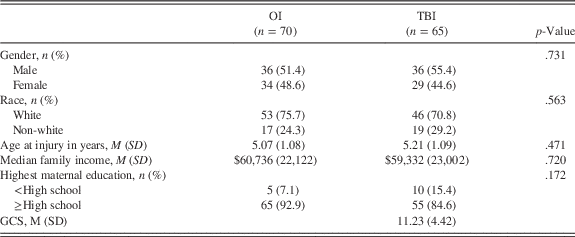
Note. GCS=Glasgow Coma Scale.
DNA Collection
DNA was collected from saliva samples, purified using the Oragene (DNA Genotek, Ottawa, Ontario, Canada) OG-500 self-collection tubes. TaqMan (Applied Biosystems) protocols were used to genotype the rs429358 and rs7412 single nucleotide polymorphisms. Allele frequencies were 8.9% (e2), 76.7% (e3), and 14.4% (e4). Using JMP genomics software, APOE allele frequencies violated Hardy-Weinberg equilibrium assumptions; however, allele frequencies were consistent with population frequencies in Caucasians of 7% (e2), 78% (e3), and 15% (e4). Participants were dichotomized into carriers and non-carriers of a single e4 allele. Distribution of carriers (TBI=18; OI=20) and non-carriers (TBI=47; OI=50) was comparable between injury groups, χ2(1)=0.013, p=.910.
Measures
Child functioning
Adaptive functioning was assessed at the final visit using the Child and Adolescent Functional Assessment Scale (CAFAS; Hodges, Wong, & Latessa, Reference Hodges, Wong and Latessa1998). Scores ≤50 are considered to be “unimpaired” and those >50 as “impaired.” Parents completed the age-appropriate form of the Behavior Rating Inventory of Executive Function (BRIEF; Gioia, Isquith, Guy, & Kenworthy, Reference Gioia, Isquith, Guy and Kenworthy2000) at all visits. We analyzed the age-standardized global executive composite T score (BRIEF GEC) to assess global executive function behaviors. Parents completed the age-appropriate form of the Child Behavior Checklist (CBCL; Achenbach & Rescorla, Reference Achenbach and Rescorla2001) at all visits. We analyzed the age- and sex-standardized Total Problems T score to assess child behavioral adjustment. Parent reports at baseline were based on retrospective recall of the child’s function before injury to control for premorbid differences. Higher scores on each measure reflect poorer functioning.
Family environment
Parents completed the Parenting Practices Questionnaire (PPQ) at all visits. The PPQ is used to assess the extent that parents rate themselves as engaging in authoritarian, permissive, and authoritative parenting behaviors (Robinson, Mandleco, Olsen, & Hart, Reference Robinson, Mandleco, Olsen and Hart1995). We analyzed the raw total score for these dimensions to characterize the level of each parenting style (Baumrind, Reference Baumrind1966). We used the Early Childhood Home Observation for Measurement of the Environment (EA-HOME; Bradley & Caldwell, Reference Bradley and Caldwell1984), an interview and observation-based measure, to assess the quality and quantity of stimulation, support, and structure available in the home environment at the initial visit shortly after injury.
Statistical Analysis
In SAS 9.3, linear mixed models examined the moderating effect of APOE e4 status on group differences and on associations of the environmental factors with adaptive functioning at the final visit and executive functioning and child behavior problems across all visits. Four environmental factors (three parenting styles and the EC-HOME) were included in separate models for each of the three outcomes. We initially examined the highest-level interaction of APOE e4 status with group (TBI vs. OI), environmental factor, and visit (for the GEC and CBCL), followed by lower-level interaction terms. Participants were considered as random effects.
In modeling the BRIEF and CBCL, parent ratings from a total of five visits (6 months, 12 months, 18 months, 3.5 years, and 6.8 years post injury) were modeled longitudinally, with baseline ratings of executive function (BRIEF GEC) or behavior problems (CBCL Total Behavior Problems) included as a covariate in modeling the corresponding outcomes to control for pre injury status. Parenting style moderators were treated as time-varying to allow modeling of dependent variables in association with concurrent measures of the family environment. Initial models controlled race (white vs. non-white), sex, and socioeconomic status. Models were trimmed using systematic backward elimination and a p value threshold of .1. When a significant interaction was detected, post hoc analyses examined group differences in outcome at each visit (if relevant) and low and high levels of family environment (defined at the 10th and 90th percentile for the sample) for ease of interpretation.
An alpha of .05 was used to determine significance of interactions and main effects, despite multiple comparisons, to reduce the risks of Type II error associated with tests of interactions in non-experimental designs (McClelland & Judd, 1993) and because interactions were the primary focus of the study. Post hoc analyses of significant interactions were corrected for multiple comparisons using the Holm-Bonferroni adjustment (Holm, Reference Holm1979) based on a priori contrasts examining carriers versus non-carriers within the TBI group and relative to carriers and non-carriers in the OI group. Effect sizes were computed by standardizing the outcomes and all continuous predictors (M=0; SD=1) other than time since injury and obtaining parameter estimates based on the final mixed model for each dependent variable (Yeates, Taylor, Walz, Stancin, & Wade, Reference Yeates, Taylor, Walz, Stancin and Wade2010). Because our present focus is gene by environment interactions, we only report significant results for main effects of APOE e4 status or interactions involving APOE e4 status and injury group.
RESULTS
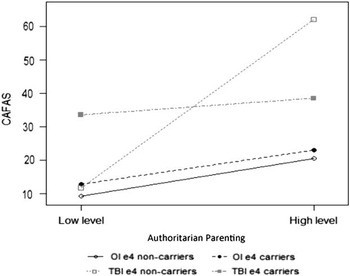
CAFAS analysis revealed an interaction between APOE e4 status, level of authoritarian parenting, and injury group, F(1,119)=6.47, p=.012 (Table 1 and Figure 1), with a medium effect size, standardized estimate=−0.72. Planned post hoc contrasts revealed that, at low levels of authoritarian parenting, children in the TBI group who were e4 allele carriers showed significantly poorer adaptive functioning relative to children with TBI who were non-carriers, t(119)=−2.47, adj p=.033, as well as relative to both carriers, t(119)=−2.03, adj p=.045, and non-carriers, t(119)=−2.58, adj p=.033, in the OI group. Effect sizes were large, standardized estimate=0.81, medium, standardized estimate=0.68, and large, standardized estimate=0.81, respectively. At high levels of authoritarian parenting, however, non-carriers of the e4 allele in the TBI group showed the poorest adaptive functioning, which was significantly poorer relative to the carriers in the TBI group, t(119)=3.17, adj p=.008, and both carriers, t(119)=3.81, adj p<.001, and non-carriers, t(119)=−4.95, adj p<.001, in the OI group. Effect sizes were large, standardized estimates=−1.00, −1.48, and 1.55, respectively.
Mean CAFAS scores as a function of APOE e4 status (carriers vs. non-carriers), authoritarian parenting (low vs. high), and injury group (TBI vs. OI).

Analysis failed to reveal main effects of APOE e4 status or interactions involving APOE e4 status and injury group for models that included levels of authoritative or permissive parenting and EA-HOME as predictors of adaptive functioning. Parallel analyses failed to reveal main effects of APOE e4 status or interactions involving APOE e4 status and injury group on post injury executive functioning or behavioral adjustment.
DISCUSSION
This study provides preliminary evidence for an interaction of APOE e4 status and parenting style in moderating long-term child outcomes following early moderate to severe TBI. In contrast to our hypothesis that the presence of the e4 allele in children with TBI would exacerbate adverse effects of less optimal family environments on child functioning, children with TBI who were e4 carriers showed poorer long-term adaptive functioning relative to children with TBI who were non-carriers and carriers and non-carriers with OI, but only in the context of low authoritarianism. At high levels of authoritarianism, non-carriers with TBI had the poorest adaptive functioning. In other words, the detrimental effect of the APOE e4 allele on adaptive functioning was observed in the context of positive parenting, while non-carriers had poorer adaptive functioning in the context of less optimal parenting.
Our finding of a TBI-specific interaction involving APOE genotype and family environment for only adaptive functioning, and not for specific measures of behavioral adjustment, is consistent with previous studies of pediatric TBI showing significant associations between APOE e4 status and global outcomes. In contrast to prior studies, however, we did not find significant main effects involving APOE e4 status. This may be attributable to our investigation of more fine-grained measures of child functioning; the APOE e4 allele may influence pathophysiological processes following injury that, in turn, affect more global outcomes such as survivorship and global functioning, but that these processes are not related to more selective deficits. A sample with higher rates of global impairment, thus, may be required to detect these effects.
Another possible reason for null main effects could be insufficient power due to a smaller sample size than some previous studies. Nevertheless, other studies also failed to find main effects of APOE on outcomes following pediatric TBI (Lo et al., Reference Lo, Jones, Chambers, Beattie, Forsyth, Mendelow and Minns2009; Quinn et al., Reference Quinn, Smith, Murray, Stewart, Nicoll and Graham2004), and future work should focus on explaining these mixed results. The finding that APOE e4 status moderated associations between parenting style and adaptive outcomes highlights the importance of considering the family environment when examining influences of genetic factors on pediatric TBI outcomes.
Non-carriers of the APOE e4 allele appeared to be more sensitive to parenting style relative to carriers, with the effects of injury on adaptive functioning surprisingly diminished in the context of less optimal parenting styles and exacerbated in the context of more positive parenting styles among children who did not possess the e4 allele. These results suggest that the effects of environmental factors differ by APOE e4 status, such that APOE acts as a “variability gene” (Berg, Kondo, Drayna, & Lawn, Reference Berg, Kondo, Drayna and Lawn1989). Although APOE by environment interactions have not previously been studied in TBI, other studies of gene by environment interactions influencing cognition in older adults provide mixed evidence with regard to whether e4 allele carriers (Lee, Glass, James, Bandeen-Roche, & Schwartz, Reference Lee, Glass, James, Bandeen-Roche and Schwartz2011) or non-carriers (Ritchie et al., Reference Ritchie, Jaussent, Stewart, Dupuy, Courtet, Malafosse and Ancelin2011) show greater sensitivity to environmental influences.
The apparent protective effect of the APOE e4 allele on adaptive functioning in the context of less optimal parenting is difficult to explain and contrasts with evidence for detrimental effects of the e4 allele on neurobehavioral outcomes in several conditions affecting adults. APOE may have a pleiotropic association with neurobehavioral outcomes across the lifespan, in which genotypes may confer benefits in youth but become risk factors in later life (Ihle, Bunce, & Kliegel, Reference Ihle, Bunce and Kliegel2012). Although several studies have reported better cognitive performance in carriers versus non-carriers of the APOE e4 allele in typically developing children, a recent meta-analysis found no evidence for APOE e4-related cognitive benefits in children, adolescents, or young adults (Ihle et al., Reference Ihle, Bunce and Kliegel2012).
Although the present study is one of the largest investigations of genetic factors and developmental outcomes following pediatric TBI to date, the small sample size and resultant low statistical power for the many statistical comparisons are significant limitations and the results should be considered preliminary. Nevertheless, effect sizes were medium to large in magnitude, suggesting potentially clinically meaningful differences. Our reliance on retrospective recall of premorbid child function is another significant limitation. Larger samples are needed to replicate findings and more definitively elucidate the conjoint effects of genetic variants and environmental factors on long-term outcomes.
Studies examining genetic and gene–environment interactional influences on recovery following pediatric TBI are just beginning. Directions for future research include the examination of finer-grained child outcomes, identification of mechanisms by which APOE and other genotypes influence outcomes, examination of changes in genetic influences as a function of time since injury and development, and the interaction of multiple genes and multiple environmental influences on outcome. A more comprehensive understanding of the genetic contribution to recovery following pediatric TBI will facilitate prognosis and may illuminate targets for novel interventions and rehabilitative strategies. Our preliminary findings suggest that models of recovery and subsequent development after childhood moderate to severe TBI should consider the role of the family environment and its interrelationships with genetic factors.
Acknowledgments
The authors report no conflicts of interest. This publication was supported by an Institutional Clinical and Translational Science Award, NIH/NCRR Grant Number 1UL1RR026314 and in part, by the Rehabilitation Medicine Scientist Training Program (RMSTP) K-12 HD001097-16 and National Institute for Child Health and Human Development K23HD074683-01A1. Its contents are solely the responsibility of the authors and do not necessarily represent the official views of the NIH. Additional support provided to Dr. Wade included grant R01 HD42729 from NICHD and Trauma Research grants from the State of Ohio Emergency Medical Services.