It owed nothing to African skill; it required none.
V. S. NaipaulAfter work, housing is arguably the basic element in urban life, important for the lives of the people and also as the physical frame for much of daily urban life. It is not just a question of a physical presence and conditions, important as these are. What matters as much are the legal and social relationships that are embedded, re-created and sometimes challenged through particular forms of housing tenure. The most common forms are owner-occupancy, rental from private landlords, public rental (usually from municipalities), co-operatives and employer housing. The meaning of each of these varies according to the context. But in general each is associated with peculiar relations and challenges, which can shape life in the cities where they prevail. In this respect no tenure regime was more peculiar than that which prevailed in the cities of British East-Central Africa in the colonial period. Here, employers and municipalities were together supposed to supply the housing needs of all Africans, even though they constituted the absolute majority of urban residents, 54 per cent in 1948. The purpose of this article is to survey the logic, dimensions and limitations of this unusual response to the problem of housing the urban population.
In the colonial era the urban centres of East, Central and southern Africa contained indigenous Africans as well as Europeans and south Asians, who were usually referred to as Indians.Footnote 1 Europeans and Asians usually fended for themselves by acquiring or renting property on the private market. Africans, however, presented a wholly different case, one which, because they were the largest racialized group and had unique moral and political claims, dominated public debate if not the urban scene.Footnote 2 For the most part Africans were not supposed to settle in urban areas and the public expectation, defined in legislation, was that they would be housed by European and south Asian employers or, failing that, by municipalities.Footnote 3 These principles were complicated by the fact that they were enforceable only within municipal limits; little was, or could, be done to prevent Africans squatting (or sometimes settling on tribal lands) in urbanizing fringe areas from which they could easily travel daily to work. The principles were also complicated by a continuing wrangle between employers and local government, and the outcome is unclear. Employers disputed their responsibility for temporary workers; public administrators grumbled that employers failed to house even their permanent employees; contemporaries noted that municipalities failed to pick up the slack; and, when they have paid attention to the matter, historians have spoken of a collective neglect. In fact no systematic attempt has been made, for any of the colonies in question, to document how urban Africans were housed. This article begins to fill this gap by focusing on the provision of African housing in urban Kenya up to the outbreak of World War II.
If the British African territories presented a number of variations on the theme of colonial urban housing, what distinguished Kenya was the presence of a significant white settler population and of a relatively large number of south Asians in all major urban areas. Asians outnumbered Europeans in every urban centre of any note: their community was more than twice as large as the European in Nakuru and Eldoret, four times larger in Nairobi, and more than twelve times larger in Mombasa and Kisumu. Indeed, in the latter town it was as large as the African, at least within municipal limits. Most importantly, in the present context, its two largest urban centres, Nairobi and Mombasa, were a study in contrasts. Mombasa, much the older, contained a larger hybrid and Swahili, coastal Arab, community; its European population was small, while other groups were substantially intermingled.Footnote 4 Nairobi and other, smaller inland towns such as Kisumu, Eldoret and Nakuru were recent colonial settlements where most Africans lived in segregated districts away from the European and Asian sections of town. Needs and circumstances varied widely. The colonial government framed legislation that was supposed to apply equally everywhere, but local administrators, employers and municipalities had to make it work in each place. Having sketched the general context within which colonial urban policy was framed, we outline the achievements of employers. Since neither appear to have changed greatly over the study period, our concern is to articulate the logic of policy and the broad pattern of employer response, rather than to trace a narrative. Since the employer's response was always inadequate it left an unsatisfied housing shortage to which local municipalities had to respond. These responses were strikingly varied. We conclude by discussing the reasons for this variation, by offering a broad assessment of Kenya's peculiar urban scene, and by suggesting what implication it might have for our more general understanding of colonial urban policy in the wider region.
The period that ended with the outbreak of World War II is distinctive both for the Kenyan city as it was for colonial policy in Africa as a whole. As implied by the favoured term ‘Dual Mandate’, colonial policy was framed by two contradictory purposes: development of colonial resources, and protection of indigenous lifeways through ‘trusteeship’.Footnote 5 In East, Central and southern Africa the British argued that only those Africans whose labour was needed should reside in towns, and only for as long as they were employed. It was in such terms that from 1906 they justified section 31 of the Employment of Servants Ordinance that required employers, private and public, to house their permanent African staff, together with the pass laws that kept other Africans out of town.Footnote 6 In the late 1930s their thinking began to change. New policy articulated in London, and embodied in the Colonial Development and Welfare Act of 1940, spoke of colonial development in a way that rendered trusteeship obsolete.Footnote 7 By the 1950s the British had accepted that to promote this new type of development they would have to accommodate, literally, the permanent urbanization of Africans. Until 1939, however, a more restrictive and paternalistic policy held sway.
African housing and colonial policy
The problems of urbanization and housing in colonial Kenya received a good deal of attention from contemporaries, and have not been ignored by historical scholars. Most historians have concentrated on the post-war years, and especially the era of Mau Mau.Footnote 8 This was, of course, a time of high drama and rapid change, but its historical urban roots have been relatively neglected.Footnote 9 Then, too, for both the earlier and the later years of colonial rule most writers have focused on specific cities rather than upon the broad picture. In particular, they have examined the capital Nairobi, or Mombasa, the chief port, at the expense of the smaller urban centres.Footnote 10 Events in these two cities mattered most for the development of colonial policy, but for analytical purposes the experience of the smaller centres also offer valuable insights.Footnote 11 Above all, apart from passing references to its inadequacy, perhaps the most striking oversight has been the neglect of employer housing. A balanced account of the housing scene in Kenya, then, must recognize the diversity of local urban experiences, a diversity defined in part by the ways in which employers met their statutory responsibilities. The present survey draws on the available secondary literature that includes official, published reports.Footnote 12 These have been supplemented with archival materials that document employer housing, early public activity and conditions in the smaller towns.Footnote 13 Collectively, these sources provide a clear sense of British opinion and policy but only an indirect impression of the attitudes of the growing African majority.
Employers are vital to the narrative because for decades colonial policy gave them a central role. By the 1920s British policy had two stated purposes that were embraced in the concept of the ‘Dual Mandate’: the exploitation of colonial resources and the promotion of development ‘along native lines’.Footnote 14 In addition, in 1923 a White Paper articulated a doctrine according to which ‘the interests of the African natives must be paramount’. On the surface this might appear to have been a surprisingly progressive view, but the truth was otherwise: it was articulated in response to political pressure from the Indian community in Kenya (and of the Indian government), and was intended to justify continuing limitations on the franchise and prestige of this group. Moreover, to ensure that European interests were not seriously threatened, African paramountcy was construed as something that the British must continue to hold in ‘trust’.Footnote 15 Soon clarified and reaffirmed, this policy indicated the need to help the African to ‘develop his own economic opportunities’ and to promote forms of social progress that included ‘efforts to improve the housing of the natives’.Footnote 16 But the continuing model of trusteeship required that rural lifeways were to be preserved, or at least protected from rapid change. Throughout East and Central Africa this meant that Africans were to be discouraged from settling in urban areas. This required pass laws, and a prohibition on the ownership by Africans of urban land.Footnote 17 This logic had long been appreciated in South Africa, where pass laws had existed in the Cape since the late eighteenth century and had become widespread by the late nineteenth.Footnote 18 In the East African Protectorate, de facto pass laws were enacted through the Registration of Natives Ordinance (1915), which became effective in the new Kenyan colony in 1920. But the maintenance of trade, and the domestic comfort of Europeans, meant that some Africans were needed in towns. There was a contradiction here, as the liberal intentions of many administrators – including a disproportionate number in London – conflicted with the interests of white settlers and urban employers.
This contradiction was partly resolved by section 31 of the Employment of Servants Ordinance, which was first enacted for the East African Protectorate in 1906. Recognizing the tied and contingent nature of African life in and near urban areas, this legislation made African housing the responsibility of European or Asian employers.Footnote 19 The practical difficulty was that, from the very beginning, many employers failed to carry out this charge. As trustee, the colonial government therefore had the moral responsibility of providing urban housing, not just for its own workers but for an undefined and potentially large number of urban Africans. This was true from the beginning and was eventually spelled out most clearly by the Kenya Land Commission in 1934. Commenting on the growth of overcrowding in Kibira, one of Nairobi's unregulated settlements, Commissioners observed that ‘the natives, as being a people under tutelage, are entitled to expect that Government will direct and control’. Significantly, they added, ‘where Government relaxes that control it must . . . share the responsibility if irregularities occur’.Footnote 20 The implication was that the state should enforce pass laws effectively, or else help municipalities address the urban housing problem. In practice it meant that the ultimate responsibility for African housing fell upon the municipality.
How seriously should we take the rhetoric of trusteeship and paramountcy? These terms were certainly used to secure British interests against the claims of both the larger south Asian population and of the African.Footnote 21 Behind both was the consistent goal of regulating the supply of African labour in country and city.Footnote 22 Where there was a labour shortage Africans were encouraged to migrate, notably by the imposition of a hut tax. First levied in 1901, and at rates that varied geographically according to regional labour needs, this pushed Africans to migrate to earn the cash with which to pay the levy.Footnote 23 Labour surpluses were managed by enforcing pass laws. Within cities, early efforts to regulate and improve African housing were driven by concerns about public health, but it was the health of Europeans that framed the debate. In the case of Kenya the 1910s were crucial, chiefly due to the growth of Nairobi. Inspired in part by South African initiatives, in 1913 a report commissioned by the Colonial Office recommended a policy of racial segregation throughout East Africa on sanitary grounds.Footnote 24 This was not formally implemented and anyway would have been useless in relation to domestic servants. In 1914 the District Commissioner for Nairobi pointed out that when employers failed to accommodate their servants even ‘respectable boys’ ended up in ‘filthy dens, rookeries and even brothels which are let out for hire by Asiatics’.Footnote 25 He warned what might happen when these servants came into the homes of Europeans in order to prepare and serve food, especially since it was generally understood that Africans ‘do not hold that cleanliness is next to godliness’.Footnote 26 Considerations of public health and labour supply always guided policy towards urban settlement and African housing and, as exemplified by the confusing language of African paramountcy, the rhetoric of colonial rule was often deployed cynically to cloak real motives.
But the rhetoric of trusteeship was not wholly self-serving. Many colonial officials took it seriously. This was perhaps especially true of District Officers in rural areas, but the same attitude carried over into the towns and cities. In 1938, for example, Douglas Brumage, the Municipal Native Affairs Officer for Nairobi, noted that ‘it is not part of our definite policy, of course, to turn natives in the Colony into black Europeans’, and then added regretfully, ‘yet we have done little to prevent this from taking place’.Footnote 27 He clearly assumed that he, and the colonial administration in general, had a moral responsibility to solve the urban problems that their actions – and inaction – had created. Then, too, although the discourse of trusteeship was flexible it was a real compromise that constrained the government's options. The doctrine of paramountcy, in particular, was a real threat to white settler interests, as their opposition and unrest during the 1920s demonstrates.Footnote 28 In time, such language created and justified expectations among Africans, offering a persuasive discourse with which to advance their claims.
The logic of trusteeship implied that employer or municipal housing should take a particular form. Raymond Betts has suggested that there was a general ‘tilt’ of colonial policy towards urban areas in the first half of the twentieth century, one which was also apparent in East and Central Africa.Footnote 29 Urbanization brought new freedoms, new bases and forms of community, and the need for new forms of administration and control.Footnote 30 Within this particular region, cities were associated with a freedom from tribal norms and laws. But these freedoms, and the urbanization on which they depended, were partial because temporary or cyclical. Men, especially, went to work in cities for shorter or longer periods but retained homes – often in the form of small farms, shambas – in rural areas. There arose what came to be known, variously, as temporary urbanization and circular migration.Footnote 31 The commitment of many Africans to urban life was in fact contingent, with complex consequences for the urban housing that they required. Equally important, from the point of view of colonial and municipal governments, the African was supposed to be a sojourner in the town, with very specific consequences for the type of housing that he was supposed to require. Bachelor housing was the norm, while the acknowledged need for community facilities, notably schools, was limited or non-existent.Footnote 32 Employers or, failing them, municipalities, were responsible for housing Africans, but they were not expected to provide very much else.
Employer housing
The government might have required employers to provide their workers with housing, but there was usually little incentive for them to do so. The main calculus involved weighing the uncertain effects on the labour force against the predictable costs. Where there is a labour shortage, of course, decent housing can attract and keep workers. This can be especially important where businesses rely on a labour force with specialized skills. But neither situation applied with much force in urban Kenya. Most Africans were employed in menial jobs and in urban areas there was usually a labour surplus. Some employers might have found it advantageous to try to exercise comprehensive control over a work force that was, for the most part, unaccustomed to the disciplines of wage labour: the idea of running their own housing estate might have seemed to make sense. But complete control can arouse complete resistance, as the owners of company towns elsewhere had often found, most notably the Pullman Car Company during the 1890s. The effects of exercising close control were unclear, whereas the costs of housing provision were both unwelcome and wholly predictable. In most places and for most of the time, employers had reasons to drag their feet. In the majority of cases that is what they did.
Although the details are fuzzy, it is clear that employers did not provide even bachelor housing for their entire permanent labour force. Some came close to meeting their statutory responsibilities; some fell far short; many did little or nothing. Government observers have suggested that inaction was the norm. In 1937, for example, the Native Affairs Department commented in its annual report that the ‘number of employers who take not the slightest interest in their labour is amazing’.Footnote 33 Such claims cannot be taken at face value: it was in the interest of the colonial government to emphasize the responsibility (and failures) of employers and to direct attention away from itself. That said, it seems that even where employers were short of labour they were reluctant to build. This was chiefly an issue in rural areas, where the most extreme difficulties of recruitment were faced in the early twentieth century.Footnote 34 By the 1920s the government was encouraging farmers by providing design guidelines, emphasizing that good housing would improve health and productivity, while reducing labour turnover.Footnote 35 Some estates, such as the Kenya Tea Company and the African Highlands Produce Company, paid heed. Eventually the Kericho Tea Estate experimented with concrete rondaavels while the Produce Company built a stone crushing plant to supply matériel for 4,000 model dwellings.Footnote 36 But these were exceptions. In 1931 the colony's Annual Report on the Social and Economic Progress of the People suggested that only ‘some’ estate houses were available in the European settled areas, and other accounts indicate that most were built – often by Africans themselves – of mud and wattle.Footnote 37 All too common were the sorts of conditions described by Okeno Sare to the East Africa Royal Commission in 1953. Sare spoke of a farm plantation where five-foot diameter huts housed four labourers each, with no lavatory for the whole camp.Footnote 38 In most cases, on European estates as in the designated reserves, Africans fended for themselves.
In rural areas Africans were often in a position to accommodate themselves, and indeed were often expected to. Farmers provided building plots, at least for as long as Africans and their families continued to work for them. The same was not true, and was not supposed to be true, in urban areas where the need for employer housing was greater. Official reports routinely deplored the indifference of urban employers. In 1939, for example, the Medical Officer of Health for the Municipal Board of Mombasa commented that the average employer ‘neither knows nor cares’ where his workers live: ‘his boys appear for work of a morning and disappear from his ken in the evening to that vague address . . . “Majengo” [native quarter]’.Footnote 39 This judgment has been echoed by historians. Clayton and Savage, endorsing the opinion of Mombasa's Native Commissioner, suggest that in the late 1930s employers, ‘including the municipality and the government’, had ‘virtually ignored’ their responsibility to their workers.Footnote 40 This may have been true for Mombasa but in general is wrong. In 1939 E.R. St Davies, the Native Affairs Officer for Nairobi, undertook a detailed and systematic survey of the housing of African workers.Footnote 41 Based on 5,125 returns, St Davies estimated that there were 36,147 employed Africans and their dependants in Nairobi. Of these 21,016 (including 18,772 workers and 2,244 dependants) were employed by private individuals and companies. Of these 9,959, or 47 per cent, were ‘legitimately housed’ by, and with, their employers.Footnote 42 The majority of the Africans who were housed (71 per cent) were live-in domestic servants in the European or Asian sections of the town, an arrangement of mutual convenience (Figure 1). A minority worked for small businesses, typically Asian, and many of these also lived with, or near, their employers in the Central District. Conditions varied and were sometimes awful. But it is clear that many of Nairobi's employers did act upon their statutory responsibilities.
Asian dwelling for an extended family, with a separate room for one or more African servants (‘boys’) in the courtyard, Desai Rd, Nairobi, 1927. This dwelling was erected by the Kenya and Uganda Railways for Asian staff. Asian and European employers were also required to house domestic servants and, partly because it was convenient to have them on call, most did.
Source: Finn Barnow, Niels W. Hansen, Mette Johnsen, Anne Poulsen, Vibeke Rønnow and Kaare Sølvsten, Urban Development in Kenya. The Growth of Nairobi 1900–1970 (Copenhagen: Aurora Publishers, 1983), 33.

The state, as an employer, had not been inactive though its performance was variable. The government had washed its hands of housing its European employees in Nairobi and Mombasa by 1926, but there were difficulties in applying such a policy in smaller towns where decent accommodation was often unavailable, and it conceded that it would have to house those Asian civil servants whose pay made it impossible for them to afford decent housing.Footnote 43 But it acknowledged a full responsibility for housing (or of providing a housing allowance to) African employees, initially without charge.Footnote 44 Following through on this at Starehe, Nairobi, in 1928 the government built good accommodation for some of its staff, a project that it extended after 1942. By then the East Africa High Commission had built a couple of projects, one of which was considered ‘very select’.Footnote 45 But these types of project were the exception. One government report commented that Public Works Department (PWD) housing, widely dispersed and nominally permanent, was often dilapidated, in part because lacking in supervision.Footnote 46 In general the housing of African civil servants was haphazard, heavily dependent on local conditions and the initiative of administrators in a range of departments. A complete survey of government workers in Kisumu provides an exceptional snapshot which may not be exactly typical – how would we know? – but which shows a symptomatic range of possibilities. It appears that in 1940 a (probably large) majority of Kisumu's African government workers, amounting to 384 employees and 313 dependants, were housed in some way.Footnote 47 At different points in time more than half a dozen agencies had built housing, including the police and prisons, the PWD and conservancy departments, Posts and Telegraphs, the health office and the District Commissioner. Standards varied and a health inspector deemed that only one third of all African employees occupied ‘proper’ quarters. At the one extreme, the health office boasted a ‘model cottage’ of ‘permanent materials’ to ‘bye-law standards’; towards the other extreme, the police made do with a ‘camp’ of circular huts thatched with olengi grass. It may be, as one historian has suggested, that Kisumu's government housing for its own employees was ‘an embarrassing problem’, but the story was not one of wholesale neglect.Footnote 48
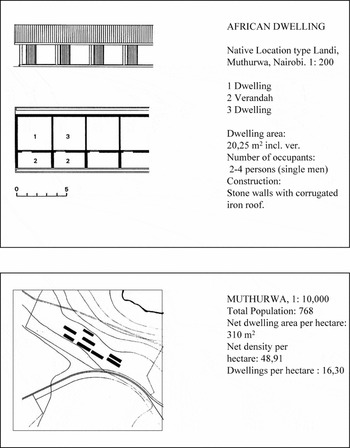
The housing record of other employers, whether private or quasi-public, was at least as variable. The exemplar was the Kenya and Uganda Railways and Harbours Administration (KUR). The largest employer in the country, the KUR was in effect a public employer since it was run through a High Commission for Transport under the joint supervision of the Kenya and Uganda governments. It hired Africans in every major town and its housing was regarded as a model. It took responsibility for almost all of its permanent and even some of its casual employees. In 1945, for example, it housed 1,816 of its 2,547 African workers in Mombasa, some in temporary facilities.Footnote 49 From an early date it had built well. In the mid-1920s, for example, it rehoused some of its Mombasa workers out of grass huts into permanent structures; at about the same time, and at the other end of the country in Kisumu it built ‘permanent landies [barrack-type lines] of good design’; in between, in Nairobi, it had completed some ‘well-built ranges of dormitories of permanent construction’.Footnote 50 It also built abundantly. In Nairobi it began to build at Muthurwa soon after 1900, with later expansions in 1924–29, 1930–31, 1936 and 1938 (Figure 2).Footnote 51 By the beginning of 1939 it controlled enough ‘bedspaces’ for 1,683 married men, with 600 more under construction and another 600 planned for the following year. (In the era when most housing was built for bachelors, bedspaces, rather than dwelling units or even rooms, was the accepted unit of measurement.) The government's African Affairs Department suggested that KUR was building ‘probably the best type of native lines south of the Equator’, while other reports described them as ‘palatial’.Footnote 52 This was a gross overstatement, one which says more about the low level of prevailing expectations than about the dwellings in question, most of which were in blocks of twenty, 10′ × 10′ rooms. But clearly Kenya's major employer had been setting an example of a sort.
Landies (lines) of housing for unaccompanied men built by the Kenya and Uganda Railways, Muthurwa, Nairobi, 1923. The KUR's housing for its African workers was generally regarded as a model.
Source: Finn Barnow, Niels W. Hansen, Mette Johnsen, Anne Poulsen, Vibeke Rønnow and Kaare Sølvsten, Urban Development in Kenya. The Growth of Nairobi 1900–1970 (Copenhagen: Aurora Publishers, 1983), 24.

How many private employers followed the example of the Railways, or even the faltering initiatives of the government? There is no satisfactory answer. At most, survey data from 1954 may be used to throw retrospective light on the pre-war scene.Footnote 53 This survey showed that the proportion of monthly-paid workers housed by their employers varied enormously from place to place. Confirming the perennial complaints of local observers, Mombasa (10 per cent) and Kisumu (10 per cent) fell at the bottom end of the spectrum. At the other extreme lay Thika (95 per cent), an industrial centre near Nairobi whose growth was promoted after 1945 in an attempt to deflect some development away from the capital.Footnote 54 Nairobi itself (40 per cent), and the important inland towns of Nakuru (65 per cent) and Eldoret (45 per cent), lay in between. By then, at least some of this housing took the form of ‘cottages’, rather than the barracks, lines and landies of the pre-war era.Footnote 55 The figures for monthly-paid workers give a fair impression of the wide range of local experience, but they are misleading. Because they pertain to the more permanent and better-paid African workers, they overstate the extent to which industrial and commercial employers housed their entire labour force. But when domestic servants are included in the picture, it appears that employer housing remained important until the very end of the colonial period. In 1959 Andrew Hake found that, on the still-conventional bedspace criterion, 67 per cent of employed Africans in Nairobi were housed by their employers.Footnote 56 The Railways administration alone controlled 10,814 bedspaces.Footnote 57 Hake's report was silent about those urban residents who lived just beyond city limits, and about those without officially recorded employment. Even so, it underlines the fact that employers played a major – if very variable – role in Kenya's urban housing scene throughout the colonial period.
The surprising thing is not that employers did so little but that they did so much. Apart from the costs and uncertain effects on labour, one of the local disincentives to build was the fact that the available contracts for land were often short term; this discouraged investment in any type of durable housing.Footnote 58 Municipalities tried to circumvent this problem by setting aside locations in which they either encouraged employers to build, or where they themselves built housing for employers to rent out. Nairobi did both after 1945, the leading example of the latter type of development being the Gorofani location which opened in 1949 and which by 1955 had a bedspace capacity of 2,688 in 896 rooms.Footnote 59 Above all, though, employers disliked the aggravations of maintenance and, especially, supervision. One of the employers interviewed by Andrew Hake observed, ‘I am sick of running a slum.’Footnote 60 It was not just a question of moral opprobrium but also of potential unrest.
The residual housing problem
If the contribution of employers to the housing of urban Africans was greater than has often been suggested, it was never sufficient – anywhere. There was never enough housing of any sort, while housing that actually satisfied anyone, Africans or administrators, was rare indeed. In truth, from the sources that we were able to consult, it is difficult to know what Africans thought of the housing that was available to them in urban areas. For cultural reasons they would have had different expectations from those, say, of British workers: lower in terms of public services, and also of private domestic space. Then, too, since most were recent rural migrants their expectations of urban housing might at first have been rather ill-defined. But, even in the absence of direct evidence, it is clear that conditions were so bad that most Africans regarded them as an affront. Certainly, British administrators came to the conclusion that poor housing for Africans in urban areas became one of the main, proximate causes of social unrest.
From the foundation of the colony, the government perceived that the problem of African housing in towns was ‘acute’.Footnote 61 At first it considered that the ‘essential housing problem of the colony’ lay on the reserves.Footnote 62 As conditions, shortages and then tensions in urban areas deteriorated, however, the balance shifted. Nairobi attracted the most attention. There, as early as 1922 the Medical Officer of Health complained that too much of the housing provided for government workers was ‘unfit for human habitation’ while ‘in the commercial area . . . in the majority of cases, natives cannot reasonably be stated to be housed at all, odd corners, kitchens, passages, verandahs, bathrooms and even latrines being used by them . . . any odd place that provides some sort of roof’.Footnote 63 Such ‘very unsatisfactory’ conditions worsened during the 1920s as Nairobi's African population rose from about 15,000 in 1920 to 28,000 in 1930, and by then the housing shortage was indeed ‘severe’.Footnote 64 It was then that the colony's annual report began to include a section on housing. In the early 1930s the African population fell and the housing shortage eased briefly, but by 1936 the number of Africans had returned to their pre-Depression peak and by 1939 probably exceeded 41,000.Footnote 65 By then a growing crisis had prompted St Davies' survey which showed that, although employers did house many thousands of Africans there was a major shortfall. St Davies claimed, with spurious precision, that there were 14,617 Africans employed in Nairobi who were not housed by their employers, while several thousand unemployed Africans and unofficial dependants were also illegally resident in town.Footnote 66 The result was extreme overcrowding, and awful conditions. Acknowledging the influence of employer housing, one assessment of African living conditions in Nairobi by the 1940s spoke pungently of ‘foetid slums’ that were run ‘by and for European and Asian business interests’.Footnote 67
Nairobi was not the best case, but neither was it the worst. Some observers claimed that the situation in Mombasa was better, in part because an enlightened policy was allowing the construction of inexpensive housing by private interests.Footnote 68 But in 1914 the city's Medical Officer of Health had commented that, of sanitation in Mombasa, ‘roughly there is none’, and by 1939 a commission claimed that conditions there were ‘deplorably bad’.Footnote 69 Sanitary services, in particular, continued to lag so that in 1953 two-thirds of the three mainland wards of the city lacked latrines.Footnote 70 Elsewhere, no town could present such a concentrated mass of misery as had accumulated in the capital. Especially in the smaller urban centres, Africans settled in large numbers just beyond city limits. Circumstances varied. The housing shortage in Eldoret, for example, was relieved when neighbouring farmers decided formally to rent building sites to Africans. Perhaps because some were from South Africa, they spoke of ‘kaffir farming’.Footnote 71 Landowners around Nakuru, an inland town of comparable size, did not follow this example, and conditions there were worse, even ‘appalling’.Footnote 72 Kisumu was a whole other story. There, a native reserve butted up against the municipal boundary and extensive fringe settlement was used by the municipality as an excuse for inaction. In 1949 a European visitor who knew all of the major inland urban centres, including Nairobi, declared that African housing in Kisumu was ‘squalid and overcrowded almost beyond belief’ and judged its administration to be the ‘most backward . . . of any of the towns I have visited’.Footnote 73 Here, perhaps, was the urban nadir.
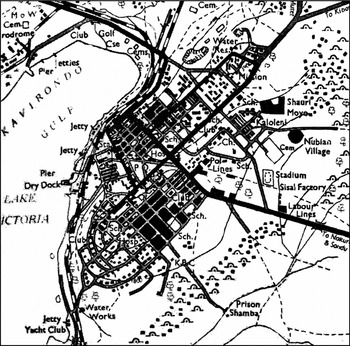
Kisumu was probably a suburban nadir too. In theory, except on the coast, Africans were allowed to settle only in designated city ‘locations’, which is where government and employer housing was built. Only those who lived on their employers' premises were supposed to reside elsewhere. In fact, Africans developed their own informal settlements in, or more commonly just outside, every urban centre. In this ‘suburbia of the poor’ where even basic services were absent, they erected shelters with whatever materials they could afford or what lay to hand.Footnote 74 The resulting danger to public health was expressed by administrators in their preferred term, ‘septic fringe’.Footnote 75 Physically, this fringe was inferior to all but the worst city slum, and was further from city jobs. But Africans often preferred to live there. In Eldoret, in Kisumu and in Nairobi, Africans voted with their feet: urban housing built to western standards often stood vacant while shacks sprang up beyond city limits.Footnote 76 In Kisumu during the 1920s ‘Manyatta’, as the main fringe settlement was known, was preferred to the Railway landies; much later, when the municipality built housing for its employees it was embarrassed to find that it had few takers (Figure 3).Footnote 77 Sometimes the appeal of the fringe was that it was cheaper than urban locations, although the difference was marginal. More important, beyond city limits Africans could design houses, and layouts, that suited their extended family structures and tribal cultures. Most generally, they enjoyed the freedom from official ‘interference’, whether by the police, or by busybody health inspectors.Footnote 78 Interference in the urban locations became all-pervasive: during Mau Mau, when a clampdown made Eastlands – the district that included all of the African locations in Nairobi – ‘one of the most closely administered parts of British Africa’.Footnote 79 By comparison, the city's fringe areas were weakly controlled. This period was exceptional, but the contrast between regulated city and uncontrolled fringe was a persistent feature of urban administration in the colonial period. Combined with the shortage of housing, it guaranteed that fringe settlement would occur.
Kisumu and vicinity, 1962. ‘Huts’ indicate the location of extensive squatter settlements where many dwellings would have combined local and western-style materials and designs. These poor settlements indicate the persistent shortage of housing but proved more attractive to Africans than the municipal project at Shauri Moyo, built after 1945.
Source: Kenya Colony and Protectorate. Survey of Kenya, Atlas of Kenya. A Comprehensive Series of New and Authentic Maps (Nairobi: Government Printer, 1962), 39.

The existence of fringe settlements was a constant concern to administrators, not just on the grounds of health but also of security. The fringe attracted criminals, and eventually rebels. At regular intervals Nairobi, at any rate, attempted to eliminate these settlements. Several of them, including Kaburini, were cleared in the 1920s, thereby removing Africans from the western sector of the town, which became European.Footnote 80 After years of debate, Pangani was cleared in 1938. But the problem invariably resurfaced. Many of those displaced from Pangani simply moved to new squatter settlements in the same part of Mathare Valley, which then grew during the 1940s, were demolished in 1952 and then grew again after 1960.Footnote 81 The game of whack-a-mole simply moved the problem around.
Local initiatives
Because employers could not satisfy the growing need for decent African housing in urban areas the colonial state came under pressure to act. Initially the response was local and piecemeal. The degree of need varied from place to place, as did prevailing building materials and methods of construction, as well as the organization of the building industry.Footnote 82 So did the other important influences on public action.Footnote 83 The most important of these were the political pressures that were brought to bear, the organization of local administration, the receptiveness of local elites and the financial capacity of each municipality.
Kisumu had some of the worst conditions, and the least conscientious employers, but geographically and politically it was marginal. It was a mainly Asian and African town, far from the main areas of European settlement. Out of sight was out of mind, as the Commission on Local Government implied in 1927. Led by Judge Feetham, a South African, this Commission noted that, in contrast to the situation in South Africa, municipalities in Kenya were not required to build housing for Africans. Feetham pointed out, however, that neglect was a viable option only if municipalities really did regulate the number of Africans in town.Footnote 84 Since local action might become necessary, he recommended that some small towns be given municipal powers. The main exception was Kisumu, which he suggested could remain under a District Commissioner since it was ‘not regarded by the European settler as his natural commercial centre’.Footnote 85 A similarly neglectful attitude was implied in 1934 by the Kenya Land Commission. It, too, stressed the importance of keeping the unemployed away from towns but suggested that this mattered less in the smaller urban settlements that lay outside the Highlands.Footnote 86 Of these the largest was Kisumu.
Towns that lay within or near the Highlands were another matter. The Land Commission of 1934 discussed at some length the importance and feasibility of municipal housing schemes. Commissioners did not dismiss this possibility, but they were not keen.Footnote 87 They agreed with Feetham that the better, if partial, alternative was to minimize the African urban population and asserted that this took on ‘special importance’ in and near ‘townships of the European highlands’.Footnote 88 There was general agreement that it was most important to regulate, and more positively to satisfy, Africans in the places that mattered most to Europeans. Eldoret and Nakuru, the ‘informal capital of European settlers’, were the largest of these.Footnote 89 But it was Nairobi, the capital itself, that mattered most.
Nairobi contained by far the largest concentration of Europeans in Kenya, it was home to the colonial government, a prime ‘security risk’, and the leading symbol of colonial rule to domestic and foreign critics.Footnote 90 Nowhere was it so important that Africans be placated, or that government be seen to be taking appropriate measures. It is true that Mombasa was more important than Nairobi to Kenya's economy, and that in the 1930s and early 1940s it was the site of more substantial labour unrest.Footnote 91 But its Municipal Board was run by a conservative oligarchy, while liberal influences on Nairobi's City Council were markedly stronger.Footnote 92 If Kisumu seemed likely to be the slowest to develop municipal housing, Nairobi, followed by Nakuru, Eldoret and Mombasa, seemed likely to be the first to act. To a surprising extent these broad expectations were not met.
In 1908 Kisumu was the first urban place in Kenya to establish a native location, but it did very little with it.Footnote 93 By 1922 it had set aside 665 lots on which employers and Africans were encouraged to build, but it provided no services, assistance or guidance.Footnote 94 The township offered exhortations, and eventually in 1931 the government began to build houses for 60 of its own workers (15 married and 45 bachelor quarters). Administrators repeatedly acknowledged how bad conditions were, and by 1939 were looking anxiously at the unrest that had broken out in Mombasa, but they had done nothing.Footnote 95 Nakuru, and especially Eldoret, showed more initiative. In 1931 Nakuru began to house its own staff, planning for both married and bachelor accommodation.Footnote 96 Two years later it began its first municipal scheme, with two buildings, latrines, kitchens and water supply (probably to a standpipe).Footnote 97 The first, consisting of five 10′ by 10′ rooms, was intended to accommodate fifteen labourers; in the second the five rooms were slightly larger and were meant to take four labourers each.Footnote 98 The municipality also began plans for a 60-bed lodging house with attendants' quarters.Footnote 99 These modest beginnings were intended to be the nucleus for the ‘future undertaking of a municipal housing scheme’.Footnote 100 Because the Depression persisted, Nakuru failed to carry through on any such scheme until after 1945. Nevertheless, at a very difficult time it had shown some initiative.
Eldoret's actions were more impressive. Indeed, in the context of the time they were extraordinarily ambitious. In 1930 it enacted a by-law that required that ‘no adult native, except natives being [domestic] servants housed by their employers, shall reside elsewhere within the Municipal Area than in the Native Location’.Footnote 101 This was a fairly standard requirement in Kenyan towns, except on the coast. What was altogether unusual was that Eldoret's Municipal Board did not want employers to build accommodation in this location; instead, convinced that it was the only way to ensure satisfactory management, the Board insisted on owning and managing its own housing. It fought its case with the government, and won, though it did agree to set aside a separate compound for government employees.Footnote 102 In the remainder of the location it completed dwellings to house more than 600 Africans, the majority of whom worked for private employers, with other civil servants making up the balance. A variety of accommodation was completed by January 1931, including 30 two-room houses for families; 70 single rooms, also for families; 82 single rooms, each with two single men; and 39 larger single rooms to house three men each.Footnote 103 These came with communal bath houses, wash places and latrines. In addition, a market place with eight shops, a beer store and canteen and an ‘eatery’ was built. In one fell swoop, the Board claimed to have provided ‘good and hygienic accommodation for all natives legitimately employed in Eldoret’.Footnote 104 This was certainly an overstatement since within a month there was a waiting list.Footnote 105 Nevertheless, the project won the grudging admiration of the government, which indeed soon claimed that in Eldoret ‘a solution has been found’.Footnote 106 Moreover Eldoret soon expanded its scheme, in 1935 and then again in 1942. The latter extension added 50 rooms, for about 100 workers; the 1935 extension probably added half that amount. Other additions eventually saw the construction of churches and health clinics. Eldoret had done a great deal in a short time, more than Nakuru, whose importance to the white Highlands might have suggested that it would act first.
Indeed, by the end of the 1930s, for its size Eldoret had done a great deal more to house its African workers than had the capital, but Nairobi's initiatives were larger and have received far more attention.Footnote 107 Like Kisumu, Nairobi had begun to plan its first native location in about 1906 but the site for Pumwani, as it came to be known, was not purchased until 1919, and did not open until January 1922.Footnote 108 Serviced with latrines, roads and standpipes at washplaces, it was intended for ‘all Africans employed in or visiting the town’, sites being allocated in blocks on a tribal basis.Footnote 109 At first a few dwellings were built by the municipality as models, but the Council had never intended that Pumwani should become a municipal estate and later housing was built by private individuals, usually for rent. Many of these took the form of Swahili-style housing in which rooms were distributed along a central corridor that led from the front door to a kitchen and latrine at the rear (Figure 4). By 1934 the Land Commission reported that it contained 317 dwellings, of which 10 had been built by the municipality.Footnote 110 The Council had created a space for African housing, and then let the market do the rest. Increasingly, it lost control. The planned capacity had been 4,150 persons but as owners made additions by 1931 the population had reached more than 7,000 and by 1939 exceeded 8,000.Footnote 111
Swahili-style housing, Pumwani, Nairobi. Pumwani was the oldest and largest of Nairobi's African locations. Away from the coast, except for domestic servants, all Africans were expected to live in segregated locations.
Source: Finn Barnow, Niels W. Hansen, Mette Johnsen, Anne Poulsen, Vibeke Rønnow and Kaare Sølvsten, Urban Development in Kenya. The Growth of Nairobi 1900–1970 (Copenhagen: Aurora Publishers, 1983), 34.

Nairobi took a more definite step in 1924 by building Kariokor, its first municipal project. Named after the Carrier Corps, this consisted of eight dormitories that were intended to house 320 labourers, together with eight ‘cubicles’ for another 160. More were planned for the following year, bringing the nominal capacity to 960 beds.Footnote 112 The cubicles proved unpopular and were soon converted into ‘tiny rooms’, while the government acknowledged that ‘a more comprehensive scheme is required’ but nothing was done for another decade.Footnote 113 In 1938, Nairobi laid out Shauri Moyo, its second location, adjacent to Pumwani, with a planned capacity of 3,042 persons. This was intended to re-house people who were displaced by the demolition of Pangani, a squatter settlement. Demolition was completed in October 1938 and by then the municipality had built 175 stone houses in Shauri Moyo. Cheaper houses, some privately built, were later added as the municipality relaxed some of its building regulations. By the beginning of World War II Pumwani, and Nairobi's two municipal estates, had a nominal capacity of perhaps 8,900 persons, less than a quarter of the city's African population of about 41,000.Footnote 114 In relative terms, then, Nairobi had done far less than Eldoret.
It is difficult to compare Mombasa's achievements with those of any of the inland centres. For a start, Mombasa had a more subtle approach to existing low-income districts than was the colonial norm. When other Kenyan towns did anything about low-income slums they usually brought in the wrecking crew. In the 1920s there were advocates of this approach in Mombasa, too, notably the city's Medical Officer of Health. But the costs of wholesale demolition of the districts that were regarded as slums in Mombasa would have been prohibitive, and the day was carried by A. G. Baker, the Director of Land Surveys, who argued that a more modest and less disruptive strategy of street widenings and improvements would work as well.Footnote 115 Complementing this strategy was an innovative approach to new development. In Kisumu's African location, and in Pumwani, private individuals were allowed to build their own homes. In the case of Pumwani, but not of Kisumu, they were at first quite closely supervised. In general, however, the model for municipal estates, as for employer housing, were structures built by Public Works departments from modern materials, using British designs and standards. Mombasa appears to have built no municipal housing of this sort before World War II. Instead, from 1927 onwards, it permitted, and in limited ways encouraged, the private development of ‘village layouts’.Footnote 116 These were municipally serviced subdivisions where landowners and builders combined to erect, and then to rent out, Swahili-style dwellings that were especially characteristic of the coast. Evidence for the 1950s confirms earlier reports that most landlords were Arabs while most tenants were Africans.Footnote 117 Such layouts were evidently profitable, but also quite affordable. Although Mombasa's Municipal Board could claim only indirect credit for their prevalence, they did constitute a deliberate and effective municipal response to the housing needs of urban Africans. Indeed in the 1950s Gordon Wilson, the official ‘government sociologist’, judged that these layouts were ‘the most effective short-term solution to African housing in the urban areas of Kenya that I have ever studied’.Footnote 118 By 1941, the 57 that had been authorized must have housed several thousand people.Footnote 119 In that sense, in the early years when housing initiatives were an essentially local affair, Mombasa achieved almost as much as any urban place in Kenya.
Discussion
It is difficult, and in some respects unhelpful, to generalize about the housing regime in Kenyan towns before 1939. Some employers were exemplars; others remained indifferent. Some municipalities had done far more, and to much better effect, than others. Eldoret was the model, having housed the majority of its African labour force by the mid-1930s. Nakuru, and to a lesser extent Nairobi and Mombasa, could claim some credit for very different sorts of initiatives, while Kisumu's inaction was by all accounts shameful. Variations in housing need do not readily account for this pattern of variation. Conditions were probably worst in Kisumu yet least was done to rectify them; the situations in Nairobi and Mombasa were among the worst in the colony, certainly in absolute terms, and yet only modest initiatives were undertaken, either by employers or by the municipalities. Political and security considerations surely played a part, especially in Eldoret and Nakuru in the white Highlands, but before 1939 they had not galvanized much action in the capital. The quality of local leadership must have mattered, but this we have not been able to document. It is, then, a complex picture.
Local details should not obscure a broad conclusion. Although they have come in for a good deal of criticism, employers and municipalities in Kenya were surprisingly active before 1939: in most urban places the majority of employed Africans were provided with some sort of housing. Much of it was of very poor quality; even the best was usually designed only for bachelors. Individually and collectively it could only discourage the settlement of Africans in urban areas, which of course was consistent with urban policy at the time. But for all its limitations and inadequacies, it constituted a substantial and distinctive regime of urban housing. It was less stable than most others. It depended on the government's capacity to keep unemployed Africans out of the cities and upon the willingness of Africans to comply with such restraints. It embodied a central contradiction of the Dual Mandate, which could not reconcile, in theory or in practice, the proposition that some Africans should be encouraged to come to town with the equally compelling proposition that most should be kept away. But, fragile and contradictory, it had its own logic and character.
The problem with this tenure regime was that it was inflexible, while its paternalism fostered a resentful dependency. When employers wanted to take on new workers they were, in principle, responsible for providing new housing at the same time. When they had to fire workers they were also supposed to evict them. The difficulties were obvious. To the extent that they tried to avoid their responsibilities the municipalities had to take responsibility for providing a basic need. They might earn some credit for this. Given the meagreness of what they could afford, and given that their notion of what was appropriate differed so markedly from what Africans were accustomed to, it was much more likely that they would become the object of criticism. Indeed, municipal housing was likely to exacerbate a colonial syndrome that Norman Leys described in 1924: ‘Africans in Kenya are apt to attribute all they dislike in life to the Government.’Footnote 120 Three decades later, the Africans who lived on Nairobi's municipal estates dismissed everything from property neglect to litter as ‘shauri ya Sera Kali’ – the affair of the authorities.Footnote 121 By then, the numbers and expectations of urban Africans had risen, and municipalities found themselves in a real bind. The more they built, the more Africans were encouraged to move to town, the more tenants that municipalities had to regulate, and the more resentment they created. It was a recipe for confrontation.
It is not clear how consistently the logic of the employer-municipal regime of colonial housing was pursued elsewhere in Africa, or how such initiatives compare with those in South Africa from which it drew ambivalent inspiration. As Anthony O'Connor has emphasized, the combination of tenure forms varied enormously, with Nairobi containing a relatively large proportion of municipal housing by the end of the colonial era.Footnote 122 But if Kenya was not typical it was not wholly unique. By the 1930s, for example, Northern Rhodesia boasted plenty of employer housing in mine compounds. There, in ways that had few parallels elsewhere, it co-existed with municipal housing in municipal locations. But systematic comparisons are not possible. We still lack a general, basic knowledge about how much of the different types of housing there was. If we are eventually to understand the logic of colonial housing in sub-Saharan Africa we need to construct such knowledge within a comparative frame of reference. There was no theme apart from its variations.