Introduction
In the field of drug development and effectiveness evaluation, the use of surrogate outcomes, as laboratory markers, is acceptable as long as they reliably predict a positive effect on clinical outcomes, such as mortality and/or morbidity (Reference Buyse, Molenberghs, Burzykowski, Renard and Geys1–4). HbA1c is a widely used surrogate in clinical trials evaluating drugs in patients with diabetes mellitus (DM) (Reference Boussageon, Pouchain and Renard5). This is a laboratory test that provides an estimate of the blood glucose level in the last 3 months (Reference Weir, Jameson and De Groot6). The support for the use of HbA1c as a surrogate of clinical outcomes in DM is based on the results of two large clinical trials conducted in the 1990s, the Diabetes Control and Complications Trial (DCCT) (7), and the UK Prospective Diabetes Study (UKPDS) (8;9). Both studies showed that a lower HbA1C was associated with patient-important outcomes in patients with type 1 diabetes (DCCT), and newly diagnosed type 2 diabetes (UKPDS), at least in the form of microvascular complications (e.g., a lower risk of diabetic retinopathy) and in relation to specific drugs. However, there is more recent evidence suggesting that there is no relationship between the use of an intensive glycemic-lowering regimen and an improvement in clinical outcomes for DM (Reference Rodriguez-Gutierrez and Montori10;Reference Bejan-Angoulvant, Cornu, Archambault, Tudrej, Audier and Brabant11). Some studies even suggest that the use of certain antihyperglycemic drugs, such as thiazolidinediones, paradoxically increase the risk of cardiovascular events in patients with DM (Reference Liao, Saver, Wu, Chen, Lee and Ovbiagele12;Reference Cheng, Gao and Li13).
The aforementioned has created controversy in the scientific community, who question whether HbA1c is a valid surrogate outcome that predicts a clinical benefit in patients with DM and whether its use is justified as an effectiveness measure in studies evaluating DM drugs (Reference Boussageon, Pouchain and Renard5;Reference Bejan-Angoulvant, Cornu, Archambault, Tudrej, Audier and Brabant11;Reference Lipska and Krumholz14). The answer to these questions requires studies that evaluate the validity of HbA1c as a surrogate of clinical outcomes in DM, which is achieved through the investigation of the association between both outcomes with data from multiple RCTs and regression analysis at the individual and/or trial level (Reference Buyse, Molenberghs, Burzykowski, Renard and Geys1–4). The interpretation of the results will depend on the strength of the association of the outcomes, which is measured through the correlation coefficient (R) or the determination coefficient (R 2) and the 95 percent confidence intervals (CIs). In order to demonstrate validity, the relevant literature suggest a high correlation between effects on the surrogate and the clinical outcome (R-value close to 1) (3;4). According to the German Institute for Quality and Efficiency in Healthcare, IQWiG, a surrogate has a proven validity when the association demonstrates an R-value with a lower bound of the 95 percent CI greater than or equal to .85 (4).
Surrogate end point validation studies are generally scarce in the scientific literature. In the specific case of HbA1c, no systematic reviews of RCTs were identified that allow validating HbA1c as a surrogate in DM studies. Even though two recent systematic reviews evaluated the association between HbA1c reduction and diabetic complications with data from RCTs with antihyperglycemic drugs, these did not adequately report the correlation values (R-values with their corresponding 95 percent CIs) that allow conclusions to be drawn about the predictive capacity of HbA1c (Reference Giugliano, Bellastella, Longo, Scappaticcio, Maiorino and Chiodini15;Reference Huang, Wang, Sung, Chen, Lip and Cheng16).
The objective of the present study was to investigate whether HbA1c is a valid surrogate for evaluating the effectiveness of antihyperglycemic drugs in DM trials.
Methods
To validate the HbA1c as a surrogate of clinical outcomes in DM studies, first, we conducted a systematic review of placebo-controlled RCTs evaluating the effect of a treatment on HbA1c (mean difference) and clinical outcomes (relative risk of mortality, myocardial infarction, stroke, heart failure, and/or kidney injury) in patients with DM. Second, we investigated the association between treatment effects on HbA1c and clinical outcomes using regression analyzes at the trial level. Lastly, we interpreted the R-values using the cut-off points suggested by the IQWiG from Germany. RCT was the study design selected for inclusion in this review, as they provide much stronger evidence than observational studies for surrogate outcome validity (Reference Ciani, Buyse, Drummond, Rasi, Saad and Taylor2;3). The IQWiG guideline was used because it is the most detailed and prescriptive international guideline, providing methods for the validation of surrogates outcomes and defining the levels of correlation necessary for the association between surrogate and clinically relevant outcomes. The IQWiG guideline is based on a comprehensive review of all methodological approaches available in the literature to validate surrogates and is in line with the general international consensus that calls for a high correlation to demonstrate validity (4).
Systematic Review
We performed a systematic review following the Preferred Reporting Items for Systematic Reviews and Meta-analyses (PRISMA). The PRISMA checklist is provided in Supplementary Table 1. The protocol was registered with the International Prospective Register of Systematic Reviews (PROSPERO) database (ID: CRD42020209172). Neither ethics approval nor patient consent was required for this analysis.
Selection Criteria
The inclusion criteria for eligible studies required each of the following: (i) RCTs comparing the effects of an antihyperglycemic drug versus placebo in patients with DM, (ii) reporting cardiovascular or renal events as the primary outcome, (iii) follow-up and/or duration of intervention greater than or equal to 52 weeks, (iv) recruiting a total number of patients over 1,000, (v) reporting the mean difference in HbA1c level (measured in percentage) between intervention and placebo at the end of follow-up, or the mean changes (from baseline) or final values of HbA1c levels for both arms of the study, and (vi) reporting the number of events that occurred for at least one clinical outcome of interest: mortality, kidney injury, dialysis, blindness, neuropathy, myocardial infarction, stroke, heart failure, and amputations. Composite outcomes were not considered unless there was no information for individual outcomes of interest. The search was restricted to publications in English and Spanish. Conference abstracts and trials with fewer than twenty events of clinical outcomes were excluded.
Search Strategy
Searches were conducted in MEDLINE/PubMed and Embase from inception to 31 October 2020. Search strategies are shown in Supplementary Table 2.
Study Selection
Two reviewers independently screened the retrieved titles and abstracts for potential inclusion, and reviewed the full text of potential studies. Any disagreements were resolved by discussion and consensus. Article selection was performed through the Rayyan web-based application for systematic reviews (Reference Ouzzani, Hammady, Fedorowicz and Elmagarmid17).
Data Extraction
Two reviewers independently extracted the data of studies that met the inclusion criteria. Any disagreements were resolved by discussion. Data were extracted using a Microsoft Excel Spreadsheet. The following data were extracted: main author, year of publication, study name, sponsor, number of patients randomized, characteristics of included patients, intervention, control, time of follow-up, baseline characteristics of the patients (e.g., age, percentage of men, body mass index, HbA1c level), and information on outcomes of interest at the end of follow-up (the mean difference in HbA1c level between the intervention group and placebo, or the mean changes or final values of HbA1c levels for both arms of the study, and the number of clinical outcome events in the intervention group and placebo). No assumptions were made about any missing or unclear information.
Quality Assessment
The quality of the selected RCTs was assessed using the Cochrane Collaboration's risk of bias tool version 1.0 (Reference Higgins, Altman and Sterne18). Quality assessment was performed in parallel with data extraction by the same researchers.
Trial-Level Meta-Analysis: Statistical Analysis to Measure the Association Between Treatment Effects
From the RCT data, the following treatment effects were estimated at the trial level and at the end of the follow-up (greater than or equal to 52 weeks): (i) predictor variable “x”: mean difference in HbA1c level between the treatment group and the control group and (ii) response variable “y”: the relative risk (RR) of a clinical outcome (i.e., mortality, myocardial infarction, stroke, heart failure, and/or kidney injury) for the treatment group compared to the control group.
The association between treatment effects on HbA1c level “x” and clinical outcomes “y” was assessed by simple linear regression analysis at the RCT level. The strength of the association was quantified using the coefficients of correlation (R) and the associated 95 percent CIs. To account for differences in sample size, regression analyzes were weighted by the number of patients included in each study. Statistical analyzes were only performed if at least ten studies provided data for variables “x” and “y”. A sensitivity analysis transforming the response variable “y” to a logarithmic scale was also conducted. The results were considered statistically significant with a p-value ≤ .05. Analyzes were carried out using the statistical software STATA version 14 and are presented as tabular formats and weighted linear regression analysis graphs.
Methodology to Validate the Surrogate Outcome
Following the approach proposed by Buyse (Reference Buyse, Molenberghs, Burzykowski, Renard and Geys1) and the cut-off points suggested by the IQWiG from Germany (4), the following criteria were taken into consideration to validate HbA1c as a surrogate of a clinical outcome:
(1) Consider HbA1c as a valid surrogate outcome when a high correlation is demonstrated at the trial level: (Lower limit of the 95 percent CI) R greater than or equal to .85.
(2) Consider as the lack of validity when a low correlation is demonstrated at the trial level: (Upper limit of the 95 percent CI) R less than or equal to .70.
(3) Consider as uncertain validity when a medium correlation is demonstrated at the trial level: (R less than .85 and R greater than .70).
Results
Systematic Review
Selection of Studies
Through a systematic literature search, a total of 2,427 records were retrieved, excluding duplicates (Supplementary Figure 1). Of these, thirty-one publications were retained for full-text analysis. Nineteen RCTs published in twenty-three manuscripts met the inclusion criteria and were selected for data extraction and quality assessment (Reference Dormandy, Charbonnel, Eckland, Erdmann, Massi-Benedetti and Moules19–Reference Marso, Daniels, Brown-Frandsen, Kristensen, Mann and Nauck41).
Characteristics of the Included Studies
The characteristics of the included studies are shown in Supplementary Table 3. The participants were all adult patients with type 2 DM. All trials were sponsored by the industry. The trials were published between 2005 and 2020. All trials had a double-blind, parallel group design, and their median follow-up ranged from 1.3 to 5.4 years. Baseline HbA1c ranged from 7.2 to 8.7 percentage but was similar between groups (drug versus placebo) within the same trial. The populations studied ranged in size from 3,183 (PIONEER 6) to 17,169 (DECLARE-TIMI 58) and were of similar age (range: 60–66 years). The antihyperglycemic drugs evaluated were thiazolidinediones: pioglitazone; dipeptydil-peptidase-4 inhibitor (DPP-4i): alogliptin, saxagliptin, sitagliptin, linagliptin, omarigliptin; sodium-glucose co-transporter-2 inhibitors (SGLT-2i): empagliflozin, canagliflozin, dapagliflozin, ertugliflozin; glucagon-like peptide 1 receptor agonists (GLP-1RA): lixisenatide, liraglutide, semaglutide, exenatide, albiglutide, dulaglutide; peroxisome proliferator-activated receptor agonists (PPARa): aleglitazar.
Quality Assessment
The summary and overall assessment of risk of bias for the nineteen included studies are shown in Supplementary Figures 2 and 3, respectively.
Definitions of Clinical Outcomes in the Studies
Regarding myocardial infarction, fifteen of eighteen RCTs reported total myocardial infarction events and three reported only nonfatal myocardial infarction events. In terms of stroke, fourteen of seventeen RCTs reported total stroke events, and three reported only nonfatal stroke events. With regard to heart failure, fourteen of eighteen RCTs reported heart failure events that led to the patient's hospitalization and four reported total heart failure events. Regarding kidney injury, the majority of RCTs evaluated composite outcomes that included the following events: persistent macroalbuminuria, doubling of creatinine level, initiation of dialysis, kidney transplantation, initiation of renal replacement therapy, reduction of estimated glomerular filtration rate (eGFR) greater than or equal to 30 percentage, end-stage renal disease and/or death from kidney disease. Although the definition of kidney injury varied among all RCTs, all of them described renal function impairment.
Association Between Treatment Effects
Mean differences in HbA1c level between groups and RR of clinical outcomes are shown in Supplementary Table 4. The mean difference in HbA1c level with antihyperglycemic drugs versus placebo ranged from −.20 percentage (saxagliptin) to −.86 percentage (semaglutide). Data from at least ten RCTs were available to perform the association analysis between HbA1c and mortality (n = 19), myocardial infarction (n = 18), stroke (n = 17), heart failure (n = 18), and kidney injury (n = 16), respectively.
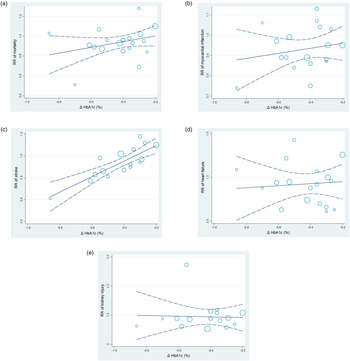
According to the trial-level linear regression analyzes (Table 1; Figure 1), there were no statistically significant associations between the mean difference in the HbA1c level and the relative risk of mortality (p = .156; R = .339; 95 percent CI −.136 to .687), myocardial infarction (p = .428; R = .199; −.295 to .609), heart failure (p = .755; R = .079; −.403 to .526), and kidney injury (p = .892; R = −.037; −.523 to .467), but between the mean difference in the HbA1c level and the relative risk of stroke (p < .001; R = .811; .541 to .929). Similar results were observed in the sensitivity analysis between the mean difference in the HbA1c level and the log-transformed relative risk for the clinical outcome (Supplementary Table 5).
Association between the effects of treatment on the HbA1c level (mean difference) and clinical outcomes (relative risk): graphs of weighted linear regression analysis at the RCT level. (a) Mortality, (b) myocardial infarction, (c) stroke, (d) heart failure, and (e) kidney injury. Abbreviations: RR, relative risk; Δ, mean difference. The area of the bubbles is proportional to the number of patients. The solid line is the prediction and the long dashed lines are the 95 percent prediction limits.

Association between treatment effects on the HbA1c level (mean difference) and clinical outcomes (relative risk): results of weighted linear regression analysis at the RCT level

RR, relative risk; α, intercept; β, weighted linear regression coefficient; 95% CI, 95 percent confidence interval; LL, lower limit; UL, upper limit; R 2, coefficient of determination; R, Pearson's correlation coefficient; HbA1c, glycated hemoglobin.
The association between treatment effects on HbA1c level and clinical outcomes according to drug class could not be assessed due to insufficient number of RCTs (n < 10).
Validity of HbA1c as a Surrogate Outcome
According to the cut-off points proposed by the IQWiG, none of the evaluated associations was strong enough to validate HbA1c as a surrogate outcome that reliably predicts a clinical outcome (Table 1). There was a lack of validity for mortality, myocardial infarction, heart failure and kidney injury, and uncertainty in the validity for the stroke outcome.
Discussion
The present study aimed to investigate whether HbA1c is a valid surrogate for evaluating the effectiveness of antihyperglycemic drugs in DM trials. Using data from placebo-controlled RCTs (n = 19) (Reference Dormandy, Charbonnel, Eckland, Erdmann, Massi-Benedetti and Moules19–Reference Marso, Daniels, Brown-Frandsen, Kristensen, Mann and Nauck41) and trial-level linear regression analysis, the findings of this study show that a reduction in HbA1c does not reliably predict a reduction in the relative risk of mortality, myocardial infarction, stroke, heart failure, and kidney injury in type 2 DM (DM2) trials. Even though a statistically significant association was found between stroke and HbA1c, the strength of the association did not reach the cut-off point established for HbA1c to be considered a valid surrogate (lower limit of 95 percent CI of R greater than or equal to .85). Regarding type 1 DM, no studies were identified that made it possible to assess the validity of HbA1c as a surrogate outcome.
Regarding the associations between the treatment effects on HbA1c (measured through the mean change between groups) and the treatment effect on clinical outcomes (measured through the RR) in DM2 studies, the results of the present study are consistent with those described in the literature. Through a comprehensive search for systematic reviews, we identified two recently published reviews by Giugliano et al. (Reference Giugliano, Bellastella, Longo, Scappaticcio, Maiorino and Chiodini15) and Huang et al. (Reference Huang, Wang, Sung, Chen, Lip and Cheng16). Both studies evaluated the association between HbA1c reduction and the relative risk of clinical outcomes in placebo-controlled RCTs with antihyperglycemic drugs, including DPP-4i, GLP-1RA, and SGLT-2i. The reviews included fifteen and ten RCTs, respectively. Both studies reported a statistically significant association between treatment effects on HbA1c and stroke (p < .05), but not between treatment effects on HbA1c and mortality, myocardial infarction, and hospitalization for heart failure. However, unlike our study, none of these studies reported the 95 percent confidence intervals of the R for stroke; therefore, it was not possible to know whether their results differed from those of this study with respect to the validation of HbA1c as a surrogate outcome using specific criteria to judge its predictive capacity, such as those proposed by IQWiG.
Regarding the treatment effects, it is important to note that even though all drugs reviewed in this study showed a reduction in HbA1c after 52 weeks of treatment or more, some of them did not show any benefit in terms of the clinical outcomes of interest, and even others showed a significant increase in the risk of the same. For example, alogliptin (DPP-4i), lixisenatide (GLP-1RA), sitagliptin (GLP-1RA), linagliptin (DPP-4i), and omarigliptin (DPP-4i) showed no effects on mortality, myocardial infarction, stroke, heart failure, and kidney injury; pioglitazone (thiazolidinedione) and saxagliptin (DPP-4i) showed a statistically significant increase in the risk of heart failure and no effect on other clinical outcomes of interest; and aleglitazar (PPARa) showed a statistically significantly increased risk of kidney injury and no effect on other clinical outcomes. Furthermore, although some of the included studies showed treatment effects of antihyperglycemic drugs in patient-relevant clinical outcomes, such as mortality and heart failure, it cannot be assumed that the HbA1c reduction was the mechanism of action that lead to a favorable effect on the clinical outcomes. In fact, treatment effects on clinical outcomes could be explained by mechanisms of action other than the glycemic effect. For example, it has been described that, for the specific case of SGLT-2i, a decrease in blood pressure, a decrease in intraglomerular pressure, a reduction in albuminuria, and an improvement in volume overload could represent plausible protective mechanisms for their benefit on cardiovascular outcomes (Reference Giugliano, Maiorino, Longo, Bellastella, Chiodini and Esposito42;Reference Verma and McMurray JJ43). Many reasons for failure of surrogate outcomes have been described. According to Fleming et al. (Reference Fleming44), these include the possibility that the surrogate is not in the causal pathway of the disease process, the disease process could affect the clinical outcome through several causal pathways, with the intervention affecting only the pathway mediated through the surrogate, and the intervention exert effects outside the disease process that can have unmeasured harms or benefits on clinical outcomes.
The implications of our results have to do with the use of HbA1c as a surrogate and effectiveness outcome in DM studies. Similar to the conclusions reported by authors who investigated the relationship between intensive glycemic control (HbA1c levels around 7 percentage) and diabetic complications (Reference Boussageon, Pouchain and Renard5;Reference Rodriguez-Gutierrez and Montori10;Reference Bejan-Angoulvant, Cornu, Archambault, Tudrej, Audier and Brabant11), this study did not find a high level of confidence that changes in HbA1c consistently predict the desired clinical outcomes in DM. Therefore, it is considered pertinent that future trials evaluating antidiabetics drugs, rather than assuming effectiveness based on a reduction in HbA1c, demonstrate benefits in terms of clinically relevant outcomes from the patient's perspective, such as the clinical outcomes assessed in this review (mortality, myocardial infarction, stroke, heart failure, and/or kidney injury), as well as a clinically favorable risk-benefit ratio. This is feasible, considering that some drug regulatory agencies with international impact, such as the US Food and Drug Administration (FDA), have required pharmaceutical companies since 2008 to demonstrate that new antidiabetics do not increase the risk of cardiovascular events; which implies that clinical trials are carried out with long follow-ups and large samples (45). Although all the DM studies included in this analysis used cardiovascular or renal outcomes as primary outcomes, the main objective was to demonstrate that antihyperglycemic drugs did not increase the risk of these events. Therefore, even if they did not demonstrate to reduce the risk in these outcomes, they were authorized by the FDA for marketing given their effects on reducing HbA1c. However, it is remarkable that, even for antihyperglycemic drugs that showed an increased risk of heart failure and no effect on other clinical outcomes, such as saxagliptin, the FDA has authorized its use to improve glycemic control. This is of crucial importance, as it shed doubts regarding the safety of some DM drugs that are being licensed, with no proven benefits in terms of prolonging overall survival, reducing morbidity, or improving quality of life.
As the predictive capacity of HbA1c remains unclear, therapeutic decisions should be based on the risk-benefit ratio of each antihyperglycemic drug, in terms of patient-oriented clinical outcomes such as mortality, morbidity, adverse effects, and health-related quality of life. In addition, patients should be informed about the evidence supporting the use of antihyperglycemic drugs and, in particular, about the absence of evidence of effectiveness and the increased risk of cardiovascular events associated with some of them, despite showing a reduction in HbA1c levels. Regarding the usefulness of HbA1c as a therapeutic target, some authors have advised against using an HbA1c value only as a therapeutic target in the absence of information on the relationship between HbA1c and mean blood glucose in each individual (Reference Ikeda and Shimazawa46). This is because there is some evidence suggesting that factors other than glucose concentration affect glycation of hemoglobin, thus questioning the validity of HbA1c as a surrogate for mean blood glucose (Reference Ikeda and Shimazawa46). However, more research is still required to determine the ability of different glycemic parameters to predict changes in final outcomes in DM (Reference Alfieri, Myasoedova, Vinci, Rondinelli, Songia and Massaiu47).
The main limitation of this study was the use of trial-level data rather than patient-level data which would allow a more robust analysis. Besides, it should be noted that it was not possible to assess the associations between treatment effects on HbA1c and clinical outcomes according to antihyperglycemic drug classes due to insufficient data. Furthermore, considering that the associations evaluated were mainly based on studies carried out with DPP-4i, SGLT-1i, and GLP-1RA, it is not possible to extrapolate this information to other classes of drugs for DM. Similarly, given that the studies were conducted in patients with DM2 and cardiovascular disease risk factors, it is not possible to extrapolate the findings of this study to groups of patients with different characteristics. Another limitation includes the use of different definitions regarding the clinical outcomes evaluated, and in particular, for the outcome of kidney injury, since this was generally evaluated through composite outcomes that included different individual outcomes of functional impairment. These differences in definitions could affect the estimated association for this outcome.
Regarding the strengths of this study, there are different points that increase the reliability in the analysis carried out. First of all, it should be noted that only RCTs with follow-up longer than 1 year and with populations of more than 1,000 patients were included, which increases the chances of detecting treatment effects on clinical outcomes. For example, some of the included studies (EXSCEL, PIONEER-6, EMPA-REG OUTCOME, and LEADER) showed statistically significant reductions in the risk of death only after 1.3 to 3.8 years of follow-up. Second, the populations of the studies selected for the analysis presented similar characteristics; they were all adult patients with DM2 and risk factors for cardiovascular disease, with 7 to 16 years of disease duration, baseline HbA1c levels that ranged between 7 and 9 percentage, and average age of 60 to 66 years. This reduces clinical heterogeneity between studies. Third, the present review used an approach to validate surrogates widely used in validation studies for other etiologies (Reference Blumenthal, Karuri, Zhang, Zhang, Khozin and Kazandjian48–Reference Johnson, Liauw and Lassere50) and by health technology assessment agencies around the world, including the ones that make up the European Network for Health Technology Assessment (EUnetHTA) (3;4). This approach, initially proposed by Buyse et al. (Reference Buyse, Molenberghs, Burzykowski, Renard and Geys1), emphasizes the need to demonstrate a strong correlation between a surrogate and a clinical outcome with data from multiple RCTs before replacing a clinical outcome with a surrogate and assuming clinical benefit. Although the most reliable approach includes performing analyzes at the individual level (Reference Ciani, Buyse, Drummond, Rasi, Saad and Taylor2), it is not common for pharmaceutical companies, who have access to individual data, to publish studies that allow the validation of surrogate outcomes with individual data. In addition, regarding the cut-off point to demonstrate the validity of a surrogate, although there is no consensus on the correlation values (R) and the associated 95 percent CIs, values between .85 and .95 are often considered (3), a range that includes the value proposed by the IQWiG of Germany, which was used in the present study.
Conclusion
In conclusion, the evidence from multiple placebo-controlled RCTs with antihyperglycemic drugs in patients with DM2 shows that a reduction in HbA1c does not meet IQWiG criteria to be considered a consistent predictor of clinical benefit, in terms of clinically relevant outcomes from the patient's perspective, such as mortality, myocardial infarction, stroke, heart failure, and kidney injury. This is because a strong correlation was not shown between treatment effects on HbA1c and the clinical outcomes of interest. Furthermore, despite the fact that all the drugs analyzed lowered HbA1C levels, many of them had no effect on clinical outcomes of interest and some even increased the risk of harm, such as heart failure or kidney injury. No studies were identified that would allow validating HbA1c as a surrogate of clinical outcomes in type 1 DM. Consequently, evidence does not support the use of HbA1c as a surrogate outcome to measure effectiveness of antihyperglycemic drugs in DM studies. As the surrogacy of HbA1c remains uncertain, the risk-benefit ratio of each antidiabetic drug, in terms of patient-relevant clinical outcomes, should be the key point of therapeutic, regulatory, and reimbursement decisions, regardless of its hypoglycemic effect.
Further studies are needed to investigate the validity of HbA1c as a surrogate for clinical outcomes in DM using patient-level data from multiple RCTs. Additional empirical evidence from observational studies would also help to assess the association between HbA1c and the clinical outcomes of interest independently of treatment effects. Lastly, the scientific community has an opportunity to generate more data that can assess the predictive ability of glycemic control (i.e., HbA1C less than 7) as a measure of the risk of clinical outcomes, and the same for other potential surrogates in DM, such as blood glucose, fructosamine, glycated albumin, and blood pressure.
Supplementary material
The supplementary material for this article can be found at https://doi.org/10.1017/S0266462321001689.
Authors’ Contributions
Paola Andrea Rivera: Conceptualization, methodology, formal analysis, investigation, writing – original draft, project administration. Milton J. M. Rodríguez-Zúñiga: Investigation, writing – review and editing. José Caballero-Alvarado: Methodology, writing – review and editing. Fabián Fiestas: Conceptualization, methodology, writing – review and editing.
Funding
This research received no specific grant from any funding agency, commercial, or not-for-profit sectors.
Conflict of Interest
The authors declare that they have no known competing financial interests or personal relationships that could have appeared to influence the work reported in this paper.