Introduction
Campylobacter spp. cause more cases of bacterial food-borne illness each year than any other bacterial pathogen worldwide (Schönberg-Norio et al., Reference SCHÖNBERG-NORIO, SARNA, HÄNNINEN, KATILA, KAUKORANTA and RAUTELIN2006; Jonsson et al., Reference JONSSON, HEIER, NORSTROM and HOFSHAGEN2010) and is the most commonly reported food-borne disease in industrial countries (Mylius et al., Reference MYLIUS, NAUTA and HAVELAAR2007).
Several international epidemiological studies have established the link between the consumption of poultry meat and campylobacteriosis (Wingstrand et al., Reference WINGSTRAND, NEIMANN, NIELSEN, GERNER-SMIDT, WEGENER and MOLBAK2006).
In 2006 within New Zealand, the notification rate for campylobacteriosis was 384 per 100,000, thus an increase of 56% from 2001 and 14% since 2005 (NZPHO, 2007). New Zealand epidemiological studies have indicated the same link (French, Reference FRENCH2008a) and the high level of prevalence and contamination of poultry meat (80-100%) with Campylobacter (French, Reference FRENCH2008b) and the increase in consumption of poultry concomitant with the increase in rate of reported campylobacteriosis, all indicate fresh chicken as the main risk factor for campylobacteriosis. It has been reported that New Zealand Campylobacter strains differ genetically from international strains. The subtypes isolated in New Zealand have not been identified previously on other international databases (McKenzie, Reference MCKENZIE2006). Therefore, it is possible that local strains have greater heat tolerance and thus are better able to survive cooking. Moreover, the remarkably high D value for C. jejuni reported in The Netherlands (D100°C value of about 2 min; De Jong et al., Reference DE JONG, VAN ASSELT, ZWIETERING, NAUTA and DE JONGE2008) may indicate the emergence of heat resistant strains. Therefore, it is important that the current knowledge of thermal process lethality of New Zealand and international Campylobacter spp. is updated and expanded. In the following review, the pathogen survival characteristics in the environment and its heat resistance are discussed in order to provide reliable data for decision makers (such as government authorities), industry, consumer and researchers in New Zealand and abroad.
The pathogen
The majority of Campylobacter spp. are motile, possess a single flagellum at one or both poles and are micro-aerophilic. The genus Campylobacter has changed dramatically since its inception in 1963 (Sebald and V'Eron, Reference SEBALD and V'ERON1963) at which time the genus contained just two taxa, C. fetus and C. bubulus. At present, Campylobacter contains 16 species and six subspecies (Bergey et al., Reference BERGEY, BOONE, CASTENHOLZ, BRENNER, KRIEG, STALEY and GARRITY2001). Most human illness is caused by one species, C. jejuni, but 1-5% of human Campylobacter cases are caused by other species. C. jejuni and C. coli are considered the major species threatening public health in New Zealand (Lake et al., Reference LAKE, HUDSON, CRESSEY and NOTRJE2003); C. upsaliensis and C. lari are less common species. C. jejuni is a gram-negative, slender, curved, and motile rod. It contains two subspecies that differ substantially in their ubiquity and to some extent ecology. C. jejuni subspecies jejuni is often simply referred to as C. jejuni and represents the taxon first reported by Jones et al. (Reference JONES, ORCUTT and LITTLE1931) as Vibrio jejuni from bovine intestinal contents. Its prevalence in food animals makes it one of the most important food-borne pathogens today. Many studies (Wassenaar and Newell, Reference WASSENAAR and NEWELL2000; Dingle et al., Reference DINGLE, COLLES, WAREING, URE, FOX, BOLTON, BOOTSMA, WILLEMS, URWIN and MAIDEN2001) have stated its genetic diversity with a range of phenomena determining its genomic plasticity.
survival and growth of C. jejuni in the environment
Campylobacter spp. are harboured in many wild and domestic warm-blooded animals (Adams and Moss, Reference ADAMS and MOSS2000) and the pathogen does not survive well outside the gut nor does replication occur readily (Ketley, Reference KETLEY1997). Most literature reports the best range for growth as 37- 43°C with 42°C as the optimum, similar to chicken body temperature (FDA/CFSAN, 2000; Lake et al., Reference LAKE, HUDSON, CRESSEY and NOTRJE2003; CFSAN, 2008). Over the years, various studies have been targeted at this to determine the environmental conditions necessary for growth and survival.
Laboratory studies suggest that Campylobacter spp. are unable to grow in the presence of elevated levels of oxygen (above 5% O2), they are difficult to multiply outside the animal host and are highly sensitive to environmental conditions such as drying, acidity, salting, freezing, chlorination, osmotic stress and pressure (Park, Reference PARK2005). Consequently, the organism is reported to survive only for up to six hours on hands and moist surfaces (Humphrey et al., Reference HUMPHREY, MARTIN, SLADER and DURHAM2001; De Cesare et al., Reference DE CESARE, SHELDON, SMITH and JAYKUS2003). Moreover Campylobacter is a poor competitor against other organisms in typical environment (Corry et al., Reference CORRY, POST, COLIN and LAISNEY1995). However, the pathogen can survive and remain in a viable but non-culturable state for up to four months at 4°C (Rollins and Colwell, Reference ROLLINS and COLWELL1986). Hazeleger et al. (Reference HAZELEGER, WOUTERS, ROMBOUTS and ABEE1998) reported catalase activity, ATP generation, oxygen consumption, chemotaxis, and protein synthesis for the pathogen at the same temperature. Its viability at -20 and -70°C, for 14 days and 56 days respectively, has been confirmed (Lee et al., Reference LEE, SMITH and COLOE1998). Campylobacter spp. survival at low temperature remains poorly understood and further research is required.
Atmosphere
Campylobacter strains survive well in modified atmosphere and vacuum packaging but poorly at atmospheric oxygen (21%) concentrations (Kelly, Reference KELLY2008). The optimum atmosphere or gas composition for growth has been reported as, 5% O2, 10% CO2 and 85% N2 (ICMSF, 1996). Studies investigating the growth of Campylobacter spp. under different gas compositions have used different techniques (Koidis and Doyle, Reference KOIDIS and DOYLE1983; Grigoriadis et al., Reference GRIGORIADIS, KOIDIS, VARELTZIS and BATZIOS1997).
Water activity
Campylobacter is sensitive to drying and its survival is dependent on the suspending substrate, the temperature and the extent of drying (ICMSF, 1996). The pathogen does not survive long in less moist environments in comparison to Salmonella spp. and E. coli. For example, Campylobacter spp. survived poorly on dishes with organic matter whereas Salmonella spp. survived for 24 hours and E. coli for even longer (Humphrey et al., Reference HUMPHREY, MASON and MARTIN1995; Mattick et al., Reference MATTICK, DURHAM, DOMINGUE, JØRGENSEN, SEN, SCHAFFNER and HUMPHREY2003).
Temperature
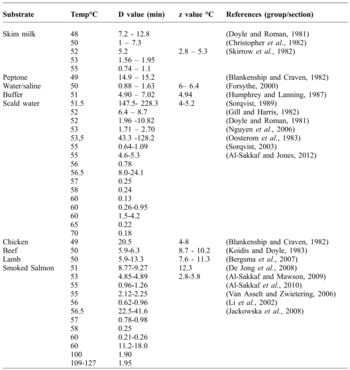
The organism cannot grow below 30°C (Jacobs-Reitsma, Reference JACOBS-REITSMA2000; Downes and Ito, Reference DOWNES and ITO2001) meaning it should not multiply during food processing or storage at typical ambient temperature or sub-ambient temperature. However, it survives in food better under refrigeration than at ambient temperature (ICMSF, 1996). It grows only slowly at the optimum temperature (42°C) in the laboratory, and it typically takes 48 hours for colony formation on agar plates. Campylobacter spp. failed to grow above 47°C (Doyle and Roman, Reference DOYLE and ROMAN1981) as a result of the irreversible denaturation of proteins, thermal breakdown of the plasma membrane and disruption of the most sensitive parts of ribosome. Information on the biological aspects and mechanisms of inactivation at a molecular level as to what takes place from a physiological and genetic perspective are not yet completely understood but current knowledge is summarised in various studies (Park, Reference PARK2002). The methods for measuring the heat resistance of food pathogens can be classified by the heating method (direct or indirect) or by the method of sampling, namely successive sampling systems or multiple replicate unit systems. The detailed characteristics of these are described in the literature (Pflug, Reference PFLUG1990; Downes and Ito, Reference DOWNES and ITO2001). Table 1 summarises the decimal reduction time (D) values and the change of temperature (°C) required to reduce the D- value by 10 fold (z) values reported for Campylobacter spp.
Thermal inactivation parameters from studies of Campylobacter heat resistance.

factors affecting heat resistance of microorganisms
Many factors are reported to have an influence on heat resistance of pathogens including between strain variation, presence of salt/acid, cell growth phase, experimental conditions (e.g. heating media directly or indirectly), cooling after heating and products or laboratory media used.
Strain variation
The diversity within Campylobacter jejuni strains is well known and has been detected at both phenotypic and genotypic levels. The number of typed strains is rapidly increasing within data banks as different typing methods (microarrays, multi-locus sequence typing system (MLST), pulsed field gel electrophoresis (PFGE), Penner and Lior and other DNA-based methods) are developed and used (Maiden et al., Reference MAIDEN, BYGRAVES, FEIL, MORELLI, RUSSELL, URWIN, ZHANG, ZHOU, ZURTH, CAUGANT, FEAVERS, ACHTMAN and SPRATT1998; Enright and Spratt, Reference ENRIGHT and SPRATT1999; Petersen et al., Reference PETERSEN, NIELSEN and ON2001; Garaizar et al., Reference GARAIZAR, REMENTERIA and PORWOLLIK2006). Different strains of Campylobacter may show different ability to resist environmental stress (ICMSF, 1996; Chan et al., Reference CHAN, TRAN, KANENAKA and KATHARIOU2001; Alter and Scherer, Reference ALTER and SCHERER2006; Habib et al., Reference HABIB, UYTTENDAELE and DE ZUTTER2010). However, few studies have addressed differences in strain behaviour under environmental stress. Chan et al. (Reference CHAN, TRAN, KANENAKA and KATHARIOU2001) reported the variation in the survival of 19 different C. jejuni isolates under temperature stress. The focus of the study was on the survival of the pathogen at low temperatures (4°C and -20°C). Similarly, Cools et al. (Reference COOLS, UYTTENDAELE, CARO, D'HAESE, NELIS and DEBEVERE2003) tested the survival of a few C. jejuni strains in drinking water and reported their recovery after 64 days at 4°C. Poultry strains survived for a longer time than human, water and bovine strains. Terzieva and McFeters (Reference TERZIEVA and MCFETERS1991) investigated the survival of C. jejuni in stream-water and the impact of strain variation. Murphy et al. (Reference MURPHY, CARROLL and JORDAN2003) suggested that the pathogen's acid tolerance may be strain dependent. The infection with Campylobacter spp. on poultry carcasses during processing is strain-dependent with the more resistant strains remaining on the carcass at the end of processing as the temperature varies during the processing (Newell et al., Reference NEWELL, SHREEVE, TOSZEGHY, DOMINGUE, BULL, HUMPHREY and MEAD2001). A study by Gill and Harris (Reference GILL and HARRIS1982) in New Zealand strains, investigated six Campylobacter spp. from human cases and six from calf and sheep and reported a D-value of less than one minute at 60°C in broth medium. Evidently poultry strains were not included and the study was conducted with the available methods, instrumentation and techniques at that time (1982) with regard to strain typing, isolation, recovery, enumeration, inactivation and incubation.
Test and experimental conditions
Test conditions have significant effects on the reported data of heat resistance. A variety of methods, used for determining heat-resistance have attempted to reduce the errors introduced by calculation of heat transfer (sample come up time calculation), sample dilution and accuracy of time and temperature measurement. Sorqvist (Reference SORQVIST1989) compared the types of test tubes for the D-value determination and found marked differences between the capillary tube and other types. The D-value obtained by test tube was up to 29 times higher than the D-value obtained by capillary tube. Similarly, Stumbo (Reference STUMBO1973) reported a lower D-value for Listeria monocytogenes by using a complete submerged system. A study by Line (Reference LINE2006) compared the type of enrichment vessels used for recovery of Campylobacter spp. Moore and Madden (Reference MOORE and MADDEN2000) compared the heat transfer properties of three flasks in order to select the best one which could be used later for their Campylobacter spp. heat sensitivity experiment and they concluded that stoppered glass diluent bottles were better than sealed glass universal bottles or plastic universal bottles in terms of their conductivity. Heat-resistance studies have used a range of equipment for heating including water baths, heating blocks, incubators, oil baths, a thermo-resistometer (Condon et al., Reference CONDON, LOPEZ, ORIA and SALA1989; Reference CONDON, ARRIZUBIETA and SALA1993), submerged–coil heating units (Cole and Jones, Reference COLE and JONES1990), temperature gradient incubators (Elsgaard and Jørgensen, Reference ELSGAARD and JØRGENSEN2002), differential scanning calorimeter (DSC) heating units (Brown, Reference BROWN1988) and Petlier units. The Petlier unit operates like a thermocouple in reverse and junctions heat or cool as the voltage changes across them. A specially designed apparatus for heating food samples was developed for the Bug Death project (Foster et al., Reference FOSTER, KETTERINGHAM, SWAIN, KONDJOYAN, HAVET, ROUAUD and EVANS2006) which had the ability of heating the surface of a food from 8 to 120°C in 14 seconds, cooling from 120 to 40°C in 28 seconds and then to 8°C in 300 seconds. Recently, a 1 ml volume aluminium cell was developed for investigating kinetics parameters (Chung et al., Reference CHUNG, BIRLA and TANG2008) and a modified thermo-resistometer with the ability to use during non-isothermal heat treatment (Conesa et al., Reference CONESA, ANDREU, FERNANDEZ, ESNOZ and PALOP2009).
Culturing media and recovery procedure
The isolation of Campylobacter spp. and the methods used for its detection are well documented (Bolton et al., Reference BOLTON, HUTCHINSON and COATES1984; Line, Reference LINE2001; Donnison, Reference DONNISON2002). Corry et al. (Reference CORRY, POST, COLIN and LAISNEY1995) listed 40 liquid and solid selective types of media used for its isolation. However, the detection and the recovery of heat-injured cells have not yet received much attention by researchers. Murphy et al. (Reference MURPHY, CARROLL and JORDAN2005) concluded that there was a direct effect of the medium used on stress and survival of C. jejuni, and suggested that studies using different media may not be comparable. In that study, Murphy et al. (Reference MURPHY, CARROLL and JORDAN2005) compared the growth of C. jejuni after acid stress in seven selected media and observed a remarkable difference in growth of C. Jejuni; up to a five log difference. Similarly, Jasson et al. (Reference JASSON, UYTTENDAELE, RAJKOVIC and DEBEVERE2007) tried to describe a procedure for sub-lethal injury for Campylobacter spp. stressed by different environmental factors (heat, cold, freeze, acid and oxidation) with comparing the number of the survival counts in selective (modified Cefoperazone Charcoal Deoxycholate Agar) and non-selective media (Columbia Blood Agar). The results showed that Campylobacter spp. contributed to the high variation in test reproducibility and repeatability. The results also demonstrated that there were more difficulties in standardisation when using Campylobacter spp. than when other pathogens were used. Habib et al. (Reference HABIB, SAMPERS, UYTTENDAELE, BERKVENS and DE ZUTTER2008) compared three selective media for Campylobacter spp. (mCCDA, Karmali agar and CampyFood ID agar) and concluded that there were minor differences between the three selective media in terms of the reproducibility and repeatability. The use of mCCDA, which is recommended by the International Organization for Standardization (ISO), has no major accuracy problems for the results obtained by using it.
Effect of pH and presence of acids
The effect of pH is dependent on the type of campylobacter strain used, suspending medium, water activity and test temperature. Generally heat resistance is at its maximum at pH 7 and decreases as the pH shifts from neutrality (ICMSF, 1996). A study (Humphrey and Lanning, Reference HUMPHREY and LANNING1987) reported the D-value was 11.5min at 52°C in scald water tank at pH 7 and it was reduced to 0.4 min and 1min when the pH was adjusted to 4 and 10, respectively. In addition, in that study (Humphrey and Lanning, Reference HUMPHREY and LANNING1987) it was reported that adjusting the scalding water tank to pH 9 significantly reduced bacterial numbers in the scalding water but not the bacterial count on the carcass. Humphrey and Cruickshank (Reference HUMPHREY and CRUICKSHANK1985) reported a lower D-value in phosphate buffer solution (0.1 M, pH 7) than in peptone water or in food (ICMSF, 1996).
Effect of age (growth phase) of microorganisms
Micro-organism cells in the stationary phase of growth are assumed to be the most resistant to heat stress (Kelly et al., Reference KELLY, PARK, BOVILL and MACKEY2001). Kelly et al. (Reference KELLY, PARK, BOVILL and MACKEY2001) indicated that Campylobacter spp. did not show more heat resistance in the stationary phase. To the contrary, it was more heat resistant in the exponential phase. However, Kelly et al. (Reference KELLY, PARK, BOVILL and MACKEY2001) was not able to explain adequately why a number of cells survived after the prolonged period of heat application of the cells in the stationary phase of growth and the variation of the total cell number. Kelly et al. (Reference KELLY, PARK, BOVILL and MACKEY2001) has related this phenomenon to the acquisition of resistance during prolonged period of stress application. However, Martinez-Rodriguez et al. (Reference MARTINEZ-RODRIGUEZ, KELLY, PARK and MACKEY2004) reported that a strain isolated from the late stationary phase showed a small increase in heat resistance over its parent.
heat resistance studies in liquid media
Many reports have been published addressing the response of Campylobacter spp. under thermal stress conditions by using broth or liquid media, summarised in Table 1. Some of these studies investigated changes in heat resistance combined with changes in pH or gas composition. Poultry meat slurry was used in modelling the combined effect of heat and high hydrostatic pressure (Lori et al., Reference LORI, BUCKOW, KNORR, HEINZ and LEHMACHERI2007). Several studies reported that Campylobacter spp. survive better under aerobic and ambient temperature in biofilms (Buswell et al., Reference BUSWELL, HERLIHY, LAWRENCE, MCGUIGGAN, MARSH, KEEVIL and LEACH1998; Tang and Schraft, Reference TANG and SCHRAFT2000; Joshua et al., Reference JOSHUA, GUTHRIE-IRONS, KARLYSHEV and WREN2006). However Trachoo and Brooks (Reference TRACHOO and BROOKS2005) claimed the heat-resistance was not affected within biofilms.
heat resistances studies in red meat and poultry
Bergsma et al. (Reference BERGSMA, FISCHER, VAN ASSELT, ZWIETERING and DE JONG2007) reported the highest D-value for C. jejuni in fried chicken fillets (1.95 min at a surface temperature ranging from 109 to 127°C). De Jong et al. (Reference DE JONG, VAN ASSELT, ZWIETERING, NAUTA and DE JONGE2008), a co-author in the study by Bergsma et al. (Reference BERGSMA, FISCHER, VAN ASSELT, ZWIETERING and DE JONG2007), confirmed these finding in an independent experiment, and reported a D-value of 1.9 min at 100°C in boiled chicken fillet. These extremely high D-values have not been confirmed by other studies in the literature. Gunsen (Reference GUNSEN2008) could not detect any colonies of Campylobacter spp. after cooking artificially inoculated chicken drumsticks for three and five minutes to a core temperature of 70°C and 80°C respectively, in an oven at 200°C. However Sampers et al. (Reference SAMPERS, HABIB, DE ZUTTER, DUMOULIN and UYTTENDAELE2010) found that the 4.5 log cfu/g of C. jejuni in inoculated chicken burgers was reduced to below the detectable level (<10 cfu/g) after four minutes of frying with the internal temperature of 57.5°C. The 2.5 log cfu/g of naturally contaminated chicken burgers was reduced to below the detectable level after four minutes frying, with an internal temperature of 52.1°C. Meatballs artificially inoculated with 5 log cfu/g, was cooked in a deep fryer (180°C; for one, two or three minutes, with the lowest core temperature being 72.1°C); on a grill (for four, eights and 12 minutes) and in an oven (200°C; for five, 10 and 15 minutes with the highest core temperature being 98.4°C). For each method of cooking, C. jejuni was not detected in the meatballs after cooking (Bostan, Reference BOSTAN2001).
A few studies targeted the effect of scalding water temperature on the contamination level of poultry carcases (sprayed with 2.5 ml of inocula containing 103-104 CFU/ml) and their results indicated reductions of only 1-1.4 log for scalding temperatures 52, 56 and 60°C and contact time 2, 1.5 and 1 minute respectively (Slavik et al., Reference SLAVIK, KIM and WALKER1995). Yang et al. (Reference YANG, LI and JOHNSON2001) reported a reduction up to 2 log while Guerin et al. (Reference GUERIN, SIR, SARGEANT, WADDELL, O'CONNOR, WILLS, BAILEY and BYRD2010) reported a reduction by 1.3 to 2.9 cfu/g after scalding in a commercial scalding operation at temperatures ranging usually from 49-62°C for 90 to 220 seconds for the poultry processing plants studies reviewed in his paper.
Several studies examined the treatment of poultry carcasses by immersion or spraying of hot water, or steam treatment to reduce the contamination level. The reduction in the carcass contamination level was again up to 2 log (Purnell et al., Reference PURNELL, MATTICK and HUMPHREY2004; Cox et al., Reference COX, RICHARDSON, BAILEY, COSBY, CASON, MUSGROVE and MEAD2005; Corry et al., Reference CORRY, JAMES, PURNELL, BARBEDO-PINTO, CHOCHOIS, HOWELL and JAMES2007). Further challenge test studies for the pathogen were conducted with poultry (Acuff et al., Reference ACUFF, VANDERZANT, HANNA, EHLERS and GARDNER1986; Lee et al., Reference LEE, SMITH and COLOE1998). The survival of Campylobacter spp. during poultry scalding and chilling was reported (Yang et al., Reference YANG, LI and JOHNSON2001), and their survival has been studied in red meat (Barrell, Reference BARRELL1984; Hanninen et al., Reference HANNINEN, KORKEALA and PAKKALA1984), pork skin (Bracewell et al., Reference BRACEWELL, REAGAN, CARPENTER and BLANKENSHIP1985) and butter (Zhao et al., Reference ZHAO, DOYLE and BERG2000). Since the peak campylobacteriosis notification rate in 2006, there has only been one New Zealand study investigating the cooking time and temperature required to eliminate naturally contaminated livers (Whyte et al., Reference WHYTE, HUDSON and GRAHAM2006). The results of that study showed that the total elimination of 4 log cfu/liver can be achieved by the pan frying method if the internal temperature was in excess of 70° and was held at this temperature for two to three minutes.
the latest heat resistance studies
The thermal inactivation kinetic parameters (D and z) for the tested NZ strains of C. jejuni isolated from both humans and poultry were obtained by a broth experiment and did not indicate that the most implicated strains in human cases were more heat resistant than the international strains recorded in internationally published data (Al-Sakkaf and Jones, Reference AL-SAKKAF and JONES2012). Fitting the survival curves of the tested NZ strains in broth or food matrix to different models, or using the one step regression analysis, did not alter the fact that New Zealand tested strains are heat sensitive. Moreover, New Zealand strains were, to some extent, more heat sensitive than most of the international C. jejuni strains (Al-Sakkaf and Jones, Reference AL-SAKKAF and JONES2012). The D values for all New Zealand isolates at 60°C (1.5 to 4.2 seconds), and shown in Table 1, are slightly lower than the minimum D-value of the published international isolates which range from seven to 23 seconds (Sorqvist, Reference SORQVIST1989; ICMSF, 1996). Similarly, the z values calculated for all isolates by Al-Sakkaf and Jones’ study, ranging from 4.0 to 5.2°C are within the range of the published z-values of 2.8 to 5.8°C (Li et al., Reference LI, YANG and SWEM2002; Sorqvist, Reference SORQVIST2003; Jackowska et al., Reference JACKOWSKA, SZCZAWIŃSKI, PE¸CONEK and FONBERG-BROCZEK2008). The results obtained for the tested New Zealand strains using chicken skin under isothermal conditions (Al-Sakkaf and Mawson, Reference AL-SAKKAF and MAWSON2009; Al-Sakkaf et al., Reference AL-SAKKAF, JONES and MAWSON2010) are in agreement with most of the published international data. The D and z values obtained by the skin experiment at 60°C are two to five times higher than the values obtained by the broth experiment; 11 to 18 seconds and 8 to 11°C, respectively. It is obvious that the presence of a food matrix altered the kinetic parameters for Campylobacter spp. heat resistance (Stumbo, Reference STUMBO1973; Yang et al., Reference YANG, LI and JOHNSON2001), but the increase in the D-values was not a significant increase as was reported in the Netherlands (Bergsma et al., Reference BERGSMA, FISCHER, VAN ASSELT, ZWIETERING and DE JONG2007; De Jong et al., Reference DE JONG, VAN ASSELT, ZWIETERING, NAUTA and DE JONGE2008).
Recently Sampers et al. (Reference SAMPERS, HABIB, DE ZUTTER, DUMOULIN and UYTTENDAELE2010) with a similarly set-up experiment as Bergsma's study and using frying chicken fillets, found that levels of 4.5 log cfu/g of C. jejuni inoculated into chicken burgers was reduced to below the detectable levels (<10cfu/g) after four minutes of frying at an internal temperature of 57.5°C, and that 2.5 log cfu/g of naturally contaminated chicken burger reduced to below the detectable level after four minutes of frying at the internal temperature of 52.1°C. Although the objective of their trial was not to determine the kinetic parameters (D and z) for their complexity within the experimental design used in the study, the results obtained were valuable for determining the minimum time and the internal cooking temperature required to eliminate the contamination level, and are in agreement with the conclusion of this study regarding the heat sensitivity of C. jejuni in general. It is assumed that the results obtained in the Netherlands need further investigation. One of the Netherlands study (Bergsma et al., Reference BERGSMA, FISCHER, VAN ASSELT, ZWIETERING and DE JONG2007), stated the limitations which has caused variations in the survival data and, consequently, the scientific interpretation of such study has become questionable. The other study (De Jong et al., Reference DE JONG, VAN ASSELT, ZWIETERING, NAUTA and DE JONGE2008) from the Netherlands has not yet been published in any peer reviewed journal and was presented only as a poster in a conference. Moreover, a study by Gunsen (Reference GUNSEN2008) found that baking a chicken drumstick for three or five minutes at the core temperature of 80°C and 70°C respectively eliminated all Campylobacter spp. viable cells. Additionally, the results obtained under dynamic conditions of D and z values for New Zealand strains (Al-Sakkaf et al., Reference AL-SAKKAF, JONES and MAWSON2010) are broadly in agreement with the published international isothermal data and with our isothermal data obtained for the same isolates previously under isothermal conditions. They do not indicate that New Zealand Campylobacter spp. are more heat resistant than other strains. The obtained D-values and the z-values under dynamic conditions for C. jejuni were the first reported values in the scientific literature, due to the mathematical complexity of the calculations involved and the instruments required for conducting such experiments. These results confirm that the tested New Zealand C. jejuni strains did not have unusual heat resistance, and the high rate of campylobacteriosis in New Zealand was not associated with the emergence of more heat resistant strains. This finding has a significant impact for the poultry industry, regulators, consumers and researchers, as it has revealed the scientific evidence to maintain the standards for heat treatment practices at the plant, food services and in homes. The change of heat treatment practice can cause unpredicted losses to the poultry industry and challenges the regulatory bodies to convey the message of altering consumers’ cooking temperature to all consumers within a short time, given the reluctance of New Zealand consumers to use thermometers to verify the cooking temperature at home (Gilbert et al., Reference GILBERT, WHYTE, BAYNE, PAULIN, LAKE and VAN DER LOGT2007).
Conclusions
Due to the increase of notified cases of campylobacteriosis in New Zealand and internationally it is necessary to develop a strategy to protect consumers and lower the rate of human illness associated with Campylobacter spp. This strategy will identify the appropriate steps within the production to consumption chain to target interventions (Al-Sakkaf, Reference AL-SAKKAF2013a) . Consumers play an important role in making certain the food they prepare, handle and serve is safe. Consumers can take steps to prevent cross contamination. Cross-contamination is also considered as the major factor in the transmission of campylobacteriosis and becomes the most critical food handling practice (Nauta et al., Reference NAUTA, FISCHER, VAN ASSELT, DE JONG, FREWER and DE JONGE2008; Al-Sakkaf, Reference AL-SAKKAF2012). Therefore, it is believed that improper food handling practices contribute to at least 40–60% of cases of food-borne illness (Humphrey et al., Reference HUMPHREY, MARTIN, SLADER and DURHAM2001; Cogan et al., Reference COGAN, SLADER, BLOOMFIELD and HUMPHREY2002). A New Zealand analysis of gastroenteritis disease outbreaks for the period of 1998 to 2000 revealed that 39.3% of the cases were acquired at home (Gilbert et al., Reference GILBERT, WHYTE, BAYNE, PAULIN, LAKE and VAN DER LOGT2007). Another New Zealand study reported that about 30% of the study participants reported food-borne illness in 2007. In the years 2003 and 2005 about 20% of the participants experienced food-borne illness. It is obvious that the provision of insights into the cross contamination contribution to the high notification rate in New Zealand, understanding of the relationship between consumer knowledge, attitudes and food handling practices, and discussing the discrepancy between the predicted consumer behaviour and the observed behaviour are the key issues in addressing the campylobacteriosis epidemic in New Zealand (Al-Sakkaf, Reference AL-SAKKAF2012; Al-Sakkaf, Reference AL-SAKKAF2013b). Moreover, investigation of the best hygiene measures, such as hand washing and other practices, to prevent cross contamination during preparation of food are vital to provide public health, risk managers and regulatory authorities with the scientific support for health promotion plans that will discourage consumers’ risky, unsafe food preparation practices (Al-Sakkaf, Reference AL-SAKKAF2012). Laws and regulations cannot enforce controls and measures to prevent unsafe practices at home, as is the case for commercial food processors and retailers. Thus, the only possibility to change consumers’ risky practices is by educating consumers about food hygiene.