On September 19, 2010, the Business Cycle Dating Committee of the National Bureau of Economic Research (NBER) met by conference call and determined that the “Great Recession” that had begun in December 2007 had ended in June 2009. While the NBER Committee was careful to note that its members “did not conclude that economic conditions since that month have been favorable or that the economy has returned to operating at normal capacity,” they did conclude that the American economy was recovering from the longest recession since the Second World War.Footnote 1
Several months later, a March 2011 report from the Bureau of Labor Statistics (BLS) found that approximately 90 percent of the jobs that had been created in the preceding year, during the NBER-declared “recovery,” had gone to men.Footnote 2 In other words, what the NBER had called a recovery had been, up to that point, what journalists came to call a “hecovery,” with benefits going primarily to men. Moreover, because cuts in public sector employment (which accounts for a disproportionate share of jobs held by women and African Americans) continued well after the recovery was said to have begun, by some indicators both women and people of color fared worse after the economic crisis of the Great Recession had “officially” ended.Footnote 3
Read in tandem, the NBER and BLS reports provide a window into several key issues at stake in the relationships among power, normativity, and the politics of economic “crises.” Most broadly, juxtaposing the reports raises questions about the official and unofficial indicators that political elites use to identify “crises,” defined here as bad things that are framed as potential crossroads worthy of national attention or as emergencies that demand swift and decisive action to avert disaster.Footnote 4 The reports also raise questions about the ways in which gendered and racialized inequalities are implicated in these definitions, and about how this imbrication works to define some “bad times” as “economic crises” even as others—particularly the ongoing and quotidian economic inequalities endured by marginalized populations—typically are not. Finally, considering the two reports together draws our attention not only to the framings and constructions of economic bad times and crises, but also to the ways in which gendered and racialized norms and expectations regarding income inequality and labor force participation shape ideas about solutions to economic problems and assumptions about how we can tell that crises are over and that times are once again “good.”
A full conceptual, theoretical, or empirical treatment of these questions is impossible in this short essay, and the topics that I raise here do not, by any means, represent an exhaustive list of the many important issues at stake in the relationships among race, gender, and economic crises. Rather than suggest a comprehensive theoretical approach to the theme or a novel framework of analysis that synthesizes and fills lacunae in the many relevant literatures, I offer here an indication of what such an approach might reveal about some of the factors that serve to normalize some “bad things” while constructing others as crises. In particular, I suggest that the very notion of economic crisis relies on assumptions and practices that reflect, reproduce, and constitute prevailing attitudes and normative expectations about racialized and gendered labor and economic inequalities.
To these ends, I begin below with a brief discussion of crisis as a political concept, focusing in particular on its relationship to racialized and gendered inequalities. I then address the three constellations of questions I identified above through brief explorations of three economic crises—the Great Depression, the Great Recession, and the mortgage crisis. (The very names we conventionally use to describe these episodes expose the nature and extent of their social constructions.) Each of these crises, I argue, reveals different facets of the ways in which the power, normativity, and privilege of those perceived to be affected by economic hard times serve to construct some economic troubles as normal and others as crises; to prevent economic problems related to structural inequalities from being treated as crises by dominant political actors and institutions; and to shape ideas about the ostensible solutions to and conclusions of economic crises. By calling attention to these features of economic crisis, I aim to demonstrate the relevance of the extensive scholarship on race, class, gender, sexuality, and intersectionality to fundamental questions of contemporary politics and political economy that scholars do not typically view through this lens. I hope that the thoughts I offer will stimulate constructive engagement on these issues among political science scholars from a wide range of perspectives.
Crisis as a Political Concept
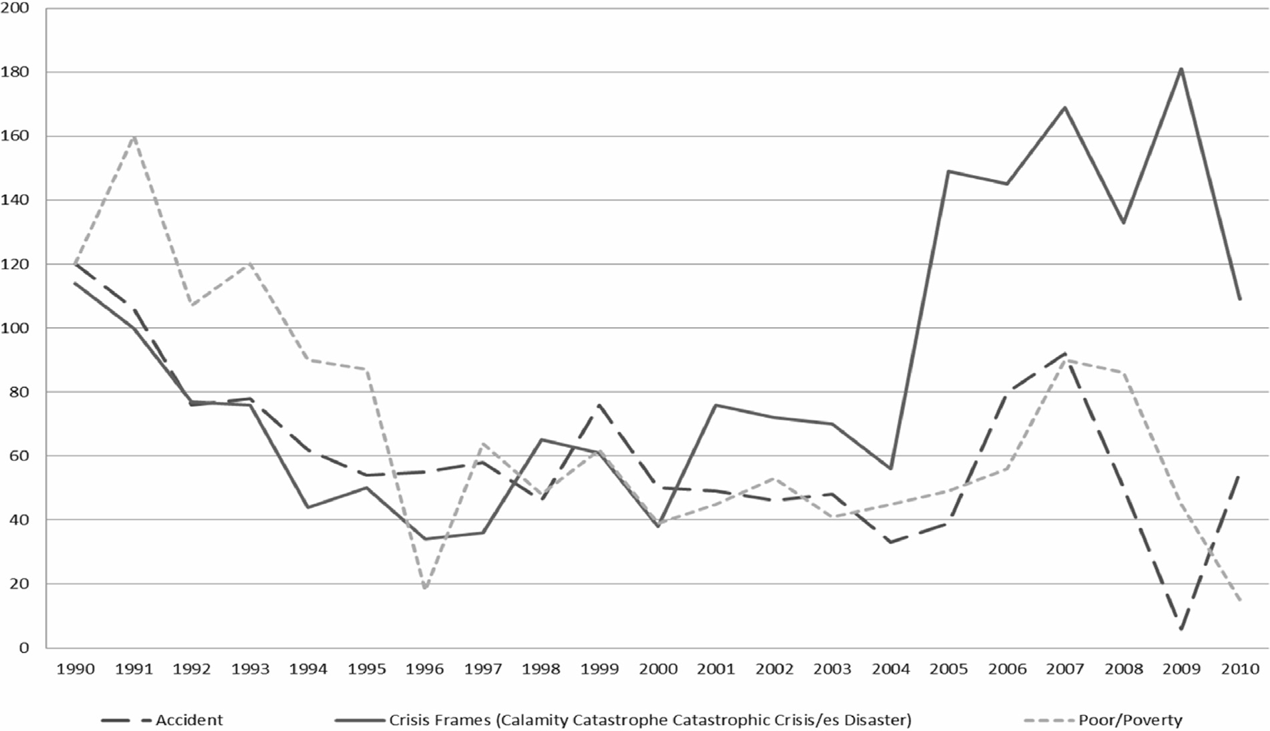
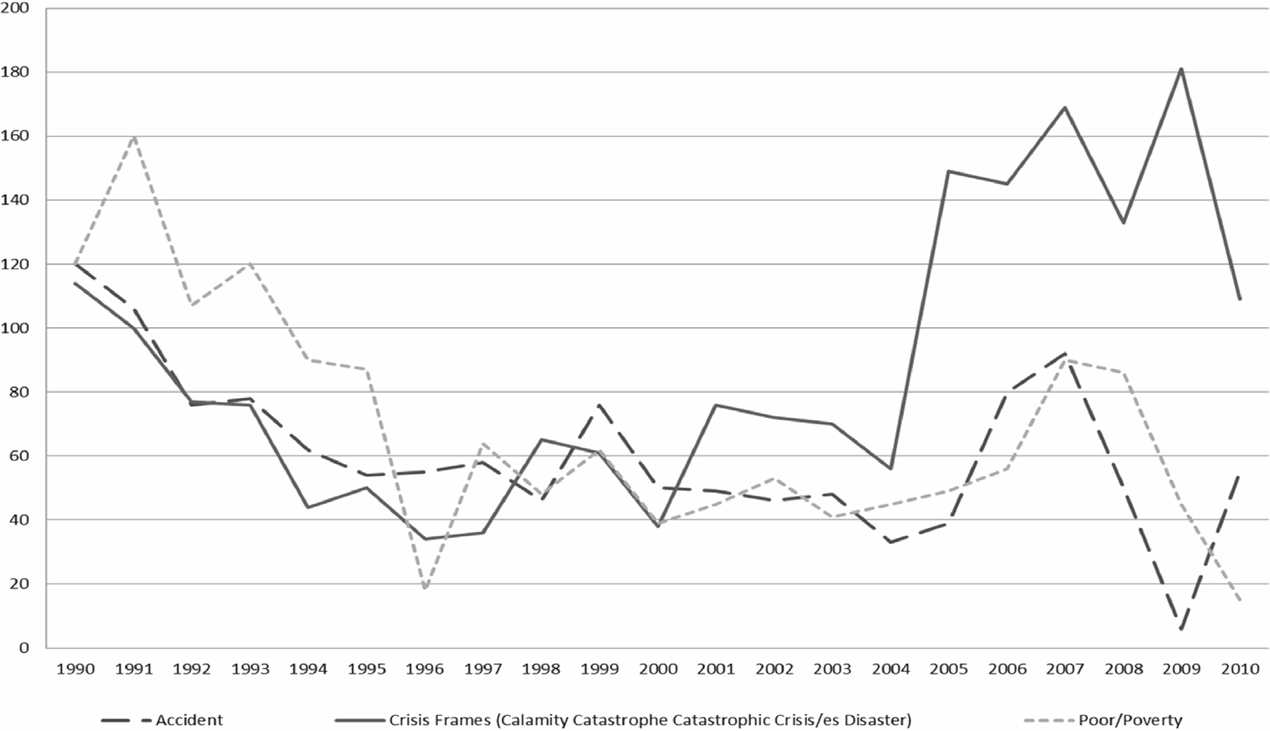
Following the events of September 11, 2001, the American political and economic landscape was shaped by a convergence of troubles that interrupted what has come to be characterized as the peace and prosperity of the 1990s.Footnote 5 Among these difficulties have been several economic calamities, including the Great Recession and the housing market collapse, both of which were quickly figured as national crises, as moments that marked deep historical ruptures with the prosperity of the preceding decade, and as exceptional events that justified broadly-based and urgent government responses.Footnote 6 The graph in Figure 1, for example, depicts the use of the words calamity, catastrophe, catastrophic crisis, crises, and disaster—what I will call “crisis language”—in the titles of all Congressional hearings from 1990–2010, comparing the use of these terms to that of two other descriptors, “accident” and “poor/poverty.” As the graph makes clear, crisis language increased markedly in 2000 and then again in 2004, both compared with its use during the 1990s and compared to the incidence of the words “poor,” “poverty,” and “accident.”
Select Words in Titles of Congressional Hearings, 1990–2010
In an environment of such heightened rhetorical invocations of crisis, one might be forgiven for wondering whether it is a concept in urgent need of scrutiny, whether it has become so deeply naturalized that it evades critique, or whether it has become so over-determined as to prohibit analysis. Reinhart Koselleck, for example, indicts the media for their profligate use of the term, employing it, he argues, “interchangeably with ‘unrest,’ ‘conflict,’ ‘revolution,’ and [using it] to describe vaguely disturbing moods or situations.”Footnote 7 The concept of crisis, he contends, “which once had the power to pose unavoidable, harsh and non-negotiable alternatives, has been transformed to fit the uncertainties of whatever might be favored at a given moment.”Footnote 8 Peter Schuck argues similarly that words like crisis and catastrophe are used “so casually and promiscuously that their meanings have lost whatever precision they may have once possessed, and have acquired that familiar fuzziness that marks so much of our popular discourse.”Footnote 9
Conceptually fuzzy and over-deployed though such terms might be, crises have long served as defining elements of global and national politics and as moments for reflection. French sociologist Edgar Morin argues that crises reveal gaps in our knowledge as well as “in the very social reality where the ‘crisis’ appears.”Footnote 10 Austin Sarat and Javier Lezaun claim that this “revelatory quality” offers “powerful reminders of the fragility of our social and institutional architectures” that lay bare “the conditions that make our sense of normalcy possible.”Footnote 11 As such, crisis remains a potent frame, both as a lens through which to understand events and as a justification for political action.Footnote 12 It is consequently important to interrogate and track its political construction, meanings, deployment, and effects—to, as Morin argued, “put the concept of crisis in crisis.”Footnote 13
Recessions, Meltdowns, and the Normalization of Bad Times
But interrogating the seemingly ubiquitous evocation of crisis to describe some bad things also underscores its absence as a designator for others.Footnote 14 For as scholars of agenda setting and issue framing ranging from Murray Edelman and Deborah Stone to John Kingdon, Frank Baumgartner and Bryan Jones make clear, it is not inevitable that a bad thing will be defined and treated as bad, much less that it will be regarded as a crisis.Footnote 15 Among marginalized groups—whether defined by race, class, disability, gender, sexuality, or citizenship status—bad things are often ongoing and continuous, and times can be perennially hard. Persistent problems—including economic difficulties such as long-term unemployment, poverty, homelessness, and racialized and gendered wage disparities and labor force segmentation—are typically normalized, however, rather than recognized as emergencies by dominant political actors. For they are, indeed, part of the fabric of “ordinary life.”
Moreover, as scholars of public policy and American political development remind us, political and policy changes are the result of interactions between relatively stable system parameters on the one hand and “dynamic events” on the other hand. As Larry Jacobs and Desmond King observe, “even unusual turmoil spurs not only significant and salient changes … but also the continuation of already established norms and patterns,” serving, as Gretchen Ritter writes, to underscore the co-existence of order and continuity with “political disorder, disequilibrium, punctuation, and transfomration.”Footnote 16 The durability of established norms and patterns—even, and perhaps especially, during moments of alleged crisis—is particularly evident if we contextualize the economic crises of the early twenty-first century alongside the preceding decade and within a framework that emphasizes the politics of exclusion, inequality, and marginalization. Doing so highlights the fact that while the convergence of crises has changed the political landscape, this terrain continues to be shaped by perennial and quotidian “hard times” produced by structural marginalization and by race, class, gender, and sexuality-related inequalities.Footnote 17
In this light, rather than serving as an objective gauge of when there have and have not been crises, the variation in the use of crisis language depicted in Figure 1 suggests that having a bad thing recognized as a crisis within dominant institutions is itself a political victory. That is, as the work of scholars such as Paul Pierson and Jacob Hacker makes clear, economic disparities actually increased during the allegedly booming 1990s.Footnote 18 Considered in this context, the 1990s might well be characterized as a decade of crisis for marginalized groups. As such, the titles of Congressional hearings reveal the constructedness of both the “peace and prosperity” of the 1990s and of the “crises” of the 2000s and serve as an indicator—albeit a blunt one—that the bad things that happen to marginalized groups evade crisis framings and are instead normalized and particularized within dominant institutions.
Such a lens consequently underscores tensions between the framings of endemic and episodic problems, making visible the backdrop of persistent hard times and inequalities that evade definition as economic crises and that are cast instead as unfortunate, perhaps even tragic, but ultimately normal, inevitable, and possibly even necessary elements of American political, economic, and social orders.Footnote 19 An adequate political understanding of economic crisis thus ought to foreground the politics of exclusion, inequality, and marginalization, examining the relationships between, on the one hand, bad things that become defined as crises and, on the other hand, ongoing and quotidian bad things endured by marginalized populations that typically do not get defined in this way.Footnote 20
In the next section, I use the Great Depression, the Great Recession, and the mortgage meltdown to explore some of the ways in which racialized and gendered norms, assumptions, and processes lead to the normalization of some bad things and the rendering of others as crises. I show that understanding these three economic episodes as exceptional crises is possible only if we accept a troubling premise: that major economic disparities and discriminatory practices—such as the fact that unemployment is typically much higher among African Americans than it is among whites, that women's rates of employment and wages are typically much lower than those of their male counterparts, and that residential patterns will remain racially and economically segregated—are indicators of a normal or even of a good economy.
This premise suggests further that one of the key properties of those bad things that come to be constructed as crises is that, all else being equal, they are situations in which, with apologies to Rabbi Harold Kushner, bad things happen to otherwise lucky and privileged people, creating hardships for relatively advantaged and normative groups for whom hard times are atypical or exceptional.Footnote 21 In contrast, political and policy elites treat the unemployment, poverty, and home foreclosures endured by marginalized groups as already accounted for in longstanding ideological tropes and infrastructures. The interests of marginalized groups are thus regarded as “special” interests, their problems are seen as inevitable, and they are treated as the perpetrators of their own crises, which are attributable to individual defects or cultural dysfunctions.Footnote 22 Rather than being defined as national crises remediable through swift and massive intervention, these ongoing bad things serve instead as benchmarks for determining precisely the kinds of catastrophes that could follow for dominant groups should a crisis's potential for destruction be realized.
The Mortgage Meltdown, or When Does a Crisis Begin?
Such constructedness is well-illustrated by the recent mortgage meltdown. In the fourth quarter of 2007, when the foreclosure crisis was widely recognized as being underway, the Mortgage Bankers Association estimated that 3.6 percent of all loans were seriously delinquent (that is, more than 90 days late) or in foreclosure, and that an additional 0.9 percent were entering foreclosure.Footnote 23 Longer-term data demonstrate, however, that foreclosure rates among people of color, immigrants, low-income people, and female-headed households were at similar or higher levels well before the crisis was said to have begun.Footnote 24 For example, a 2002 study commissioned by the U.S. Department of Housing and Urban Development found that the foreclosure rates for African American, American Indian, and Latino homeowners in 1996 were 4.8 percent, 4.4 percent, and 5.4 percent respectively, while rates were 2.9 percent for whites and 3.7 percent for Asian Americans.Footnote 25 Although some advocates, financial analysts, and policy makers (notably Representative Keith Ellison, D-MN) expressed concern about these high rates and worried that the resetting of subprime variable rate mortgages would escalate the problem, these concerns received scant attention in the mainstream media or from dominant political institutions.
As we might expect, the sharp increase in foreclosures that began in 2007 did, indeed, take a disproportionate toll on Africans Americans and Latinos, particularly on those who owned homes in majority-minority neighborhoods.Footnote 26 Foreclosure rates during that period were higher and increased more steeply in census tracts in such neighborhoods (defined in the Joint Center for Housing Studies of Harvard University report as census tracts in which over 50 percent of residents are members of racialized minorities) compared to mixed (defined in the report as census tracts with 10–50 percent minority residents) and white (defined as less than 10 percent minority) tracts, even after controlling for average income. Moreover, rates in moderate-income majority-minority neighborhoods approached those in low-income white neighborhoods, and foreclosure rates in high-income minority neighborhoods exceeded rates in moderate-income white neighborhoods.Footnote 27
These disparities are themselves troubling reminders about the ways in which the material effects of crises can disproportionately harm members of marginalized groups. However, the indicators that were regarded as the harbingers of the crisis are most germane. In particular, the high foreclosure rates documented among some groups as early as 1996 did not suffice to constitute a crisis. Rather, those disparities were construed as the perhaps unfortunate but nonetheless unremarkable and predictable—and, it seems, acceptable—results of patterns of racially-segregated housing, discrimination on the part of lenders, and lower average incomes among women and people of color. In other words, these ongoing economic problems and disparities were normalized, construed not as crises but as explanations and justifications for higher interest rates. It was not until foreclosure rates among middle-class white male-breadwinner households reached levels typical of those in minority communities (and, by some accounts, of those in female-headed households) that a foreclosure crisis was said to have begun.
The Great Depression, the New Deal, and the Reinscription of Racialized and Gendered Norms and Inequalities
The case of the mortgage crisis illustrates some of the ways in which power, normativity, and privilege served to construct the meltdown in the housing market as a crisis while normalizing more prevalent rates of foreclosure among people of color. And once a bad thing is framed as a crisis this has real and far-reaching political and policy effects.Footnote 28 As such, the differential benchmarks for the construction of crisis lead to significant policy consequences and feedback effects that are themselves shaped by racialized and gendered norms and inequalities. These processes are evident in the discriminatory racial and gender norms that were codified in many New Deal labor and redistributive policies enacted in response to the crisis of the Great Depression. Neither the National Labor Recovery Act nor the initial Social Security program covered agricultural and domestic workers, for example. So, approximately two thirds of black workers, and female workers of all races, were not initially covered by these allegedly “universal” policies.Footnote 29 In addition, although rates of unemployment among African Americans were approximately twice those for whites, many categories of assistance for which blacks were eligible were left to the discretion of state workers.Footnote 30 Often, especially in the South, blacks were consequently denied assistance. Similarly, both the Fair Labor Standards and the Social Security Acts excluded occupations like retail clerks and seasonal workers, which were dominated by women, while the National Economy Act legislated that a husband and wife could not both work for the Federal Government or be employed by programs administered by federal agencies such as the Works Progress Administration. Because women typically earned less than men, many women quit, were denied, or simply did not take federal jobs.Footnote 31 Women's entitlements under programs such as Aid to Dependent Children were typically tied to their roles as mothers, and access to them consequently required that they conform to traditional gender roles, thereby reinforcing and codifying gender discrimination, traditional gender roles, and women's economic marginality and dependence on men.Footnote 32
In other words, rather than challenging patterns of racialized and gendered poverty and labor, the very policies that helped to alleviate the economic crisis of the Great Depression and to offer citizens a “New Deal” in fact reflected, reinforced, and reconstituted these patterns of inequality. It is not just that some women or people of color were “left out” by these policies. Rather, inequalities were rearticulated and exacerbated by precisely those policies that are typically viewed as the most emancipatory and redistributive programs of the twentieth century. Although many of the overt exclusions associated with these policies were eventually remedied, scholars such as Linda Gordon, Alice Kessler-Harris, Suzanne Mettler, Margot Canaday, Margaret Weir, Gwendolyn Mink, Gretchen Ritter, Robert Lieberman, and Jill Quadagno have shown a range of ways in which the disproportionate benefits that New Deal policies afforded to heterosexual white men also came to circumscribe the benefits available to women, people of color, and men and women of all races who did not conform to either prevailing norms of gender and sexuality, nor to the defining ideas about rights and entitlements, pity and blame, and citizenship and belonging based on those norms.Footnote 33 These lines have persisted in and been entrenched by many subsequent social and economic policies, from the Great Society programs of the 1960s to the Personal Responsibility and Work Opportunity Reconciliation and the Family and Medical Leave Acts of the 1990s.
From Mancession to Hecovery
The examples of the mortgage crisis and the Great Depression illuminate the roles of persistent racialized and gendered inequalities in determining when crises begin as well as how they might be resolved. These inequalities also mark the criteria used to indicate that an economic crisis has ended and that we have returned to normal or even good economic times. The juxtaposition of the report from the NBER with the one issued by the BLS with which I opened this essay helps to illustrate this phenomenon by demonstrating how gendered norms and expectations about men's and women's labor force participation marked ideas about both the depth and gravity of the Great Recession as well as the indicators that it was over.
In December 2007, the American economy entered a recession that would eventually be marked by the highest unemployment rates of any recession since 1982.Footnote 34 Soon after this Great Recession began, economists noted that unemployment among men was rising more quickly than unemployment among women. In May 2009, for example, male unemployment had reached 10.5 percent (up from 5 percent in 2007), while female unemployment increased to only 8 percent (from 4.8 percent in 2007).Footnote 35
It did not take long before political observers coined the phrase “mancession” to characterize this phenomenon, and several years of debate, speculation, and hand wringing about the gap's origins, effects, and meaning ensued.Footnote 36 Analysts pointed out that the disparity was, in part, a function of declines in industries such as construction, which remain dominated by men and which had been hard-hit by the collapse in the housing market.Footnote 37 Others noted that while the unemployment rate for women was lower than the one for men, women's rates of unemployment were not actually declining but remained, in fact, remarkably high. Women continued to endure inequalities that had affected them long before the recession had begun: They remained concentrated in lower-paying service positions, average wages for white males remained higher than those for white women, and white men with high school diplomas continued to earn about as much as white women with college degrees.Footnote 38
While observers and analysts noted these disparities, there was scant acknowledgement of the fact that women's lower rates of unemployment were at least in part an artifact of long-standing norms about women's paid labor, whereby the proportion of women in the labor force was—and remains—far lower than the proportion of men. Lawrence Mishel and his colleagues estimate for example, that in 2007, before the recession began, 90.9 percent of men between the ages of 25 and 54, but only 75.4 percent of women in this same group, were in the labor force.Footnote 39 So among all those in the paid labor force, it was true that a greater proportion of men were unemployed compared to the proportion of women. But even when the gap in male and female unemployment rates was at its peak, a greater proportion of Americanl men than American women were nonetheless employed.Footnote 40 The absolute value of the number of men working also remained higher than the number of women, those men continued to earn more than their female counterparts, and they also continued to hold better jobs than more highly-educated women. Yet once again, it was not these long-term structural inequities that constituted the situation as a crisis; rather, it was the suggestion that gendered norms were being challenged and gendered disparities possibly narrowing or reversing that was deemed the problem worthy of attention. In other words, the crisis was that white men were increasingly relegated to economic conditions previously and unceremoniously reserved for women and people of color.
It is only in this context that an upturn in which 90 percent of the jobs created went to (mostly white) men could be construed as a “recovery” from the Great Recession.Footnote 41 And while the NBER was careful to issue the caveat that the economy had not “returned to operating at normal capacity,” even as, or perhaps because, women and people of color fared worse, the notion that the economy had entered a recovery—the central and symbolically powerful verdict rendered—was not questioned, and these racialized and gendered realities were at once subsumed, made invisible, and neutralized by this official end to crisis.Footnote 42 Indeed, that the disproportionate benefits of the recovery went to white male workers was—and has long been—one of the conditions that “make our sense of normalcy possible.”Footnote 43
Conclusion
Scholars such as Linda Williams have pointed out that bringing marginalized groups into our frames of analysis forces us to recalibrate how we understand over-time changes in levels of economic inequality, and that failing to do so leads to incomplete and incorrect stories about the causes and meanings of these changes.Footnote 44 Incorporating analyses of quotidian inequalities into our ideas about crises is similarly recalibrating, forcing us as it does to de-normalize and de-particularize the “non-crisis” problems faced by marginalized groups and to question the idea that the problems faced by dominant groups should be treated as national crises.Footnote 45 As such, the mortgage crisis, Great Depression, and Great Recession represent cautionary tales for political science, crystallizing as they do the ways in which understandings about what constitute good vs. bad times, normal vs. unusual patterns, and broad vs. particularistic problems and solutions can serve to obscure, reflect, and reproduce rather than to illuminate and resolve inequalities. More complete and accurate accounts of times that are allegedly hard for “everyone” require that we recognize the ongoing effects of the racialized, gendered, and other norms and inequalities that persist even during ostensibly good times.