Congenital heart diseases (CHD) are among the most common causes of birth defects that occur in approximately 1% of annual live births. Reference Hoffman and Kaplan1 Critical CHDs require long-term hospitalization due to the need for intensive care support with many interventions in the neonatal period. In these patients, the need for prolonged mechanical ventilation, cardiac surgery, and frequent invasive procedures such as central venous catheterizations in addition to other concomitant factors (genetic causes, prematurity, etc.) have increased the risk of infections.
Neonatal sepsis (NS) is a clinical syndrome characterised by signs and symptoms of infection in the first 28 days of life. Reference Satar, Arısoy and Çelik2 Despite the developments in the field of neonatal care, four in ten infants with neonatal sepsis in developed countries die or suffer from a major disability, including significant permanent neurodevelopmental impairment. Reference Brocklehurst, Farrell and King3 The current gold standard, to confirm the diagnosis of neonatal sepsis, is the isolation of the microorganism by blood culture in the presence of clinical signs and symptoms. However, blood cultures result after 24–48 hours of incubation and are usually negative. Reference Satar, Arısoy and Çelik2 The diagnosis of sepsis also requires evaluating the laboratory findings. Leukopenia, neutropenia, thrombocytopenia in addition to elevated acute phase reactants such as C-reactive protein and interleukin-6 are considered to be valuable. Reference Russell and Kumar4 It is noteworthy that many biomarkers for the early diagnosis of sepsis have been investigated in the literature, but none of them has sufficient specificity alone. Therefore, the search for new parameters to use for this purpose continues.
The systemic immune-inflammatory index (SII), which is initially used as an indicator of inflammation in many cancer types, is also claimed to be promising in the diagnosis of sepsis. Reference Tong, Tan, Zhou, Song and Song5 Systemic immune-inflammatory index can be obtained from the parameters of the complete blood count (hemogram), which is one of the routine blood tests, without the need for additional blood collection from newborn babies with suspected sepsis. Reference Xue, Gan and Wu6 According to current data, there is no study on the predictive value of systemic immune-inflammatory index in the diagnosis of sepsis in infants with CHD. Therefore, in our study, we planned to investigate the role of systemic immune-inflammatory index in the diagnosis of sepsis in newborns with CHD and to compare it with other parameters.
Materials and Methods
Study design and participants
This was a retrospective study conducted on newborns with a diagnosis of sepsis who were admitted to our level III neonatal ICU with CHD between January 2017 and June 2021.
Our hospital is a pediatric heart centre. Approximately 100 newborns with CHD are followed up in our NICU per year. According to our in-hospital working protocol, newborns with CHD have been followed up in the NICU before and after surgery. Pediatric cardiologists work as consultants. The surgeries have been performed by the pediatric cardiovascular team.
During the study period, 431 newborns with CHD were followed up in our neonatal NICU. Of these, 186 (43.1%) were found to have neonatal sepsis. Initially, we intended to record all patients who were with CHD and neonatal sepsis. The patients without C-reactive protein, interleukin-6, and hemogram records, and premature babies with a gestational age of less than 35 weeks were excluded from the study. According to the exclusion criteria, 20 of 186 patients were not eligible for the study. Finally, a total of 166 (38.5%) patients were included in the study.
This study was ethically approved by the local ethics committee of the University of Health Sciences of Turkey, Dr Sami Ulus Maternity and Children Training and Research Hospital, Ankara, Turkey (No: E-22-278). Written informed consent was taken for all patients.
Data collection
Necessary data were obtained from the hospital records. The following variables were evaluated for all patients: demographics (maternal age, gestational week, gender, age on admission to neonatal ICU, age at diagnosis of sepsis, etc.), clinicopathological features (types of CHD, types of cardiac surgery, age at operation, the duration of mechanical ventilation, etc.), and the presence of clinical or proven neonatal sepsis. Data on length of NICU stay and mortality were also noted.
The recommended diagnostic criteria for NS (two or more of the following clinical features) were used to identify the patients with sepsis Reference Haque7,Reference Aydogan, Akduman and Dilli8 : respiratory distress, that is tachypnoea, apnoea, increased respiratory support, or desaturation; cardiovascular deterioration, that is bradycardia, pallor, decreased perfusion, or hypotension; metabolic changes, that is hypothermia, hyperthermia, feeding intolerance, glucose imbalance, or metabolic acidosis; or neurological changes, that is lethargy, hypotonia, or decreased activity. The following pre-approved haematological criteria were used as indicators for NS Reference Haque7,Reference Aydogan, Akduman and Dilli8 : leukocytosis or leukopenia, neutrophilia or neutropenia, immature/total neutrophil ratio > 0.2, and thrombocytosis or thrombocytopenia. In addition to clinical criteria, if two or more parameters were abnormal, it was considered neonatal sepsis, and the newborn was started on antibiotics. Babies with positive blood culture results were diagnosed to have proven sepsis.
For all patients, blood tests including blood haemoglobin (g/dL), white blood cells (WBC) (/mm3), lymphocyte (/mm3), absolute neutrophil count (ANC) (/mm3), platelet (×103/mm3), mean platelet volume (MPV) (fL), C-reactive protein (CRP) (mg/L), and interleukin-6 (IL-6) (pg/mL) obtained on admission (pre-sepsis) and following the development of nosocomial sepsis (sepsis) were compared.
Haematologic indices including neutrophil/lymphocyte ratio (NLR), platelet/lymphocyte ratio (PLR), and systemic immune-inflammatory index (neutrophil count x platelet count/lymphocyte count)] were calculated based on complete blood count obtained at the time of diagnosis of sepsis (sepsis). The sepsis values of these indices were compared with the admission values (pre-sepsis) for all patients.
Diagnostic values of the haematological indices in the prediction of neonatal sepsis in newborns with CHD were investigated.
Statistical analysis
A priori power analysis was used to determine the required number of patients for the study. According to our preliminary data, systemic immune-inflammatory index values were 407 ± 406 in patients without sepsis and 541 ± 382 in patients with sepsis. When the power was taken as 95.0% with an effect size of 0.33 and alpha level of 1%, the required numbers were calculated to be 158 for two dependent groups (G * Power 3.1.9.4).
Statistical analysis was performed using the Statistical Package for the Social Sciences (SPSS.23, IBM SPSS Statistics for Windows, Version 23.0 Armonk, NY: IBM Corp.). Kolmogorov–Smirnov test was preferred to determine the normality of distribution. Categorical variables were expressed as percentages, and continuous variables have been denoted as mean (± standard deviation) or median (interquartile range), as appropriate. Paired-Samples t-test was performed for repeated measurements. Pearson’s test was used for correlation analyses.
Receiver operating characteristic (ROC) curve analysis was used to determine the optimal cut-off values of the haematological indices for the diagnosis of neonatal sepsis in patients with CHD. A Youden index was applied to the Receiver operating characteristic curve to define the best cut-off value (Youden index = sensitivity + specificity − 1).Reference Fluss, Faraggi and Reiser 9 A p-value less than 0.05 was considered statistically significant.
Results
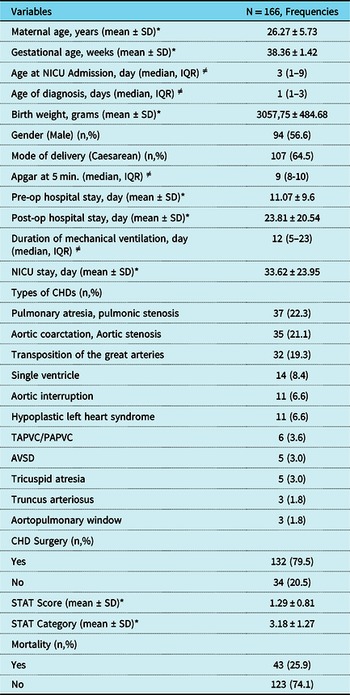
During the study period, 431 patients with CHD were followed up in our NICU. Among them, 166 patients who developed neonatal sepsis and eligible for the study were evaluated. Of all study patients, 94 (56.6%) were male and 72 (43.4%) were female. The demographic and clinical characteristics of the patients are shown in Table 1. The mean gestational age and birth weight were 38.36 ± 1.42 weeks and 3057.75 ± 484.68 g with a median admission age of 3 (1–9) days. A total of 132 (79.5%) patients were operated on for CHD. The most common types of surgeries were aortic arch repair; 41 (24.7%), arterial switch; (Jatene) 27 (16.3%), and modified Blalock-Taussig shunt; 26 (15.7%). Overall NICU stay was 33.62 ± 23.9 days with a neonatal mortality rate of 25.9% (n = 43).
Demographic and clinical and characteristics of the study patients

*Mean ± SD (standard deviation), ≠Median (IQR); interquartile range, 25–75%.
AVSD: atrioventricular septal defect; NICU: Neonatal intensive care unit; STAT: The Society of Thoracic Surgeons-European Association of Cardio-Thoracic Surgery; PAPVC: Partial anomalous pulmonary venous connection; TAPVC: Total anomalous pulmonary venous connection.
While 29 (17.5%) of patients were inborn, 137 (82.5%) were transferred to our hospital from another centre. Only 43 (25.9%) patients had a prenatal diagnosis of CHD. Since the increased migration to our country in recent years, 27 (16.3%) of the cases were Syrian, 4 (2.4%) Iraqi, and 1 (0.6%) Afghan.
Of all study patients, clinical sepsis developed in 114 (68.7%) and proven sepsis in 52 (31.3%). The most common pathogens were coagulase-negative staphylococci; 19 (11.4%), Klebsiella pneumonia; 13 (7.8%), and Acinetobacter baumannii 5 (3%).
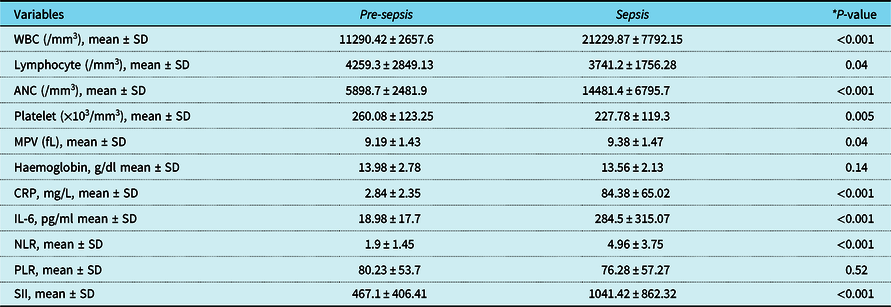
The laboratory data obtained on admission (pre-sepsis) and at the time of diagnosis of sepsis (sepsis) are shown in Table 2. When analysed for repeated measurements, it was found that the white blood cells, mean platelet volume, absolute neutrophil count, serum C-reactive protein, and blood interleukin-6 levels were statistically significantly higher at the sepsis point (p < 0.05 for all analyses). However, the platelet and lymphocyte counts were statistically significantly lower at the sepsis point than those of the pre-sepsis values (p = 0.005 and p = 0.04, respectively). When analysed for haematological indices, it was found that systemic immune-inflammatory index (SII) and neutrophil/lymphocyte ratio (NLR) were significantly increased at the time of sepsis. There was no significant change in platelet/lymphocyte ratio during sepsis.
Comparison of the laboratory data obtained on admission (pre-sepsis) and at the time of diagnosis of sepsis (sepsis)

* p values are for Paired-Samples t-test.
WBC: white blood cell; MPV: mean platelet volume; ANC: absolute neutrophil count; CRP: serum C-reactive protein; IL-6: interleukin-6; NLR: neutrophil/lymphocyte ratio; PLR: platelet/lymphocyte ratio; SII: neutrophil count x platelet count / lymphocyte count.
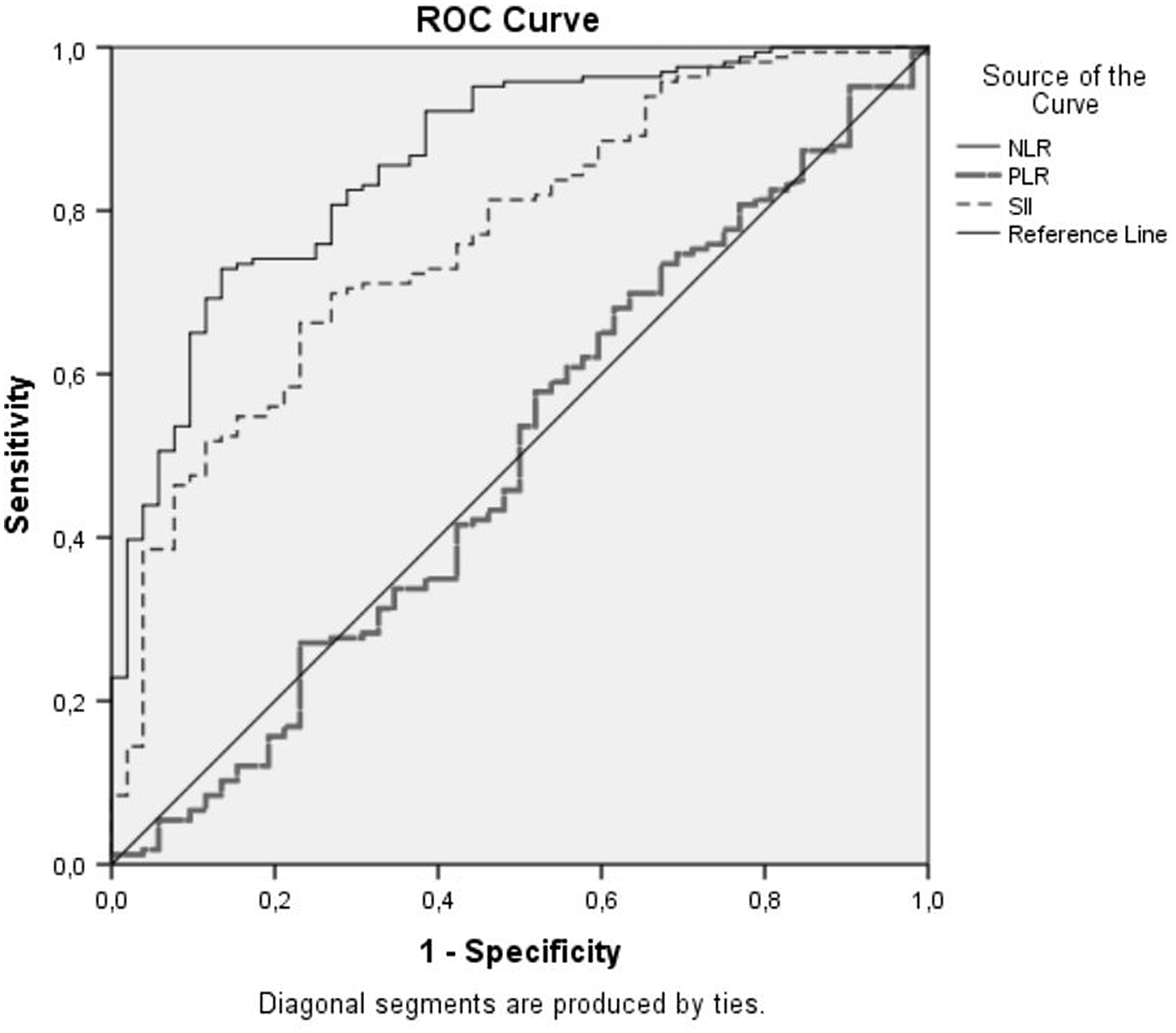
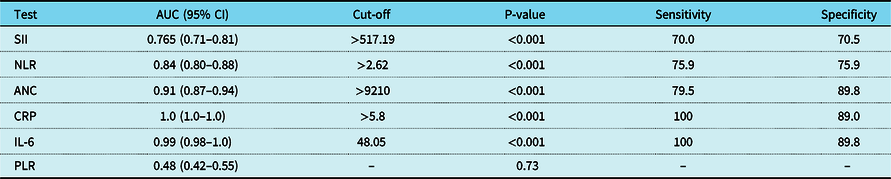
Receiver operating characteristic curve showed that only systemic immune-inflammatory index, neutrophil/lymphocyte ratio, and absolute neutrophil count have predictive ability to define neonatal sepsis among newborns with CHD. Receiver operating characteristic curve analyses for systemic immune-inflammatory index, neutrophil/lymphocyte ratio, and platelet/lymphocyte ratio to describe proven sepsis in newborns with CHD were also provided similar results (Table 3, Fig. 1).
ROC curve analyses for SII, NLR, and PLR for patients with proven sepsis. NLR: neutrophil/lymphocyte ratio; PLR: platelet/lymphocyte ratio; SII: neutrophil count × platelet count / lymphocyte count.

ROC curve analyses for proven sepsis in newborns with CHDs

NLR: neutrophil/lymphocyte ratio; PLR: platelet/lymphocyte ratio; SII: neutrophil count × platelet count / lymphocyte count.
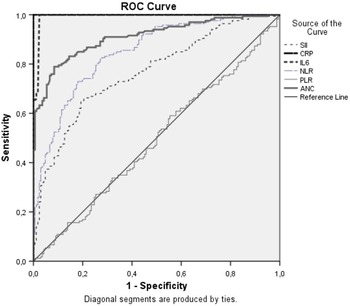
The systemic immune-inflammatory index produced an area under the curve Receiver operating characteristic (ROC) of 0.76 (0.71–0.81) (70% sensitivity, 70.5% specificity). Area under the curve values were 0.84 (0.80–0.88) (75.9% sensitivity, 75.9% specificity) for neutrophil/lymphocyte ratio and 0.91 (0.87–0.94) (79.5% sensitivity, 89.8% specificity) for absolute neutrophil count. To discriminate NS, the cut-off values of systemic immune-inflammatory index, neutrophil/lymphocyte ratio, and absolute neutrophil count were 517.19, 2.62, and 9210/mm3, respectively (Table 4, Fig. 2).
ROC curve analyses for SII, NLR, PLR, CRP, IL-6, and ANC. ANC: absolute neutrophil count; CRP: serum C-reactive protein; IL-6: interleukin-6; NLR: neutrophil/lymphocyte ratio; PLR: platelet/lymphocyte ratio; SII: neutrophil count × platelet count/lymphocyte count

ROC curve analyses for neonatal sepsis in newborns with CHDs

P < 0.05, AUC: Area Under the Curve; CI: Confidence interval; ROC: Receiver operating characteristics.
ANC: absolute neutrophil count; CRP: serum C-reactive protein; IL-6: interleukin-6; NLR: neutrophil/lymphocyte ratio; PLR: platelet/lymphocyte ratio; SII: neutrophil count × platelet count / lymphocyte count.
Correlation analyses showed that neutrophil/lymphocyte ratio (r = 0.34, p < 0.001) and systemic immune-inflammatory index (r = 0.30, p <0.001) were weakly positively correlated to C-reactive protein. Interleukin-6 was also weakly correlated to neutrophil/lymphocyte ratio (r = 0.17, p = 0.001) and systemic immune-inflammatory index (r = 0.21, p <0.001). Neither C-reactive protein nor interleukin-6 was correlated to platelet/lymphocyte ratio.
Discussion
In this retrospective study, we investigated the predictive role of systemic immune-inflammatory index as a new indicator in the early diagnosis of neonatal sepsis. It was found that SII might be used for this purpose in combination with classical parameters in newborns.
In developing countries, neonatal sepsis is still the most common cause of neonatal mortality and morbidity. Reference Manandhar and Basnet10 Moreover, newborns with CHD have a greater risk of developing neonatal sepsis than normal neonates, both because of the accompanying morbidities and the requirement of many invasive procedures during the NICU course.
Blood culture positivity is known as the gold standard in the diagnosis of neonatal sepsis. A major limitation of blood culture is the requirement of a minimum of 48 hours for the earliest result. Furthermore, blood culture positivity can only be detected only in 60-80% of newborns with sepsis. Reference Hornik, Fort and Clark11-Reference Wynn13 Gram-positive bacteria have been shown to be the most common cause of neonatal sepsis in developing countries. Reference Li, Chen and Lin14 In our study, there was a growth in blood culture in 52 (31%) of the patients. The most common causative agents were coagulase-negative staphylococci, Klebsiella pneumonia, and Acinetobacter baumannii.
Delayed diagnosis and treatment of neonatal sepsis can lead to increased mortality and morbidity. The clinical findings of neonatal sepsis are non-specific and may be similar to many neonatal diseases, which makes difficult early diagnosis. In newborns with CHD, the course of CHD may mask neonatal sepsis, making the diagnosis more challenging. Therefore, new markers are needed for the early diagnosis of neonatal sepsis. Reference Aydogan, Akduman and Dilli8
As it has been used for years, CRP is one of the most reliable parameters in the diagnosis of NS, showing a significant increase, especially in gram-negative bacterial sepsis. Reference Chacha, Mirambo and Mushi15 Today, CRP is still one of the first line markers used in the diagnosis of neonatal sepsis. Reference Aydogan, Akduman and Dilli8,Reference Can, Hamilcikan and Can16,Reference Arcagok and Karabulut17 In our study, we also found a significant increase in serum CRP values at the point of neonatal sepsis.
In neonatal sepsis, the diagnostic values of some haematological parameters are higher than those of the others. Reference Aydogan, Akduman and Dilli8,Reference Can, Hamilcikan and Can16-Reference Ashour, Waael, Rashwan and Fayed20 Platelets play a role in inflammation and host defence as well as contribution to haemostasis. It has been suggested that increased platelet turnover in the course of sepsis causes thrombocytopenia. Therefore, many studies on neonatal sepsis have shown that thrombocytopenia is a common finding during NS. Reference Ree, Fustolo-Gunnink, Bekker, Fijnvandraat, Steggerda and Lopriore18-Reference Ashour, Waael, Rashwan and Fayed20 In mild inflammation, MPV increase is observed due to the passage of large platelets into the peripheral circulation, but its level may be low due to consumption of large platelets in severe inflammation. In the current study, we observed a statistically significant decrease in platelet count and an increase in mean platelet volume after the development of sepsis. As previously reported, we found that neutrophil levels of the patients increased statistically significantly during sepsis. However, sepsis point lymphocyte levels were found to be significantly lower than pre-sepsis levels. This situation made us think that neonatal sepsis is mostly caused by bacteria.
The lack of a definitive and perfect diagnostic marker in the diagnosis of neonatal sepsis has led authors to search for new markers. It was suggested that haematological indices based on peripheral neutrophil, platelet, and lymphocyte counts may be a guide for the early diagnosis of NS. Reference Zhang, Diao and Qi21,Reference Chen, Zhai and Yuan22 Among them, some quickly available parameters, such as neutrophil/lymphocyte ratio and platelet/lymphocyte ratio, calculated from routine complete blood count, have been investigated as potential indicators. It has been suggested that they may be more sensitive biomarkers of inflammation than the levels of each blood cell line. Reference Mannaerts, Heyvaert, De Cordt, Macken, Loos and Jacquemyn23 In the present study, we investigated the predictive role of SII, in addition to neutrophil/lymphocyte ratio, and PLR in the diagnosis of neonatal sepsis in newborns with CHD.
Today, NLR is becoming a more valuable marker of inflammation than neutrophilia or lymphocytopenia alone, especially for detecting bacterial infection. Reference Can, Hamilcikan and Can16 NLR and SII have been used to predict disease activity, prognosis, and survival rates in diseases with systemic inflammation, particularly many types of cancer: hepatocellular cancer patients, breast and colorectal cancers, and bacterial and bloodstream infections. Reference Ashour, Waael, Rashwan and Fayed20,Reference Chen, Zhai and Yuan22,Reference Yang, Wu and Hsu24-Reference Yang, Chang, Meng, Gao and Wang26 Because of the changes in neutrophil, platelet, and lymphocyte counts induced by inflammation, NLR and SII have also been considered as inflammatory markers for neonatal sepsis. In a recent study conducted on neonatal sepsis, significantly higher NLR was found in septic patients. Reference Can, Hamilcikan and Can16,Reference Ashour, Waael, Rashwan and Fayed20 In the present study, we found that NLR, one of the indices we evaluated in our patients, also increased significantly at the time of sepsis. An increase in NLR has also been detected in cardiac conditions with ischaemia. Reference Zhang, Diao and Qi21,Reference Chen, Zhai and Yuan22 In our patients with NS and CHD, both inflammation and ischaemia may have contributed to an increase in neutrophil/lymphocyte ratio. We found a cut-off value of 2.62 for neutrophil/lymphocyte ratio in the early diagnosis of neonatal sepsis in newborns with CHD. This value had 75.9% sensitivity and 75.9% specificity. Our findings were similar to a previous study. Reference Zhang, Diao and Qi21 Can et al. stated that the sensitivity increased to 97.4% and the specificity increased to 100% when the cut-off value for neutrophil/lymphocyte ratio was set to 6.76. The authors reported that a platelet/lymphocyte ratio value of 94.05 might be predictive for early-onset neonatal sepsis. Reference Can, Hamilcikan and Can16 According to available data, the SII cut-off values ranged from 200 to 1375 for the detection of inflammation. Reference Wang, Zhu, Huang, Liu, Liu and Tian27 In the present study, we observed that the cut-off value of systemic immune-inflammatory index was 517.19 to define NS.
There is a systemic inflammation in heart diseases and NLR can be used as an indicator of systemic inflammation. Reference Zhang, Diao and Qi21 It has also been suggested to be useful in determining prognosis and mortality in heart diseases. Reference Ayca, Akin and Celik28 Heart injury can lead to the enhancement of the inflammatory response and the activation of the inflammatory cells. Many studies have investigated the PLR and NLR to analyse the prognosis of acute myocardial injury. Recently, Liu et al. Reference Liu, Ao, Zhou, Luo, Wang and Xiang29 found that post-operative NLR and PLR were useful indicators for predicting the occurrence of major adverse cardiovascular events during heart injury.
There are also studies on the usability of PLR in the diagnosis of neonatal sepsis, but no consensus has been reached. In our study, although PLR was numerically low during sepsis, no statistically significant decrease was observed following sepsis. This finding is similar to the data of Ashour et al. Reference Ashour, Waael, Rashwan and Fayed20 However, other studies have shown that PLR is higher in sepsis groups than in control groups. Reference Can, Hamilcikan and Can16,Reference Arcagok and Karabulut17 In our study, the reason why PLR was lower at the time of sepsis compared to the time of presentation might be caused by the decrease in the platelet count at the time of NS accompanying the decrease in the lymphocyte count.
Initially, SII was used to define the disease prognosis as a high inflammation marker in hepatocellular cancer. Reference Hu, Yang and Xu25 Systemic immune-inflammatory index has also been investigated in cardiac morbidities with ischaemia. Reference Chen, Zhai and Yuan22,Reference Yang, Wu and Hsu24-Reference Yang, Chang, Meng, Gao and Wang26 Neonatal sepsis and CHD are clinical conditions with a high risk of inflammation and ischaemia; we aimed to determine the predictive value of SII in the diagnosis of neonatal sepsis in patients with CHD. As a result of our study, we observed that the SII values increased significantly following the development of sepsis. In our population, we thought that both inflammation and ischaemia contributed to the increase in systemic immune-inflammatory index. The reason why we did not include a control group in healthy newborns in our study is the elimination of the ischaemic effect caused by CHD.
Our study has several limitations. Firstly, it was a retrospective, single-centre study of newborn patients with CHD and neonatal sepsis admitted to the hospital. Another limitation of the study may be the heterogeneity of CHDs. The lack of healthy controls may also be a limitation of the study. However, to our knowledge, this is the first study to investigate the prognostic value of SII in the diagnosis of neonatal sepsis in this population. In addition, NLR and SII can be calculated from routine complete blood count tests without incurring additional costs. New studies with larger case series are needed for the use of different haematological indices in the diagnosis of sepsis in newborns.
Conclusion
In this study, we determined that systemic immune-inflammatory index might be valuable in the early diagnosis of neonatal sepsis in newborns with CHD. It is known that inflammatory markers such as C-reactive protein do not increase in many patients with sepsis. Considering these cases, the use of haematological indices such as systemic immune-inflammatory index in combination with classical parameters might be a better guide for the diagnosis of neonatal sepsis.
What is known?
Sepsis is an important cause of morbidity and mortality in the neonatal period. Many biomarkers have been investigated in the early diagnosis of neonatal sepsis. The systemic immune-inflammatory index has been used as a prognostic marker in some cancer types.
What is new?
The systemic immune-inflammatory index may be helpful in the early diagnosis of sepsis in newborns with CHD.
Author contributions
Seda Aydogan: Formal analysis; Software; Writing-original draft; Writing-review & editing, final review. Dilek Dilli: Conceptualisation; Data curation; Formal analysis; Investigation; Methodology; Writing-original draft; Writing-review &editing, final review. Caganay Soysal, Hasan Akduman : Data curation, Writing-review & editing, final review. Utku Arman Örün, Mehmet Taşar, İrfan Taşoglu: Data curation; Investigation; Methodology; final review. Aysegül Zenciroglu: Methodology; final review.
Financial support
This research received no specific grant from any funding agency, commercial or not-for-profit sectors.
Conflicts of interest
None.