Social science literature contains ample warning that even if a range of methods exists for involving external interests in policy making, external interests still do not necessarily have equal opportunities to voice their concerns. Schattschneider's oft-quoted indictment of the American interest-group system that ‘the flaw in the pluralist heaven is that the heavenly chorus sings with a strong upper-class accent’ has been echoed in subsequent studies not only of the United States but also of other political systems.Footnote
1
However, even if the literature finds strong support for the conclusion that business interests dominate at the aggregate level, such a finding masks considerable internal variation. The bias in the heavenly chorus is not equally strong every time it sings, because a number of characteristics related to the performance itself may affect the degree of bias. It is, therefore, surprising to find a lack of studies explaining and empirically testing the conditions under which we are likely to see different levels of bias in the participation of substantive interests between cases. Moreover, studies often draw conclusions on bias without explicitly relating the distribution of active interests to that of the interest-group population as a whole.
In this research note, we analyse a new dataset of participation in the European Commission's online consultations during the last ten years and compare it to the population of registered interests. Our aggregate findings show that business dominance in consultations is even higher than in the population of registered groups. Moreover, our findings offer a first systematic empirical, large n test of how the character of different types of policy affects participation patterns. We find a linkage between characteristics of policies and degrees of bias in individual consultations. Participation on expenditure issues with direct consequences for budgets is more diverse than on regulatory issues, where private actors primarily cover the costs. Finally, a narrower range of interests mobilize on proposals with concentrated costs than on proposals whose costs are carried by a broader range of stakeholders. We start the note by briefly reviewing the literature on bias in interest representation and considerations of the conditions under which we should expect it to vary. Thereafter, we examine how the character of policy affects mobilization patterns.
What Explains Varying Levels of Bias?
Most of the literature of diversity in interest representation focuses on the American system and largely confirms Schattschneider's critical assessment by finding strong business dominance, no matter whether studies examine active interests on specific issues,Footnote
2
PAC registrations,Footnote
3
or the structure of organized interest at the state and federal level in the United States.Footnote
4
Also studies of the European Union (EU) population of interest representatives find that the participation of different types of interests is not equal. Recent studies have linked data from different public and commercial registers of EU interest representatives. Such studies include a broad range of all those actors lobbying the EU, including corporations, interest associations, consultants and law firms, and found that industry associations and corporations dominate.Footnote
5
Moreover, when it comes to participation by actors in specific EU-level activities, analyses by Quittkat and Finke and Quittkat of actor participation in consultation instruments of the Directorate-General (DG) for Employment and the Directorate for Health and Consumers (SANCO) and a smaller number of case studies of online consultations also find that business associations play a very prominent role.Footnote
6
One problem involved in interpreting many of these findings is that there is no good benchmark for judging whether a certain balance of interests is sufficient. Moreover, it should be remembered that participation can be biased in a number of different respects.Footnote
7
Here, bias refers to the distribution between different types of substantive interests, such as business interests, occupational groups, unions, public groups, identity groups and other interests. Moreover, since the literature is concerned with whether business interests dominate, we also look specifically at their degree of participation. To understand fully bias in mobilization, we would like ideally to compare this distribution to the latent interests in society. However, there is no such thing as a good overview of all the potential latent interests, which makes it very difficult to know how an unbalanced system of interest representation would actually look.Footnote
8
Instead, we compare the participation of these different types of interests in Commission consultations to their representation in the EU interest-group population as a whole. This means that, like the remaining literature, we will not be able to judge whether all latent interests are active. At the same time, relating active interests to those registered to lobby the EU serves as a crucial benchmark that allows us to avoid making a purely normative assessment of bias. Hence, not all types of interests may exist in equal numbers in the first place. Therefore, we would not necessarily expect them to demonstrate similar frequencies of participation.Footnote
9
Another challenge in the existing literature is that, despite frequent criticism of bias in participation, we know little about the conditions under which bias is likely to vary. Our emphasis here is therefore not only on assessing the overall distribution of different types of substantive interests but on explaining relative differences in this distribution between individual cases of external actor participation. Several studies have examined variation in the structure of state interest-group populations in the United States.Footnote
10
However, because these studies examine the diversity of populations between different geographical entities rather than the use of different participatory exercises within a given entity, many of the independent variables in their models are at the system level and thus not suitable for our analysis. Therefore, we also consider the broader literature of interest representation and public policy to develop expectations about the conditions under which we should expect bias in participation to vary.
Policy Type And Cost Structure
The literature on public policy states that different policies generate different levels of conflict and controversy and that in turn this may lead to differences in the bias of mobilized interests. To theorize what it is exactly about the character of different types of policy that affects mobilization patterns, we suggest considering who carries the costs of a given policy and what its cost structure looks like. Who pays for a given policy was one of several important criteria considered by Lowi in his distinction between different types of policies.Footnote
11
Policies with direct consequences for public budgets are often highly important to different parts of the public because they involve allocating public funding for goods and services among different groups of actors. Examples of such public expenditure policies in the EU include agricultural transfers and research support. It is likely that much attention will be cast on such issues, and we would expect a relatively broad spectrum of different types of interests to mobilize and voice their concerns. In contrast, regulatory policies limit the discretion of certain actors or compel them to engage in certain types of behaviour. Typically the costs of such regulations are carried by the target groups themselves rather than being financed via public budgets. Examples of regulatory policy in the EU include business regulation and the regulation of public goods such as air, water and communication. Such issues often relate to a narrower group of interests and may also be less important to the general public than the more principled distributive issues, which concern public budgets directly. Important parts of the public might therefore be inattentive and not bothered if a few technical experts broker the details with policy makers. We would thus expect a more narrow set of interests to mobilize on regulatory issues, where private actors primarily cover the costs, than on expenditure issues with direct consequences for the EU or member state budgets.
Recent work by Broscheid and Coen also argues that there is a link between the regulatory-distributive distinction and the number of actors that mobilize.Footnote
12
According to them, regulatory policy is ‘usually fairly technical’, which makes the costs associated with lobbying fairly high, since a comparatively high level of expert input is required.Footnote
13
In contrast, the costs of mobilizing for interest groups should be lower, where the expertise required is more of an administrative/positional nature. As a result the number of groups mobilizing should be higher in distributive than in regulatory policy domains. It is likely that these differences in the organizational and lobbying costs between issue areas should affect not only the numbers but also the broadness of the interests that mobilize.
Apart from who funds a given policy, the structure of costs incurred by a policy might also affect the broadness of the range of interests that mobilizes. We are interested in whether the costs of the policy will be concentrated among firms within a small number of industries or sectors or are diffuse across multiple industries/sectors or the taxpayers at large. This distinction was one of the dimensions in Wilson's policy typology in which he outlined four different subsystems of politics characterized by different combinations of concentrated and diffused costs and benefits.Footnote
14
In particular, we expect that groups should have a strong incentive to mobilize when the agenda includes points that incur costs for them and might potentially hurt them. However, the broadness of the range of groups that mobilize is likely to depend on how diffuse and concentrated these costs are. We would expect a more narrow set of interests to mobilize when the costs are concentrated than when they are diffuse.
Complexity And Density
Truman argued that ‘complex civilization necessarily develops complex political arrangements. Where the patterns of political behavior in society are intricate, the patterns of political behavior must be also’.Footnote
15
He and other scholars have subsequently used this reasoning to argue that there should be a link between the degree of economic complexity and the diversity of participation.Footnote
16
This argument cannot be tested directly in a study of one system only. However, based on this logic we argue that, if a given participatory exercise is complex in one respect, we would also expect it to be complex and diverse in others. We can also think of a participatory exercise as being complex by attracting the participation of both many different types of actors on an aggregate level (public actors, interest groups, individuals etc) but also by attracting many different types of interest groups within the interest-group category itself. If complexity in one respect influences complexity in another, we would expect the two to be related. Hence, from a pluralist perspective, the underlying societal structures that are likely to trigger different types of actors to mobilize in one respect are also likely to be the ones that trigger diversity in others. All things being equal, we would expect, therefore, that the more diverse the range of different actor types participating, the lower the level of bias between the different types of substantive interest groups that participate in a given consultation.
A final factor to consider here is how the total number of mobilizing actors on a consultation should affect bias. According to Truman's idea of ‘countervailing power’, groups mobilize in response to disturbances to their own interests.Footnote
17
As the public policy agenda involves issues of concern to them, groups mobilize and the net result is a system where all salient interests are represented. There is little worry of bias because the idea of ‘countervailing power’ is that as one type of interest mobilizes to defend its views, other groups will mobilize to counterbalance those views. This logic may not only hold at the system level but also in concrete participatory exercises. An important motivation for groups to participate is to counterbalance the views of others. In such a situation, a higher number of groups not only leads to further increases in the number of groups, but also lowers bias among the types of participating interests. All things being equal, we would expect, therefore, that the higher the number of participating groups, the lower the level of bias between different types of substantive interest groups in a given consultation.
Consultations In The European Union
We examine the European Commission's online consultations to test our theory. They are commonly referred to as ‘online’ consultations, because calls for these consultations are published online, typically on the websites of the different European Commission DGs and on the single access point for these consultations, ‘Your Voice in Europe’. However, the norm is that contributions can be submitted both online and offline, meaning that our dataset includes both types. Although consultations are not systematically held on all legislative proposals, they tend to take place on the most salient ones, and any initiative subject to an extended impact assessment is generally open for consultation.Footnote
18
A recent investigation by Rasmussen and Toshkov of the official documents of all proposals submitted to the 2004–09 European Parliament under the co-decision legislative procedure reports that consultations took place on 52 per cent of the files with evidence of some form of external stakeholder involvement in the preparatory phase of making policy.Footnote
19
After presentation of an initial policy document by the Commission, interested parties are given a minimum of two months to respond. Typically the European Commission finishes the process by reporting the number of responses and explaining how it has taken the presented views into account.Footnote
20
There are good reasons for expanding the study of bias in participation to the EU system, which is a political system that places a particularly high emphasis on involving external stakeholders, not least as a result of continued criticism of its state of democracy.Footnote
21
The Lisbon Treaty is based on both ‘the principle of representative democracy’ and the ‘principle of participatory democracy’ and the Treaty on European Union explicitly states that the Union shall ‘maintain an open, transparent and regular dialogue with representative associations and civil society’.Footnote
22
An ambitious White Paper on European Governance was put forward in 2001 and followed up by a Communication including a series of general principles and minimum standards for the conduct of consultations.Footnote
23
Our primary goal is to examine how general factors linked to policies and mobilization patterns affect relative levels of bias irrespective of the institutional setting.Footnote
24
The EU is not a state, but shares important characteristics with other political systems.Footnote
25
When it comes to consulting external interests, online consultations of the Commission are comparable to consultations conducted in a number of other political systems on proposed legislation and other initiatives by executives before such initiatives are presented to parliaments.Footnote
26
However, we cannot ignore that there are structural differences in interest representation and lobbying between the EU and other political systems, just as there are differences between national political systems in general, which may affect absolute levels of bias in participation. All things being equal, we would expect a relatively strong degree of business participation in the EU. Even if a high share of competences has been delegated to this level, its degree of competence is particularly strong in business-related policy areas.Footnote
27
This is exactly why the present study does not look at diversity in activity relative to some abstract notion of bias or the bias level of a specific national political system. Instead, we use a benchmark from a second dataset, which enables us to compare the diversity of substantive types of interest groups participating in concrete lobbying activities to the Commission to that of those registered as lobbying the European Union.
Online consultations are only one of many tools for involving the voices of external interests, which also happens in advisory committees, stakeholder forums, and through informal contacts of a purely ad hoc nature. Hence, actors participating in consultations may not constitute a representative sample of all active external interests. However, the advantage of examining online consultations is that the barriers to entry in this form of external actor involvement are relatively low. They are typically open to everyone including interest groups, public actors and individual citizens and do not require prior invitation. Moreover, even if contributing requires certain skills from participants, it requires fewer resources than other types of lobbying, where participants need to travel to meet face-to-face with decision-makers.
Data And Methodology
Our first dataset contains information about consultations conducted between December 2001 and April 2010. Consultations are launched by the relevant European Commission Directorates-General (DGs) and typically published on the Your Voice in Europe portal and/or the websites of the separate DGs.Footnote
28
Because there is no single access point where information about consultations is stored, and also not necessarily a standard location for where information on consultations on the individual DG websites is stored, locating information about them is far from easy. All consultations for which we could find information about participating actors online in June/August 2011, i.e. altogether 219 consultations, are included in our dataset.Footnote
29
These consultations span over seventeen different Commission DGs and demonstrate a high degree of variation in our main independent variables, which are discussed below.
If there are any missing submissions for a given consultation, there is no reason why they should be non-random with respect to actor and interest-group type.Footnote
30
Two independent human coders recorded more detailed information about the contents of the consultations and the contributing actors by visiting their websites (when available). Coders received detailed instructions beforehand and disagreements were checked by a third coder with previous experience with the coding scheme from a similar project. Actors were classified into: (1) company, (2) public organization, (3) European body or institution, (4) private person, (5) interest group, (6) international organization or (7) other. We define an interest group as ‘an association of individuals or organizations, usually formally organized, that on the basis of one or more shared concerns, attempts to influence public policy’.Footnote
31
The analyses here are made for the 210 consultations where we registered interest-group contributions. Our reason for doing this it that, even if we mentioned there are many ways of understanding bias, our focus is on the distribution between different types of substantive interests that participate rather than what the balance is between the general actor categories listed above. Many of the general actor categories above do not give us this information. As one example, stating that public actors or individuals have contributed to a participatory exercise does not tell us which substantive interests are represented, since some public actors and individuals might represent business, others might support the environment etc. In contrast, the advantage of focusing on groups is that the group type itself gives more information on the substantive interest represented. Using a modified version of Schlozman et al.'s categorization we distinguish between (1) trade and other business associations, (2) occupational associations, (3) unions, (4) public interests, (5) identity groups, (6) organizations including public authorities as members and (7) other interests.Footnote
32
Our second data source is a dataset constructed by Vlad Gross from the Transparency Register, which was launched in June 2011.Footnote
33
The Transparency Register includes the Commission Register of interest representatives (former CONECCS) and the former European Parliament registry. It contains a broad range of actors seeking access to EU policy making, including companies, professional consultancies, local and regional authorities and different types of association. When downloading the data in November 2011, Gross only included information for the actor categories from the Transparency Register that were relevant for our analysis of interest groups and subsequently deleted an additional 290 entries from these categories that did not fit our definition of what constitutes an interest group.Footnote
34
As a result, the dataset includes altogether 2,786 interest groups from the Transparency Register, of which Gross was able to code 2,765 according to the same coding scheme for interest-group type as the consultation data.
Registration is voluntary, meaning that even if it is currently by far the biggest register of EU interest representatives, it is unlikely to contain all active interests lobbying the EU. However, it is the best available benchmark for us at the present moment. First, many previous registers, such as CONECCS and the EP door-pass register are no longer being updated and typically also contained a lower number of actors than the transparency register into which these databases are now integrated. Berkhout and Lowery conclude that CONECCS contained approximately 750 organizations in 2007 but this figure ‘significantly underrepresents the population of interests’.Footnote
35
Moreover, in the door-pass register (which contained some 2,000 actors), we can expect a bias towards organizations with a physical presence in Brussels or Strasbourg, making it less relevant for comparison with consultations, for which responses can be submitted from anywhere. Finally, even if several commercial directories exist, the most important of which are Landmarks’ ‘European Public Affairs Directory’, Euroconfidentiel's ‘Directory of European Union Information Sources’ and Dods’ ‘European Union and Public Affairs Directory’, they contain a diverse set of actor types, which may not be in regular contact with the EU institutions and the criteria for inclusion are not well specified.Footnote
36
Secondly, relying on the Transparency Register is preferable to using the data sources compiled by other scholars. The best of these is that of Wonka et al. which combines the data sources listed above.Footnote
37
However, it is not coded for type of interest group and includes a broad range of actors using a categorization that is not easily comparable to others. Moreover, it relies on older data sources and actually contains a lower number of interest-group actor categories than the Transparency Register at the time we downloaded it. Finally, another alternative would be to rely on a dataset used by Berkhout and Lowery and Messer et al., where the authors took random samples of actors from two editions of three commercial directories, the CONECCS register, and the EP door-pass register.Footnote
38
However, this dataset has not been updated either and by sampling fifty actors from each source does not map the interest-group population as a whole.Footnote
39
In sum, even if the Transparency Register does not contain a perfect overview of the EU interest- group population, it is the most relevant register to use as a benchmark here. The Commission's policy is to use the register as a basis for its different contacts and activities, which should encourage registration.Footnote
40
Moreover, even if we know that companies, lobby consultancies, law firms and think tanks have been reluctant to register, none of the reviews conducted report a systematic bias in the registration of different types of interest groups, which is what matters here.Footnote
41
Hence, we are interested in the relative difference in the number of registered group types.
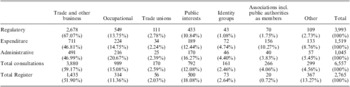
Table 1 describes the dataset according to interest group and policy type and compares it to the distribution between group types in the Transparency register. At first sight, the relative degree of similarity in the representation of different types of interests in these two samples is striking. Hence, we see that the dominance of business interests is not a feature of Commission online consultations alone but that it reflects a similar distribution in the EU interest-group population as a whole. At the same time, the joint participation of business and occupational groups is approximately 11 percentage points higher in the consultations than in the population. A binomial significance test indicates that the difference between the two in the share of business versus non-business groups is significant (p < 0.001). Strong EU business participation is also what we would expect due to the high degree of EU policy competence in business-related areas. In fact, we see that business is even more dominant in this system than in the US Washington Representatives Directory, for example.Footnote
42
This ‘business overrepresentation’ is matched by an ‘underrepresentation’ of public interest groups and groups representing other interests, which include social welfare and the poor, education, health and foreign and development aid groups in the EU system. Finally, we find preliminary evidence that there may be differences in the participation of different types of interests between different policy types, as we expected. Even if business and occupational groups dominate participation in all types of policy, their dominance is less pronounced in expenditure than in regulatory policy.
Table 1
Distribution of Interest Group Substantive Type across Policy AreasFootnote *
Following existing literature, we calculate two measures of bias for each consultation, which we use as dependent variables in the subsequent analysis.Footnote
43
The first is the Herfindahl-Hirschmann Index (HHI). It is calculated for each consultation as the sum of the squared proportions of organizations belonging to each category. The index ranges from 1/(number of categories) to one with values closer to 1, indicating bias. Because each interest group falls into one of seven categories, bias of substantive interest-group type measured this way ranges from 1/7 (minimal bias: each of the seven substantive types participate to an equal degree) to 1 (maximal bias: all contributing actors come from a single type). One of the disadvantages of using the HHI as a measure of bias is that each category mathematically will count as equally ‘distinct’ from the other categories. However, arguments about bias are often made with reference to the degree of business dominance in the interest-group system rather than how concentrated the range of different substantive interests is. Therefore, we also use a second indicator of bias by measuring the relative presence of business in the set of interest groups participating in consultations. To measure the relative presence of ‘business’ at European Commission consultations more effectively, we combine the categories business and trade associations and occupational associations.
The first independent variable is the policy type to which a consultation relates. In line with Kardasheva, regulatory proposals involve costs to be covered primarily by private actors (without direct costs for Member States or the EU budget).Footnote
44
An expenditure proposal is one which is expected to affect the allocation of EU funding and to contain a direct reference to the EU financial framework, or one involving costs to be covered largely by Member States’ own budgets. Finally, administrative proposals are expected to involve no or minor costs. Classifying policy type is far from easy and we do not claim to have found the perfect solution. Relying on knowing who funds a given policy has the advantage that it uses a very explicit criterion for classifying policies rather than a more abstract definition of policy type. Moreover, we avoid making the assumption that all policies within a given policy domain fall within one category.
We also include a variable in our analysis for whether the suggested policy is likely to involve concentrated or diffuse costs. Because such a classification involves subjective judgement, we used a two-step coding procedure: coders were first asked to record the actor(s) targeted by the intended legislation or guidelines, i.e. those actors whose behaviour is modified under legislation, or for whom guidelines for behaviour are issued. Thereafter, they were asked to evaluate whether the costs of the policy (whether guidelines or legislation) will be concentrated among firms within a small number of industries or sectors or are diffuse across multiple industries/sectors or the taxpayers at large. Interest-group density is measured by counting the number of contributions by interest group for each consultation. Moreover, to see whether diversity in the participation of different substantive types of interest groups is linked to diversity of all the seven actor types that may have participated in a given consultation, we calculate an additional HHI, which measures the degree of concentration across all seven actor types.
We use ordinary least squares (OLS) to examine bias across numerous categories of interests and fractional logit to examine the share of business interests. The fact that the linear and additive properties of the OLS model make possible predictions for bias that lie outside its range of allowable values does not bias the results in the first models, because the calculated Herfindahl values are approximately normally distributed. In contrast, the non-normal distribution of our second dependent variable, the proportion of business and occupational interest groups, forced us to use an alternative technique. When the range of a dependent variable is bounded by 0 and 1, Papke and Wooldridge propose a fractional logit model in the framework of generalized linear modelling (GLM) that assumes a binomial distribution for the dependent variable.Footnote
45
Moreover, unlike in OLS, the predictions will lie within the actual range of the dependent variable. Given that logit adequately links the data to the likelihood function (which is testable), the results are consistent and robust standard errors are required.
For both dependent variables, we present a simple model with the key independent variables (interest-group density, country bias, organizational bias among all groups, and policy type using the three-type categorization) and a second model with control variables. First, we include the length of the consultation from the date the consultation opened until the deadline for submitting contributions. Secondly, we control for the year in which a consultation took place because the greater use of consultations over time might encourage mobilization of a broader range of interests.
Analysis
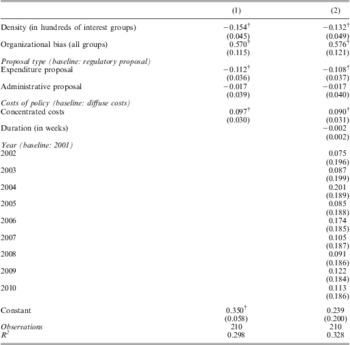
The results for the first regression on substantive bias across numerous categories of interest groups are given in Table 2. As expected, policy type affects interest-group bias. With regulatory policy as the base case, we see that expenditure policies are significantly less biased while ‘administrative’ policies are not significantly different. The HHI is 0.11 lower for expenditure policies than for regulatory policies. The structure of costs also has an effect. In both models, consultations on proposed policies where the costs are expected to be concentrated have a higher degree of bias than those where the costs are likely to be diffuse. In substantive terms, the HHI is between 0.10 (Model 1) and 0.09 (Model 2) higher for policies involving concentrated costs than for those involving diffuse costs. As expected we find a negative effect of interest-group density on the HHI in both models. Each additional one hundred groups lowers the HHI by between 0.15 (Model 1) and 0.13 (Model 2).
Table 2
OLS Explaining Bias (HHI) in Representation of Substantive Interests across Categories (Unstandardized Coefficients)
We also find some evidence that consultations that are complex in one respect are more diverse on another dimension. The degree to which participation is concentrated across all types of groups (i.e. across categories such as public actors, companies, individuals etc) has a significant effect on interest-group bias in both models. None of the control variables in Model 2 are statistically significant. We might have expected to see some learning effects over time in the use of consultations. It is plausible that greater use and familiarity with the instrument could have encouraged mobilization of a broader range of interests. However, we find no significant differences between biases in the different years. There is also no indication that consultations which have lasted longer have given the opportunity for a broader range of interests to mobilize. Even if the inclusion of the control variables improves the fit of the model from an R
2 of 0.30 in Model 1 to 0.33 in Model 2, these scores also indicate that there is still a certain amount of variation in interest-group bias to be explained.
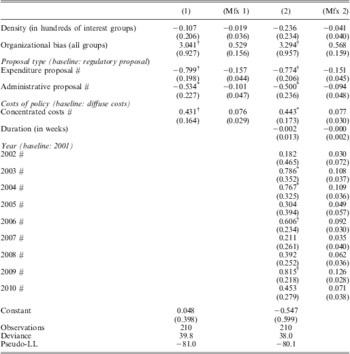
Finally, we present fractional logit models to explain the proportion of business, trade and occupational groups among interest groups contributing to a consultation (Table 3). These models are analogous to those of our first dependent variable and thus contain the same independent variables. In order to interpret the substantive results of these models more accurately, marginal effects for each variable are presented alongside each in Table 3. Our findings are generally in line with what we just saw in the OLS regressions with the Herfindahl indices.
Table 3
Fractional Logit Explaining Proportion of Business and Occupational Groups (Unstandardized Coefficients) with Marginal Effects
Most importantly, the proportion of business and occupational groups also differs markedly between consultations concerning regulatory policies where the costs fall primarily on private actors and those concerning expenditure policies where the costs are financed by EU and national budgets. Expenditure policies have a lower share of business groups, that is between 0.16 (Model 1) and 0.15 (Model 2). Here the difference between ‘administrative’ policies and regulatory policies is also statistically significant (the proportion is lower by 0.10 and 0.09 for Models 1 and 2, respectively). We again see the effect of the cost structure in both models. Proposals with concentrated costs have a greater share of business groups, that is 0.08 percentage points higher in both models. Whereas interest-group density had a significant effect on bias across interest categories in the first model, we do not find such an effect on the relative presence of ‘business’ here. It could be that even if more actors are present the accent of the heavenly chorus does not change much since they all sing with similar accents. Finally, we again find effects suggesting that consultations that are complex in one respect are also more diverse on another dimension. Organizational concentration across all types of actors has a positive effect on the proportion of business and occupational groups, an effect that is significant in both models. As consultations receive contributions from fewer types of actors (beyond interest groups) contributions from interest groups come increasingly from business and occupational groups. None of the control variables were again significant in the more fully specified model, with the exception of the years 2003, 2004, 2006, and 2009, which were all more biased than 2001.Footnote
46
To ensure the appropriateness of fractional logit, two specification tests were carried out. Both the link test and the Ramsey RESET test reveal a properly specified model.
Conclusion
Our findings support Schattscheider's predictions that the ‘pluralist choir’ does not sing without an accent. Business dominance is very obvious at the aggregate level and present in all types of policy examined. Moreover, even if there is a high degree of similarity in the participation of different group types in consultations and the analysed register, business groups are more strongly represented in the former than in the latter. At the same time, we add to Schattschneider's conclusions by demonstrating the conditions under which the dominance of the business accent is likely to be of different strength in the different consultations. Drawing on insights from the public policy literature, we show how the degree of bias varies between policies with different cost structures in all model specifications and types. In this way, we confirm the expectations in a large share of the public policy literature that the nature of conflict and controversy of a given policy area is likely to affect the mobilization of interests. Moreover, we offer a systematic, empirical, large n test of how the character of different types of policy affects these mobilization patterns in Commission consultations. First, we saw that it matters who funds a given policy. Expenditure policies funded by the EU or national budgets attracted the attention of a broader set of interests than regulatory ones, where private producers carried the costs and which are often more narrow and technical in scope. Secondly, we found evidence that it is not only who pays but also how concentrated and diffuse the costs of a planned policy are that affects mobilization. Policies whose costs are concentrated on, for example, a small number of industries or sectors are likely to witness more bias in mobilization than those whose costs are diffuse across many industries/sectors or the taxpayers at large.
Needless to say our dataset will not provide the final word on whether EU interest representation is biased, since Commission consultations constitute only one of many different types of lobbying activities used by interest groups. Future work should, therefore, expand ours to other areas of lobbying. Moreover, it should move the research agenda forward by refining our measures and thinking further about the linkages between these concepts and mobilization in a systematic way. More theory that systematically considers the links between policy characteristics of concrete issues and mobilization is a fruitful way forward. Just as linguistic accents are rather persistent in the real world, such efforts will not ultimately remove whatever accents will dominate the different heavenly choirs of the future. However, such knowledge will allow researchers to deepen their understanding of the linkages between the character of policy and external actor involvement.






Social science literature contains ample warning that even if a range of methods exists for involving external interests in policy making, external interests still do not necessarily have equal opportunities to voice their concerns. Schattschneider's oft-quoted indictment of the American interest-group system that ‘the flaw in the pluralist heaven is that the heavenly chorus sings with a strong upper-class accent’ has been echoed in subsequent studies not only of the United States but also of other political systems.Footnote 1 However, even if the literature finds strong support for the conclusion that business interests dominate at the aggregate level, such a finding masks considerable internal variation. The bias in the heavenly chorus is not equally strong every time it sings, because a number of characteristics related to the performance itself may affect the degree of bias. It is, therefore, surprising to find a lack of studies explaining and empirically testing the conditions under which we are likely to see different levels of bias in the participation of substantive interests between cases. Moreover, studies often draw conclusions on bias without explicitly relating the distribution of active interests to that of the interest-group population as a whole.
In this research note, we analyse a new dataset of participation in the European Commission's online consultations during the last ten years and compare it to the population of registered interests. Our aggregate findings show that business dominance in consultations is even higher than in the population of registered groups. Moreover, our findings offer a first systematic empirical, large n test of how the character of different types of policy affects participation patterns. We find a linkage between characteristics of policies and degrees of bias in individual consultations. Participation on expenditure issues with direct consequences for budgets is more diverse than on regulatory issues, where private actors primarily cover the costs. Finally, a narrower range of interests mobilize on proposals with concentrated costs than on proposals whose costs are carried by a broader range of stakeholders. We start the note by briefly reviewing the literature on bias in interest representation and considerations of the conditions under which we should expect it to vary. Thereafter, we examine how the character of policy affects mobilization patterns.
What Explains Varying Levels of Bias?
Most of the literature of diversity in interest representation focuses on the American system and largely confirms Schattschneider's critical assessment by finding strong business dominance, no matter whether studies examine active interests on specific issues,Footnote 2 PAC registrations,Footnote 3 or the structure of organized interest at the state and federal level in the United States.Footnote 4 Also studies of the European Union (EU) population of interest representatives find that the participation of different types of interests is not equal. Recent studies have linked data from different public and commercial registers of EU interest representatives. Such studies include a broad range of all those actors lobbying the EU, including corporations, interest associations, consultants and law firms, and found that industry associations and corporations dominate.Footnote 5 Moreover, when it comes to participation by actors in specific EU-level activities, analyses by Quittkat and Finke and Quittkat of actor participation in consultation instruments of the Directorate-General (DG) for Employment and the Directorate for Health and Consumers (SANCO) and a smaller number of case studies of online consultations also find that business associations play a very prominent role.Footnote 6
One problem involved in interpreting many of these findings is that there is no good benchmark for judging whether a certain balance of interests is sufficient. Moreover, it should be remembered that participation can be biased in a number of different respects.Footnote 7 Here, bias refers to the distribution between different types of substantive interests, such as business interests, occupational groups, unions, public groups, identity groups and other interests. Moreover, since the literature is concerned with whether business interests dominate, we also look specifically at their degree of participation. To understand fully bias in mobilization, we would like ideally to compare this distribution to the latent interests in society. However, there is no such thing as a good overview of all the potential latent interests, which makes it very difficult to know how an unbalanced system of interest representation would actually look.Footnote 8 Instead, we compare the participation of these different types of interests in Commission consultations to their representation in the EU interest-group population as a whole. This means that, like the remaining literature, we will not be able to judge whether all latent interests are active. At the same time, relating active interests to those registered to lobby the EU serves as a crucial benchmark that allows us to avoid making a purely normative assessment of bias. Hence, not all types of interests may exist in equal numbers in the first place. Therefore, we would not necessarily expect them to demonstrate similar frequencies of participation.Footnote 9
Another challenge in the existing literature is that, despite frequent criticism of bias in participation, we know little about the conditions under which bias is likely to vary. Our emphasis here is therefore not only on assessing the overall distribution of different types of substantive interests but on explaining relative differences in this distribution between individual cases of external actor participation. Several studies have examined variation in the structure of state interest-group populations in the United States.Footnote 10 However, because these studies examine the diversity of populations between different geographical entities rather than the use of different participatory exercises within a given entity, many of the independent variables in their models are at the system level and thus not suitable for our analysis. Therefore, we also consider the broader literature of interest representation and public policy to develop expectations about the conditions under which we should expect bias in participation to vary.
Policy Type And Cost Structure
The literature on public policy states that different policies generate different levels of conflict and controversy and that in turn this may lead to differences in the bias of mobilized interests. To theorize what it is exactly about the character of different types of policy that affects mobilization patterns, we suggest considering who carries the costs of a given policy and what its cost structure looks like. Who pays for a given policy was one of several important criteria considered by Lowi in his distinction between different types of policies.Footnote 11 Policies with direct consequences for public budgets are often highly important to different parts of the public because they involve allocating public funding for goods and services among different groups of actors. Examples of such public expenditure policies in the EU include agricultural transfers and research support. It is likely that much attention will be cast on such issues, and we would expect a relatively broad spectrum of different types of interests to mobilize and voice their concerns. In contrast, regulatory policies limit the discretion of certain actors or compel them to engage in certain types of behaviour. Typically the costs of such regulations are carried by the target groups themselves rather than being financed via public budgets. Examples of regulatory policy in the EU include business regulation and the regulation of public goods such as air, water and communication. Such issues often relate to a narrower group of interests and may also be less important to the general public than the more principled distributive issues, which concern public budgets directly. Important parts of the public might therefore be inattentive and not bothered if a few technical experts broker the details with policy makers. We would thus expect a more narrow set of interests to mobilize on regulatory issues, where private actors primarily cover the costs, than on expenditure issues with direct consequences for the EU or member state budgets.
Recent work by Broscheid and Coen also argues that there is a link between the regulatory-distributive distinction and the number of actors that mobilize.Footnote 12 According to them, regulatory policy is ‘usually fairly technical’, which makes the costs associated with lobbying fairly high, since a comparatively high level of expert input is required.Footnote 13 In contrast, the costs of mobilizing for interest groups should be lower, where the expertise required is more of an administrative/positional nature. As a result the number of groups mobilizing should be higher in distributive than in regulatory policy domains. It is likely that these differences in the organizational and lobbying costs between issue areas should affect not only the numbers but also the broadness of the interests that mobilize.
Apart from who funds a given policy, the structure of costs incurred by a policy might also affect the broadness of the range of interests that mobilizes. We are interested in whether the costs of the policy will be concentrated among firms within a small number of industries or sectors or are diffuse across multiple industries/sectors or the taxpayers at large. This distinction was one of the dimensions in Wilson's policy typology in which he outlined four different subsystems of politics characterized by different combinations of concentrated and diffused costs and benefits.Footnote 14 In particular, we expect that groups should have a strong incentive to mobilize when the agenda includes points that incur costs for them and might potentially hurt them. However, the broadness of the range of groups that mobilize is likely to depend on how diffuse and concentrated these costs are. We would expect a more narrow set of interests to mobilize when the costs are concentrated than when they are diffuse.
Complexity And Density
Truman argued that ‘complex civilization necessarily develops complex political arrangements. Where the patterns of political behavior in society are intricate, the patterns of political behavior must be also’.Footnote 15 He and other scholars have subsequently used this reasoning to argue that there should be a link between the degree of economic complexity and the diversity of participation.Footnote 16 This argument cannot be tested directly in a study of one system only. However, based on this logic we argue that, if a given participatory exercise is complex in one respect, we would also expect it to be complex and diverse in others. We can also think of a participatory exercise as being complex by attracting the participation of both many different types of actors on an aggregate level (public actors, interest groups, individuals etc) but also by attracting many different types of interest groups within the interest-group category itself. If complexity in one respect influences complexity in another, we would expect the two to be related. Hence, from a pluralist perspective, the underlying societal structures that are likely to trigger different types of actors to mobilize in one respect are also likely to be the ones that trigger diversity in others. All things being equal, we would expect, therefore, that the more diverse the range of different actor types participating, the lower the level of bias between the different types of substantive interest groups that participate in a given consultation.
A final factor to consider here is how the total number of mobilizing actors on a consultation should affect bias. According to Truman's idea of ‘countervailing power’, groups mobilize in response to disturbances to their own interests.Footnote 17 As the public policy agenda involves issues of concern to them, groups mobilize and the net result is a system where all salient interests are represented. There is little worry of bias because the idea of ‘countervailing power’ is that as one type of interest mobilizes to defend its views, other groups will mobilize to counterbalance those views. This logic may not only hold at the system level but also in concrete participatory exercises. An important motivation for groups to participate is to counterbalance the views of others. In such a situation, a higher number of groups not only leads to further increases in the number of groups, but also lowers bias among the types of participating interests. All things being equal, we would expect, therefore, that the higher the number of participating groups, the lower the level of bias between different types of substantive interest groups in a given consultation.
Consultations In The European Union
We examine the European Commission's online consultations to test our theory. They are commonly referred to as ‘online’ consultations, because calls for these consultations are published online, typically on the websites of the different European Commission DGs and on the single access point for these consultations, ‘Your Voice in Europe’. However, the norm is that contributions can be submitted both online and offline, meaning that our dataset includes both types. Although consultations are not systematically held on all legislative proposals, they tend to take place on the most salient ones, and any initiative subject to an extended impact assessment is generally open for consultation.Footnote 18 A recent investigation by Rasmussen and Toshkov of the official documents of all proposals submitted to the 2004–09 European Parliament under the co-decision legislative procedure reports that consultations took place on 52 per cent of the files with evidence of some form of external stakeholder involvement in the preparatory phase of making policy.Footnote 19
After presentation of an initial policy document by the Commission, interested parties are given a minimum of two months to respond. Typically the European Commission finishes the process by reporting the number of responses and explaining how it has taken the presented views into account.Footnote 20
There are good reasons for expanding the study of bias in participation to the EU system, which is a political system that places a particularly high emphasis on involving external stakeholders, not least as a result of continued criticism of its state of democracy.Footnote 21 The Lisbon Treaty is based on both ‘the principle of representative democracy’ and the ‘principle of participatory democracy’ and the Treaty on European Union explicitly states that the Union shall ‘maintain an open, transparent and regular dialogue with representative associations and civil society’.Footnote 22 An ambitious White Paper on European Governance was put forward in 2001 and followed up by a Communication including a series of general principles and minimum standards for the conduct of consultations.Footnote 23
Our primary goal is to examine how general factors linked to policies and mobilization patterns affect relative levels of bias irrespective of the institutional setting.Footnote 24 The EU is not a state, but shares important characteristics with other political systems.Footnote 25 When it comes to consulting external interests, online consultations of the Commission are comparable to consultations conducted in a number of other political systems on proposed legislation and other initiatives by executives before such initiatives are presented to parliaments.Footnote 26 However, we cannot ignore that there are structural differences in interest representation and lobbying between the EU and other political systems, just as there are differences between national political systems in general, which may affect absolute levels of bias in participation. All things being equal, we would expect a relatively strong degree of business participation in the EU. Even if a high share of competences has been delegated to this level, its degree of competence is particularly strong in business-related policy areas.Footnote 27 This is exactly why the present study does not look at diversity in activity relative to some abstract notion of bias or the bias level of a specific national political system. Instead, we use a benchmark from a second dataset, which enables us to compare the diversity of substantive types of interest groups participating in concrete lobbying activities to the Commission to that of those registered as lobbying the European Union.
Online consultations are only one of many tools for involving the voices of external interests, which also happens in advisory committees, stakeholder forums, and through informal contacts of a purely ad hoc nature. Hence, actors participating in consultations may not constitute a representative sample of all active external interests. However, the advantage of examining online consultations is that the barriers to entry in this form of external actor involvement are relatively low. They are typically open to everyone including interest groups, public actors and individual citizens and do not require prior invitation. Moreover, even if contributing requires certain skills from participants, it requires fewer resources than other types of lobbying, where participants need to travel to meet face-to-face with decision-makers.
Data And Methodology
Our first dataset contains information about consultations conducted between December 2001 and April 2010. Consultations are launched by the relevant European Commission Directorates-General (DGs) and typically published on the Your Voice in Europe portal and/or the websites of the separate DGs.Footnote 28 Because there is no single access point where information about consultations is stored, and also not necessarily a standard location for where information on consultations on the individual DG websites is stored, locating information about them is far from easy. All consultations for which we could find information about participating actors online in June/August 2011, i.e. altogether 219 consultations, are included in our dataset.Footnote 29 These consultations span over seventeen different Commission DGs and demonstrate a high degree of variation in our main independent variables, which are discussed below.
If there are any missing submissions for a given consultation, there is no reason why they should be non-random with respect to actor and interest-group type.Footnote 30
Two independent human coders recorded more detailed information about the contents of the consultations and the contributing actors by visiting their websites (when available). Coders received detailed instructions beforehand and disagreements were checked by a third coder with previous experience with the coding scheme from a similar project. Actors were classified into: (1) company, (2) public organization, (3) European body or institution, (4) private person, (5) interest group, (6) international organization or (7) other. We define an interest group as ‘an association of individuals or organizations, usually formally organized, that on the basis of one or more shared concerns, attempts to influence public policy’.Footnote 31 The analyses here are made for the 210 consultations where we registered interest-group contributions. Our reason for doing this it that, even if we mentioned there are many ways of understanding bias, our focus is on the distribution between different types of substantive interests that participate rather than what the balance is between the general actor categories listed above. Many of the general actor categories above do not give us this information. As one example, stating that public actors or individuals have contributed to a participatory exercise does not tell us which substantive interests are represented, since some public actors and individuals might represent business, others might support the environment etc. In contrast, the advantage of focusing on groups is that the group type itself gives more information on the substantive interest represented. Using a modified version of Schlozman et al.'s categorization we distinguish between (1) trade and other business associations, (2) occupational associations, (3) unions, (4) public interests, (5) identity groups, (6) organizations including public authorities as members and (7) other interests.Footnote 32
Our second data source is a dataset constructed by Vlad Gross from the Transparency Register, which was launched in June 2011.Footnote 33 The Transparency Register includes the Commission Register of interest representatives (former CONECCS) and the former European Parliament registry. It contains a broad range of actors seeking access to EU policy making, including companies, professional consultancies, local and regional authorities and different types of association. When downloading the data in November 2011, Gross only included information for the actor categories from the Transparency Register that were relevant for our analysis of interest groups and subsequently deleted an additional 290 entries from these categories that did not fit our definition of what constitutes an interest group.Footnote 34 As a result, the dataset includes altogether 2,786 interest groups from the Transparency Register, of which Gross was able to code 2,765 according to the same coding scheme for interest-group type as the consultation data.
Registration is voluntary, meaning that even if it is currently by far the biggest register of EU interest representatives, it is unlikely to contain all active interests lobbying the EU. However, it is the best available benchmark for us at the present moment. First, many previous registers, such as CONECCS and the EP door-pass register are no longer being updated and typically also contained a lower number of actors than the transparency register into which these databases are now integrated. Berkhout and Lowery conclude that CONECCS contained approximately 750 organizations in 2007 but this figure ‘significantly underrepresents the population of interests’.Footnote 35 Moreover, in the door-pass register (which contained some 2,000 actors), we can expect a bias towards organizations with a physical presence in Brussels or Strasbourg, making it less relevant for comparison with consultations, for which responses can be submitted from anywhere. Finally, even if several commercial directories exist, the most important of which are Landmarks’ ‘European Public Affairs Directory’, Euroconfidentiel's ‘Directory of European Union Information Sources’ and Dods’ ‘European Union and Public Affairs Directory’, they contain a diverse set of actor types, which may not be in regular contact with the EU institutions and the criteria for inclusion are not well specified.Footnote 36 Secondly, relying on the Transparency Register is preferable to using the data sources compiled by other scholars. The best of these is that of Wonka et al. which combines the data sources listed above.Footnote 37 However, it is not coded for type of interest group and includes a broad range of actors using a categorization that is not easily comparable to others. Moreover, it relies on older data sources and actually contains a lower number of interest-group actor categories than the Transparency Register at the time we downloaded it. Finally, another alternative would be to rely on a dataset used by Berkhout and Lowery and Messer et al., where the authors took random samples of actors from two editions of three commercial directories, the CONECCS register, and the EP door-pass register.Footnote 38 However, this dataset has not been updated either and by sampling fifty actors from each source does not map the interest-group population as a whole.Footnote 39
In sum, even if the Transparency Register does not contain a perfect overview of the EU interest- group population, it is the most relevant register to use as a benchmark here. The Commission's policy is to use the register as a basis for its different contacts and activities, which should encourage registration.Footnote 40 Moreover, even if we know that companies, lobby consultancies, law firms and think tanks have been reluctant to register, none of the reviews conducted report a systematic bias in the registration of different types of interest groups, which is what matters here.Footnote 41 Hence, we are interested in the relative difference in the number of registered group types.
Table 1 describes the dataset according to interest group and policy type and compares it to the distribution between group types in the Transparency register. At first sight, the relative degree of similarity in the representation of different types of interests in these two samples is striking. Hence, we see that the dominance of business interests is not a feature of Commission online consultations alone but that it reflects a similar distribution in the EU interest-group population as a whole. At the same time, the joint participation of business and occupational groups is approximately 11 percentage points higher in the consultations than in the population. A binomial significance test indicates that the difference between the two in the share of business versus non-business groups is significant (p < 0.001). Strong EU business participation is also what we would expect due to the high degree of EU policy competence in business-related areas. In fact, we see that business is even more dominant in this system than in the US Washington Representatives Directory, for example.Footnote 42 This ‘business overrepresentation’ is matched by an ‘underrepresentation’ of public interest groups and groups representing other interests, which include social welfare and the poor, education, health and foreign and development aid groups in the EU system. Finally, we find preliminary evidence that there may be differences in the participation of different types of interests between different policy types, as we expected. Even if business and occupational groups dominate participation in all types of policy, their dominance is less pronounced in expenditure than in regulatory policy.
Distribution of Interest Group Substantive Type across Policy AreasFootnote *
* A chi-square contingency test reveals that the distributions of interest groups by substantive type in the consultations and Transparency Register data are significantly different (p < 0.001).
Following existing literature, we calculate two measures of bias for each consultation, which we use as dependent variables in the subsequent analysis.Footnote 43 The first is the Herfindahl-Hirschmann Index (HHI). It is calculated for each consultation as the sum of the squared proportions of organizations belonging to each category. The index ranges from 1/(number of categories) to one with values closer to 1, indicating bias. Because each interest group falls into one of seven categories, bias of substantive interest-group type measured this way ranges from 1/7 (minimal bias: each of the seven substantive types participate to an equal degree) to 1 (maximal bias: all contributing actors come from a single type). One of the disadvantages of using the HHI as a measure of bias is that each category mathematically will count as equally ‘distinct’ from the other categories. However, arguments about bias are often made with reference to the degree of business dominance in the interest-group system rather than how concentrated the range of different substantive interests is. Therefore, we also use a second indicator of bias by measuring the relative presence of business in the set of interest groups participating in consultations. To measure the relative presence of ‘business’ at European Commission consultations more effectively, we combine the categories business and trade associations and occupational associations.
The first independent variable is the policy type to which a consultation relates. In line with Kardasheva, regulatory proposals involve costs to be covered primarily by private actors (without direct costs for Member States or the EU budget).Footnote 44 An expenditure proposal is one which is expected to affect the allocation of EU funding and to contain a direct reference to the EU financial framework, or one involving costs to be covered largely by Member States’ own budgets. Finally, administrative proposals are expected to involve no or minor costs. Classifying policy type is far from easy and we do not claim to have found the perfect solution. Relying on knowing who funds a given policy has the advantage that it uses a very explicit criterion for classifying policies rather than a more abstract definition of policy type. Moreover, we avoid making the assumption that all policies within a given policy domain fall within one category.
We also include a variable in our analysis for whether the suggested policy is likely to involve concentrated or diffuse costs. Because such a classification involves subjective judgement, we used a two-step coding procedure: coders were first asked to record the actor(s) targeted by the intended legislation or guidelines, i.e. those actors whose behaviour is modified under legislation, or for whom guidelines for behaviour are issued. Thereafter, they were asked to evaluate whether the costs of the policy (whether guidelines or legislation) will be concentrated among firms within a small number of industries or sectors or are diffuse across multiple industries/sectors or the taxpayers at large. Interest-group density is measured by counting the number of contributions by interest group for each consultation. Moreover, to see whether diversity in the participation of different substantive types of interest groups is linked to diversity of all the seven actor types that may have participated in a given consultation, we calculate an additional HHI, which measures the degree of concentration across all seven actor types.
We use ordinary least squares (OLS) to examine bias across numerous categories of interests and fractional logit to examine the share of business interests. The fact that the linear and additive properties of the OLS model make possible predictions for bias that lie outside its range of allowable values does not bias the results in the first models, because the calculated Herfindahl values are approximately normally distributed. In contrast, the non-normal distribution of our second dependent variable, the proportion of business and occupational interest groups, forced us to use an alternative technique. When the range of a dependent variable is bounded by 0 and 1, Papke and Wooldridge propose a fractional logit model in the framework of generalized linear modelling (GLM) that assumes a binomial distribution for the dependent variable.Footnote 45 Moreover, unlike in OLS, the predictions will lie within the actual range of the dependent variable. Given that logit adequately links the data to the likelihood function (which is testable), the results are consistent and robust standard errors are required.
For both dependent variables, we present a simple model with the key independent variables (interest-group density, country bias, organizational bias among all groups, and policy type using the three-type categorization) and a second model with control variables. First, we include the length of the consultation from the date the consultation opened until the deadline for submitting contributions. Secondly, we control for the year in which a consultation took place because the greater use of consultations over time might encourage mobilization of a broader range of interests.
Analysis
The results for the first regression on substantive bias across numerous categories of interest groups are given in Table 2. As expected, policy type affects interest-group bias. With regulatory policy as the base case, we see that expenditure policies are significantly less biased while ‘administrative’ policies are not significantly different. The HHI is 0.11 lower for expenditure policies than for regulatory policies. The structure of costs also has an effect. In both models, consultations on proposed policies where the costs are expected to be concentrated have a higher degree of bias than those where the costs are likely to be diffuse. In substantive terms, the HHI is between 0.10 (Model 1) and 0.09 (Model 2) higher for policies involving concentrated costs than for those involving diffuse costs. As expected we find a negative effect of interest-group density on the HHI in both models. Each additional one hundred groups lowers the HHI by between 0.15 (Model 1) and 0.13 (Model 2).
OLS Explaining Bias (HHI) in Representation of Substantive Interests across Categories (Unstandardized Coefficients)
Note: Standard errors in parentheses. *p < 0.05, †p < 0.01.
We also find some evidence that consultations that are complex in one respect are more diverse on another dimension. The degree to which participation is concentrated across all types of groups (i.e. across categories such as public actors, companies, individuals etc) has a significant effect on interest-group bias in both models. None of the control variables in Model 2 are statistically significant. We might have expected to see some learning effects over time in the use of consultations. It is plausible that greater use and familiarity with the instrument could have encouraged mobilization of a broader range of interests. However, we find no significant differences between biases in the different years. There is also no indication that consultations which have lasted longer have given the opportunity for a broader range of interests to mobilize. Even if the inclusion of the control variables improves the fit of the model from an R 2 of 0.30 in Model 1 to 0.33 in Model 2, these scores also indicate that there is still a certain amount of variation in interest-group bias to be explained.
Finally, we present fractional logit models to explain the proportion of business, trade and occupational groups among interest groups contributing to a consultation (Table 3). These models are analogous to those of our first dependent variable and thus contain the same independent variables. In order to interpret the substantive results of these models more accurately, marginal effects for each variable are presented alongside each in Table 3. Our findings are generally in line with what we just saw in the OLS regressions with the Herfindahl indices.
Fractional Logit Explaining Proportion of Business and Occupational Groups (Unstandardized Coefficients) with Marginal Effects
Note: Standard errors in parentheses for the coefficients; robust standard errors of the marginal effects in parentheses for the marginal effects. *p < 0.05, †p < 0.01. # Dummy variables for which a discrete change from 0 to 1 is reported; otherwise marginal effects at the mean are reported for each independent variable.
Most importantly, the proportion of business and occupational groups also differs markedly between consultations concerning regulatory policies where the costs fall primarily on private actors and those concerning expenditure policies where the costs are financed by EU and national budgets. Expenditure policies have a lower share of business groups, that is between 0.16 (Model 1) and 0.15 (Model 2). Here the difference between ‘administrative’ policies and regulatory policies is also statistically significant (the proportion is lower by 0.10 and 0.09 for Models 1 and 2, respectively). We again see the effect of the cost structure in both models. Proposals with concentrated costs have a greater share of business groups, that is 0.08 percentage points higher in both models. Whereas interest-group density had a significant effect on bias across interest categories in the first model, we do not find such an effect on the relative presence of ‘business’ here. It could be that even if more actors are present the accent of the heavenly chorus does not change much since they all sing with similar accents. Finally, we again find effects suggesting that consultations that are complex in one respect are also more diverse on another dimension. Organizational concentration across all types of actors has a positive effect on the proportion of business and occupational groups, an effect that is significant in both models. As consultations receive contributions from fewer types of actors (beyond interest groups) contributions from interest groups come increasingly from business and occupational groups. None of the control variables were again significant in the more fully specified model, with the exception of the years 2003, 2004, 2006, and 2009, which were all more biased than 2001.Footnote 46 To ensure the appropriateness of fractional logit, two specification tests were carried out. Both the link test and the Ramsey RESET test reveal a properly specified model.
Conclusion
Our findings support Schattscheider's predictions that the ‘pluralist choir’ does not sing without an accent. Business dominance is very obvious at the aggregate level and present in all types of policy examined. Moreover, even if there is a high degree of similarity in the participation of different group types in consultations and the analysed register, business groups are more strongly represented in the former than in the latter. At the same time, we add to Schattschneider's conclusions by demonstrating the conditions under which the dominance of the business accent is likely to be of different strength in the different consultations. Drawing on insights from the public policy literature, we show how the degree of bias varies between policies with different cost structures in all model specifications and types. In this way, we confirm the expectations in a large share of the public policy literature that the nature of conflict and controversy of a given policy area is likely to affect the mobilization of interests. Moreover, we offer a systematic, empirical, large n test of how the character of different types of policy affects these mobilization patterns in Commission consultations. First, we saw that it matters who funds a given policy. Expenditure policies funded by the EU or national budgets attracted the attention of a broader set of interests than regulatory ones, where private producers carried the costs and which are often more narrow and technical in scope. Secondly, we found evidence that it is not only who pays but also how concentrated and diffuse the costs of a planned policy are that affects mobilization. Policies whose costs are concentrated on, for example, a small number of industries or sectors are likely to witness more bias in mobilization than those whose costs are diffuse across many industries/sectors or the taxpayers at large.
Needless to say our dataset will not provide the final word on whether EU interest representation is biased, since Commission consultations constitute only one of many different types of lobbying activities used by interest groups. Future work should, therefore, expand ours to other areas of lobbying. Moreover, it should move the research agenda forward by refining our measures and thinking further about the linkages between these concepts and mobilization in a systematic way. More theory that systematically considers the links between policy characteristics of concrete issues and mobilization is a fruitful way forward. Just as linguistic accents are rather persistent in the real world, such efforts will not ultimately remove whatever accents will dominate the different heavenly choirs of the future. However, such knowledge will allow researchers to deepen their understanding of the linkages between the character of policy and external actor involvement.