

Introduction
Seabird conservation status has recently fallen faster than in any other bird group. While some local declines may be caused by shifts in geographical range due to climate change (Gorta et al. Reference Gorta, Smith, Everett, Kingsford, Cornwell, Suthers, Epstein, McGovern, McLachlan, Roderick, Smith, Williams and Callaghan2019), many declines are in global populations. In 2010, 97 (28%) of the 346 seabird species were globally threatened, of which 17 (5%) were ‘Critically Endangered’ (Croxall et al. Reference Croxall, Butchart, Lascelles, Stattersfield, Sullivan, Symes and Taylor2012). The most recent assessment (BirdLife International 2018) reported that 150 of 359 (42%) seabird species were threatened; the additional 13 seabird species arose from taxonomic decisions, with revised taxa inevitably having small populations, limited distributions, and hence raised threat status. The main drivers of seabird declines, in terms of the number of species affected, were identified by Dias et al. (Reference Dias, Martin, Pearmain, Burfield, Small, Philips, Yates, Lascelles, Garcia, Borboroglu and Croxall2019) as invasive alien species at breeding colonies, fisheries bycatch, and climate change/severe weather. Disturbingly, these authors recognised plastic contamination as an emerging and rapidly increasing threat.
Worldwide, marine ecosystems at all depths are now contaminated with plastics (Eriksen et al. Reference Eriksen, Lebreton, Carson, Thiel, Moore, Borerro, Galgani and Reisser2014, Gibbens Reference Gibbens2019, Jamieson et al. Reference Jamieson, Brooks, Reid, Oiertney, Narayasanaswamy and Linley2019, Ribeiro et al. Reference Ribeiro, Okoffo, O’Brien, Fraissinet-Tachet, O’Brien, Gallen, Samanipour, Kaserzon, Mueller, Galloway and Thomas2020). Many plastics are buoyant in seawater (Lavers and Bond Reference Lavers and Bond2017) and thus susceptible to dispersal by winds, ocean currents and waves (Lebreton et al. Reference Lebreton, Egger and Slat2019), leading to widespread concentration of plastic debris at the ocean surface. Increasingly, this contamination is being found to impact a wide variety of seabirds (Battisti et al. Reference Battisti, Staffierib, Poetab, Soracec, Luisellide and Amor2019). UNESCO (2017) reported that plastic debris killed >1,000,000 seabirds annually. Mortality results primarily from ingestion and entanglement. Ingestion can lead to gut obstruction and consequent starvation (Pierce et al. Reference Pierce, Harris, Larned and Pokras2004, Rodríguez et al. Reference Rodríguez, Rodríguez and Carrasco2012, Lavers et al. Reference Lavers, Bond and Hutton2014, Cartraud et al. Reference Cartraud, Le Corre, Turquet and Tourmetz2019) and Wilcox (Reference Wilcox, van Sebille and Hardesty2015) reported that 59% of seabird species had been found to have ingested plastic fragments, with procellariids being particularly susceptible. Floating plastic particles also provide platforms for colonisation by fouling fauna and flora, including pathogens (Kirstein et al. Reference Kirstein, Kirmizi, Wichels, Garin-Fernandez, Erler, Löder and Gerdts2016), and plastic can adsorb chemical pollutants, including persistent pesticides, hormone analogues and trace metals, which can then impact animals following ingestion (Teuten et al. Reference Teuten, Saquing, Knappe, Barlaz, Jonsson, Björn, Rowland, Thompson, Galloway and Yamashita2009, Kiessling et al. Reference Kiessling, Gutow, Thiel, Bergmann, Gutow and Klages2015, Lavers and Bond Reference Lavers and Bond2016, Wu et al. Reference Wu, Zhang, Huang and Liu2016). Entanglement, which is often associated with, and difficult to distinguish from, fisheries bycatch, where seabirds become trapped in fishing tackle, has reportedly affected 36% of seabird species (Ryan Reference Ryan2018). In some species entanglement can also result from the incorporation of plastic debris in nests (e.g. Votier et al. Reference Votier, Archibald, Morgan and Morgan2011, Grant et al. Reference Grant, Lavers, Stuckenbrock, Sharp and Bond2018, Tavares et al. Reference Tavares, Moura and Merico2019, Garcia-Cegarra et al. Reference Garcia-Cegarra, Ramirez and Orrego2020). The proportion of seabird species affected by plastic debris is predicted to increase as global production of plastics continues to rise (Wilcox et al. Reference Wilcox, van Sebille and Hardesty2015, Provencher et al. Reference Provencher, Bond, Avery-Gomm, Borrelle, Bravo Rebolledo, Hammer, Kühn, Lavers, Mallory, Trevail and van Franeker2017)
The wide geographical distribution of oceanic plastic waste is revealed by its deposition on the beaches of remote islands (e.g. Duhec et al. Reference Duhec, Jeanne, Maximenko and Hafner2015, Bouwman et al. Reference Bouwman, Evans, Cole, Choong Kwet Yive and Kylin2016, Burt et al. Reference Burt, Raguain, Sanchez, Brice, Fleischer-Dogley, Rebecca Goldberg, Talma, Syposz, Mahony, Letori, Quanz, Ramkalawan, Francourt, Capricieuse, Antao, Belle, Zillhardt, Moumou, Roseline, Bonne, Marie, Constance, Jilani Suleman and Turnbull2020, Dunlop et al. Reference Dunlop, Dunlop and Brown2020 for the tropical western Indian Ocean). Both coastal feeding and pelagic seabirds that breed on such islands are thus likely to be exposed to floating plastic particles while foraging, directly and/or through consumption of prey that have ingested plastic.
Seychelles is an archipelago of small remote islands with a land area totalling only 455 km2, within an Exclusive Economic Zone (EEZ) of 1,370,000 km2 of the tropical western Indian Ocean (UNESCO/IOC undated). It supports breeding colonies of 18 species of seabird (Skerrett and Disley Reference Skerrett and Disley2011), of which the most pelagic (Jaeger et al. Reference Jaeger, Feare, Summers, Lebarbenchon, Larose and Le Corre2017) and most abundant (estimated at c.3 million pairs in 2007; Feare et al. Reference Feare, Jaquemet and Le Corre2007) is the Sooty Tern Onychoprion fuscatus.
Sooty Terns are subject to anthropogenic threats worldwide (Huang et al. Reference Huang, Bass and Pimm2017). In Seychelles, large numbers of eggs have been and continue to be harvested for human consumption as a local delicacy (Feare Reference Feare1976a). This has led to population declines and colony extinctions (Feare et al. Reference Feare, Jaquemet and Le Corre2007). A major population decline in the Atlantic Ocean has been accompanied by a dietary shift to a lower trophic level, attributed to increasing sea surface temperature (Bond and Lavers Reference Bond and Lavers2014) and intensive industrial fishing of large predatory fish (Reynolds et al. Reference Reynolds, Hughes, Wearn, Dickey, Brown, Weber, Weber, Paiva and Ramos2019).
During a long-term study of Sooty Terns on Bird Island, Seychelles, begun in 1972, small pieces of plastic were first observed on the ground in the colony in 1994. Most pieces lie on the ground between the closely packed nests, with a few found in the nest depressions (C. Feare pers. obs.). Sooty Terns typically nest on the ground in large colonies (in the western Indian Ocean <2,000,000 pairs; Feare et al. Reference Feare, Jaquemet and Le Corre2007), in which densities of <7 nests/m2 have been recorded (C. Feare and C. Larose unpubl. data). Nests are usually shallow depressions made in the sand, but sometimes additional material is incorporated, often dried vegetation but occasionally small stones, hard fruits of Casuarina equisetifolia or pieces of coral (Schreiber et al. Reference Schreiber, Feare, Harrington, Murray, Robertson, Robertson, Woolfenden, Poole and Gill2002). The added material is pulled towards the nest with the bill, while the bird is sitting in the depression. Nest “material” is thus obtained from the immediate vicinity of the nest depression and is not transported from any distance (C. Feare pers. obs.).
Since 1994, plastic fragments have been observed each breeding season, but their origin is unknown. Similar presence of plastic fragments has been reported from some other Sooty Tern colonies: Farquhar Atoll, Seychelles (A. Duhec pers. comm.), Trinidade Island, Brazil (de Souza-Petersen et al. Reference de Souza-Petersen, Krüger, Dezevieski, Petry and Montone2016) and Ascension Island, South Atlantic (S. J. Reynolds pers. comm.), but in none of these colonies has the behaviour been quantified or the origin of the fragments investigated. In 1995, however, C. Feare placed four plastic fragments, collected in the colony, at each main compass point around 10 nests, c.10 cm from the depression centre. Most fragments were moved but only a few centimetres: some were found closer to the nest centre, one in the depression, while others were moved further away. During prolonged observations at nests, no birds were seen to deliberately move plastic fragments and the observed movements were likely due to sand disturbance when birds landed or moved in the small nest territory.
The aim of the present study was to discover whether the plastic fragments are imported accidentally and might present a threat to the birds’ health (e.g. in food or seawater during drinking), or intentionally (e.g. to aid mate attraction or nest site recognition). We investigated the timeline of appearance of plastic fragments into the colony and attempted to identify the mode of transport of the plastic onto the island (through ingestion and regurgitation or excretion). We used a quadrat sampling approach to examine the spatio-temporal occurrence of small plastic fragments among the nests. We additionally investigated the flotation capacity of plastic fragments found in the colony in seawater to determine the location in the water column where birds were most likely to encounter them. Finally, we aimed to verify whether Sooty Terns were unique in importing plastic fragments or whether other common breeding seabird species on Bird Island, Brown Anous stolidus and Lesser Noddy A. tenuirostris, were also involved.
Methods
Study colony
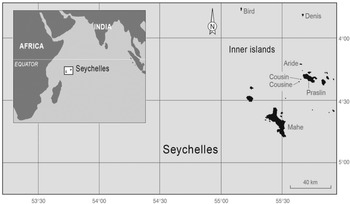
Bird Island (3°43’S, 55°12’E), the northernmost island of the Seychelles archipelago (Figure 1) is a c.100-ha coralline sand cay on the northern edge of the shallow (<100 m) Seychelles Bank. Its maximum elevation is 4 m asl (Hill et al. Reference Hill, Vel, Holm, Parr, Shah and Hill2002), but the main part of the Sooty Tern colony, where our study was located, lies beyond the reach of recent tidal surges (C. Feare pers. obs.). The island is privately-owned with a small hotel catering for c.50 visitors. Bird Island is managed as a nature reserve, with all seabird species protected; however, Sooty Tern eggs are harvested (sanctioned by the Seychelles Ministry of Agriculture, Climate Change and Environment) from part of the colony for sale as a traditional delicacy for people on the main inhabited islands.
Location of Bird Island, Seychelles. The inner islands lie on a shallow bank, with Bird Island on its northern extremity. About 1 km north of Bird Island the ocean floor drops from c.55 m (Braithwaite 1984) to >2,000 m.

Bird Island is categorised as an Important Bird Area based on its large seabird populations (BirdLife International 2019). Breeding species (pairs) include c.500,000 Sooty Terns, c.10,000 Brown Noddies, c.20,000 Lesser Noddies, c.1,000 White Terns Gygis alba, c.50 White-tailed Tropicbirds Phaethon lepturus, and a large population (number unknown) of Wedge-tailed Shearwaters Ardenna pacifica (C. Feare unpubl. data). Additionally, >500 Greater Fregata minor and Lesser F. ariel Frigatebirds and >500 Red-footed Boobies Sula sula and >100 Bridled Terns Onychoprion anaethetus, roost mainly at night but many remain during daytime.
Sooty Terns rely heavily on shoals of predatory fish (especially tuna), and sometimes marine mammals, to drive small fish and squid to or above the sea surface (Schreiber et al. Reference Schreiber, Feare, Harrington, Murray, Robertson, Robertson, Woolfenden, Poole and Gill2002). The prey are caught at or above the water surface during frenzied feeding bouts, whose duration is determined by the feeding behaviour of the predatory fish (Feare Reference Feare2017). Depletion of these large predators was believed to have contributed to the diet change in the tropical Atlantic (Reynolds et al. Reference Reynolds, Hughes, Wearn, Dickey, Brown, Weber, Weber, Paiva and Ramos2019). Sooty Terns also drink in flight, descending to the water surface and momentarily dipping the bill into the water; this behaviour is especially conspicuous during breeding when adults procure water for themselves, and after hatching for their chicks, immediately offshore of the breeding colony. During incubation, adults additionally briefly immerse their feet and bellies, which leads to moistening of the egg on their return to their nest (Feare Reference Feare1976b).
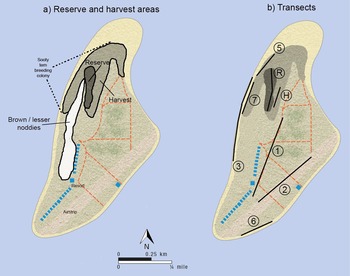
Sooty Terns nest during the south-east trade wind period (May–October). The colony occupies c.11 ha of largely open, sparsely vegetated, ground towards the northern end of the island but some parts of the nesting area spread into beach-crest bush vegetation. The western 3 ha of the Sooty Tern nesting area is designated as a reserve and is fully protected; reserve “R” (Figure 2a, b), and neither island staff nor visitors are permitted to enter this area throughout the breeding season (2–3 researchers excepted). All eggs in the remaining 8 ha of the nesting area are harvested daily at dawn (Feare Reference Feare1976b), after being laid the previous afternoon (Feare Reference Feare1976a); this area is thus visited daily by 10–15 people to collect the eggs; harvest “H” (Figure 2a, b).
Map of Bird Island, with in panel a) the locations of the reserve area (light grey), harvest area (dark grey) and noddy colony (white), and in b) the locations of the seven transects.

Brown and Lesser Noddies also breed mainly during the south-east trade wind season but the former nest also during the wetter north-west monsoon (December–April). Some Brown Noddies nest on the ground in the hotel area but most nest in vegetation (from bushes to trees <20 m tall), while Lesser Noddies are strictly arboreal (trees c.3–20 m)
Our study was undertaken between 2 June and 1 September 2019 and involved sampling during incubation (normally May to mid-June), chick rearing (mid-June to mid-August) and chick fledging (mid-August onwards) in the reserve. Throughout the study, birds in the harvest area were establishing nest territories and laying eggs and left the colony as soon as eggs were harvested, to be replaced by other incoming birds.
Plastic fragments associated with seabird species on Bird Island
To identify whether seabirds were implicated in the ingress of plastic fragments to Bird Island, and already being aware that plastic fragments were commonly found in the Sooty Tern colony, we sampled island habitats outside the colony on 23–25 June. Plastic fragments were searched for and counted in 10 2 x 2 m quadrats along transects through six open (non-woodland) habitats (Figure 2b): (1) a track through the village/hotel area used for transporting goods; (2) the airstrip; (3) wave-washed lower beach on the west coast; (4) upper beach on the west coast where Sooty Terns roosted at night but which was deserted during daytime; (5) upper beach on the west coast where Sooty Terns nested but where eggs were harvested at dawn each day; (6) beach at the southern end of the island where Sooty Terns never landed. At sites 1, 2 and 3, quadrats were spaced at 50-m intervals, while at sites 4, 5 and 6 quadrats were spaced at 20-m intervals.
The soil surface in each quadrat was searched by close examination and, where necessary, by moving low vegetation using forceps. Visible plastic fragments (mostly >1 mm2) were counted and their colour was recorded.
In addition, plastic fragments were searched for within 50 cm of the nests of 50 ground-nesting Brown Noddies in the hotel area (Figure 2a). Most nests had eggs, but some had small chicks. Brown Noddies roost by day on many structures and here they defecate onto the ground below, leaving a white deposit on stone/concrete surfaces. Two of these surfaces, representing a surface area of approximately 10 m2, were examined daily for plastic fragments during June and July.
Searches were also undertaken beneath 51 trees that contained at least 10 Lesser Noddy nests, within the hotel area and along a track that at its northern end abutted the Sooty Tern reserve area (Figure 2), on 26–29 June. Most nests had eggs, some had small chicks.
Temporal abundance of plastic fragments in the Sooty Tern colony
To investigate when plastic fragments appeared in the colony, 20 2 x 2 m fixed quadrats were established at approximately 20-m intervals in the reserve nesting area of Sooty Terns on 2–4 June, during egg-laying and early incubation, and an additional five fixed quadrats were established in a nearby area from which Sooty Tern eggs were harvested daily (Figure 2b). Each quadrat was marked with biodegradable red tape, supported by four wooden corner posts. The five quadrats in the harvested area were occupied only temporarily by incubating birds. Having lost the egg, the pair left the area (Feare Reference Feare1976a) but the vacated space was soon occupied by a new pair whose egg was similarly harvested the day after laying. Chicks were thus never reared in the harvested quadrats, but these quadrats were occupied by a succession of laying pairs.
After establishment of the quadrats, each was searched for plastic fragments. Searches were visual and while most fragments were picked up using fingers, smaller ones were collected using forceps. This limited the size of fragments collected to a minimum of c.1 mm2, but in practice our searches revealed few fragments as small as this. All fragments were removed from each quadrat and stored separately in small plastic bags for later examination. The search and collection of fragments was repeated on 11 and 18 June. On 18 June the first eggs began to hatch and visits to the quadrats were suspended to avoid chick mortality due to human disturbance (Feare Reference Feare1976b, Reference Feare2017). Visits to the quadrats were resumed on 13 July, by which time chicks were less vulnerable to temporary disturbance. On 13 July all fragments were cleared from each quadrat and weekly collections and storing of fragments resumed on 20 July and continued until 1 September, when many chicks were able to fly. The main fledging of the chicks began after the 17 August collection. In the harvested part of the colony, the area containing the quadrats had been largely deserted by adult Sooty Terns by 25 August.
Type, colour, and size of plastic fragments from the Sooty Tern colony
The collected fragments were allocated to plastic type according to the categorisation of Provencher et al. (Reference Provencher, Bond, Avery-Gomm, Borrelle, Bravo Rebolledo, Hammer, Kühn, Lavers, Mallory, Trevail and van Franeker2017). Fragments from each quadrat were allocated to seven colours: blue, green (including turquoise), red, white, purple, orange, and yellow (we did not have a palette for finer colour distinction).
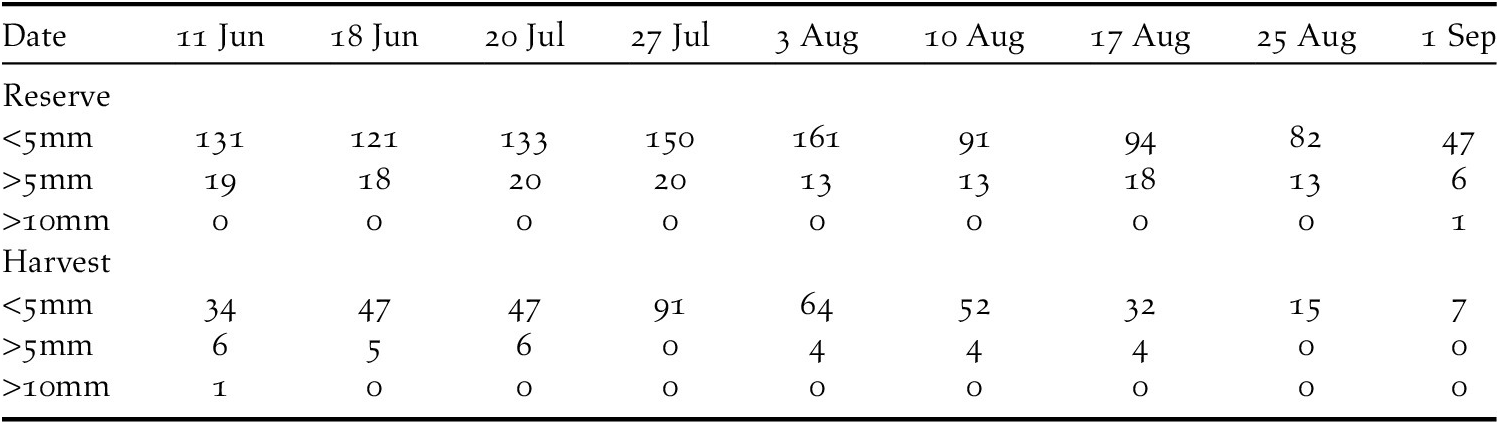
Fragments from each collection date were amalgamated to provide total numbers for reserve and harvest area samples. The resulting weekly samples were sieved using 5 x 5 mm and 10 x 10 mm wire mesh to separate fragments into size classes <5 mm, <10 mm and >10 mm.
Examination of Sooty Tern adults and chicks, and chick regurgitates, for ingested plastic fragments
Seven adult Sooty Terns that were found dead or injured in the nesting colony or on the beach were dissected to examine the contents of the proventriculus and gizzard. Seventeen chicks estimated from plumage development (Feare Reference Feare1976b) to be 5–7 weeks old and found dead in the colony were similarly dissected. During the ringing of 654 chicks (all c.8 weeks old) between 25 August and 5 September, 38 of the birds regurgitated food. All the regurgitates were examined for plastic fragments.
Flotation of plastic fragments
Thirty blue and green fragments, collected from the ground in the Sooty Tern colony on 2 June, were placed in a container of sea water and maintained until 31 August to determine whether they floated or sank.
Statistical analysis
Data were analysed using R (R Core Team 2016). We used the ‘lme4’ package (Bates et al. Reference Bates, Mächler, Bolker and Walker2014) to construct Generalized Linear Mixed Models (GLMMs) with a Poisson error distribution and with Plot ID and Observation ID to account for repeated observations of the different plots. The models included the number of plastic fragments found as dependent variable, and nest stage (categorised as incubation (11–18 June), chick-rearing (20 July–10 August) and fledging (17 August–1 September), plot type (categorised as reserve and harvest) and their interaction were included as fixed variables.
Results
Plastic fragments associated with seabird species on Bird Island
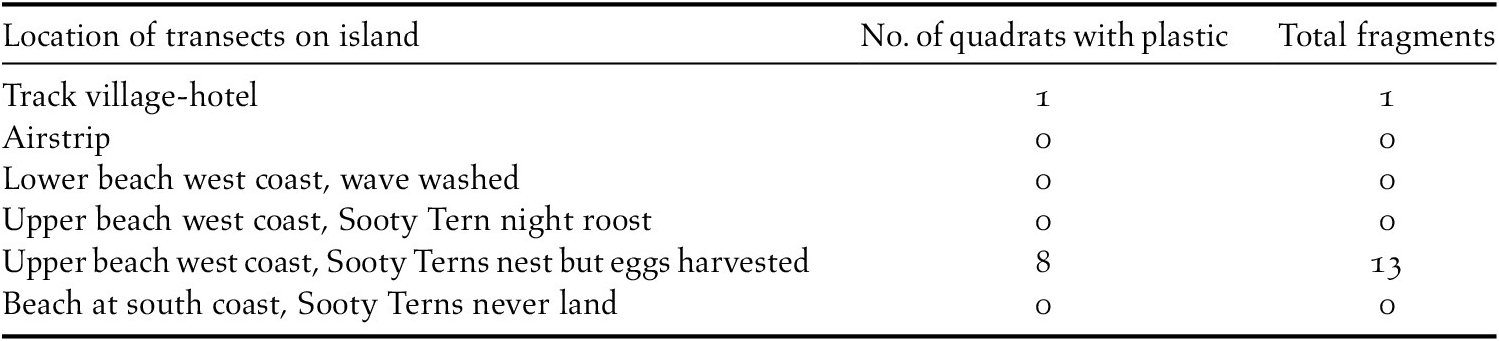
In four of the open habitats where we searched for plastic fragments, none were found (Table 1). On the track running through the village and hotel, the island’s major thoroughfare where a variety of goods is transported regularly by tractor, bicycle, or on foot, only one fragment was found in one quadrat. On an upper part of the beach (transect 5, Figure 2), where Sooty Terns laid but their eggs were harvested, fragments were found in eight of the 10 quadrats.
The number of plastic fragments found in ten 2 x 2 m quadrats in each of six areas of Bird Island.

No plastic fragments were found within 50 cm of the 50 Brown Noddy nests examined, and none were found in the accumulated droppings beneath Brown Noddy roosting sites. No plastic fragments were found beneath the nests of Lesser Noddies.
Temporal abundance of plastic fragments in the Sooty Tern colony
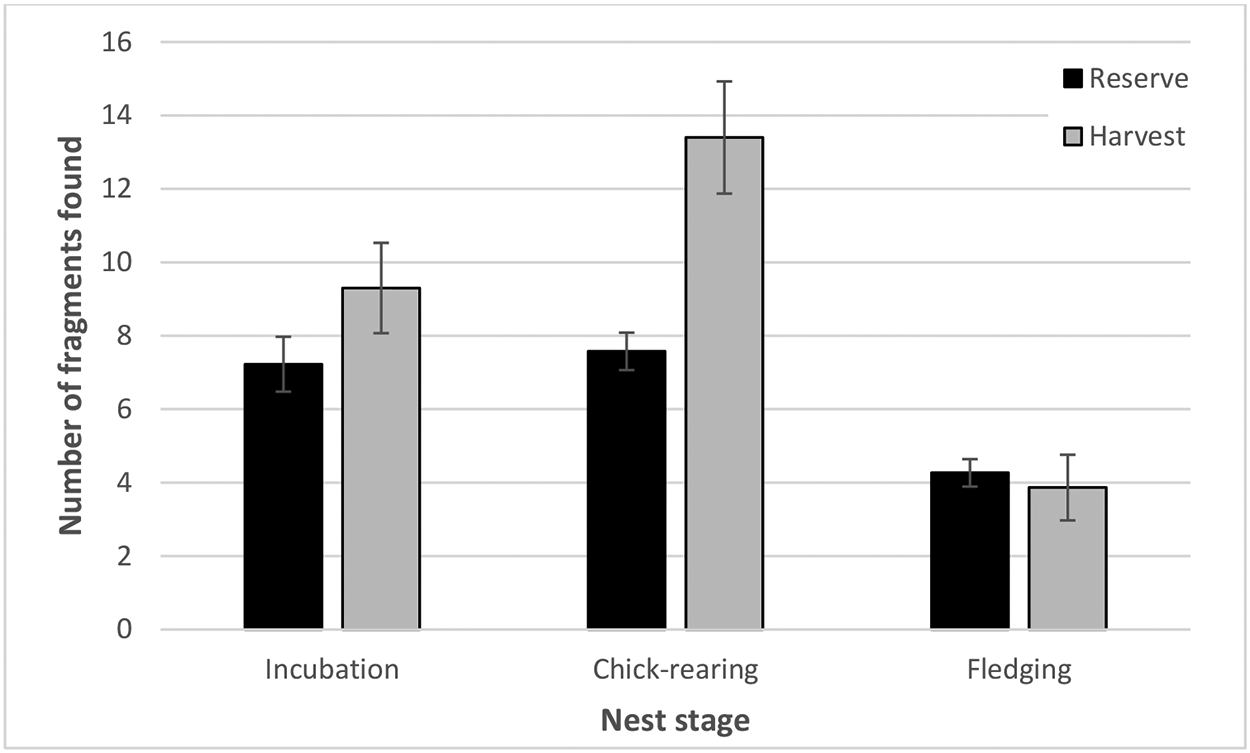
The removal of all plastic fragments from the quadrats in the Sooty Tern colony, and subsequent counting and collection of fragments each following week, demonstrated a continual input of plastic during incubation and chick-rearing periods (Figure 3).
Clustered bar means (± SE) of accumulated plastic fragments collected weekly from fixed quadrats in the reserve and harvest areas of the Sooty Tern colony, during the incubation, chick-rearing and fledging stages in the reserve.

Overall, the number of fragments found was higher in the harvest plots than in the reserve plots (χ2 = 4.18, df = 1, P = 0.041). The number of fragments found also differed over-all per nest stage (χ2 = 10.46, df = 2, P = 0.005), but the significant interaction between nest stage and plot type (reserve or harvest, (χ2 = 19.66, df = 2, P < 0.001) indicates that the influence of plot type on the number of fragments found differed over the course of the breeding season (Figure 3).
Post-hoc tests revealed that during the incubation and chick-rearing stages (in the reserve area), significantly fewer fragments were found in the reserve plots than in the harvest plots (pincubation = 0.034, pchick-rearing < 0.001), whereas in the fledging stage there was no difference (pfledging = 0.05). In both plot types, significantly more fragments were found during incubation (preserve and pharvest = both 0.004) and chick-rearing (preserve and pharvest both <0.001), than in the fledging stage which started from mid-August onwards. There was no difference in the number of fragments found between the incubation and chick-rearing stage in both plot types (both P ≥0.25).
Type, colour, and size of plastic fragments from the Sooty Tern colony
All 2,135 plastic fragments collected from the quadrats were hard user plastic (Roman et al. Reference Roman, Schuyler, Hardesty and Townsend2016, Provencher et al. Reference Provencher, Bond, Avery-Gomm, Borrelle, Bravo Rebolledo, Hammer, Kühn, Lavers, Mallory, Trevail and van Franeker2017, Andrades et al. Reference Andrades, Santos, Joyeux, Chelazzi, Concinelli and Giarrizzo2018), apart from two pieces of fibre. A small proportion of the fragments showed signs of heat stress or weathering but nevertheless retained their rigidity.
Blue and green fragments accounted for 94.6% of the total collected (Table 2). Within sampling dates in the reserve, the frequency of blue and green fragments ranged from 91.9 to 98.1%, with no temporal trend, while in the harvest area the frequency ranged from 88.2 to 100.0%, again with no temporal trend.
Number of plastic fragments, collected from 25 permanent quadrats in Bird Island’s Sooty Tern colony between 2 June and 4 September, in each colour category.

In each weekly sample, in both the reserve and harvest areas, the number of fragments that passed through the 5 mm sieve greatly exceeded the number of larger particles (Table 3); overall, 89.1 % of the fragments collected were <5 mm. Only two fragments failed to pass through the 10 mm sieve.
Number of plastic fragments recorded in each size category each week in the 20 reserve quadrats and five harvest quadrats. The 11 and 18 June samples were collected during incubation; July-September samples were collected during chick rearing.

Examination of Sooty Tern adults and chicks, and chick regurgitates, for ingested plastic fragments
None of the dissected Sooty Terns had plastic fragments in the proventriculus or gizzard. Five of the adults were found injured on the beach, most likely following attack by frigatebirds (Fregata ariel and F. minor) to stimulate the terns to regurgitate food (Feare et al. Reference Feare, Dietrich, Larose and Lebarbenchon2015) and their guts contained neither food nor plastic fragments; two birds had small pieces of coral in the gizzard. Two adults were found in the colony, one freshly dead, one injured; the dead bird was emaciated and had probably starved, while the injured bird might have been attacked by frigatebirds. Neither bird had food or plastic fragments in the gut.
The chicks were all found dead in the colony at a time when many chicks had low body mass and starvation was the most likely cause of death (chick deaths were widespread at the time of our collection of corpses). None contained food or plastic in the proventriculus/gizzard, but one bird contained five large fish scales in the gizzard (probably flying fish; Exocoetidae) and three contained crustacean limb segments and small squid beaks.
Regurgitations from chicks during handling contained mainly fish. Seven of the 38 regurgitates comprised boluses of fish larvae, five comprised squid mantles, two comprised headless flying fish c.7 cm long, one comprised an unidentified headless pink fish c.8 cm long, and the remaining regurgitates comprised intact sardine-like fish (Clupeidae and Mullidae), c.4 cm long. None of the prey contained plastic fragments. None of the 2,135 plastic fragments were found incorporated into Sooty Tern faeces at the nest sites and on later examination only two fragments showed limited faecal contamination.
Flotation of plastic debris
All the plastic fragments placed in sea water remained floating throughout the 90 days of the flotation trial.
Discussion
Plastic fragments were distributed throughout the Sooty Terns’ nesting area but were not found where other seabird species bred or roosted, nor in parts of the island with high human activity, indicating that Sooty Terns alone imported the fragments. Reports of fragments in other Sooty Tern colonies (see Introduction) suggest that the behaviour is widespread in this species, but the mechanism and function of the behaviour remain enigmatic.
As on many oceanic islands, Bird Island’s beaches receive a constant input of plastic debris. Most are largely intact (e.g. bottles, flip-flops, toothbrushes, cigarette lighters, fishing gear) and during recreational walks we did not find any fragments of the type that occur in the colony at any level of the beaches, apart from at the top of the north-west beach where some Sooty Terns laid but whose eggs were harvested.
Sooty Tern activity differed in the reserve and harvest areas. In the reserve, pairs arrived, displayed, established, and aggressively defended nest territories, made nest scrapes, and laid until the area was as densely packed with nests as the habitat supported. In 2019 this was late June. In the harvest area, site acquisition behaviours and laying activities continued throughout the breeding season as birds that had lost their eggs were continually replaced by new arrivals, from the earliest laying until its end in early August. In the build-up to laying, both pair members spend most of their time at the nest site but with frequent commutes to the nearby sea to drink; after laying, only one adult remains at the nest. In the harvest area, most nest sites thus have two attending adults throughout the breeding season, which might have contributed to the higher plastic input to this area. However, daily human disturbance of the soil and vegetation during the egg harvest might render any buried fragments more conspicuous, possibly augmenting the counts.
Characteristics of the plastic fragments
All of the plastic fragments, collected in the colony at the start of our study, remained afloat in sea water for the 90 days of the trial. Long-term buoyancy could facilitate contact between Sooty Terns and the fragments at the ocean surface.
Eighty-nine percent of the particles collected from the quadrats were microplastics <5 mm, and the remainder mesoplastics < 20 mm. All fragments were “user” plastics (Provencher et al. Reference Provencher, Bond, Avery-Gomm, Borrelle, Bravo Rebolledo, Hammer, Kühn, Lavers, Mallory, Trevail and van Franeker2017), derived from the fragmentation of larger plastic commodities. Microplastics are the most abundant size class collected in plankton nets during oceanic surveys (Cózar et al. Reference Cózar, Echevarría, González-Gordillo, Irigoien, Úbeda, Hernández-León, Palma, Navarro, García-de-Lomas, Ruiz, Fernández-de-Puelles and Duarte2014, Eriksen et al. Reference Eriksen, Lebreton, Carson, Thiel, Moore, Borerro, Galgani and Reisser2014, Martí et al. Reference Martí, Martin, Galli, Echevarría, Duarte and Cózar2020). Together with the irregular shapes of the fragments, this suggests that the birds do not select sizes and shapes.
Almost 95% of the fragments collected from the quadrats were blue or green (including turquoise). In a wide-ranging study − including the Indian Ocean − of the colour of floating plastics captured in trawl nets, 47% of fragments were white/translucent, with this proportion being higher among microplastics and in those recovered from waters more distant from land (Martí et al. Reference Martí, Martin, Galli, Echevarría, Duarte and Cózar2020); only 11 % of the fragments were blue/green. If these proportions are representative of the colour of ocean surface plastics within the foraging ranges of Bird Island’s Sooty Terns, this suggests that the birds preferentially selected blue/green fragments.
Mechanism of import
Despite studying this colony for many years, we have never observed a Sooty Tern carrying any object into the nesting area, but our data showed that plastic fragments were imported throughout the breeding period, with a decline in frequency during chick fledging. During incubation, adults do not carry items in the bill. During chick-rearing, food items and sea water are ingested by adults and regurgitated to chicks, but we have not seen plastic fragments in regurgitates; this could be difficult to observe because small items, such as boluses of fish larvae or small fish, are passed quickly from adult to chick. We did not find any plastic fragments in any of the small number of regurgitates that we examined, but the sample was small and few of the prey items examined were large enough to contain visible fragments.
The dead adults we dissected had been injured, most likely by frigatebirds when attempting to force the terns to regurgitate the food they were carrying back to the colony (Feare et al. Reference Feare, Dietrich, Larose and Lebarbenchon2015), and the dead chicks we examined had died from starvation. The absence of plastic fragments in their guts is thus not surprising. Seabirds that die through accidents have been found to provide more accurate dietary information than birds that die of natural causes (Rodríguez et al. Reference Rodríguez, Ramírez, Nazaret Carrasco and Chiaradia2018, Cartraud et al. Reference Cartraud, Le Corre, Turquet and Tourmetz2019), but accidental deaths of Sooty Terns on Bird Island are rare. A non-invasive technique (e.g. x-ray or ultrasound) for examining healthy living birds could provide better evidence of plastic fragments in the digestive systems of adults and chicks.
Plastic fragments might be ingested accidentally. During frenzied feeding over shoals of predatory fish, Sooty Terns dart at potential prey at or above the water surface, which is often “boiling” with the movement of the sub-sea predators and their jumping prey, many of which are bluish.
However, the almost complete lack of faecal contamination of fragments collected from the quadrats suggests that the fragments had not been excreted. An alternative might be that plastic fragments adhere to breast/belly feathers when breeding adults drink or wet their breast and belly feathers in the sea just offshore; this could be tested experimentally.
A further constraint on our ability to detect the mode of import of plastic is the likely frequency of a bird bringing fragments into the colony. The average number of fragments in a 2 x 2 m quadrat over the breeding season was 6.4/week. The average density of nests in the colony in 2019 was 20.5 per 2 x 2 m quadrat (C. Feare and C. Larose unpubl. data), representing 41 nesting birds. On this basis, any individual would be expected to import 0.16 fragments in a week and the chance of finding a bird containing a fragment is less than one per day in a group of 20 nests.
Possible function of imported of plastic fragments
De Souza-Petersen et al. (2016) postulated that Sooty Terns imported plastic fragments as nest material on Trinidade Island, Brazil. However, our observations on Bird Island showed that most fragments were on the ground between nests, rather than in the scrapes. Furthermore, the lack of directional movement of fragments placed between nests towards them (C. Feare pers. obs. 1995) suggested that the fragments were not being used as nest material. In the few nests where items (leaves, seeds, and small stones and coral pieces) were incorporated into scrapes, they were all sourced locally, within bill reach of the sitting bird (see Introduction).
Other potential functions of imported plastic are mate attraction and nest site recognition. The continued import of plastic fragments through the breeding season casts doubt on a mate attraction role, which would be required only during courtship at the onset of breeding. Nest site recognition, on the other hand, remains important throughout the season (Watson Reference Watson1908), for adults returning to the colony to relieve incubating mates, and later to deliver water and food to chicks. During their development, chicks increasingly move from their nest sites during hotter parts of the day to form crèches in the shade of vegetation, or on the beach. Towards evening they navigate back to their nest sites but the cues they use, such as geographic markers that could include plastic fragments, are unknown.
Despite the continual input of plastic fragments during the incubation and chick-rearing phases, there was no clear build-up of fragments in the colony outside the sampling quadrats, suggesting a continual removal of plastic, likely through photodegradation, thermodegradation and physical degradation due to trampling by adults and chicks.
Potential threats
Further study is needed to determine whether the fragments are harmful to Sooty Terns, directly through damage to the digestive system or indirectly through the birds’ potential consumption of adsorbed toxic chemicals, hormone analogues, or pathogens (Avery-Gomm et al. Reference Avery-Gomm, Borelle and Provencher2018). The birds’ potential consumption of microscopic plastic particles in their diet (Ribeiro et al. Reference Ribeiro, Okoffo, O’Brien, Fraissinet-Tachet, O’Brien, Gallen, Samanipour, Kaserzon, Mueller, Galloway and Thomas2020) also warrants investigation. Tracking studies have shown that Sooty Terns from Bird Island disperse widely over the Indian Ocean after breeding (Jaeger et al. Reference Jaeger, Feare, Summers, Lebarbenchon, Larose and Le Corre2017). This confers upon them a utility as sentinels of health of the tropical Indian Ocean through monitoring of accumulated contaminants throughout their life cycle. Any adverse effects of pollutants would add to the threat posed by the annual egg harvest in Seychelles, along with the potential impact of climate change and industrial fishing (Reynolds et al. Reference Reynolds, Hughes, Wearn, Dickey, Brown, Weber, Weber, Paiva and Ramos2019), which is a major source of income for this small island nation (Christ et al. Reference Christ, White, Hood, Vianna and Zeller2020).
Better knowledge of the threats caused by pollutants, such as plastics, will help both the conservation of this species itself and understanding their signals as health indicators of the ecosystem.
Acknowledgements
The study was undertaken opportunistically during other studies on Bird Island’s Sooty Terns. This research did not receive any specific grant from funding agencies in the public, commercial, or not-for-profit sectors. We thank Bird Island management for their long-term support for research on their seabird colonies, and for their particular interest in this study of plastic fragments. We also thank Rachel Bristol, Camille Lebarbenchon, Sophie Pelolari and Dylan Savy and for help in collecting some of the weekly samples.