Diagnosis of catheter-associated urinary tract infection (CAUTI) is challenging among patients in intensive care units (ICUs), a patient population for which CAUTI diagnosis relies on fever. 1 – Reference Tambyah and Maki 3 Frequent urine culturing as part of a diagnostic evaluation for fever (ie, “pan-culturing”) may increase the detection of asymptomatic bacteriuria and funguria that do not require treatment. Misdiagnosis of asymptomatic bacteriuria or funguria as CAUTI is a major cause of inappropriate antimicrobial use.Reference Lo, Nicolle and Coffin 2 – Reference Cope, Cevallos, Cadle, Darouiche, Musher and Trautner 5
From January 1, 2011, through March 31, 2014, an academic tertiary care hospital in Maryland, which had been measuring CAUTI rates in its ICUs using the Centers for Disease Control and Prevention’s National Healthcare Safety Network since 2010, implemented a series of CAUTI prevention strategies in response to high CAUTI rates. In October 2013, epidemiologists from the Centers for Disease Control and Prevention were invited by the Maryland Department of Health and Mental Hygiene and the hospital to assist with an investigation of the high CAUTI rates. This report focuses on the impact of a urine culturing protocol to reduce unnecessary urine cultures.
METHODS
The investigation focused on 5 ICUs at the hospital: cardiac critical care unit, medical ICU, neurocare ICU, neurotrauma critical care unit, and surgical ICU. CAUTI events, CAUTI rates, and the urinary catheter device utilization ratio were defined on the basis of National Healthcare Safety Network protocols. 1
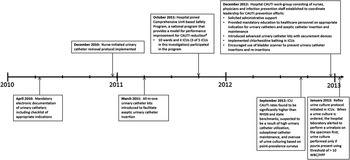
The investigation team assessed implementation of policies and procedures related to CAUTI prevention from 2010 into 2014 (Figure 1). In January 2013, a reflex urine culture protocol was initiated in ICUs in response to recognition of suboptimal urine culturing practices such as repeated ordering of cultures and obtaining cultures without accompanying urinalyses. Under the reflex urine culture protocol, when a urine culture is ordered, the hospital laboratory is alerted to perform a urinalysis on the specimen first. A urine culture is subsequently performed only if pyuria is present, defined by the clinical laboratory as greater than 10 white blood cells/high-power field. This protocol was implemented on the basis of data that the absence of pyuria in an immunocompetent patient suggests a diagnosis different from a urinary tract infection.Reference Tambyah and Maki 4 , Reference Stoval, Haenal and Jenkins 7 The protocol was not an option for oncology or transplant patients and physicians could override the protocol if necessary. During the first 6 months of implementation, clinicians manually ordered a urine culture if the urinalysis was positive; in July 2013, this procedure was automated by the lab.
Timeline of catheter-associated urinary tract infection (CAUTI) prevention initiatives implemented by the hospital, 2010–2014. HPF, high-powered field; ICU, intensive care unit; NHSN, National Healthcare Safety Network; WBC, white blood cell.

Data collected included the number of urine cultures performed in the laboratory and data reported to National Healthcare Safety Network, including CAUTIs, urinary catheter–days, and patient-days from all 5 locations. Monthly rates of urine cultures (urine cultures/100 patient-days) performed on specimens from all patients (with and without urinary catheters) admitted to the 5 ICUs from January 1, 2012, through March 31, 2014, were calculated. Monthly CAUTI rates (CAUTIs/1,000 urinary catheter–days) among the 5 ICUs from July 1, 2011, through March 31, 2014, were assessed. The potential impact of the reflex urine culture protocol (ie, intervention), implemented by the hospital on January 1, 2013, on urine culturing rates and CAUTI rates was evaluated using a negative binomial regression interrupted time-series analysis. Since urine culturing rate data were not available before January 1, 2012, the preintervention period for assessing CAUTI rates was 6 months longer than for urine culturing rates; the postintervention period was the same for both (January 1, 2013–March 31, 2014). Because the reflex urine culture protocol intervention is not expected to affect device use, temporal changes in the urinary catheter device utilization ratio (urinary catheter–days/patient-days) from July 1, 2011, through March 31, 2014, were assessed using log binomial regression. Differences in urine culturing rates, CAUTI rates, and the device utilization ratio were assessed across the 5 ICU locations by adding interaction terms between ICU and intervention in the final models. All analyses were conducted using SAS, version 9.3 (SAS Institute).
RESULTS
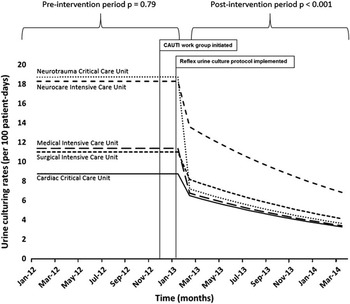
Urine culturing rates at the beginning of the preintervention period differed significantly among the 5 ICU locations (Figure 2). There was no significant change in the monthly urine culturing rate in any location (P=.79) during the preintervention period. In the month immediately following the intervention, the urine culturing rates decreased significantly (P=.0012) across all 5 units, with the neurotrauma critical care unit and surgical ICU experiencing greater decreases compared with other units. There were significant downward trends in monthly urine culturing rates during the postintervention period, which was consistent across all 5 ICU locations (P<.001).
Predicted urine culturing rates in 5 intensive care units in relation to hospital interventions, January1, 2012–March 31, 2014. Urine culturing rates at the beginning of the preintervention period differed significantly among the 5 intensive care unit locations; therefore, each unit is shown individually. CAUTI, catheter-associated urinary tract infection.

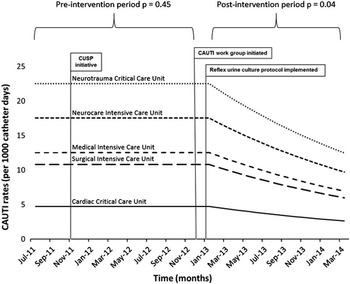
CAUTI rates at the beginning of the preintervention period also differed significantly among the 5 ICU locations (Figure 3). There was no significant monthly change in the CAUTI rate in any location (P=.45) during the preintervention period. In the month immediately following the intervention, there was no significant change in the CAUTI rate (P=.90) in any location. However, during the postintervention period, there were significant downward trends in the monthly CAUTI rates across all ICU locations (P=.04). When included in the final model, the device utilization ratio in each unit did not significantly impact the CAUTI rates.
Predicted catheter-associated urinary tract infection (CAUTI) rates in 5 intensive care units in relation to hospital interventions, July 1, 2011–March 31, 2014. CAUTI rates at the beginning of the preintervention period differed significantly among the 5 intensive care unit locations; therefore, each unit is shown individually. CUSP, Comprehensive Unit-based Safety Program.

The device utilization ratio decreased significantly in 4 of the 5 ICU locations (neurotrauma critical care unit, neurocare ICU, medical ICU, and surgical ICU) from July 1, 2011, through March 31, 2014, with individual ICU decreases ranging from 31.9% to 47.9%. However, the device utilization ratio increased significantly by 15.5% in the cardiac critical care unit during the same period.
DISCUSSION
A multifaceted series of CAUTI prevention strategies was initiated at a large tertiary care hospital. A reflex urine culture protocol was temporally associated with a significant reduction in both urine culturing rates and CAUTI rates across 5 ICUs. Differences in urine culturing rates among ICUs in the month immediately following the intervention are likely related to both the preintervention rates and variable compliance with the intervention.
There are several limitations to the analysis. First, we could not assess a specific causal relationship between the reflex urine culture protocol and the outcomes; multiple CAUTI prevention measures were implemented over time, and urine culturing data were not collected in the first 6 months (July 1, 2011–December 31, 2011) to align with the CAUTI rates. Furthermore, we did not have data to assess implementation and adherence to the CAUTI prevention interventions to evaluate their impact on CAUTI rates. However, no significant trends were observed over 18 months before the intervention, suggesting that this period reflected an appropriate baseline. Although we did not systematically assess whether adverse events occurred as a result of the intervention, no adverse events were reported. Because this intervention was performed before the revised 2015 National Healthcare Safety Network definitions, the impact on reported CAUTI rates may not be the same as with current definitions. 1 Finally, our results may not be generalizable to other healthcare facilities that do not have comparable CAUTI rates.
In conclusion, a reflex urine culture protocol may be an effective strategy to decrease unnecessary urine cultures. Further efforts are warranted to evaluate the role of the clinical laboratory in improving the diagnostic approach for CAUTIs and standardizing protocols for urine culturing and analysis, which includes validating thresholds of pyuria to triage specimens for urine culture.Reference Stoval, Haenal and Jenkins 7 , Reference Burd and Kehl 8 These findings also hint at a broader question of whether test ordering practices can be modified to optimize test performance and patient outcomes. Assessing the impact of laboratory-based interventions on other outcomes such as antimicrobial use will inform future interventions.
ACKNOWLEDGMENTS
Financial support. None reported.
Potential conflicts of interest. All authors report no conflicts of interest relevant to this article.
The findings and conclusions in this report are those of the authors and do not necessarily represent the official position of the Centers for Disease Control and Prevention.