INTRODUCTION
The diet fed to the animals is one of the most important production factors affecting the composition of milk and meat from cattle, sheep and goats. For example, the sensory and nutritional properties of meat from pasture-fed lambs differ from those of concentrate-fed lambs: the meat has a different flavour and colour (Rousset-Akrim et al. Reference Rousset-Akrim, Young and Berdagué1997; Priolo et al. Reference Priolo, Micol, Agabriel, Prache and Dransfield2002a) and a different fatty acid composition, and studies have demonstrated the nutritional advantages of meat produced from pasture-fed lambs compared with lambs fed concentrate diets (Enser et al. Reference Enser, Hallett, Hewett, Fursey, Wood and Harrington1998; Wood et al. Reference Wood, Richardson, Nute, Fisher, Campo, Kasapidou, Sheard and Enser2003; Aurousseau et al. Reference Aurousseau, Bauchart, Calichon, Micol and Priolo2004). The subcutaneous fat of the carcass is firmer and slightly more yellow in pasture-fed lambs than in grain-fed lambs (Priolo et al. Reference Priolo, Micol, Agabriel, Prache and Dransfield2002a; Wood et al. Reference Wood, Richardson, Nute, Fisher, Campo, Kasapidou, Sheard and Enser2003). These effects are due to specific compounds that are directly transferred from the feed to the end product or that are transformed or produced by rumen micro-organisms or the animal's metabolism under the effect of specific diets. Some of these compounds can therefore be used as diet markers (Prache et al. Reference Prache, Cornu, Berdagué and Priolo2005). There is currently an increased consumer demand for information on herbivore production factors, and particularly the animal diet. To meet these demands, farmers and commercial organizations develop specifications via quality labels (Roche et al. Reference Roche, Dedieu and Ingrand2000; Prache et al. Reference Prache, Martin, Nozière, Engel, Besle, Ferlay, Micol, Cornu, Cassar-Malek and Andueza2006). There is therefore a need for analytical tools to be able to guarantee that the specification commitments have been fully met or to help with constructing them. The French lamb brand of ‘Agneau Pré-Salé’ (salt-marsh lambs) provides a pertinent illustration of such specification commitments. The meat from these lambs is renowned for its particular flavour, which stems from the specific flora of these salt-marsh pastures which are regularly flooded by seawater. Farmers commit to raise the lambs on the ‘prés salés’ for a minimum duration, to keep the concentrate supplementation below a predefined ceiling, and not to finish the lambs on concentrate diets indoors for longer than a certain maximum time. For scientists, these commitments lead to research questions such as identifying specific markers of these pastures and more generally specific markers of pasture-feeding, investigating the time of appearance and persistence in the animal tissues, and studying the dose-responses relating marker concentrations in the animal tissues with intake levels. The ability to authenticate the feed given to animals has therefore become a major challenge for scientists, monitoring bodies, commercial organizations and farmers alike. This review of recent developments deals mainly with authentication of feeding diet, although it also provides insight into authentication of geographical origin. The current paper reports data on sheep; Renou et al. (Reference Renou, Deponge, Gachon, Bonnefoy, Coulon, Garel, Verite and Ritz2004a) and Martin et al. (Reference Martin, Cornu, Kondjoyan, Ferlay, Verdier-Metz, Pradel, Rock, Chilliard, Coulon, Berdagué, Hocquette and Gigli2005) consider dairy cows, Renou et al. (Reference Renou, Bielicki, Deponge, Gachon, Micol and Ritz2004b) and Serrano et al. (Reference Serrano, Prache, Chauveau-Duriot, Agabriel and Micol2006) discuss beef, and Prache et al. (Reference Prache, Martin, Nozière, Engel, Besle, Ferlay, Micol, Cornu, Cassar-Malek and Andueza2006) cover all herbivores.
ANALYTICAL METHODS
Efforts have recently been made to develop analytical tools to authenticate the diet. The first approach is the quantification of specific compounds in the animal's products or tissues whose presence or proportions are characteristics of the diet. The second approach is the use of fingerprints: actually, differences in the meat and milk composition induce differences in their optical properties, and therefore in their spectral features, which can also be used for diet authentication. To date, much of this research in sheep has focused on pasture-based v. concentrate-based diets.
Potential biomarkers
Carotenoid pigments
Carotenoids form the main group of natural pigments. Lutein is the only carotenoid stored in the fat of sheep (Prache et al. Reference Prache, Priolo and Grolier2003b), whereas cattle also store carotenes (Nozière et al. Reference Nozière, Graulet, Lucas, Martin, Grolier and Doreau2006). Carotenoid content in the animal tissues and products is highly dependent on dietary supply, i.e. the nature and amount of the forage consumed (Nozière et al. Reference Nozière, Graulet, Lucas, Martin, Grolier and Doreau2006). Carotenoids are present at high concentrations in green leafy pasture (430–700 mg/kg dry matter (DM) for total carotenoids, 250–415 mg/kg DM for lutein, Prache et al. Reference Prache, Priolo and Grolier2003a). The content in forage decreases proportionally to the degree of light exposure during drying and conservation, since carotenoids are highly UV-sensitive. Sun-drying in the field therefore greatly decreases the carotenoid content of the forage: compared with the initial concentration in pasture, the concentration decreases by 40% for wilted silage at 280 g/kg DM, 70% for wilted silage at 350 g/kg DM, 70% for haylage and 80% for hay (Nozière et al. Reference Nozière, Graulet, Lucas, Martin, Grolier and Doreau2006). Dehydrated lucerne contains 0·4–0·65 of fresh green pasture (Dian et al., unpublished). Maize silage is poor in these pigments (70–80 mg/kg DM), and zeaxanthin, the carotenoid present in maize seed, is not stored by ruminants. Most concentrates are very low in these pigments. Carotenoids have therefore been successfully proposed as markers of pasture-feeding in sheep (Prache & Theriez Reference Prache and Theriez1999) and more generally in herbivore meat and milk (Prache et al. Reference Prache, Priolo, Tournadre, Jailler, Dubroeucq, Micol, Martin, Durand, Emile, Huyghe and Lemaire2002; Serrano et al. Reference Serrano, Prache, Chauveau-Duriot, Agabriel and Micol2006).
Phenolic compounds
Forages are also rich in cellular phenolic compounds (flavonoids and other phenolic compounds (FPC)), which have recently proved their usefulness for diet authentication. Besle et al. (Reference Besle, Lamaison, Dujol, Pradel, Fraisse, Viala, Martin, Hocquette and Gigli2005) compared six diets in cows: concentrate-rich (0·65 of the diet), based on maize silage, ryegrass silage, ryegrass hay, native mountain hay and native mountainous grazed pasture (+0·15 concentrates). The FPC content of the forages, as determined by high-performance liquid chromatography (HPLC), ranged from 0·8 to 8 g/kg DM, with the native pasture by far the richest. About 100 FPC were detected in the milks; two thirds of them were found in all the milks, but other compounds, that were specific to one diet, may be used for authenticating the animal diet. Experimental evaluation of these compounds is warranted for small ruminant milk and meat.
Milk and meat fatty acid composition
Since animal diet can strongly affect the fatty acid composition of meat and milk (Wood & Enser Reference Wood and Enser1997; Wood et al. Reference Wood, Richardson, Nute, Fisher, Campo, Kasapidou, Sheard and Enser2003; Aurousseau et al. Reference Aurousseau, Bauchart, Calichon, Micol and Priolo2004, in lamb; Martin et al. Reference Martin, Cornu, Kondjoyan, Ferlay, Verdier-Metz, Pradel, Rock, Chilliard, Coulon, Berdagué, Hocquette and Gigli2005, in dairy cows), fatty acid composition may be a useful source of relevant information on the animal's diet. α-Linolenic acid (C18:3n−3) is a characteristic fatty acid of forage lipids and is not synthesized by mammals. Green pasture is rich in α-linolenic acid, which typically ranges from 500 to 700 g/kg total lipids, and part of the dietary linolenic acid escapes rumen hydrogenation. Grain-based diets contain high proportions of linoleic acid (C18:2n−6). Feeding pasture therefore results in higher concentrations of C18:3n−3 (and other n−3 polyunsaturated fatty acids (PUFA)) and lower concentrations of C18:2n−6 (and other n−6 PUFA) in muscle lipids than grain-based diets (Enser et al. Reference Enser, Hallett, Hewett, Fursey, Wood and Harrington1998). The C18:2n−6/C18:3n−3 ratio in muscle phospholipids (PL) could therefore be of interest to discriminate pasture-fed from concentrate-fed animals. However, it should be noted that linseed is also very rich in α-linolenic acid, and its inclusion in grain-based concentrates could affect the reliability of the discrimination based on the milk or meat fatty acid composition (Scollan et al. Reference Scollan, Choi, Kurt, Fisher, Enser and Wood2001, in beef; Cooper et al. Reference Cooper, Sinclair, Wilkinson, Hallett, Enser and Wood2004, in lamb). Further experiments are required to address this question.
Volatile compounds
The nature and amount of volatile compounds present in ruminant meat and milk strongly depend on the animal diet (see the review by Vasta & Priolo Reference Vasta and Priolo2006). These compounds are directly transferred from the diet into milk and meat or originate from the animal's metabolism under the effect of specific diets. Dynamic headspace is the extraction method best suited to analyse these compounds which are present at very low concentrations in milk and meat. The sample is continuously purged by an inert gas. The volatile compounds are released and efficiently concentrated in a trap before analysis by high-resolution gas chromatography coupled to mass spectrometry (GC-MS).
Among the volatile compounds released from meat and milk, terpenes have been one of the more important studied. They form a large class of molecules almost exclusively synthesized by plants and are transferred from pasture to animal tissues and products. Terpenes content in grassland plants vary widely according to botanical family, and dicotyledons are typically more terpene-rich than monocotyledons (Mariaca et al. Reference Mariaca, Berger, Gauch, Imhof, Jeangros and Bosset1997). Since natural grassland flora is a component of the specific locality (and thus any relevant quality label), its terpene profile together with that of the corresponding animal product can therefore be characteristic of the geographical area. Terpenes from forages eaten by cattle have been detected in both milk (Dumont & Adda Reference Dumont and Adda1978) and meat (Larick et al. Reference Larick, Hedrick, Bailey, Williams, Hancock, Garner and Morrow1987). A number of studies have reported higher amounts and wider diversities of terpenes in the tissues and products of grazing animals than animals given conserved forages or concentrates (Suzuki & Bailey Reference Suzuki and Bailey1985; Young et al. Reference Young, Berdagué, Viallon, Rousset-Akrim and Theriez1997; Martin et al. Reference Martin, Cornu, Kondjoyan, Ferlay, Verdier-Metz, Pradel, Rock, Chilliard, Coulon, Berdagué, Hocquette and Gigli2005). Terpenes have been used successfully in meat and milk as markers of the animal diet (Cornu et al. Reference Cornu, Kondjoyan, Begnaud, Micol, Renou and Berdagué2001, in beef; Priolo et al. Reference Priolo, Cornu, Prache, Krogmann, Kondjoyan, Micol and Berdagué2004b, in lamb; Martin et al. Reference Martin, Cornu, Kondjoyan, Ferlay, Verdier-Metz, Pradel, Rock, Chilliard, Coulon, Berdagué, Hocquette and Gigli2005, in milk); moreover, they have been successfully used in meat from pasture-fed beef to discriminate between two geographical origins (Cornu et al. Reference Cornu, Kondjoyan, Begnaud, Micol, Renou and Berdagué2001).
The fat concentrations of certain volatile compounds such as 2,3-octanedione and 3-methylindole (skatole) are typically higher in pasture-fed than in concentrate-fed lambs (Vasta & Priolo Reference Vasta and Priolo2006). Suzuki & Bailey (Reference Suzuki and Bailey1985) found that the fat from pasture-fed lambs contained much more 2,3-octanedione than the fat from maize-fed lambs and this result was confirmed in subsequent experiments (Young et al. Reference Young, Berdagué, Viallon, Rousset-Akrim and Theriez1997; Sebastian et al. Reference Sebastian, Viallon-Fernandez, Berge and Berdagué2003; Priolo et al. Reference Priolo, Cornu, Prache, Krogmann, Kondjoyan, Micol and Berdagué2004b). Young et al. (Reference Young, Berdagué, Viallon, Rousset-Akrim and Theriez1997) hypothesized that this compound may originate from the oxidation of linoleic acid by the lipoxygenase enzyme, which is present in leafy plants but absent in grain, except soybeans (Keen & Wilson Reference Keen and Wilson1992). Young et al. (Reference Young, Berdagué, Viallon, Rousset-Akrim and Theriez1997) also reported that skatole was present at higher concentrations in fat from pasture-fed lambs than concentrate-fed lambs. This has been attributed to enhanced rumen degradation of tryptophan, due to the typically high protein content and high protein/non-fibrous carbohydrate ratio of green pasture. However, it should be noted that condensed tannins are responsible for reduced protein degradability in the rumen and may, as a consequence, affect skatole biosynthesis (Roy et al. Reference Roy, Fraser, Lane, Reynolds, Deighton and Peters2004).
Isotopic composition
Isotope ratio mass spectrometry (IRMS) is another method that has been used to authenticate both the feeding diet and the geographic origin. The diet and the site where the animals are raised influence the isotopic composition of the water, fat and protein of their tissues and products. The stable isotope ratios of carbon (δ13C, i.e. 13C/12C) and nitrogen (δ15N, i.e. 15N/14N) in lamb meat have been used to authenticate the diet. Piasentier et al. (Reference Piasentier, Valusso, Camin and Versini2003) analysed the longissimus thoracis muscle by IRMS in lambs fed different diets during their finishing period (milk, pasture or concentrate containing maize grain). A good discrimination (0·917 of samples) was obtained with the combination of δ13C of fat, δ13C of protein and δ15N of protein. Stable isotope signatures in animal products actually reflect the stable isotope composition of the diet modified by the animal's metabolism. Maize is a C4 plant and has higher 13C content than most of temperate pasture plants (C3 species) because of the different photosynthetic pathways between C4 and C3 plants. The utilization of maize in the diets therefore results in higher 13C contents in the animal tissues, whereas animal products from temperate grassland-based diets show lower 13C contents (Piasentier et al. Reference Piasentier, Valusso, Camin and Versini2003; Gebbing et al. Reference Gebbing, Schellberg, Kühbauch, Lüscher, Jeangros, Kessler, Huguenin, Lobsiger, Millar and Suter2004). However, the C isotope signature cannot reveal intensive fattening by use of other cereals due to similar photosynthetic pathways of most grassland plants and cereals. The δ15N ratio in pasture plants is influenced by the intensity of agriculture use. N fertilizer application increases the 15N content of the nitrogen compounds in plants, whereas the presence of leguminous plants (which are more widespread in poorly fertilized grasslands) has the opposite effect, due to their use of atmospheric nitrogen as a nitrogen source. Finally, 13C nuclear magnetic resonance has been used to authenticate the animal diet in cows' milk and beef meat, by determining the relative proportions of polyunsaturated, monounsaturated and saturated fatty acids (Renou et al. Reference Renou, Deponge, Gachon, Bonnefoy, Coulon, Garel, Verite and Ritz2004a, Reference Renou, Bielicki, Deponge, Gachon, Micol and Ritzb).
Determination of geographic origin has been successfully assessed by measuring the stable isotope ratios of oxygen (δ18O, i.e. 18O/16O) in milk water, and the nitrogen (δ15N) and carbon (δ13C) isotope contents of specific milk fractions (Renou et al. Reference Renou, Deponge, Gachon, Bonnefoy, Coulon, Garel, Verite and Ritz2004a, in dairy cows) or of the meat produced in different regions of Europe (Piasentier et al. Reference Piasentier, Valusso, Camin and Versini2003, in lamb). Renou et al. (Reference Renou, Deponge, Gachon, Bonnefoy, Coulon, Garel, Verite and Ritz2004a, Reference Renou, Bielicki, Deponge, Gachon, Micol and Ritzb) demonstrated that δ18O values in milk and meat water were affected by both latitude and altitude, thus allowing discrimination between milk and meat produced in highlands from those produced in lowlands.
Fingerprint approaches
Differences in the meat and milk composition induce differences in their optical properties, and therefore in the spectral features of the products and tissues, which can be used for diet authentication. Methods based on the optical properties of the fat and lean have been recently proposed. Prache & Theriez (Reference Prache and Theriez1999) proposed a mathematical analysis of the reflectance spectrum of the fat to quantify the signature of carotenoid pigments and discriminate pasture-fed from concentrate-fed lambs. Cozzolino et al. (Reference Cozzolino, De Mattos and Vaz Martins2002) investigated the spectral characterization of the meat using visible and near infrared reflectance spectroscopy to discriminate beef meat from two feeding systems (pasture v. maize silage-based diet). Analysis of the optical information by principal component analysis and soft independent modelling of class analogy showed differences in muscles resulting from the two different feeding systems, which allowed correct classification of 0·81 of the meat samples. This method may have important potential applications and warrants further experimental evaluation.
There are also promising breakthroughs in the development of functional genomics. Given that nutrients regulate metabolic activity by modifying gene expression, it is likely that gene expression will find a use in the development of new methods to authenticate feeding diets in herbivores. Cassar-Malek et al. (Reference Cassar-Malek, Bernard, Jurie, Barnola, Gentès, Dozias, Micol, Hocquette, Hocquette and Gigli2005) observed gene expression modifications in response to production system. They performed transcriptome studies using a multi-tissue bovine cDNA repertoire to compare gene expression profiling in pasture-fed v. maize silage-fed Charolais steers. They found that Selenoprotein W was under-expressed in the Rectus abdominis of pasture-fed animals and could therefore be further investigated as a potential indicator of a pasture-based system. This approach is, however, only beginning to emerge and will require further experimental evaluation.
DISCRIMINATION OF CONTRASTING DIETS
The first step in an experimental evaluation of potential diet markers is to investigate their discrimination reliability in contrasting conditions. Over recent years, research has been undertaken to discriminate pasture-fed from concentrate-fed lambs and authenticate pasture-feeding in sheep meat. Lambs fed either green leafy pasture (P) or a diet containing 0·85 concentrate and 0·15 hay (C) have been compared. The feeding of C lambs was adjusted to achieve similar growth patterns in both treatments. Concentrate-fed lambs ingested only 0·02–0·03 of the carotenoid intake level of P lambs (Prache et al. Reference Prache, Priolo and Grolier2003a). The results showed that there were differences in carotenoids in plasma and fat, terpenes and 2,3-octanedione in fat, and the fatty acid composition of the meat that distinguished P and C lambs. Plasma and perirenal fat carotenoid content were respectively 5- and 3-fold higher in P than in C lambs (63·3 v. 11·6 μg/l and 24·6 v. 8·7 ng/g; Prache et al. Reference Prache, Priolo and Grolier2003a, Reference Prache, Priolo and Grolierb). The concentration of 2,3-octanedione in subcutaneous fat was 25-fold higher in P than in C lambs (Priolo et al. Reference Priolo, Cornu, Prache, Krogmann, Kondjoyan, Micol and Berdagué2004b), and the C18:2n−6/C18:3n−3 ratio in longissimus thoracis muscle PL was 5-fold higher in C than in P lambs (16·7 v. 3·5; Aurousseau et al. Reference Aurousseau, Bauchart, Calichon, Micol and Priolo2004).
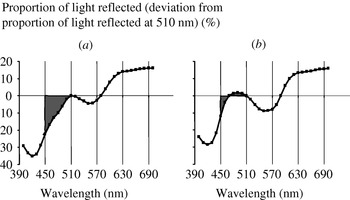
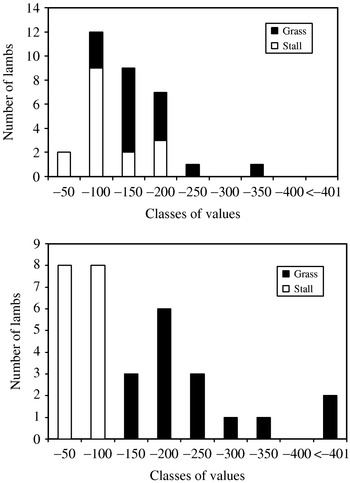
A method has been pioneered to discriminate between P and C lambs via analysis of the reflectance spectrum of fat in the zone of light absorption by carotenoids (510–450 nm) (Prache & Theriez Reference Prache and Theriez1999) using a MINOLTA CM-2002 portable spectrophotometer. A spectrocolorimetric index (I 450–510) is calculated that quantifies light absorption by these pigments (Fig. 1). It is preferable to measure perirenal rather than subcutaneous fat, since perirenal fat stores more carotenoids (Fig. 2; Priolo et al. Reference Priolo, Prache, Micol and Agabriel2002b). This method was further used quite successfully for ewe's milk (Priolo et al. Reference Priolo, Lanza, Barbagallo, Finocchiaro and Biondi2003) where two treatments were compared: a diet containing maize silage, concentrate and oats hay v. 4 h grazing per day+con centrate+hay indoors. The spectrocolorimetric index (I 450–510) was strongly affected by treatment. There was some overlapping for 0·16 of milk samples, but the reliability of the discrimination would probably be further improved with higher grazing times. This method, which has been patented (Prache & Priolo Reference Prache and Priolo2003), has the advantage of being rapid, noninvasive, and easily applicable in the meat and milk industry. It has been further extended to bovine meat, milk and cheese (Prache et al. Reference Prache, Priolo, Tournadre, Jailler, Dubroeucq, Micol, Martin, Durand, Emile, Huyghe and Lemaire2002; Serrano et al. Reference Serrano, Prache, Chauveau-Duriot, Agabriel and Micol2006). It should be noted, however, that a high variability between animals, particularly between pasture-fed animals, is generally observed in plasma, milk and fat carotenoid concentrations and in the spectrocolorimetric index.
Reflectance spectrum pattern of perirenal fat at slaughter for (a) a lamb having a high (i.e. 588·63 units) and (b) a low (i.e. 53·55 units) absolute value of the integral of the translated spectrum between 510 and 450 nm. The integral is the shadow area comprised between the curve and the X-axis in the zone 450–510 nm. The portion of this area that is above the X-axis is positive and the portion that is under the X-axis is negative. From Prache et al. (Reference Prache, Priolo and Grolier2003b).

Distribution of stall- and pasture-fed lambs in the different classes of the spectrocolorimetric index obtained using the visible reflectance properties of caudal (top) or perirenal fat (bottom) between 450 and 510 nm (i.e. the zone of light absorption by carotenoid pigments). From Priolo et al. (Reference Priolo, Prache, Micol and Agabriel2002b).

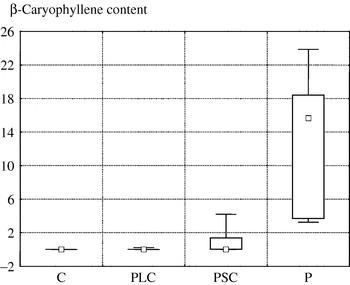
In the experiments with lambs, marked differences were also found in the sesquiterpene profiles of fat from P v. C lambs (Priolo et al. Reference Priolo, Cornu, Prache, Krogmann, Kondjoyan, Micol and Berdagué2004b). Two terpenes, β-caryophyllene and trans-cadina-1(6),4-diene, were present at significant concentrations in the lambs fed at pasture until slaughter, but only at basal concentrations or even undetectable in C lambs or lambs raised on pasture and finished on concentrates. These compounds may therefore be proposed as biomarkers of pasture-feeding in sheep meat, particularly β-caryophyllene (Fig. 3). Two other terpenes, α- and β-cubebene contents were also 4-fold higher in P lambs than in C or in concentrate-finished grazing lambs, although their discrimination potential may be lower than β-caryophyllene. These results were obtained with lambs grazing pastures containing mainly graminaceae. Hence, it did not support the hypothesis that a generic discrimination of pasture-fed v. concentrate-fed animals by means of a terpene profile may be difficult because pastures rich in monocotyledons have low terpene concentrations (Mariaca et al. Reference Mariaca, Berger, Gauch, Imhof, Jeangros and Bosset1997). As for carotenoids, the variability in terpenes concentrations in the fat from P lambs was generally high. However, not all the terpenes detected in lamb fat were positively related to pasture diets, since β-gurjunene was found at 80-fold higher concentrations in fat from C lambs than fat from P lambs.
Box-plot presentation of the sesquiterpene β-caryophyllene value (arbitrary units) measured on the subcutaneous caudal fat at slaughter from lambs raised on pasture (P), finished with a concentrate-based diet in stall for a long (PLC) or a short (PSC) period after grazing at pasture, and raised and finished in stall with a concentrate-based diet (C). Maximum, minimum, median and quartile distributions are shown. From Priolo et al. (Reference Priolo, Cornu, Prache, Krogmann, Kondjoyan, Micol and Berdagué2004b).

In the same experiments, Aurousseau et al. (Reference Aurousseau, Bauchart, Calichon, Micol and Priolo2004) found that fatty acid composition in muscle PL allowed perfect discrimination between P and C lambs. Proportions of C18:2n−6 and other n−6 PUFA were lower and proportions of C18:3n−3 and other n−3 PUFA were higher in the fatty acids of the longissimus thoracis muscle from P lambs compared with C lambs. These differences were significant in both triglycerides and PL, but were more noticeable in PL where higher proportions of PUFA accumulate. In muscle PL, the proportion of C18:3n−3 in total fatty acids ranged from 0·019 to 0·046 mg/g (0·031 mg/g on average) and from 0·006 to 0·014 mg/g (0·009 mg/g on average) in P and C lambs, respectively. Moreover, the C18:2n−6/C18:3n−3 ratio ranged from 2·44 to 4·77 and from 10·31 to 24·51 in P and C lambs, respectively. Milk fatty acid composition also proved to be very useful for discriminating feed diets in dairy cows (Martin et al. Reference Martin, Cornu, Kondjoyan, Ferlay, Verdier-Metz, Pradel, Rock, Chilliard, Coulon, Berdagué, Hocquette and Gigli2005), but there are no experimental data in dairy ewes. However, Priolo et al. (Reference Priolo, Bella, Biondi, Fasone, Galofaro, Scerra, Valvo and Lanza2004a) found that lambs fed exclusively maternal milk had a lower (n−6)PUFA/(n−3)PUFA ratio when the dams grazed at pasture than when they were fed concentrates indoors, with the ratios overlapping in only two lambs out of 20.
In these experiments with lambs, the concentration of the volatile compound 2,3-octanedione in subcutaneous fat allowed to perfectly discriminate between P and C lambs, whereas skatole was not significantly different between the two groups (Priolo et al. Reference Priolo, Cornu, Prache, Krogmann, Kondjoyan, Micol and Berdagué2004b). Young et al. (Reference Young, Lane, Priolo and Fraser2003) reported higher concentrations of skatole in the fat of pasture-fed compared with concentrate-fed lambs (although the differences were not always significant). However, Sebastian et al. (Reference Sebastian, Viallon-Fernandez, Berge and Berdagué2003) did not confirm this result. Although differences between studies may reflect differences in the site of fat measurement (perirenal fat in Young et al. Reference Young, Lane, Priolo and Fraser2003v. subcutaneous fat in the other studies), the reliability of skatole in authenticating pasture-fed sheep meat probably requires further investigation.
The nature of the diet ingested strongly influences the composition of milk and meat, and this composition may therefore be used to authenticate the diet. However, responses are sometimes highly variable between animals, and the extent to which this variability could impair the reliability of the authentication method needs to be addressed further. A validation procedure has commenced with a large cohort of animals, both in experimental facilities (Dian et al. unpublished) and with commercial sheep producers (Prache et al. unpublished). Questions regarding the effects of plant phenological stage on vegetal biomarker contents deserve further investigation, as well as the effects of sward availability and supplementation at pasture. Prache et al. (Reference Prache, Priolo and Grolier2003a) reported that plasma carotenoid concentrations in pasture-fed lambs varied with time, with values in June being 1·5-fold higher than in July and 2·5-fold higher than in August. A plant's volatile compound content also varies with phenological stage (Mariaca et al. Reference Mariaca, Berger, Gauch, Imhof, Jeangros and Bosset1997) and Tornambé et al. (Reference Tornambe, Cornu, Pradel, Kondjoyan, Carnat, Petit and Martin2006) observed that milk terpene contents from grazing cows were affected by both the phenological stage of the pasture and the grazing management system. More generally, future research may be directed towards investigating the animal's response to the marker intake level. Animal-specific factors, particularly breed and production level, may affect the animal's response (Fisher et al. Reference Fisher, Enser, Richardson, Wood, Nute, Kurt, Sinclair and Wilkinson2000; Nozière et al. Reference Nozière, Graulet, Lucas, Martin, Grolier and Doreau2006) and their implications for diet authentication purposes warrant further research.
PERSISTENCE OF THE DIET EFFECTS AND IMPLICATIONS FOR DIET AUTHENTICATION
The research discussed so far has been focused on the development of potential markers, and has thus investigated the effects and discrimination of contrasting diets. However, it is frequently the case that grazing lambs are finished indoors on concentrate diets due to pasture shortage or to increase their live weight gain (LWG). The effect of concentrate finishing after grazing on the animal tissue and product concentrations of the compounds likely to serve as biomarkers of pasture-feeding, and its implications for authentication purposes, have recently been investigated in lambs (Prache et al. Reference Prache, Priolo and Grolier2003a, Reference Prache, Priolo and Grolierb, for carotenoid pigments; Priolo et al. Reference Priolo, Cornu, Prache, Krogmann, Kondjoyan, Micol and Berdagué2004b, for fat volatiles). The following treatments were compared in lambs: grazing pasture (P), concentrate-based diet (C; diet containing 0·85 concentrate and 0·15 hay), concentrate finishing for a long (PLC; 42 days on average) or a short (PSC; 30 days on average) period after grazing pasture. Concentrate supply was regulated to achieve similar growth patterns across all treatments.
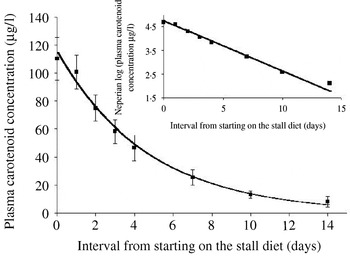
Carotenoid contents in plasma and fat and 2,3-octanedione content in fat all decreased with the interval from starting out on stall diet after pasture, according to an exponential model: Y=a×e(−b×day), where b is the deceleration parameter (Fig. 4). Carotenoids showed less persistence in blood than in fat. After an average 8 days on the stall diet, the plasma carotenoid content of previously pasture-fed lambs fell to the values found in C lambs. The intensity of light absorption by lutein present in the fat was negatively correlated with the duration of the finishing period, this effect being mediated via a dilution of existing fat with whiter fat rather than through pigments coming out of the fat. The model developed using LWG during the finishing period and plasma carotenoid concentration at the end of the grazing period predicted that the spectrocolorimetric index (I 450–510) would reach a value similar to that of the C lambs after 11 kg LWG on average on the stall diet, i.e. about 35 days when lamb average daily gain is 300 g/day.
Means of the plasma carotenoid concentration of concentrate-finished grazing lambs according to the interval from starting on the concentrate diet. Bars represent standard errors. A semi-neperian logarithmic representation of the same data is presented in the inset. From Prache et al. (Reference Prache, Priolo and Grolier2003a).

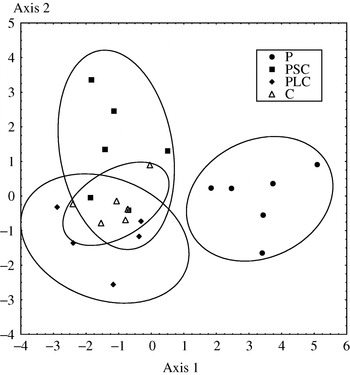
In the experiment, the terpene profile of the stall-finished grazing lambs did not differ markedly from that of the C lambs, suggesting that the persistence of these compounds is low (Fig. 5). β-Caryophyllene was found in all P lambs, but only in two and one out of six PSC and six PLC lambs, respectively. The concentration of this compound was actually 15-fold higher on average in the fat from P compared with PSC lambs. Factorial discriminant analysis indicated that four of the 33 terpenes detected in the fat could discriminate P animals from all the others. Among the fat volatile compounds, 2,3-octanedione proved to be a good provider of reliable information on the duration of the concentrate-finishing period. It is worth noting that the residual standard deviation of the semi-neperian logarithmic model of persistence of 2,3-octanedione in the fat was low, suggesting low interference of between-animal variability.
Factorial analysis of four terpenes (β-cubebene, β-gurjunene, S8 and geranyl acetone) that discriminate animals fed exclusively pasture (P) from all the other animals (C: lambs fed a concentrate-based diet; PLC: lambs concentrate-finished for a long period after pasture; GSC: lambs concentrate-finished for a short period after pasture).

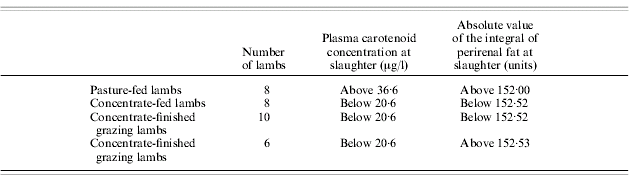
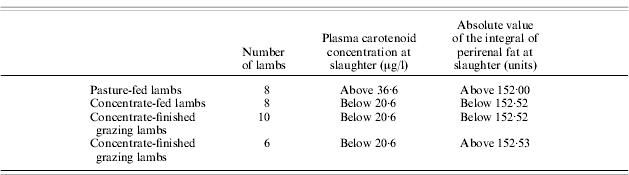
Furthermore, there is clear evidence that the combined use of different compounds and different tissues improves reliability in the discrimination of pasture-fed, concentrate-fed and concentrate-finished grazing lambs, by taking advantage of the differences in the persistence patterns (Table 1; Prache et al. Reference Prache, Priolo and Grolier2003b, Reference Prache, Cornu, Berdagué and Priolo2005). Lambs with high plasma carotenoid concentration and high value I 450–510 are pasture-fed. Lambs with low plasma carotenoid concentration and low value I 450–510 are concentrate-fed or concentrate-finished grazing lambs. Lambs with low plasma carotenoid concentration and high value I 450–510 are concentrate-finished grazing lambs. This finding shows the refinement coming from the combined use of fat and blood measurements at slaughter, which takes advantage of the differences in the rate of reduction in carotenoid concentration in blood and fat. This method, however, does not enable us to discriminate concentrate-fed lambs from concentrate-finished grazing lambs having a low absorption of carotenoids or an over-long finishing period.
Distribution of lambs according to the combined use of plasma carotenoid concentration and absolute value of the spectrocolorimetric index between 450 and 510 nm (i.e. the zone of light absorption by carotenoid pigments) of perirenal fat at slaughter. From Prache et al. (Reference Prache, Priolo and Grolier2003b)
CONCLUSIONS
Research on diet authentication in herbivore meat and milk is conducted within a general context of increasing consumer concern regarding the mode of animal production. Within this context, there is a need for authentication tools to guarantee that specification commitments have been fully met and to help constructing them. Recent developments in analytical methods made it possible to discriminate between contrasting diets in sheep meat and milk, based on quantifying specific compounds in the product or the animal tissues or based on fingerprints. The results show that the combined use of different compounds and tissues is useful. Cost and ease of implementation vary among methods. The spectrocolorimetric method for quantifying fat concentration of carotenoid pigments can be applied rapidly in abattoirs. Other methods can only currently be used on a small number of samples, but the possibility that they may be used can still deter fraud. These methods were so far developed using small animal number and some of them are currently being validated with a much larger number of animals. A validation procedure is essential because between-animal variability can be high, and the ability to accumulate some of these compounds may have a genetic component. Further research will be directed at evaluating the capability of these methods to discriminate intermediate feeding conditions and investigating the interactions between feeding conditions and animal characteristics.