Introduction
Patients with advanced cancer must cope with multiple, diverse challenges related to the illness. Approximately one in four cancer patients is diagnosed with a psychiatric disorder (Gil et al., Reference Gil, Costa and Pérez2008, Reference Gil, Costa and Pérez2010). In addition, advanced cancer patients who report suicidal thoughts are more likely to meet criteria for posttraumatic stress disorder and panic disorder, feel unsupported, lack a religious affiliation and spirituality, have less sense of self-efficacy, and experience more physical distress (Spencer et al., Reference Spencer, Ray and Piri2012).
In this context, the aim of existential-focused psychotherapy is to promote a discussion of death and life meaning to decrease depressive symptoms and improve quality of life in these patients. The model developed by Breitbart—meaning-centered psychotherapy (MCP)—has been shown to improve spiritual well-being, reduce hopelessness and patient desire for a speedy death, and to decrease the distress related to the physical symptoms of the disease process (Breitbart et al., Reference Breitbart, Rosenfeld and Pessin2015). MCP has been adapted for different populations and countries (Breitbart, Reference Breitbart2017). Another therapeutic model is compassion-focused therapy (CFT), which was developed by Gilbert (Reference Gilbert2010, Reference Gilbert2014). CFT proposes that compassion is composed of two distinct but interdependent approaches, one that motivates patients to engage with suffering, to stay with it, and to understand its causes in a nonjudgmental way and another that enables patients to work skillfully toward alleviating and preventing suffering and its causes. However, as Gilbert (Reference Gilbert2010) observes, this process would be very limited without mindful awareness. Several treatment programs based on the principles of CFT have demonstrated the benefits of this approach in individuals with eating disorders (Gale et al., Reference Gale, Gilbert and Read2014) and a reduction in depression in individuals with psychosis (Braehler et al., Reference Braehler, Gumley and Harper2013). Compassion can consist of both compassion toward others and self-compassion, which has been defined as “being touched by and open to one's own suffering, not avoiding or disconnecting from it, generating the desire to alleviate one's suffering and to heal oneself with kindness” (Neff Reference Neff2003, p. 86). Self-compassion has been shown to improve clinical outcomes in anxiety and depression (Van Dam et al., Reference Van Dam, Sheppard and Forsyth2011).
Numerous psychological and psychotherapeutic interventions are available for palliative care patients who are near the end of life. The most common of these is standard psychological counseling; however, another approach is based on MCP and is known as the MCP-palliative care version (MCP-PC) (Rosenfeld et al., Reference Rosenfeld, Saracino and Tobias2017). This treatment was created by the same research team that developed the original MCP (Breitbart et al., Reference Breitbart, Rosenfeld and Pessin2015). MCP-PC appears to be both feasible and acceptable and has the potential to help patients better cope with the inherent challenges in confronting death and dying.
Given the proven value of both MCP and CFT, we hypothesized that combining elements of both of these interventions could potentially improve treatment outcomes in patients with advanced cancer. Thus, we developed a slightly modified version of the MCP-PC, which we have named MCP-compassionate palliative care (MCP-CPC). The main difference between MCP-PC and MCP-CPC is the focus on fostering self-compassion. The intention was not to radically change MCP, but rather to enhance it by adding the “connectedness exercise” and the “self-compassion letter” from CFT.
In this context, we designed a pilot study to compare MCP-PC, MCP-CPC, and standard psychological counseling to determine the relative effectiveness of these interventions in a sample of terminally ill patients approaching the end of life. More specifically, we also sought to elucidate which aspects of these treatments that patients found to be the most salient.
Method
Participants
A total of 51 terminally ill cancer patients hospitalized at a comprehensive cancer hospital were recruited and randomly assigned to one of three brief interventions consisting of three sessions of MCP-PC, MCP-CPC, or standard counselling. All of the participants had been referred to the psycho-oncology unit with a life expectancy of less than 6 months and were receiving palliative care. All participants were Spanish-speaking, diagnosed with terminal cancer, and were considered cognitively intact. The study was approved by the institutional review board of our hospital. All participants were required to provide informed consent.
Procedures
First, participants were informed of the study aims and procedures and asked to sign the informed consent form. Next, the patients were interviewed to obtain their sociodemographic characteristics. Their medical history was obtained from medical records. During the treatment sessions, a research assistant was present as an observer to code for treatment adherence. All patients were assigned to the same therapist (FG), who is fully trained in all three interventional approaches. The sessions were delivered in the patient's private hospital room, and the length of each session was tailored to the patient's functional capacity (approximately 30 minutes). Ten patients were allocated to each interventional arm.
Manualized individual psychotherapy interventions
Counseling
The three counselling sessions were focused on helping patients to cope with advanced cancer by encouraging them to share any concerns related to the illness and/or treatment. We also sought to validate emotions, and patients were asked to describe their experiences and emotions related to the cancer and identify any challenges they faced.
MCP-PC
The goal of MCP-PC is to extract the most salient elements from MCP treatment while maintaining the integrity of the approach, with a particular emphasis on developing or bolstering a sense of meaning and purpose in life. In accordance with the recommendations of Rosenfeld et al. (Reference Rosenfeld, Saracino and Tobias2017), we limited the number of individual treatment sessions to three to accommodate the level of impairment in palliative care cancer patients.
The first MCP-PC session addressed the patient's own understanding of meaning and the experience of meaning in his or her life. The second session focused on sources of meaning, including experiential, creative, and attitudinal sources; in this second session, patients were asked to reflect on which of these sources of meaning they still draw upon despite the limitations imposed by their illness. The third and final session focused on finding meaning through courage and commitment, living one's legacy, and finding a sense of peace. The exercises were designed to identify times in the past when the patient showed courage and to consider how he or she might draw from these experiences in the present situation. Patients were encouraged to discuss their legacy and how they hoped to impact the world.
MCP-CPC
This psychotherapeutic approach is largely based on MCP and seeks to maintain the integrity of that approach, particularly those aspects that emphasize the importance of a sense of meaning and purpose in life. The main difference between this approach and the standard MCP is the increased focus on compassion. For this reason, two of the three sessions included two experiential exercises designed to promote compassion and self-compassion. Thus, we made minor modifications to the original MCP intervention by adding the “connectedness exercise” and the “self-compassion letter.” Nevertheless, we largely maintained the same structure as used in the MCP-PC intervention.
The first session of the MCP-CPC intervention was exactly the same as the third session of the MCP-PC (that is, focused on finding meaning through courage and commitment, living one's legacy, and finding a sense of peace). The second session addressed the importance of being compassionate with others, including relatives, friends, and even the medical team. In this session, patients were asked to reflect about the need to show compassion to others, and to consider how this might benefit both themselves and the people around them. At the end of the session, patients participated in a “connectedness exercise” in which they were encouraged to role-play the act of telling their main caregiver or friend how they feel, and to ask them how they were feeling. The third and final session focused on fostering self-compassion. In that session, patients were asked to reflect on the benefits of developing a self-compassionate attitude, about being kind and understanding of themselves. At the end of the session, the patients were asked to write a self-compassion letter to reflect on their past and present experience with the cancer diagnosis and treatment. They were instructed to be kind to themselves in that letter and not to just tell themselves what they should do to help themselves.
Measurements
At the end of the third (final) session, patients completed a brief questionnaire to elicit their perception of the intervention and its utility. Patients were asked to rate their responses to the patient satisfaction questionnaire on a 4-point scale ranging from 0 to 3 (not at all, a little, quite a bit, a lot), with higher scores indicating greater satisfaction.
In addition, the notes made by the research assistant during the treatment sessions were used to verify how closely the interventions following the guidelines in the treatment manuals for all three interventions (data available upon request).
Statistical analysis
The IBM SPSS Statistical software program, version 21.0, was used for statistical analyses. A descriptive univariate analysis of all the study variables was performed. After the first analysis, we used the Wilcoxon test for repeated measures. We also used the Kruskal-Wallis test to compare the various treatments.
Results
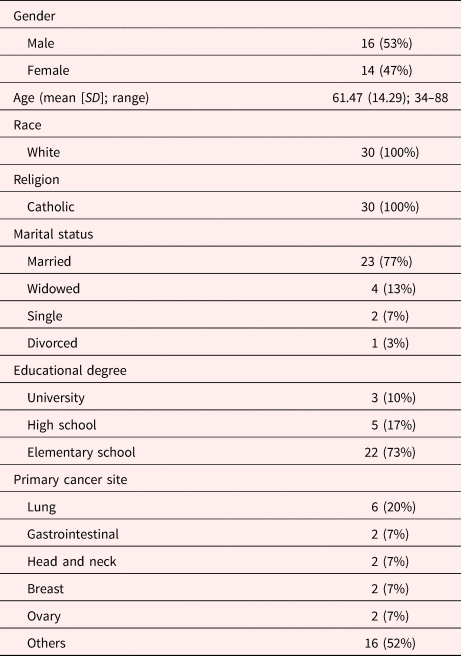
The sample was well-balanced between men (53%) and women (47%). The mean age was 61.5 years. Table 1 presents the demographic and clinical characteristics of the study participants.
Sample characteristics (N = 30)

Of the 51 patients that began one of the three psychotherapy treatments, 30 (10 in each group) completed the three-session interventional program as well as the posttreatment questionnaires. The remaining 21 patients were unable to complete the full treatment because of physical and/or cognitive deterioration, referral to another hospital, or being discharged to home to receive home palliative care.
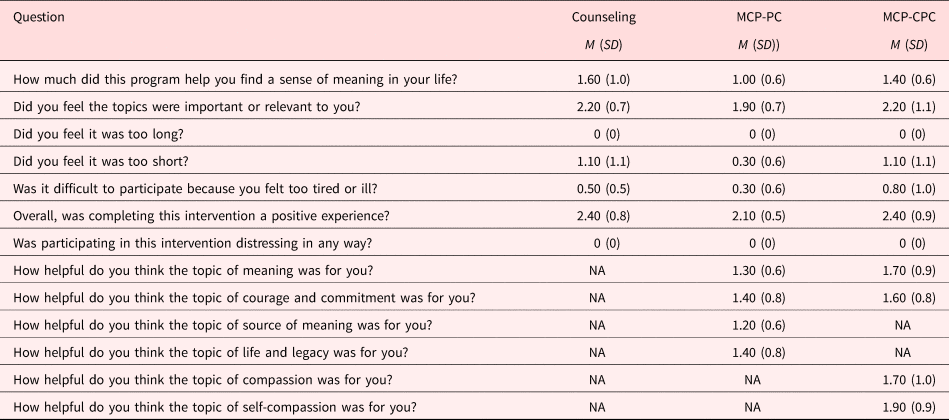
Responses to the posttreatment questionnaire are summarized in Table 2. There were no differences in the feedback expressed by the patients about the structure, focus, and length of the three psychotherapeutic models. In general, all patients rated the content of the interventions positively. None of the patients found the intervention to be distressing and all were satisfied with the length of treatment.
Posttreatment participants’ feedback (N = 30)

MCP-CPC, meaning-centered psychotherapy – compassionate palliative care, MCP-PC, meaning-centered psychotherapy – palliative care; NA, not applicable question in accordance to the intervention aims.
There were no significant differences between the MCP-CPC and MCP-PC groups in terms of patient perceptions about the constructs or elements meaning and courage and commitment. Patients in both the MCP-PC and MCP-CPC groups found that meaning, self-compassion, compassion, legacy, courage, and commitment were helpful elements of therapy (Table 2).
The most highly rated item on the questionnaire in all three groups was the overall satisfaction rating, with mean scores ranging from 2.1 (MCP-PC) to 2.4 (standard counseling and MCP-CPC groups). Interestingly, there was a large discrepancy among the groups with regard to the perceived value of the intervention to help find a sense of meaning, with a score of only 1.0 in the patients in the MCP-PC group versus scores of 1.4 (MCP-CPC) and 1.6 in the counseling group.
There was also a small discrepancy between the groups in response to the importance/relevance of the topics, with the lowest score (1.9) in the MCP-PC groups versus 2.2 in the other two groups.
Discussion
The present pilot study was designed to compare the feasibility, acceptability, and utility of three brief psychotherapeutic interventions to address the psychosocial needs of patients in the final weeks of life. This study sought to determine which components of these models were considered to be the most helpful for patients. By identifying the most valued components, it may be possible to further improve the emotional and spiritual well-being of patients at the end of life.
Overall, the participants in all three psychotherapeutic interventions were highly satisfied with the intervention, as evidenced by satisfaction scores ranging from 2.1 to 2.4 (maximum score = 3). Consistent with findings of Rosenfeld et al. (Reference Rosenfeld, Saracino and Tobias2017), none of the patients in our study reported finding participation in the intervention to be distressing in any way, as indicated by a score of 0 in all three groups in response to the question “Was participating in this intervention distressing in any way?” This is an important outcome considering the sensitive topics that are explored during these interventions.
Similarly, participants were largely satisfied with the length of treatment, with none finding it too long. Interestingly, patients in the counselling and MCP-CPC groups gave higher scores (mean = 1.1) to the question “Was it too short?” whereas patients in the MCP-PC group provided lower ratings (mean = 0.3). This suggests that the counseling and MCP-CPC groups may have had more interest in continuing the sessions compared with the MCP-PC groups. In this same line of analysis, it is interesting to observe that, although all groups rated their overall satisfaction highly, the lowest scores (mean = 2.1) were in the MCP-PC group (vs. mean = 2.4 in the other interventional groups). Moreover, the perceived value of the intervention to help find a sense of meaning was also substantially lower (mean = 1.0) in the MCP-PC group versus the other two groups. Similarly, the importance/relevance of the topics were also scored lower (mean = 1.9) in the MCP-PC group (vs. mean = 2.2 in the other two groups). Although we must stress that satisfaction of patients in the MCP-PC group was high, that they were somewhat less satisfied than the other two groups is notable. The reason for this discrepancy, however, is not clear, although we suspect that the inclusion of compassion elements in both the standard counselling and MCP-CPC groups may have tilted the scales in favor of those two interventions. Nonetheless, the differences are small and more studies are needed to assess the benefit of including compassion and self-compassion constructs in these end-of-life interventions.
The elements of MCP-PC that patients found to be the most relevant were meaning, legacy, courage, and commitment. These elements offer patients, particularly in the end of life, the opportunity to see that their life has had meaning based on their achievements and interactions with relatives and friends. In the case of the patient's legacy, the participants were able to see how they used courage to meet their commitments. Patients in both the MCP-CPC and MCP-PC groups considered the same elements to be highly relevant; however, the patients in the MCP-CPC group also rated the constructs of compassion and self-compassion very highly. This finding provides support for introducing the compassion/self-compassion construct into psychotherapeutic interventions in this patient population.
From an integrative perspective, there is a need for an individualized psychotherapeutic approach to the patients to maintain an adequate degree of standardization through a manualized intervention. Both the MCP-PC and MCP-CPC can be adapted to suit the particular needs and characteristics of patients with terminal illnesses.
Study limitations
The main limitation of this study is the small sample size; however, this was a pilot study. Another potential limitation is that a single clinician was responsible for delivering the treatment in all three treatment arms. This could be problematic because it is possible that meaning-based topics would come up in the counseling intervention and compassion-based topics might come up in the other two arms. Another limitation is that 40% of patients were unable to complete the interventions; however, this high attrition rate, which could bring into question the feasibility of these interventions, is common in the palliative care setting, regardless of the specific psychotherapy intervention used.
Conclusions
The findings of the present study show that all three psychological interventions—MPC-PC, MPC-CPC, and standard counseling—were effective and well-received by patients. MCP-CPC, as an abbreviated psychotherapy for patients at the end of life, is a feasible and potentially beneficial approach to help patients manage the psychological distress associated with advanced and terminal illness.
Importantly, these findings provide support for incorporating the compassion and self-compassion constructs in meaning-centered interventions. As we have seen, the inclusion of these constructs may further improve the emotional and spiritual well-being that patients develop after working on the construct meaning and the other elements related with it (legacy, courage, and commitment). However, more research is needed in larger samples to assess the efficacy of MCP interventions and to compare this approach with usual care. Future research studies should evaluate the value of incorporating new elements or constructs—such as compassion or self-compassion—to MCP to improve efficacy.
Conflicts of interests
The authors declare no potential conflicts of interest with respect to the research, authorship, and/or publication of this article.