INTRODUCTION
Since its inception, the primary goal of the hospice movement has been to alleviate pain and suffering at the end of life. Hospices focus on maintaining high-quality care for dying patients as well as providing information and support for families, both of which are fundamental to the original mission of the hospice movement. Since family members are participants in the dying process, they can provide crucial information about their perception of the quality of hospice care to the dying person as well as their own experiences with hospice. Hospices strive to help patients, family members, and caregivers prepare for loss through education about the process of death, and most family members agree that knowing what to expect about the death is very important to them (Steinhauser et al., Reference Steinhauser, Christakis and Clipp2000). Thus, to evaluate hospice care, two main outcomes to consider are family members' overall satisfaction with their hospice experience and family members' confidence that they knew what to expect during the dying process.
The Family Evaluation of Hospice Care (FEHC) is one of the most widely used program evaluation instruments employed by U.S. hospices. More than 20% of American hospices utilize the FEHC to gather information about family caregivers' perceived quality of care at the end of a loved one's life (Rhodes et al., Reference Rhodes, Mitchell and Miller2008). Previous studies have analyzed FEHC data in an effort to inform and enhance hospice services (Connor et al., Reference Connor, Teno and Spence2005; Rhodes et al., Reference Rhodes, Mitchell and Miller2008; Teno et al., Reference Teno, Shu and Casarett2007), and this research has yielded useful descriptive results. Of particular interest to the present study is the previous finding that family members' greater overall satisfaction with hospice was associated with their feelings that they had adequate information about what to expect when the patient was dying (Rhodes et al., Reference Rhodes, Mitchell and Miller2008).
These studies provide a baseline from which to assess the quality of hospice services. However, they have primarily focused on straightforward associations between predictors and outcomes and have not yet examined more complex relationships among predictors that may relate to family members' evaluation of the quality of hospice services. Thus far, researchers have not explored the potentially complex interplay among the predictor variables themselves that influence hospice satisfaction and other outcomes, including caregivers' confidence in their expectations about the death. To address this gap, the present study examines the direct and indirect (i.e., mediating) effects of relevant patient, family, and care-related factors on two primary outcomes: overall satisfaction with hospice and caregiver confidence.
We examine here these direct and indirect effects using structural equation modeling (SEM). Aside from allowing for examination of mediating variables, SEM has the advantage of being able to model latent constructs with multiple indicators while limiting the influence of measurement error—all of which may be particularly useful for the FEHC, which includes many questions with overlapping item content.
We will specifically examine the association between several independent variables (namely, patient demographic factors, caregiver relationship to the patient, location of services, length of stay, timing of referral, and patient symptoms) and two outcomes: overall satisfaction with hospice and caregiver confidence. Based on previous findings, we hypothesize that family members of patients with a longer length of stay (Rickerson et al., Reference Rickerson, Harrold and Kapo2005), a referral perceived as being at the “right time” (Schockett et al., Reference Schockett, Teno and Miller2005; Teno et al., Reference Teno, Shu and Casarett2007), and fewer symptoms (Tierney et al., Reference Tierney, Horton and Hannan1998) would tend to have more positive outcomes. Furthermore, we expect that these associations will be mediated by perceptions of the quality of information/education received, provision of care to the patient, and emotional/spiritual support offered to the family. Demographic variables, caregiver relationship to the patient, and location of services (i.e., inpatient vs. at home) are included as relevant exploratory variables.
METHOD
Participants and Procedure
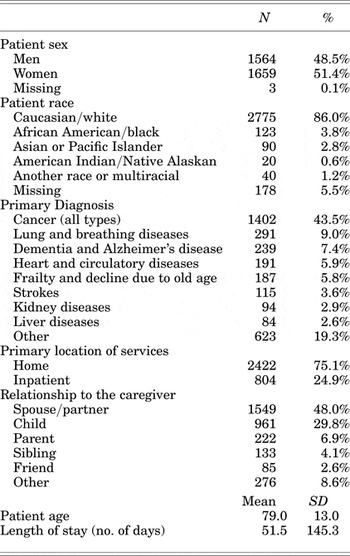
Data were collected from 3226 individuals from February of 2008 to April of 2013 using the Family Evaluation of Hospice Care (FEHC) at a large hospice in an urban area of the Southwest United States. Consistent with its recommended guidelines, participants in the study were mailed the FEHC 1 to 3 months following their loved one's death, along with a postage-paid, preaddressed envelope for returning the completed survey. Of those mailed during this timeframe, 33.2% of surveys were returned, similar to the average response rate for the FEHC nationally (National Hospice and Palliative Care Organization, 2009). Surveys were mailed to the individual listed as the patient's primary caregiver or health representative, most of whom were spouses/partners (48.0%) or adult children (29.8%) of the patient. Most participants provided information about a Caucasian patient (86.0%) who was a woman (51.4%) receiving services at home (75.1%) with a primary diagnosis of cancer (43.5%). On average, patients were 79.0 (SD = 13.0) years old at the time of death and received hospice services for 51.5 days (SD = 145.3). Additional demographic and background information about the sample is provided in Table 1.
Demographic and background information (N = 3226)

Measures
All participants provided information on the FEHC, which is widely used for program evaluation purposes in hospices across the nation (Rhodes et al., Reference Rhodes, Mitchell and Miller2008). This survey includes questions regarding the caregiver's perception of the quality of information, care, and support that the patient and family received from hospice staff as well as their overall level of satisfaction with hospice services and degree of confidence as a caregiver. Questions pertaining to demographic information, patient symptoms, and timing of referral to hospice are also included.
Indicators of the constructs of interest were chosen based on several factors, including prior groupings of items into content areas (Connor et al., Reference Connor, Teno and Spence2005; Rhodes et al., Reference Rhodes, Mitchell and Miller2008; Teno et al., Reference Teno, Clarridge and Casey2001), consensus among the researchers about overlapping item content, and the research questions of interest. In order to make the best possible use of the available information, preference was given to items that were relevant to all participants (e.g., participants could not “skip out” on the question based on a prior response), consistent across all versions of the survey (i.e., included in the new and old versions as well as home care and inpatient versions of the survey), and had a minimal amount of missing data. The final grouping of items into content areas matched closely with previous recommendations (Connor et al., Reference Connor, Teno and Spence2005; Rhodes et al., Reference Rhodes, Mitchell and Miller2008; Teno et al., Reference Teno, Clarridge and Casey2001).
Variables were further categorized as independent variables (i.e., factors that the hospice likely had little or no control over), mediating variables (i.e., perceived quality of various services offered by the hospice), and dependent variables (i.e., outcomes presumed to result from those hospice services), as described below.
Independent Variables
Independent variables included age, patient sex (0 = men, 1 = women), patient race (0 = Caucasian, 1 = racial minority), length of hospice services, perceived timing of referral to the hospice (0 = too early or too late, 1 = at the right time), primary location of services (0 = home, 1 = inpatient), relationship to the caregiver (0 = non-spouse, 1 = spouse), and patient symptom severity, which was represented as a count of endorsed symptoms, including pain, breathing problems, and sadness/anxiety.
Mediating Variables
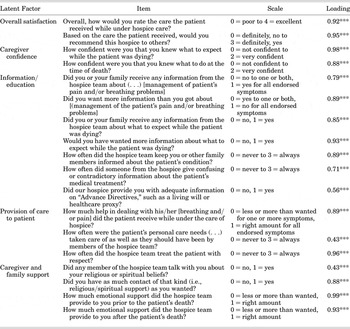
Mediating variables tapped into perceptions of the quality of various hospice services and were divided into three broad content areas. As shown in Table 2, information/education was assessed with seven items, direct provision of care to the patient was assessed via three items, and emotional and spiritual support offered to the caregiver and other family members was measured with four items. All items employed to assess these mediating variables were coded in such a way that a higher score indicated greater contentment with the service provided.
Standardized factor loadings for items included in the structural equation model

***p < 0.001.
Dependent Variables
Overall levels of satisfaction with hospice care and caregiver confidence were conceptualized as outcome variables that were likely influenced by the quality of provided services (i.e., the mediating variables). Overall satisfaction with hospice care and caregiver confidence were each assessed with two items, as can be seen from Table 2.
Plan of Analysis
Structural equation modeling (SEM) was utilized to test the independent variables' (i.e., patient age, sex, race; length of stay; location of services; timing of referral; and patient symptom severity) direct and indirect (via information/education, care to the patient, and caregiver/family support) effects on overall satisfaction with hospice and caregiver confidence. The independent variables were each represented by a single indicator. The other constructs were treated as latent factors that were assessed with a variety of indicators (as shown in Table 2). Dichotomous and ordinal variables were treated as ordered categorical variables.
A measurement model was first tested, which only included these latent variables as correlated factors. Following a test of this measurement model, a larger model was examined that included direct and indirect paths (via the three mediating variables) from each independent variable to overall satisfaction and caregiver confidence.
We relied upon a variety of fit indices to assess model fit, including the χ2 goodness-of-fit test, the comparative fit index (CFI) (Bentler, Reference Bentler1990), the Tucker–Lewis index (TLI) (Tucker, Reference Tucker1973), and the root mean square error of approximation (RMSEA) (Browne & Cudeck, Reference Browne, Cudeck, Bollen and Long1993). CFI and TLI values greater than 0.90 are generally regarded as favorable (Hu & Bentler, Reference Hu and Bentler1999; Kline, Reference Kline2005). Likewise, RMSEA values equal to or less than 0.05 are considered a close approximate fit (Browne & Cudeck, Reference Browne, Cudeck, Bollen and Long1993). SEM analyses were performed in MPlus (Version 6.11) (Muthén & Muthén, Reference Muthén and Muthén1998–2010), and parameters were estimated using a weighted least-squares (WLS) procedure, which is ideal when many categorical indicators are included in a model.
Missing data were handled using multiple imputation, which has the advantage of providing unbiased estimates while making use of all available data. However, data from 41 individuals who only provided information on the independent variables and had missing data for all indicators of the latent variables were excluded from the analysis. Incomplete responses that were excluded from the analysis were more likely to be from spousal caregivers (p < 0.01) as well as caregivers of a male patient (p < 0.05), a patient identified as a racial minority (p < 0.001), older patients (p < 0.05), those with a shorter length of stay (p < 0.001), and patients with a primary diagnosis other than cancer (p < 0.001).
RESULTS
Prior to running the full SEM analysis, a measurement model was pilot tested that only included the latent variables as correlated factors (with corresponding observed indicators loading on each). The measurement model was found to fit the data well: χ2(125) = 705.90, p < 0.001, CFI = 0.98, TLI = 0.97, RMSEA = 0.038. As can be seen from Table 2, all indicators in this model also had loadings that were statistically significant (all p's < 0.001).
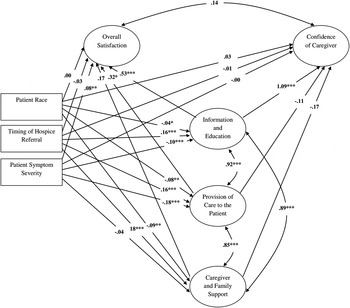
In the full SEM analysis, patient demographic factors (i.e., age, sex, race), length of stay, location of services, timing of referral, and patient symptom severity were treated as independent variables; information/education, care to the patient, and caregiver/family support as mediating variables; and overall satisfaction and caregiver confidence served as dependent variables. This model included paths from the independent variables to the mediating and dependent variables as well as paths from the mediating variables to the dependent variable (see Figure 1 for a pictorial representation). Overall, this model provided a good fit for the data: χ 2 (229) = 1165.66, p < 0.001, CFI = 0.97, TLI = 0.96, RMSEA = 0.036.
Pictorial representation of the structural equation model with standardized estimates. Patient age, patient sex, length of stay, primary location of services, and relationship to the caregiver were also included as independent variables in the model but are not represented here because none of these variables showed statistically significant indirect effects (through any of the mediating latent factors) on overall satisfaction or caregiver confidence. *p < 0.05, **p < 0.01, ***p < 0.001.

As shown in Figure 1, only two of the mediating variables were significantly associated with the dependent variables. Specifically, participants who expressed greater contentment with the information/education and patient care that was received were more likely to report greater overall satisfaction with hospice care. Caregiver/family support was not significantly associated with overall satisfaction. With regard to caregiver confidence, only information/education was found to be a significant correlate, with those who indicated greater contentment with the information/education they received being more likely to report feeling very confident about what to expect and/or do as their loved one approached the end of life.
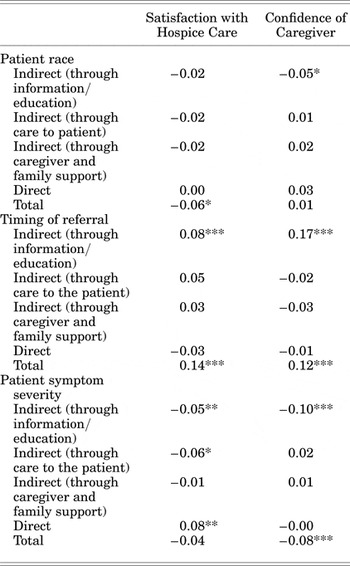
Only three independent variables were found to have significant indirect effects (via one or more of the mediating variables) on overall satisfaction and/or caregiver confidence. Thus, only these independent variables are presented in Figure 1 and Table 3. As can be seen from Figure 1, participants completing the FEHC with regard to a racial minority patient were more likely to report lower levels of contentment with the information/education received, provision of care to the patient, and caregiver/family support. Patient race did not show statistically significant direct effects on overall satisfaction or caregiver confidence. However, patient race was indirectly associated with lower levels of caregiver confidence through education/information (see Table 3). Stated differently, participants reporting on a racial minority patient were more likely to express some discontent with the education/information they received, which in turn put them at greater risk for feeling less confident as a caregiver.
Direct and indirect effects in the structural equation modeling analysis

*p < 0.05, **p < 0.01, ***p < 0.001.
As presented in Figure 1, participants who indicated that the patient was referred to hospice “at the right time” were more likely to be content with the information/education, patient care, and caregiver/family support received. Timing of referral was not significantly associated with overall satisfaction or caregiver confidence as a direct effect. However, contentment with timing of the referral to hospice was indirectly associated with greater overall satisfaction and caregiver confidence via information/education, as shown in Table 3. In addition, the indirect effect of timing of the referral on overall satisfaction through patient care approached statistical significance (regression coefficient, β = 0.05, p = 0.06).
Figure 1 also shows that participants reporting on patients with a more complex symptom profile were less likely to express contentment with the information/education and patient care received. As presented in Table 3, greater patient symptoms were also indirectly associated with less satisfaction (via information/education and care to the patient) and caregiver confidence (via information/education). Somewhat unexpectedly, patient symptoms were found to be positively associated with satisfaction as a direct effect. Thus, once its indirect effects through information/education and patient care were taken into account, more patient symptoms were actually associated with greater overall satisfaction.
Though not shown in Figure 1, it should be noted that the SEM analysis also revealed that spousal caregivers were less likely to report contentment with provision of care to the patient (β = –0.05, p < 0.05) and tended to report lower levels of overall satisfaction with hospice care (β = –0.05, p < 0.01) compared to non-spousal caregivers. Those who primarily received inpatient services were also more likely to report higher levels of overall satisfaction (β = 0.04, p < 0.05). Age, patient sex, and length of stay were not significantly associated with any of the variables included in the SEM analysis.
DISCUSSION
Our results suggest that the most important factors that influence caregivers' perceptions of hospice care are: patient race, patient symptoms, and their appraisal of the timing of hospice referral. Specifically, caregivers of racial minority patients, patients with a more complex symptom profile, and patients perceived to be referred too late or too early tended to express less contentment with the information/education and patient care received from the hospice staff. Racial minority status and late/early referral were also associated with less positive perceptions of caregiver/family emotional and spiritual support. These findings related to patient symptoms and the timing of referral are consistent with our hypotheses and fit with the previous literature on these factors (Teno et al., Reference Teno, Shu and Casarett2007; Tierney et al., Reference Tierney, Horton and Hannan1998). Racial minority patients and their families have been found in previous research to view hospice less favorably (Welch et al., Reference Welch, Teno and Mor2005), which has been attributed to greater discomfort discussing death, a stronger desire for aggressive care at the end of life, spiritual beliefs that conflict with the goals of hospice, and greater mistrust of the healthcare system (Johnson et al., Reference Johnson, Kuchibhatla and Tulsky2008).
The mediating variables examined in our study were found to differentially impact caregiver confidence and overall levels of satisfaction with hospice care. Specifically, only information/education was significantly associated with caregiver confidence. Examination of indirect effects also revealed that information/education largely accounted for the link between the independent variables (i.e., race, patient symptoms, and timing of referral) and caregiver confidence. This pattern of results suggests that efforts directed toward informing/educating patients' family members may be most potent in terms of promoting a sense of self-efficacy and confidence. Notably, a previous review of self-efficacy-enhancing interventions in healthcare settings similarly found that the most successful programs provide relevant information from well-trained staff and rely on a diverse set of strategies for educating patients and their family members (Marks & Allegrante, Reference Marks and Allegrante2005).
More positive perceptions of information/education and patient care were both found to be associated with higher levels of overall satisfaction. Consistent with our hypotheses, these two mediating variables were also found to largely account for the effects of patient symptoms and timing of the referral on overall satisfaction. Although definitive causal statements cannot be made based on these cross-sectional findings, these indirect effects suggest that families of patients with a more complex symptom profile and less-than-ideal timing of referral may tend to be less satisfied with hospice as a result of their discontent with the information/education and patient care received. With regard to patient symptoms, it is important to point out that, after these indirect effects were taken into account, caregivers of patients with greater symptoms were actually found to be more satisfied with hospice overall. Thus, families of patients who are suffering more severely and who feel as though they received excellent information/education and patient care may tend to be especially thankful and satisfied with their hospice experience.
Somewhat surprisingly, caregiver/family support was not significantly associated with overall satisfaction or caregiver confidence, suggesting that support alone, without the provision of valuable information and quality patient care, may not have a strong influence on caregivers' overall assessments of hospice or their own abilities. It should also be noted that non-spousal caregivers and those receiving inpatient care were found to be more satisfied with hospice care. This pattern of findings could stem from a tendency for more distant and perhaps less emotionally invested caregivers (e.g., extended family members, friends) as well as those who have more exposure and opportunities to interact with hospice staff to have fewer concerns.
The findings of our study are, of course, limited by its cross-sectional design, reliance on a single informant, modest response rate, and relatively homogenous sample from one geographic location. Nevertheless, this study provides researchers with a model for examining the complex interrelations among relevant variables included in the FEHC. If the findings of our study are replicated with more diverse samples, which perhaps also include multiple informants and longitudinal follow-ups, several recommendations for hospice care could be made. First, these results suggest that hospice staff's time would be well spent developing and implementing culturally sensitive models of care for racial minority patients and their families, perhaps based on the recommendations of Crawley and her colleagues (Reference Crawley, Marshall and Lo2002). It would also seem that the family members of patients who are experiencing multiple symptoms—including pain, dyspnea, and psychological distress—may be in greatest need of specialized attention that focuses on providing detailed information about their loved one's condition and the care being offered. Finally, hospices would be well advised to concentrate their efforts on overcoming internal and external barriers to timely patient referral (Friedman et al., Reference Friedman, Harwood and Shields2002), possibly by eliminating or minimizing restrictive enrollment policies (Carlson et al., Reference Carlson, Barry and Cherlin2012). Efforts geared toward providing community referral sources with education about the importance of timely hospice referrals, instruction on how to broach the topic with eligible patients and their families, and reduced incentives for implementing costly medical procedures at the end of life that offer little benefit could also go a long way to promoting a cultural shift in the healthcare industry that might lead to far fewer late hospice referrals (Petersen, Reference Petersen1992).