While carefully crafting a valentine to his would-be-lover Mary, Sam Weller finishes rather abruptly, and his father, looking over his shoulder, asks, “That's rayther a sudden pull up, ain't it, Sammy?” Sam's response emblematizes the driving force of the serial novel: “Not a bit on it. . . she'll vish there wos more, and that's the great art o' letter writin'” (344; no. XII, ch. XXXIII).Footnote 1 Charles Dickens's great art of serial writing aimed to leave his readers repeatedly wishing there was more: more pages, more plot, more world, and above all, more time with their favorite characters. This desire encouraged readers to imagine beyond the novel – to pursue characters outside the pages of The Pickwick Papers itself. Their desires were rewarded with a wide range of continuations that included theatrical adaptations, plagiarisms, or unauthorized sequels – anything that, like the valentine, could reunite readers with their beloved Sam.
Such “continual reading,” as I will call it, is the result of a complex set of textual and extra-textual institutions and practices. Distilled to special strength in the Victorian serialized novel, continual reading still shapes reading practices today. In what follows, I treat The Pickwick Papers as the seminal Victorian serialized novel,Footnote 2 to argue that the serial's reoccurring interruptions and divisions stimulate the reader's desire for continuations. This desire can be fulfilled by the novel or by a host of external sources; the same motivation that causes us to pause in our readings and imagine different narrative possibilities can drive us to consume external continuations. The first section below focuses on continual reading within the serialized novel; the second examines the continuations that exist outside of it. Reframing such familiar categories as serialization, paratextual advertisement, plagiarism, sequelization, and adaptation as means to continual reading, the argument to come hopes to extend theoretical discussions that have to date been centered in adaptation theory.
I Incompleteness
Serializations like Pickwick prescribed continual reading by positioning each installment as an incomplete part of a larger whole. When Dickens first looks back over the completed novel in his preface (published at the end of the final installment), he reflects “that every number should be, to a certain extent, complete in itself, and yet that the whole twenty numbers, when collected, should form one tolerably harmonious whole” (viii; no. XIX-XX). Skeptical Pickwick readers emphasize the “tolerably harmonious” portion of this remark, noting the novel's non-linear, episodic structure. However, it's more significant that Dickens presents the novel as “tolerably whole.” Throughout the novel and its advertisements he has repeatedly reminded readers that he is the “editor” of a pre-existing set of documents: “the Pickwick travels, the Pickwick diary, the Pickwick correspondence, in short, the whole of the Pickwick Papers” (Dexter 46). Evidently we're to believe that there is a surplus of Pickwickiana going unread. When, in his address in the tenth number, Dickens “hints that he has strong reason to believe that a great variety of other documents still lie hidden in the repository from which these were taken, and that they may one day see the light,” he invites readers to imagine details and events that haven't yet been narrated.
It was an effective suggestion: “Even as a boy,” writes G. K. Chesterton, “I believed there were some more pages that were torn out of my copy, and I am looking for them still” (83–84). These missing pages turned up in unexpected places, as when the editors of the Metropolitan Magazine found and published the “omitted” pages of “Winkle's Journal,” which recounted a hitherto undisclosed waltzing escapade (“Winkle's Journal” 158).
In this way, the serialized novel we read is presented quite overtly as limited: there is more to be read. But the novel is assertively (if unremarkably) limited in other ways as well, as when the editors mention that they “cannot state the precise nature of the thoughts which passed through Mr. Trotter's mind, because [they] don't know what they were” (166, no. VI, ch. XVI). In such comments, Dickens draws attention to the realism of his story: in this story, as in our everyday lives, we can only know so much about others and about the world. But, in highlighting these restrictions, as in highlighting his selective editorial practices, Dickens urges readers to move beyond them and to speculate about Mr. Trotter's unknowable thoughts. Although literary scholars sometimes discourage speculative reading – it conflates reality and representation and can lead to terrible student papers about what Miss Havisham was really thinking when she put on her wedding dress – it's important for us to recognize that Victorian novels often encourage it. Pickwick's narrative framework routinely reminds us of the limits of even a realist representation: as Erich Auberach puts it, “the people whose story the author is telling experience much more than [the author] can ever hope to tell” (549). Continual reading occurs within the space thus created between the incomplete narrative and a potentially complete one; continuations bridge the gap. The text's limitations are invitations to imagine the completed story, and our readerly reach extends beyond the pages in our grasp.
Interruption
Part breaks frequently interrupt the serial novel and frustrate readers who desire more. Peter Brooks attributes this narrative “desire” – that which “makes us turn pages and strive toward narrative ends” – to the power of plot, which “carries us forward, onward, through the text” (xiii, 37). While it is often the plot that we think of when imagining the readerly desire for continuation, readers want other things continued as well – characters most notably. The features traditionally associated with plot-driven, serialized literature, like cliffhanger endings, are less prevalent than we might imagine. Pickwick's installments rarely tantalize readers with questions about what will come next. Most of its breaks fall between the framing narrative and inset stories, with open-mouthed characters about to speak, or at the conclusion of narrative digressions.
These breaks have little to do with plot-driven suspense, and more to do with separation anxiety. The last few lines of number VII, for instance, close with a slack-jawed old man, Jack Bamber, in the midst of speaking:
This was the figure that now started forward, and burst into an animated torrent of words. As this chapter has been a long one, however, and as the old man was a remarkable personage, it will be more respectful to him, and more convenient to us, to let him speak for himself in a fresh one. (210, no. VII, ch XX)
The part break delays readers' access to Bamber's “animated torrent of words,” and even though the plot does not hinge on this story, the suggestion that the story is continuing on without them may prompt readers to crave the next installment. Alternatively, installments that end on the conclusion of narrative digressions (like numbers five and ten, which finish with the stories of the Bagman and Gabriel Grub, respectively) solicit continual reading by withholding the reader's return to the primary narrative. The first two chapters in these parts lie within the outer framework and center on the acknowledged favorites, Mr. Pickwick and Sam; but almost the entire last chapter in each number is encompassed by the inset tale, a digression that pulls readers away from these familiar friends. We know that nothing has happened, that the characters have been passively listening to the same story as we have – unless they too have engaged in continual reading and possess continuations of their own. Either way, we want to return to the familiar voices and faces that first captured our attention, not to see what happens to them, but to see them. Though Dickens's later works don't employ interpolated stories in the same way – indeed Victorian novelists largely moved away from this earlier form – they preserve the effects of an interrupted narrative by alternating between different characters' subplots and perspectives.Footnote 3 Each interruption is also a reunion with an earlier character, which is eventually interrupted in turn, creating a constant, though shifting desire for a return to an earlier character.
My claim – that it was a desire for the continued company of characters rather than an eager desire to find out what happens next that often prompted continual reading – is supported by a glance at reviews of Pickwick. Periodical reviewers rarely raised questions about plot or sequence. They were more likely to express their desire for more of a particular character, usually Sam: “We hope that Boz will stick to Mr. Weller” (“Miscellaneous” 584); “We know not what may be the fate reserved for honest Sam. . . but we trust it will be such as to keep up the interest with which he has inspired the reader” (Rogers 342). When Dickens reminded his readers in an address published midway through the serial that “For ten months longer, then,. . . the PICKWICK PAPERS will be issued in their present form, and will then be completed,” readers didn't speculate about how the narrative would end (front matter; no. X). Instead, they protested:
We trust that this is a mere threat, which the remonstrances of the reading public, and the long faces which they will otherwise unquestionably pull, will induce him to retract it. . . . Boz must positively make some more last appearances after the termination of the ten months. (“Literary Notices” 11)
They didn't express an interest in the specific plot of the final number; they just wanted more numbers, narrated by Boz.
Of course, Dickens did write cliffhangers. Even some Pickwick numbers contain them: the Bardell Trial scene and Mrs. Bardell's appearance in debtor's prison both hinge on suspense. However, these suspenseful endings often center on a character's uncertain future. Dickens's most cited instance of suspense – the penultimate installment of The Old Curiosity Shop, which left American readers clamoring at the docks to find out if Little Nell died – depends more on the readers' fear of losing their favorite character, than on their interest in what comes next in the plot. The tragedy was not that the plot would end; it was that she would die.
Paratextual Division
Dickens accentuated the novel's fragmented form by forcing readers to notice and pause at standard textual divisions, like chapter breaks. As we have seen, Dickens often ends one chapter by gesturing toward another. In many cases, he not only inserts a break, but calls attention to it within the narrative, thereby preventing readers from “overrid[ing] the textual divisions” (Ireland 41). It's easy to imagine an absorbed reader quickly jumping over the new chapter heading to reach the next paragraph – particularly when the break falls within an installment and the next chapter is readily available. However, by inscribing the chapter break into the narrative, Dickens forces his readers to participate in the stop and restart rhythm characteristic of continual reading.
Advertisements also shaped continual reading, sometimes by promoting the author, rather than the text. In the penultimate installment of Pickwick, Chapman and Hall write:
New Work by “BOZ.”
Messrs. CHAPMAN and HALL have the pleasure of announcing that they have completed arrangements with MR. CHARLES DICKENS, for the production of an ENTIRELY NEW WORK, (with illustrations by Phiz,) to be published monthly, at the same price, and in the same form, as the Pickwick Papers. The first Number will appear on the 31st of March, 1838. (front matter; No. XVIII)
The advertisement does not try to position this “ENTIRELY NEW WORK” as a direct continuation of Pickwick. Instead, it assumes that readers, faced with the novel's impeding termination (announced right above this ad), will settle for more of the author and form. Chapman and Hall don't even need to include a title. For once there is no more Pickwick to be had – an idea that Chapman and Hall promote so their readers don't turn to unauthorized continuations – then more author is the next best thing. Of course, Dickens's death would eventually limit even that option. “But,” in Dickens's own words, “bless our editorial heart, what a long chapter we have been betrayed into! We had quite forgotten all such petty restrictions as chapters, we solemnly declare” (299; no. X, ch. XXVIII).Footnote 4 So we will wait to address the complications of his death in another section.
II
The continual reading that occurs within the novel encourages the continuations that exist outside of it. These continuations both satiate and enhance readers' desire for more of the novel and its characters. One continuation often leads to others, and Victorian readers found continuation in a variety of forms: novels and serials, but also plays, newspaper columns, music, and commodities. Some were generated by the author's pen, but many more were produced by the plagiarist or fan. Each of these forms produced continual reading in different ways, but they all promised readers more face time with their favorite characters. By pursuing Dickens's characters beyond his pages, readers could create a more comprehensive, amalgamated text that blurred the distinction between the continuation and the text continued.
Authorized Reading
Continuations produced by the original author sometimes enjoyed the least amount of success, maybe because readers expected more from an “authorized” continuation, or maybe because they felt that the author's version posed a greater threat to their own imagined continuation. It's easier to dismiss a plagiarist's continuation than the author's and, therefore, as we will see, maybe easier to accept it as well. Readers often clamored for Dickens to produce more Pickwick, and sometimes they insisted that “none but himself ought to be allowed to interfere with” it (“Theatricals” 56). But when he did revive Pickwick's characters in the miscellany Master Humphrey's Clock, many readers first described their return as a desperate attempt to “save that new work from absolute ruin,” rather than as a viable continuation (“Book Review” [1840] 399). This line of reflection suggests that Master Humphrey's Clock, Dickens's early experiment with a miscellany periodical, initially failed because it didn't produce the continual reading that readers had come to expect from Dickens's serials. Afraid that the public might “tire of the same twenty numbers over again,” Dickens thought to invent “a new mode as well as kind of serial publication” that would allow him to “discontinue the writing of a long story with all its strain on his fancy” (Forster 192; vol. I, ch. XI). Unfortunately, when he developed this new mode, he omitted the very thing that made his serial novels so popular. He created a miscellany of disparate stories presented under a single title, but not threaded together as continuations of each other.Footnote 5
Low sales and poor reviews led Dickens to search for ways to “give the work a less discursive appearance” (Letters 2: 41). He introduced a longer story in the fourth number, one that ran for several numbers and finally grew into the novel that we know as The Old Curiosity Shop.Footnote 6 But Dickens didn't abandon the miscellany form altogether. The members of Master Humphrey's Clock continued to interrupt The Old Curiosity Shop, and in the fifth number, Mr. Pickwick and the Wellers joined their club. Dickens's decision to include the Pickwick characters was not merely a marketing ploy – though it was that – but an attempt to re-engage readers in continual reading.
Dickens carefully orchestrated the characters' appearances in Master Humphrey's Clock to help readers transition from the disjointed mode of reading created by the first three miscellany-like numbers to the continual reading produced by Dickens's return to serial form with The Old Curiosity Shop. After the third number, Master Humphrey's Clock alternates between characters from The Old Curiosity Shop and characters from The Pickwick Papers. The other members of the Clock and their submissions are largely forgotten. Readers meet Little Nell and her grandfather in the fourth number, and then quickly shift gears during the next two weeks as they welcome Mr. Pickwick to the club and listen to his tale. In the seventh number, Dickens gives readers a little of each: the first half Pickwick and the second half Old Curiosity Shop. He continues this oscillation through the eleventh number, until finally turning over the publication to Little Nell entirely.Footnote 7 Dickens uses familiar characters from Pickwick to guide readers back into the mindset of continual reading; he assumes that readers, like Master Humphrey, will welcome Mr. Pickwick with open arms, remembering him from “read[ing] his adventures” and recognizing his features “from the published portraits” (51; no. V). By interpolating these Pickwickian segments into The Old Curiosity Shop, Dickens encourages readers to view each number as a continuation of an earlier text (either Pickwick or an earlier installment of The Old Curiosity Shop), rather than as a disparate part in a miscellany. As one reviewer remarked, this allowed readers “to turn from the old loves to the new” (Hood 887).
The Pickwick interpolations are particularly effective at manipulating modes of reading because Dickens designed the framework of Master Humphrey's Clock to model the type of reading he hoped the text would generate. In his preface to the first volume, Dickens writes:
It was never the author's intention to make the Members of Master Humphrey's Clock active agents in the stories they are supposed to relate. Having brought himself. . . to feel an interest in these quiet creatures, and to imagine them in their old chamber of meeting, eager listeners to all he had to tell, the author hoped – as authors will – to succeed in awakening some of his own emotions in the bosoms of his readers. (iii; vol. I)
Dickens uses the frame narrative with its “eager listeners” – really, eager readers – to invite readers to participate in a shared reading experience with the other club members. Dickens, in a sense, becomes both author and reader; he creates the stories, but also reacts to them through the members of the clock. So, when Pickwick and the Wellers enter, they not only affect the narrative, they also influence how we read it. They occupy the narrative framework, staying outside of the inset tales stored in the clock. These interpolations aren't merely a sequel to the earlier novel, what Dickens called “reopening an exhausted and abandoned mine” (iii; vol. I). Instead, Dickens uses them to “interest his readers in those who talked, and read, and listened,” to “connect them in the thoughts of those whose favourites they had been, with the tranquil enjoyments of Master Humphrey” (iii; vol. I). So Mr. Pickwick becomes the reader with whom we are reading, even as we watch others read him. Master Humphrey “[knows him] directly” and considers him an “old friend,” even though he has only met him through his textual representations (51; no. V). Conversely, Pickwick petitions to become a member of the club, one of the readers, “after reading your [Master Humphrey's] account of yourself and your little society” (51; no. V). They cohabit the world of the narrative framework (where they can meet face to face), a world which also houses their texts (they can read each other), and we join with them in reading and reading them – an altogether convoluted experience that epitomizes the interconnectedness of continual reading.
In addition to contributing to the overwhelming success of The Old Curiosity Shop, these Pickwickian segments of Master Humphrey's Clock also helped Dickens to reclaim the Pickwick characters as his intellectual property. Pickwick was, famously, a popular source of continuation for other authors as well: Dickens chose to publish Master Humphrey's Clock in both weekly and monthly parts to “baffle the imitators” (Letters 7). After first meeting Pickwick, Master Humphrey tells us that he took the opportunity to “condol[e] with him upon the various libels on his character which had found their way into print” (51; no. V). Initially, readers might think that Master Humphrey was referring to Pickwick's alleged breach of promise in the Bardell vs. Pickwick trial that occurs within the diegetic world of The Pickwick Papers. But it soon becomes clear that he is calling attention to the many unauthorized, and (to Dickens) libelous representations of Pickwick in the press: “Mr. Pickwick shook his head, and for a moment looked very indignant, but smiling again directly, added that no doubt I was acquainted with Cervantes's introduction to the second part of Don Quixote, and that it fully expressed his sentiments on the subject” (51; no. V). In this introduction Cervantes attacks (by hyperbolically refusing to attack) Alonso Fernández de Avellaneda, who published a spurious Second Volume of the Ingenious Gentleman Don Quixote before Cervantes had completed Part II of the novel:
God bless me, gentle (or it may be plebeian) reader, how eagerly must thou be looking forward to this preface, expecting to find there retaliation, scolding, and abuse against the author of the second Don Quixote – I mean him who was, they say, begotten at Tordesillas and born at Tarragona! Well then, the truth is, I am not going to give thee that satisfaction; for, though injuries stir up anger in humbler breasts, in mine the rule must admit of an exception. Thou wouldst have me call him ass, fool, and malapert, but I have no such intention; let his offence be his punishment, with his bread let him eat it, and there's an end of it. (Cervantes 475, Part II)
Like Cervantes, Dickens claims to rise above the petty plagiarists (at least within the pages of Master Humphrey's Clock);Footnote 8 he makes no further mention of his imitators, relying on the superiority of his authorized version. But his invocation of Cervantes pointedly critiques one particular imitator with whom Dickens took issue – the theatrical adaptor, William Thomas Moncrieff, who included the following quote from Don Quixote in the program for his (in Dickens's eyes) plagiaristic adaptation Sam Weller:
“That is true,” said Don Quixote, “for it would not be right that the accessories of the drama should be real, instead of being mere fictions and semblances, like the drama itself; towards which, Sancho—and, as a necessary consequence, towards those who represent and produce it—I would that thou wert favourably disposed, for they are all instruments of great good to the State, placing before us at every step a mirror in which we may see vividly displayed what goes on in human life; nor is there any similitude that shows us more faithfully what we are and ought to be than the play and the players.Footnote 9
Moncrieff's epigraph contends that playwrights and actors are uniquely suited (in a way that novelists, by implication, are not) to portraying “what we are and ought to be.” By wielding Moncrieff's own textual allusion against him, Dickens recasts the adaptor as a mere imitator, denying his right to be considered an “instrumen[t] of great good to the State,” and instead labeling him, in Cervantes's terms, an “ass, fool, and malapert.”
But Dickens's decision to speak with Cervantes's voice as he defends himself against the plagiarists raises the issue of his own distinction between derivation and imitation. Reviewers often accused Dickens of being derivative, of “remind[ing] you of the baying of several deep dogs who have gone before” (“Reviews” 841). He was compared to Sterne and Smollett, but most often to Cervantes. Mr. Pickwick became “the cockney Quixote of the nineteenth century,” with “Mr. Weller, like Sancho in Don Quixote, being ever at the heels of his redoubtable knight” (“Notice of New Works” 6, “Literature, &c” 4). By acknowledging his debt to Cervantes and Don Quixote even as he condemns his own imitators, Dickens makes clear that he differentiates between his inspirations and others' plagiarisms; continuation marks his dividing line. He seems to view unauthorized continuations, texts that prolong a pre-existing reading experience, as plagiarisms, whereas he views allusions, stylistic influences, or character types as building blocks for creating a different reading experience. But as we'll see, the distinction is not a simple one.
Pirates and Plagiarisms
“Dickens is one of those writers who are well worth stealing,” proclaimed George Orwell in 1940 (41), and despite (or maybe because of) Dickens's now famous epithet – “the inimitable Boz” – other authors frequently imitated, copied, pirated, plagiarized, and sometimes simply stole his materials. Pickwick first earned Dickens his “inimitable” title,Footnote 10 but it also first disproved it, spawning hundreds of imitations that met with varying degrees of success. But what exactly constitutes an imitation? And if we read an imitation, are we participating in continual reading?
Gérard Genette supplies us with a useful taxonomy of terms for thinking through the relationships between imitation and continuation. What he calls a “hypertext” is grafted onto a “hypotext, an earlier text that it imitates or transforms” (ix). While many continuations are hypertextual and many hypertexts are also continuations, these terms are not interchangeable. Genette identifies two main types of hypertextuality: imitation – a form of stylistic aggravation, which includes pastiche, caricature, and forgery – and transformation – the distortion of the hypotext, which includes parody, travesty, and transposition (25). Continuations can be either stylistic imitations or textual transformations. They depend less on these distinctions than on the kind of reading they produce: whether or not they extend the experience of reading the hypotext. Let's consider some limit cases.
Genette's “forgery” category seems like the safest to eliminate from our understanding of continuation. Genette defines forgery as “the state of a text resembling as much as possible those of the imitated corpus, without anything in it that draws attention to the mimetic process itself, or to the mimetic text, whose resemblance must be as transparent as possible without designating itself as a resemblance” (87). Forgeries then, do not invite continual reading, since a) their readers might be unaware of any mimetic process occurring, and therefore would not consume them as continuations of prior works; b) they usually cater to a different (often poorer) readership than the hypotext, so it's unlikely that the same person would read both texts; and c) the hypertext is essentially identical to the hypotext, and therefore isn't adding anything to the reading experience. Forgery's close neighbor, plagiarism, at first might seem to present the same obstacles to continual reading. Authors and critics often condemn plagiarisms and forgeries in the same breath, since they both seem to undermine the value of the original hypotext. In fact, many Victorian critics lumped all hypertexts together as plagiarisms. However, plagiarisms, unlike forgeries, can produce continual reading, thereby enhancing, rather than diminishing, readerly interest in the original.
Critics condemned the authors of one of Pickwick's most popular plagiarisms – The Penny Pickwick – for “wantonly sporting with the property and the originality of another” (“On the Origin” 9). They assumed that, as a plagiarism, it must detract from its source's “originality.” However, this text is more than a simple forgery. Although it generally imitates Dickens's characters and plots, it doesn't lift his exact language. In fact, every scene contains some small difference: altered character names (Samuel Pickwick is “Christopher Pickwick” and Nathaniel Winkle becomes “Matthew Winkletop”), modified author and illustrator pseudonyms (“Bos” and “Phis” replace “Boz” and “Phiz”), and different plot details (club members set out in a boat instead of a cab, for instance).
Despite these small differences, you may be reluctant to think of this plagiarism as adding substantial “original” material to the novel. Certainly Edward Lloyd (the publisher of this and several other similar Dickensian plagiarisms, including Oliver Twiss, Nickelas Nicklebery, and David Copperful) and Thomas Peckett Prest (author of the same) hoped that The Penny Pickwick would function as what Genette calls “a murderous or parricidal continuation,” one that replaces, rather than supplements, the hypotext (200). In the preface to The Penny Pickwick's first consolidated edition, Lloyd and Prest claim that their publication targets an entirely different readership that otherwise would be unfamiliar with Pickwick: the “poor man” who “should not be debarred from possessing to himself as lively a source of entertainment [as the wealthier classes] and at a price consistent with his means” (Grego 42). This “poor man” reader, who hasn't read Dickens's Pickwick, would experience The Penny Pickwick as its substitute. Any of his future interactions with Pickwick continuations would position The Penny Pickwick as his hypotext. So, for this reader – though not for all readers – this plagiarism functions as a forgery and not a continuation.
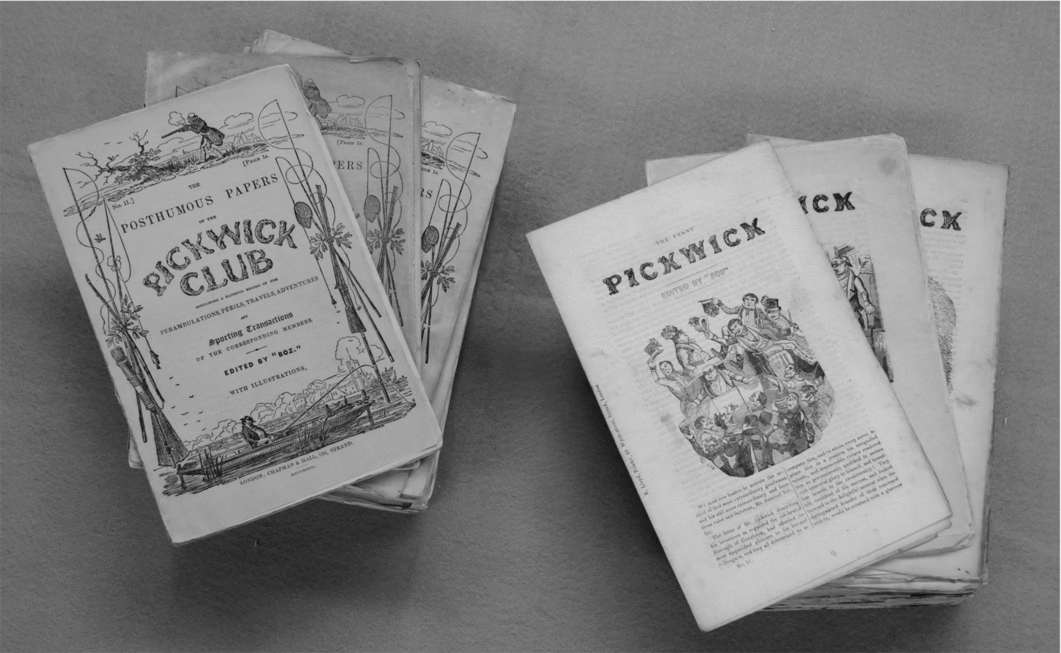
However, when Chapman and Hall took the plagiarists to court over this case of “fraudulent imitation,” the judge justified The Penny Pickwick's legality by claiming that it couldn't replace Boz's Pickwick Papers (“Law Intelligence” 4). Chapman and Hall argued that in the practice of “publishing the works of eminent authors in a cheap form nothing was more likely than that unobservant persons should be induced to purchase this work on cheap terms, which would materially interfere with the profits of the original publication” (“Law Intelligence” 4). Although Prest insisted that he used “none other but his own materials” (Grego 44), the plaintiffs argued that the “variations were only colourable” (“Law Intelligence” 4). The tiniest details, like font type, became major points of contention: Chapman and Hall argued that Lloyd “had copied or imitated the style and form of the letters in which the word ‘Pickwick’ is printed on the cover of the plaintiff's publication” (“Law Intelligence” 4). The judge admitted that there “was some resemblance” but ultimately decided that there was sufficient “material difference” since “one was printed in a curved form, and the other with straight letters” (“Law Intelligence” 4). You can judge for yourself; the two are shown side-by-side (Figure 1). Ultimately, the judge, swayed by the differences in material and content, decreed that “the two works were so exceedingly dissimilar that nothing but the grossest ignorance could allow itself to fancy that when a party meant to have that work which for nearly a year had delighted the world he would purchase the other” (“Law Intelligence” 4).
Photograph of The Posthumous Papers of the Pickwick Club by Boz (left), and the Penny Pickwick by Thomas Prest (right). Taken by Mark Zupan. Courtesy of David M. Rubenstein Rare Book & Manuscript Library, Duke University.

By rejecting the plaintiff's complaint while simultaneously acknowledging the close connections between the two publications, the judge effectively positioned the plagiarism as a potential continuation, not a forgery, of The Pickwick Papers. If no reader (or only the most grossly ignorant reader) would purchase The Penny Pickwick when he meant to buy the original, then the average reader would probably purchase it for one of the following reasons: 1) he could only afford the cheaper version, 2) he preferred Bos's working-class themes to Boz's middle-class ones, or 3) he was familiar with the original Pickwick Papers and wanted to extend his time with it by seeking out a different version. The last two scenarios both offer possibilities for continual reading: the third, most obviously, by prolonging the reader's engagement with the source text, and the second by adapting or updating a familiar text. Although readers needn't treat plagiarisms like The Penny Pickwick as continuations, the fact that they can distinguishes plagiarism from forgery.
Reynolds and the Sequel
The successful career of G. W. M. Reynolds, deemed by some “the most popular writer of our time,” highlights the prominence and popularity of one of the most original forms of continuation: the sequel (“Obituary” 600). Although best known today for The Mysteries of London, in the period Reynolds established his fame through continuations like The Youthful Imposter (which borrows characters from Alexandre Dumas's Angèle), Robert Macaire in England (whose protagonist is derived from Frédéric Lemaître's performance in L'Auberge des Adrets),Footnote 11A Sequel to Don Juan (a continuation of Byron's epic poem), and several Dickens-inspired texts: Master Timothy's Bookcase, The Steam-Packet,Footnote 12Pickwick Married, and most notably, Pickwick Abroad; or the Tour in France. The latter was one of his biggest successes, selling “upwards of twelve thousand copies”Footnote 13 and becoming synonymous with the name Reynolds; in later publications he almost always styled himself “author of Pickwick Abroad, etc.” (“Biographical Sketches” 191).
Despite their popular appeal, these continuations didn't earn Reynolds much respect from his fellow authors or critics: Dickens condemned him for “pander[ing] to the basest passions of the lowest natures” and Marx called him a “scoundrel” (qtd. in John 164). Modern scholars continue to downplay Reynolds's continuations; even the most comprehensive study of his life and works prioritizes his more “original” work as a novelist, journalist, translator, and politician. Reynolds and the many other authors like him who, in the words of Juliet John, “flaunt their hybridity,” remain critically underappreciated, perhaps because we are reluctant to recognize originality in these openly parasitic works (165).
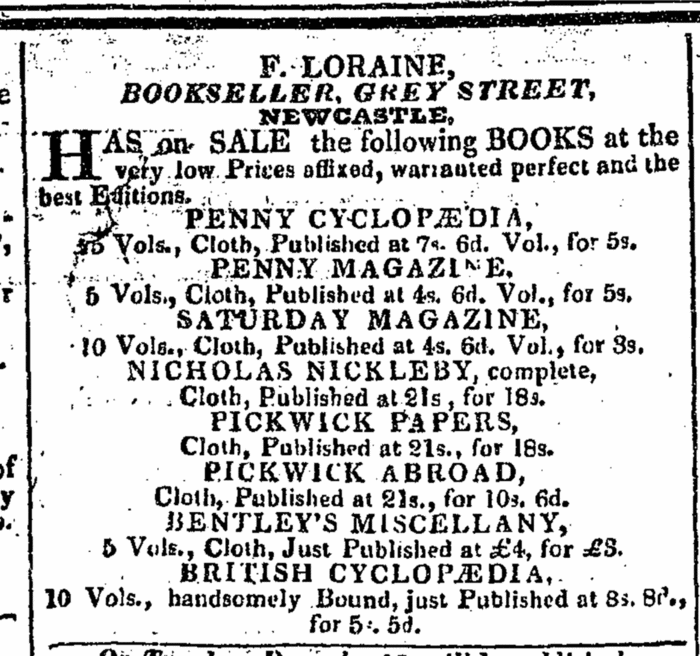
But sequels can revitalize the originals by imbuing them with new life, new material. Sometimes it's difficult to tell where the original ends and the sequel begins. Pickwick Abroad became such an integral part of the Pickwickian saga that in advertisements for new editions, some booksellers listed Pickwick Abroad right after The Pickwick Papers, smack in the middle of Dickens's oeuvre, without even acknowledging the different authorship (see Figure 2). The blurred boundary between The Pickwick Papers and Pickwick Abroad resulted in additional continuations like Moncrieff's theatrical sequel Sam Weller's Tour (1838) which drew from both Dickens's and Reynolds's works to stage Pickwick's adventures in France.
Advertisement, from the Newcastle Courant, Part Second (6 Dec. 1839): 2. Web. Gale British Newspapers.
Sequels retroactively change readers' perceptions of the originals. Marjorie Garber calls this the “sequel-effect,” when the sequel “corrects,” “amplifies,” and sometimes “radically revises the ‘original,’” “making the reader or audience rethink the various meanings of the work” (3–5). In the seventh chapter of Pickwick Abroad, Reynolds introduces “Mr. Pickwick's private journal,” and “transcribes” journal entries to correct errors in the original. On November 11, 1834 Mr. Pickwick recounts:
Was a quarter of an hour too early for my breakfast, so took up the biography of myself and friends, and glanced cursorily over the notes which I have prepared for my editor, ‘Boz.’ Found that in 1827 I had made Mr. Jingle declare himself to have written a poem on the French Revolution, which only took place in 1830. (22; vol. XXV, ch. VII)
Reynolds then inserts his own commentary in a footnote: “We are sorry to find that Mr. Pickwick omitted these necessary corrections; and that his Editor, ‘Boz,’ has also unaccountably suffered them to remain” (22). This addendum not only calls the reader's attention to the error by correcting it, it also questions the integrity of Boz's editorship, encouraging readers to reevaluate the accuracy of The Pickwick Papers. Pickwick Abroad becomes a supplement for readers who want both to read about Pickwick's new adventures abroad and to better understand the past events depicted in Boz's original.
However, authors of continuations rarely stop at correcting minutiae; they often approach their sequels with an ideological agenda. Julie Sanders describes these texts as “appropriations” that are shaped by the author's “political or ethical commitment” (2). Think of the postcolonial commentary in Jean Rhys's Wide Sargasso Sea or Tom Stoppard's meta-commentary in Rosencrantz and Guildenstern are Dead. Pickwick is particularly susceptible to nationalist agendas, in part because it so enthusiastically advertises its own British identity. By capturing Sam Weller's cockney dialect and Samuel Pickwick's distinctive British airs in print, Dickens appeals to an “imagined community” of readers united by their national pride (Anderson 6). In the words of one reviewer, Pickwick “go[es] before the critical world abroad, stamped with the unanimous approval of the whole British people; embodying and involving the great guiding principles of public taste in England” (Jeffrey 161).
Sequels literally took Pickwick's characters abroad, shuttling them around the globe: Pickwick in America!, Pickwick in India,Footnote 14 and Pickwick Abroad each allowed the characters to colonize new territory on behalf of the British, but they also claimed to expand their readers' global awareness. Reynolds infuses Pickwick Abroad with his own sympathies for French culture, using the papers as “a vehicle for faithfully depicting French manners, habits, and peculiarities” (“Literature” [1838] 1). He regularly confronts British stereotypes of the French, disproving Sam's seemingly ignorant assertion that France is “a lost country – a nation vithout [sic] principle” (570; vol. XXIV, ch. II). By drawing on the nationalist themes embedded within Pickwick, Reynolds encourages his readers to re-imagine their national identity within a global context.
Other sequels hijack the story for a totally new purpose, counting on the readers' love for the old characters to outweigh their possible distaste for the new agenda. In 1840 Reynolds joined the temperance movement and edited the Teetotaler: A Weekly Journal Devoted to Temperance, Literature, and Science.Footnote 15 In it he “endeavoured to inculcate the principle of Teetotalism by means of amusing fictions,” using a continuation of Pickwick Abroad – “Noctes Pickwickianae” – to draw in readers who otherwise would not subscribe to the journal (Reynolds Teetotaler i; vol. I, no. I). Although temperance doesn't play a role in The Pickwick Papers (if anything, the club's gleeful overindulgence leans in the opposite direction), Reynolds redirects the plot to accommodate his new cause. And it appears that this ploy was successful. In the thirtieth number Reynolds expresses his pleasure at the “rapidly increasing circulation” and declares his decision to comply with the “general wish” of the audience that he “should commence another continuous Tale in THE TEETOTALER” (233; vol. I, no. XXX). Notice that the readers request a continuous tale – a sustained tale spread out over many issues. Although “Noctes Pickwickianae” attracted readers by evoking the pre-existing Pickwickian oeuvre, it didn't itself push readers outward towards new continuations; it existed only as a couple of disparate anecdotes. However, Reynolds's response to the request for a “continuous tale” combined both strategies: Pickwick Married, the tale of Mr. Pickwick's pursuit and acquisition of an abstemious wife, was “continued weekly” and spanned twenty-one numbers (Teetotaler 233).
Adaptations
Continuation is a useful concept for unpacking the relationship between adaptations and the texts they adapt. Adaptation studies has long rejected the concept of fidelity, or staying “true” to the text, as a useful criterion for evaluating or characterizing the intertextual relationship between adaptations and source texts. Instead, adaptation theorists have shifted critical focus from the original story to the process of change the adaptation produces.Footnote 16 In short, they – like me – are interested in what the adaptive process adds to the reader's experience with the text, rather than how faithfully the text is reproduced. However, when distinguishing between what does and does not “count” as an adaptation, these scholars tend to distance adaptations from other forms of continuations. Hutcheon locates “adaptation proper” in the middle of a “continuum of fluid relationships between prior works and later. . . revisitations of them” (171). Revisitations that aim for fidelity constitute one end of Hutcheon's spectrum, while “spin-offs,” “sequels,” and “prequels” – the texts that most assertively depart from the prior work – reside at the other (171). Although she acknowledges the fluidity between these genres, Hutcheon maintains that “sequels and prequels are not really adaptations” (9). I contend that many of the texts usually labeled “adaptations” – particularly nineteenth-century theatrical adaptations – function as continuations, and therefore share space with sequels and prequels on the latter end of the spectrum. Marjorie Garber writes that the desire for a sequel stems in part from “the desire that [stories] never come to a definitive end” (3). Many theatrical continuations of nineteenth-century novels similarly sought to prolong readers’ experience with the novel.
The Victorian discourse surrounding theatrical adaptations of Pickwick anticipates Hutcheon's description of the sliding scale between faithful adaptations on the one end and sequels and prequels – or as I'll more broadly characterize them, continuations – on the other. Victorian theatres were notoriously unfaithful to their source texts. Producers considered the composition of their stock companies, the popularity of their actors, and the tastes of their audiences before considering the quality or content of the script. In response, Victorian critics often complained that the plays didn't stay true to the spirit of the novel. But the critics’ and audience members’ responses to these adaptations were divided: critics often complained about the same unfaithful texts that audience members enjoyed. In one representative review of Moncrieff's Sam Weller, the critic closed his condemnation of this “injustice to [the] talented author [Dickens]” by acknowledging, “it is however but right to state that the audience seemed highly amused, and laughed incessantly during the representation of the piece” (“New Strand Theatre” 1). Moncrieff, the author of the offending play, responded to the conflicting and conflicted reviews in an advertisement that he distributed with the published edition:
It is wasting time to show the absurdity of these addle-pated persons, for their ‘blow hot and blow cold’ articles are as incomprehensible to themselves as they are to everybody else. In one of them I am, first of all, abused for having sacrilegiously meddled with any of MR. DICKENS'S matter, and then abused for not having meddled with it enough. The reader is told that everybody is pleased with my piece, and is then informed that nobody should be pleased with it. . . . [T]he ‘high intellectual’ winds up by asserting that the drama would be a very good drama if I had not happened to have wrought it. (v)
His satirical barb cuts to the heart of the conflict between the “high intellectual” critics who approached the play as an unfaithful adaptation (claiming he had sacrilegiously meddled) and audiences who approached it as a continuation (claiming he hadn't meddled enough).
Adaptation-as-continuation is a process of selection and addition that extends the novel and prolongs readers’ time with familiar characters. Louis James remarks that nineteenth-century “printed plays make very little attempt to follow Dickens's plot; their interest was almost entirely in the characters” (55). By encasing beloved characters in new (though largely irrelevant) plots, adaptations offer readers the chance to continue interacting with characters beyond the book. Some adaptors waited until Dickens had completed the novel to reunite his readers with their favorite characters, taking advantage of their lingering disappointment that there would be no more Pickwick. Charles Selby cunningly promised (though he didn't deliver) that his drama would “interweave some of the leading features of the work already before the public (and several hitherto untouched Characters and Incidents) with a new Story” (Engel 32). He hoped that the promise of a “new Story” – what actually might be called “more of the old story” – would attract audiences. But other adaptors, like Moncrieff and William Leman Rede, impatiently intervened even before the novel's completion, capitalizing on the lag between Dickens's numbers. Moncrieff's Sam Weller appeared alongside Pickwick's fifteenth installment, and its title and advertisements promised readers more time with their favorite characters as they waited for the next installment: Moncrieff boasts in the program that “[l]ate experience has enabled him [Moncrieff] to bring Mr. Pickwick's affairs to a conclusion rather sooner than his gifted biographer has done, if not so satisfactorily, at all events legally” (Grego 17). In this pre-emptory conclusion, audience members could witness Jingle marrying Mrs. Bardell and conspiring with Dodson and Fogg to extort money from Mr. Pickwick – all “original” Moncrieff material that reunited theatre-goers with Dickens's characters.
Although we can't be sure that all of Moncrieff's audience members were faithful continual readers of Dickens's Pickwick, the advertisement in the published version of the play suggests that Moncrieff expected most readers to be familiar with the Pickwickian characters. He declares that cataloging the differences between his play and Dickens's novel would be “supererogatory” since “the Papers are in every body's hands, and the deviations speak for themselves” (iii). Of course, these “Papers” needn't have come from Dickens himself – as we have seen, there were many other Pickwickian papers in circulation that could have informed the New Strand Theatre's audience. The Penny Pickwick, in particular, catered to a working class readership. The fact that Pickwick had, in the words of another adaptor, “obtained a celebrity wholly unexampled in that class of literature” meant that audiences probably considered Mr. Pickwick and the Weller family to be old friends, regardless of where they first met them (Grego 12).Footnote 17 And if a few theatre-goers remained strangers to Pickwick, then these adaptations could propel them towards Dickens's novel – at least, that's how the adaptors defended themselves. Moncrieff claimed that Dickens's Pickwick “must have received” a “great increase of popularity” as a result of his theatrical adaptation, and insisted that far from detracting from the publisher's profits, the play “rendered them, by increasing their sale, the most fortunate of Chapmen and dealers!” (iv-v).
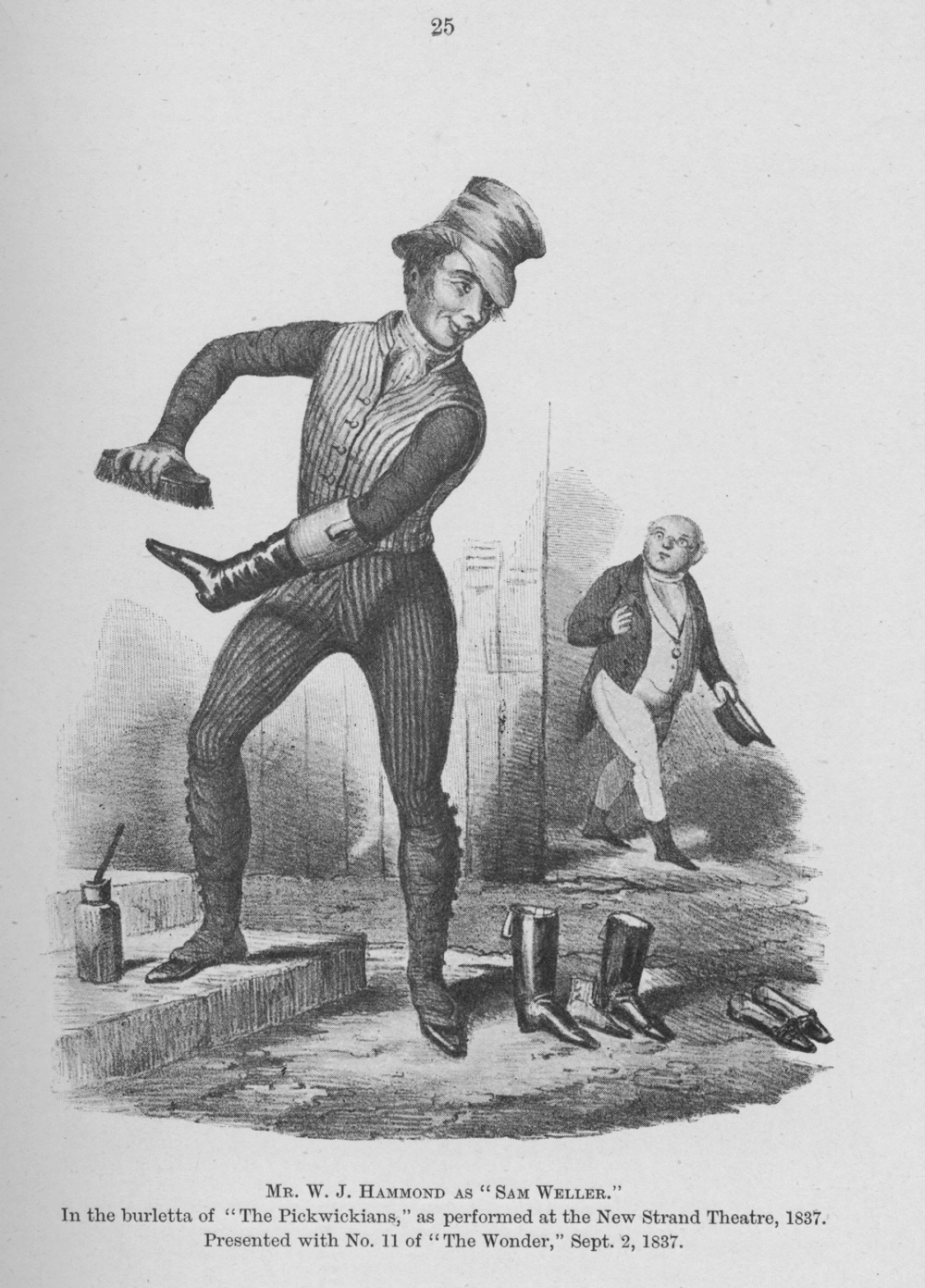
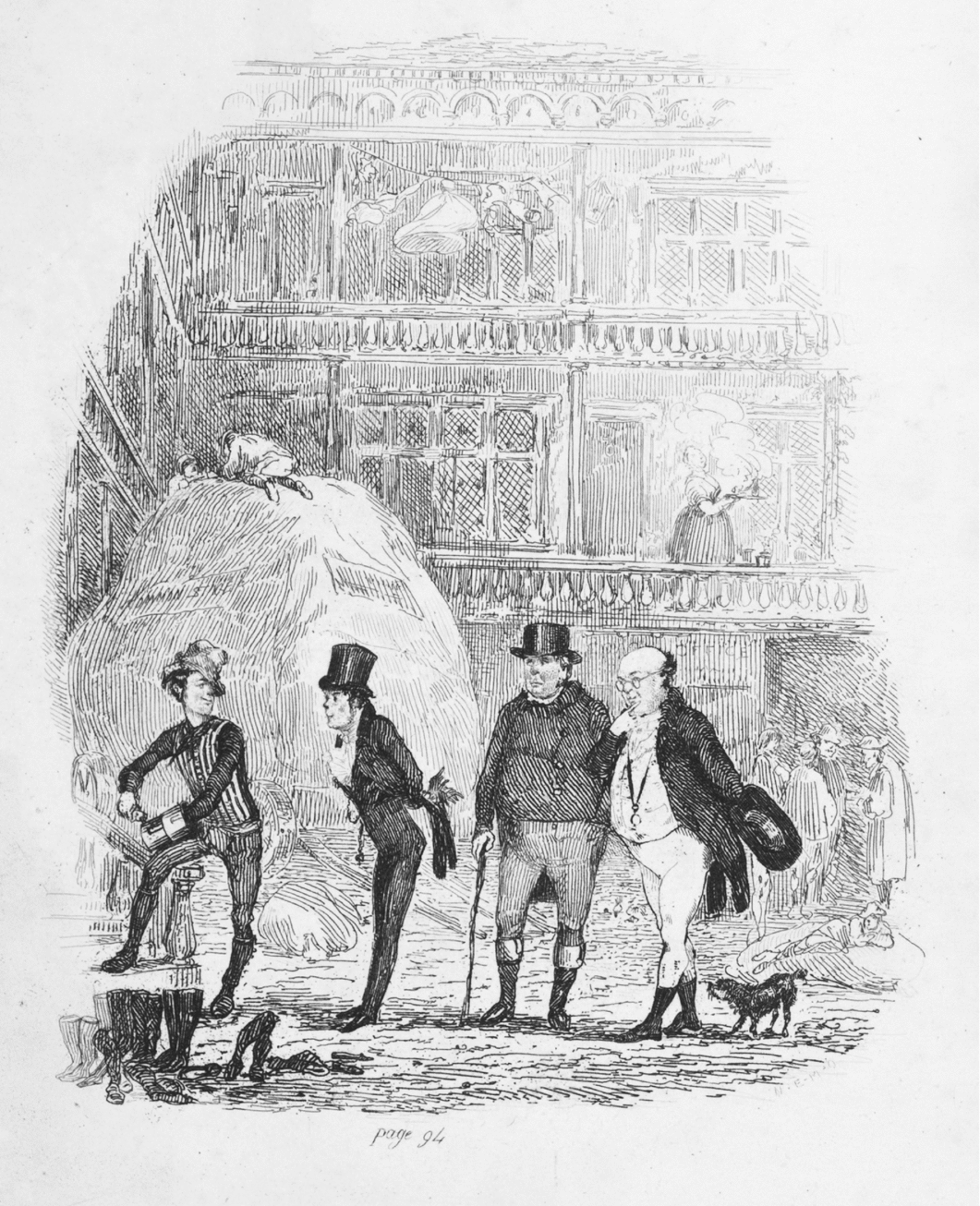
So far I've focused on how theatrical narratives invite continual reading. But to stop here would be to ignore Sharon Marcus's advice that we “take an interest in Victorian theater as performance, and [find] ways to study it that go beyond reading texts” (440). So I'll end this section by examining some performance-driven continual reading that theatrical adaptations enabled. Nineteenth-century drama was actor-centered, and the personality and reputation of a popular actor could redefine a character or reshape a story. We often think of actors as “transparent vehicle[s]” of a text, but as Marvin Carlson shows, that approach “does not take into account what the actor creatively adds to the literary text” (53). Actors can determine a character's image, filling in the sketchy outline provided by the text or its illustrations. Louis James notices that “Mr. Pickwick's Collection of Songs (c Reference Reynolds1838) has on the frontispiece a picture of Mr. Pickwick, not as portrayed by Hablot K. Browne [Dickens's illustrator], but as impersonated by Edmund Yates [the title actor in Rede's Peregrinations of Pickwick]” (55). Mr. W. J. Hammond, the actor to play Moncrieff's Sam Weller, similarly displaces Browne's Weller in the iconic image pictured below (Figures 3 and 4). Adaptations could also redirect the audience's focus to previously underdeveloped parts of the novel. In 1871, not long after Dickens's death, James Albery overhauled his adaptation to better highlight his star, Henry Irving, in the role of Mr. Jingle. Irving's celebrity status shifted focus from Sam Weller – the usual star – to Jingle. Popular actors, by playing different roles, could totally alter the character dynamic.
“Mr. W. J. Hammond as ‘Sam Weller.’ In the burletta of ‘The Pickwickians,’ as performed at the New Strand Theatre, 1837. Presented with No. 11 of ‘The Wonder,’ Sept. 2, 1837.” Engraving from Joseph Grego's Pictorial Pickwickiana (Reference Grego1899), 25. Courtesy of Indiana University Libraries, Bloomington, Indiana.
Hablot K. Browne (“Phiz”), “The First Appearance of Sam Weller.” Engraving from The Posthumous Papers of the Pickwick Club (No. IV). Courtesy of Lilly Library, Indiana University, Bloomington, Indiana.
Theatrical adaptations also allow for more readerly interaction with the novel: actors can embody characters and audiences can imitate actors. Pickwickian fashions became all the rage in the late thirties/early forties, with merchants advertising “Pickwick chintzes” and “Weller corduroys” (Hayward 484). These fashions almost certainly stemmed not from Dickens's elaborate descriptions or Browne's famous illustrations, but from stage costumes. Although a few characters do wear corduroys in the novel, Sam Weller isn't one of them, whereas his theatrical counterpart in The Peregrinations of Pickwick wears “corded breeches” (Rede 6). Similarly, in Moncrieff's Sam Weller, Aunt Rachel appears in “handsome chintz muslin,” a material absent from the novel. The adaptations seem to invite participation in a way that the novel can't (or at least can only do at a remove).
III
In the opening line ofThe Pickwick Papers, Dickens dubs his protagonist “the immortal Pickwick” (Pickwick 1), and shortly thereafter critics transferred that title to the author, hailing Dickens as “the immortal Boz.”Footnote 18 Dickens wasn't immortal, but his death in 1870 did help to immortalize his novels. H. Philip Bolton identifies the 1850s-1860s as a period of Pickwick's hibernation, but claims that in the 1870s “pirate playmakers honored the death of Dickens by dramatizing many of his works,” and he lists at least a dozen times that some part of Pickwick appeared on stage (75). Dickens's death forced readers to confront the grim reality that they could no longer expect any additional Dickens works, at least not from his pen. Once readers realized that they were cut off from the original source, their desire for continuation intensified, and they demanded the one thing they knew they couldn't have: more Dickens.
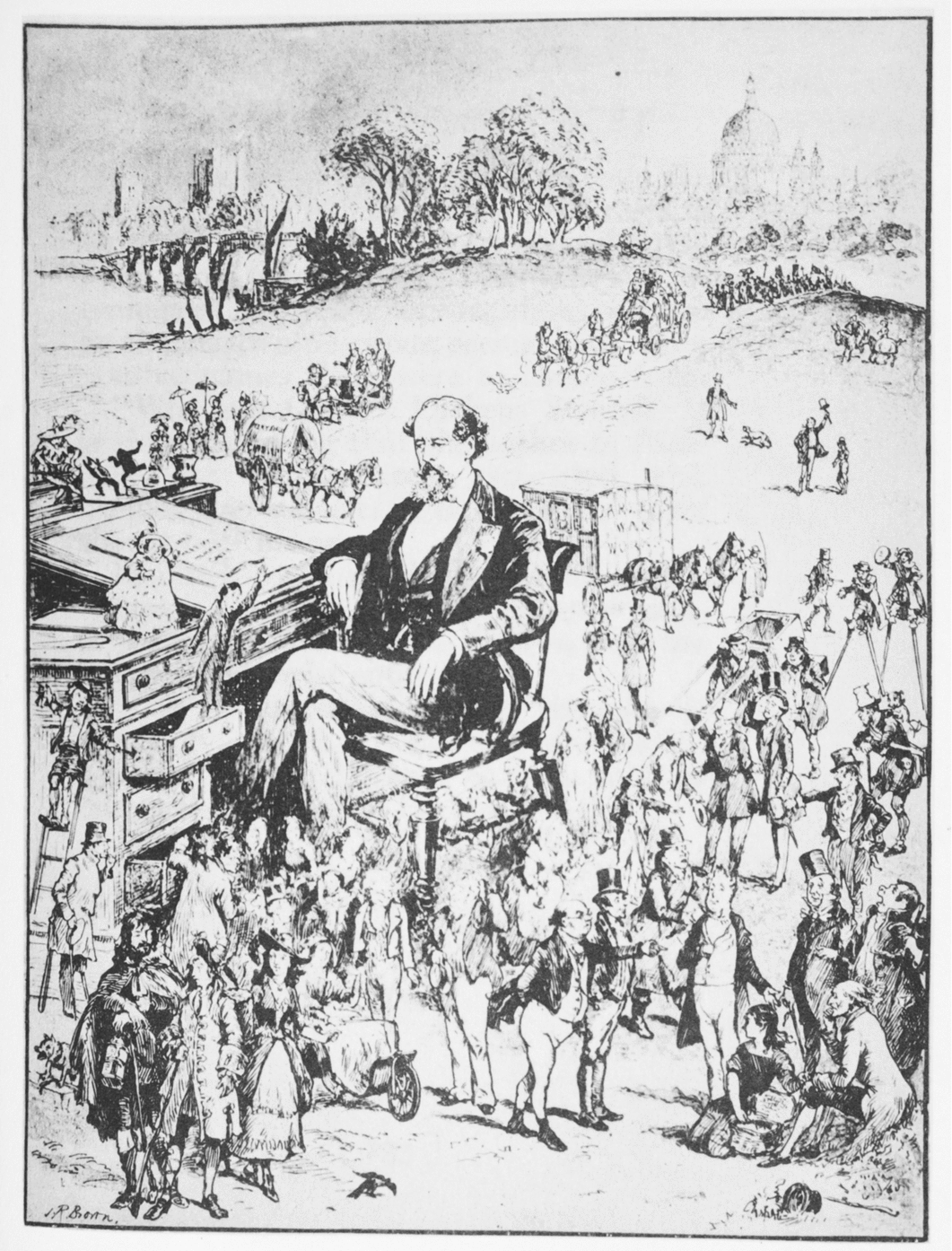
Andrew Miller argues that after his death, “Dickens's career [became] textualized” into a larger text that linked “the collected community of Dickens's characters” (336). In his lifetime, Dickens mostly kept his characters locked within their worlds, only allowing the Pickwickians to briefly escape into Master Humphrey's Clock. But Dickens's death freed his characters from the constraints of their books, allowing them to wander between novels as their readers engaged with a larger Dickensian World. Images like J. R. Brown's Charles Dickens Surrounded by his Characters (Figure 5) capture this desire to merge worlds: here Mr. Pickwick can meet Mr. Pecksniff and Grinder's lot can entertain Fagin while Mrs. Gamp watches over them all. This impulse to integrate characters from different novels coincides with the readers' recognition that Dickens wouldn't be introducing any new characters to the fold. “We read about Edwin Drood and John Jasper and Durdles and Mr. Crisparkle,” writes one critic from the Saturday Review, “but we cannot help thinking of Sam Weller and Mrs. Gamp and Dick Swiveller and Oliver Twist, and all the numerous family of predecessors who acknowledge the same parent” (“The Mystery of Edwin” 369). Dickens's death transforms these once disparate characters into a blended family. G. K. Chesterton remarked that Dickens “was the one man who might naturally have introduced old characters into new stories. . . .[T]hey really might as well have turned up (within reason) in one environment as well as in another” (403). Although Dickens did not introduce his characters to each other, his death allows us to do so.
J. R. Brown, Charles Dickens Surrounded by his Characters (1889–90). Pen and Pencil Drawing in William Glyde Wilkins's Dickens in Cartoon and Caricature (1924), 232. Courtesy of Lilly Library, Indiana University, Bloomington, Indiana.
In the years after Dickens's death, his readers hit the streets in search of the realm that housed Dickens and his characters. In 1891 William R. Hughes documented his pilgrimages into what he baptized “Dickens-land,” where he found the Pickwickians and David Copperfield living together at the Golden Cross Hotel, right across the street from Mr. Brownlow (ix, 11–13). Later readers made similar journeys; B. W. Matz wandered “Through Whitechapel With Dickens,” visiting sites from The Pickwick Papers, The Uncommercial Traveler, Little Dorrit, and Dombey and Son, all within a single stroll (234–39). The Dickensian documents several such pilgrimages. These readers comb their own realities in search of the magical doorway – the platform 9 ¾ – that will allow them to access the fictional world. Rarely do readers try to break into a single novel (few would want to enter the world of Barnaby Rudge). Rather, the individual worlds, which themselves began as cobbled together pieces of fragmented texts, coalesce into one larger whole that readers repeatedly try to revisit. Today's Dickensian fans visit Dickens World in Kent, where they can watch a mechanized Dickens converse with a motley crew of his characters: Sam Weller, Mr. Pickwick, Fagin, and the Artful Dodger. Or they attend the Dickens Universe in Santa Cruz to join likeminded enthusiasts in analyzing the same characters in the morning that they imitate in the evening when they partake in post-prandial potations or dance the Grand March. Or they listen to Mark Evan's radio mash up, Bleak Expectations, or they construct Dickens villages at Christmastime, or they party Victorian-style with “Dickens on the Strand” in Galveston, or they display their vast collections of Dickensiana. . . . In other words, they continue to repeat that perpetual refrain: Please sir, I want some more!