Introduction
Public experiences and perception of welfare can translate into broader policies, and viceversa (Bendz, Reference Bendz2017; Svallfors, Reference Svallfors, Castles, Leibfried, Lewis, Obinger and Pierson2010). A clear understanding of this relationship helps to conceptualise existing welfare structures and chart future changes accurately. However, the majority of studies embarking on this trajectory have been in Western and high-income states and often relied on Esping-Andersenʼs (Reference Esping-Andersen1990) welfare regime framework which outlines three systems; namely social democratic, liberal and conservative regimes (Svallfors, Reference Svallfors1999; Buss, Reference Buss2018). Thus, there has been a minimal research emphasis on welfare conditions in low- and middle-income countries (LMICs) and their relations with public attitudes. For this reason, Gough and Woodʼs (Reference Gough and Wood2004) treatise on global welfare regimes – an extension of Esping-Andersen (Reference Esping-Andersen1990)ʼs work – has been well-received. According to Wood and Gough (Reference Wood and Gough2006), there are three regimes: welfare state regimes, informal security regimes and insecurity regimes. Welfare state regimes are those in which people can obtain social protection by participating in the labour and financial markets, or through state support. They are predominant in autonomous states and stable democracies, capitalist economies, and in dominant formal labour market economies. Informal security regimes are characterised by contexts where welfare needs are predominately met by relying on community and family relationships. The extent of support, therefore, depends on the socioeconomic status of the benefactor and the strength and nature of the social bond. Thirdly, insecurity regimes encompass situations in which political instability, conflict, and unstable economies constrain the possibility of even informal support. This results in prolonged and cyclical inequality and insecurity for most citizens (Wood and Gough, Reference Wood and Gough2006). Therefore, most countries in sub-Saharan Africa were classified as insecurity regimes (Wood and Gough, Reference Wood and Gough2006).
This article revisits Wood and Goughʼs (Reference Wood and Gough2006) postulation by examining welfare attitudes in Ghana and its implications for the ‘insecurity’ regime. It explores the extent to which this classification is still relevant in a socio-politically stable country (Marques and Honorati, Reference Marques and Honorati2016). The article analyses the public views and attitudes towards general and specific (healthcare) welfare policies, and the socioeconomic and ideological factors associated with such attitudes. It uses some of Ghanaʼs universal and targeted welfare programmes (stated and described later) in the areas of health, education and poverty alleviation as references for discussions in a mixed-method research study. These welfare domains, particularly health, are some of the strongest correlates of prevailing welfare regimes (Bambra, Reference Bambra2006). Data from forty-nine countries based on Wood and Goughʼs (Reference Wood and Gough2006) welfare typologies revealed that incidence of disability (poor health) is more prevalent in insecurity and non-state regimes (informal and insecurity regimes) compared to welfare state regimes (Witvliet etal., Reference Witvliet, Arah, Stronks and Kunst2011).
The welfare landscape in Ghana
According to Bevan (Reference Bevan, Gough and Wood2004), nations such as Ghana became protégés of the World Bank and other international organisations in the 1980s which set the scene for a modern welfare system. However, even with political stability from the 1990s, insecurity has prevailed due to resource mismanagement culminating in recurrent economic challenges and reliance on external sources for budgetary and technical support (Bevan, Reference Bevan, Gough and Wood2004). Regardless, there was a significant improvement in Ghanaʼs welfare landscape at the turn of the century resulting from public outcry against perceived government ill-will towards social security (Sabates-Wheeler etal., Reference Sabates-Wheeler, Abdulai, Wilmink, de Groot and Spadafora2017). This resulted in the development of Ghanaʼs first social protection policy in 2008, which was revised in 2012 (Sabates-Wheeler etal., Reference Sabates-Wheeler, Abdulai, Wilmink, de Groot and Spadafora2017; GoG, 2007). Welfare expenditure has subsequently risen, although relatively low compared to other LMICs (Marques and Honorati, Reference Marques and Honorati2016). Some of the current social protection programmes in Ghana which are of interest to this article include the Education Capitation Grant (unconditional free basic education, and the recent, free senior high school policy), Livelihood Empowerment Against Poverty Programme (LEAP), and the National Health Insurance Scheme (NHIS) (GSS, 2014; GoG, 2015; Mensah, Reference Mensah2019). The free education policies aim to remove financial barriers to formal education in public schools from pre-school to senior high school (Mensah, Reference Mensah2019). The LEAP is a cash transfer scheme to cover the basic needs of poor and vulnerable individuals and households, including: older persons (sixty-five years and above); people living with severe disabilities; orphans and vulnerable children; and pregnant women and children below one-year-old (Oduro, Reference Oduro2015; Sabates-Wheeler etal., Reference Sabates-Wheeler, Abdulai, Wilmink, de Groot and Spadafora2017). It currently covers only 25 per cent of the extremely poor (Marques and Honorati, Reference Marques and Honorati2016). The NHIS is a social health insurance programme meant to improve financial access to quality health services, particularly for the poor and vulnerable (Amoah and Phillips, Reference Amoah and Phillips2018; Gros, Reference Gros2016). Groups such as pregnant women, children and older persons are exempted from premium payments. The NHIS covers about 95 per cent of all diagnosed health conditions, but only 40 per cent of the population have an active subscription (Wang etal., Reference Wang, Otoo and Dsane-Selby2017). Given the low coverage of existing programmes, the family and other social networks play a critical role in welfare provision and even in knowledge and access to available services (Gyasi etal., Reference Gyasi, Phillips and Amoah2018). Thus, the recent changes in the welfare landscape necessitate a revisit of Ghanaʼs welfare regime and particularly, how the public perceive the current system.
Welfare regimes and public attitudes
Research shows a connection between welfare regimes and public attitudes (Svallfors, Reference Svallfors, Castles, Leibfried, Lewis, Obinger and Pierson2010). A recent analysis of welfare attitudes in the UK, Norway and Germany shows strong and continuing support for social investment expansion but based on different reasons consistent with the respective regime philosophies (Taylor-Gooby etal., Reference Taylor-Gooby, Hvinden, Mau, Leruth, Schoyen and Gyory2019). Likewise, an earlier study of twenty countries argued that the nature of a welfare regime in which people find themselves informs their views on redistribution (Arts and Gelissen, Reference Arts and Gelissen2001). Notwithstanding, evidence from LMICs such as Ghana is highly limited and suggests a need for more research, particularly those relating to specific welfare policies, as there are inconsistencies in the relations between welfare regimes and public attitudes in extant research (Svallfors, Reference Svallfors, Castles, Leibfried, Lewis, Obinger and Pierson2010).
Studies on public attitudes in different welfare regimes depict two major theoretical perspectives, namely self-interest and social values hypotheses (Wu and Chou, Reference Wu and Chou2017; Buss, Reference Buss2018). On the one hand, the self-interest thesis holds that actual and perceived socio-economic conditions of individuals shape their attitudes towards welfare. Thus, people who perceive themselves as vulnerable (e.g. old persons, females, unemployed, rural residents and the less educated) tend to favour pro-welfare state ideologies compared to those in advantaged positions (Wilson etal., Reference Wilson, Spies-Butcher and Stebbing2009; Blekesaune and Quadagno, Reference Blekesaune and Quadagno2003; Bailey etal., Reference Bailey, Gannon, Kearns, Livingston and Leyland2013; Wu and Chou, Reference Wu and Chou2017; Buss, Reference Buss2018). On the other hand, the social value hypothesis posits that ideological positions, belief systems, moral consciousness, knowledge about inequality, and norms of reciprocity shape welfare attitudes. Factors such as being educated, religious, economically well-off, leaning towards the social-democratic political ideology are associated with redistribution and greater perceived welfare deservingness (Wilson etal., Reference Wilson, Spies-Butcher and Stebbing2009; Kallio and Kouvo, Reference Kallio and Kouvo2015). Based on the nature of Ghanaʼs welfare regime and the recent socioeconomic and political landscape, it is expected that most population groups – regardless of their sociodemographic attributes – will hold positive attitudes towards more welfare spending and policies. This is in view of the several weaknesses in current welfare provision such as funding challenges, low coverage, and unequal distribution of available resources in Ghana (Marques and Honorati, Reference Marques and Honorati2016; Sabates-Wheeler etal., Reference Sabates-Wheeler, Abdulai, Wilmink, de Groot and Spadafora2017).
Methods
Study design
The study employed a convergent mixed-method design based on a cross-sectional approach (Creswell, Reference Creswell2014), as part of a Comparative Study of Multidimensional Aspects of Well-being (CSMAW). Qualitative and quantitative data were collected and analysed separately. The convergence occurred through the interpretation and discussion of results. The mixed-method approach provided rich data for analysis of welfare attitudes among adults aged eighteen years and older.
Procedures
The quantitative data were gathered from four of the ten regionsFootnote 1 in Ghana in July 2018 using a multi-stage cluster sampling approach (Creswell, Reference Creswell2014). A purposive sampling technique was applied to select the regions, and twenty-three districts were randomly selected from them. The regions and districts included Greater Accra Region (six districts), Ashanti Region (eight districts), the Eastern Region (four districts) and Upper East Region (five districts). The participants were selected using a systematic technique as has been applied in related studies in the study context. Two dependent variables were assessed. The variables were used to ascertain the views of participants on general government welfare spending and specific spending on healthcare. The importance of the dependent variables is two-fold. First, they provided avenues to understand the need for welfare provision irrespective of the implications (financial) for the participants as individuals. Second, they explored the consistency in the welfare attitudes towards both specific and general policies, which helps to offer reliable and convincing arguments about the publicʼs views and its potential impact on the welfare regime. For both variables, positive responses served as signals for a shifting welfare regime (from insecurity to a more organised and reliable regime). Besides, several independent variables relating to the self-interest and social values hypotheses were captured to examine the nature of factors determining the positive or negative attitudes towards welfare. Knowledge on how such factors relate to general and specific welfare spending was considered as critical to appreciate the dynamics of welfare attitudes and indicators of a shifting (or otherwise) welfare regime. The specific questions and their response options for the dependent and independent variables can be found in Online Appendix 1 (Table 1).
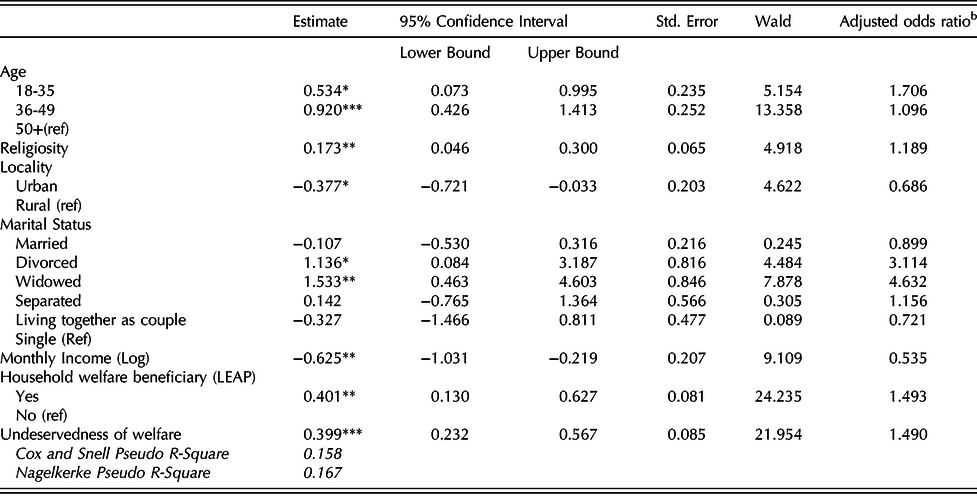
Public attitudes towards more government spending on welfare by Ordinal Logistics Regressionsa

Note: *p < .05. **p < .01. ***p < .001. a The table shows only significant results. The full table with other variables in the study is shown in Online Appendix 4. b Odds ratios were computed using resources provided by De Coster (Reference De Coster2005).
The qualitative study used an interpretivist paradigm to obtain intra-and inter-subjective meanings, experiences, and views of participants regarding welfare policies (Angen, Reference Angen2000). Further details of both qualitative and quantitative research procedures are reported elsewhere (Amoah etal., Reference Amoah, Osei-Tutu and Agyei2019) and summarised in Online Appendix 2. Overall, 1381 and twenty-seven participants were included in the quantitative and qualitative studies, respectively. However, about nine participants took part in both studies. Online Appendix 1 (Table 2) shows the demographic characteristics of participants in the qualitative study.
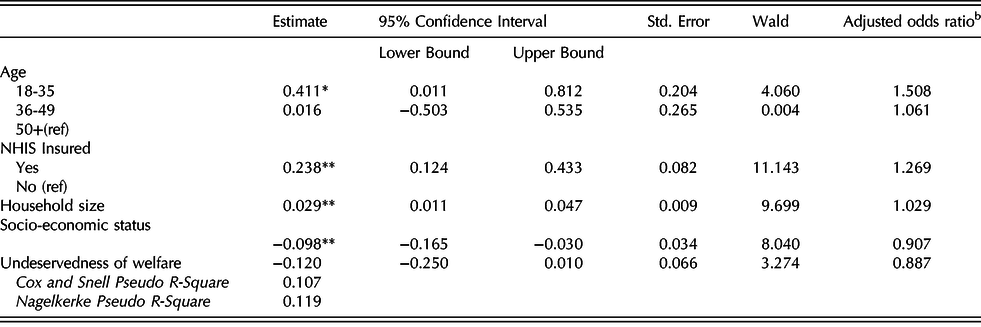
Public attitudes towards government healthcare provision by Ordinal Logistics Regressiona

Note: *p < .05. **p < .01. ***p < .001. a The table shows only significant results. The full table with other variables in the study is shown in Online Appendix 5. b Odds ratios were computed using resources provided by De Coster (Reference De Coster2005).
Data analysis
The quantitative analysis comprised two procedures. The first part was a descriptive analysis of all variables. Online Appendix 1 (Table 1) provides a detailed breakdown of how various variables were analysed. The descriptive analysis also included a Spearmanʼs correlation analysis (Online Appendix 3) to identify potential predictors of the two dependent variables. The second part comprised predictive analysis using ordinal logistics regression technique to identify factors associated with attitudes towards general welfare spending and the responsibility for health care provision. For continuous variables, missing responses were replaced with the mean of the variable, but categorical variables (with few instances) were untouched. The significance level for all associations was set at p < 0.05.
Thematic analysis technique was employed for the qualitative data. The author generated a codebook which reflected understanding, experiences, expectations, and public positions on welfare provision to analyse the data. The codes were iteratively re-examined for each transcriptFootnote 2. The two results were discursively combined. For ethical reasons, all the participant names used in the study are pseudonyms.
Findings
Quantitative findings
The quantitative study examined the state and nature of welfare attitudes in Ghana and the factors associated with the attitudes among a broader population. Approximately 13.3 per cent of participants had benefited or had family members benefiting from the LEAP policy, while 46.3 per cent had subscribed to the NHIS. Also, 59.6 per cent of them agreed that the government must spend more on welfare even if it leads to more taxes. Similarly, 82.7 per cent felt that it is the governmentʼs responsibility to provide healthcare for the sick. However, 39.2 per cent felt that most people who receive welfare do not deserve it. From Table 1 (the full Table is shown in Online Appendix 4), both young and middle-aged participants were, 70.6 per cent and 9.6 per cent respectively, more likely to support welfare spending than older persons. Also, religiosity, marital status (being divorced and widowed), being satisfied with life, and having a family member with welfare benefits, were positively related to more welfare spending. However, high-income earners and urban residents were less likely to support more welfare spending. Surprisingly, those who agreed that welfare beneficiaries were undeserving were 49.0 per cent more likely to support more welfare spending. According to Table 2 (the full Table is shown in Online Appendix 5), the specific attribution to health care provision also showed that the youth (50.8 per cent), the insured (26.9 per cent) and those with larger household sizes (2.9 per cent) opined that governments must provide healthcare for the sick. However, perceived socioeconomic status (SES) was negatively associated with governmentʼs provision of healthcare for the sick.
Qualitative findings
The qualitative study gave in-depth insights into the views of participants on welfare provision. Three main themes emerged: general knowledge and views on welfare provisions, economic support for welfare, and alternative arrangements for welfare. There were both sufficient awareness and favour of welfare policies. However, there was a significant caveat. This was related to perceived inefficiencies and corruption, and distrust, which propelled participants to prefer informal provisions.
i. General knowledge and views on welfare provisions
It was apparent that the participants’ knowledge on targeted welfare policies such as the LEAP was limited compared to universal ones (e.g. the NHIS and free education policies). Indeed, many of them were ambivalent about the introduction of policies such as the LEAP and demonstrated the limited information on the policy:
I’ve heard about that (LEAP), but I don’t know the details (Yaa Achiaa)
I don’t think the government will ever do that (LEAP).… Maybe they just said that on the radio but never implemented it. Otherwise, I would know about it (Akos)
The NHIS has been around for over ten years now. I have subscribed to it… I know that older persons and children can be enrolled for free (Adwoa)
Further exploration revealed general support for an ideational shift from the ‘insecurity regime’ towards a well-organised welfare system for the poor and vulnerable as could be deduced from their personal experiences and values:
Itʼs [LEAP] a good thing because disabled persons cannot work. I even give such people alms when I come across them… So if the government is committed to helping them itʼs a good policy (Obaa Yaa)
About seven years ago, I fell seriously ill and was admitted for several days at Tech Hospital. I couldn’t have afforded my bills had it not been for the NHIS.… The NHIS is very good (Agyeman)
Notwithstanding, many had reservations about equitability of some policies. In particular, participants were not convinced that targeted policies such as the LEAP were reaching people who actually needed them owing to inefficient implementation. Thus, without an assurance of equitable redistribution, even ardent supporters remained sceptical of the impact of such programmes based on personal and familial experiences:
The LEAP is a good thing but not everyone benefits. Itʼs not fair…. It should be like the NHIS; everyone benefits.… If we restrict it, many people who don’t need it will rather benefit (Akos)
The equity concerns were linked to the position of participants who felt that everyone must strive for their welfare. Such views were underpinned by the need to capacitate perceived vulnerable persons to take charge of their lives in the long term instead of cash benefits:
…Giving out loans will help people to start a business. Itʼs better than just giving them money for upkeep.… They can even take care of other relatives if they work (Agnes)
It was also evident that targeted policies such as the LEAP, unlike universal ones, were cumbersome to access given complex bureaucracies. Thus, there was an obvious preference for universal policies compared to targeted ones. Even the well-educated shared this position as the comment of this participant who was a nurse showed:
The process to access the LEAP is difficult.… The officials intentionally frustrate people, so they can spend the money themselves (Maame)
ii. Economic support for welfare
The study further explored the attitudes of the public in terms of prospective financial commitment to existing and future welfare policies. There was a disdain towards raising taxes (either new or old ones) to support welfare programmes. Many participants disapproved of such proposals even though they remained in favour of welfare provisions. Those that subscribed to more taxation often did so based on altruism and perceived benefits:
We can’t deny people a good life because of selfishness… I will pay [more taxes].… My only worry is whether the initiatives would still be in existence by the time I’m old (Danny)
The position of Danny touches on another critical reason why some participants would not entertain the idea of raising taxes for welfare policies; trust. Many interviewees distrusted the institutions and other frontline workers to make honest use of the funds:
Increasing tax to help the health system is all right but some of the monies they collect will not go to the government. Look, we pay a lot of taxes for the NHIS, but we always hear that the scheme is in debt.… Where do all the monies go? (Agyeiwaa)
At the centre of such views was perceived corruption and inefficiencies in public administration. Participants used cases of mismanagement of other public resources as bases of their position:
We have crude oil, gold, and cocoa. Can’t we support the poor with proceeds from them rather than the little we get from our jobs? We can barely support our families…. The government should retrieve all monies that have been stolen by officials (Akua)
iii. Alternative arrangements for welfare
As a consequence of the limited knowledge on some welfare policies and suspected inefficiencies in the system, it was a common view among participants that reliance on government for support may be a misguided choice. To many, it was better to work hard to save money for troubled times than wait on government policies. Family ties were considered as more reliable for social protection compared to the government:
If you rely on the government, you will cry in the future because a lot of the policies won’t be of benefit.… Only a few people benefit from government policies.… I pray that my children will make something good of themselves, so they provide for me when I’m too old (Frimpongmaa)
…I don’t believe that the government will do something for me. I need to work hard for my family and hope for Godʼs grace (Yaw)
Despite these concerns, it was obvious that the participants wanted, and expected, more universal and even targeted welfare policies:
…Although there is hardship in the country, it is better than previously. …Because there is an opportunity for my younger brothers to attend SHS for free. ...But I wish the government would introduce subsidies on fuel for drivers [private commercial transport operators] (Isaac)
Discussion
Relying on the theoretical postulation of Gough and Wood (Reference Gough and Wood2004), this article examined welfare attitudes in an ‘insecurity’ regime, Ghana, using a mixed-method design. Consistent with the hypothesis, most people favoured more welfare spending in the quantitative study. However, from the qualitative study, even though the participants wanted more welfare provisions, they were hesitant about contributing in taxes for welfare expansion due to distrust, and perceived inefficiencies and corruption in the governmentʼs welfare efforts. Many preferred to rely on their social networks and personal efforts for security. The findings afford critical insights into the nature of Ghanaʼs welfare regime, and they are discussed in two parts: the characteristics of welfare attitudes in Ghana, and the implications for the transformation of the welfare regime.
Characteristics of welfare attitudes in Ghana
According to the results, there was a resounding preference for more welfare spending in general and also the specific case on healthcare. Studies across various regimes have demonstrated consistent public support for more welfare, and this may not be new in an ‘insecure’ context (Svallfors, Reference Svallfors, Castles, Leibfried, Lewis, Obinger and Pierson2010; Buss, Reference Buss2018). A few explanations may apply. First, principles of justice and solidarity, which underpin positive welfare attitudes, are considered universal and tend to attenuate differences in welfare attitudes across regimes (Arts and Gelissen, Reference Arts and Gelissen2001). Second, Taylor-Gooby etal. (Reference Taylor-Gooby, Hvinden, Mau, Leruth, Schoyen and Gyory2019) argue that perceived state capability – the extent to which a government is seen as capable of providing necessary policies – sometimes accounts for welfare support across regimes. While Ghana’s situation has been described as an insecurity regime, the 2000 election, which brought about numerous campaign promises, aroused public interest in the ability of the government to provide resources to support the poor (Gros, Reference Gros2016). Some argue that it is such actual and perceived resources that emerge from the state which create a bond between welfare regimes and public attitudes (Lundberg, Reference Lundberg2008). Despite these explanations, the qualitative results in this study point to the issues of inefficiencies in the current welfare arrangements as potential sources of publicʼs expectations for more welfare spending and not necessarily only a reflection of universal principles or the stateʼs capability.
The problems arising from perceived inefficiencies were also manifested in the publicʼs desire for universal instead of targeted policies. Mainly, this could be attributed to limited knowledge of welfare policies (Oduro, Reference Oduro2015). The incoherent nature of welfare provisions in Ghana – despite recent efforts (Sabates-Wheeler etal., Reference Sabates-Wheeler, Abdulai, Wilmink, de Groot and Spadafora2017) – may have resulted in limited public awareness of existing programmes and the depth of poverty and inequality challenges in the society (Oduro, Reference Oduro2015). Indeed, previous studies show that sections of the population are incognisant of the nature of even universal policies such as the NHIS (Wang etal., Reference Wang, Otoo and Dsane-Selby2017). This knowledge gap partly explains why even participants who felt that some welfare recipients were undeserving still supported the idea of more welfare spending, perhaps because they acknowledged the need for it among sections of the population. Besides, the preference for universal policies also reflects the distrust in the administration of targeted policies.
The above perspectives can be fully understood from the categories of socioeconomic and demographic factors associated with the general and specific (healthcare) welfare attitudes. To begin with, religiosity was positively related to welfare spending. The desire for more welfare spending, even in specific areas such as health, relates strongly to the social values hypothesis on altruism and morality which are ingrained in many religions. Such religious elements have historically been a prominent fabric of welfare arrangements – where they exist – in sub-Saharan Africa, and its elevation in the present study foretells the nature of the system to some extent (Bevan, Reference Bevan, Gough and Wood2004). Besides, the findings showed that youth and middle-aged persons, rural residents, the divorced and widowed, the poor, and families that had welfare beneficiaries, were positively disposed towards higher welfare spending. These factors can be explained broadly from the self-interest hypotheses. Both young and middle-aged persons may have preferred more welfare spending due to perceived vulnerability in livelihood pursuits as observed from the qualitative part of this study and argued even in welfare state regimes (Buss, Reference Buss2018). The self-interest hypothesis also helps to explain the position of rural residents, the divorced, welfare beneficiaries and the poor. These groups are known to hold similar positions as well, especially in insecurity regimes and in welfare state regimes in times of austerity (Wood and Gough, Reference Wood and Gough2006; Buss, Reference Buss2018). However, participants with higher incomes did not support more welfare spending, and those with high perceived SES were less likely to support the governmentʼs role in the provision of healthcare for the sick. It is argued that the economically-advantaged are sometimes sceptical about welfare due to perceived inefficiencies. Hence, the phenomenon of economic individualism, whereby individuals and households are expected to strive for their survival instead of relying on the state, helps to explain the attitudes of these groups in this study (Blekesaune and Quadagno, Reference Blekesaune and Quadagno2003).
Moreover, young adults, the NHIS insured, and those with larger household sizes favoured government provision of healthcare for the sick. Considering that about 33 per cent of healthcare expenditure in Ghana is out-of-pocket expenses (Gros, Reference Gros2016), it is understandable why participants from larger households (and likely to be poor) wanted more government interventions to improve health (GSS, 2014). Finally, the support for more government healthcare provision among the youth can be explained from rising unemployment and precarious jobs leading to low economic power (GSS, 2014). These observations and the underlying explanations are consistent with health and welfare conditions in non-state regimes (Witvliet etal., Reference Witvliet, Arah, Stronks and Kunst2011).
Transformation of the welfare regime in Ghana
The characteristics of welfare attitudes in Ghana as detailed above provide a significant indication of the transformation of Ghanaʼs welfare regime from the previous insecurity regime classification, which is characterised by political and economic instabilities that forestall even informal welfare provisions (Gough and Wood, Reference Gough and Wood2004). However, the inefficiencies and the associated distrust of current welfare efforts point to entrenched weaknesses in the system and position it away from a pure welfare state regime (Wood and Gough, Reference Wood and Gough2006). Accordingly, the concerns of participants in the qualitative part of this study about welfare inequity, and their reluctance, even among high-income earners, to pay more taxes for welfare were not entirely unfounded. Previous studies show that resistance to supporting welfare programmes financially are often not on the same wavelength as positions on welfare goals and may reflect value systems and dissatisfactions (Wilson etal., Reference Wilson, Spies-Butcher and Stebbing2009) and this explains the differences in the qualitative and quantitative observations in this study. From the quantitative study alone, one may have assumed that the participants wanted more welfare because of its perceived impact and appreciation as witnessed in some welfare state regimes (Svallfors, Reference Svallfors2011; Buss, Reference Buss2018). This would have resulted in a loss of sight of the nuances of operations and characteristics of current programmes. Thus, the elaborate attribution of weaknesses in Ghanaʼs welfare system to the inefficiencies and perceived corruption offers new insight into ameliorating the regime by addressing the inefficiencies as discussed later in this section. Nonetheless, this is not to argue that negative sentiments about welfare (inefficiencies, distrust and perceived undeservedness of welfare recipients) are unique to non-state regimes such as Ghana since welfare abuses and inefficiencies are also common in advanced regimes (Svallfors, Reference Svallfors, Castles, Leibfried, Lewis, Obinger and Pierson2010). Instead, they point to the changing nature of the welfare landscape in Ghana.
The transformation of the regime is clearly evidenced in this study by how some participants preferred to rely on their social networks and personal efforts for social security instead of the state. In specific areas such as healthcare, dependence on social networks for information and supportive resources is pronounced in Ghana (Amoah etal., Reference Amoah, Edusei and Amuzu2018), and it echoes Bevanʼs (Reference Bevan, Gough and Wood2004) postulation that the main elements in social protection in sub-Saharan Africa is the family. This indicates that the welfare regime of Ghana may be moving away from the original insecurity classification to an informal security regime – at least the less effective informal security (Wood and Gough, Reference Wood and Gough2006). Two reasons can be assigned for this position. First, the recent development and implementation of comprehensive welfare plans due to socio-political stability (Marques and Honorati, Reference Marques and Honorati2016) provides hope for the vulnerable. Second, the fact that the participants had an opportunity to freely and purposively demand more welfare while making familial arrangements for their security is uncharacteristic of insecurity regimes where unpredictable environments and violence sabotage social relationships (Wood and Gough, Reference Wood and Gough2006). Indeed, the views of the participants typify the features of informal regimes, where especially ‘…poor people have to find …social protection informally through relationships and institutions which work more predictably for them’ (Wood, Reference Wood, Gough and Wood2004: 52). Nonetheless, the dependability of the informal support systems is likely to be weak – hence, the position of less effective informal security – as its role even in productivist regimes in East and South East Asia is articulated ineffectively in broader welfare arrangements (Papadopoulos and Roumpakis, Reference Papadopoulos and Roumpakis2017).
Thus, the welfare system of Ghana may be shifting towards the informal security regime contrary to the earlier position of the likes of Bevan (Reference Bevan, Gough and Wood2004) who classified the systems in most sub-Saharan African countries as insecurity regimes. However, to have a contextually-fitting and well-institutionalised informal regime, some conditions must be prioritised to strengthen state and non-state efforts in light of this study. First, the state must consciously build trust through transparent and efficient administration of existing welfare programmes. Trust is considered a fundamental ingredient in shaping welfare attitudes and significantly accounts for why traditional regimes such as those in Scandinavia work (Svallfors, Reference Svallfors2011). In Ghana, participatory approaches via a genuinely decentralised system must guide the design and governance of welfare policies and programmes to build trust. Second, the state must ensure stable economic conditions to aid the much-needed higher welfare spending (Marques and Honorati, Reference Marques and Honorati2016), and sustain programmes to support the poor, who often suffer the ill consequences of hierarchical and asymmetrical relationships predominantly found in informal security regimes (Gough, Reference Gough, Gough and Wood2004). The stateʼs efforts must also fashion clear pathways to formal rights to welfare through extensive public sensitisation on available services as Ghanaians usually consider welfare provisions as ‘a favour’ instead of ‘a right’ (Oduro, Reference Oduro2015). Considering the abundance of support for more welfare spending in this study, an intensive public engagement is likely to garner support for targeted policies and set the scene for a well-developed welfare system.
Therefore, and thirdly, the process of moving towards an informal regime necessitates a careful integration of social and familial networks in formal welfare arrangements to serve various functions including idea incubators, conduits for transmitting information (e.g. on citizenry rights), livelihood security, and, ultimately, shaping desired public attitudes. Fourth, an enabling environment is required to effectively exploit the potential (including their values) of religious and other civil society organisations. These actors are key to successful informal regimes (Wood and Gough, Reference Wood and Gough2006), and must be supported with technical and practicable regulatory frameworks to enable them to offer meaningful security and assist in monitoring existing and prospective public programmes given the strong corruption perception in Ghana. Fifth, populations with favourable disposition towards welfare [mainly] due to self-interests (e.g. rural residents, the widowed, and the poor, according to this study) must be the target in the expansion of welfare programmes and policies. Their attitudes, from this study, demonstrate a mismatch between public needs and welfare arrangements and demand re-alignment of current efforts. Contrary to the present situation, these approaches will not only result in robust informal security but also persuade people to support public welfare programmes in pecuniary terms.
While the study offers useful insights into the welfare attitudes in Ghana, the findings must be interpreted carefully. Both sets of data were based on a cross-sectional design, and this means that causal conclusions cannot be drawn from the results. Moreover, it is possible that some participants presented responses that reflect social values such as altruism. Thus, the results may be an artefact of the measuring instruments used. Correspondingly, the article does not claim that the results and its implications for the welfare regime of Ghana afford a comprehensive overview of prevailing conditions.
Conclusions
The study sought to investigate public attitudes towards welfare and the potential implications of these attitudes for the welfare regime in Ghana. It was observed that, while a high proportion of people would prefer more welfare spending, mistrust, based on suspicions of corruption and inefficiency, dissuaded many from contributing economically towards potential policies. Correspondingly, many participants preferred to rely on their efforts and that of their families and other social networks as safety nets instead of state-led arrangements. Notwithstanding, the current socio-economic, political and welfare environment are significant indications of a move from the traditional insecurity regime to, at least, a less effective informal security regime as people are now in the position to demand more welfare provisions – an improbable phenomenon in typical insecurity regimes. The challenges of the current situation require a tactful integration of social networks in current and prospective welfare policies to obtain public trust and support for successful regime transition.
Acknowledgements
The Council for Scientific and Industrial Research (CSIR) (RPN 006/CSIR-IRB/2018), and Lingnan University Research Ethics Committee (EC-052/1718) approved the research protocol. The author acknowledges funding support from Lingnan University, Hong Kong, through the Research Seed Fund (Fund code: 102338).
Supplementary material
To view supplementary material for this article, please visit https://doi.org/10.1017/S1474746420000172.