IntroductionFootnote 1
In July 1929, Norberto Correia was back in Lisbon. Correia had been an administrator of the border subdivision of Baixo-Cunene in Portuguese Angola bordering South West Africa under the South African Mandate.Footnote 2 Although he had been nursing ambiguous thoughts about the Portuguese Republic that had perished in a coup d’état of 1926,Footnote 3 Correia himself had been unable to profit from the change to authoritarianism in the metropole.Footnote 4 During the 1920s he had been entrusted with an important function in the Portuguese administration of the Colony of Angola, but he had ended up as highly unpopular with the white settler community in the Angolan border region as he had with the administrative establishment in the District of Lubango to which his subdivision belonged. During his mandate, Correia had repeatedly clashed with Portuguese merchants and peddlers, and his uncompromising attitude had engendered a great deal of hostility from them. The turbulence of the situation in the colony ruined Correia’s career; this turbulence ended only in 1930 with an unsuccessful attempt at a “putsch” by Colonel Genipro Almeida d’Eça, the Governor-General, who attempted to break away from Portugal.Footnote 5
Correia’s dismissal constitutes the background of one of the most biting and critical reports on Portuguese colonial rule in Angola. To his superiors in Luanda, Correia sent damning remarks on his experience both of administrative matters at the Angola-South West Africa border and of the plight of the African inhabitants whom he described, as might be expected, from the racially biased perspective of a European official.Footnote 6 His report will be interpreted here as an example of a single document which in one way transcends Eurocentric biases, and allows us to see an “archival grain” that sheds much light on the social history of an African region.Footnote 7 However, to make full use of the Correia Report we must compare and contrast its contents with information from the South African authorities who governed over northern South West Africa during the 1920s and the 1930s, which includes the voices of locals who were interviewed by the “native administration” of the region. It should be borne in mind that Correia, like most colonial officials and indeed like most Europeans living in any imperial region, managed to misinterpret a certain amount of what he saw. Even so, the report offers invaluable material which affords us a view from north of the border, and allows us to extract information about social conditions, with our focus on Angola.Footnote 8
Forced labor, and its effects as push factors for outward migration and flight from Angola, was the center-piece of Correia’s analysis. The report therefore is an excellent starting point for a new approach which connects colonial practices and local responses. We can discuss the reactions of local populations to the pressures forced labor put on them, an approach that adds a new “grass roots” perspective to the colonial history of a region whose historical trajectory has been interpreted until now almost exclusively from a Namibian/South West African experience. Since Namibia’s independence and after the fall of Apartheid, northern Namibia, called Ovamboland from a generic name for its inhabitants, has become quite a popular region for academic study. Following on from the groundbreaking work of Patricia HayesFootnote 9 which offered the first broad historical analysis of Ovamboland society, aspects of life in that region have been discussed from social perspectives as variable as the effect of the borderline on contemporary identifications; the effect of the frontier situation on commercial strategies; the fixing of veterinary borders; or the religious development of the Ovambo border community – including processes of Christianization. There were earlier studies on the mobility before independence of populations in the region, but Emmanuel Kreike has probably given the most ambitious interpretation so far of population movement between regions on both sides of the border. Basing his argument on an ecological-agrarian interpretation of conditions and push and pull factors, he concluded that population flow was preponderantly southward from southern Angola.Footnote 10 Meredith McKittrick, and Harri Siiskonen, were others of the first generation of international historians who shed light on elements of the social history of Ovamboland.Footnote 11 In the 2000s, Chiara Brambilla and Gregor Dobler added to our understanding of social structures in the Angolan border region, making Ovamboland the subject of anthropological and sociological studies of a type for which the historical dimensions of entanglement between local decisions made by the region’s inhabitants and the activities of colonial rule are not the main focus of analysis. In most approaches, the Angolan side of the border has attracted less attention from scholars,Footnote 12 probably because present-day conditions for research in the Cunene District are rather difficult. Then there is the situation of the archives in Luanda, where tracing much of the documentation is still a complicated matter, to say the least. Even the Portuguese archives lack the desirable degree of accessibility for such studies, because in Lisbon too, access to documentation for the interwar period in Southern Angola remains extremely difficult. Some of the material links the behavior of border populations in the 1920s and 1930s to the later history of the region. A number of recent studies have pointed to border-crossing movements during the stabilization of Portuguese colonial rule, and have followed them over time until well after the Angolan civil war broke out in 1975. After Angolan independence, the region north of the border between Angola and South West Africa went through phases of continual invasions by South Africa, activity of SWAPO (the South-West Africa People’s Organisation), and further intensification of action by the MPLA (Movimento Popular de Libertação de Angola), and the UNITA (União Nacional para a Independência Total de Angola) in the 1990s. All of that of course forms an overlay over the experiences and memories of local populations. But for much of this panorama, the longer historical trajectory of the strategic choices made by border populations has not been thoroughly analyzed, and where those choices have been examined, economic use of the border has tended to be favored over a historical perspective on other questions concerning group movement and the motives for it.Footnote 13 Moreover, anthropological and historical studies of the region are based very much on the idea of southward population-flow. The focus for many studies has been almost exclusively on the agency of Ovambo border populations, with no discussion of their interactions with colonial officials on either side. That narrow view has obscured the contexts and results of the colonial policies which played themselves out on the ground.
This analysis seeks to connect two issues of cross-border movements over the Angola-Namibia border in the 1920s and 1930s. First, it uses the Correia Report as a unique new source to create a fuller picture of how the administration on the northern side of the border operated. I have also attempted to study the administrators’ perceptions – and misperceptions – and how local inhabitants reacted to the decisions administrators made. Such an interpretation is much needed in view of the fact that much of what has been said about processes on the Angolan side has little basis in empirical evidence and leaves important questions unasked. In many cases, both the motivation for and structure of Portuguese practices are entirely unclear: it appears that their policy was simply a great failure about which not much more need be said. Regrettably, any discussion of Portuguese attitudes revealed in their interactions either with local populations or with their white South African counterparts is absent from most of the historiography.
A second, broader question is linked to the first. If conditions of administrative rule were much milder on the Mandate side of the border, why was the Cunene District not entirely depopulated by the end of the 1930s? Norberto Correia’s report helps us answer that question, for if nothing else it illuminates the structures of the most under-researched colonial system in the interwar period. But it is more than that; if we connect it to other documentation, from mainly Namibian sources and especially those containing direct testimony from individuals at different levels of the social hierarchy, we can then correct a very unbalanced discussion of what has become, since 1990, the most popular African border region for researchers.Footnote 14
Correia and Conflict: Reconsidering the “Classical” Narrative
Norberto Correia was a Portuguese administrator based first in the Gambos region, where he worked as a regional administrator from 1917 until 1920 when he was posted to the Cunene region.Footnote 15 He was a keen writer whose annual reports, now lost, were by his own admission much longer than usual, and notably he described himself as an amateur ethnographer with a good knowledge of the Ovambo and other communities living in the regions he worked in.Footnote 16 No other documents written by Correia are available, and we have few details of his career. As the region was very important to Portuguese colonialism, it is likely that copies of Correia’s reports do exist in the Arquivo Histórico Ultramarino in Lisbon. These archives have recently been integrated into the Portuguese National Archives, although it is unclear what that will mean in practical terms. If the annual reports from Baixo-Cunene are hidden somewhere in the Lisbon archives, it is likely to be a long time before anyone finds them, for inventories for most of the colonial documentation from the interwar period are entirely absent.Footnote 17
For Angola’s own National Archives the situation is even worse, especially with the caixas, as the several thousand boxes stored in the building are called. There is no official inventory available for them either, although there are a few informal lists in the archives and in 2005 Maciel Santos managed to create a provisional list with the help of MA students from the Instituto Superior das Ciências da Educação in Luanda.Footnote 18 For information on the Cunene region, the only thing to do is inquire locally, when you will be directed to the few boxes known to contain relevant documents. In Box 4987 – the box on which this research is based – apart from translations of British reports on the campaign against Kwanyama leader Mandume Ya Ndemufayo in 1917, you can find Correia’s final and most important report, which he probably sent from Lisbon while he was there recovering from illness. In any case, the report was received by the Government-General of Angola in Luanda sometime in 1929.Footnote 19
Why then is Correia’s report, so little known and so difficult to find in the vast number of unidentified boxes in the Angolan National Archives, so relevant a document of colonialism in the interwar period? At first glance, the report, full of anecdote and sprinkled with the furious remarks of a frustrated official, might seem to be of little interest to a social historian of the region. After all, disgruntled colonial officials appear commonly enough in the records – indeed it has been remarked that to gain a better understanding of the experiences of both the colonizers and their subjects a standard technique of such research must be to be alert for the ambivalence and fears of individuals like Correia.Footnote 20 However, one might well wonder if that is indeed the norm in research on colonial interaction.
In any case, to dismiss the Correia Report would be a mistake because it has four essential qualities. First, it is a unique view from the Angolan side. Second, on a more basic level I consider it obvious that a fresh view on available colonial sources is currently much needed for the region in question. After more than two decades in which excellent collections of oral information have been made especially for Ovamboland, it is now the right time to revisit the current perspectives by returning to the archives. It should not be overlooked that even in the National Archives of Namibia a good number of documents have either remained unexplored or have been interpreted from a very narrow angle. A suitable approach is to look at incongruities in the official narrative and to understand how administrators reporting regional conditions relied on local testimony. Eurocentric and racially biased filters that characterize colonial reports and correspondence can be removed so that the record can be tackled adequately.
Third, Correia’s writing in 1928–1829 is particularly useful for pointing out the incongruities of the general narrative about Portuguese colonialism. Rafael Norberto Correia was indeed a frustrated official who liked to share anecdotes and to grumble about the “corruption” of colonial rule while using the racist vocabulary of the period, although perhaps in a more popular form than what was normal for such reports (he was “plebeian,” Correia writes, and so felt compelled to maintain the style!).Footnote 21 But in 1929, Correia had his back to the wall, his colonial career finished. He was looking for good arguments to fire back at what he saw as a Lubango clique of hostile administrators, all wanting to see him ruined.Footnote 22 It was an extreme conflict, in which Correia needed to base his good arguments on equally good and plausible material and testimony.Footnote 23 He remained Eurocentric, but his particular accusations transcended the Eurocentric perspectives normally contained in such administrative texts, for Correia felt the need to explain why the relationship between local populations and the Portuguese administration was unsatisfactory. Of course, an individual like Correia might still have misunderstood certain facts and lied about others, but his analysis, stimulated by the threat of a ruined career, is much clearer than what we usually find in colonial reports. Correia at least attempted an empathic view of the violence and repression under which African populations lived, much more so than other officials did. Correia’s personal situation certainly makes his analysis very interesting.
The fourth valuable characteristic of Correia’s report is simply that it is available to us. It is important to stress that we have only a very small amount of written material emerging from within the Portuguese empire against such a background of bitter internal conflict, with administrators under attack and clearly trying to make their point and fight back by making a meticulous analysis of the misdeeds of many other individuals in the administration. All the rarer that in Correia’s case his position was based on grievances and testimony by African victims of the system.Footnote 24 The Portuguese empire had remained even more authoritarian than most colonial administrations, and apart from sentiments of esprit de corps and the concerns of individual administrators, discontented Portuguese officials ran a serious risk of being classified as subversive, especially under the Estado Novo regime. Exceptions were individuals who reached prominent positions within the system and subsequently entered politics. Some even ended up going into exile, like Henrique Galvão, who already in the 1930s had voiced criticisms in internal documents.Footnote 25 Only from the period after the Second World War does it become more common to find extensive criticism, especially by inspectors of administrative affairs sent out from Lisbon. Even then, against the repressive mechanisms of an authoritarian state, it was a difficult and complicated task to create reformist networks,Footnote 26 and criticism such as we have seen coming from a comparatively junior official like Norberto Correia is extremely unusual during the interwar period. The only truly comparable case I know of for that period concerns the small plantation colony of São Tomé e Príncipe, where heavy abuse was more strongly concentrated. There, the acting labor inspector, Afonso de Barros, wrote a report on conditions that matches Correia’s for anger and criticism.Footnote 27 These are rare cases, but should be fully exploited by historians.
That Correia’s report sheds light on the failures of Portuguese rule in the Cunene is therefore a particular strength of the document. However, the author also hoped to start a program of luring refugee populations back to the Angolan side of the border, and his observations are therefore valuable to an analysis of motives for returning Ovambo or Kwanyama.Footnote 28 Even so, it is obvious that Correia was much more biased about that than he was in his biting criticism of the administrative status quo with its misdeeds and abuses, because the attraction scheme was his principal project as an administrator. We should combine information we take from Correia with an analysis of documentation about the Ovambo that includes the voices of headmen and settlers. Such documentation is mainly to be found in the National Archives of Namibia.
A Social History of Corruption and Inefficiency –The Correia Report on Portuguese Rule and Kwanyama/Ovambo Reactions in the 1920s
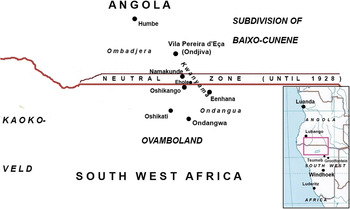
Given this particular research context, Correia’s analysis goes right to the heart of the problem. In several ways, he offers a dark picture of colonial realities close to the border (see Map 1). However, he regarded two elements of Portuguese rule in Southern Angola as particularly inadequate, dramatic, and even disgusting. One was the recruitment process of forced labor that was linked to an exploitative tax system. The other was the effect those practices had on migratory behavior. Officials of both the South African and Portuguese administrations knew that inhabitants of the Kunene region could cross the border from Portuguese territory if conditions became too brutal, and Correia was outraged about what he saw as the absence of intelligent counter-measures.Footnote 29
Map 1. The Angola–Namibia Frontier in the 1920s.

Normally, using a mechanism that existed in other colonies in Africa, Portuguese vagrancy laws could be used to organize forced labor for the construction of roads.Footnote 30 As in all colonial systems where European power officially relied on “direct rule,” the definition of “vagrancy” was complex, but in Angola it had two main aspects, affecting locals who appeared to be unemployed, and the more so if they also happened to be behind with their taxes. The definition of “unemployment” varied from region to region, but everywhere the local chiefs and the so-called “native guards” played an essential role in deciding who should be selected as “unemployed” and eligible for “state labor.”Footnote 31 Road works in the dry savannah of the Cunene subdivisions were arduous, and the punitive character of selection for the task made the whole experience of forced labor still more depressing. Forced labor as a tax-like contribution that concerned all families but only for a clearly defined interval of some days per year, met with less resistance – but such a system was something that the Portuguese never really managed to systematically establish in the Kunene region; chiefs were expected to organize unpaid communal labor for road maintenance immediately after the end of the annual rains, and attempts at distributing the burden of work evenly were extremely rare.Footnote 32 The rules that defined the period of work inflicted as punishment for “vagrancy” were vague enough; it might be six months, or three hundred days, or even more.Footnote 33 Knowing that this uncertainty and the hardships of the particular type of “public road labor” gave them a mightily powerful lever, local administrators in the south of Angola were often tempted to collaborate with European settlers, for although most of them owned farms in the Highlands of Huambo and Lubango to the north, a handful of settlers owned herds of cattle and grazed them in the Kunene region. Obviously, the practice of pushing potential forced laborers into working for European settlers was entirely illegal – but it was typical of Portuguese rule.Footnote 34 The principle in itself was very simple: “vagrants” and “tax defaulters” were rounded up and brought to the administrative posts where they were “persuaded” that they could expect to do better by “volunteering” to go and work for the settler-proprietors in the region – such “work” in the Angolan colonial context was often miserably rewarded indeed.Footnote 35 Individuals of the Ovambo community were especially sought after for they enjoyed a certain reputation as guards and cattle drovers, which made the application of forced labor and the offer of an “alternative” still more important.Footnote 36
Few official reports elaborate on these practices during the interwar period – although we find thousands of indirect allusions in documents. Kreike’s discussion of forced labor practices in the Portuguese context is brief and should certainly be expanded.Footnote 37 Colonial sources from the Portuguese side, especially those written against abusive habits, are thus crucial foundations for deeper analysis.Footnote 38 Correia’s report from 1928 is therefore essential for its vivid picture of the attitudes of European settlers, who expected the administration of the Cunene subdivisions, and the whole District of Lubango to which the region belonged for administrative purposes, to procure labor for them.Footnote 39 Correia dryly commented on the pressures, claiming that while he himself had not responded positively to such demands, most of the administrative staff in the district had done so. Of course that might or might not have been true, but anyway it exposes an interesting type of “standard routine:”
They [the settlers] want the facilities for recruitment, as they are recommended by the higher authorities, to be something not practically very different from a compulsory system (…) I was one of the authorities who, since the law did not impose on me such an obligation, and as I regarded the process as entirely inconvenient for those regions, did not generally respond to demands of this type, although I myself did not actively intervene whenever I was faced with the methods of recruitment of [by the agents of the settlers-proprietors] under conditions not disturbing native policy. For those reasons, in the eyes of the powerful I was not the man to be posted to Baixo Cunene. And the interest of those powerful individuals is always over and above everything, even of the interests of the country itself.Footnote 40
To illustrate the degree of settler mobilization, and the variety of ways in which the settlers managed to exert power over the administration, Correia pointed to a particular scandal, which to the current date has been unknown to historians. It illustrates the role of clientelism in Angola’s colonial society:
Only a little time ago in Sá de Bandeira, one of those “powerful” individuals, the most overweening of them all, said to me, that he was annoyed that a certain administrator (the administrator of Humbe of course, no secret, that) this administrator neglected to furnish him with a certain number of blacks to herd a group of cattle to I know not where. He added: “If I had anything to say about it, this little man would no longer eat the bread of the state.” The man is educated, quite an intelligent fellow; and he knows the law. But on top of everything are his interests, and, for refusing to comply with them, I shouldn’t be surprised if there’s some intrigue going on behind the back of the poor civil servant Madruga, and that Madruga has not already come close to seeing the end of his career. (…) Really, the job of an administrator in Angola has become pretty unrewarding!Footnote 41
The second problem, identified by Correia at the end of the 1920s, was that their policy for the procurement of labor for both public road-building and private enterprise, combined with aggressive tax collection, brought the Portuguese into considerable difficulties because of the effect of the border.Footnote 42 Different groups of the Ovambo lived on each side of the Kunene River in settlements that, from the 1880s onwards, placed them on opposite sides of an international border. In the pre-colonial period, the original center of the most influential political leader amongst the Ovambo, Kwanyama King Mandume Ya Ndemufayo, had been situated in Ondjiva on what was to become Angolan territory. The ground in the northern part of the Kunene floodplain was generally more fertile and more suitable for large herds of cattle.Footnote 43 Mandume had been driven south by the Portuguese in 1915, and by 1917 had been finally defeated and killed by British troops coming north from South Africa to occupy German South West Africa.Footnote 44 The Treaty of Versailles had brought that latter colony under a British mandate administered from South Africa in an evolution that would propel the whole territory, including its northern Ovambo populations, into the development of racial politics defined by Pretoria. Another effect of it was that it speeded up the process of demarcating a colonial border that before the First World War had been left unregulated as the Portuguese, as was often the case in the thirty years following the Berlin Conference of 1884–1885, had lacked the military means to occupy the region effectively. Meanwhile for their part the Germans had been concerned with their policy of agrarian settlement, diamond prospecting, and the extremely brutal “pacification” of the Herero and Nama uprisings further south.Footnote 45 After 1919, under the arbitration of the newly established League of Nations, the Portuguese and British agreed on a provisional border, while around the settlement of Namakunde a so-called “neutral zone” was created where both colonial administrations had to co-exist for a time. The “neutral zone” was eliminated only in 1928 when a mixed Portuguese–South African border commission agreed on a definitive boundary, with most of the disputed territory falling in Angola.Footnote 46 However, while the land came under Portuguese control, the various Ovambo groups living there were often unwilling to accept the fact.Footnote 47 Many were initially ready enough to resettle south of the reconstituted borderline, which brings us to the second important element from Norberto Correia’s point of view. Correia had been concerned with the question of forced labor abuses and was constantly comparing the unsatisfactory conditions on the Portuguese side with what he regarded as good order and intelligent organization of the territory under the South African Mandate. He was particularly preoccupied with the strategic choices made by the South African Native Commissioner of Ovamboland, Carl H. Hahn, whom he considered to be some kind of demon.Footnote 48 In Correia’s view, Hahn used political ingenuity to humiliate the Portuguese:
Whenever we might touch on the matter in conversation, seeking the “why” of these results, his argument was always: “You have too little empathy for the psychology of the native! You try to advance very quickly and the black man is not yet at a stage where he can understand you, he will not follow your orders, which from his view are somewhat radical. I do not govern – one could say – because it is the tribes that continue to regulate themselves following their own customs. I limit my activities purely to making our rule acceptable to them; I give them advice and, whenever they apply to me for some matter requiring the administration of justice, my decision is in harmony with their rules, although I do make shift to imbue them with more humane practices hidden away in the course of action I advise them to take. I generate no paperwork – with the exception of a meager monthly report – and if one day my Government lays a telephone line from Tsumeb to Ovamboland I will leave my post (…) Ovamboland can be governed only under the current conditions, and fortunately my Government has fully agreed with this point of view.”Footnote 49
However, according to Correia, his colleague at the other side of the border, although apparently not hostile to the Portuguese per se, did seem to be a cunning schemerFootnote 50 – but much of the situation was again the fault of undue Portuguese policy. Correia constantly wondered why his superiors were so insensitive as to maintain a brutal system that benefitted only their rivals in Windhoek and Pretoria, rivals who were very well able to profit from the abuses that characterized the administration of Southern Angola:
But does that mean there are taxes only on our side of the border? – you might well ask! “Yessir! Only this side, Sir!” In Ovamboland our neighbors do not demand any type of tax. Over the years we have planned how to raise taxes, with which today we are motivating the natives to flee our colony so that tomorrow we shall have to soothe them with promises not to implement the laws anymore. That’s always a bad thing, of course. But they, they! with perfect knowledge of the psychology of the Blacks in the region (the former English resident in Namakunde, who at the same time was Acting Native Commissioner of Ovamboland, has served there since 1916), they were going to put into practice – and this is something we need to acknowledge – an intelligent native policy formed in response to tribal customs and satisfying their [the local leaders’] small vanities, appetites, and ambitions.
(...)
Now, this South African policy is totally different from our style. The principal characteristics of our system were to rigidly punish [the blacks] and to demand money and labor from them, and I believe that this could not lead to any result but disaster, however beautiful were the eyes of the commanders, military or civil, of the Baixo Cunene [who confronted the natives]. Forgive me if I speak with frankness.Footnote 51
Correia’s “frankness” is echoed by information from South African administrators in Windhoek and Ondangua. In 1926, two years before Correia left his border subdivision for good, there was widespread panic with rumors that the Portuguese were about to “enslave” the locals. Thousands of “Cuanhama” promptly fled across the border. In fact of course, during the forty years between 1880 and 1917 constant warfare and cross-border raids had made local populations extremely sensitive to the possibility of enslavement. The exact meaning of “enslavement” remained largely undefined, but it became clear that the Portuguese administration in southern Angola drafted men and women alike as labor, and it seemed plausible to the locals that what the Portuguese were doing simply replicated earlier slave-raiding activities such as had been the rule before the 1860s. Ovambo chief Mahona Katiti, a principal gatherer of information for the Native Commissioner of Ovamboland, was unable to ascertain if any of the laborers were paid, but it was enough for the locals to know that the Portuguese made use of enormous numbers of involuntary workers, and that the line between work and slavery was blurred. Himba inhabitants in Angola were particular targets for forced labor, but neither the Kwanyama nor other Ovambo were sparedFootnote 52 and the impact of the rumors linking such recruitment with slavery was disastrous for the Portuguese. In 1932, the Portuguese administrators seized children and detained them away from their families with the object of exerting pressure on members of the Kwanyama who evaded forced labor. Although abortive, the action was again likened by the locals to the earlier activities of slaving.Footnote 53
Convinced that the South Africans possessed the necessary tact and moderation to persuade the locals to leave Angola, but that the Portuguese were entirely unprepared to deal with these strategies, Correia tried to introduce changes. He also made repeated protests to his South African colleagues against what he described as intrigues intended to attract local “headmen” and their followers. Correia had little success; indeed the South Africans probably had just as little control over the movement southward.
Often, as Correia found out in the end, it was mainly the influence of other refugees – both rulers and commoners – that convinced individuals living in Angola to leave, without any intervention by the South Africans. A single example from Correia’s own experience is enough to illustrate the mechanism. In late 1926 Correia went to Ehole, and when he got there he noticed that all the village chiefs, Capofi, Ahome, and Chinomidi by name, had disappeared. He was informed that they had taken over kraals south of the Angola–South West Africa border. Correia believed that cunning “native authorities” were behind this development, and accused a certain Moises (or Muachecha), a Kwanyama chief who lived on the Mandate side of the border, of persuading local leaders to relocate their kraals. Correia convinced himself that “the South Africans take such measures to make them move, stirring up the people and cheating them. This is unacceptable and cannot be allowed to happen without protest.”Footnote 54
The general supposition that “native” collaborators of the South African administration were behind all these cross-border movements is therefore confounded by the empirical evidence contained in the actions of the Ovambo leaders and their secret visits to Portuguese territory to encourage the locals to leave. However, it is clear what sort of atmosphere existed both within the administration and amongst the populations of the region. In fact, in the particular case cited here, three local headmen had already left Portuguese territory in the weeks and months before Moises’s visit, and as we have seen a far more important factor was the impression felt by the locals that the Portuguese presence was linked to a strong tradition of enslavement. As a young man, Headman Angush, a crucial figure in escapes from Angolan territory in the late 1920s, had been a slave of the Portuguese so he could speak from personal experience of the late nineteenth century. Belief that the Portuguese colonizers were intent on continuing with slavery, in the form of forced labor, provided enough motivation for local leaders to move their settlements southward. The fact that there was no active propaganda from Portuguese officials nor any policy of courting the chiefs to try to convince them of the more benign elements of Portuguese rule had a devastating effect, most notably after the removal of the Neutral Zone – where local populations had apparently believed that the presence of a South African official would protect them from enslavement! Hahn, the South African Native Commissioner, ironically remarked: “The Portuguese with their excitable and hasty methods having broadcasted [sic] the nwes [sic] that the Zone now belongs to them, must now, after the very noticeable migration southwards, find some justification for this exodus, the natives being recultant [sic] to accept their rule which their fellow tribesmen across the border make no secret of advertising as being all but just.”Footnote 55 In the circumstances, Correia himself regarded Portuguese policy in the region as a complete and devastating failure.Footnote 56
The Portuguese Border Disaster Beyond the Correia Report: Abuses and Flight in the 1920s and 1930s
There is no reason to doubt that much of the population movement from the Angolan Baixo-Cunene Subdivision into Ovamboland under South African rule in the second half of the 1920s was prompted by local leaders after their bad experience of Portuguese labor practices. The following is a significant example to illustrate everyday experience close to the border. Two years after the impressive exodus of 1926 and shortly after the dismissal of Correia, South African officials interrogated Chief Angush,Footnote 57 who made a neat summary of his own escape experience: “As I did not wish to live under the Portuguese I immediately asked Nakale (Mr. Eedes) to give me a new area which he did and I instantaneously moved out of Angolan into British territory.” Caught in the act by Portuguese troops and admonished to submit to Portuguese orders, he “told Captain Correia that he could see that since the border had passed south of my kraal I was now residing in Angola and was subject to him.” As Angush put it plainly: “I was just bluffing him,” and after the Portuguese had left he simply went over the border.Footnote 58 Other local headmen were less lucky. In September 1929 Kwanyama headman Shitivare and chieftainess Dapona tried to cross the border clandestinely, but were arrested on charges of civil disobedience and some of their cattle confiscated. Harold Eedes, the South African official at the border post of Oshikango, then met with Kwanyama headman Hamkoto Wapata to come up with a strategy to convince local rulers upon liberation to come over to the Mandate side of the border.Footnote 59 Their scheme worked and the local rulers did come over, but that only partly confirms Correia’s earlier suspicions about South African maneuverings with regard to cross-border flight. Local individuals of every social rank were all quite capable of developing their own plans to escape. One of them was the headman Jikuma, who in the 1920s had established himself as the wealthiest cattle-owner amongst the Kwanyama of Ondjiva. Jikuma, like other Kwanyama leaders, had been threatened by the Portuguese with confiscation of his property and had entered into negotiations with the South Africans on his own account with a view to escaping to Mandate territory. In the end he too went over to the Mandate side.Footnote 60
As South African Native Commissioner of Ovamboland, Hahn continued to regard Portuguese behavior as incomprehensible, and his view did not change after his conversations with Correia. In fact Hahn became even more surprised by the shortcomings of Portuguese strategy when in 1929–1930 the Kunene Region experienced an extensive drought, which under normal circumstances was likely to trigger a considerable return flow of people onto the grazing land at the other side of the border where better soils would offer a certain amount of protection against the drought’s worst effects.Footnote 61 However, in 1929 Portuguese labor and tax policies were harsh enough to deter local cattle-owners from permanently returning into AngolaFootnote 62 and for Hahn that was proof of a completely misguided “native policy” – one that the South Africans fortunately did not follow. With regard to the punishment of Shitivare, he dryly remarked:
If these tactics of the Portuguese administrators continue there is no doubt that the majority of those natives who recently moved into Angola as a means of self preservation, will return to our country as soon as it is at all possible after the rains, in spite of the large areas which many have received in Angola.
I was informed by the Portuguese some years ago that the Administration of Southern Angola had been transferred to the civil authorities, but all their principal officials still belong to the military, and their complement of European and native soldiery has not been reduced and the latter are used in bullying the tribal natives in every possible manner.Footnote 63
My interpretation of Correia’s report therefore significantly extends the better-known South African historical sources and certain interpretations of oral testimony as offered by Kreike, Hayes and others. It reflects upon a Portuguese account of the situation that can be confirmed by the interpretation of documents from the South West African side, and in the next part of this article I will follow Correia’s vision in an attempt to shed light on an enigma of colonial policies at the Angolan-Namibian border. We have seen that “illegal” migration was an efficient response to comparably brutal conditions of life under forced labor obligations. Correia shows that colonial policies were not at all “rational.” After a colonial administration had established certain routines, it clung to them in ways that in any other circumstances would be called “obsessive.”Footnote 64 Therefore, discussion of contested views in Correia’s report demonstrates that those approaches were clear ingredients for disaster.
However, that does not free us from the task of understanding how it was that for the local populations such experiences fitted into autonomous dynamics that in the end led to a new balance. From my interpretations so far, it might be expected that in the late 1920s and the 1930s the large majority of the inhabitants of the Kunene Floodplain simply left Angolan territory where unfavorable labor conditions reigned. However, the situation is not that simple, for by the end of the 1930s at the very latest border-crossings were once again in both directions. However, Correia’s testimony clearly shows that by 1928 the South African administration of Ovamboland had far more to offer in material terms and conditions of autonomous “native government” than the Portuguese in the District of Lubango. If, therefore, conditions were so extremely repressive on the Portuguese side we must find explanations for why locals would consider staying there.
Why stay? Rationales of Action by Border-Crossing Ovambo Populations in the 1920s and 1930s
The reactions of the Kwanyama and other Ovambo populations living close to the Angola-South West Africa border were much more complex than a simple one-way flow, and the effect of the Portuguese policies which Norberto Correia denounced was not linear and must be seen in context. Other factors had an effect, in particular the long-standing trends of migration in connection with agricultural cycles and access to trade goods and commercial networks. There was violent conflict also, and questions of dominance among Ovambo communities south of the border. Finally we should not forget the clandestine practices of forced labor which existed in the north of the South African Mandate. All four of those factors affected what local individuals actually did, and in the following paragraphs I shall discuss their importance in the light of Correia’s analysis. First of all, even in the period 1915–1930, we find of course a type of migration for which political and administrative conditions were of only secondary importance. Actually, there was a long tradition of large-scale migration in the area.Footnote 65 From the conquest period beginning in the late nineteenth century to the anti-colonial wars of the 1960s and 1970s, tens of thousands crossed the border to improve their living conditions, and naturally people might go in either direction. I have argued above that originally many such movements had nothing to do with politics, but were due to the dependence of many of the region’s inhabitants on cattle and cattle-breeding and the fact that many of the regions adjacent to the Kunene floodplain were periodically hit by drought. Thus, the locals needed to respond to environmental problems and their strategy involved crossing the border, however much the colonial powers wished to keep them inside their new and artificially created boundaries.Footnote 66 Although in theory colonial officials had a great deal of leeway in confiscating cattle on the basis of veterinary regulations, the Portuguese rarely went as far as that – unless such confiscation was to be used to discipline any recalcitrant local leader who stood against colonial demands for taxes and forced labor.Footnote 67
Second, apart from practices of forced labor and tax regimes, we find other “colonial” variables at play, particularly access to trade goods. Separate commercial networks existing on each side of the border were an important magnet for local migration in either direction. As Correia reported – and this was something by which the Portuguese administrator was genuinely impressed – there was more in the shops on the South West African side of the border, another thing which could have dislodged even more individuals from Angola and enticed them south of the border.Footnote 68 Hahn’s native administration was actively trying to encourage them. Credit arrangements in Ovamboland under the South African Mandate were generous, and local chiefs were given privileged access to sought-after commercial goods. Trade routes, some of them clandestine, even crossed the remote dry regions of neighboring Kaokoveld to the west of the Cunene Floodplain.Footnote 69 In the interwar period, many Herero from Angola might travel as far as Tsumeb, to obtain goods more cheaply.Footnote 70 For the Cunene region, such movements blended deeply into other forms of trans-border migration so that it is more difficult to analyze them – but they were doubtlessly of considerable importance.
Even so, there were two trading items that the South Africans were not prepared to provide – or at least not in sufficient quantities: firearms and alcohol. In that, the Portuguese were at a “traditional” advantage, which they were perfectly well able to use. Even when the inhabitants of kraals crossed into South West Africa they remained eager consumers of Portuguese wine and many depended on the sale of Portuguese weapons for hunting and raids,Footnote 71 for which they needed to smuggle barrels and crates over the border, running the gauntlet of South African border patrols. As punishment, smugglers might eventually lose the privileges they obtained from the mandated power.Footnote 72 For much of the 1920s Portuguese merchants and cattle-breeders crossed the border to buy cattle whenever they could legally do so, and to trade for goods by barter.Footnote 73 However, many such individual transactions were illegal from the point of view of the mandated power. At their peak, the number of visits by Portuguese traders at Oshikango trying to bring merchandise into South West Africa multiplied so considerably that the officer at the border post begged his superior to dramatically restrict access by individual Portuguese merchants, many of whom were accompanied by junior officials. In some exasperation the border official commented: “My weekends at Oshikango are a nightmare as crowds of Portuguese arrive on a visit for no apparent reason, and strew my yards with cigarette ends and empty cigarette packets!”Footnote 74 Thereafter, the South African authorities limited access to Ovamboland for Portuguese traders – rightly believing that many such characters were actually smugglers.Footnote 75 By 1929, local leaders were forced once again to cross the borders or send their subjects across if they wished to guarantee access to goods like especially ammunition or alcohol. Correia’s analysis shows that the less rigid Portuguese trade regulations in fact benefited the Portuguese at the border as the many small traders in rural areas could provide the desired resources.Footnote 76 In order not to be cut off from goods regarded as essential it was necessary to live in Angola for part of the year, or to have good contacts there.
Third, many existing interpretations by historians omit to mention that in spite of brutal Portuguese “pacification” the regional political situation remained unstable, with continuing conflicts between local rulers. Violence was most prevalent at the boundary between the Kwanyama and Ondanga communities. There, warfare continued until 1920 when to a certain extent colonial officials managed to disarm and “pacify” local groups.Footnote 77 Further westward, among the Herero of the Kaokoveld, raids clearly remained part of local life during the interwar period. From 1915 onwards, the Herero community of the Kaokoveld was led by Tom “Oorlog” Vita until his death in 1937. Even before 1913 OorlogFootnote 78 had been a mercenary in the service both of the Portuguese administration and Afrikaner communities in Angolan territory, relying on a network of Herero and Nama allies, some of whom had married their daughters to him.Footnote 79 During the constant warfare in the region, many leaders of small groups of raiders transported their captives back and forth across the border between Angola-South West Africa, and raiding had its effects on Ovamboland.Footnote 80 Raids continued to be a fact of life under colonial rule, especially south of the border, and the South African authorities were able to reduce them but could never manage to eliminate them altogether. Raiding was naturally carried out largely out of sight of colonial control and of course involved the movement of locals from the northern part of the Mandate. Finally, many Kwanyama had fled their settlements north of the border in the late 1910s because they felt that by installing as chiefs men from the Cuamato communities who had been auxiliaries during the conquest period, the Portuguese colonizers were altering local hierarchies. Correia’s subsequent removal of such chiefs seemed to have the clear effect of signaling the normalization of power relations.Footnote 81
Fourth, while forced labor and labor abuses in the Portuguese colony were an important factor, as they clearly account for flight movements and resistance, South West Africa saw its own share of doubtful labor practices and techniques for mobilizing unfree labor, even if they were less visible than Portuguese practices. In the case of Ovamboland much depended on measures taken by the Mandate’s administration to guarantee “native labor” for the southern diamond fields. In the early 1920s conditions in diamond mining were obviously bad, and populations of Ovamboland had for some time had the impression that mine labor of that type was by no means preferable to life in the Portuguese territory north of the border. The experience of influenza and other epidemics in the diamond zone only strengthened that impression. As early as 1924 and in terms revealing the greatest concern, the Native Commissioner in Tsumeb commented about the “difficulties:”
You will remember that I promised to send you copies of correspondence re the laborers returned from Lüderitz, well, the whole affair died out without a word – I have not heard a word since – it appears to have been the policy to clear Lüderitz as quietly as possible owing to the enormous death rate. I have heard so confident[ial]ly and came to the conclusion that it was also politique [sic] for me to “shut up.”
At all events it has had a disastrous effect on the recruiting as only 84 came down last month and this month to date is 46. I understand the returning gangs met the laborers coming down and told them there was no work here etc. etc., and the recruits returned to their homes.Footnote 82
In 1923, some of the white settler-farmers in South West Africa reported – with obvious interest – that the laborers being transported southward were not allowed to choose their employers. Thus, in the case of Dornhügel Farm close to Grootfontein, its proprietor protested that “the incoming Ovambo are forced against their will to go to Lüderitz by the authorities, notwithstanding the fact that some expressed the wish to enter my service.”Footnote 83 That is only one example of the type sounding a note of protest, but there were others and they give the historian the impression that such constraint was a reasonably regular thing. With regard to road labor – a practice criticized by Correia in the Portuguese colony – we find evidence illustrating that the Mandate was far from being entirely free from similar labor practices. Indeed, in a way it was more complicated for local South West African populations to complain against forced labor practices, because the native commissioners for Ovamboland left such matters in the hands of the headmen and chiefs – although they did exert a certain amount of pressure on them to comply with administrative priorities. The type of so-called “communal labor,” a term suggesting such practices were somewhat “traditional,” so not linked to colonial repression, is very characteristic for much of the British Empire both in West Africa and in the Central African colonies – but it was copied by the Mandate’s administration for South West Africa where it seems to have been converted into a type of hidden forced labor.Footnote 84 When Harold Eedes, who in the meantime had become Native Commissioner of Ovamboland, retired from this post in 1954, the eulogy declaimed by the scribes of the native administration explicitly separated his period of government from that of Carl Hahn by reference to the question of road labor, for it had been thanks to Eedes that forced and unpaid labor practices had disappeared after the Second World War.Footnote 85 Therefore, what Correia had been unable to understand was that the South Africans too relied on techniques of involuntary recruitment and work, for he had been convinced that the neighboring administration had no need of such methods. Correia pointed to the competitive wages offered in the mines and held that no compulsion was necessary to recruit labor.Footnote 86 He also underestimated the use of coercion in the maintenance of roads and Ovamboland’s other infrastructure.Footnote 87 The techniques of forced labor may have been more refined and definitely well-hidden from the international public behind formulae of “communal traditions,” but migrants arriving from Angola were nevertheless confronted by repressive practices comparable to Portuguese abuses.
The Limits of Non-Adaptation
By the time of Norberto Correia’s dismissal, a number of Portuguese administrators including Correia himself had understood that “native policy” in the Kunene region needed to be reframed. Almost as soon as such an understanding became more widely implemented, with offers being made to selected Ovambo chiefs and influential individuals, the balance in the complex decision-making processes of community leaders shifted in favor of Portuguese Angola.Footnote 88 One of the first successes was the case of female community leader Dilekerua, a chief who returned with her entourage to Angolan territory, although South African officials believed she would soon regret it because she would face punitive taxation, or perhaps the recruitment of family and kraal members for forced labor. For Dilekerua, those dangers were of lesser importance because she felt that the move back into Angola improved her own position and enhanced the positions of her favored heirs under the rules of lineage.Footnote 89 The return of another female leader Galinacho who was the sister of Dilekerua, was another similar success, showing that at some point the Portuguese had understood that it might be sensible to court female chiefs, although in improvised circumstances.Footnote 90 Correia used the same method and his successors followed his lead. Correia had understood by 1920 that the South Africans had a tendency to support male over female leaders, notwithstanding the more complex systems of heritage within Ovambo communities. He therefore tested a strategy of supporting female leaders by approaching Queen Anhanca for her support, and noticed a strong effect on her followers and others who were critical of “native administration” practices on the south side of the border.Footnote 91 However, the changes in the administrative strategies of the Portuguese and in their interaction with Ovambo leaders began to have a real effect only from second half of the 1920s onward. In 1929, the Portuguese administration in Ondjiva again became more optimistic about their chances of convincing important chiefs to come back. They even sent the Ombadja headman Hero to visit the chief Shitivare in his kraal in South West Africa to offer him the paramount chieftaincy over the Kwanyama on Angolan territory, on condition that he return to Angola. In this, a particularly spectacular case, the mission failed when both Shitivare and his son Tenegelamo refused the offer.Footnote 92 Even so, the example shows that return flow was no longer unusual, and at a moment when the Portuguese feared the worst for southern Angola believing that literally no one would stay, populations began to return in greater numbers. Between 1927 and 1929 various groups of returnees amounted to more than ten per cent of the resident population of Baixo-Cunene.Footnote 93
Still, as reported by the missionaries working for the Finnish Mission, certain of the political returnees were to be subject to punishment for their earlier flight.Footnote 94 In other situations, groups of Kwanyama herdsmen had fled from Mandate territory and come to the Portuguese colony looking for labor contracts, to escape their allegedly abusive chiefs. Those Kwanyama had quickly learned that the Portuguese were unwilling to send anyone back even if the request for extradition originated with some dignitary in Ovamboland and was endorsed by a South African official or was for alleged criminal acts committed in the Mandate.Footnote 95 For such refugees, their choice was between the repressive colonial power in the north, whose agents were not always able to exercise violent control, and conditions under “native rule” in the south, where “native authorities” might operate a much more intense form of repression. As a matter of fact, between 1925 and 1940 many chose to travel northward again, but they seem to have kept their options open to return if conditions, and notably demand for unpaid labor, become altogether unbearable. In May 1933, a new Portuguese administrator of the border subdivision of Baixo-Cunene complained to Hahn in a long letter that some of the laborers had “fled” again, taking their new agricultural equipment with them to South West Africa.Footnote 96 However, few refugees had decamped, and even less of those who had experienced problems with the chiefs on Mandate territory after converting to Christianity. The mission of the Holy Ghost Fathers in southern Angola had an unexpected disciplinary effect on the refugees, who largely took the missionaries’ advice to stay.Footnote 97
Finally, Correia and his successors had little understanding of the details of political relations among Ovambo communities, but their reports often instinctively pointed to strained political relations and tactical movements. Thus, Portuguese officials reported that in a panorama of strong mobility, firstcomers amongst the Ovambo headmen and leaders (in particular amongst the Kwanyama and Ombadja) could effectively block the path to other members of their groups who might later wish to flee to South West Africa and resettle there. The case of Shitivare was certainly the most significant in the 1920s, and after he had established himself as the leading representative of the Ombadja very few other Ombadja crossed the border from Angola. There was even a widespread rumor that Shitivare would avenge himself on anyone alleged to have had any role in ousting him from his former chieftaincy in the Baixo-Cunene, and unsurprisingly no one wished to be the first to feel the effect of his wrath.Footnote 98 Therefore, the decision either to stay in Angola or to return there was often conditioned by the complex negotiation of individual and smaller group interests, and internal group dynamics were as much a factor as colonial repression or forced labor.
Conclusion
Agents of colonial rule might be racist and misinformed, or unmotivated or intellectually incapable of adequately describing local routines. Moreover, their testimony is often likely to be biased, and needs critical reflection. Even so, with the right amount of critical analysis, colonial sources can still bring us important new insights, and Norberto Correia’s report is an example par excellence of a source of that type for the Angola-Namibia border region in the 1920s. It shows, first of all, that while the Portuguese in Angola indeed enjoyed no “uneconomic imperialism,” they relied upon improvised routines built on entrenched and unquestioned practices and personal agendas.Footnote 99
However, while Correia accused the South Africans of far more strategy in their approach and of consciously attracting locals from Portuguese territory, it becomes obvious from his comments that the South Africans’ tactics were improvised also, in particular by one individual official who knew how to please the important local chiefs.Footnote 100
Second, Correia’s analysis clearly points to the importance of the experience of forced labor, the possibility of which was a constant threat to border populations. For their part therefore, borderers like the Kwanyama and other Ovambo groups were constantly on the move, and if they stayed still for any length of time it was often because they were planning and negotiating their future with regard to labor obligations, processes facilitated by the international border and the mobility of the Ovambo as cattle-owners. From that perspective the border between Angola and South West Africa offers an enlightening case of a universal colonial phenomenon seen in wide parts of the African continent: through its labor demands and the necessary reactions to them, rural life became destabilized and in fact partly destroyed.
Correia’s report, if put in line with other contemporary sources, also allows us to challenge an image according to which we would find a linear flow of Ovambo individuals outward from Angolan territory. Although conditions of forced labor were worse in the Portuguese colony, nevertheless pull factors existed to motivate locals to return to Angola. They included access to trade goods, but in particular there was the effect of internal politics among the groups. Often, locals accepted forced labor if its obligations were unlikely to take much time, and they did so also to escape the repressive control of local leaders. Since initially many Ovambo leaders established their kraals south of the border, return or continued establishment on Angolan territory was seen as a useful strategy.
The observations I have made about factors pushing and pulling mobile populations at the border of Angola with South West Africa are valid for at least the two decades after 1917. A considerable proportion of Portuguese officials remained heavy-handed and abusive and during the Second World War some conditions even worsened for Kwanyama populations in the Subdivision of Baixo-Cunene, as the colonial power attempted to extract the greatest profit from its territories by intensifying its use of forced labor.Footnote 101 But beginning in the early 1950s the general situation began to change, with a greater influx of white settlers into the Angolan District of Lubango. Also, the recruitment of Angolans for the Lüderitz Diamond Fields was more strongly regulated. In the 1960s and 1970s, major improvements like the ending of forced labor on the Portuguese side and reduction in taxes further lessened the South African Mandate’s economic advantages. However, the needs of an anticolonial war had made it essential for Portuguese administrators who by then were under pressure from the military, to offer better conditions to local populations in a campaign to win support from their colonial subjects. Even then, the internal debate that went on about abuses remains a vital source both for local reactions and the incongruities of colonial rule Portuguese style – although later complaints often lack the acerbic tone and profound understanding found in Norberto Correia’s report.
Alexander Keese is Research Group Director of the European Commission-funded project ForcedLabourAfrica (ERC Starting Grant 240898) at the Humboldt University at Berlin. He has published numerous articles in peer-reviewed, international journals, and he is the author of Living with Ambiguity: Integrating an African Elite in French and Portuguese Africa, 1930–61 (Stuttgart: Steiner, 2007), and the editor of Ethnicity and the Long-Term Perspective: the African Experience (Bern: Peter Lang, 2010), and (with Tony Chafer) Francophone Africa at Fifty (Manchester: Manchester University Press, 2013). E-mail: Alexander.Keese@unige.ch