In this Special Issue article on “Early Adversity, Stress and Neurobehavioral Development” we focus on adversity during one of the most dynamic epochs of human brain development, the antenatal period. Children exposed to antenatal maternal depression are at greater risk for childhood mental disorders (O'Donnell, Glover, Barker, & O'Connor, Reference O'Donnell, Glover, Barker and O'Connor2014; Pearson et al., Reference Pearson, Evans, Kounali, Lewis, Heron, Ramchandani and Stein2013). However, the effect of maternal antenatal depression on child mental health shows considerable inter-individual variation such that we currently lack the ability to identify the children at greatest risk (Plomin & Simpson, Reference Plomin and Simpson2013), which precludes targeted intervention. Here, we seek to better describe the interplay between maternal antenatal depression and child genomic variation to understand the prenatal origins of individual differences in neurobehavior and mental health.
There is now considerable evidence for the importance of genotypic variation as a moderator of the impact of early life adversity on neurodevelopmental outcomes as well as the treatment outcomes of interventions (e.g., Belsky et al., Reference Belsky, Jonassaint, Pluess, Stanton, Brummett and Williams2009; Brody, Yu, & Beach, Reference Brody, Yu and Beach2015; Cicchetti, Toth, & Handley, Reference Cicchetti, Toth and Handley2015; Ellis, Boyce, Belsky, Bakermans-Kranenburg, & van IJzendoorn, Reference Ellis, Boyce, Belsky, Bakermans-Kranenburg and van IJzendoorn2011; Manuck & McCaffery, Reference Manuck and McCaffery2014; Rutter, Reference Rutter2007; van Ijzendoorn & Bakermans-Kranenburg, Reference van Ijzendoorn and Bakermans-Kranenburg2015). Several candidate gene analyses (e.g., brain-derived neurotrophic factor [BDNF], catechol-O-methyltransferase [COMT], dopamine receptor D4 [DRD4], solute carrier family C6, member 4 [SLC6A4]) suggest child genetic variation may moderate the associations between multiple forms of antenatal maternal “distress” and child emotional/behavioral development (Babineau et al., Reference Babineau, Green, Jolicoeur-Martineau, Bouvette-Turcot, Minde and Sassi2015; Graffi et al., Reference Graffi, Moss, Jolicoeur-Martineau, Moss, Lecompte and Pascuzzo2017; O'Donnell, Glover, Holbrook, & O'Connor, Reference O'Donnell, Glover, Holbrook and O'Connor2014; O'Donnell et al., Reference O'Donnell, Glover, Lahti, Lahti, Edgar, Räikkönen and O'Connor2017). Some of these associations have been replicated in independent samples (e.g., O'Donnell et al., Reference O'Donnell, Glover, Lahti, Lahti, Edgar, Räikkönen and O'Connor2017). However, the single candidate gene-by-environment (GxE) approach suffers from well-documented limitations (see Border et al., Reference Border, Johnson, Evans, Smolen, Berley, Sullivan and Keller2019; Duncan, Pollastri, & Smoller, Reference Duncan, Pollastri and Smoller2014; Ficks & Waldman, Reference Ficks and Waldman2009 for discussion) and commonly accounts for only a small proportion of the variance in complex phenotypes (O'Donnell et al., Reference O'Donnell, Glover, Lahti, Lahti, Edgar, Räikkönen and O'Connor2017; Sullivan, Daly, & O'Donovan, Reference Sullivan, Daly and O'Donovan2012; Visscher, Hill, & Wray, Reference Visscher, Hill and Wray2008). Likewise, previous studies have not examined the nature of the interaction between maternal antenatal depression and child genotype. A subgroup of children, carrying specific genotypes, may be more vulnerable to the effects of antenatal maternal depression; that is, a diathesis–stress model. Alternatively, in children carrying the same genotype, the presence or absence of maternal antenatal depression may associate with increased or decreased risk of disorder, respectively; that is, a differential susceptibility model (Belsky, Reference Belsky1997; Belsky, Bakermans-Kranenburg, & van IJzendoorn, Reference Belsky, Bakermans-Kranenburg and van IJzendoorn2007; Belsky et al., Reference Belsky, Jonassaint, Pluess, Stanton, Brummett and Williams2009; Belsky, Pluess, & Widaman, Reference Belsky, Pluess and Widaman2013; Pluess & Belsky, Reference Pluess and Belsky2009; Roisman et al., Reference Roisman, Newman, Fraley, Haltigan, Groh and Haydon2012). A more thorough understanding of the nature of the interaction between maternal antenatal depression and child genetic variation may help better predict who is likely to benefit from intervention programs that target maternal antenatal depression to improve child outcome. These intervention programs thus far show modest effects on measures of child neurodevelopment (Goodman, Cullum, Dimidjian, River, & Kim, Reference Goodman, Cullum, Dimidjian, River and Kim2018).
Large-scale initiatives such as the Psychiatric Genomics Consortium and the Social Science Genetic Association Consortium are beginning to define the genetic architecture of individual differences in complex phenotypes (Rietveld et al., Reference Rietveld, Medland, Derringer, Yang, Esko, Martin and Koellinger2013; Sullivan et al., Reference Sullivan, Agrawal, Bulik, Andreassen, Børglum, Breen and O'Donovan2018), including child neurodevelopmental disorders such as attention-deficit/hyperactivity disorder (ADHD) (Demontis et al., Reference Demontis, Walters, Martin, Mattheisen, Als, Agerbo and Neale2019; Martin et al., Reference Martin, Walters, Demontis, Mattheisen, Lee, Robinson and Neale2018; Neale et al., Reference Neale, Medland, Ripke, Asherson, Franke, Lesch and Nelson2010). For example, ADHD shares genetic risk factors with at least four other common psychiatric disorders – depression, schizophrenia, autism, and bipolar disorder (Cross-Disorder Group of the Psychiatric Genomics Consortium, 2013). These findings suggest that genetic variants associated with ADHD may have pleiotropic effects on psychopathology as well as specific predictive value for ADHD (Brikell et al., Reference Brikell, Larsson, Lu, Pettersson, Chen, Kuja-Halkola and Martin2020; Du Rietz et al., Reference Du Rietz, Coleman, Glanville, Choi, O'Reilly and Kuntsi2018; Martin, Hamshere, Stergiakouli, O'Donovan, & Thapar, Reference Martin, Hamshere, Stergiakouli, O'Donovan and Thapar2014; Stergiakouli et al., Reference Stergiakouli, Martin, Hamshere, Langley, Evans, St Pourcain and Davey Smith2015, Reference Stergiakouli, Martin, Hamshere, Heron, St Pourcain, Timpson and Davey Smith2017). This hypothesis is also supported by clinical observations that find childhood ADHD to be comorbid with a range of childhood mental disorders (Biederman, Newcorn, & Sprich, Reference Biederman, Newcorn and Sprich1991), as well as the heterotypic continuity observed across common childhood-onset mental disorders (Shevlin, McElroy, & Murphy, Reference Shevlin, McElroy and Murphy2017).
Existing genome-wide association studies (GWAS) typically identify a large number of genetic variants, each with a small effect on disease risk. A polygenic risk score (PRS) represents an aggregate score of the additive effects of a number of single nucleotide polymorphisms (SNPs) that collectively contribute to the genomic risk for a given phenotype (Wray, Goddard, & Visscher, Reference Wray, Goddard and Visscher2007; Wray et al., Reference Wray, Lee, Mehta, Vinkhuyzen, Dudbridge and Middeldorp2014). These scores can be used to segregate cases from controls and provide a relatively simple measure of the direct effects; that is, main effects of genomic variation for risk of a given disorder (Brikell et al., Reference Brikell, Larsson, Lu, Pettersson, Chen, Kuja-Halkola and Martin2020; Cross-Disorder Group of the Psychiatric Genomics Consortium, 2013; Groen-Blokhuis et al., Reference Groen-Blokhuis, Middeldorp, Kan, Abdellaoui, van Beijsterveldt, Ehli and Boomsma2014; Martin et al., Reference Martin, Hamshere, Stergiakouli, O'Donovan and Thapar2014; Stergiakouli et al., Reference Stergiakouli, Martin, Hamshere, Langley, Evans, St Pourcain and Davey Smith2015, Reference Stergiakouli, Martin, Hamshere, Heron, St Pourcain, Timpson and Davey Smith2017). Few studies have examined how variation across the genome (genomic variation) may moderate the impact of maternal antenatal depression on child outcomes and no study to date has examined if the effects of maternal antenatal depression on child mental health symptoms are moderated by genomic variation in the child (although see Pearson et al., Reference Pearson, Bornstein, Cordero, Scerif, Mahedy, Evans and Stein2016, Qiu et al., Reference Qiu, Shen, Buss, Chong, Kwek, Saw and Meaney2017; Sfelinioti & Livaditis, Reference Sfelinioti and Livaditis2017).
One of the challenges of using PRS in GxE designs is the inherent “main effects” bias within PRS: these scores are based on SNPs with main effects on a given phenotype and only a subset of these SNPs may contribute to any interaction effect. Alternatively, quantifying interaction effects between a predictor of interest and each SNP within the human genome, a so-called Genome-wide × Environment interaction analysis, requires very large cohorts (Dunn et al., Reference Dunn, Wiste, Radmanesh, Almli, Gogarten, Sofer and Smoller2016; Van der Auwera et al., Reference Van der Auwera, Peyrot, Milaneschi, Hertel, Baune, Breen and Grabe2018). We propose an alternative approach, one that refines a conventional PRS to retain only those SNPs that interact with an exposure of interest to predict an outcome of interest. We refer to these novel genomic predictors as interaction PRS (xPRS). In this study, we highlight the utility of xPRS to better understand individual differences in the impact of maternal antenatal depression on child emotional/behavioral difficulties in two independent cohorts.
Method and materials
Cohorts
Cohort 1
The Maternal Adversity, Vulnerability and Neurodevelopment (MAVAN) project is a longitudinal birth cohort in Montreal and Hamilton, Canada that examines the influence of the early environment on child development (O'Donnell et al., Reference O'Donnell, Gaudreau, Colalillo, Steiner, Atkinson and Moss2014). We used a subsample (n = 187) of 496 mother–child dyad participants in MAVAN for which complete data were available for child genotyping, maternal mental health, and child mental health outcomes (an overview of this cohort is provided in O'Donnell et al., Reference O'Donnell, Gaudreau, Colalillo, Steiner, Atkinson and Moss2014). Institutional approval for this study was obtained from the Douglas Hospital Research Centre, Montreal and St. Joseph Healthcare, Hamilton (protocol number IUSMD-03-45/IUSMD-06-09).
Cohort 2
The “Basal Influences on Baby Development” (in Dutch: “Basale Invloeden op de Baby Ontwikkeling” – BIBO) study is an ongoing longitudinal community-based birth cohort in the Netherlands (see Beijers, Jansen, Riksen-Walraven, & de Weerth, Reference Beijers, Jansen, Riksen-Walraven and de Weerth2010 for more information). Measures of maternal mental health, child outcomes, and child genetic variation were available on 132 children. Institutional approval for the BIBO cohort was obtained from the Faculty of Social Sciences of Radboud University (#ECG300107).
Child mental health
Child mental health symptoms were assessed via maternal report using the Child Behavior Checklist (CBCL) at 60 months postpartum (Achenbach, Reference Achenbach1991). The total score was further refined to describe internalizing or externalizing symptoms. Internalizing problems included emotional reactive symptoms, anxious/depressed symptoms, somatic complaints, and withdrawn behaviors. The externalizing problems included inattention and aggressive behaviors. In the BIBO cohort, the Dutch CBCL (Verhulst, Akkerhuis, & Althaus, Reference Verhulst, Akkerhuis and Althaus1985) was completed by mothers at 72 months postpartum. The internalizing problems included anxious/depressed symptoms, somatic complaints, and withdrawn behaviors. The externalizing problems included delinquent and aggressive behaviors.
Maternal depression
Mothers in the MAVAN cohort completed the Center for Epidemiologic Studies Depression Scale (CES-D) (Radloff, Reference Radloff1977) to assess symptoms of depression. CES-D scores were available during the third trimester of pregnancy (CES-Dpre) and at 12 months (CES-D12mths) and 60 months postpartum (CES-D60mths). In the BIBO cohort, maternal depression was assessed using the Dutch version of the Edinburgh Postnatal Depression Scale (EPDS) (Cox, Holden, & Sagovsky, Reference Cox, Holden and Sagovsky1987; Pop, Komproe, & van Son, Reference Pop, Komproe and van Son1992) during the third trimester of pregnancy (EPDSpre) and at 72 months postpartum (EPDS72mths).
Genotyping, quality control, and imputation
We used the PsychChip (v1) or PsychArray (v1.1) (Illumina, Inc.) to assess genomic variation in children within the MAVAN cohort. Samples with low call rates (<90%) and probes with low sample call rates (<95%) or that deviated from Hardy–Weinberg equilibrium (p < 1 × 10⁻¹¹) were removed during quality control. Genome-wide imputation was performed using the Sanger Imputation Service (McCarthy et al., Reference McCarthy, Das, Kretzschmar, Delaneau, Wood and Teumer2016) on autosomal SNPs with minor allele frequency (MAF) ≥ 5%. The Haplotype Reference Consortium (release 1.1) was used as the reference panel (McCarthy et al., Reference McCarthy, Das, Kretzschmar, Delaneau, Wood and Teumer2016). Imputed SNPs with low imputation accuracy (info score ≤ 0.8), multi-allelic SNPs, and palindromic SNPs were removed prior to PRS computation. Overall, 17,703,929 autosomal SNPs were available for our analyses.
We used the Infinium Global Screening Array (Illumina, Inc.) to assess genomic variation in children within the BIBO cohort. Samples and probes with low call rates <95%, deviated from Hardy–Weinberg equilibrium (p < 1 × 10⁻²⁰), or MAF < 5% were removed during quality control. We used the Sanger Imputation Service (McCarthy et al., Reference McCarthy, Das, Kretzschmar, Delaneau, Wood and Teumer2016) to impute autosomal SNPs against the Haplotype Reference Consortium (release 1.1) providing 23,037,776 autosomal SNPs for our analyses.
Conventional polygenic risk score calculation
PRSs are derived using a count function of risk alleles with each allele weighted by its association with the risk of disorder (Chen et al., Reference Chen, Yao, Garg, Zhu, Nguyen, Pokhvisneva and O'Donnell2018). These effect-size estimates and associated summary statistics are provided by an independent, existing GWAS. PRSs for ADHD (PRSADHD) were computed using the summary statistics from a GWAS of ADHD by the Psychiatric Genomics Consortium (Neale et al., Reference Neale, Medland, Ripke, Asherson, Franke, Lesch and Nelson2010) and not the more recent GWAS of ADHD carried out by Demontis et al. (Reference Demontis, Walters, Martin, Mattheisen, Als, Agerbo and Neale2019). We chose this approach based on findings from the MAVAN cohort, which revealed a stronger prediction of an objective measure of child ADHD using a PRS based on the findings from the Neale et al. study (Demontis et al., Reference Demontis, Walters, Martin, Mattheisen, Als, Agerbo and Neale2019; Neale et al., Reference Neale, Medland, Ripke, Asherson, Franke, Lesch and Nelson2010) (See Supplementary Appendix A: Figure S1). All subsequent analyses focus on PRSADHD informed by the findings from Neale et al. (Reference Neale, Medland, Ripke, Asherson, Franke, Lesch and Nelson2010). SNPs were pruned using the p value informed clumping function in PLINK 1.9 (Chang et al., Reference Chang, Chow, Tellier, Vattikuti, Purcell and Lee2015), which removed SNPs in high linkage disequilibrium (r 2 > .2) across a 500 kilobase regions, retaining a single sentinel SNP for a given region (Neale et al., Reference Neale, Medland, Ripke, Asherson, Franke, Lesch and Nelson2010). PRSADHD was computed at p value thresholds between 0.01 and 1.00 at intervals of 0.01 using PRS-on-Spark (Chen et al., Reference Chen, Yao, Garg, Zhu, Nguyen, Pokhvisneva and O'Donnell2018) and adjusted for measures of population stratification (see Supplementary Appendix A: Supplementary Methods and Figure S2) (Patterson, Price, & Reich, Reference Patterson, Price and Reich2006; Price et al., Reference Price, Patterson, Plenge, Weinblatt, Shadick and Reich2006).
Statistical analysis
All statistical analyses were performed using R (https://cran.r-project.org). CBCL and CES-D scores in MAVAN were square-root transformed and the CBCL scores in BIBO were log transformed to satisfy assumptions for linear regression analysis.
Conventional PRS and child mental health
We defined the “Best-Fit” child PRSADHD as the PRSADHD (at a given p value threshold) that interacted with maternal CES-Dpre to account for the largest proportion of variance (i.e., highest R 2) in child outcome (see Equation 1). All models of child emotional/behavioral problems were adjusted for concurrent maternal depressive symptoms to avoid potential bias in the report of child outcomes (van der Toorn et al., Reference van der Toorn, Huizink, Utens, Verhulst, Ormel and Ferdinand2010). The addition of gender to the model did not improve model fit and was not considered in subsequent analyses (see Supplementary Appendix A for further information).
Best-Fit Model:

Interaction polygenic risk scores and child outcomes
We used linear models (Equation 2) to identify individual SNPs (SNPi…j) within the Best-Fit PRSADHD that moderate the association between maternal CES-Dpre and child outcome:
Single SNP Interaction Model:

Interaction PRS (xPRS)
Next, we constructed a novel PRS based on SNPs that moderate the association between maternal CES-Dpre and child outcome, which we term an interaction PRS (xPRS). We generated xPRS at a range of p value thresholds (i.e., the p value for the interaction term between each SNP and CES-Dpre from Equation 2) such that distinct xPRS consisted of different numbers of SNPs. Likewise, each SNP within the xPRS was weighted by the ADHD-associated effect-size estimates from the discovery GWAS (Neale et al., Reference Neale, Medland, Ripke, Asherson, Franke, Lesch and Nelson2010). Finally, xPRSs were adjusted for population stratification. In line with our analyses of the conventional PRSADHD, we examined the interaction between maternal CES-Dpre and xPRS calculated at a range of thresholds (p ≤ .01- p ≤ 1.00). We defined the “Best-Fit” xPRS as the xPRS that moderated the association between maternal CES-Dpre and child CBCL scores and accounted for the largest proportion of the variance in the child outcome (see Equation 3):
Best-Fit xPRS Model:

SNPs that contributed to the Best-Fit xPRS in MAVAN were used to compute the xPRS in the BIBO cohort and the resulting xPRS was adjusted for population stratification.
xPRS Replication (BIBO):

Cross-validation analysis
We performed a leave-one-out cross-validation (LOOCV) in MAVAN using the caret package in R (Kuhn, Reference Kuhn2008). We compared the predictive accuracy of three separate models: Model 1: a main effects model (see Equation 5), which simply tested the predictive accuracy of an additive model that considered CES-Dpre, CES-D60mths and child PRSADHD to predict child CBCL scores; Model 2: an interaction model (equivalent to Equation 1) and Model 3: an xPRS interaction model (equivalent to Equation 3). Root-mean-square error (RMSE) was used to measure the average prediction error across models.
LOOCV Main effects:

Diathesis–stress versus differential susceptibility models of child outcome
We calculated three different metrics that can be used to evaluate if an interaction supports a diathesis–stress or differential susceptibility model (Roisman et al., Reference Roisman, Newman, Fraley, Haltigan, Groh and Haydon2012). These metrics included the regions of significance (RoS), the proportion of interaction (PoI), and the percentage affected (PA) index. RoS refer to the range of values of the predictor (i.e., maternal antenatal symptoms of depression) where the outcomes (i.e., child mental health symptoms) are significantly different between those scoring high or low on the moderator (i.e., child xPRS). Differential susceptibility is supported if the upper and lower bound of the RoS fall within two standard deviations of the mean of the predictor. The PoI measures the total area between the lines of an interaction plot above the cross-over point. PoI values ranging from 0.40–0.60 support differential susceptibility, while a value of 0.00 provides clear evidence of diathesis–stress. Finally, the PA refers to the percentage of individuals within the cohort who fall above the cross-over point for a given interaction plot. Differential susceptibility is supported if the PA is greater than 16% (Roisman et al., Reference Roisman, Newman, Fraley, Haltigan, Groh and Haydon2012).
Enrichment analysis
We mapped SNPs from our Best-Fit xPRS to their corresponding genes and performed gene ontology (GO) enrichment analysis using MetaCore® (Thomson Reuters). The genes identified from SNPs within the conventional child PRSADHD were set as the background gene list for this analysis. We only reported the significant (False Discovery Rate ≤ 5%) top-ranked biological processes and cell components from this analysis.
Results
Demographics
Table 1 shows the demographic information as well as the maternal and child measures for each cohort.
Cohort demographics. Mean and standard deviations are presented

a Maternal symptoms of depression were measured using Center for Epidemiologic Studies Depression Scale (CES-D: MAVAN) or the Edinburgh Postnatal Depression Scale (EPDS: BIBO).
MAVAN = Maternal Adversity, Vulnerability and Neurodevelopment; BIBO = Basal Influences on Baby Development” (in Dutch: “Basale Invloeden op de Baby Ontwikkeling” – BIBO)
Maternal antenatal depression and child mental health
We examined the correlation between child CBCL scores at 60 months and predictors of interest (Table 2). Maternal depression symptom scores across all time points were consistently associated with child internalizing, externalizing, and total problem scores (Table 2). CBCL scores did not differ between boys and girls (total problems: t (185) = −0.129, p = .90; internalizing problems: t (185) = −0.381, p = .70; externalizing problems: t (185) = 0.482, p = .63).
Correlations between child mental health symptoms at 60 months and predictors of interest in the Maternal Adversity, Vulnerability and Neurodevelopment (MAVAN) cohort

Maternal depression scores during pregnancy (CES-Dpre), at 12 months (CES-D12mths), and at 60 months (CES-D60mths) were significantly correlated with child internalizing, externalizing and total problem scores. rp/rs = Pearson/Spearman correlation coefficients.
Moderation by PRSADHD
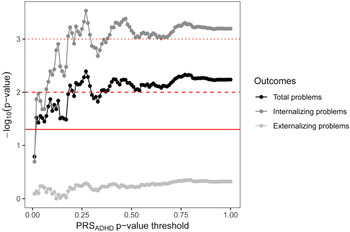
Child PRSADHD (at p value thresholds p ≥ .01) moderated the association between maternal CES-Dpre and CBCL total problem scores (Figure 1 and Supplementary Appendix A Figure S3). There was a significant interaction between child PRSADHD and maternal CES-Dpre scores in prediction of internalizing problems, but not externalizing problems (see Figure 1 and Supplementary Appendix A Figure S3). An interaction model that considered maternal antenatal depressive symptoms and a PRSADHD at p value threshold of p = .27 accounted for the largest proportion of variance in child internalizing symptoms (R 2 = .18, F (4,182) = 9.97, p = 2.55 × 10⁻⁷; Figures 2 and Supplementary Appendix A Figure S3). This Best-Fit PRSADHD consisted of 59,683 independent SNPs. Children with a higher PRSADHD born to women with higher symptoms of antenatal depression had a greater number of internalizing symptoms (interaction term: beta = 0.283, p = 2.94 × 10⁻⁴; Figure 3). To test if this finding was robust, we considered potential interactions between our exposure (maternal antenatal depressive symptom scores), our moderator (PRSADHD) and all covariates in our model following recommendations by Keller (Reference Keller2014). Our results were largely unchanged (see Supplementary Appendix A: Tables S1 and S2).
p value curve plot for models testing the interaction between child polygenic risk scores for attention-deficit/hyperactivity disorder (PRSADHD) and maternal antenatal depression in the prediction of child outcomes. Child PRSADHD (generated at p value thresholds ≥0.01) moderate the association between maternal antenatal depression and child total problems (black line) and internalizing problems (gray line) but not externalizing problems (light gray line). Horizontal lines correspond to p = .05 (solid line), p = .01 (dashed line), p = .001 (dotted line).

Variance explained (R 2) by models considering interactions between child polygenic risk scores for attention-deficit/hyperactivity disorder (PRSADHD) and maternal antenatal depression in the prediction of child internalizing problems. The label at p = .27 indicates the PRSADHD p value threshold that explains the highest proportion of variance in child internalizing symptoms (i.e., the Best-Fit PRSADHD).

The Best-Fit polygenic risk score for attention-deficit/hyperactivity disorder (PRSADHD) significantly moderates the relationship between maternal antenatal depression and child internalizing problems. Maternal symptoms of depression (CES-D scores) predict higher internalizing symptoms in children with higher ADHD polygenic risk scores (visualized using a median split). Regions of significance are depicted outside the vertical dotted lines. CBCL = Child Behavior Checklist, CES-D = Center for Epidemiologic Studies Depression Scale.

Moderation by xPRS
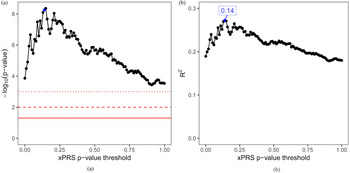
Child PRSADHD significantly moderated the association between maternal symptoms of antenatal depression and child CBCL problem scores. We then sought to create a PRS specific for this interaction effect. We thus examined the interaction between maternal antenatal depressive symptom scores and each SNP within our Best-Fit PRSADHD (PRSADHD p value threshold = 0.27, with 59,683 SNPs) and generated xPRS at a number of different p value thresholds (ranging from p ≤ .01 to p ≤ 1.00, see Method). An xPRS generated from SNPs with an interaction p value ≤0.14 (13,835 SNPs) accounted for the largest proportion of variance in child outcomes consisted of (R 2 = .272, F (4,182) = 17.036, p = 6.96 × 10⁻¹²; Figure 4b) and was deemed the Best-Fit xPRS. In contrast, an xPRS generated from SNPs with an interaction p value ≤ 0.05 (i.e., SNPs with a significant interaction term, n = 6,711 SNPs) accounted for a much smaller proportion of the variance in child internalizing symptoms (R 2 = .221, F (4,182) = 12.87, p = 3.00 × 10⁻⁹), highlighting the increased predictive power of the Best-Fit xPRS, which included nominally significant SNPs and SNPs with more modest interaction effects.
Interaction-based polygenic risk score (xPRS) model selection. p value curve plot of models testing the interaction between xPRS at different p value thresholds and maternal antenatal depression in the prediction of child internalizing problems (a). R 2 curve plot of models testing the interaction between xPRS at different p value thresholds and maternal antenatal depression in the prediction of child internalizing problems (b). The label and point indicate the xPRS p value threshold that accounted for the largest proportion of variance (i.e., the Best-Fit xPRS). Horizontal lines correspond to p = .05 (solid line), p = .01 (dashed line), p = .001 (dotted line).

Children with a higher xPRS born to women with a higher antenatal depressive symptom score had a greater number of internalizing problems (interaction term: beta = 0.335, p = 5.50 × 10⁻⁹; Figure 5).
The Best-Fit interaction-based polygenic risk score (xPRS) significantly moderates the relationship between maternal antenatal depressive symptoms and child internalizing problems. Maternal symptoms of depression (CES-D scores) predict higher internalizing symptoms in children with a higher xPRS (visualized using a median split). Regions of significance are depicted outside the vertical dotted lines. CBCL = Child Behavior Checklist, CES-D = Center for Epidemiologic Studies Depression Scale.

Model prediction
We used a leave-one-out cross-validation to compare the predictive accuracy of competing models of child internalizing symptoms: Model 3, which considered main effects and an interaction term between CES-Dpre and the xPRS outperformed all other models (Table 3).
Leave-one-out cross-validation analyses

Competing prediction models of child internalizing symptoms from the Child Behavior Checklist (CBCLINT) were compared using two measures of model fit: the total proportion of variance explained (R 2) and the root-mean-square error (RMSE). CES-D = Center for Epidemiological Studies Depression. xPRS = Interaction polygenic risk score.
Replication analyses
Ninety-six per cent (n = 13,252) of SNPs from the Best-Fit xPRS in the MAVAN sample were available for analysis in the BIBO cohort. In the BIBO cohort the child xPRS significantly moderated the association between maternal depressive symptom scores in pregnancy and child internalizing symptoms at 72 months in the BIBO cohort (beta = 0.02, p = .02), consistent with our findings in the MAVAN cohort. The association between maternal EPDSpre scores and child internalizing problems was more pronounced in children with a higher xPRS (Figure 6).
The interaction between child xPRS and maternal antenatal symptoms of depression (EPDS scores) in the prediction of child internalizing problems in the BIBO cohort. Regions of significance are depicted outside the vertical dotted lines. CBCL = Child Behavior Checklist, Edinburgh Postnatal Depression Scale (EPDS).

Differential susceptibility versus diathesis–stress
Table 4 provides RoS, PoI, and PA estimates from prediction models of child internalizing symptoms in the MAVAN (Models A and B) and BIBO (Model C) cohorts. In the MAVAN cohort, the interaction between maternal antenatal symptoms of depression and (a) child PRSADHD or (b) child xPRS provide greater evidence for differential susceptibility than a diathesis–stress model. Specifically, the RoS fall within two standard deviations of mean maternal CES-Dpre scores, the PoI is closer to 0.40 (than 0.00) and the PA is greater than 16%. In the BIBO cohort, the RoS and PA provide support for differential susceptibility. For example, the PA is above 16% and the lower bound of the RoS falls within two standard deviations of mean antenatal EPDS scores, while the upper bound falls just outside of this two standard deviation range (13.74 vs. 13.04). In contrast, the PoI value in the BIBO cohort (0.06) suggests the relationship between maternal antenatal symptoms of depression, child xPRS and child internalizing symptoms is better explained by a diathesis–stress model.
Analysis of the interactions for the Best-Fit polygenic risk score (PRS) interaction models for internalizing problems (CBCLINT) and the replicated findings

Model A (MAVAN) = CBCLINT ~ PRSADHD + CES-Dpre + PRSADHD × CES-Dpre + CES-D60mths Model B (MAVAN) = CBCLINT ~ xPRS + CES-Dpre + xPRS × CES-Dpre + CES-D60mths.
Model C (BIBO) = CBCLINT ~ xPRS + EPDSpre + xPRS × EPDSpre + EPDS72mths.
RoS = regions of significance fall below (lower bound) or above (upper bound) the reported interval; PoI = proportion of interaction; PA = percentage affected.
Gene ontology of xPRS
Our xPRS analysis identifies SNPs that significantly moderate the association between maternal mental health and child behavioral problems. We interrogated our xPRS by mapping the xPRS SNPs to genes and examining biological functions associated with these genes. This analysis provides insight into candidate neural processes that lie along the pathway linking maternal antenatal mental health to child behavioral problems. Enrichment analysis of the SNPs comprising the Best-Fit xPRS showed a highly significant enrichment for genes associated with synaptic functions and neuronal development (Supplementary Appendix A: Table S3 and Figure S4). The top ten enriched GO cellular components can be localized to the “postsynapse” (GO:0098794; p = 5.84 × 10⁻¹⁰) and “dendrite” (GO:0030425; p = 8.97 × 10⁻¹⁰). In addition, genes identified within the xPRS are involved in a number of biological processes related to neurogenesis (“generation of neurons” GO:0048699; p = 9.74 × 10⁻¹²) and cell projection (“regulation of plasma membrane bounded cell projection organization” GO:0120035; p = 1.64 × 10⁻⁹).
Discussion
The impact of maternal antenatal mental health on child emotional/behavioral outcomes is well documented (Gentile, Reference Gentile2017; Goodman et al., Reference Goodman, Rouse, Connell, Broth, Hall and Heyward2011; Meaney, Reference Meaney2018; O'Donnell et al., Reference O'Donnell, Glover, Barker and O'Connor2014; Pearson et al., Reference Pearson, Evans, Kounali, Lewis, Heron, Ramchandani and Stein2013) as are the individual differences observed with such effects. A detailed systematic review revealed that the association between maternal depression and child behavioral problems, while highly reliable across studies, is generally modest (Goodman et al., Reference Goodman, Rouse, Connell, Broth, Hall and Heyward2011). Our findings are consistent with the idea that child genotype is an important source of variation. The challenge is that of capturing this genotypic variation beyond proof-of-principal studies with candidate genes. The use of PRSs has provided one approach; however, PRSs are based on genetic main effects, while clinical phenotypes inevitably derive from GxE interactions. PRSs may thus be of limited value for analyses of genotypic moderation of early life adversity (Peyrot et al., Reference Peyrot, Van der Auwera, Milaneschi, Dolan, Madden, Sullivan and Penninx2018 and see below). We outline a novel approach, an interaction-based PRS (xPRS) that better describes child genomic susceptibility to maternal antenatal depression than the conventional PRS approach. We thus leveraged insights from a large-scale GWAS of child neurodevelopment to better understand the individual differences in the impact of maternal antenatal depression on child mental health. In doing so, we find convergent evidence for differential susceptibility in the prediction of child internalizing symptoms as a function of child genomic variation and maternal antenatal depression.
Our findings further underscore the importance of considering child genotype when describing the impact of maternal antenatal mental health on child development (Grizenko et al., Reference Grizenko, Fortier, Zadorozny, Thakur, Schmitz, Duval and Joober2012; O'Donnell et al., Reference O'Donnell, Glover, Lahti, Lahti, Edgar, Räikkönen and O'Connor2017; O'Donnell & Meaney, Reference O'Donnell and Meaney2017; Thompson et al., Reference Thompson, Stein, Medland, Hibar, Vasquez and Renteria2014). Our approach moves beyond candidate gene analyses to consider genetic variants across the genome, prioritizing SNPs identified by a GWAS of child neurodevelopment (Neale et al., Reference Neale, Medland, Ripke, Asherson, Franke, Lesch and Nelson2010). A small number of previous studies used a genome-wide data on genomic variation to understand how prenatal exposures shape child neurodevelopment (e.g., Qiu et al., Reference Qiu, Shen, Buss, Chong, Kwek, Saw and Meaney2017; Silveira et al., Reference Silveira, Pokhvisneva, Parent, Cai, Rema, Broekman and Meaney2017, Reference Silveira, Pokhvisneva, Gaudreau, Atkinson, Fleming and Sokolowski2018). Qiu et al. (Reference Qiu, Shen, Buss, Chong, Kwek, Saw and Meaney2017) report that a child's PRS for major depressive disorder (MDD) moderates the association between maternal antenatal depression and amygdala volume in neonates from two independent cohorts. Silveira et al. (Reference Silveira, Pokhvisneva, Parent, Cai, Rema, Broekman and Meaney2017) show that child genomic variation (SNPs in genes co-expressed with the serotonin transporter) moderates the effect of prenatal adversity on child development, an effect that was not observed when using a candidate gene approach. In adults, analyses that consider the interaction of environmental exposures and PRSs show mixed results. Peyrot et al. (Reference Peyrot, Milaneschi, Abdellaoui, Sullivan, Hottenga, Boomsma and Penninx2014) find that a PRS for MDD significantly moderates the association between childhood trauma and risk of MDD; individuals with a higher PRS for MDD exposed to childhood trauma show higher rates of MDD. Mullins et al. (Reference Mullins, Power, Fisher, Hanscombe, Euesden, Iniesta and Lewis2016) observe an interaction between childhood trauma and a PRS for MDD but in the opposite direction; that is, a higher genetic risk predicts lower risk of MDD in individuals with a history of childhood trauma. A larger meta-analysis, which includes both cohorts, finds no significant interaction between childhood trauma and a PRS for MDD in the prediction of MDD (Peyrot et al., Reference Peyrot, Van der Auwera, Milaneschi, Dolan, Madden, Sullivan and Penninx2018). The authors conclude that such inconsistent findings may arise when SNPs that do not moderate the association between childhood maltreatment and risk for MDD are included in a conventional PRS.
Our xPRS approach specifically addresses the issue raised by Peyrot et al. (Reference Peyrot, Van der Auwera, Milaneschi, Dolan, Madden, Sullivan and Penninx2018): we focused our xPRS on SNPs that moderate the association between maternal antenatal depressive symptoms and child outcome. The xPRS moderated the relationship between maternal antenatal depressive symptom scores and child internalizing problems to a greater extent than the conventional PRS for ADHD (i.e., PRSADHD). Specifically, the model using the Best-Fit xPRS explained an additional 9.2% of the variance in child internalizing symptoms than a model using the Best-Fit PRSADHD. We also replicated this finding in an independent cohort. Our xPRS approach adds to a growing number of studies that outline novel approaches to integrate PRS in genome by environment analyses (see Hüls, Ickstadt, Schikowski, & Krämer, Reference Hüls, Ickstadt, Schikowski and Krämer2017a; Hüls et al., Reference Hüls, Krämer, Carlsten, Schikowski, Ickstadt and Schwender2017b; Lin, Huang, Liu, Tsai, & Kuo, Reference Lin, Huang, Liu, Tsai and Kuo2018).
Our xPRS enrichment analyses reveal candidate gene networks related to neuronal/synaptic function that may moderate the association between maternal antenatal depressive symptoms and child mental health outcomes (see Supplementary Appendix B: Supplementary Data). Qiu et al. (Reference Qiu, Shen, Buss, Chong, Kwek, Saw and Meaney2017) also observe significant enrichment of genes associated with synaptic function within their genetic predictor (a PRS for MDD). Similarly, Poelmans, Pauls, Buitelaar, and Franke (Reference Poelmans, Pauls, Buitelaar and Franke2011) conclude that the top-ranked ADHD-associated genes in previous GWAS literature encode proteins involved in neurite outgrowth, while Hayman and Fernandez (Reference Hayman and Fernandez2018) report that ADHD-associated genes contribute to synaptic function. These findings and others (see Franke, Neale, & Faraone, Reference Franke, Neale and Faraone2009; Lesch et al., Reference Lesch, Timmesfeld, Renner, Halperin, Roser, Nguyen and Jacob2008) converge on the role of dendritic spine formation/plasticity in GWASs of child neurodevelopment.
Our conventional PRS (PRSADHD) and the xPRS were informed by a GWAS of child ADHD (Neale et al., Reference Neale, Medland, Ripke, Asherson, Franke, Lesch and Nelson2010). However, both the conventional ADHD PRS and the xPRS moderated the effects of maternal antenatal depressive symptoms on child internalizing rather than externalizing symptoms. This finding could, in part, reflect differences between the cohorts used in the current analysis and the cohorts included in the original GWAS. Importantly, the children included in the original GWAS of ADHD were older (10.5 years) than the children included in the current analysis (5–6 years of age), an age when child psychopathology becomes more clearly differentiated. Our findings may also reflect the heterotypic continuity observed between internalizing symptoms in early childhood and later symptoms of ADHD (Finsaas, Bufferd, Dougherty, Carlson, & Klein, Reference Finsaas, Bufferd, Dougherty, Carlson and Klein2018). Alternatively, it is possible that genetic risk factors for ADHD may not be diagnosis specific. In an analysis of over 13,000 children, Brikell et al. (Reference Brikell, Larsson, Lu, Pettersson, Chen, Kuja-Halkola and Martin2020) found that a PRS for ADHD was more closely associated with a general factor for child psychopathology than for specific symptoms of hyperactivity/impulsivity. These findings suggest that GWAS of ADHD, and genetic predictors based on such GWAS, may be informative for understanding a broader range of child mental health phenotypes. This is a potentially fruitful focus for future analyses with appropriately large data sets and breadth of outcomes. Likewise, it will be interesting to analyze the degree to which an xPRS specific for a certain early life adversity is predictive for other forms of adversity.
Our xPRS analyses provided greater evidence for differential susceptibility than diathesis–stress. Children with higher xPRS showed the highest and the lowest number of internalizing symptoms contingent on level of exposure to maternal depression in pregnancy. Conversely, children with lower xPRS showed similar internalizing symptoms irrespective of the levels of antenatal maternal depression. Our results are consistent with findings of other GxE analyses of emotional/behavioral outcomes, which suggest “vulnerability” genetic risk factors may be better conceptualized as “plasticity” factors (Belsky et al., Reference Belsky, Bakermans-Kranenburg and van IJzendoorn2007; Belsky et al., Reference Belsky, Jonassaint, Pluess, Stanton, Brummett and Williams2009). Our findings suggest that the children most at risk for adverse mental health outcomes may be the same children who would benefit the most from targeted interventions to improve maternal antenatal mental health. Genetically-informed analyses of trials designed to improve antenatal maternal mental health are required to test this hypothesis.
One limitation of our study was the sample size of our cohorts. Nevertheless, the effect size of the interaction between xPRS and antenatal maternal depressive symptoms is moderate (Cohen's f 2 = 0.21). This allowed us to detect a significant moderation effect in distinct cohorts from Canada (MAVAN) and the Netherlands (BIBO). We note that both of these cohorts are predominantly Caucasian. Validation of the xPRS approach in more diverse samples is required. Similarly, future studies will determine if the moderating influence of xPRS on the relationship between maternal antenatal depression and child outcome is stable or dynamic across different developmental stages.
Another potential limitation of the current study is our focus on a subset of SNPs identified from a GWAS of child ADHD. It is plausible that there are additional SNPs, not identified from GWAS of ADHD, that moderate the impact of maternal antenatal depression on child outcome and have not been considered in our xPRS. While we acknowledge the potential utility of genome-wide SNP by environment interaction analyses (see Arnau-Soler et al., Reference Arnau-Soler, Macdonald-Dunlop, Adams, Clarke, MacIntyre, Milburn and Thomson2019; Bentley et al., Reference Bentley, Sung, Brown, Winkler, Kraja, Ntalla and Cupples2019), we were not powered to perform such an analysis. Alternatively, xPRS provides a GWAS-informed approach that is suitable for use in community cohorts, which place a greater emphasis on clinical and environmental phenotyping than sample size. Initiatives such as the Psychiatric Genomics Consortium (Sullivan et al., Reference Sullivan, Agrawal, Bulik, Andreassen, Børglum, Breen and O'Donovan2018), PhenX (Hendershot et al., Reference Hendershot, Pan, Haines, Harlan, Marazita, McCarty and Hamilton2015), and the National Institutes of Health-funded Environmental influences on Child Health Outcomes (ECHO) program (Gillman & Blaisdell, Reference Gillman and Blaisdell2018), which harmonize genetic and clinical measures across cohorts, may facilitate future genome-wide SNP by environment interaction analyses.
Conclusion
There are considerable individual differences in the effects of maternal antenatal depression on child outcome. We describe a novel approach, xPRS, to better describe the genomic basis for variation in developmental outcomes associated with early life adversity. Individual differences in susceptibility complicate the development and assessment of interventions targeted solely on the basis of environmental exposures. While PRSs alone are likely to be inadequate, they do provide a pool of genomic variants associated with clinical outcomes of interest and are thus a useful tool for the development of genomic measures. This more targeted GxE approach may better identify children at risk for adverse mental health outcomes following exposure to specific forms of adversity, such as antenatal maternal depression, which in turn may inform targeted prevention/intervention efforts through identification of the most vulnerable children.
Supplementary Material
The supplementary material for this article can be found at https://doi.org/10.1017/S0954579420001418.
Acknowledgments
We acknowledge the families who generously gave their time to participate in the MAVAN and BIBO cohorts. The MAVAN cohort received support from the Canadian Institutes of Health Research and the Ludmer Centre for Neuroinformatics and Mental Health.
We would like to acknowledge the remarkable contribution of Dr. Megan Gunnar to our understanding of child development. Dr. Gunnar's research continues to inspire us to better understand how the early environment shapes child neurodevelopment and challenges us to ask how we can harness this knowledge to improve child outcomes.
Funding Statement
LMC is supported by the Brain Canada Foundation through the Canada Brain Research Fund, with the financial support of Health Canada and Kids Brain Health. MJM is supported by grants from the Hope for Depression Research Foundation, The Canadian Institutes for Health Research, The National Medical Research Council (Singapore), the Natural Sciences & Engineering Research Council of Canada, The Webster Foundation, The JPB Foundation through a grant to The JPB Research Network on Toxic Stress: A Project of the Center on the Developing Child at Harvard University, and core funding from the Agency for Science, Technology and Research (A*STAR, Singapore). MJM, MSK, and KOD are Fellows of the CIFAR Child and Brain Development Program. KOD is supported by the Canada First Research Excellence Fund Healthy Brains for Healthy Lives initiative at McGill University, the Jacobs Foundation and the Fonds de recherche du Québec-Santé and the Brain and Behavior Research Foundation. CdW is supported by the Netherlands Organization for Scientific Research VIDI grant 575-25-009 and the Jacobs Foundation. RB is supported by a Netherlands Organization for Scientific Research VENI grant (016.195.197), and a Sara van Dam Project Grant of the Royal Netherlands Academy of Arts and Sciences.
Conflicts of Interest
None