This article examines changes in institutions that protected property rights and regulated their use in the commons in the Italian Alps and, more specifically, in the Trentino region, which is situated at the linguistic border with the German-speaking South Tyrol. We study the alternative management systems adopted for the common pastures and forests through medieval and modern times (1200–1800). It is well known that when a group of users harvest a natural resource without regulations, they end up overexploiting it in comparison to the socially optimal use.1
Gordon, “Economic Theory”; and Clark, Mathematical Bioeconomics.
McCloskey, “Enclosure”; and Clark, “Commons Sense.”
This article combines empirical data and the theory of infinitely repeated games for the study of historical institutions. There are only few studies along this line and they have analyzed the organization of merchants.3
Milgrom et al., “Role”; Greif, “Contract Enforceability”; Clay, “Trade”; and Okazaki, “Role.”
See the Appendix for a more detailed description of the data.
Instead of building a charter, communities could have relied on informal enforcement. Because of the long-term interaction among community members, one would expect that users could have exercised mutual restraint in harvesting the commons and achieved full efficiency. These small settlements in the mountains, where families' roots in the community extended back for several generations, may be one of the closest situations one can find in the field for the infinitely repeated interaction required to apply the so called “folk theorem.”5
Friedman, “Non-Cooperative Equilibrium.” “In the 1950s, several game theorists had conjectured that rational players should be able to cooperate—for example in the … prisoners' dilemma—if the game would only continue long enough …. Its folklore flavor is the reason why the result came to be referred to as the ‘Folk Theorem”’ (Royal Swedish Academy of Sciences, “Robert Aumann's and Thomas Schelling's Contributions”).
Myerson, Game Theory, pp. 349–50.
Why would the villagers choose to build costly private-order institutions when informal cooperation through repeated interaction was available? We exploit the differences in characteristics of the about 200 communities and their different timing of charter adoption (or nonadoption) to understand the reasons behind the choice of governance regime on the land under communal property. This article finds, in particular, that the likelihood of a legal institution's being established increases with a community's size, its proximity to other settlements, and the amount of its common resources. Contiguous effects were not important in the timing of adoption. The empirical analysis includes an event history model, a technique that is widely used in demographic studies and other survival analysis studies, but with only few applications in economic history.7
For demographic studies, see Tuma and Hannan, Social Dynamics; Forster and Jones, “Role”; and Honjo, “Business Failure.” For economic history applications, see Tunali and Pritchett, “Cox Regression.”
From a game-theoretic perspective the charters may have improved efficiency in the use of the communal resources. From the empirical analysis we find that the emergence of the charters is compatible with Demsetz's intuition that institutions change in response to the benefits the change entails.8
Demsetz, “Toward a Theory.”
In the balance of the paper we first introduce the Trentino economy and the charter system. Other possible governance regimes on the common land are then described along with the game-theoretic issues for the application of the folk theorem. A specific discussion is reserved to the transitioning from one management regime to another. The empirical evidence presented here includes both details on the institutional structure and an econometric analysis, where the latter consists of a static and a dynamic models. The static model studies why a community ever adopted a charter before 1800. The dynamic model employs an event history estimation that aims at explaining both whether and when a community adopted a charter. At each point in time we consider only those communities who have not yet adopted a charter and model the likelihood that a charter will be adopted in the future.
THE CARTE DI REGOLA SYSTEM IN THE ITALIAN ALPS
Trentino is a mountainous area of about 2,400 square miles situated to the northwest of the Republic of Venice. It is in the Romance-speaking area of the Alps, and includes parts of the Dolomite Mountains and of the Garda Lake. There were a few hundred, very small communities scattered all over the region. According to the 1810 census, the median population of a village was 410 people.9
The biggest city, Trento, never went beyond the role of local capital—with the exception of the years of the Catholic Church Council—and, even in 1800, its population was no more than 7,000 (Bairoch et al., Population).
The prevalent pattern is nucleated communities and not houses scattered and surrounded by their own estate. For an interesting comparison with the neighboring German-speaking communities see Cole and Wolf, Hidden Frontier.
The Adige river was navigable and connects the region to large Italian cities such as Verona and ends in the Adriatic sea. Even one of its minor affluents, the Avisio river, had been improved to carry timber logs. Finally, the Mincio river leaves the Garda lake for Mantova and then ends into the Po river, connecting Trentino to Ferrara and to the Adriatic sea. As early as the fourteenth century, export of timber reached the Adriatic sea, where it was used for ship building (Patitucci, “Vie d'acqua”).

FIGURE 1 EXAMPLE OF TOPOGRAPHY OF A TRENTINO COMMUNITY
The Trentino climate exhibits dramatic variations, mostly depending on the altitude of the location, which varied between 220 and 12,349 ft. The climate sharply constrains the potential uses of the land. For instance, vineyards, which supplied a valuable tradable product, can grow at altitudes only up to 2,500 ft., ruling out more than 70 percent of Trentino. Sites above 5,000 ft. are characterized by a short season without snow and—provided they are not bare rocks—can only sustain pastures or forest. Another important feature of the land is its slope. Grains were cultivated where the slope was gentle, but arable framing on steeper land exposed it to the erosion of the rain and to the risk of landslides. As a result of the double constraints of altitude and slope, arable land accounted for only 8 percent of the regional surface in 1897.
Whereas vineyards and arable land were mostly individual property, forest, meadows, and pasture were mostly communal property. Forests covered about half of the area and were a precious source of firewood to warm up houses during the long and cold winters, and of timber to build houses and craft furniture, and of litter for the animals kept in stalls. Moreover, logging could be carried on in winter, the off-peak season for labor demand on the fields. Timber was also a traded commodity, provided that transportation was not too costly. The other important activity on the commons was cattle grazing. During the summer, cattle could graze on the high mountain pastures, while villagers mowed the hay on the lowest meadows. Meadows and pastures covered about one-third of the land surface of the region. When fall came, the cattle were moved onto the low pastures and, after harvest, onto the arable land. During winter, the animals were kept inside stalls and fed with the hay stored in the barns, and, as soon as the season got better, they were brought outside to graze on the arable land that was waiting for seeding time.12
The arable land was planted with vineyards or grains of various kind (rye, wheat, barley, oat, and others minor grains). Other crops such as cabbages, turnips, or broad beans were also present, although not very common. Corn was introduced in the mid seventeenth century, and the potato only in the early nineteenth century.
Starting from the thirteenth century we see the emergence of the Carte di Regola (or rural charters), which are legal documents for the management of the community resources.13
Written documents become common in Trentino starting from the eleventh century.

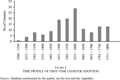
FIGURE 2 TIME PROFILE OF FIRST-TIME CHARTER ADOPTION
The rural charters were a codification of the rules established by the community assembly for managing the economic resources of the community. The charters restricted individual resource use, in the form of individual quotas, time, and place restrictions. Such rules were intended to exclude nonowners from the use of the land and, in various ways, limit the exploitation level of the resources held in common. There are clear statements about this latter goal regarding pasture usage in the form of “wintering rules.” According to the rule, if a villager could not feed his animals during the winter with grass from his own meadows, the animals were not allowed on the common pastures in the summer.14
Vigolo Vattaro, 1496, c. 28, “Item se statuisse et ordina che niuna persona de qual se voglia conditione,…, non debbia pascolare in su i communi da Vigolo con bestie quale non puossi invernar, tener et sostentar l'inverno con il feno di suoi prati, oltra tre dí: sotto pena de lire tre per ciascun dí che contrafará” Similarly in Comun Comunale, 1544. Mortaso, 1558 had a more relaxed rule but in the same spirit (maximum ten extra sheep, four extra goats, and two extra cows). Communities with a particularly large pasture endowment or in exceptionally good years, rented out grazing rights to other communities. The format to quote a charter is [community],[year],[article]. Unless otherwise noted, the charter was published in Giacomoni, Carte di regola.
To make sure rules were enforced, villagers appointed officials to police the land and eventually impose cash fines in case violations occurred. A charter might be seen as an agreement between a community and the Prince in order for the community to freely administer local justice on economic matters. Rural charters exhibit all the features of official deeds. A notary recorded in a written document the will of a group of people in the presence of external witnesses and, sometimes, of a representatives of the feudal powers. To be effective, every charter needed to be confirmed by the Prince or, in some cases, by its feudal lord. Through this confirmation, the Prince stated the compatibility between the charter and the laws in force and promised to enforce the rules contained in the charter against resistant violators, on a community request.15
A community could tailor its own rules and apply them to its members and to outsiders using particularly simplified enforcement procedures. The Prince maintained control over the content of the charters and occasionally censored it. Every new Prince had to approve again the old charters in order for them to be effective. For a discussion of cases of some specific villages see Nequirito, Le carte de regola.
The central institution in the community organization was the general assembly (regola), which appointed officials in charge of the daily administration, most importantly the governor (regolano). The governor had a one-year appointment and was in charge of the enforcement of the rules for the community and for the Prince. There were various other posts to assist him. The guards (saltari) patrolled the community land to detect potential violators of the rules, some took care of the land near the village, some took care of the forest and the high mountain land. A distinct role fell to the herdsman, who was chosen to handle the summer grazing activity, which was often organized collectively. In some cases, a few designated people were in charge of estimating damages that needed to be refunded (stimadori). There were variations from community to community in the number and type of officers.
GOVERNANCE REGIMES
There were five property rights arrangements, or governance regimes, that are relevant for the analysis of the Trentino case. At one extreme there is open access and at the opposite extreme there is private property. This study will focus on the “in-between” governance regimes— communal property with state enforcement, communal property with informal enforcement, and communal property with private-order governance— which can avoid the worst effects of the tragedy of the commons and in same cases may deliver optimal outcomes.16
Ostrom, “Coping with Tragedies”; Gibson et al., People; and Stevenson, Common Property Economics.
Open Access
When a natural resource such as a forest or a pasture is available for everyone to use (open access), there is complete dissipation of any rent for the users.17
Gordon, “Economic Theory.”
Private Property
Unlike an underground oil reserve or a fishery, the common land could technically be divided into individual plots. A single owner would have the correct incentive to harvest the resource optimally when all others were excluded from using it. To achieve this outcome, what matters is not the legal entitlement to the resource but the effective exclusion of others.18
Barzel, “Property Rights.”
Communal Property with State Enforcement
This regime is the textbook example of the commons.19
Clark, Mathematical Bioeconomics.
Communal Property with Informal Enforcement
Multiple owners share the resource and enforce property rights informally without the intervention of the state. As in communal property with state enforcement, insiders do not have any internal structure of governance. When insiders are engaged in a long-term interaction and are sufficiently patient, they may be able to harvest the resource optimally. Cooperation may be sustained because an individual deviation from a target level of resource use could be punished by the others in future interactions. Even if there is a short-run incentive to deviate, repetition can make it in the best interest of each to follow the target harvesting level. The necessary conditions for this result are formally listed in the folk theorem, which applies to a variety of situations, including common resource appropriation, under the condition that participants interact repeatedly and do so infinitely into the future.20
Friedman, “Non-Cooperative Equilibrium.” The folk theorems apply also to situations of indefinitely repeated interaction, where agents ignore the exact number of repetitions because after each period there is a always a positive probability of another period of interaction.
There are three potential problems with this regime. First, with informal enforcement, many levels of cooperation may be sustainable, not just one. The folk theorem clearly states that anything from no cooperation to full cooperation on the optimal harvesting policy could be possible equilibria. To avoid the tragedy of the commons, the resource users must coordinate on a specific target and on a specific punishment strategy. Miscoordination on either one may easily lead to the unraveling of cooperation.21
Kandori, “Use.” In a more recent case among firms, setting up the lysine cartel among five corporations during 1993–1995 involved 25 multiparty price-fixing meetings at the top level; dozens of supplementary bilateral meetings by regional sales managers and hundreds of telephone calls. The U.S. Federal Trade Commission secretly videotaped some of these meetings (Connor, “Global Cartels”).
The second problem is that the less a user is able to monitor others, the less likely she is to detect an overuse of the resource by others. One can show that the efficiency of informal enforcement is related to how perfectly insiders are able to monitor the harvesting actions of other users.22
Abreu, Pearce, and Stacchetti, “Toward a Theory”; and Fudenberg, Levin, and Maskin, “Folk Theorem.”
Clay, “Trade”; and Greif, Institutions, chapter 10.
For an application to fisheries, see Laukkanen, “Cooperative and Non-Cooperative Harvesting.”
The third problem is that trespassing from outsiders increases the uncertainty about the harvesting level of insiders. In a completely isolated community, everyone knows that any harvesting going on was carried out by insiders even when there is uncertainty as to which person actually did it. Such inference is more difficult when trespassing is possible.25
Baland and Platteau, Halting Degradation.
Communal Property with Private-Order Governance
Insiders internally negotiate a set of rules to manage the common resource and have them approved or at least tolerated by the higher political authority. These rules concern levels and modality of harvest as well as enforcement procedures. Daniel Bromley presents several case-studies of fisheries, pastures, and water resources managed under this regime.26
Bromley, Making the Commons Work.
Ostrom, Governing the Commons.
First, private-order governance can lead to superior information about resource appropriation in at least two ways. One obvious way is to gather additional information by actively monitoring users. This activity is costly, but could enable insiders to achieve higher levels of efficiency by reducing the uncertainty in the knowledge of the actions taken by others.28
Abreu, Pearce, and Stacchetti, “Toward a Theory”; and Fudenberg, Levin, and Maskin, “Folk Theorem.”
Myerson, Game Theory, pp. 349–52.
Milgrom et al., “Role.”
Second, a private-order institution can introduce more efficient punishment technologies toward insiders. When information is less than perfect, informal enforcement entails some degree of punishment in equilibrium.31
When information is perfect, nobody in equilibrium ever defects from the cooperative agreement; hence, there is no punishment. In that case, as long as the punishment threat is credible, the specific punishment technology adopted is irrelevant.
Abreu, Pearce, and Stacchetti, “Toward a Theory.”
As Dixit, Lawlessness; and Haddock, Threat, illustrate, property rights can also be protected with private violence but such enforcement could generate heavy deadweight costs for a society.
Third, private order governance may create a more effective enforcement toward outsiders. Informal punishment of outsiders is more problematic than the punishment of insiders. Trespassing outsiders may be either neighbors or strangers. When dealing with a stranger, a legal-type punishment has a clear advantage because informal punishment is ineffective. With neighbors, the interaction is repeated although the monitoring problems may be so severe that state enforcement is preferable to an informal cooperation solution. For instance the victimized community may observe a person trespassing, while the trespasser's community may be unaware of it. A retaliatory harvesting raid in the trespasser's community territory will be interpreted as a first action of trespassing, which, in turn, deserves punishment. If such instances are frequent, this will induce continuous “wars” among neighboring communities. For external enforcement, a community may profit from replacing an informal mechanism with a legal mechanism.34
An informal enforcement toward outsiders resembles to the community responsibility system discussed in Greif, Institutions, chapter 10. He argues that the system was employed to enforce trade transactions among merchants of distant cities.
INSTITUTIONAL EVIDENCE
Governance Regimes
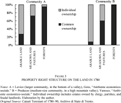
There is abundant anecdotal evidence in the charters about the communal property of forests and grazing land. Quantitative evidence can be found in the 1780 Land Registers. Although a systematic analysis of this source has not yet been carried out, micro-level data from two very different communities show a clear pattern (Figure 3). First, almost all forest and a large portion of meadows and pastures were communal property (100 percent, 95 percent and 60 percent, 66 percent, respectively). Second, only a small portion of arable land was communal property (27 percent, 8 percent) while the remaining was private property.

FIGURE 3 PROPERTY RIGHT STRUCTURE ON THE LAND IN 1780
This study will focus on land under communal property, which is mostly used as forest and high mountain meadow. More specifically, we focus on the choice between informal enforcement and private-order governance in the management of communal property. We do not investigate why communal property was chosen instead of private property and assume that this choice was exogenous. Although such an assumption simplifies the analysis, it is clearly a limitation of the present study. A possible reason for the exogeneity could be a legal constraint imposed by the feudal authorities in selling or dividing the communal land, or otherwise preventing changes to a possibly more efficient management regime. Giampaolo Andreatta and Silvio Pace argue that the communal land was inalienable and some charters explicitly mention a feudal authorization when selling the communal land.35
Andreatta and Pace, Trentino. See Cagnò, 1587, c. 3 (modification of 1693). An example of restriction was the prohibition to sell land whose revenues were taxed to people that were exempted from tax payments.
Dossi, Le pergamene and Un antico ruolo. See also footnotes 46 and 51.
Epstein, “‘Italy’.”
Netting, “Of Men” and Balancing on an Alp; and Casari, “Property Rights Arrangements” consider possible reasons for the persistence of communal property on forests and pastures. See also Anderson and Hill, “Evolution,” for a classic article on the rational for communal property.
State enforcement of property rights was problematic. The Principality of Trento had a court system to protect property rights. When the issue involved high stakes, such as the demarcation of property borderlines between communities, there is evidence of state justice involvement. The archives contain several documents about border disputes, mostly regarding communal property issues between neighboring communities.39
The main archives are Archivio di Stato di Trento, Ferdinandeum Museum of Innsbruck, and the Archivio di Castel Bragher.
Welber, Riflessioni.
An example of intervention to limit the powers of the peasant assemblies is given by the Moderatio Betta, a resolution elaborated by Prince bureaucrats in 1586 and systematically imposed on local communities.
Nequirito, Le carte de regola.
Another issue to clarify before proceeding further is that forests and pastures in Trentino were common property and not open access resources. As a rule, only pater familias that were members of a community (vicini) could use the communal property, and this right was inherited from father to son. Although all the people who were permanently living in the community could generally harvest the resources under communal property, the decision powers were in the hands of one representative for each family, which was usually a mature male.43
The family could be represented by a widow, if her children were still too young. It is conventionally assumed that a pater familias represents on average four other people.
Examples of forestieri were the residents of neighboring communities, seasonal workers living in the village, occasional travelers. Similar systems were adopted in other regions of Europe (Popkin, Rational Peasant).
Stable Communities
Villagers stayed in the same community for generations. A comparison over time of last names of pater familias within the same communities shows a remarkable stability.45
There was limited mobility of males across communities as it is evident from the list of participants to the general community meetings. A comparison of last names at intervals of one or two centuries could be used as a proxy for mobility. The reason is that, first, most last names are village-specific; second, both membership rights and last names were transmitted through male lineage. Last name lists reveal little change within each community. This proxy is not perfect because a family name can also disappear from natural death, especially in the long run, and new last names can emerge as modifications of old last names.
Admission into and departures from the community were limited by the peculiar structure of property rights on the land. A person became an insider either by inheritance from his father or by the approval of the insiders' assembly. Interestingly, a person could not become an insider by buying a fraction of the communal property from an existing insider because such trading with outsiders was not allowed. Selling communal land was always a collective right that belonged to the community as a whole. Moreover, an alienation decision required the consent of a supramajority of the community.46
A qualified majority of at least two-thirds was required to sell the common land in Cles 1641, c.5 and in Cis 1587, c.80.
Cles, 1641 (modification 1719, c.2), “attestati autentici della sua buona vita et costumi.” In addition to requiring the prospective member to give good references about his reputation, Nago and Torbole required some form of real warranty in case of misbehavior. For instance, see Nago and Torbole, 1647 (modification 1670, c. 72): outsiders cannot stay in the village for more than three days unless they own a piece of land or a house (stabili) worth at least 200 fiorini. No outlaw could be accepted (banditi or ricercati).
Not all charters described the admission procedure. Three examples are Cis, 1587 (all but three dissenters), Cles, 1641, Tres, 1551 (unanimity required in 1599).
For example Cles, 1641,c.57: “Che li forestieri habitanti nella communità di Cles siino colettati dalla regola per l'honesto in loro arbitrio, considerando la loro qualità et animali che tengono sopra li comuni, et in più concorrino ad ogni cosa ordinaria et straordinaria come li vicini, … .” See also Tres, 1551 and following modifications.
The existing users wanted not only to have a say about the admission decision but also to be compensated for the reduction in their share of resources. In corporate law, this right is analogous to the right of shareholders to deliberate about the issuance of new preferred shares and decide about their price. Formally, when all users appropriate the resource at the same rate, the addition of a new user to a group is equivalent—for the original N agents—to alienate at least a 1 / (N + 1)th of the value of the resource. When the group is informally cooperating, the same group surplus is divided into N + 1 parts instead of N. When the outcome is the Nash equilibrium solution, a lower group surplus is divided in N + 1 parts.
See the modification to Cis, 1587, c.80: “… alienare beni comunali o ricevere alcuno forestiero per vicino se meno di 3 vicini son contrari” (any group of three or more insiders could veto the decision).
Exiting the community was possible but costly because it involved losing the social support of the community and losing the right to use the common land. An insider could sell his individually owned house and fields but not his share in the community land. According to current property laws in civil law countries, if three people own a piece of land in common and one of them wants to get out of the estate for no reason, he or she has the right either to sell his part to anyone or to be refunded by the other two. The arrangement in the north Italian communities was rather different.52
No charter ever mentions the right of an insider to be refunded the value of his share of common land in case he leaves the community, let alone the procedures to satisfy that right, but they prohibit the trading of rights to membership.
From Statuti et Ordini della Spet. Communità di Nago e Torbole (1683): Nago and Torbole, 1647: “Cittadini, che non habitaranno non possino goder beni communi” (c.73: They cannot bring timber outside the village borders; they can use the common land only if they still have individually owned land in the village). “Cittadini, che partono dal commune, et ritornano, che non possino goder beni communi, se non passato un anno” (c.74). Similar rules can be found in the charters of other communities, for instance Tres, 1551 (the 1599 modifications regulates the insider status) and Casez, 1632, c.45.
In a charter, typically only a small part of the regulations concerned specifically outsiders (forestieri). Most articles of a charter were for “everyone” or directed toward insiders. The remainder of the section is devoted to the latter.54
As we will see in the Empirical Analysis section, the absence of contagion effects from the neighboring communities in charter adoption may also suggests that the main concern was more of restraining resource use of insiders than stopping trespassing from outsiders.
Monitoring and Coordinating
Once insiders face a continuing relationship, informal cooperation can be sustained provided that each insider can monitor the cooperation level of the others (informal enforcement). The available evidence suggests that monitoring was imperfect. This is puzzling at first considering the small size of communities. In 1810, about 80 percent of the communities had fewer than 1,000 inhabitants. Moreover, considerable information about insiders' actions was freely acquired as a byproduct of daily activities. Still, there was underprovision of information in relation to the socially optimal level.
Consider first the ability to monitor individual actions. Thefts from the private fields were widespread. There were frequent complaints of robberies of fruits and vegetables. In order to reduce this risk, the peasants adopted inefficient agricultural practices, such as tiny vegetable gardens located near houses and small areas devoted to orchards.55
For references from community charters, see for instance Malosco 1593, c.25, 26 and Tres 1551, c.53, 54, and 55. Monteleone (1964), pages 34–37, provides clear evidence for the years 1810s when the community charters were abolished. Not only were grapes stolen, but the wooden supports from the vineyards as well.
Pieve di Sanzeno, 1586, chapter 23: “Item per tor via molti abusi et cative usanze et cativi costumi che per alcuni che per il passato si ha fatto, si statuisce che niuno della pieve non debba, né anco forestiero ardisca, di stare di notte, né dì di festa, eccetto che il gazaro, uno over più, in la montagna predetta ed massime nel tempo della segagion ed mentre è ancor il fieno nelli pradi: sotto penna de lire cinque per cadauna persona; ed se fosse rubato fieno ad alcuno over legnami over anco taiato legnami (…) che si imputi tal furto ed contrafacion a quello over quelli che si trovarono esser stati la note over il giorno di festa sul monte”, see Cagnò, 1587, c.43 for a more generic rule against working during holidays.
Consider now the ability to observe the overall cooperation level of the community. As an alternative to monitoring individual actions, a villager could have inferred what others had harvested, and thus whether they were cooperating, by simply observing the physical stock of the common forest or pasture. This information, however, was just an imprecise proxy of the community cooperation level. A farmer could observe the milk production of his cow after a day of grazing the common pasture and from the variations in milk quantity and quality draw some inference on the status of the common pasture. A walk into the forest may give a villager a good sense of the level of exploitation of the forest. However, the villagers did not know exactly how many trees were in the forest or the exact quantity of grass that was on the ground in comparison with the level to be found if the harvesting was optimal. Moreover, the resource stock estimate could have been private information instead of being publicly known. A case of private information would be if villagers sampled different areas of the common land and did not share their information with everyone else. If different villagers had different information, the informal cooperation solution could have been even less efficient.57
For a theoretical analysis see Kandori and Matsushima, “Private Observation”; Compte, “Communication”; and Mailath and Morris, “Repeated Games.”
An additional challenge for a community engaged in informal cooperation was to agree on a specific level of cooperation. This coordination problem is particularly difficult when monitoring is not perfect because after having agreed on a cooperation level there may be disagreement on how to implement it. In particular, coordinating on an informal cooperation solution is likely more difficult for larger communities (Implication 1). One obvious reason is simply the number of heads. Another reason is that individual estimates about others' cooperation level are more likely to be different in a larger community.
Implication 1 (Population)
The larger the group, the higher the cost of coordination on informal punishment. Hence, communities with a large population are more likely to increase their efficiency by adopting a charter than small communities.
Additional issues of monitoring and enforcing cooperation are raised by outsiders trespassing on the common property. The communities of Romeno, Don, and Amblar could count on topography. The villagers owned in common a side valley mainly covered by forest. The valley was delimited on three sides by steep mountains and on the only side where access was feasible, the entrance was so narrow that villagers built a gate on it and provided the gate with a lock. As the 1459 charter states, the only key was kept in the church of the community of Romeno. The community governor could have easily controlled everyone who went into the valley to log trees and lock the door at the end of the season.58
Romeno, 1459, c. 24: Item che la chiave della porta di Vallavena sia tenutta et conservatta nella sacrestia della chiesa di santa Maria di Romeno.
Although based only on casual observation, it is apparent that borders between communities were actively chosen using natural barriers such as mountain ranges or rugged creeks to create obstacles for trespassers. Such barriers were not always available to a single village but one can see various examples of communities composed of more than one village, as in the example just quoted, that teamed up to exploit a better external border.
As already explained, there is a synergy between monitoring insiders and outsiders. When monitoring insiders is difficult, the informal cooperation solution is less efficient for those communities more subject to outsider trespassing. We conjecture that more remote communities were endowed with more natural barriers and had a lower density of potential trespassers.
Implication 2 (Remoteness)
The more remote the community, in the sense of being farther away from towns and communication routes, the more efficient the informal cooperation solution.
The Private Order Solution
The community charters emerged as a legal innovation to reduce the transaction costs involved in enforcing property rights on the land.59
The oldest known of such charters dates back to 1202 and was drawn by the small village of Civezzano, near the administrative center of Trento.
Sometimes the feudal lord appointed a regolano maggiore to oversee the other community officials and, possibly, to ensure that the community paid this share of the fines. The role of the feudal lord and the Prince was particularly important to ensure compliance of convicted outsiders. No additional trial was needed but cases of noncompliance would be referred to them.
The guards could generally retain a third of the fine paid by convicted persons, which provided an important incentive to engage in costly monitoring activities. Any insider could actually report violations and, if the person was convicted, that portion of the fine would go to him instead of going to the guard.61
For an experimental study of the Carte di Regola monitoring and sanctioning system see Casari and Plott, “Decentralized Management.” For an experimental study on the emergence of peer sanctioning institutions see Guererk et al., “Competitive Advantage.”
A charter could boost efficiency not only by organizing the gathering of additional information but through fact-checking and information-sharing institutions.62
Some regulations imposed a re-organization of production to make actions more readily observable.
For instance, in some Bolivian communities that currently rely on informal sanctioning institutions, the leader of the village publicly announces when somebody has violated a norm about the use of the common resource. The announcement works as a coordination device to trigger the informal punishment by all the villagers. Oral communication by Marco Boscolo, June 2000.
Moreover, there was an economy of scope in monitoring insiders and outsiders, as the same guards could be employed to report both trespassing by outsiders.
Another definite advantage was in effectively deterring trespassing. There is evidence from the record of fines that a high fraction of them were incurred by outsiders. The 1677/78 administration booklet of the community of Coredo lists at least ten fines extolled from outsiders, oftentimes for cutting trees in the community forest.65
From the Libri de Conti della Honoranda Comunità di Coredo: “ricevuto per condane fatte alli sottoscritti come forestieri” (1677–78). There are other reports of fines where it is not specified if the payment came from insiders or outsiders: “per due larici taliati nel ingazato, e venduti a Sfruz” (1672–73), “per haver tagliato un pez dent in sas nella sorte” (1673–74), “per il valor di legni menati dal monte con buoi forestieri senza licenza” (1677–78).
On 18 July 1589 the governor of the village recorded that a gentleman named Michel had been caught while illegally collecting firewood on common land. As a result, he had to pay a fine for an amount of troni (4) and carantani (10) in accordance with the community charter. Libretto di Amministrazione (1589): “per una codanaza fatta per aver menado entro legna da le giare del nos,” which translates “for a penalty inflicted for having removed firewood from the bank of the river Nos.” The community charters of Mezzolombardo is reported in Devigili (1979). Most of these booklets went destroyed. We were able to find them for just two communities and for selected years.
A charter brought advantages in terms of information, a legal punishment technology for insiders, and effective enforcement toward outsiders. Still, it involved sunk costs for creating and maintaining it. Writing an official document such as a community charter involved non-recoverable costs, as did spending time in the community meetings or serving as a community officer. If the potential surplus generated by the common property resources is small in absolute terms, the fixed costs to set up and run a private-order institution would not have been recovered.67
A sufficient condition for implication 3 to hold is that charter creation and administration costs are less than proportional than the value of the common property benefits.
Implication 3 (Minimum size of the commons)
Under the assumption of a fixed cost to set up and run a community charter, all other things being equal, the higher the value of the common resources, the higher is the potential gain from adopting a charter. In particular, with an endowment of common property below a given threshold, it would be more efficient to rely on informal cooperation than on a charter.
GOVERNANCE REGIME TRANSITION
Suppose there exist communities where a private-order governance regime is a more efficient arrangement than informal cooperation. One can simply assume the potential gains of a management regime are enough to drive its adoption. Thrainn Eggertsson calls this position the naïve theory of property rights.68
Eggertsson, Economic Behavior.
Setting up a charter may involve solving a collective action problem. Everyone would be better off with the charter but, as the individual effort is costly, nobody has an incentive to contribute to it. The actual process of establishing the charter resembled a social contract situation and hence voting could have overcome the dilemma that an unstructured group generally faces. A community charter had to pass two tests of consensus. First, the community assembly needed to agree on a set of rules through a supramajority voting procedure. Second, the local political authority, which in this case was the Prince of Trento, had the right to accept or reject the charter.69
There are instances where a charter was approved under the condition that some specific provisions had to be changed. As it is for private contracts today, there was also a general framework of rules that no charter could contradict.
Yet, it is well known from social choice theory that voting procedures are often characterized by instability and cycles among outcomes. How was this problem overcome in the case of the northern Italian communities? If we assume that there was homogeneity of interest among the villagers of a community, in the sense that either preferences were identical or highly correlated, then efficiency-enhancing policies should have had majority or supramajority support. For these reasons, the larger the group, the more difficult it would be to agree upon the provision of a charter.
Implication 4 (Population; Alternative to Implication 2)
Communities with a large population are less likely to transition to a charter than small communities.
The communities that adopted a charter did so at different points in time, in some cases centuries apart (Figure 2). The patterns of geographical diffusion may be revealing about the underlying motive of adoption. We discuss two possible reasons, innovation by imitation and deterrence (Implication 5). A community of mostly illiterate peasants would find it hard to create a relatively sophisticated legal institution such as a charter from scratch, at least not without a pre-existing model. Imitation of other communities seems more plausible than invention. Imitation would be easier if the community was aware of the existence of this legal institution and, more importantly, there was social proximity with a working example of it.
An alternative reason for adopting a charter is as a defensive measure toward neighboring communities having adopted it first. A charter may have worked as a signaling device toward trespassers; when a community adopted it, it diverted violators from its resources to the resources of neighboring communities. Once the process of charter adoption got started, the other communities, especially the physical neighbors, felt an increasing pressure to adopt it as well.70
In this sense, the role of the charters may resemble the role that home security systems play in neighborhoods where warning stickers at entry points deter thieves, but encourage them to break in somewhere else without security devices.
Implication 5 (Contagion)
A community is more likely to adopt a charter when nearby communities have already adopted it.
The two explanations point to quite different welfare effects of charter adoption and we will try to disentangle them empirically. In the former case, the regime transition is purely efficiency-enhancing. The delay in the transition is a deadweight loss caused by difficulties in information transmission. In the latter case, the increased surplus in the charter-establishing communities is, at least partially, offset by declines in surplus from increased outsider infringement in noncharter communities. In the latter case, it may also be that the aggregate costs of private-order institutions are higher than the aggregate benefits. Once locked up into an all-charter situation, no community would have an incentive to switch back to informal cooperation.
EMPIRICAL ANALYSIS
Static Model
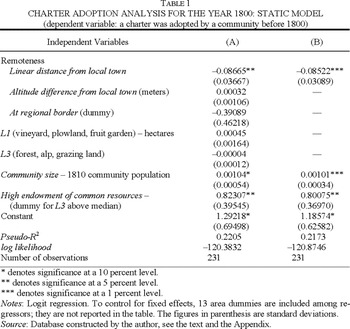
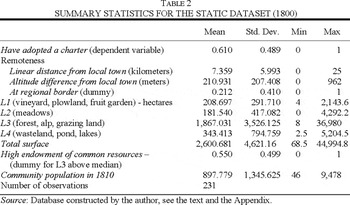
This section includes two empirical models of charter adoption, one static and one dynamic. The static model presents factors that influenced the decision of a community to adopt a charter at any point in time before 1800 (Table 1). A total of 231 communities are included in the regressions (Table 2).71
The dataset was built using both published and unpublished sources as detailed in the Appendix. The year of eventual adoption of a charter was recorded after accessing the original document, a transcription of it, or reliable news of the existence of the document. In 26 instances, the community charter regulated two or more villages. In that case the villages are consolidated into a single community. We believe that the reason for a joint charter was mostly to enjoy the protection of a stronger natural barrier such as a mountain range or a river. Moreover, seven communities were excluded because the charter date were unreliable. Trento was excluded as well because it was the major city in the region and had a unique peculiar statute.


Proxies for community remoteness are built using linear and altitude distances from major towns. Distances are measured in reference to 17 major towns that were headquarters of the decentralized government administration in the year 1810. In a mountain landscape, the length, as well as the steepness of a path could be related to how isolated a community is, although altitude and linear distances are correlated (ρ = 0.54). Community-level population data are from the 1810 census.72
Andreatta and Pace, Trentino. When break-downs at the village level were not available, we use the proportions from 1897 data (Consiglio provinciale d'agricoltura pel Tirolo, 1903).
Using the 1897 land survey data, one can cluster the land in a community into four categories. Category one includes vineyards, fruit gardens, and plow land (L1). Category two is meadows (L2), and category three comprises forests, alps, and grazing land (L3). Finally, category four is wasteland, lakes, and ponds (L4). We have chosen L1 as proxy for the land under private property and L3 as proxy for the land under common property. As mentioned, a quantitative analysis of the 1780 land registers of two communities suggests that L1 land was largely private property whereas L3 land was almost entirely common property.73
Goio, Ambiente economico-sociale; and Varesco, Ambiente economico-sociale.
The logit regression presented in Table 1 estimates the likelihood that a community has already adopted a charter at any time before 1800. Such likelihood significantly decreases with the remoteness of the community, measured as distance from the local town. This finding is in line with Implication 1. The other dimensions of remoteness, altitude difference from the administrative center and being at the regional border are not significant. Table 1 includes two specifications of the static model, (A) and (B), which yield similar results. Specification (B) drops some insignificant variables in order to reduce multicollinearity problems.
An important result is that the larger the community in terms of population, the more likely it is to adopt a charter. Implications 2 and 4 had opposite predictions regarding the impact of population. Implication 2 relied on the higher efficiency of the charter solution for larger communities and that is supported by the data. Implication 4 stressed the increasing difficulty to transition to a more efficient management regime as population size increases. The result suggests that if there were growing obstacles to the transition in larger communities, they were weaker in comparison to effect 2, at least in the long run. Finally, large amounts of commonly owned resources are positively correlated with the likelihood of adopting a charter. This finding is in line with Implication 3.
Dynamic Model
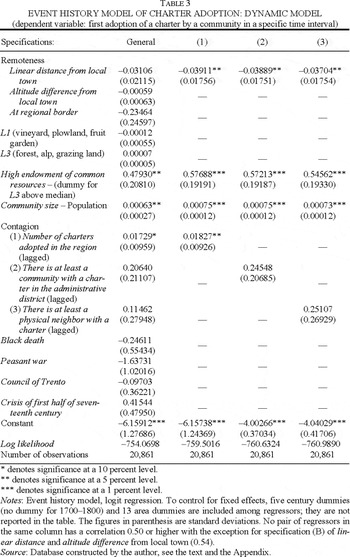
The second model aims at explaining both whether and when a community adopted a charter. The timing of charter adoption is shown in Figure 2. The estimation presented in Table 3 is done through an event history model; it confirms all of the findings coming from the static model. We use a discrete time version of the event history model. In particular, the time interval is five years; hence we have 120 intervals t between 1200 and 1800. The relevant observations for the analysis are those communities that have not yet adopted a charter at each point in time (risk set). A community that adopted a charter in a year that falls in time interval t contributes to the dataset with t observations. Those observations up to the time interval (t − 1) have a dependent variable set to zero; and the observation at the time interval t of adoption has a dependent variable set to one. For time intervals subsequent to t, no observations are included in the data set for that community. If a community never adopts a charter, it has 120 observations, one for each time interval. Otherwise, it has less.
74This methodology can handle two issues present in the data set, censoring and time-varying explanatory variables (Allison, Event History). Censoring occurs because the period considered is finite and the event of a charter adoption does not occur for all the units. Time-varying explanatory variables such as if a neighboring community has already adopted a charter could be relevant before the community itself adopts the charter but not after that event.

where P(t) is the number of charters adopted in time interval t divided by the number of communities in the risk set in the same time interval t. There are three classes of explanatory variables: Time trend, a(t), century fixed effects; Time-invariant variables, x1, remoteness proxies, private property size, common property size, and area fixed effects; and Time-varying variables, x2(t), community population, contagion variables, and specific historic event dummies.

In addition to the time-invariant variables x1 of the static model, the explanatory variables a(t) and x2 were added to the dynamic model. Population data at the community level are not available from primary sources for each five-year interval. The 1810 data were taken as the main reference and have been scaled proportionally over time using the Italian population data from Athos Bellettini's work.75
Bellettini, La popolazione italiana.
If population is assumed to be endogenous then both static and dynamic regressions are biased toward finding a positive coefficient for “population.” On the positive side the proxy built for the dynamic model eliminates most of the endogeneity in the timing of population change. Even with exact five-year interval data on village populations, the interpretation of the causality in the charter-population relationship would be ambiguous.
To control for fixed effects, both area and century dummies were employed. As in the static model, 13 binary dummies were included for different areas of the region. In addition, five century dummies were created to control for variations in the trend of the baseline hazard function over time (no dummy for 1700–1800). In addition, dummies for important historical events are also included to control for population shocks such as that from the Black Death (1350–1400), or institutional shocks that might have changed the propensity of the Prince to grant charters, such as the Peasant War (1525–1535) or the Council of Trento (1545–1565); the Italian crisis of the first half of the seventeenth century (1600–1650) is probably a mixed case. As it turns out, none of these latter historical dummies show a significant impact.
Another class of regressors concern contagion effect, i.e., the impact of the previous charter adoption by another set of communities.77
Consider a model of contagion, where the dynamic is governed by a logistic function: Dx(t) / dt = rx(t)((1 − x(t)) / K), where r, K > 0 and x(t) is the number of communities who have already adopted a charter. The cumulative number of charters, x(t), is an S-shaped function of time. The regressor is the number of communities with a charter in the previous time interval as the variable to be explained is P(t) = (dx / dt) / (1 − x) = rx / K.
ρ = 0.47 for (1) with (3); ρ = 0.63 for (1) with (2); ρ = 0.45 for (3) with (2).
Table 3 presents four different specifications of the event history model. The first column is the most general, whereas the other three are limited to significant regressors and just one contagion proxy to avoid multicollinearity problems. All the results from the dynamic model confirm the findings of the static model with regard to remoteness, population, and common property size.
Although the signs are correct for all contagion proxy coefficients, the only significant impact comes from the regional proxy 1. Even when proxy 2 or proxy 3 is the only contagion proxy in the model, it is not significant at a 10 percent level. In other words the existence of other communities with a charter significantly raised the likelihood that a community would adopt a charter itself. The influence was not local but there was a general adoption trend in the region. Neither the adoption by physical neighbors (proxy 3) nor by the immediate administrative group around the community had a significant impact (proxy 2). These results have important consequence for evaluating the motivation behind a charter adoption. Setting up a new charter was not an effort to offset the better protection strategy of immediate neighbors; the interpretation of charter adoption as a zero-sum game is not corroborated by the data. The significance of the general proxy 3 is ambiguous. The variable could capture general factors missing from the model such as commodity prices that influenced charter adoption by all communities. Still, it is compatible with an interpretation of the charters as legal innovation that spreads the more rapidly the lower the costs of information about its content and procedure of adoption.
DISCUSSION AND CONCLUSIONS
Based upon thirteenth- through nineteenth-century data on more than 200 communities in the Italian Alps, we study the transition from informal to formal property rights arrangements in the governance of the land held in common. The key to interpreting the choice of governance regime over the forest and grazing land held in common is the long-term interaction among the stake-holders. A close-knit group living in the same community for generations was eventually able to establish and enforce a new system of property rights, in the form of a “charter.” Given the long-term interaction within the group, the emergence of a charter could be an equilibrium.
At the same time, one may argue that, thanks to the long-term interaction, informal cooperation in using the common resource could spontaneously arise without the need for a charter or any other formal enforcement institution. The tragedy of the commons literature generally assumes a one-shot interaction among the resource users. Empirically, that is clearly not the case in many situations and specifically in these alpine communities. Henceforth, the conditions that may explain the transition to a charter governance regime are the very ones that may foster informal community cooperation, thus making a regime transition not needed.
We show that this contradiction is only apparent because the informal cooperation regime was plagued by several weaknesses in the management of the common resources and the costly charter regime included several provisions that complemented and boosted informal cooperation. Through the lenses of the theory of infinitely repeated games (folk theorem), we identified five such institutional functions. These functions set critical incentives in any organization where members repeatedly engage in a collective action task or in team production:
Protection from outsiders' appropriations. Through the charter, the state allowed the local community legal jurisdiction to prosecute outside poaching. Although it was an important precondition for cooperation among insiders, long-term interaction by itself was either ineffective or wasteful in protecting from outsiders' appropriation.
Community building institutions restricted mobility in and out of the group. Settling into a new community, or cheating and immediately leaving the community carried implicit and explicit penalties. The charter had provisions to raise those penalties in order to make the group more stable over time.
Information-enhancing institutions gathered new information, consolidated and validated existing information. To sustain informal cooperation, everyone had to be able to monitor others' resource appropriations. Using guards and public meetings, charters actively organized the public dissemination of novel and of private information, hence making it possible to sustain higher levels of cooperation.
Coordination institutions selected one of the multiple equilibria available to the group and selected a strategy to implement such equilibrium. Charters employed written rules on limits to resource appropriation and associated penalties, court verdicts, and legal procedures for collective deliberations, which solved the coordination problem.
Punishment institutions provided adequate incentives to group members to comply with the rules while minimizing the social loss of punishment. Although there were plenty of informal ways available to punish others, the charters employed monetary fines, which presented two advantages, they avoided physical injuries (the state would prosecute the punisher as a criminal) and they were not wasteful because they simply transferred resources.
A charter may be more beneficial to some communities than to others. As a matter of fact, about one-third of the communities in the sample never adopted a charter. In particular, we found that charters were more likely to be adopted by less isolated communities (Implication 1) and larger communities in terms of population (Implication 2), and with a large endowment of common property resources (Implication 3).
We found no evidence that the transition from informal cooperation to a charter was problematic in this particular time period. Written documents became common in Trentino starting in the eleventh century. At about the same time a new political institution, the Principality of Trento, was created. These contingencies opened up the conditions for the institutional option of setting up charters.79
Greif, Institutions; and Rosenthal, Fruits.
Appendix: Notes on Data Sources
COMMUNITY CHARTERS (Carte di Regola)
Unpublished sources: The original manuscripts are kept at several archives: Biblioteca Comunale di Trento, Archivio di Stato di Trento, Archivio della Curia Arcivescovile di Trento, Biblioteca Civica di Rovereto, Ferdinandeum Museum of Innsbruck, Archivio di Castel Bragher (Coredo), and in the Archivi Municipali of Coredo, Mezzolombardo, and others. Casetti (Guida) provides a basic guide to the Trentino archives.
Published sources: About 190 of these charters where published in Giacomoni (Carte di regola). Many other publications have published just one charter. An exhaustive list of such articles and books for the years before 1988 is given in Nequirito (1988) while for the years after 1988 a list can be provided upon request.
Dataset: We have collected information for 356 charters from both published and unpublished sources. Of them, the text was found for 265 charters but only the news of their existence is available for 91 charters. They refer to 224 different geographical units, although there are instances of a charter referring to a group of villages and villages within the group having a distinct charter. The present study focuses only on the first adoption of a charter by a community. Some charters are newer versions of a first draft.
LAND REGISTER DATA (Dati catastali)
Year 1780, Unpublished: A collection of manuscripted books recording property rights on land can be found in the Archivio di Stato di Trento under Serie Catasti Teresiani. It comprises one or more books for each village (comune catastale) and describes in a systematic manner all parcels of land in the region and records the owner. A detailed data analysis of the books for the village of Levico was done in Goio (“Ambiente”). An analogous analysis for the village of Predazzo was done in Varesco (“Ambiente”).
Year 1897, Published: Consiglio provinciale d'agricoltura pel Tirolo (“Tabelle”). The original sources of the data are land registers. Land registers are not the Catasti Teresiani. A new survey was carried out in the mid nineteenth century with new criteria and in addition to the books, maps were drawn up (Mappe Napoleoniche). The 1897 land register partition of the region is taken as reference for the community charter analysis. The region is divided into 395 geographical units which, with a handful of exceptions, is always a finer partition than the community areas of the charters. The regional statistics brought from this source consider an area of 6,356.33 square km; that is, 2.4 percent greater than the current area of the province of Trento.
Dataset: For each of the 395 geographical units (comune catastale), the data set reports village surface devoted in 1897 to plowland, meadow, fruit garden, vineyard, grazing land, alp, forest, lake or pond, wasteland, houses, and total surface in hectares (10,000 squared meters).
POPULATION DATA
The 1810 village level data used in the regression are based on the data reported in Andreatta and Pace (Trentino). In the instances where a finer partition was necessary, the 1810 figure was divided proportionally to the 1897 figures, which are published in Consiglio provinciale d'agricoltura pel Tirolo (“Tabelle”).
NEIGHBORING COMMUNITIES
Partitioning of the region: based on the 1810 administrative division of Trentino described in Andreatta and Pace (Trentino).
Physical bordering: reconstructed using land register data and GIS maps from the Ufficio Catastale of Fondo (Trento).
COMMUNITY INTERNAL ADMINISTRATION
Unpublished:
Libretti d'Amministrazione [della Comunità di Mezzolombardo], series of booklets of the years 1589, 1652–1699, 1718–1797, manuscripts, Archivio Comunale di Mezzolombardo, province of Trento, Italy
Libro de' Conti dei Regolani della Honoranda Comunità di Coredo, series of booklets from 1635–36 to 1698–1699, manuscript, Archivio Comunale di Coredo, province of Trento, Italy
Published:
Delugan and Visani (“Corpi”), Valenti (“Notizie”), Papaleoni (“Le più antiche carte” and “I ‘Divisi’”), and Dossi (Le pergamene and Un antico ruolo) describe aspects of the property rights structure on the land.
LEGAL AND ECONOMIC CONTEXT OF COMMUNITY CHARTERS
Monteleone, “L'economia agraria”; Capuzzo, “Carte di regola”; and Grossi, “Assolutismo giuridico.”
This article has developed from a chapter of my Ph.D. dissertation written at the California Institute of Technology. I wish to thank Douglas Allen, Jose Apesteguia, Benito Arruñada, Jeremy Atack, Marco Bellabarba, Giangiacomo Bravo, Lance Davis, Paolo Ghirardato, Alvaro Gonzalez Staffa, David Haddock, Peter Hill, Philip Hoffman, Fred McChesney, Larry Neal, Rosella Nicolini, Isan Tunali, Charles Plott, Andrew Seltzer, Simon Wilkie, Dean Williamson, and three anonymous referees for their valuable comments. This work has also benefited from the comments of participants to presentations at Northwestern University, University of Bologna, Workshop on Institutional Analysis, Barcelona, Royal Holloway, London, Autonoma University of Barcelona, Simposios de Analisi Economica in Salamanca and Sevilla, Simon Fraser University, Koç University, Sabanci University, TUFTS, Caltech, University of Trento, European Historical Economics Society Summer School, Sweden, and the IASCP conference at Indiana University. Help to access original documents and other data was provided by Simonetta Cova, Mariano Devigili, Maurizio Erlicher, Fabio Giacomoni, Filippo Militello, Enrico Recla, Marco Stenico, Gian Maria Varanini. Thank you also to Luisito Bertinelli and Anya Savikhin for the technical and editorial assistance. All remaining errors are mine.