Do authoritarian governments always censor news about protests to prevent unrest from spreading? Existing research on authoritarian politics stresses the danger that information spread within the society poses for a regime. In particular, media coverage of social protests is conventionally viewed as threatening to authoritarian rule, as reports of protests can incite more protests and thus spread political instability (Huntington Reference Huntington1991; Kuran Reference Kuran1991; Lohmann Reference Lohmann1994; Hale Reference Hale2013). The 1989 Eastern European revolutions, the color revolutions of early 2000s, and the 2011 Arab Spring all seem to confirm this argument, as protests covered by news media and the Internet spread from one country to another, or from one region to another region in the same country. Therefore, authoritarian regimes are believed to censor as much news about social protests as possible. After all, information censorship is a fundamental feature of authoritarianism, and citizen protests are negative news for authoritarian regimes. To nip social unrest in the bud and prevent regime breakdown, it seems natural that an authoritarian regime would forbid media or Internet reports of such unrest. A recent influential study of the Chinese Internet thus argues that the Chinese government’s goal of Internet control is to censor information about collective action events or events with collective action potential, rather than criticism of the government (King, Pan and Roberts Reference King, Pan and Roberts2013). Other important studies, while showing that media can help the ruler incentivize or monitor lower officials, similarly hold that information spread within the society is dangerous for the regime as it facilitates citizen coordination and mobilization (Egorov, Guriev and Sonin Reference Egorov, Guriev and Sonin2009; Lorentzen Reference Lorentzen2014).
But media and the Internet in China, the largest authoritarian country in the world, have regularly reported social protests, including, and perhaps particularly, some large and significant ones. Consider the unprecedented taxi drivers’ strike in Chongqing in November 2008, during which some 9000 taxis stopped work to protest excessive management fees and fuel shortages, among other issues, stranding numerous rush-hour commuters in one of China’s largest metropolises (Liu Reference Liu2008). Within hours, several state-controlled national media outlets published eyewitness reports of the strike, followed by further in-depth media coverage across the country. Three days later, Chongqing’s Communist Party chief, one of China’s top officials, met with the strikers, and the meeting was televised live and available online across China. Media coverage of the Chongqing strike did lead to a protest cascade: within a month taxi drivers in 18 other cities across China followed suit and held similar strikes (Wong Reference Wong2008), forcing officials in various cities to vow to eliminate excessive fees and provide more fuel supplies, while others stepped down or received administrative admonitions.
The Chongqing taxi drivers’ strike was by no mean the only social protest in China that received significant media coverage. In fact, Chen (Reference Chen2013) collected data on 5300 confrontational protests in China from 2000 to 2013, and most of the information was from Chinese official media. Steinhardt (Reference SteinhardtForthcoming) shows that the state media tends to use sympathetic language when reporting citizen protests, and that the evolution of the state media policies is a critical facilitator of this phenomenon. Indeed, China’s Emergency Response Law, promulgated in 2007, stipulates that government authorities should publicize accurate and timely information about the development and handling of emergencies, including social security incidents such as citizen protests.
Why is the Chinese media frequently allowed to report and discuss social protests, despite the government’s high capacity to censor media (Lorentzen Reference Lorentzen2014) and the previous literature’s argument that such coverage is politically destabilizing? The standard theory about media reports of social unrest endangering authoritarian rule focuses on protests that reveal information about the unpopularity of the regime (Kuran Reference Kuran1991; Lohmann Reference Lohmann1994). From this perspective, media reports are harmful because they can induce anti-government protest cascades. We show that this standard theory is incomplete if citizen protests are targeted at local officials’ corruption, transgressions, or incompetence, rather than the whole regime. Allowing media the freedom to report such local protests has two potential benefits for the regime, precisely because this may cause protests to spread. First, by enabling protest diffusion free media can help the regime identify and address more local grievances, before they turn into resentment against the national regime and threaten its survival. In other words, media-induced protest diffusion can help release potential revolutionary pressure on the regime. Second, the threat of protest diffusion has a deterrence effect, and local bureaucrats will be forced to be less corrupt to pre-empt potential protests. Having better behaved bureaucrats lowers citizen grievances and potential demand on the regime’s resources to address such grievances. The underlying pressure that can be channeled to a revolution against the regime itself can also decrease. Thus, even though giving media the freedom to report local protests may lead to an increased incidence of citizen protest, it can also bring about a net gain to the regime under many circumstances and contribute to its resilience. In other words, the regime often wants protest diffusion or the threat of it!
These mechanisms are particularly useful in a large authoritarian country with multiple layers of government and large variations in local conditions. In such a country, citizens’ daily interactions with the government are mostly through local officials, and their livelihoods are significantly affected by local policies and local implementation of national policies. Local communities’ costs, and hence willingness, to launch protests are also rather heterogeneous. This is why our empirical focus is on China. Indeed, as has been well documented, the vast majority of citizen protests in China are targeted at local officials (O’Brien Reference O’Brien1996; Cai Reference Cai2010; Chen Reference Chen2012), with corruption, land expropriation, and environmental degradation among the most common causes of social grievances. Citizens often protest against their local officials’ specific misbehavior, and call for the central government to address their grievances, but they rarely question the legitimacy of national institutions or even link up similar grievances across different localities (Lorentzen Reference Lorentzen2013). In fact, they usually emphasize their loyalty to the regime and routinely cite central regulations or national leaders’ speeches to justify their demands (Perry Reference Perry2010). We construct a simple game-theoretic model to explain why an authoritarian government often has incentives to permit or even encourage news reports of such protests. We then illustrate the argument with examples from the Chinese media and Internet.
This paper is situated within the expanding literature on media and information flow in authoritarian countries. The existing literature emphasizes the danger for authoritarian regimes of allowing transparency or information sharing among citizens (Bueno de Mesquita and Downs Reference Bueno de Mesquita and Downs2005; Hollyer, Rosendorff and Vreeland Reference Hollyer, Rosendorff and Vreeland2015). In Egorov, Guriev and Sonin (Reference Egorov, Guriev and Sonin2009) and Lorentzen’s (Reference Lorentzen2014) analyses of how media affects local governments’ behavior in authoritarian countries, while free media helps the regime by providing information about local (mis)governance, it also enables citizens to coordinate rebellion against the regime by making widely known the regime’s incompetence or the prevalence of social grievances. Lorentzen’s (Reference Lorentzen2013, Reference Lorentzen2015) work on protests similarly holds that costly protests can help the regime identify discontented social groups and monitor lower levels of government, but the regime needs to limit the spread of information about protests lest political entrepreneurs use the information to organize a national revolution. In other words, for these scholars the flow of information from local regions to the central government is beneficial to the regime, but the lateral information spread among citizens and within the society is dangerous. We show that information spread laterally within the society can also benefit the regime through a novel mechanism: instead of informing the ruler about local misbehavior, the media can be used to encourage citizens to protest and thus reveal further social grievances, thereby releasing pressures on the regime, and deterring local officials. In addition, the media does not need to directly observe government corruption or misbehavior, only citizen protests. Though this mechanism may appear somewhat unusual at first glance, citizen protests are like fire alarms (McCubbins and Schwartz Reference McCubbins and Schwartz1984) and easier to observe and report than government corruption, which requires police or media patrols.
A critical reason behind the difference in results between the existing literature and the present article is that in previous studies localized protests, if linked up by media coverage or coordinated by political entrepreneurs, will spiral upward into a national revolt directly challenging the regime. In our framework, local protests will initially remain targeted at local governments and officials even when there is a cascade of such protests; only when the regime refuses to address these localized grievances will such pent-up grievances turn into resentment against the whole regime and a national revolution may emerge. That is, the local protests and potential national revolution occur in two separate stages, and the citizens’ decision to turn against the national regime depends on its responsiveness to localized demands. This is a reasonable setup in many real world situations, which has not been explored in the existing literature. To be sure, authoritarian governments sometimes do fear that local protests will develop directly into an anti-regime national movement. Under such circumstances, they may not always welcome media reports of local protests, but will tolerate them up to a certain point and then tighten up. Even in such cases, however, the question of why an authoritarian regime is willing to allow some initial media coverage of citizen protest is interesting, and our model can help shed light on this issue.
Some recent studies discuss the potential benefits (for the regime) of information sharing between citizens, which can disorganize citizens by revealing their disagreements over the government (Shadmehr and Bernhardt Reference Shadmehr and Bernhardt2011; Chen and Xu Reference Chen and Xu2014; Little Reference Little2016).Footnote 1 In contrast, we show how information spread among citizens can benefit the regime by helping citizens organize collective action, which releases social pressure and disciplines government officials. Other recent studies of authoritarian information politics focus on how propaganda or censorship affects a regime’s direct interactions with citizens and, consequently, its maintenance of power (Edmond Reference Edmond2013; Gehlbach and Sonin Reference Gehlbach and Sonin2014; Guriev and Treisman Reference Guriev and Treisman2015; Huang Reference Huang2015; Shadmehr and Bernhardt Reference Shadmehr and Bernhardt2015; Chen and Xu Reference Chen and XuForthcoming), whereas we study how information flow affects the regime through its impact on the behavior of lower officials, similar to Egorov, Guriev and Sonin (Reference Egorov, Guriev and Sonin2009) and Lorentzen (Reference Lorentzen2014).
A few caveats are in order. First, we do not argue that there is no censorship of protest news in China. In fact, the previous literature has shown there is plenty. But as we discuss in the empirical section, such censorship is often pursued by local officials, rather than by the central government, in an effort to protect their own careers. Second, we only argue that the central government often permits or encourages media reports of local protests; we do not claim that it will encourage news and discussions of protest activities threatening the regime itself. For example, the call for an Arab Spring-style Jasmine revolution in China in 2011 was severely censored: not only were almost all online discussions of the call deleted, there was even a temporary ban of the sale of jasmine flowers in Beijing (Jacobs and Ansfield Reference Jacobs and Ansfield2011; Page Reference Page2011). Our study thus builds on the previous literature and suggests a way forward for empirical work on Chinese censorship distinguishing between censorship by the central regime and that by local officials. Last, we do not model the regime as a benevolent dictator. In fact, in the model, the regime is interested only in maintaining its rule and maximizing resources. But it nevertheless has incentives to reduce local misgovernance and release social pressure, lest social grievances accumulate and threaten the regime’s survival.
The next section presents the game-theoretic model, and the third section presents the analysis. The model is purposefully simple and stylized in order to achieve an intuitive understanding of the three-way interactions between citizens, local officials, and the central government. The fourth section discusses the theory’s empirical relevance, in which we provide examples of media and Internet reports of Chinese local protests and discuss the difference between the central government and local governments in their approaches to media reports of protests. The last section concludes.
The Model
There is a central government denoted by G and two local districts denoted by i, i=1, 2. In the following the central government will sometimes be simply called the government or regime. Each district is endowed with 1 unit of resource. District i is governed by a local bureaucrat (B i ), who is appointed by the government to administer local affairs. A bureaucrat can exploit his district by appropriating its resource, but will be fired from his position and lose what he appropriated if his appropriation causes citizen protest. The level of appropriation is denoted by a i ∈[0,1]. We assume that the bureaucrat receives the same wage in his current employment as he would receive elsewhere, so the net benefit of keeping the job is what he appropriates. Therefore, the bureaucrat accepts the position whenever his expected net gain from the post is ≥0.
District i’s decision to protest the loss of a i is captured by a binary variable p i : p i =1 if i protests and p i =0 otherwise. Overcoming the collective action problem to launch a protest imposes on district i a cost equal to t i , but a protest may also lead the government to compensate the district (see below). If a district’s expected compensation for its loss exceeds its protest cost, it will protest; otherwise it is not worthwhile to protest. Therefore, t i can be viewed as the district’s tolerance level for bureaucratic appropriation. The protest cost t i can be high (h) or low (l), with 0<l<h<1. A district knows its own t i , which may be affected by such factors as the district’s skills in launching a protest, its solidarity, and whether it has a charismatic leader, while all other actors think it is equally likely to be h and l. We call a district with t i =l a low-cost district, and a district with t i =h a high-cost district.
If a district protests, the central government learns of it and fires the responsible bureaucrat.Footnote 2 The bureaucrat also loses all of his appropriation income, although this income cannot be returned to the district in the form of the original resource.Footnote 3 In addition, the central government decides whether or not to compensate the loss of the protesting district out of its own pocket. We assume that the government has resources, denoted by R, to fully compensate both districts if it chooses to; in other words, R≥2 (the maximum total appropriation possible). This does not mean all governments are equally rich: some may be more limited in resource and have a stronger incentive to minimize compensation than others.
The utility of the bureaucrat is then given by
 $$U_{{B_{i} }} \,{\equals}\,a_{i} (1{\minus}\,{\rm prob}(p_{i} \,{\equals}\,1)).$$
The utility of district i consists of three parts. It loses the resource that is appropriated, a i . If it does not protest, it does not gain or lose any further. If it does protest, however, it incurs a protest cost, t i , but receives a compensation equal to c i . Combining all these, we have the utility of district i given by
 $$U_{i} \,{\equals}\,{\minus}a_{i} {\plus}I_{{p_{i} {\equals}1}} \left( {c_{i} {\minus}t_{i} } \right),$$
where
 $$I_{{p_{i} {\equals}1}} $$
is the indicator function that is equal to 1 when i protests.
As for the government’s utility, any compensation reduces by an equal amount the government’s own consumption and is thus costly. But if the government does not compensate a district, the unaddressed grievances against local officials will escalate to resentment against the central government, from which a national revolt may emerge and, depending on the vulnerability of the government, threaten the survival of the regime. If the government is overthrown, it loses its (remaining) resources and its payoff is 0.
The ex ante probability that the government is vulnerable (
 $$v\,{\equals}\,v_{h} \,\gt\,{1 \over {R{\minus}2}}$$
) is denoted by ρ∈(0,1), and the government is not vulnerable (v=v
l
=0) with the residual probability 1−ρ. In the main text of the paper, we assume the government is as likely to be vulnerable as not, that is,
 $$\rho \,{\equals}\,{1 \over 2}$$
. The section on general government vulnerability in the Appendix shows that all main results of the paper hold with a general ρ ∈ (0,1); in fact, we obtain stronger results with a higher ρ. Assuming an equal likelihood for vulnerability not only simplifies the exposition, but also provides a more neutral setting where we can focus on the other comparative statics exercises.
After a protest occurs, the regime learns of its vulnerability to the situation, as political activists and entrepreneurs may use the opportunity of the protest to press for national political change or even revolution,Footnote 4 and the regime observes how the mass public, foreign governments, international media, etc., are reacting to the political activists’ efforts. The government makes the compensation decision after learning of its vulnerability.
We do not model the process through which grievances against local officials turn into resentment against the regime and lead to a national uprising, but simply assume that any uncompensated local appropriation reduces the probability that the central government will survive, if the government is vulnerable to the threat of national revolt. Formally, we capture the probability of survival of a regime by
 $${1 \over {1{\plus}v\mathop{\sum}\limits_{i\,{\equals}\,1}^2 \left( {a_{i} {\minus}c_{i} } \right)}}$$
. If the government is vulnerable, its chances of survival decrease in total uncompensated appropriation, protested or not. If a vulnerable central government compensates all local appropriations, it will survive with probability 1. If the government is not vulnerable, its survival probability is impervious to appropriations; in that case, its utility is simply its residual resources:
 $$R\,{\minus}\mathop{\sum}\limits_{i\,{\equals}\,1}^2 c_{i} $$
. To summarize, the (expected) utility of the central government is the chances of its survival times the resources it has left after providing compensations:
 $$U_{G} {\rm \,{\equals}\,}{{R\,{\minus}\mathop{\sum}\limits_{i\,{\equals}\,1}^2 {c_{i} } } \over {1{\plus}v\mathop{\sum}\limits_{i\,{\equals}\,1}^2 {\left( {a_{i} \,{\minus}\,c_{i} } \right)} }}.$$
In this utility function (3), the numerator denotes the central government’s direct loss from compensation, and the inverse of the denominator indicates its survival probability. The utility form thus captures a vulnerable government’s existential trade-off: compensation lowers its resources but at the same time increases its chances to keep them.
The compensation policy is one of the two choices that the central government has to make. The other choice takes place at the very beginning of the game when it contemplates whether to allow media the freedom to report local protests and the government’s handling of protests. When the media is not free, because one district is not aware of what transpires in the other, it cannot condition its protest decision on the other district’s action. Information-wise, this is equivalent to saying that districts make their decisions pertaining to protest simultaneously. Therefore, without a free media, there is essentially one protest stage and the districts simultaneously decide whether or not to protest.
With free media, if there is a district that protests initially, it must be the low-cost district, say district i, which finds a protest worthwhile in expectation of the government’s vulnerability and compensation decision (see Analysis section). The other district, say district j, has an additional option that is not feasible without free media: it can wait to see if i protests first, which will be revealed through media reports. Moreover, if i does protest, j can observe whether i receives compensation or not. District j can then decide if it should follow suit and launch a protest as well. In fact, as the following analysis will show, the government will compensate a protesting district if and only if it is vulnerable. So if the media reports that district i has been compensated following its protest, district j will know that the government is vulnerable and that it, too, will be compensated upon protesting. In this sense, there are potentially two protest stages when the media is free.
In sum, the sequence of the game is as follows:
1. The government chooses whether or not to adopt a system whereby the media has the freedom to report local protests and the government’s responses to the protests.
2. The bureaucrats simultaneously choose how much to appropriate.
3. Protests, if any, occur.
4. The government learns of its vulnerability and decides whether to compensate any protesting district. The game proceeds directly to step 7 if media is not free.
5. If the media is free, it reports any protest and the ensuing government reaction in the previous stage, and the district that has not already protested decides whether or not to launch a protest of its own.
6. The government decides whether or not to address any second stage protest.
7. A national revolt against the regime emerges with the probability increasing in the total amount of uncompensated appropriation.
Jumping ahead, this setup describes an environment where media freedom may lead to protest diffusion: reports of a district’s protest and the government’s ensuing compensation signal the other district about the government’s vulnerability (as only a vulnerable government will pay off the protesters), and thus encourage the second district to protest as well. While addressing further protests exhausts more resources, the increased probability of citizen protest under media freedom also dampens local appropriation, thus reducing local grievances. When this deterrence effect does not work and local corruption triggers citizen protest, the central government can obtain information about local bureaucratic misbehavior, punish responsible officials, and prevent rebellion against the regime by compensating angry citizens. The subsequent analysis will show if and when the central government benefits from media freedom.
Analysis
Preliminaries
We use backward induction to solve the game given its sequential nature. Because the two districts are ex ante identical, we look for symmetric equilibria in which both bureaucrats appropriate the same amount: a
1=a
2=a. The form of the government’s utility dictates that the government either compensates fully a protesting district, c
i
=a, or does not provide any compensation at all (c
i
=0).Footnote
5
When each bureaucrat appropriates a and both districts protest, the government’s utility is equal to R−2a after compensating both districts,
 $${{R\,{\minus}\,a} \over {1{\plus}va}}$$
if it compensates only one of the two districts, and
 $${R \over {1{\plus}2va}}$$
if it does not compensate at all. Coupled with our assumptions on the size of government vulnerability,
 $$v_{h} \,\gt\,{1 \over {R\,{\minus}\,2}}$$
and v
l
=0, the government compensates all protesting districts if it is vulnerable, and does not compensate any district otherwise.
When the media is free and a protest by district j (and the ensuing compensation by the government) reveals the government’s vulnerability, district i protests when the appropriation exceeds its protest cost:Footnote 6
 $$a_{i} \,\gt\,t_{i} .$$
When either the media is not free, or no protest has occurred irrespective of the government's media decision, district i only knows that the government is vulnerable with probability
 $$\rho \,{\equals}\,{1 \over 2}$$
. Therefore, ex ante the district will protest if
 $${1 \over 2}a_{i} \,\gt\,t_{i} ,$$
or if a i >2t i .
As (4) and (5) suggest, the magnitude of protest costs is important in determining the media’s effect. Therefore, we study the model case by case according to the relative sizes of the protest costs. To aid the analysis, we parameterize the central government’s utility with the appropriation level:
 $$U_{G}^{r} (a^{r} )$$
denotes the central government’s utility when the media system is r=m,n, where m denotes that the media is free and n denotes that it is not, and each bureaucrat appropriates a
r
. Similarly,
 $$U_{B}^{r} (a^{r} )$$
denotes the bureaucrat’s utility from appropriation level a
r
under system r.
Small Costs of Protest
We start with the parametric alignment
 $$l\,\lt\,h\leq {1 \over 2}$$
, which corresponds to small costs of protests, where both the low and high protest costs are no higher than
 $${1 \over 2}$$
(the probability that the government is vulnerable). If the media is not free, there are effectively only two levels of appropriations to consider: 2l and 2h by (5). Any appropriation amount up to 2l avoids protest given the uncertainty about the government’s compensation policy, and hence will be sure income for a bureaucrat. Any level above 2h would push even a high-cost district to protest, which surely results in the responsible bureaucrat losing his job and the appropriation income. Any appropriation amount above 2l but below 2h will cause only the low-cost district to protest when the media is banned. Consequently,
 $$U_{B}^{n} (2l)\,{\equals}\,2l$$
and
 $$U_{B}^{n} (2h)\,{\equals}\,h$$
by (1). The following result suggests that if the protest costs are sufficiently disparate, the bureaucrat finds it worthwhile to extract more, and risk facing a low-cost district and losing his income.
Lemma 1: (Bureaucrats’ choice when media is not free): When
 $$l\,\lt\,h\leq {1 \over 2}$$
and the media is not free, a local bureaucrat will set a
n
=2h if
 $$l\,\lt\,{1 \over 2}h$$
, and a
n
=2l if
 $$l\geq {1 \over 2}h$$
.Footnote
7
Media freedom is important for the district that has not protested yet. The strategy of district i is as follows: protest in the first stage if and only if a i >2t i . Conditional on reaching the second stage (which happens if a i ≤2t i and a j >2t j , j≠i), i does not protest given c j =0; and given c j =a, i protests if and only if a i >t i .
There are three levels of appropriation to consider under media freedom: 2l, h (if h>2l), and 2h. As before, if a=2l, then there is no protest, and
 $$U_{B}^{m} (2l)\,{\equals}\,2l.$$
If a=h (>2l), which causes only a low-cost district to protest,
 $$U_{B}^{m} (h)\,{\equals}\,{1 \over 2}h$$
. If a=2h, however, a high-cost district protests if an earlier protest by a low-cost district reveals that the government is vulnerable. As a result, the bureaucrat can retain his appropriation if either both districts have high protest costs, or his district has a high protest cost and the protest of the other district reveals the government to be invulnerable. The first event is observed with probability
 $${1 \over 4}$$
, and the second event is observed with probability
 $${1 \over 8}$$
. Therefore,
 $$U_{B}^{m} (2h)\,{\equals}\,2h({3 \over 8})\,{\equals}\,{3 \over 4}h$$
. Comparing the expected utilities leads to the following result:
Lemma 2: (Bureaucrats’ choice when media is free): When
 $$l\,\lt\,h\leq {1 \over 2}$$
and the media is free, a local bureaucrat sets a
m
=2h if the protest costs of both district types are sufficiently different (
 $$l\,\lt\,{3 \over 8}h$$
), and a
m
=2l otherwise (
 $$l\geq {3 \over 8}h$$
).
The choice of the appropriation levels follows the same rationale as in Lemma 1: either extract a high amount and risk getting caught, or appropriate a small amount and do not get caught. The two lemmas above show that if
 $$l\,\lt\,{3 \over 8}h$$
, the local bureaucratic appropriation level will be 2h under both media systems. This is because, the relatively large gap between the two types of protest costs renders high appropriation more desirable for the bureaucrat. If
 $${3 \over 8}h\leq l\,\lt\,{1 \over 2}h$$
, free media can reduce bureaucratic appropriation from 2h to 2l by the threat of protest diffusion, which indirectly increases the probability of a bureaucrat getting caught and the moderate gap between appropriation levels is not worth this risk. At an appropriation level of 2h, the probability that both districts protest is higher under media freedom, as a high-cost district protests in the second stage if it learns that the government is vulnerable. The probability of observing no protest is the same irrespective of the media system. Finally, if
 $$l\geq {1 \over 2}h$$
, that is, if the two types of protest costs are close enough to each other, it is not worthwhile to appropriate a high level and risk protest, and so a local bureaucrat appropriates 2l under both media systems.
To calculate the government’s expected utility under each media system, we focus on the situation in which the government turns out to be vulnerable, because only a vulnerable government is affected by protests. The analysis of the government’s payoff from each system given the possible appropriation levels leads to the following result. All proofs not already provided in the main text are in the Appendix.
Proposition 1: When
 $$l\,\lt\,h\leq {1 \over 2}$$
, the government chooses media freedom if the two types of protest costs are sufficiently different (
 $$l\,\lt\,{3 \over 8}h$$
). When the difference between the high and low protest costs is moderate (
 $${3 \over 8}h\leq l\,\lt\,{1 \over 2}h$$
), the government chooses media freedom if the government’s resources are limited, or if the low protest cost is sufficiently low. When the two costs are sufficiently close (
 $$l\,\gt\,{1 \over 2}h$$
), the choice of media system does not matter for the government as a bureaucrat will choose low appropriation under either system.
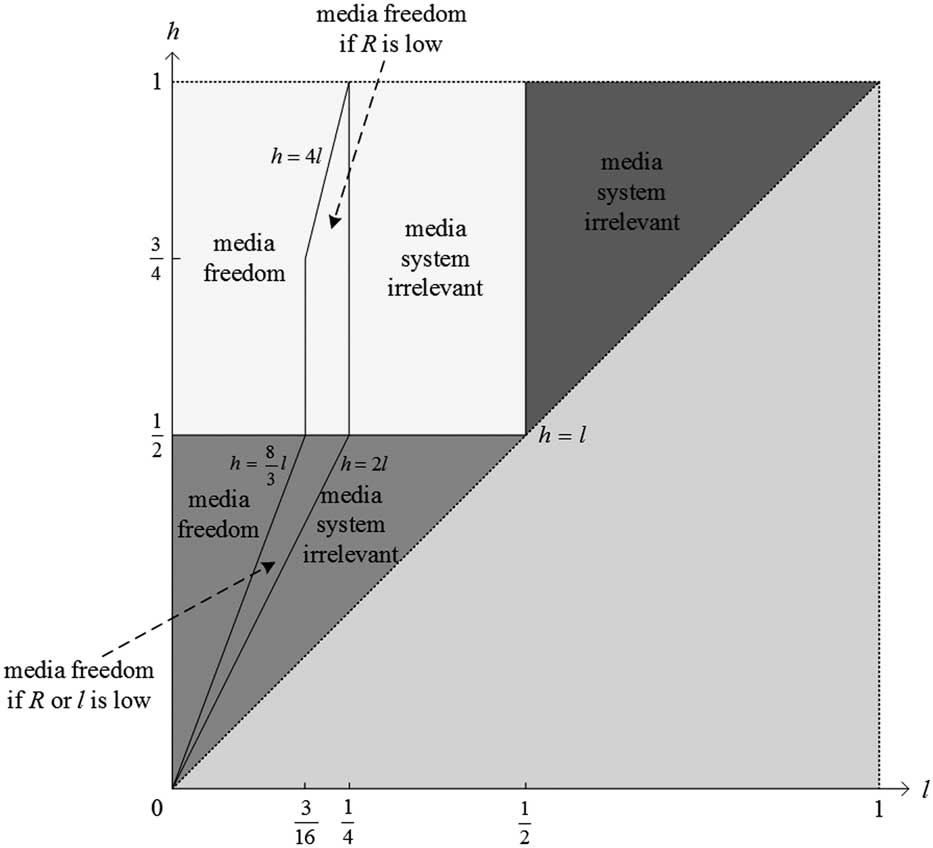
The result is shown graphically in Figure 1, where the lower triangle to the left of the dashed line h=l refers to the parametric region of Proposition 1:
 $$l\,\lt\,h\leq {1 \over 2}$$
. Here, the central government chooses media freedom when the high and low protest costs are sufficiently different (
 $$l\,\lt\,{3 \over 8}h$$
or equivalently
 $$h\,\gt\,{8 \over 3}l$$
). In this case, local appropriations will be high under both media systems because the temptation to expropriate is too strong for the bureaucrats to resist. However, media freedom enables further protests against these high appropriations, and accordingly, the government can identify and compensate more local grievances so that they will not develop into pressure of revolution on the regime. This is the pressure release function of media-induced protest diffusion.
The government’s choice of media system when
 $$\rho {\equals}{1 \over 2}$$
Note: The lower triangle to the left of the dashed line h=l corresponds to Proposition 1, the upper left rectangular corresponds to Proposition 2, and the upper triangle to the left of h=l corresponds to Proposition 3.

When the difference between the high and low protest costs is moderate, the threat of protest diffusion under media freedom forces local bureaucrats to choose low appropriation, which reduces underlying social grievances. This is the appropriation reduction function of free media. When bureaucratic appropriation is reduced, the amount of total social grievances that can potentially be channeled into a revolution will be lower, and the government’s compensation, if a protest occurs, will also be lower. The downside of low bureaucratic appropriation is that when it is sufficiently low, citizens may not protest, and the social grievances will then be hidden from the government. This leads to an interesting result: the underlying pressure will not be released but may be later channeled to a national revolution, which can reduce the regime’s survival probability.Footnote 8 This is what happens in Proposition 1 when the difference between the high and low protest costs is moderate, as media reports reduce the appropriation to such an extent that no district protests. For poor governments who have relatively fewer resources (low R), however, not having to pay (high) compensations is the more overriding concern, and the risk of being overthrown due to uncompensated grievances is acceptable when the appropriation is low. This leads the poorer governments to opt for media freedom. If the low cost is sufficiently small (and so the appropriation under media freedom will be correspondingly low), rich governments also prefer media freedom as the hidden social grievances will be too little to pose a real threat to its survival. When the low cost is not sufficiently little, however, a resource-rich government will choose to ban the media because it prefers to avoid the risk of losing all its resources through an overthrow caused by unprotested and hence uncompensated appropriations.
The above trade-off between a lower appropriation and a lower chance to discover appropriation does not always occur. As the section on general government vulnerability in the Appendix shows, when the ex ante likelihood that the government is vulnerable is sufficiently high (
 $$\rho \geq {2 \over 3}$$
), free media can reduce appropriation to a level that makes citizens still willing to protest and reveal local grievances. Hence, media freedom offers a dual advantage to the government reducing both the amount of compensation needed when a protest occurs, and the amount of uncompensated social grievances that can be channeled into a revolution against the regime.
Finally, if the two types of costs are quite close to each other (
 $$l\,\gt\,{1 \over 2}h$$
or equivalently h<2l), a local bureaucrat chooses low appropriation under both media systems as expropriating slightly more but facing an increased risk of getting caught does not pay off. As a result, there will be no protests, and the media system is irrelevant for both the central government and local officials.
Moderate Costs of Protest
We now study the case with moderate average cost:
 $$l\,\lt\,{1 \over 2}\,\lt\,h\,\lt\,1$$
. The only effective appropriation levels to consider are 2l and 1 when the media is not free. The appropriation level 2h is >1 and therefore no longer feasible. Without a free media, the probability that both districts protest when a
n
=1 is equal to the probability that both districts have low protest costs:
 $${1 \over 4}$$
. The probability that only one district protests is equal to the probability that only one district has low protest cost:
 $${1 \over 2}$$
; and the probability that no district protests is
 $${1 \over 4}$$
. We now derive the optimal appropriation levels for the local bureaucrats. When the media is not free,
 $$U_{B}^{n} (2l)\,{\equals}\,2l$$
(no district protests) and
 $$U_{B}^{n} (1){\equals}{1 \over 2}$$
(only a low-cost district protests). When the low cost is low enough leading to only a small appropriation amount, the bureaucrat risks protests and chooses the high appropriation level. Hence, the following result:
Lemma 3: (Bureaucrats’ choice when media is not free): When
 $$l\,\lt\,{1 \over 2}\,\lt\,h$$
and the media is not free, a local bureaucrat sets a=2l if the protest costs are sufficiently close to one another (
 $$l\geq {1 \over 4}$$
), and appropriates the maximum amount a=1 if protest costs are sufficiently different (
 $$l\,\lt\,{1 \over 4}$$
).
When the media is free, another appropriation to consider is a=h if h>2l, that is, if there is sufficient dispersion between protest costs. When we compare the bureaucrat’s utility from each appropriation level, we obtain the following result:
Lemma 4: (Bureaucrats’ choice when media is free): When the media is free, a bureaucrat chooses a
m
=2l if the protest costs are either sufficiently close to one another (
 $$l\geq {1 \over 4}$$
), or moderately apart (h≤4l and
 $${3 \over {16}}\leq l\,\lt\,{1 \over 4}$$
); a
m
=h when protest costs are sufficiently different (
 $$h\,\gt\,{\rm max}\left\{ {{3 \over 4},4l} \right\}$$
); and finally, a
m
=1 when both protest costs are relatively low (
 $$l\,\lt\,{3 \over {16}}$$
and
 $${1 \over 2}\,\lt\,h\,\lt\,{3 \over 4}$$
).
Comparing the government’s payoffs under each media system brings us to the following result:
Proposition 2: Consider the parametric alignment
 $$l\,\lt\,{1 \over 2}\,\lt\,h$$
. When the low protest cost is small enough, that is,
 $$l\,\lt\,{1 \over 4}$$
, the government benefits from media freedom when protests costs are sufficiently different: either
 $$l\,\lt\,{3 \over {16}}$$
or h>4l. When the protest costs are moderately apart, that is, h≤4l and
 $${3 \over {16}}\leq l\,\lt\,{1 \over 2}$$
, the government prefers free media if its resources are sufficiently limited. The government’s decision on media is irrelevant if the protest costs are sufficiently close to one another, that is,
 $$l\geq {1 \over 4}$$
.
This proposition is shown graphically in the upper left rectangular of Figure 1. The central government’s decision on media follows a similar rationale as in the previous subsection. When the high and low protest costs are sufficiently disparate, local bureaucrats appropriate everything when the media is not free, given the lower probability of protest and hence, a smaller risk of getting caught. When the media is free, local bureaucrats choose to appropriate either entirely (a m =1) or moderately (a m =h) depending on the specific alignment of the two protest costs. Although having free media does not always lower local appropriation, it helps identify and then address local grievances, thereby increasing the survival probability of the central government. This outweighs the cost of compensation. In the case of moderately different protest costs when the threat of media-induced protest diffusion forces local bureaucrats to choose lower appropriation, a poorer central government benefits by having less demand on its resources as there will be no protests, and the risk of the regime being overthrown due to uncompensated grievances is manageable.Footnote 9 Compensating the maximum appropriation when media is not free but protests may break out (a n =1) will be too costly given its resources. With sufficiently close protest costs, local bureaucrats choose to usurp the low amount under both media systems as it does not payoff to appropriate only slightly higher and face the risk losing it. Consequently, media freedom or the lack thereof is immaterial for both the central government and local officials.
High Costs of Protest
When
 $${1 \over 2}\leq l\,\lt\,h$$
and the media is not free, the protest costs are too high and the expected return from protesting is not sufficient to cover the protest cost. A bureaucrat can therefore simply appropriate 1, the maximum feasible level, and there will be no protest. A free media will not make any difference as there will be no protest in the first stage given the uncertainty about the government’s compensation policy, and hence there will be no second stage protest either. Hence, the proposition below, which is graphically shown in the upper triangle to the left of the line h=l in Figure 1.
Proposition 3: When protests are too costly, as captured by
 $${1 \over 2}\leq l\,\lt\,h$$
, a local bureaucrat will appropriate the maximum feasible level, and there will be no protest. The government’s choice of media system is immaterial.
Empirical Discussion
The model above has shown that, in general, media freedom offers benefits to the government as long as the protest costs are somewhat heterogeneous and not all protest costs are high. This applies well in a large authoritarian country like China, which contains numerous local districts that vary enormously in local conditions including economic development, community structure, education level, and social norms, all of which affect a district’s solidarity and cost of organizing a collective action. As a result, some local districts will have relatively low protest costs, and the central government will benefit from allowing media freedom, given the two benefits analyzed above: the pressure release function of media-induced protest diffusion and the appropriation reduction function of the threat of protest diffusion.
In this section, we provide empirical evidence to show that the Chinese government, indeed, often allows media and Internet reports of local protests. As already noted, this paper only analyzes the incentives of the central government, not those of local governments, to allow reports. As protests harm their careers, local officials obviously have strong incentives to reduce the impact of the protests or to prevent news reports from making the existing protest in their jurisdiction even bigger. Because censorship by local officials only reduces or slows the spread of information without changing the incentive of the other players in the model or the nature of their interactions, it is not explicitly modeled in the paper. In the empirical discussion, however, we will discuss not only examples of publicly reported protest news, but also how the central government and local governments treat media and Internet reports of local protests differently, which will highlight the central government’s incentive to allow the media to report protests.
Thus, given the well-known observation that China’s information control bureaucracy is very localized (see below), our work suggests a way forward for future empirical work on Chinese censorship: distinguishing between central and local censorship. King, Pan and Roberts’ innovative study of Chinese censorship notes that “[w]e have found some evidence of disagreements within this large and multifarious bureaucracy, such as at different levels of governments, but we have not yet studied these differences in detail” (Reference King, Pan and Roberts2013, 330). This is reasonable given that they were primarily concerned with what is most often censored, not who censors. Our discussion below builds on their contributions and sheds light on the central-local differences.
Public Protest News in China
The most important rural protest in China in recent years was the prolonged 2011 protest in Wukan, a village of about 13,000 residents in Guangdong Province, over unauthorized sale of public land by village leaders for commercial purposes, which has been a familiar issue that constantly breeds social tensions in rural China. The protest resulted in villagers chasing responsible cadres out of the village, high-level provincial officials negotiating directing with the protesters, and new and free elections ushering in protest leaders as the village’s new leaders (Jacobs Reference Jacobs2012b). Although most Chinese newspapers were initially silent about Wukan, the Communist Party’s flagship newspaper People’s Daily openly praised the Wukan incident’s outcome (Zhang Reference Zhang2011), and other influential Chinese media published in-depth investigative reports of the tensions behind the protest (Wu Reference Wu2011). Perhaps more significantly, Sina Weibo, an extremely popular Twitter-like microblogging platform in China, was filled with discussions about the Wukan protest and election as the events unfolded (Johnson Reference Johnson2011; Chung Reference Chung2012). The youth of Wukan also actively used Sina Weibo to advocate for their cause and helped turn the protest into a global media event (Lagerkvista Reference Lagerkvista2015).Footnote 10 The Wukan protest consequently inspired several other similar protests in southern China, including in Guangzhou (Lau Reference Lau2012), Haimen (Leung and Tang Reference Leung and Tang2011), and Wenzhou (Chung Reference Chung2012), with participants often explicitly calling their own protest another Wukan.
In urban China, arguably the most significant form of citizen protests in recent years has been environmental protests, with their number increasing by an average of 29 percent annually from 1996 to 2011 (Duggan Reference Duggan2013). Some of the most high-profile environmental protests have been about the construction or operation of paraxylene (PX) plants, which many local authorities are eager to build for fiscal revenue and economic development. The first large protest of this kind occurred in Xiamen, Fujian Province, in June 2007, when about 10,000 local residents marched to the city’s government offices to protest the government’s secret decision to build a huge PX plant near the city center and residential areas, which eventually forced the local government to relocate the plant (Johnson Reference Johnson2010; Hassid Reference Hassid2012). The Xiamen protesters also pioneered the mobilization tactic of calling the demonstration “taking a collective walk” (jiti sanbu). This anti-PX protest was live-reported by participants online (Xiao Reference Xiao2011), and widely discussed in Chinese media (for some examples, see Zhu (Reference Zhu2007) of the People’s Daily and Liu and Zhou (Reference Liu and Zhou2007) of China Newsweek).Footnote 11 The successful Xiamen protest inspired several similar protests against PX projects in other parts of China, including in Chengdu in 2008, Dalian in 2011, Ningbo in 2012, Kunming in 2013, and Maoming in 2014 (Lee and Ho Reference Lee and Ho2014), in which protesters often emulated Xiamen protesters’ strategy of “taking a collective walk.”
In these and other environmental protests, the mainstream media or the Internet provided significant opportunities for local residents to articulate their demands, with social media often serving as a critical mobilization platform (Larson Reference Larson2011; Spegele Reference Spegele2012; Lee and Ho Reference Lee and Ho2014). The government also used the news media and the Internet to interact with the protesters. Information about these protests and related issues is thus widely available from the Chinese media and Internet. For example, a search for the 2014 “Maoming PX incident” in Chinese (Maoming PX shijian) in baidu.com, China’s dominant Internet search engine (which is subject to the scrutiny of the Chinese government), returns about 634,000 results, significantly more than the number of results from the same search in google.com, which is 268,000.Footnote 12 When a massive explosion occurred in the relocated Xiamen PX project in April 2015, the Chinese Internet also erupted with bitter criticisms of “I told you so,” and the news, uncensored by the government, became the most-discussed topic on Sina Weibo (Allen-Ebrahimian Reference Allen-Ebrahimian2015).
In addition to these protests on the ground, the Internet has revolutionized popular discourses and become the center of citizen activism in China (Yang Reference Yang2009). The most notable form of online activism is “online incidents” (wangluo shijian) (Xiao Reference Xiao2011; Hassid Reference Hassid2012), in which large numbers of Internet users participate in online efforts to reveal scandals, protest government corruption or social injustice, and pressure the government to either punish corrupt officials or change policies. Such online collective action has played direct roles in the ouster of many corrupt and misbehaving local officials, whether in the infamous Sun Zhigang case (Chung Reference Chung2008), or the more recent “Brother Wristwatch” and “Uncle House” cases (Osnos Reference Osnos2012).
Internet uproars over such scandals involving local officials are allowed to exist and spread on the Internet, and the exposure of one scandal and the resultant punishment of guilty officials will encourage similar acts in the future. As a result, “a single blog can start a prairie fire” in China (Kristof Reference Kristof2006), which forces the government to respond and address social grievances, consequently enhancing its claim to legitimacy and regime stability (Sullivan Reference Sullivan2014). The government is “effectively abetting the anticorruption free-for-all by declining to pull the plug on the online denunciations” (Jacobs Reference Jacobs2012a).
Central Permission Versus Local Censorship
As mentioned before, our theory does not imply that local governments will not censor news reports or Internet discussions about protests within their jurisdictions. Citizen protests threaten the careers of local officials, who therefore have strong incentives to reduce the impacts of the protests or at least censor the news so that the existing protest will not become even larger. Local officials also try to reduce the scale of social contentions to maximize rent-seeking opportunities or minimize administrative strain (Chen, Pan and Xu Reference Chen, Pan and Xu2016). The contrast between the treatment of local protests by China’s central government and local officials will vividly demonstrate our argument about the incentives of the central government.
It is well known that, rather than being monolithic, China’s authoritarian system is fragmented (Lieberthal and Oksenberg Reference Lieberthal and Oksenberg1988), with many disparate actors pursuing disparate goals. China’s management of the media and Internet is also multi-layered: While the central authorities maintain various departments that manage various aspects of information flow in the country, there are also local-level propaganda departments attached to their respective subnational governments that often act directly in controlling local news media and websites to protect local interests (Tong Reference Tong2010; Hess Reference Hess2015).
These tensions between China’s central and local governments in media relations have been well documented (Hassid Reference Hassid2012; Tai Reference Tai2014), with the former often encouraging critical reports of issues of a local nature, while local officials receiving negative press for scandals and protests often crack down on news websites hosted within their jurisdictions and forbid local media outlets from covering the issues.Footnote 13 For example, Tai (Reference Tai2014) examines a set of 1403 secret directives issued by China’s central and local propaganda departments from 2007 to 2013, which were leaked by Chinese media practitioners and collected by a US-based organization. She finds that most of the censorship directives in the data set on reports about government officials, people’s livelihoods, disasters and accidents, and corruption, that is, matters of a socioeconomic and local nature, were issued by local governments. This is despite the fact that 80.3 percent of the directives were issued by the central government.Footnote 14
The contrast between central permission versus local censorship can also be vividly seen in some of the aforementioned protests. During Xiamen’s PX crisis in 2007, a central figure mobilizing citizens to protest was the well-known blogger Lian Yue, who waged an online campaign to warn citizens of the potential environmental danger of the plant (Hassid Reference Hassid2012). Although local authorities vigorously deleted anti-PX messages on Internet servers within their jurisdiction, Lian Yue’s posts remained because his blog was hosted on a server in a different province (Xiao Reference Xiao2011). With regards to the traditional media, the local Xiamen press did not inform readers of the controversies about the PX project but actively engaged in propaganda on its behalf, while non-Xiamen magazines carrying critical coverage of the issue were pulled from shelves. On the other hand, websites and newspapers controlled by the central government chastised local governments for failing to meet public demands and to preserve the environment (Liu Reference Liu2013). Similarly, in response to the 2011 Dalian PX crisis, China’s state-owned national TV network sent reporters to investigate the safety issues with the Dalian plant’s chemical storage tanks, but they were stopped and beaten at the gate (Larson Reference Larson2011).
This central-local difference about negative local news, including protests, has given rise to the phenomenon called cross-region media supervision (yidi jiandu): local officials ban their media outlets from reporting damaging news within their own jurisdictions, but not similar happenings in other jurisdictions, as such news will help local officials in their competition for promotion against rival officials in other jurisdictions (Li Reference Li2006; Hess Reference Hess2015). It has also given rise to an industry specializing in deleting Internet posts for clients such as local government officials (Wang et al. Reference Wang, Wang, Ren, Zhu and Yu2013). A major Beijing firm in this business reported that over 60 percent of its profit came from government officials in second- and third-tier cities, particularly police chiefs and county magistrates, who were willing to pay “almost anything” to protect their careers from being ruined by negative news (Wang et al. Reference Wang, Wang, Ren, Zhu and Yu2013). Local police monitoring the Internet are also known to bribe police in other jurisdictions so that the latter delete damaging posts on websites hosted in their jurisdiction (Xi Reference Xi2014). Obviously such local censorship, when successful, silences citizens’ collective expression. But local censorship, as our model implies, often harms the interests of the regime.
Concluding Remarks
The previous literature on media and information flow in authoritarian countries has argued that allowing the media to report social unrest and protests will trigger protest cascades and thus endanger authoritarian rule. While reports of social unrest at the national level are indeed destabilizing and feared by authoritarian rulers, the conventional reasoning should go one step further when it comes to protests targeting local officials. Reports of such protests may indeed incite more protests, but precisely because of this, more social grievances can be identified and more revolutionary pressure against the regime can be released. The threat of protest diffusion under media freedom can also force local governments to be less corrupt in order to pre-empt citizen protests, which will result in lower social grievances as well as less demand on the regime’s resources to address citizen protests when they occur. This can be especially true in a large authoritarian country with significant local heterogeneity in protest costs, and when the government is likely to be vulnerable to grievances caused by uncompensated local government appropriation. In the absence of elections, the (threat of) media-induced protest diffusion can serve as a mechanism to release social pressure against the regime and as a disciplining device to deter official misconduct, and thus promote regime interests.
Ever since the Tiananmen movement in 1989, the Chinese government has been haunted by the fear of a systematic political breakdown. Initially many observers expected the regime to fall to the “third wave” of democratization. But, instead, the regime has consolidated its power and met many challenges in the ensuing years with broad effectiveness (Nathan Reference Nathan2003), partly due to the roaring economy that has brought unprecedented prosperity to many citizens, and partly due to the regime’s ability to adapt to changing social conditions (Shambaugh Reference Shambaugh2008). This paper has shown that allowing media and the Internet considerable freedom to report local protests is one of the adaptations and mechanisms that has contributed to the government’s resilience.
China’s local protests have increased over the years, from about 10,000 in 1994 to 80,000 in 2008 and 180,000 in 2010 (Orlik Reference Orlik2011; Lorentzen Reference Lorentzen2013), while the economy has kept growing during the same period. The dramatic increase in protests after 2008 is particularly interesting, as there has not been a concomitant, dramatic increase in social tensions in the same period. China’s Gini coefficient, for example, actually declined during the period. One likely reason is simply the increase of media and Internet reports about social protests, which encouraged more protests to occur. In other words, the increasing number of social protests does not necessarily mean that the country is a volcano waiting to erupt, or that the regime is increasingly losing control, as suggested by much of the academic and policy literature; rather it may be a deliberate strategy that the regime adopts to maintain its power and interests. Steinhardt (Reference SteinhardtForthcoming) argues that the purpose of the Chinese state’s loosening of control on media reports of grassroots protests is to distance the central government from local officials and to discourage local officials from applying overly harsh repression, while the increased number of local protests is an unintended consequence of the state policy. This article shows, however, that the increased mobilization of local citizens actually serves the state’s strategic purpose. We agree with the previous literature’s insight that the Chinese government is tolerant of criticisms, as they provide useful information for responsive authoritarianism. In fact, we show that this insight can be developed further: if citizen protests are targeted against corrupt local officials without explicitly threatening the legitimacy of the central government, from the latter’s perspective the protests can be treated as equivalent to strong criticisms, and should therefore be permitted.
An important scope condition of this article’s argument, as mentioned in the introduction, is that local protests will remain localized unless the national government ignores popular grievances. If the government fears, however, that there is a substantial risk that the initially localized protests may turn into a broader based, cross-regional movement challenging the regime, the government’s attitudes toward the media will be more conflicted. This article also focuses on China, although the mechanism through which a regime maintains its rule or achieves other political objectives by enabling or encouraging citizens’ (collective) action against local elites, what some scholars call a “sandwich strategy” (Fox Reference Fox1992; Fox Reference Fox2015), can be applicable in other authoritarian states. How media plays its role in such a strategy of integrating top-down pressure with bottom-up grassroots mobilization in other countries is worth future research.