1 Introduction
Let
 $S_{g}$
be a hyperbolic surface of genus g. A set C of closed geodesics on
 $S_{g}$
is said to fill if the complement in
 $S_{g}$
consists of a union of polygons. In this paper, all sets of curves will be assumed to have the property that any two curves in the set have geometric intersection number at most one.
Theorem 1.1. Suppose C is a set of filling curves that spans homology and that
 $C_{+}$
is a set of curves not contained in C, such that the curves in
 $C\cup C_{+}$
also intersect pairwise at most once. There is a nonempty subset
 $C_{-}$
of C such that
 $C_{+}\cup (C{\smallsetminus } C_{-})$
fills and spans homology.
A systole on
 $S_{g}$
is a closed geodesic of shortest length. Every hyperbolic surface has a least one systole. The Thurston spine
 $\mathcal {P}_{g}$
[Reference Thurston5] is the set of points in the Teichmüller space
 $\mathcal {T}_{g}$
of genus g surfaces on which the systoles fill. Cut and paste arguments show that two systoles can intersect in at most one point.
The thick part,
 $\mathcal {T}_{g}^{\mathrm {thick}}$
, of
 $\mathcal {T}_{g}$
is defined to be the set of all points of
 $\mathcal {T}_{g}$
corresponding to surfaces with injectivity radius no less than the Margulis constant
 $\epsilon _{M}$
. The complement of the thick part of
 $\mathcal {T}_{g}$
is the thin part. One reason for decomposing
 $\mathcal {T}_{g}$
into thick and thin parts is that Margulis’s lemma ensures the systoles in the thin part of
 $\mathcal {T}_{g}$
are pairwise disjoint. Another reason is that it follows from the arguments given in [Reference Thurston5] that
 $\mathcal {T}_{g}$
equivariantly deformation retracts onto
 $\mathcal {T}_{g}^{\mathrm {thick}}$
. It was shown in [Reference Ivanov, Daverman and Sher3] that
 $\partial \mathcal {T}_{g}^{\mathrm {thick}}$
is homotopy equivalent to Harvey’s complex of curves
 $\mathcal {C}_{g}$
. This gives control over the topology of
 $\partial \mathcal {T}_{g}^{\mathrm {thick}}$
because it is known from [Reference Harer1] that
 $\mathcal {C}_{g}$
is homotopy equivalent to an infinite wedge of spheres of dimension
 $2g-2$
.
The Steinberg module is defined to be the homology group
 $H_{2g-2}(\mathcal {C}_{g};\mathbb {Z})$
. Since the mapping class group acts simplicially on
 $\mathcal {C}_{g}$
, the Steinberg module is a mapping class group-module. A mapping class group orbit of properly embedded
 $(2g-1)$
-dimensional balls
 $\{\mathcal {B}_{i}\}$
in
 $\mathcal {T}_{g}$
was constructed in [Reference Irmer2] for every
 $g\geq 2$
. For fixed g, these are the unstable manifolds of a mapping class group-orbit
 $\{p_{i}\}$
of critical points of the systole function. These critical points were first defined in [Reference Schmutz Schaller4]. Each ball
 $\mathcal {B}_{i}$
intersects
 $\partial \mathcal {T}_{g}^{\mathrm {thick}}$
in a sphere of dimension
 $2g-2$
. Decomposing the sphere into regions on which different marked curves are shortest gives the sphere the structure of a subcomplex of
 $\mathcal {C}_{g}$
. A generating set for the Steinberg module is given by the homology classes represented by the elements of this orbit of subcomplexes.
In a cell complex, an unmatched face of a locally top dimensional cell of dimension k is a
 $(k-1)$
-dimensional boundary cell that is not on the boundary of any other cell of dimension greater than or equal to k.
Each of the critical points
 $\{p_{i}\}$
has the property that the set of systoles determines a spanning set for
 $H_{1}(S_{g};\mathbb {Q})$
. Theorem 1.1 is another way of understanding why the
 $(2g-2)$
-dimensional spheres obtained from
 $\{\mathcal {B}_{i}\}$
represent homologically nontrivial elements of
 $H_{2g-2}(\mathcal {C}_{g};\mathbb {Z})$
. Every
 $\mathcal {B}_{i}$
intersects
 $\mathcal {P}_{g}$
only in the point
 $p_{i}$
. Homotopies that fix the intersection of
 $\mathcal {B}_{i}$
with the thin part of
 $\mathcal {T}_{g}$
can only move
 $\mathcal {B}_{i}$
off
 $\mathcal {P}_{g}$
into
 $\partial \mathcal {T}_{g}^{\mathrm {thick}}$
if the subcomplex of
 $\mathcal {P}_{g}$
on which the systoles span
 $H_{1}(S_{g};\mathbb {Q})$
has unmatched faces. Theorem 1.1 essentially rules this out.
2 Proof of theorem
In this section, Theorem 1.1 will be proven. A small amount of terminology will first be defined.
A curve on
 $S_{g}$
is always assumed to be simple and closed; in other words, it is a nontrivial isotopy class of embeddings of
 $S^{1}$
into
 $S_{g}$
, where
 $S^{1}$
is the unpointed, unoriented 1-sphere. On the surface
 $S_{g}$
, each curve has a unique geodesic representative. For simplicity, the image of a particular representative of the isotopy class (usually a geodesic) will also be called a curve.
Suppose C is a set of curves. Orient the curves, and suppose the corresponding set of homology classes spans
 $H_{1}(S_{g}; \mathbb {Q})$
. It will be said that C spans homology.
Theorem 1.1 will now be proven.
Proof of Theorem 1.1.
Due to the assumption that curves in
 $C\cup C_{+}$
can intersect pairwise in at most one point and the set
 $C\cup C_{+}$
fills, neither C nor
 $C_{+}$
can contain any separating curves. Choose and fix an oriented curve
 $c_{1}$
in
 $C_{+}$
. Since each oriented curve in
 $C_{+}\cup C$
represents a nontrivial homology class,
 $[c_{1}]$
is given by a linear combination of the homology classes represented by oriented curves in a subset
 $C'$
of C.
Claim 1.
There is a curve
 $c^{*}$
in
 $C'$
such that the set of curves
 $C_{+}\cup (C{\smallsetminus } \{c^{*}\})$
fills
 $S_{g}$
.
Note that if the claim holds,
 $C_{+}\cup (C{\smallsetminus } \{c^{*}\})$
spans homology and
 $C_{-}$
can be taken to be
 $\{c^{*}\}$
, proving the theorem.
Proof of Claim 1.
Let
 $c_{2}$
be a curve in
 $C'$
. By construction, the curves in
 $C_{+}\cup (C{\smallsetminus } \{c_{2}\})$
represent a spanning set for
 $H_{1}(S_{g}, \mathbb {Q})$
, so every nonseparating curve on
 $S_{g}$
intersects at least one curve in this set. If the curves in
 $C_{+}\cup (C{\smallsetminus } \{c_{2}\})$
do not fill, there is a separating curve
 $c_{3}$
whose geodesic representative intersects the geodesic representative of
 $c_{2}$
and is disjoint from the geodesic representative of every curve in
 $C_{+}\cup (C{\smallsetminus } \{c_{2}\})$
.
Either there are curves of
 $C'$
contained in both connected components of
 $S_{g}{\smallsetminus } c_{3}$
or there are not. Suppose not. The intersection of
 $c_{2}$
with the connected component
 $S_{g}(3,1)$
of
 $S_{g}{\smallsetminus } c_{3}$
not containing
 $c_{1}$
must be separating. Recall that the geodesic representative of each curve in
 $C_{+}\cup (C{\smallsetminus } \{c_{2}\})$
is to one side or the other of
 $c_{3}$
. It follows that there cannot be a curve of
 $C_{+}\cup (C{\smallsetminus } \{c_{2}\})$
with geodesic representative contained in
 $S_{g}(3,1)$
that intersects
 $c_{2}$
, because such intersections would need to occur in pairs, and
 $c_{2}$
can only intersect another curve in
 $C_{+}\cup (C{\smallsetminus } \{c_{2}\})$
at most once. Moreover, each individual connected component of
 $c_{2}\cap S_{g}(3,1)$
must be separating in
 $S_{g}(3,1)$
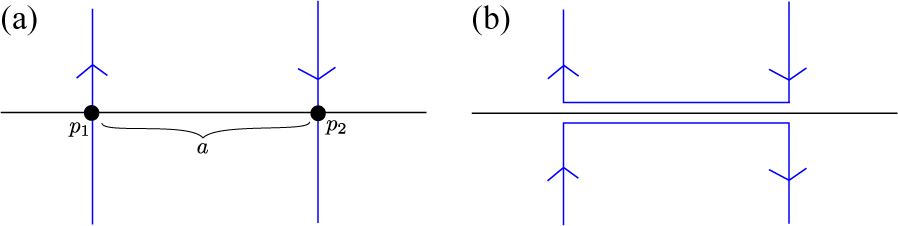
. Otherwise, if there were an arc a in
 $c_{2}\cap S_{g}(3,1)$
that is not separating, as a is on one side of
 $c_{3}$
, it is possible to surger
 $c_{3}$
along a, as shown in Figure 1(a). Doing so gives a multicurve with two connected components. Since a is not separating in
 $S_{g}(3,1)$
, neither of these connected components could be separating in
 $S_{g}$
. Each connected component is therefore a nonseparating curve, disjoint from every curve in the set
 $C_{+}\cup (C{\smallsetminus } \{c_{2}\})$
. This contradicts the fact that
 $C_{+}\cup (C{\smallsetminus } \{c_{2}\})$
determines a spanning set for
 $H_{1}(S_{g}; \mathbb {Q})$
.
(a) A portion of an oriented curve c is shown in blue. Let
 $\mathcal {T}_{\epsilon }(c)$
be a tubular neighbourhood of c of radius
 $\epsilon $
. The arc a has its endpoints on the curve and, for small
 $\epsilon $
, only intersects one connected component of
 $\mathcal {T}_{\epsilon }(c){\smallsetminus } c$
. (b) Surgering c along a involves cutting c at the points
 $p_{1}$
and
 $p_{2}$
, and gluing in two copies of the arc a to obtain a multicurve, a portion of which is shown in blue.

Since every connected component of
 $c_{2}\cap S_{g}(3,1)$
is separating in
 $S_{g}(3,1)$
, there exists an arc b in the intersection of the geodesic representative of
 $c_{2}$
with
 $S_{g}(3,1)$
such that every other connected component of the intersection of the geodesic representative of
 $c_{2}$
with
 $S_{g}(3,1)$
is on the same side of b in
 $S_{g}(3,1)$
. Surgering
 $c_{3}$
along b will therefore give a multicurve with two homotopically nontrivial connected components. Since b is separating in
 $S_{g}(3,1)$
, each connected component of the multicurve will be separating, and at least one connected component (the one to the side of b disjoint from all the other connected components of
 $c_{2}\cap S_{g}(3,1)$
) will be disjoint from
 $c_{2}$
and every curve in
 $C_{+}\cup (C{\smallsetminus } c_{2})$
. This contradicts the assumption that the curves in
 $C_{+}\cup C$
fill. There must therefore be curves of
 $C'$
contained in both connected components of
 $S_{g}{\smallsetminus } c_{3}$
.
The next step is to show that either the curve
 $c_{3}$
can be replaced by a separating curve strictly contained in
 $S_{g}(3,1)$
, or a curve
 $c^{*}$
proving Claim 1 is found.
Let
 $c_{4}$
be a curve in
 $C'$
with geodesic representative contained in
 $S_{g}(3,1)$
. If the curves in
 $C_{+}\cup (C{\smallsetminus } \{c_{4}\})$
do not fill, there is a separating curve
 $c_{5}$
that intersects
 $c_{4}$
and is disjoint from the geodesic representative of every curve in
 $C_{+}\cup (C{\smallsetminus } \{c_{4}\})$
. Since
 $c_{4}$
is contained in
 $S_{g}(3,1)$
, it follows that
 $c_{5}$
intersects the subsurface
 $S_{g}(3,1)$
. If
 $c_{3}$
and
 $c_{5}$
were disjoint, this would imply that
 $c_{5}$
is contained in
 $S_{g}(3,1)$
.
Claim 2.
It can be assumed without loss of generality that the curves
 $c_{3}$
and
 $c_{5}$
are disjoint.
Note that Claim 1 follows from Claim 2, as Claim 2 ensures the search for
 $c^{*}$
terminates. It therefore suffices to prove Claim 2.
Proof of Claim 2.
To prove Claim 2, suppose
 $c_{3}$
and
 $c_{5}$
intersect. Since
 $c_{2}$
does not intersect
 $c_{5}$
, the points of intersection of
 $c_{2}$
with
 $c_{3}$
are all on one side of
 $c_{5}$
. Choose a connected component a of
 $c_{3}\cap (S_{g}{\smallsetminus } c_{5})$
on the other side of
 $c_{5}$
. Denote by
 $\mathcal {T}_{\epsilon }(c_{5})$
a tubular neighbourhood of
 $c_{5}$
of width
 $\epsilon $
. Due to the fact that
 $c_{5}$
is separating, for small
 $\epsilon $
, the arc a only intersects one connected component of
 $\mathcal {T}_{\epsilon }(c_{5}){\smallsetminus } c_{5}$
, and is therefore an arc that
 $c_{5}$
can be surgered along as shown in Figure 1(b).
Surger
 $c_{5}$
along a. The result is a null homologous multicurve that does not intersect any curve in C except
 $c_{4}$
. Choose a connected component of this multicurve and call it
 $c_{6}$
. The curve
 $c_{6}$
is separating, because if it were not, a contradiction is obtained by observing that C determines a spanning set for homology, the algebraic intersection number of
 $C'$
with
 $c_{6}$
is zero, and
 $c_{6}$
only intersects one curve,
 $c_{4}$
, in C, with
 $c_{4}$
contained in
 $C'$
.
The separating curve
 $c_{6}$
has smaller geometric intersection number with
 $c_{3}$
than
 $c_{5}$
. Either
 $c_{6}$
is disjoint from
 $c_{3}$
, or this construction can be iterated to obtain a curve satisfying Claim 2.
Acknowledgement
The author would like to thank the IHES for its hospitality while this paper was written.