Most political scientists, political pundits, and Americans agree that problems exist within the United States' presidential primary system. These problems have been glaringly evident for almost 30 years now; while many have proposed reforms or argued for and/or against reforming the way in which we nominate presidential candidates (Morton Reference Morton2006; Bartels Reference Bartels1988; Busch Reference Busch2003; Crotty and Jackson Reference Crotty and Jackson1985; Cronin and Loevy Reference Cronin and Loevy1983; Gangale Reference Gangale2004; Hadley and Stanley Reference Hadley and Stanley1989; Marshall Reference Marshall1981 Morton and Williams Reference Morton and Williams2001; Norrander Reference Norrander2000), no feasible solution has been adopted.
Part of the problem may lie at the feet of our founding fathers, who did not foresee the formation of political parties competing for the presidency and provided no constitutional guidelines, footnotes, amendments, or clauses to address nominating the executive. However, more of the troubles with our presidential nomination system can be blamed on competing interests. “The nomination of presidential candidates is an issue that straddles the gaps in our federal system of government. It cuts across party lines and jurisdictional boundaries. No single political institution, either partisan or governmental, either state or federal, has clear authority on this issue” (Gangale Reference Gangale2004, 84).
This article remedies some of the current critiques of the presidential primary system by introducing a new, innovative approach to nominate a candidate for commander-in-chief. After a brief overview of the major criticisms concerning our current system, I outline the Voter Turnout Initiative, a reform that, if adopted, may create a presidential nomination process that fits more ideally within our American political system, rewards Americans for their efficacy, and, perhaps most importantly, provides simplicity and sensibility to portions of the process when little has previously existed.
The presidential nomination process has evolved from a top-down system in which elites chose the candidate who would carry the party's banner in the general election into a bottom-up system, the result of the McGovern-Fraser Commission's report, in which the voters choose delegates, who ultimately then choose the party nominee (Gurian and Haynes Reference Gurian and Haynes2003, 175). Although the current system is arguably the most democratic Americans have known and allows voters greater access to political participation during the process (Cooper Reference Cooper2001, 772), the perception that the system remains undemocratic persists.
This persistence is mostly attributable to many voters' lack of control in selecting the nominee. During the presidential primary season, voters in states at the end of the nomination process have virtually no choice in whom their party's nominee will be. Voters have little, if any, control over the order their state votes in the nomination campaign and no voice in the two states that have been at the front of that order for election cycle after election cycle. These factors lead to “candidates being chosen whose policy positions are more representative of early voters than of later ones” (Morton Reference Morton2006, 489). Furthermore, the claim that New Hampshire, the first primary, and Iowa, the first caucus, are unrepresentative of the rest of the country persists (Busch Reference Busch2003, 188; Scala Reference Scala2003, 187). This claim, however, would most likely continue regardless of which states commence the primary season.
The answer is not to eliminate early states in the process in favor of a regional or national primary, but to make the choice of which states vote early in the process logical, fair, and more democratic. “Front-loading seems to advantage well-known front-runner candidates. On the other hand, when primaries are drawn-out there is empirical evidence that voters learn information about candidates that allows them to make what may be more informed decisions” (Morton and Williams Reference Morton and Williams2001, 32–33).
In our current system, early primary voting states have a substantial advantage over those states that hold primaries later. Iowa and New Hampshire have welcomed this unwarranted privilege with open arms. New Hampshire has even passed legislation requiring their state to hold the first primary in the nation (Bosman Reference Bosman2007). The precedent of importance that Iowa and New Hampshire possess was set by president Jimmy Carter during his presidential candidacy 36 years ago. In 1976, Carter was elected president after polling just 30% of the Democratic support in the Iowa caucuses. Because Carter's percentage was significantly higher than the other candidates, the media quickly named him the “clear winner of the year's first presidential contest” (Purdum Reference Purdum2004). The caucuses were not even considered an integral part of campaigns until this period, creating a snowball effect that continues to this day. Since the 1976 nomination campaign, the primary system has become more contentious, with states leapfrogging one another, resulting in the front-loading of the nomination campaign.
Early voting states receive significant advantages from leading the pack, especially in terms of increased tourism. Iowa's economy grossed an estimated $50 to $60 million in revenue solely from the 2008 presidential caucuses, compared to the meager amount later states can expect to collect (Mehta Reference Mehta2008). The revenue is derived from hotels, restaurants, branches of tourism, and advertising sales.
In addition to increased tourism revenue, early primary states benefit from the candidates directly addressing the issues of concern to those states' citizens. Economist Harvey Siegelmen wrote, “Iowa's issues and strengths are highlighted on a national platform every four years, which is the kind of publicity no state could afford to buy” (Mehta Reference Mehta2008). Candidates mold their national platforms from these issues to achieve front-runner status. A prime example is the increased attention to ethanol interests in Iowa during every presidential campaign season. In 2005, a USA Today article argued, “the first caucuses of the 2008 presidential campaign are more than two years in the distance, but Iowa's interest in ethanol knows no season” (Malone Reference Malone2005).
The order in which states hold primaries not only has a profound effect on who the party nominee will be, but also determines which issues are emphasized by candidates to appeal to those early voting states. The issues of importance to voters in Iowa and New Hampshire also become the most important issues to the remainder of the country as well, because these two states typically “receive 10–20% of the total national news media coverage devoted to the nomination campaign; the other states typically receive less than 2% each” (Gurian and Haynes Reference Gurian and Haynes2003, 177). The early states in the nomination campaign receive greater advantages than those later in the season, for whom presidential candidates accommodate local interests and issues significantly more than later voting states (Morton and Williams Reference Morton and Williams2001, 18; Vavreck, Spiliotes, and Fowler Reference Vavreck, Spiliotes and Fowler2002, 596).
In addition to the significant influence these early states wield in deciding who the party nominees will be, states benefit from increased tourism, media coverage, and candidate promises to promote the economic and political interests of those early states. “The New Hampshire primary receives more coverage than any other state's race and more than most states combined (Buell Reference Buell, Orren and Polsby1987)” (Vavreck, Spiliotes, and Fowler Reference Vavreck, Spiliotes and Fowler2002, 596).
Other states realize the significant advantages of holding their nomination election earlier rather than later, which has resulted in the primary elections becoming more front-loaded, with states leapfrogging over one another to be at the front of the pack (Gangale Reference Gangale2004, 81; Morton Reference Morton2006, 476; Morton and Williams Reference Morton and Williams2001, 2). Rather than reforming the nomination process to embrace national or regional primaries, we need to recognize that early voting states are important. Retail politics in presidential elections is necessary. National or regional primaries would prevent candidates from meeting potential voters, as well as preclude candidates from building their support and fundraising throughout the primary season.
Personal contact between presidential candidates and voters is essential in our democratic system. This contact not only allows voters to meet and talk with candidates personally, but it increases efficacy by requiring citizens to actively engage in the electoral process (Vavreck, Spiliotes, and Fowler Reference Vavreck, Spiliotes and Fowler2002).
Personal contacts are different from other campaign stimuli in several ways. They not only bypass the filtering and interpreting functions of the news media and political elites, but they also involve nonverbal cues. In addition, some types of direct contact, such as attendance at a rally, involve mobilization effects because voters must do something such as go to the town hall, rather than simply receive a message. For these reasons, contact does more than simply provide information
(Hadley and Stanley Reference Hadley and Stanley1989, 596).Direct contact between voters and candidates is a hallmark of retail politics in America. Retail politics is a way for candidates to accustom themselves to the rigors of a presidential campaign, to learn first-hand the concerns of voters, and to create support throughout the primary season. For voters, retail politics provides personal contact and understanding of candidates and, most importantly, requires voters to actively engage and participate in our presidential electoral system (Vavreck, Spiliotes, and Fowler Reference Vavreck, Spiliotes and Fowler2002).
In framing the reforms necessary to repair the current presidential primary system, retaining early voting states is essential to maintain the importance of retail politics in the electoral process. The order of state primaries, however, must be logical, fair, and as democratic as possible. Is it democratic to allow Iowa and New Hampshire to reap benefits over other states based solely on their position in the presidential primaries?
In the 2008 primaries, Michigan and Florida attempted to position themselves earlier in the nomination process to gain some of the economic and social benefits enjoyed by Iowa and New Hampshire. As a result, Michigan and Florida were denounced by the Democratic Party, which threatened to not seat their delegates at the Democratic National Convention, thereby causing them to lose their voice in selecting the Democratic nominee for president.
A proposal reforming the presidential primary process into a system that consists of ordering the states in a logical and fair way is crucial. The Voter Turnout Initiative is a system that would allow states power and choice in determining their order in the presidential primary process. This reform proposes that the order of state primaries be based on the voter turnout of a state in the previous presidential general election. The order of state primary elections could alter every four years depending on the percentage of the state's registered voters who voted in the previous presidential election. Citizens would possess the power to influence their state's voting position. This system empowers the citizens of this nation to have a voice in the order of state primary elections.
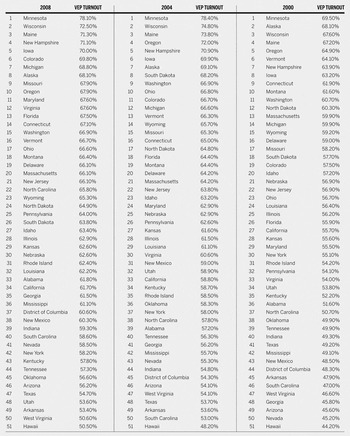
Using data from Michael McDonald from the United States Elections Project at George Mason University, table 1 shows the voter turnout for the 2008, 2004, and 2000 general elections by state. The Voter Turnout Initiative would allow states that are not usually considered important in the primary season by the presidential campaigns and the news media the opportunity to gain the attention usually enjoyed by New Hampshire and Iowa early in the presidential primary process. This friendly competition between states to move up in the primary rankings would influence the states to mobilize voters more strongly as well as influence the citizens to vote to give them a greater voice and advantage in the next presidential primary. The front-loading problem is caused by states wanting to have an impact and believing that they should not be less advantaged than another state. The Voter Turnout Initiative satisfies the problem by putting states in an order of their own creation.
General Election Voter Turnout by State, 2000, 2004, 2008

Note: VEP = voting-eligible population.
Source: United States Voting Project; http://www.elections.gmu.edu.
The Voter Turnout Initiative is based on only general election turnout results for several reasons. First, states can continue to choose between primary elections and caucuses. If the Voter Turnout Initiative were based on primary election voter turnout, states holding caucuses would be disadvantaged due to the lower voter turnout for caucuses and ultimately choose primary elections instead to compete. The Voter Turnout Initiative refuses to devalue the deliberative nature of caucuses and contributes to their demise. Second, many states hold separate presidential and state primaries. Using the voter turnout results from the general election alleviates the problem of deciding which of the turnout percentages to use. Finally, some states hold their Democratic and Republican primaries on different dates, which would make calculating total voter turnout more difficult.
Because no federal agency collects voter turnout percentages, the offices of state secretaries of state, which are generally in charge of collecting the state election data, would have to agree on a standard measure of voter turnout. Detractors of this plan may suggest that this initiative solves only the degree of arbitrariness that allows Iowa and New Hampshire to be first in the presidential primary process. Furthermore, it does little to alleviate the criticism that Iowa and New Hampshire are states with populations that are unrepresentative of the rest of the country. However, the nonrepresentational criticism would be most likely levied on whatever state happened to hold the first primary. Perhaps only a national primary would quell the criticisms of the first states to hold primaries being unrepresentative, but a national primary is clearly antithetical to the retail-based campaigning presented in the Voter Turnout Initiative.
Close observers of table 1 may perceive that voter turnout rates in states are somewhat correlated with state political cultures (Elazar Reference Elazar1972). States identified by Elazar has having moralistic political cultures are more likely to have higher voter turnout rates due to citizens' high political participation, while those identified as having traditionalistic political cultures tend to have lower voter turnout due to the citizenry's adherence to the status quo. Although this correlation presents some interesting research areas if the Voter Turnout Initiative were adopted, it does not present undue complications. The reality is that citizens who choose to vote will vote regardless of their state's political culture; and if their state's political culture is one that more citizens choose to vote, that benefits their state by enabling them to advance in the order of the primary elections. However, several critics of Elazar's state classifications suggest states have not been assigned the correct political culture (Schiltz and Rainey Reference Schiltz and Rainey1978) or that Elazar's research is impossible to replicate, which makes it unreliable (Erikson, McIver, and Wright Reference Erikson, McIver and Wright1987; Nardulli Reference Nardulli1990).
Basing the order of presidential primaries on voter turnout has greater advantages than merely providing a fairer way to determine the order of the states' primaries during the nomination campaign. “Low electoral turnout is often considered to be bad for democracy, whether inherently or because it calls legitimacy into question or by suggesting a lack of representation of certain groups and inegalitarian policies (Patterson Reference Patterson2002; Piven and Cloward Reference Piven and Cloward2000; Teixeira Reference Teixeira1992; Wattenberg Reference Wattenberg2002)” (Franklin Reference Franklin2004, 1). Increasing political participation allows citizens to use their voice, to choose the leaders who affect their lives, and creates higher government legitimacy (Hill Reference Hill2006, 7).
States and their citizens will also mobilize voters to take part in presidential elections in this reform plan.
Empirical research on voter turnout has shown the importance of mobilization. Caldeira, Patterson, and Markko Reference Caldeira, Patterson and Markko1985, in an examination of turnout in congressional elections in 1978, find that political mobilization is a significant determinant of voter turnout. Rosenstone and Hansen Reference Rosenstone and Hansen1993 present a detailed empirical study of the relationship between mobilization and participation
(Morton and Williams Reference Morton and Williams2001, 44).Political parties and candidates' campaigns would no longer be the sole mobilization efforts for voter turnout. However, research on voter mobilization by political parties and political organizations shows that when individuals are asked to vote, they are statistically more likely to do so (Hill Reference Hill2006, 19; Lewis-Beck et al. Reference Lewis-Beck, Jacoby, Norpoth and Weisberg2008, 103; Rosenstone and Hansen Reference Rosenstone and Hansen1993). Under the Voter Turnout Initiative citizens have another reason to vote: to help their state increase their voter turnout and move up in the primary order during the next presidential election cycle.
In addition to the front-loading problems, serious public concern exists over the length of the current presidential primary process. Americans have been overwhelmed with constant media coverage, political slander, and media advertisements. Many states vote several months after the candidates have been unofficially declared the party nominee, causing a domino effect of voter apathy and lower turnout rates.
In addition to changing the order of the states voting during primary season, the Voter Turnout Initiative involves altering the length of the nomination campaign. The proposed ten-week primary calendar would begin the first week in April and extend through the second week in June, with states holding primaries on Tuesdays and Saturdays. Those states holding primary elections in April would be rewarded for their efficacy, those held in June would reflect voter apathy in those states. As shown in figure 1, the calendar would progress gradually, with only six states holding elections in the first three weeks.
Proposed Primary Calendar
*This includes the District of Columbia

The states with the highest voter turnout would be rewarded with an exclusive primary date that would encourage candidates to concentrate on the issues of interest to those states. In the fourth week of the primary season, primary dates would be shared by two states; and eventually, in the last week of the primary season, six states would share a primary date. The only realistic way of preventing the media from saturating the primaries with coverage and alienating voters is by shortening the campaign calendar. A long, drawn-out schedule breeds apathy and confusion among voters and favors candidates with greater sums of money, placing less-funded and less well-known candidates at a disadvantage.
By rolling out the schedule in a gradual fashion note that the states that did not produce a higher voter turnout are not technically being punished for their lack of voter participation. In fact, states with the lowest voter turnout whose primary elections are scheduled in June still have certain advantages. A certain importance may be afforded to the latter states due to the large amount of potential delegates available, making later primary dates a vital part of the nomination. The slow graduation of primaries ensures that securing a nomination for any candidate is virtually mathematically impossible early in the process. The progression of the primary calendar also alleviates problems with the disproportionate weight now afforded to early states by consolidating the dates in which primaries are held. Any claims that the first few states to hold primaries are nonrepresentational are solved by the condensed calendar.
The current primary calendar “encourages candidates to criticize each other and to exaggerate nuanced differences in policy position” (Norrander Reference Norrander1996, 899). The gradual progression of the proposed primary schedule could potentially benefit lesser-known candidates by allowing them to connect to voters and raise more money (Steger Reference Steger2007, 92; Flanigan and Zingale Reference Flanigan and Zingale2006, 188–89). Primary candidates
do not have the luxury of beginning the primary cycle with the support of just one faction of the party, with the hope of adding other factions later in the process. Coupled with front-loading is the need to raise large amounts of money (at least 20 million dollars, conventional wisdom dictates) before the primaries even begin; in a front-loaded process, an insurgent candidate can no longer “live off the land,” counting on upset victories to bring more funds into campaign coffers, in order to fight and win another day
(Busch Reference Busch2003, 191).Campaign contributors learn about a candidate's electability and viability from early voting states (Gurian and Haynes Reference Gurian and Haynes2003, 177). Early successes during the first weeks of the primary campaign enable candidates to raise more money in the long run. “The advantage in campaign contributions is amplified by the fact that candidates' needs for resources increase with the number of states they have to cover in their campaigning—as they have to plan larger events, mailings, television and radio ads, and so on” (Morton Reference Morton2006, 478).
In addition, well-known candidates experience no disadvantages due to the change in the shorter primary campaign. The proposed calendar allows for candidates' momentum to grow throughout the campaign. Building momentum is essential for candidates to gain support—electorally, financially, and from the media—for later in the primary process (Morton and Williams Reference Morton and Williams2001, 21; Norrander Reference Norrander1996, 895). Gaining momentum “may increase perceptions of electability as well as perceptions of viability for those candidates who do well in the early nominating elections” (Steger Reference Steger2007, 98).
The change will also benefit primary voters, who may make more knowledgeable decisions than they would in a front-loaded or national primary (Morton and Williams Reference Morton and Williams2001, 7, 32–33; Norrander Reference Norrander1996, 884). The gradual progression of the primaries will increase political learning for voters and provide voters with knowledge concerning a candidate's viability and electability (Steger Reference Steger2007, 98; Morton and Williams Reference Morton and Williams2001, 3; Alvarez and Glasgow Reference Alvarez and Glasgow1997, 11).
IMPLEMENTING THE VOTER TURNOUT INITIATIVE
This proposed primary reform, the Voter Turnout Initiative, solves the problem of states jockeying for position to be near the front of the pack during primary season. Because the possibility of convincing states to voluntarily remove themselves from the beginning of the process is untenable and the prospect of national legislation to enforce its solution is arguably unconstitutional, this reform relies on the political parties for enforcement.
To institute this reform proposal, the political parties must adopt the precepts of the Voter Turnout Initiative during their 2012 national conventions. Because the adoption of a primary reform system relies on the political parties to endorse and enforce, the parties must agree on a set of sanctions for states that do not conform to this new system, including refusing to seat the delegates from any state in noncompliance with the Voter Turnout Initiative at the national convention.
Adopting the Voter Turnout Initiative through the political parties is the simplest way to achieve reform in this manner. The national government is not constitutionally permitted to dictate to states how primary elections must be scheduled; attempts to convince each individual state to change their state electoral laws have thus far yielded no results (Gangale Reference Gangale2004, 84). However, primary elections are the constructs of political parties. In California Democratic Party et al v Jones, Secretary of State of California, et al, the Supreme Court ruled “a state cannot force a political party to allow nonparty members to vote in their primaries unless the party chooses to do so—forcing the political party to allow nonmembers to vote when the party rules do not permit them to is a violation of the political party's constitutional right of freedom of assembly” (Morton Reference Morton2006, 115). The precedent set in this case may be applicable to allowing political parties to sanction states who refuse to comply with the Voter Turnout Initiative.
CONCLUSION
In his article supporting the proposed primary reform, the California Plan, Gangale also supports using political parties to enforce changes to the current electoral schedule, providing a probable scenario concerning what would occur if one political party adopted a reform idea while the other did not:
If the Republican Party were to adopt the California Plan at its national convention in 2004, this is what could happen in 2008. The Democrats, operating under the front-loaded schedule, determine their nominee in February. But no race means no news, and he or she immediately drops off the radar screen. Meanwhile, a half-dozen Republican candidates wage vigorous campaigns for months. By June, the contest boils down to two candidates, both of whom have built massive name recognition, while the Democratic nominee has languished in obscurity. Republican issues have been hotly debated and finely honed, and are at the forefront of the electorate's consciousness, while few have any idea of the Democratic nominee's vision for the nation. The Republican nominee has merely proven to be a masterful fundraiser, but may turn out to be a mediocre campaigner. This is a prescription for Republican victory in November. Of course, were the Democrats to be the first party to adopt this reform, the reverse scenario would apply
(Gangale Reference Gangale2004, 85–86).There is precedent for one political party following the reforms of another, including the selection of convention delegates (Mayer Reference Mayer1996, 719) and the institution of Super Tuesday (Hadley and Stanley Reference Hadley and Stanley1989, 20).
There are, however, potential complications for political party adoption. It is absolutely conceivable that one party would not follow the other, especially if the states with the highest voter turnout strongly favored one political ideology over the other. One solution to this problem would be to institute closed primaries in each state, thereby preserving the party faithfuls' choices of primary candidates. The issues associated with the potential for adopting the Voter Turnout Initiative are complex. However, if citizens were aware of the proposed nomination system, they may be able to pressure both states and political parties to adopt it.
The Voter Turnout Initiative would also recommend that each general election ballot have a no-vote option for citizens who wish to be accounted for voter turnout but do not intend to vote for any candidates on the ballot. This would allay fears of uninformed and apathetic citizens voting during the general election but allow for state residents to influence the order of their state in the next presidential primary. These citizens would then be able to enjoy the benefits of their primary being early in the process, such as increased tourism and political attention to the policy issues of importance to their states.
The shortened calendar requires more traveling for candidates and largely prevent their “camping out” in early states. Only states with the highest voter turnouts benefit prior to the actual primaries. The stability of the schedule allows ample time for candidates to campaign in a state, but also requires that they campaign in and travel to every state, so as not to alienate voters or stall their campaigns. This schedule breeds consistency, which is an ingredient the process now lacks.
Citizens will vote in greater numbers in hopes of becoming one of the early states at the beginning of the primaries, which allows candidates to delve more deeply into the individual needs of the people of those states. The Voter Turnout Initiative allows change to occur in the presidential primary voting process, which can positively alter the issues that states wish to address. What if the District of Columbia came first? What if Alabama was second? What if Alaska was third? This system makes it possible for every voter's voice to be heard.
An aspect of the Voter Turnout Initiative that demonstrates its true flexibility is that the states in the latter half of the schedule are not forever relegated to that low position. They, in fact, hold the power and the opportunity to make themselves an early April primary. By stimulating a culture of civic responsibility and increasing voter turnout in the state, a state can earn the right to be an early power broker, increase the attention to their state's needs, and increase tourism within the state.
The Voter Turnout Initiative eliminates Super Tuesdays or Tsunami Tuesdays, which cause candidates to favor the larger states in a cluster and ignore the smaller states. On February 5, 2008, Super Tuesday, very few candidates visited the states of Idaho, Kansas, and Delaware for any significant period of time, instead choosing to focus on larger, delegate-rich states like California, New York, and Illinois. The Super Tuesdays cause voters in America to lose that personal connection with the candidates. This solution maintains the retail politics aspect of the primary process, allowing candidates to meet voters, ask and answer questions, build voter support, attract financial contributors, and actively seek to remedy the problems that plague that area. The consistency of the ten-week schedule makes it possible for candidates to personally and properly address voter concerns, regardless of their state size.
There is, of course, the possibility that the first state to vote in the presidential primary may be a very populous one. For example, if California had the highest voter turnout in the previous general election, the state would win the opportunity to hold the first primary in the next presidential election. A populous state with the first primary would certainly eliminate the benefits of preserving the retail politics associated with a progressive primary calendar. However, presidential hopefuls would have four years to prepare for this scenario and mold their campaign strategies to the particular issues associated with the first state's primary. In addition, the second primary would occur only four days later; and the condensed calendar would require potential candidates to campaign in the first several states to gain momentum.
The Voter Turnout Initiative is proposed as a possible reform to the current presidential primary system that may expand political participation by the electorate, increase the democratic nature of our nation, and improve the quality of presidential candidates. Voters who believe that their primary vote has minimal effect on the party's nomination now will be empowered to change the order of primary states every four years, leading to greater voter turnout, increased civic responsibility, and a newfound political efficacy in America.