

Introduction
For the abolitionist movement against the death penalty, Asia, home to the majority of mankind, is seen as ‘the next frontier’.Footnote 1 The region's strong resistance to change arouses great interest of not only practitioners but also scholars in a bid to understand what the main causes are and how to rectify the status quo. This makes the continent a crucial laboratory for abolitionism. The trajectory of the death penalty in Asia will unveil whether the campaign against the state killing that has gained momentum since World War II is truly a global phenomenon.
With regard to capital drug offences, Southeast Asian nations are notorious for their zero-tolerance approach. Specifically, eight out of eleven countries retain the death penalty for drug-related offenses. The high number of death sentences for drug criminals and executions in those countries during 2015–2019 are a serious provocation to the global abolitionist movement.Footnote 2 Those countries could be grouped into three categories: Abolitionist (Cambodia, the Philippines, Timor-Leste); De facto abolitionist (Brunei Darussalam, Lao PDR, Myanmar); Retentionist (Indonesia, Malaysia, Singapore, Thailand, Vietnam). While not all of them carry out executions of drug offenders in practice, a commonality among these nations is that drug-related offenses are considered the most serious crimes. Hence, in their view, drug offenses should be punishable by the death penalty. This interpretation of international law, however, is ill-founded.Footnote 3
Death penalty for drug offenses frequently tops the international agenda. In response to robust calls for its abolition, a United Nations General Assembly's moratorium resolution was passed resoundingly on 17 November 2020 with 120 nations voicing support.Footnote 4 For its part, three Southeast Asian nations (Cambodia, Malaysia, Philippines) explicitly endorsed the resolution, while Singapore and Brunei voted against it; the rest abstained. The moratorium vote denotes the common view of the international community against the application of the death penalty. Also, it demonstrates Southeast Asian countries’ obsession with the death penalty, despite tireless efforts for change.Footnote 5 Evidently, there is much work to be done before Southeast Asian countries can give up their appetite for capital punishment.
The structure of this article consists of three main parts. The proceeding section will provide the starting point from the perspective of international law and Vietnamese criminal law. It reaffirms that the application of the death penalty is subject to very rigorous safeguards as provided under international human rights law. Accordingly, drug offenses do not meet the thresholds of the ‘most serious crimes’. This is a dynamic process of learning and opinion-shifting, rather than an abrupt change. This dynamic change is also witnessed in the case of Vietnam. The country has made effort to restrict the use of capital punishment on drug offenders, moving closer to be in line with international law. This shift is made incrementally alongside the process of international socialisation and the willingness to reshape its punitive approach to drug offences. Drawing on comparative scholarship, the section thereafter probes the question of whether there is any room left for the abolition of capital punishment for drug crimes. It concludes that although many factors relevant in other countries on this subject-matter bear little relevance to Vietnam's current context, but the total abolition of capital punishment for drug crimes is possible, albeit slim. Concluding remarks will be provided with key recommendations for Vietnam if capital drug crimes remain in its law.
The focus of this article is the death penalty for drug crimes. In the interest of clarity, an advocate for the abolition of capital drug offenses would denote reductionism rather than abolitionism. However, even reductionism may help spark the spill-over effect on the death penalty practice. Murder and drug offenses attracts most of the death sentences meted out in Vietnam's justice system. This is in part owed to the widely-held belief that those are heinous and punishable by death for the purposes of deterrence. Rethinking the seriousness of drug crimes can possibly (and hopefully) give rise to a grander discourse on the death penalty and its deterrent effect in the Vietnamese context.
The Dynamics of International Law and Vietnam's Law on Capital Drug Crimes
International Law and the Abolition of the Death Penalty on Drug Crimes: A Big-bang Moment or Progressive Learning?
Although the question of whether international law forbids the imposition of the death penalty on drug crimes is settled, there is a need to briefly review the development of international standards on this issue for the purpose of discussing a possible change in the case of Vietnam.
To start with, human right to life is protected under the international bill of rights. As a legally binding document, Article 6 of the International Covenant on Civil and Political Rights (ICCPR) protects everyone's inherent right to life as well as impose legal limits on the application of the death penalty. Despite abolitionist efforts during the drafting process of the ICCPR,Footnote 6 the proposal did not solicit sufficient support, though the attempt was not entirely fruitless as it resulted in a compromise between the abolitionist and retentionist camps.Footnote 7
The threshold for the application of the death penalty is entrenched in Article 6(2) concerning ‘the most serious crimes’. At the time of entrenchment, it was an innovation because flexibility was given to states to interpret the limitation provided their national circumstances. Yet this has also become a source of intense controversies due to the generic and ambiguous scope of the term. Many states availed themselves of this leeway to justify the retention of capital drug crimes while repelling the propensity for abolitionism.Footnote 8 Singapore is a typical example. Facing relentless criticisms from the international community, it vehemently rejects the narrow interpretation of ‘the most serious crimes’ which excludes drug crimes.Footnote 9 It follows that a large number of countries still hold the view that drug offenses satisfy the threshold of this category.
To rewind a bit, the UN Human Rights Committee's (HRC) early view on capital drug crimes was ambivalent. In country reports, the body implied that the use of the death penalty against drug trafficking was not incompatible with the spirit of Article 6(2) of the ICCPR. For example, while Bolivia's imposition of death sentences on drug crimes came to the attention of the HRC, the body omitted when addressing the country's report.Footnote 10 One of the very first documents for condensation of the body's view on the application and interpretation of the ICCPR, the ‘General Comment No. 6’ of 1982, touched upon the right to life. Regrettably, the Committee did not address the term ‘most serious crimes’ in details.Footnote 11 This opened the floodgate for member states to advance their own classification of crimes, justifying the zero-tolerance approach to drug offenses.
Together with the development of international law and increasing assertiveness, the HRC have repeatedly voiced its opposition against capital drug crimes. The HRC has made it clear that ‘drug-related offenses’ do not meet the threshold of ‘most serious crimes’ within the ambit of Article 6(2).Footnote 12 To put the quarrel to bed, the HRC's ‘General Comment No. 36’ of 2019 on the right to life explicitly pronounces that the category of ‘the most serious crimes’ must be interpreted restrictively and correspond only to those of extreme gravity such as intentional killing.Footnote 13 Hence, regardless of divergent understandings on the severity of drug crimes, the HRC is of the view that without an intention to cause loss of human life the gravity of such crimes do not amount to the category of the ‘most serious crimes’ and should not be punishable by death.Footnote 14 The imposition of the death penalty on drug crimes is thus incongruous with Article 6 of the ICCPR.
Despite the explicit call for the abolition of capital punishment for drug crimes, an elephant in the room is that the authority of the outputs produced by treaty-based bodies is subject to controversy. One of the main contentions is that the instruments of treaty-based bodies, the HRC for example, are void of legal force.Footnote 15 In the traditional school of international law, states assume interpretative responsibility, thus their definition of ‘most serious crimes’ trumps that of the HRC.Footnote 16 It is unnecessary to address this debate in length here. Clearly, the view above continually demonstrates the state-centric approach to international law and treaty interpretation. It fails to adequately factor in non-state actors’ interests and understanding of international law, as well as that of other relevant actors, to ensure the implementation of international law.
For what it is worth, the obscurity of legal binding value does not deprive the HRC's outputs of their legitimacy.Footnote 17 On the contrary, the Committee's interpretation still enjoys legitimacy for its standing – as the only body tasked with interpreting the Covenant – and pluralist drafting process.Footnote 18 We subscribe to John Tobin's thesis of the ‘interpretive community’ where states are central – but not exclusive – actors in treaty interpretation.Footnote 19 Apart from states, non-state actors, especially treaty-based bodies, have their stake in carving out and attributing a meaning to relevant human rights. A human rights norm does not necessarily hold the determinate meaning. Rather, the accepted meaning of a human right will be that which ‘attracts and achieves dominance over all other alternative understandings within the relevant interpretive community.’Footnote 20 This creates way for an evolutionary interpretive process where new understandings of any human right will arise over time.Footnote 21 More than merely giving or communicating a meaning, the HRC's interpretation should be seen as a dialogical process in which actors engage and seek to persuade the interpretive community to adopt a norm. It serves as an act of persuasion, ‘an attempt to convince the relevant interpretive community that a particular meaning from within a suite of potential meanings is the most appropriate interpretation to adopt.’Footnote 22 This denotes a communitarian model of international law which ‘vindicates values and pursues interests which cannot be said to be strictly an aggregation of distinct national interests.’Footnote 23
In this light, General Comment No. 36 is seen as an embodiment of that learning process, in which the HRC has gathered sufficient evidence to express its evolutionary view on capital punishment for drug crimes and the international consensus on this matter.Footnote 24 That, despite the ‘zero-tolerance’ grounds for this punishment, retentionist States still see a rise in drug trafficking.Footnote 25 Take Indonesia as an example: the deterrence effect of capital punishment was brought into question given that the high profitability of engaging in the drug trade continued to worsen the problem.Footnote 26 In addition, a grave concern stands as drug traffickers are just the tip of the iceberg, and drug lords remain in the periphery.Footnote 27 As a result, the kingpins continue to benefit on the back of the vulnerable. According to a 2007 UN General Assembly resolution, ‘there is no conclusive evidence of the deterrent value of the death penalty and that any miscarriage or failure of justice in the implementation of the death penalty is irreversible and irreparable.’Footnote 28 As also noted by the Human Rights Council, capital punishment for drug offenses are disproportionately punitive with little evidence to buttress its aim of deterring their commission.Footnote 29 Therefore, proponents of capital punishment should consider it, to quote Roger Hood, ‘useless cruelty’.Footnote 30
Vietnam's Incrementalism Towards the Abolition of Capital Punishment for Drug Crimes
The nascent state of Vietnamese criminal law was mainly driven by class struggle. In 1945, the nation under the leadership of the Vietnamese Communist Party succeeded in declaring its independence from the French coloniser. Amidst the volatility of the war for independence, the newly-born State of Viet Nam was predetermined to keep all French-made legal documents in place, including the Criminal Code, because of a lack of resources for building a brand-new comprehensive criminal system. Subsequently, the State quickly adopted a harsh stance against crimes, especially counter-revolutionary elements and the bourgeois, in an attempt to protect the fruit of the proletarian revolution and also ensure a crime-free communist ideal.Footnote 31 Death sentences were deemed a ‘necessary evil’ to that end. Against that backdrop, the number of capital crimes from 1945 to 1959 rose to 53.Footnote 32 Between 1959 and 1985, this number dropped to 35 due to the suspension of colonial law.
Ten years after national reunification, Vietnam enacted a comprehensive criminal code in 1985.Footnote 33 Still bearing a strong imprint of class struggle, compounded with major socio-economic change, the 1985 Criminal Code reserved death sentences for 44 crimes, making up for 20.5 per cent of the Code's 216 provisions – an 25 per cent compared to the Code's predecessor.Footnote 34 As suggested by John Quigley, the use of the death penalty in Vietnam during this time was profoundly shaped by its political ideology and economic circumstances.Footnote 35
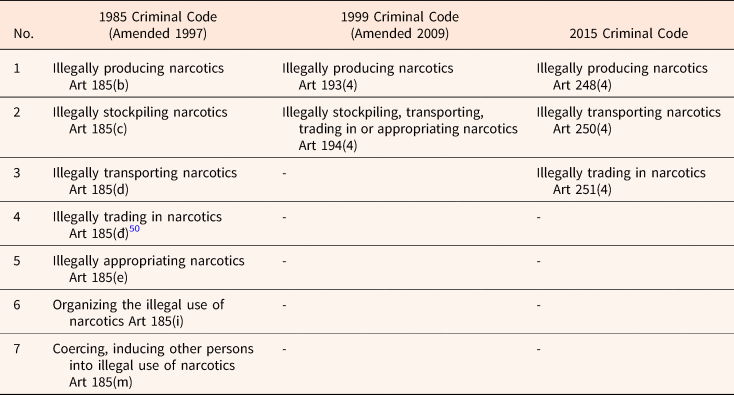
For drug-related offenses, the Vietnamese regime adopted a distinct approach.Footnote 36 This is evinced by the fact that the Code imposed the death sentence on one drug crime only, namely for organising the illegal use of narcotic drugs (Article 207), which was characterised as a ‘very serious’ crime under the chapter titled ‘Offenses Against Public Order’. Nevertheless, the perils of rampant drug-related activities made law-makers rethink their approach, and in 1989 the Code was amended to introduce the death penalty for a wide range of drug crimes including for the illegal production, stockpiling, transport, and trading in narcotics (Article 96a) which was provided in the chapter on ‘Offenses Against National Security’. In 1997, the Code was amended for a second time to introduce two more drug crimes punishable by death: the illegal appropriation of narcotics (Article 185e) and coercing and inducing other persons into the illegal use of narcotics (Article 185m). This amendment also aggravated the punishment for the illegal use of narcotics by imposing the death penalty (Article 185i). Strikingly, drug crimes were addressed in a separate chapter from other categories of crimes, namely ‘Drug-related Offenses’. Declassifying drug crimes from being concerns of national security have strong implications since that category was normally characterised as concerning the most serious crimes that are punishable by death. The introduction of a new chapter on drug-related offenses denoted that, in the view of the legislators, drug crimes were of a different nature. Ever since then, the chapter on drug crimes has been maintained in later criminal codes.
Nevertheless, the use of the death penalty has witnessed a major decrease since 2000s. With the migration of new concepts such as ‘market economy’, ‘the rule of law’, and ‘human rights’, Vietnamese criminal law was given a new look. The underlying foundation of the death penalty shifted towards a more humane, human-rights-based stance as opposed to being primarily retributive.Footnote 37 Part of the reason to explain this departure is Vietnam's attempt to mingle with the international community for strategic purposes. By making itself exposed to international law issues, including international dialogues about human rights,Footnote 38 the ruling party is incentivised to play by commonly-recognised rules. To put changes in motion, the Party's Political Bureau issued two important normative documents, ‘Resolution No. 08 on Forthcoming Principal Judiciary Tasks’ (2002) and ‘Resolution No. 49 on Judiciary Reform up to 2020’ (2005). These resolutions were issued with a view to gradually reduce the use of the death penalty.Footnote 39 This development should be seen in light of Vietnam expressing its willingness to be bound by international human rights treaties in 1982, particularly the ICCPR.Footnote 40
This reductionist trend made incremental progress. The 1999 Criminal Code that replaced its 1985 predecessor, comprised 24 chapters and 267 provisions, was a progressive, albeit minor, step toward the abolition of the death penalty, especially for drug-related offenses. Accordingly, the death penalty no longer applied to the crime of coercing and inducing other persons into illegal use of narcotics (Article 200). This Code was later amended in 2009, and the drafting process of the amendment was illuminating. Invoking the danger and interrelatedness of all drug crimes, many law-makers lambasted the proposal to split up the crime of ‘illegally stockpiling, transporting, trading in or appropriating narcotics’ into two provisions, ie, the crime of illegally stockpiling, transporting narcotics on the one hand, and the crime of illegally trading in or appropriating narcotics on the other.Footnote 41 This was considered a step to reshape the punitive approach to each category – a basis for the abolition of the death penalty. But some law-makers strongly opposed the amendment and regarded the abolition of capital punishment for drug crimes as a ‘retrogression’ in light of drug offenders’ ‘fiendish plot’.Footnote 42 This proposal did not solicit enough support for approval. Regardless, the National Assembly managed to abolish capital punishment for the crime of organising the illegal use of narcotics, citing the State's refined understanding of ‘most serious crimes’ in light of international human rights law.Footnote 43 To justify the proposal, a Ministry of Justice delegate stated before the National Assembly that this proposal was the result of a thorough study and critical evaluation of three elements: the severity of the offense, the deterrent effect, and the global trend towards abolitionism and restriction of the death penalty.Footnote 44 Hence, drug crimes punishable by death under the amended 1999 Criminal Code was reduced from seven to five.
Another radical development was displayed by the change of the method of execution and the reclassification of offenders subject to the death penalty. The brutality of death by firing squad had been subject to heated public debates.Footnote 45 This led to the employment of lethal injections since 2011 as Vietnam's execution method so as to mitigate any adverse impacts on both death row inmates and the execution officers.Footnote 46
The reductionist trend became increasingly visible in recent times. The enactment of the Constitution of the Socialist Republic of Vietnam 2013 (‘the Constitution’) was the founding stone for various legal reforms, including the 2015 Criminal Code. As the human right to life was constitutionally entrenched for the first time,Footnote 47 the making of the constitution sparked scholarly interests in the tension between the inherent right to life and the practice of the death penalty in Vietnam, which then re-emerged in the drafting debate on the Code. Eighteen capital crimes were retained in the 2015 Code as they were characterised as the worst types of crimes. These include to crimes involving national security, murder, war crimes, crimes against humanity and drug-related crimes. For capital drug crimes, departing from its predecessor, the 2015 Criminal Code assigned different levels of seriousness to the crimes of stockpiling, transporting, trading, and appropriating narcotic drugs. It thus separates these crimes into three provisions. Notably, the death penalty can be imposed against the crimes of illegally producing narcotics (Article 248(4)), illegally transporting narcotics (Article 250(4)), and illegally trading narcotics (Art 251(4)), while the crimes of illegally stockpiling and appropriating narcotic drugs were exempt from the death penalty. Therefore, currently, there are only three capital drug crimes in Vietnam.
The drafting process of the new Criminal Code was indicative in that reductionism was fuelled by rule of law and human rights principles,Footnote 48 however rhetorical it was. In its explanatory report on the amendment of the 1999 Criminal Code, the Government showed readiness to renew the punitive approach to criminal punishment in order to strike a balance between deterrence and human rights protection as entrenched in the Constitution and the international human rights treaties to which Vietnam is a State-party.Footnote 49 In this vein, the human rights argument seemed to gain currency in the death penalty discourse. Also, it bears noting that the law-makers and the government appeared to be on the same side in terms of restricting the use of the death penalty and observing higher thresholds for its use in consideration of the global movement against capital punishment.Footnote 51 Moreover, the list of those exempted from the death penalty should be expanded to exhibit the humanitarian nature in Vietnam's approach to criminal punishment.Footnote 52 Besides this, recent concerns on miscarriages of justice have fuelled support for the abolition of the death penalty.Footnote 53 As Vu Cong Giao and Nguyen Thuy Duong have pointed out, miscarriage of justice takes shape in the use of torture and coercion into giving false confessions, officials’ misconduct (ie, by prosecutors, police, or the members of the judiciary), inadequate legal representation, public or political pressure to expedite a case; and prejudice against drug offenders.Footnote 54 However, as shown below, against the backdrop of the popular and elites’ support, it remains unclear as to whether this argument can gather steam in advancing the abolitionist trend in Vietnam.
The Changes to Capital Drug Crimes in Vietnam's Criminal Codes

The Abolition of Capital Drug Crimes in Vietnam: Hitting a Brick Wall?
This section now turns to examine how change towards abolition can be made in compliance with international law, and in particular, probe the question of whether there is any room left for the abolition of the death penalty in Vietnam. The first subsection investigates the agents required to foster this change, and the next subsection discusses the case of Vietnam. In general, this section demonstrates how Vietnam's dialogical engagement with international actors has helped, to a certain extent, refine its understanding of capital drug crimes. However, its compelling effect on abolitionism remains to be seen.
The Determinants for Abolitionism
In recent times, the body of comparative scholarship on the practice of death penalty have been burgeoning. Relevantly, drawing on national trajectories, scholars have found a link between abolitionism and the emergence of certain catalysts.Footnote 55 These include political transformation, political leadership, economic development, the increasing awareness of human rights, external pressure, regional dynamics, and low execution rates.
First, political transformation indicates an abrupt moment when a country in the reconstruction process attempts to move away from its deplorable past.Footnote 56 In this light, the death penalty is considered an arbitrary device of the repressive establishment to silence critics. Adopting international human rights norms strengthens the newly instated regime's legitimacy and facilitates the transition process. South Africa is a textbook example of the abolition of capital punishment during the early stage of democratisation, and demonstrated the hope to untether itself from the heinous Apartheid regime. In contrast, Japan missed its opportunity for abolition as the ruling party's ideology (which supported capital punishment) remained strong even after its defeat in the Second World War; and the US, the helping hand in Japan, deemed it to not be a pressing issue at the time either.Footnote 57
Second, political leadership is an important element. Regardless of prevailing public opinion, leaders with progressive agendas are expected to reform criminal penalties.Footnote 58 However, top-down change would bring into question the democratic roots of that change. During the process of abolishing capital punishment, political leaders should facilitate the change of the people's perception towards this issue in order to consolidate support for reform.
Third, economic development is seen as a force driving countries away from the death penalty.Footnote 59 With the emergence of new social classes, economic development is arguably an important factor in pushing for more liberal reform. This development process also creates higher accessibility to education, which in turn can condition society to treat each other in a more tolerant and humane manner. However, quantitative studies have found no strong correlation between economic development and societal favourability of the death penalty.Footnote 60
The fourth recurring factor is the framing of the death penalty as a human rights issue, rather than a matter of criminal justice. This way of framing decentralises the exclusive power of a State in dictating on its criminal law and policy, and makes the death penalty a reputational issue. As the jurisprudence of UN and treaty-based bodies become crystal clear with regard to drug offenses, States are faced with the dilemma of abiding by international law or coming under fire in international forums.
A fifth and relevant factor is external pressure. As observed by Hood and Hoyle, the European Union has been highly active in exerting political pressure.Footnote 61 Sangmin Bae has made similar remarks about the role of the European Union in persuading and compelling countries such as Poland and Ukraine into abandoning the death penalty whilst on their way towards gaining full EU membership and integration.Footnote 62
A sixth factor is regional dynamics. This involves States mimicking their neighbouring countries, in terms of policy-making, especially where they face similar circumstances and similar policy choices.Footnote 63 Thus, the enactment of binding, regional human-rights charters, or participation in bilateral and multilateral dialogues can increase the likelihood of abolition.Footnote 64 Relevantly, the absence of intra-regional pressure in Asia is seen as a catalyst for the retention of the death penalty in most States in the region.Footnote 65
Finally, existing low execution rates are an indicator to show a State's reluctance in killing its citizens. As observed by Johnson and Zimring, the majority of countries that reached full abolition were able to do so at ‘practically no pecuniary cost and without the need to refashion their systems of criminal justice or crime control’ owing to their low rates of execution.Footnote 66 In a similar vein, Hood and Hoyle opine that abolition is possible if the death penalty can no longer prove its practical role in the criminal justice system.Footnote 67 This may be facilitated further by a change in the criminal context, such as crime rates dropping sharply.Footnote 68 However, other commentators remain suspicious of the effect of this factor as they argue that conducting fewer executions does not trigger much attention and opposition against the death penalty, resulting in less incentive to abolish it.Footnote 69
From a different perspective, these factors can be divided into two categories on the basis of the direction of their impacts: domestic and international. While some pressures towards abolition are exerted from above with the omnipresence of international actors, others manifest at the domestic level. All of these factors contribute towards spurring a State to abandon the death penalty. Needless to say, in certain countries, some determinants are compelling enough to drive the government toward abolition; while in others, despite the emergence of many of these same factors, ceasing of state-sanctioned killing in this manner is far from sight. For example, Dave McRae submits that albeit various robust catalysts, Indonesia's execution of fourteen drug offenders in 2015 put on the brakes on the country's abolitionist movement.Footnote 70 Hence, those determinants are suggestive of a possible change rather than an assurance of change.
Contextualising Vietnam's Trajectory Toward Abolishing the Death Penalty for Drug Offenses
Having those determinants for abolition in mind, this subsection aims to probe into whether Vietnam has any space to root out the death penalty against drug crimes. As it suggests, international socialisation plays a pivotal role in reshaping Vietnam's understanding on the severity of drug crimes. But some bounds are seen. Without continuing to ‘renovate’Footnote 71 its own understanding, the country remains resistant to abandoning the death penalty for drug criminals.
First, Vietnam has a long communist history. The collapse of communism in Europe wracked the brains of many Vietnamese communist leaders about how to save the regime from ideological crisis. But it was also a blessing in disguise. The crisis was the main catalyst for structural reforms and the democratisation process that has been put in motion by the regime since 1990s. The resilience of the regime is partly attributed to its openness to change as an appeal to foreign resources.Footnote 72 However, despite reform efforts, the ruling party's conception of democratisation and democracy is somewhat different from the convention in constitutional liberalism.Footnote 73 Sporadically, Vietnamese leaders implicitly reject pluralism and Western-style democracy, claiming them to be unfit for Vietnam's idiosyncratic cultural and political climate.Footnote 74 The Leninist principle of democratic centralism is widely practiced within the State's power structure.Footnote 75 Without any disruptions to this status quo, the prospect of regime change is not in sight.
Second, in Vietnam, reforms are often elite-led.Footnote 76 At first, the Đổi Mới initiatives were limited to the economic sphere. Nonetheless, the country's political and legal systems were not immune to the demands of reform,Footnote 77 and a comprehensive overhauling of the legal system and institutions ensued. Socialist market economy, rule of law, human rights, and democracy became the buzzwords of a new era. Criminal law was renovated with new values such as human rights and restorative justice being included and regarded as foundational.Footnote 78 The two most recent iterations of the Criminal Code – that of 1999 and 2015 – witnessed considerable contraction in the number of capital drug offenses.
However, the drafting process of the 2015 Criminal Code hinted at some adversarial factors. Despite unsubstantiated evidence, many legislators were of the view that capital punishment for drug crimes might produce some deterrent effect to stem its spread.Footnote 79 The retributive stance still bears a strong imprint as legislators often claim that the death sentence is the proportionate punishment for heinous crimes, including those relating to narcotics.Footnote 80 Moreover, Vietnam's death penalty is carried out behind closed doors and the law strictly prohibits the disclosure of any information concerning the death penalty. This makes data on the death penalty in Vietnam a state secret and remains unknown to the general public. In all, these denotes the Vietnamese government's paternalistic policy stance, which in turn poses hurdles to efforts that can spark discourses on the nature and use of the death penalty in the domestic context.
Third, Vietnam has reaped a bounty of economic fruit since its bold Renovation program in 1986, together with surprisingly outstanding records of poverty alleviation and access to a decent standard of education. To be fair, grand structural reforms had major effects on the nation's legal system and thinking,Footnote 81 but the Vietnamese economy remains relatively small, fragmented, and reliant on foreign export markets despite experiencing miraculous growth.Footnote 82 A fragile economy reliant on foreign trade might render the country weak when resisting universal norms considering its vulnerability to international sanctions. This explains the State's willingness to learn from the international community, and bring its laws and institutions closer to be in line with international standards without giving up political power.
With higher accessibility to education, the Vietnamese people are better equipped to meet the world's needs in various sectors. It bears noting that they were actually inspired by the idea of human rights and fundamental freedoms from their own fight for national independence. In his extensive study, Bui Ngoc Son argues that despite the international criticisms of Vietnam's human rights records, human rights have secured a solid footing in its four constitutions over the past sixty years.Footnote 83 As the State gradually loosens its control on many policy fronts, the country has seen a considerable rise in human rights discourse among policy-makers, scholars, and ordinary people.Footnote 84 Therefore, framing an argument against the death penalty in human rights language has a great effect in catching the attention of the State. This has been witnessed in the deliberation of the National Assembly on the drafting of the constitution and laws.Footnote 85
However, the effect of this factor should not be overstated since public and elite opinions remain nuanced. As indicated in some surveys, public opinion on the death penalty is mixed and even conflicting.Footnote 86 In one of the rare surveys on this topic, Vu Thi Thuy found that, in 2006, 91 per cent of respondents expressed support for the death penalty; this number climbed to 94 per cent in 2016.Footnote 87 More relevantly, in a recent survey co-sponsored by the United Nations Development Program (UNDP), the European Union and Vietnam on the possibility of the abolition of the death penalty for drug crimes, it was found that less than 15 per cent of Vietnamese respondents supported such a change.Footnote 88 This is partially attributed to the fact that drug crimes and criminals are continually vilified in mass media. Narcotic drugs and criminals are depicted as ‘white death’ and thugs who disperse suffering and despair onto the innocent.Footnote 89 In this light, public security and safety are compromised by the grave consequences of drug crimes, resulting in the ‘loss of many souls’, ‘futureless people’, and ‘domestic decay’.Footnote 90 In addition, depicting drug crimes in moral language and war metaphors has been a way to rally the popular support for anti-drug campaigns, transforming such campaigns into wars against ‘evil’. This narrative continues to hold the public hostage in fear of the perils arising from drugs, and thus enhances the appetite of the majority in Vietnam for the zero-tolerance of the death penalty as a measure against these crimes.
Although not explicitly expressed, Vietnam is an advocate for cultural relativism, supporting ideas such as the ‘Asian values’ concept to subdue the undesirable influence of the global human rights movement and abolitionist trend.Footnote 91 It follows that while a ‘naturalist’ view of human rights has gained currency, the statist approach to individual rights remains strong in Vietnamese legal culture.Footnote 92 However, the claim that Asian values and Confucianism promote the death penalty is a fallacy or misinterpretation of doctrine. As argued by Sangmin Bae, traditional Confucian doctrine actually deems the death penalty neither necessary nor desirable in countries that govern benevolently and virtuously.Footnote 93 Indeed, ‘“If excellent people managed the state for a hundred years, then certainly they could overcome cruelty and do away with executions” – how true this saying is!’, wrote Confucius.Footnote 94
Nevertheless, external pressure seems to be a relevant factor in the Vietnamese context where abolition is concerned. For strategic reasons, international acceptance matters a great deal to Vietnam in its international integration strategy and survival. The country has committed itself to playing by international rules, and various legal reforms have thus ensued as a result. To be sure, policy-makers are acutely aware of State obligations under international law. For instance, during the drafting of the 2013 Constitution, the international bill of rights was heeded thoroughly. Some constitutional drafters availed themselves of international human rights treaties of which Vietnam is a signatory, and use them as a benchmark to ensure the Constitution's compatibility with the country's international obligations.Footnote 95
Human rights dialogues between Vietnam and her peers, and with international bodies, have also burgeoned. Annual bilateral talks have been held between Vietnam and the United States, European countries, Australia, and Canada on various human rights issues of mutual concern, ranging from the rule of law and freedom of religion to freedom of expression and labour rights.Footnote 96 The death penalty regularly tops the discussion agenda between Vietnam and Australia, the European Union, Norway and Switzerland.Footnote 97 In light of Vietnam's desire to gain international credibility, Vietnamese officials have adopted a cooperative attitude toward these dialogues, resulting in the subsiding of emphasis on public security as a justification for retaining the death penalty. The mechanisms of dialogue and persuasion have also been used by Vietnamese and foreign scholars, the UNDP, Amnesty International, and other non-governmental organisations to capture the attention of the State and urge its action on this matter.Footnote 98
At the international level, Vietnam has engaged in dialogue with international bodies such the HRC through its country reports,Footnote 99 and the Human Rights Council through the Universal Periodic Review (UPR).Footnote 100 In three UPR cycles (2009, 2014, 2019) and country reports to the HRC in fulfilling the periodic report obligation (2001, 2017), Vietnam's progress towards death penalty reductionism could be observed. Noteworthy is the fact that despite its continued citation of popular opinion to brush off critics, Vietnam's responses to the recommendations of peers and international bodies on the issue have been increasingly engaging and constructive.Footnote 101 During its third UPR cycle, the Vietnamese delegation stated:
[G]iven the country's particular circumstances, the death penalty remained a necessary measure to prevent the most serious crimes, in line with article 6 of the International Covenant on Civil and Political Rights … Viet Nam is currently studying the Second Optional Protocol to the International Covenant on Civil and Political Rights, aiming at the abolition of the death penalty.Footnote 102
This statement shows that the dialogic learning process undertaken by the Vietnamese government has an effect on her perception of the use of the death penalty. It resonates with her voting patterns on moratoriums concerning the use of the death penalty in the UN General Assembly from 2007 to 2016. Vietnam's retentionist neighbours such as Brunei Darussalam, Malaysia and Singapore – fervent supporters of capital punishment – have consistently voted against the General Assembly's resolutions on the death penalty, while Lao PDR (de facto abolitionist) and Vietnam have abstained on all resolutions.Footnote 103 As observed by Pascoe and Bae, abstention is ‘a temporary and politically safe choice during a time of change’,Footnote 104 which is most often exercised by de facto abolitionist countries or those considering a move toward becoming abolitionist either in law or in practice. These indicate that Vietnam has remained on the fence on reconciling global abolitionist norms and its domestic interests. In so doing, it has chosen the ‘temporary safe choice’ to buy time for learning and possibly reshaping its perception of this policy. This view echoes the observation made by Lindsey and Nicholson in 2016 that with an increasing willingness to blend in and learn from the international community, Vietnam has emerged as one of the Southeast Asian countries with more likelihood to limit this form of state killing.Footnote 105
However, external pressure is a wild card. Vietnam stands out from the others such as Poland in the way that there is no regional or international mechanism with teeth that could compel it towards heading in a single direction. So far, Vietnam has ratified seven out of nine core international human rights treaties,Footnote 106 but it always puts forward reservations on dispute settlement mechanisms entailing a binding decision.Footnote 107 These claw-back clauses serve as a face-saving provision to shield Vietnam from harsh critics and adverse legal consequences that might be produced by these mechanisms. It, therefore, signifies that while the country pushes hard for international integration, this process also has its limits. As long as a possible policy change imperils the regime's legitimacy, it is unlikely to be adopted. It goes without saying that the Party-State that claims to be the vanguard of the Vietnamese peopleFootnote 108 sees drug offenses as social evils jeopardising people's life and social security on a large scale. Therefore, death is viewed as the proportionate punishment for drug offenders; otherwise, its legitimacy as a paternalistic State would come into question.
Worse yet, regional inertia could consolidate the zero-tolerance approach to drug offenses. It is no secret that Southeast Asian leaders do not show much empathy towards drug criminals. The populist Philippine President Rodrigo Duterte won a landslide election for having earned the reputation as ‘The Punisher’ in his relentless war on drugs.Footnote 109 As a consequence, the country has seen the resurgence of the death penalty debate on legal and socio-political fronts.Footnote 110 Departing from its voting record, the Philippines abstained in 2016 from a moratorium resolution sponsored by the UN General Assembly. In March 2021, a bill to reintroduce the death penalty for drug crimes was approved by the Philippine House of Representatives and is now awaiting the Senate's vote.Footnote 111 Malaysia adopts a hard stance against drug criminals by imposing the mandatory death penalty for related offenses. A Malaysian official even publicly stated that the abolition of the death penalty would be a ‘step backward’ in their war against drugs.Footnote 112 In the first half of 2015, global attention was drawn to Indonesia's execution of fourteen drug offenders, representing an abrupt departure from the country's previous record of two death sentences a year on average.Footnote 113 Citing drug crimes to be of the most serious nature, perhaps Singapore is the most vocal in invoking the sovereignty principle to ward off external intervention in its policy-making.Footnote 114 Likewise, in addressing international criticism, Vietnam has availed itself of the similar reasoning.Footnote 115 In 2016, ASEAN leaders vowed their commitment to ‘a zero-tolerance approach in realizing the regional vision of a drug-free ASEAN.’Footnote 116 Besides ASEAN, China is also an influential retentionist country in Asia. Given the two countries’ similar political and cultural climate, Vietnam has learnt from and mirrored some of China's legal developments.Footnote 117 Despite their convergence towards reductionism,Footnote 118 China's continued resistance against the abolition of the death penalty applicable to drug crimes might consolidate the hard-line approach of the Vietnamese authorities on this matter. Thus, the wars on drugs in Asia have become increasingly intense and perplexing. A common variable is that in advocating for the zero-tolerance punishment against drug criminals, these countries have frequently resorted to populist sentiment and the demonisation of drug criminals.Footnote 119 This has helped produce a strong democratic base for their retention. Ironically, ‘regional dynamics’ seems to be an impeding factor, rather than facilitating factor, for the abolition of capital drug offenses in Vietnam.
The last determinant is the number of executions, which does not seem favourable for abolitionists either. Murder and drug crimes are two categories of criminal offences accounting for the most death sentences in Vietnam.Footnote 120 But gathering data on this matter is tricky because they constitute state secrets. According to his own counting, Luong Thanh Hai has noted that over the eight-year period of 1993–2001, as many as 1,179 people were sentenced to death at trial in the first instance (about 147 people per year).Footnote 121 Between 2001 and 2010 (excluding 2003 and 2004 for which there is no data), the number of death sentences was 1,421 (about 177 a year).Footnote 122 Drug crimes make up a significant fraction of the death sentences. It is suggested that between 2001–2010, 40.04 per cent of death sentences were handed down to drug offenders.Footnote 123
In addition, illicit production of and trafficking in narcotic drugs have been a perennial woe in Vietnam. The country is located in the vicinity of the Golden Triangle, an intersection between Myanmar, Laos and Thailand, which is a hyperactive hub of the drug trade and drug trafficking. Between 2007 and 2017, there were 151,570 drug-related cases (account for 19.29 per cent of total criminal cases) involving 192,577 drug offenders (15.92 per cent of all defendants).Footnote 124 Of these, illegally transporting and trading in narcotic drugs are the most common offences, making up 99.35 per cent of all drug-related cases and involving 99.14 per cent of all suspects.Footnote 125 Worse yet, these numbers are just ‘the tip of the iceberg’ given that cunning traffickers always have their way to evade law enforcement agencies.Footnote 126 This volatile drug environment has fuelled the authority's call for the retention of drug crimes that attract the death penalty.
Conclusion: what now?
It is evident that the abolitionist trend has gained traction worldwide in the 21st century. Asia, a region of stalwart supporters of the death penalty, has become ‘the next frontier’ for human rights activists, and a laboratory for scholars to gauge incentives and trade-offs behind a nation's policy action. It is clear that abolitionist campaigns have faced various hurdles in this ‘battlefield’ as many countries still retain a disproportionately punitive approach to criminal offenses, especially those involving narcotics. To be sure, international law is not on their side. The HRC has elucidated the nature of ‘the most serious crimes’ in light of international human rights standards, which precludes the application of the death penalty on drug offenses. But opposition and resistance in Asia remains substantial.
In Vietnam, the abolitionist movement have met resistance from the dominant public opinion and the State's tough stance on crime deterrence. On the international stage, Vietnam does not face any international or regional enforcement mechanisms. Clearly, the country, geographically adjacent to retentionist countries, has little incentive to expedite its work towards death penalty abolition. The durability and resilience of the Party-State is remarkable, and abrupt change to the constitutional order is highly unlikely. On top of that, the situation of drug crimes in the country is highly complicated and volatile. All these compounded will certainly complicate the issue and water down domestic abolitionist efforts in times to come.
The justifications for capital punishment in Vietnam resemble those of retentionist countries, including a popular appetite for punishing wrong-doers and deterring crimes. This view is deeply embedded in their cultural norms, traditions, and customs.
Grappling with the shifting sands of public attitudes is, however, tricky. In a study of seventeen retentionist countries, Steven Stack has made two insightful conclusions.Footnote 127 First, people living in a retentionist country tend to support capital punishment.Footnote 128 It is suggested that people are guided by their shared cultural norms. This explains why popular support for the death penalty in a retentionist country remains high despite the presence of the many determinants elaborated above. Strong public sentiment in favour of the death penalty often lends support to retentionist States in justifying its use. However, it bears noting that public poll respondents are generally ill-informed about the practice of the death penalty.Footnote 129 In many instances, people form their opinion without a clear understanding of the issue.Footnote 130 Put differently, people's attitude towards the death penalty is widespread yet superficial; but, their attitudes are also subject to changes as they increasingly acquire knowledge of the relevant facts.Footnote 131 Therefore, public opinion on this matter is characterised as, in Herbert Haines’ words, ‘a mile wide and an inch deep.’Footnote 132
Stack's second conclusion is that each year subsequent to the abolition of the death penalty can lower the level of support someone has of the death penalty.Footnote 133 This resonates with Hood and Hoyle's hypothesis that since the abolition of the death penalty, people are prone to deem the punishment unnecessary and ‘of the past’ over time.Footnote 134 The wider implication is that a change at the top might likely trigger a change at the bottom.Footnote 135 For example, support for capital punishment in the UK has been shrinking since its abolition in 1965, from 75 per cent in 1983 to 65 per cent in 1996 and 48 per cent in 2015.Footnote 136 Data and statistics of other countries also buttress this observation.Footnote 137 Perhaps, as Zimring opines, ‘the presence or absence of a death penalty may not be a very important issue to the man in the streets’.Footnote 138 It is therefore critical for abolitionist movements to secure the support of elite decision makers, particularly those of influence and those who administer the criminal justice system.Footnote 139
Abolitionism in relation to capital drug crimes in Vietnam is progressing incrementally. Clearly, a single cause is too little to induce state compliance with international norms. In the case of Vietnam, a compound of many factors – predominantly political leadership, human rights dialogues and external pressure – might have produced such an effect. The State has adopted human rights norms through a process of socialisation and learning, in which Vietnamese policy-makers dialogically engage with international actors and peers to reshape their understanding of drug crimes as the ‘most serious crimes’ on which the death sentence can be imposed. This change has mostly been made at the top rather from the bottom due to its strictly secret nature. Therefore, while the penalisation of drug crimes in Vietnam has incrementally moved towards compliance with international standards, the move has not been entirely consistent.
That said, in its the latest UPR cycle, Vietnamese authorities have continued to demonstrate their willingness to engage in a learning process and harmonise domestic laws with international standards.Footnote 140 The insights of elites, especially those with relevant practical knowledge and theoretical understanding, also have a major impact on drug policy making.Footnote 141 In a recent interview by Nguyen T. Thanh Hai and others, many Vietnamese judicial and public security officials are resistant to the abolition of the death penalty for now, citing the pressing need to address rising drug crime rates in the country.Footnote 142 However, this view is hard to reconcile in relation to Laos, Myanmar and Thailand, which also are also located in the intersection of the Golden Triangle, but rarely execute drug offenders. Put differently, Vietnam's drug crime rates continue to grow despite the death penalty in place. While this poses another knotty question for policy-makers regarding the deterrence effect of the death penalty, to be fair, Vietnamese officials have acknowledged the tension between the death penalty and the human right to life. Therefore, they are generally of the view that the death penalty should be restricted and eventually abolished in its entirety in the future.Footnote 143
To that end, as suggested by various international bodies and peers,Footnote 144 Vietnam should make its statistics and data on the death penalty publicly available and accessible so as to renew public and scholarly interests in this issue. Discourses may take place at two levels, international and national. Internationally, an open and constructive discourse would facilitate Vietnam's learning process. It will give the impression of a responsible nation trying to bring its legislation in line with universally recognised standards. In return, this process helps buttress the international integration process to which Vietnam is aspiring. Additionally, a nationwide survey on drug control measures in relation to three capital drug crimes is imperative to grasp the fine-grained picture of Vietnam. The existing surveys are outdated and lacking focus on the death penalty. The findings of these new surveys can serve as a springboard for constructive and evidence-based dialogue between relevant stakeholders. This in turn would cement the democratic foundation for potential change.
Besides this, while remaining on the fence, Vietnam should put out a moratorium on the execution of death sentences for drug crimes. It bears noting that in its 2008 human rights dialogue with Switzerland, Vietnam's delegation stated that it was examining the possibility of a provisional moratorium.Footnote 145 For some reason, this has not been materialised after more than a decade since then. Vietnam has shown continuous hesitation to commit, as reflected in its voting patterns on the UN General Assembly's moratorium on the death penalty since 2007.Footnote 146 To be sure, becoming a de facto abolitionist country could be seen as a win-win for all stakeholders. On the one hand, without officially relinquishing its policy-making prerogative, the paternalistic State remains strong in the eyes of the people in Vietnam's war against drugs. On the other hand, this move signifies the country's respect for human rights norms to which it has committed at the international and constitutional levels. Also, it exhibits its convergence towards universal standards to garner acceptance and recognition from the international community for strategic purposes.
Regardless of Vietnam's chosen path towards eventual abolition of the death penalty, Confucius’ advice on the punishment should be strongly considered by the Vietnamese government – that, ‘[i]f excellent people managed the state for a hundred years, then certainly they could overcome cruelty and do away with executions’.Footnote 147