Introduction
Amphiboles are among the most common minerals in the Upper Mantle and the Continental Crust. They are ubiquitous in almost all rock types (from ultrabasic to acid, i.e. from peridotite to granite) thanks to the significant compliance of the amphibole structure to accommodate almost all the most common cations/anions and to partition them among the different sites according to the different P, T, X and  $f_{{\rm O}_{\rm 2}}$ conditions of crystallisation. Potassium dominated compositions are more common in the sodium and sodium–calcium subgroups. They are found mainly in potassic and ultrapotassic mafic rocks (Velde, Reference Velde1967; Hall, Reference Hall1982; Wagner and Velde, Reference Wagner and Velde1986; Mitchel and Vladykin, Reference Mitchell and Vladykin1996; Hogarth, Reference Hogarth1997, etc.), and in pegmatites associated with peralkaline nepheline syenites (Pekov et al., Reference Pekov, Chukanov, Lebedeva, Pushcharovsky, Ferraris, Gula, Zadov, Novakova and Petersen2004). They sometimes also occur in skarns (Della Ventura et al., Reference Della Ventura, Maras and Parodi1983; Matsubara et al., Reference Matsubara, Miyawaki, Kurosawa and Suzuki2002) and in metasomatically altered rocks (Oberti et al., Reference Oberti, Boiocchi, Smith, Medenbach and Helmers2008). The presence of potassic sodium–calcium amphiboles (e.g. potassic richterite) is typical of potassic rocks such as lamprophyres and lamproites, which are on the limit of Al undersaturation (metaluminous to slightly peralkaline). In contrast, the crystallisation of sodium amphiboles is restricted to a peralkaline setting, in intermediate and acid rocks (syenites and granitoids), fenites (product of alkaline metasomatism), or metasomatically altered rocks. Potassium-bearing sodium amphiboles are not common, and mainly belong to the arfvedsonite and leakeite compositional spaces. Both potassic-ferri-leakeite and potassic-mangani-leakeite have a metasomatic origin, whereas the K-rich arfvedsonites crystallise in magmatic environments. Examples of K-rich arfvedsonites are the amphiboles from: Gatineau, Canada (Hogarth and LaPointe, Reference Hogarth and LaPointe1984); Ilimaussaq, Greenland, and Lovozero and Khibiny, Russia (with a proposed significant oxo component; Pekov et al., Reference Pekov, Chukanov, Lebedeva, Pushcharovsky, Ferraris, Gula, Zadov, Novakova and Petersen2004); Buhovo–Seslavtsi pluton, Bulgaria (Dyulgerov and Platevoet, Reference Dyulgerov and Platevoet2006); and Monte Metocha, Mozambique (Oberti et al., Reference Oberti, Boiocchi, Hawthorne and Robinson2010). Hall (Reference Hall1982) and Hogarth (Reference Hogarth1997) have reported analysis of K-rich sodium amphiboles in the Pendennis peralkaline in Cornwall, England and in a lamproite dyke on Baffin Island, Canada, respectively, and called them ‘potassium magnesio-arfvedsonite’. However, these amphiboles, have never been thoroughly characterised and submitted to the International Mineralogical Association (IMA) Commission on New Minerals, Nomenclature and Classification (CNMNC) for formal approval. Moreover, they have very high CTi contents (>0.5 Ti atoms per formula unit, apfu), which implies the presence of a significant oxo-component. Hence, the analyses reported by Hall (Reference Hall1982) and Hogarth (Reference Hogarth1997) probably referred to compositions towards the possible new end-member ‘potassic obertiite’.
In this paper we present a detailed characterisation of potassic-magnesio-arfvedsonite from the Buhovo–Seslavtsi pluton, Bulgaria. The background information (EMPA) of this potassic-magnesio-arfvedsonite was originally published in Dyulgerov and Platevoet (Reference Dyulgerov and Platevoet2006), who found K-rich magnesio-arfvedsonites in strongly peralkaline syenite-porphyries (in samples 148, 154 and 1x). The most potassium-rich amphibole from the 1x sample was chosen for detailed characterisation and for the description of the new amphibole end-member, which was undertaken combining single-crystal-structure refinement, laser ablation inductively coupled plasma mass spectrometry (LA-ICP-MS), Raman and Mössbauer spectroscopy, as well as measurements of physical properties. Potassic-magnesio-arfvedsonite has been approved recently by the IMA CNMNC (IMA2016-083). The type specimen is deposited at The Museum of Mineralogy and Petrology, Sofia University, Bulgaria, under catalogue number M7661.
Mineral data
Occurrence
Potassic-magnesio-arfvedsonite crystallised in the strongly potassic Buhovo–Seslavtsi pluton, Bulgaria (42°47’N, 23°34’E). This pluton is a small body (3 km x 4 km) with a Variscan age. The petrography and mineralogy of the pluton are described by Dimitrov (Reference Dimitrov1935) and Dyulgerov and Platevoet (Reference Dyulgerov and Platevoet2006). The Buhovo–Seslavtsi pluton is built up of metaluminous monzonite, syenite and quartz-syenite with gradual transition between the rock types. Dykes with different rock composition follow the main magmatic activity: porphyritic and aplitic syenites, as well as fine-grained syenite porphyries (metaluminous to slightly peralkaline) can be found. Magmatic activity ended with the crystallisation of strongly peralkaline quartz-syenite and granite porphyries, in which potassic-magnesio-arfvedsonite crystallised. The peralkaline dyke rocks have massive structure and fine-grained, agpaitic texture. They are intruded within the main magmatic phase; sometimes they contain fragments of the country rocks, thus witnessing for a high fluid pressure of the intruding magma. The peralkaline quartz-syenite and granite porphyries are composed of potassium feldspar, amphibole, aegirine or aegirine–augite and quartz. The amphibole usually crystallised after potassium feldspar, along with or prior to aegirine, and sometimes they form rims around biotite. In sample 1x, a perpotassic quartz-syenite porphyry, potassic-magnesio-arfvedsonite is the sole mafic mineral and crystallised together with potassium feldspar and quartz. Common accessory minerals in peralkaline dykes are zircon, magnetite, ilmenite and titanite; hematite, pyrite and galena are rarely observed.
Appearance and physical properties
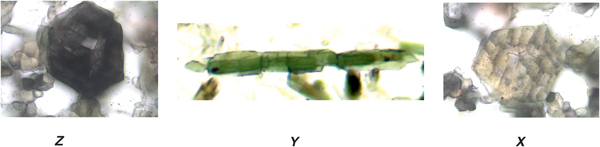
Potassic-magnesio-arfvedsonite occurs as prismatic to acicular crystals usually 0.2–0.5 mm long. It also forms isometric and rounded clusters or polycrystalline aggregates with quartz and potassium feldspar. Typical crystal forms are {110}, {010}, {001}, with perfect {110} cleavage. The mineral is brittle, and under stress leaves splintery fragments. Potassic-magnesio-arfvedsonite is greenish brown and has a grey–green streak. In transmitted plane-polarised light (λ = 590 cm–1), it is pleochroic: X = yellow pale green, Y = green and Z = dark violet–brown, with X < Y < Z (Fig. 1); it is non fluorescent and has a translucent vitreous lustre. Potassic-magnesio-arfvedsonite is biaxial (−), with strong r > v dispersion. The indices of refraction determined with immersion liquids are: α = 1.645(2), β = 1.655(2), γ = 1.660(2). 2Vmeas. (universal stage) is 60°, 2Vcalc. (calculated according to the relationships γ – β and β – α: Saranchina and Kozhevnikov, Reference Saranchina and Kozhevnikov1985) is 70°. The orientation is: X ∧ a = 44° (in β obtuse), Y ∧ c = 30° (in β acute) and Z = b.
Microphotographs in plane polarised light showing the pleochroism in potassic-magnesio-arfvedsonite.

The density measured by flotation in heavy liquids is 3.24 g/cm3; the density calculated based on the empirical formula is 3.19 g/cm3.
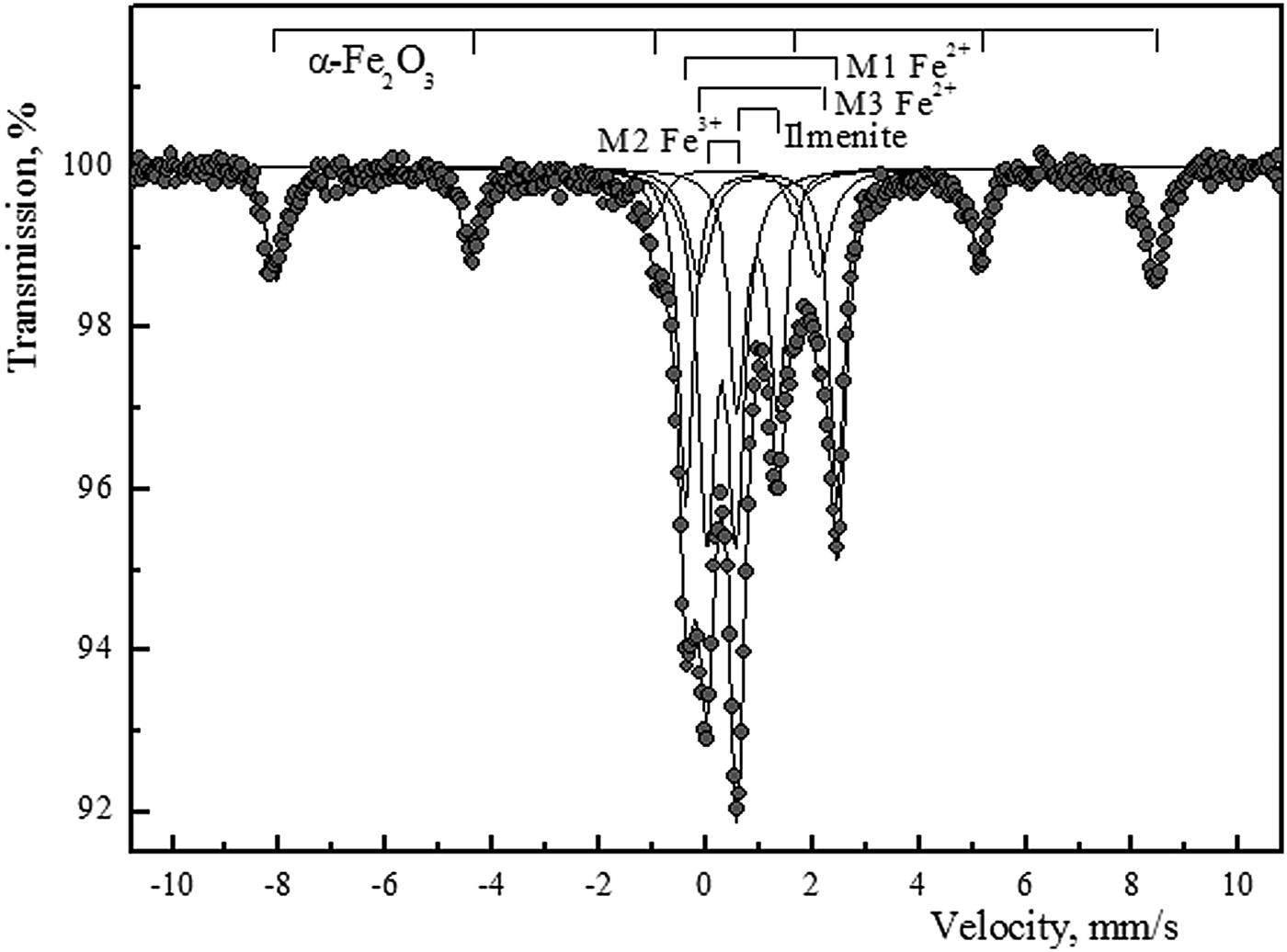
The Mössbauer spectrum of the mineral was obtained by using a standard electrodynamical driving system working in constant acceleration mode. A 57Co[Rh] radioactive source of ~20 mCi activity and a proportional counter filled with a 90/10 mixture of argon/methane were used to detect the Mössbauer γ-quanta (14.4 keV), as for velocity calibration a 25 µm α-Fe foil was used. All isomer shifts (IS) are referred to this standard at room temperature. Because the available amount of the mineral was limited, the sample was encapsulated in a conic hole on a lead plate, thus achieving a suitable area density for the sampling. Measurements were carried out in transmission geometry and the source-to-detector distance was kept short enough to obtain a large counting rate despite the small area of the sample. The spectra were least-squares fitted by a set of three Lorentzian doublets (Fig. 2). The doublet with maximum quadrupole splitting (QS) of 2.83 mm/s and isomer shift (IS) of 1.14 mm/s was assigned to Fe2+ at M1. The doublet with QS = 2.23 mm/s and IS = 1.09 mm/s was assigned to Fe2+ at M3. The narrower quadrupole splitting (QS = 0.57 and IS = 0.39 mm/s) was assigned to Fe3+ at M2. The Fe3+/Fetot ratio, calculated from the integrated areas is 0.42, in agreement with that calculated from the site populations obtained by EMPA and single-crystal structure refinement (SREF) analyses (0.35; see below). The spectra show the presence of hematite sextets and ilmenite doublets (QS = 0.74 and IS = 1.07), probably occurring as micro-inclusions in the amphibole crystals separated from the heavy liquid.
Mössbauer spectra of potassic-magnesio-arfvedsonite.

Raman spectra were obtained using a Jobin Yvon HR800 spectrometer, equipped with an Olympus BX41 microscope with a rotating plate, a HeNe 20 mW laser working at 632.8 nm and a CCD air-cooled detector. The observed absorption bands (in cm–1; the strongest intensities are underlined) are 112, 150, 171, 206, 233, 392, 540, 589, 684, 737, 924, 977, 1072. In turn, OH– related absorption bands are observed at ~3700 cm–1 (Ivanov et al., Reference Ivanov, Dyulgerov and Oberti2019).
Composition
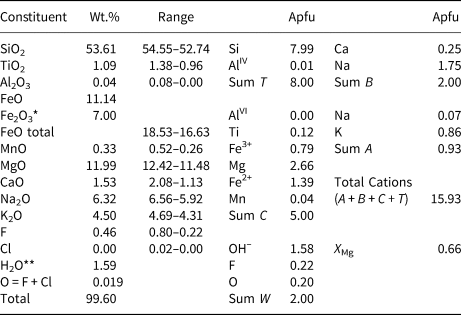
The composition of potassic-magnesio-arfvedsonite from sample 1x was obtained by EMPA (8 analytical points) using a Cameca SX100 instrument (wavelength-dispersive spectroscopy mode, 15 kV accelerating voltage, 10 nA, 0.6 µm beam diameter and counting time 15–20 s). Data reduction was done with the PAP correction procedure (Pouchou and Pichoir, Reference Pouchou, Pichoir and Armstrong1985) and the standards used were: diopside (SiO2, MgO and CaO), pyrophanite (TiO2 and MnO), orthoclase (Al2O3 and K2O), hematite (FeOt), albite (Na2O), fluorite (F) and sodalite (Cl). The results are reported in Table 1. H2O was calculated from the unit formula assuming OH–+F + Cl + 2 × M(1)Ti = 2, thus using the amount of Ti at the M1 site obtained by SREF as a proxy for the oxo component (O(3)O2–). An attempt to measure the H2O content by loss on ignition gave 1 wt.%, but this value must be considered as approximate. We were not able to separate a sufficient amount of pure amphibole crystals for H2O analysis, due to the fine grain size of the crystals and their intimate coalescence with quartz and potassium feldspar. The unit formula, calculated on 24 (O,F,Cl,OH) and 15.93 cations (as suggested by the best agreement between the refined site-scattering values for the A, B, C group sites and those calculated from the formula), is A(K0.86Na0.0.08)0.94B(Na1.74Ca0.25Mn2+0.01)2.00C(Mg2.67Fe2+1.42Fe3+0.76Ti0.12Mn2+0.03)5.00TSi8O22W(OH1.58F0.22O0.20)2.00. The ideal end-member formula of end-member potassic-magnesio-arfvedsonite is AK BNa2C(Mg4Fe3+)TSi8O22W(OH)2, and would require SiO2 56.63, MgO 18.99, Fe2O3 9.41, Na2O 7.30, K2O 5.55, H2O 2.12, total = 100.00 wt.%.
Composition and unit formulae for potassic-magnesio-arfvedsonite sample 1x.

* Fe2O3 and FeO recalculated from EMPA according to the crystal-structure refinement
** H2O content calculated based on (OH, F, O) = 2 apfu
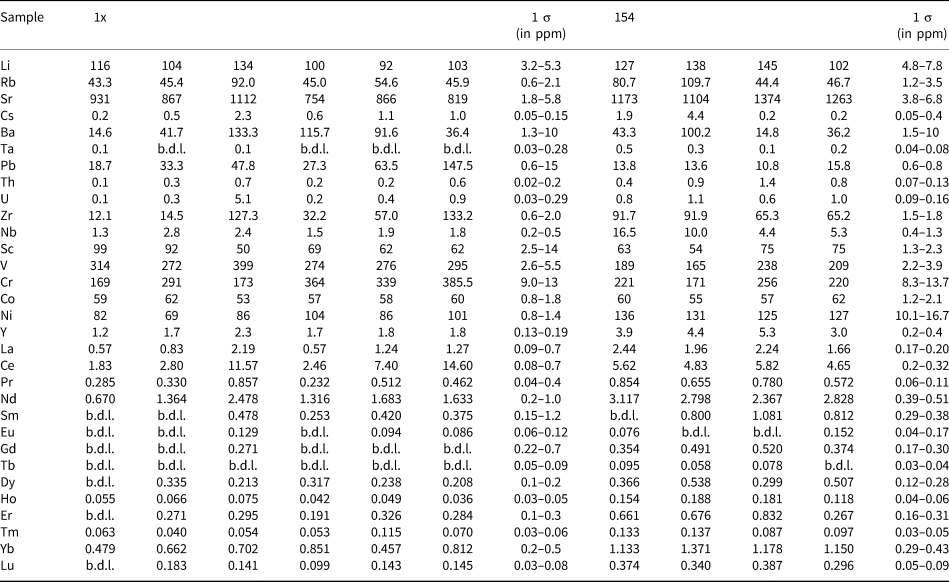
Trace elements were analysed by the LA-ICP-MS technique on a Perkin Elmer ELAN DRC with a New Wave UP 193FX ablation system. The beam spot was reduced to 35 µm due to the small crystal size, the beam current was 6 Hz, and the energy 7.2 mJ. The external standard used was NIST 610, whereas the internal standard was the SiO2 content of the amphibole obtained from EMPA; data reduction was performed by the Sills software (Allan et al., Reference Allan, Yardley, Forbes, Shmulovich, Banks and Shepherd2005). The results are reported in Table 2. The most notable minor elements are Li (0.013 apfu) and Sr (0.008 apfu); transition metals vary between 0.005 apfu (V and Cr) and 0.001 apfu (Sc, Co and Ni). Due to their content, they were ignored in the recalculation of the unit formula.
Selected LA-ICP-MS analyses of trace elements in potassic-magnesio-arfvedsonite from samples 1x and 154 and the range of 1 σ error (both in ppm).

Notes: b.d.l. – below the detection limit
Crystallography
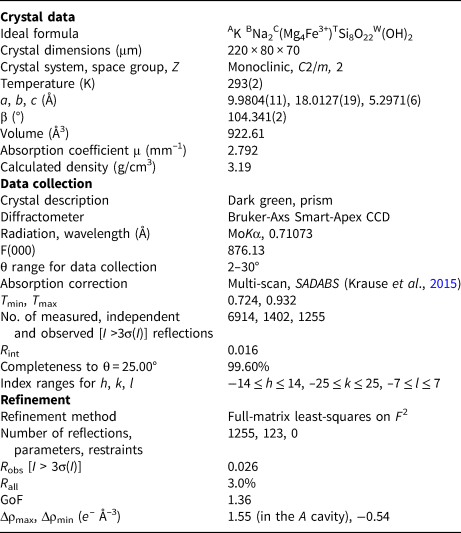
X-ray single-crystal diffraction data (details and results in Table 3) were collected with a Bruker-AXS CCD diffractometer, with graphite monochromatised MoKα radiation (λ = 0.7107 Å) on a crystal 220 µm × 80 µm × 70 µm in size. Omega rotation frames (scan width = 0.3°, scan time = 20 s and sample-to-detector distance = 50 mm) were processed with the SAINT software (Bruker, Reference Bruker2003) and intensities were corrected for Lorentz and polarisation effects; absorption effects were empirically evaluated by the SADABS software (Krause et al., Reference Krause, Herbst-Irmer, Sheldrick and Dietmar Stalke2015) and an absorption correction was applied to the data.
Details and results of the crystallographic analysis of potassic magnesio-arfvedsonite crystal 1317.

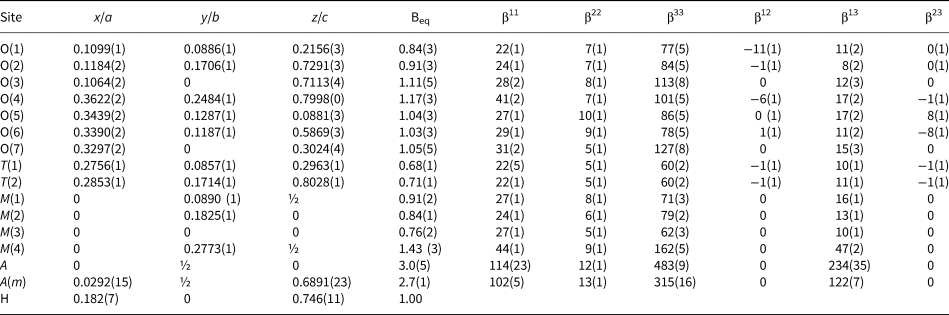
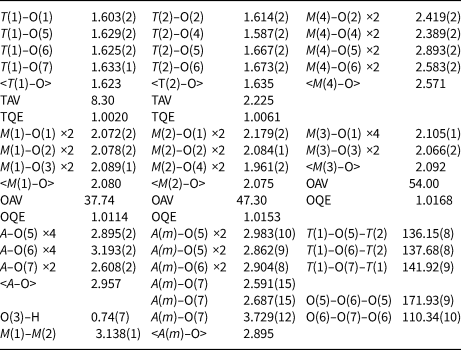
A total of 6914 collected reflections were reduced to 1402 unique reflections (mean redundancy = 5, R int = 1.6%). Of these, 1255 reflections with I o > 3 σ(I) were considered as observed during unweighted full-matrix least-squares refinement on F. Scattering curves for fully ionised chemical species were used at sites where chemical substitutions occur; neutral vs. ionised scattering curves were used at the T and anion sites [except O(3)]. F full-matrix unweighted least-squares refinement on I o > 3σ(I) gave R obs = 2.64% (1255 reflections) and R all = 3.02% (1402 reflections). Refined coordinates, atomic displacement parameters and selected bond lengths are given in Tables 4 and 5. Structure factors have been embedded in the crystallographic information file that has been deposited with the Principle Editor of Mineralogical Magazine and is available as Supplementary material (see below). The refined crystal of potassic-magnesio-arfvedsonite from sample 1x has the code 1317 in the CNR-IGG amphibole database.
Atomic coordinates and atomic displacement parameters for potassic-magnesio-arfvedsonite crystal 1317.

Selected interatomic distances (Å), angles (o), tetrahedral and octahedral angle variances (TAV, OAV, °^2) and quadratic elongations (TQE, OQE) (Robinson et al., Reference Robinson, Gibbs and Ribbe1971) in potassic-magnesio-arfvedsonite crystal 1317.

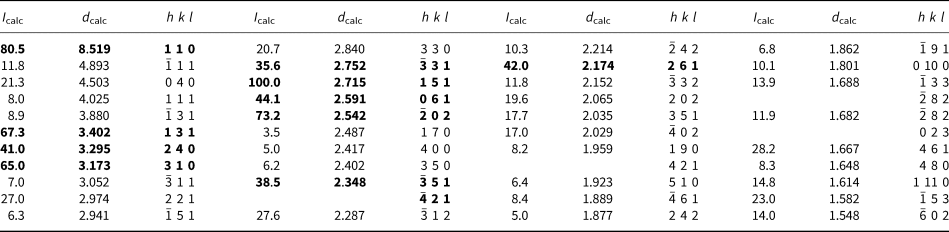
Powder X-ray diffraction data (CuKα, λ = 1.54178 Å) were obtained using the XPREP utility of SAINT (Bruker, Reference Bruker2003), which generates a 2D powder diffractogram (Debye-Scherrer technique) starting from the F obs collected on the single crystal and taking into account solely the information concerning the unit-cell dimensions and the Laue symmetry. No Lorentz and polarisation corrections were applied. Data are given in Table 6.
Powder X-ray data for potassic-magnesio-arfvedsonite (calculated from single-crystal data on crystal 1317).

Note: the strongest ten reflections are in bold. Only reflections with I rel ≥ 5 are reported.
Compatibility index
The calculated compatibility index (l – K P/K C, Mandarino, Reference Mandarino1981) for this potassic-magnesio-arfvedsonite is 0.028 (excellent).
Discussion
The studied potassic-magnesio-arfvedsonite deviates from the ideal stoichiometry mainly by the homovalent substitution CMg–1CFe1, and in a lesser extent by the homovalent substitutions BNa+–1BCa2+1, AK+–1ANa+1 and WOH––1F+1. Also, a significant amount of CTi is present (0.12 apfu), which (together with high value refined for the atomic displacement parameter at the M(1) site) suggest the presence of a significant oxo component. This latter was first evaluated to be ~0.20 apfu based on the refined value of the M(1)–M(2) distances according to the relation proposed by Oberti et al. (Reference Oberti, Hawthorne, Cannillo, Camara, Hawthorne, Oberti, Della Ventura and Mottana2007).
The chemical analyses were combined with the refined site-scattering values to obtain site populations which adhere to the correct stoichiometry and maintain overall electroneutrality. They are reported in Table 7, together with a comparison between the observed mean bond-lengths and those calculated from the site populations based on the <cation–O> distances optimised for [6]-fold coordination in amphiboles during extensive crystal chemical work at IGG-CNR-Pv (Li: 2.118 Å Mg: 2.078 Å, Ti: 1.960 Å, Mn2+: 2.173 Å, Fe2+ 2.125 Å and Fe3+: 2.025 Å).
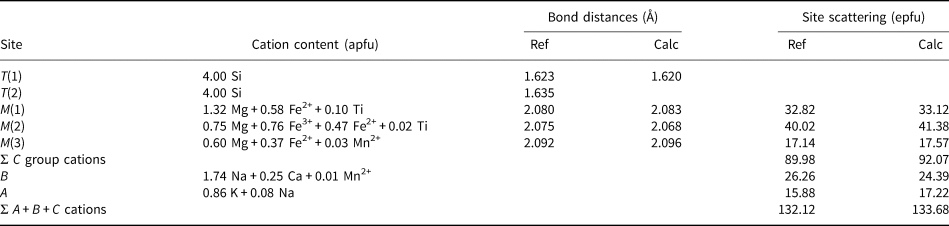
Site populations and a comparison between refined and calculated (see text for more details) bond distances and site-scattering values for potassic-magnesio-arfvedsonite 1317.

There is a reasonable agreement between the refined and calculated site-scattering values and the mean bond lengths (Table 7); however, the <M(2)–O>calc distance is slightly longer than expected. Inspection of <T(1)–O> distance confirmed the EMPA that tetrahedral sites are fully occupied by Si. The M(1)–O(3) distance is longer than M(1)–O(1) and M(1)–O(2) implying that OH– is the major W group anion, and that the amount of the oxo component is locally balanced by the occurrence of M(1)Ti via the substitution: M(1)Ti4+1 O(3)O2–2 M(1)(Mg, Fe)2+–1 O(3)(OH)––2. This occurrence is confirmed by the large value refined for B eq (0.91 Å2). The shape of the electron density within the A cavity, which has been interpreted with a model where most of it is ascribed to the A(m) site shifted by 0.41 Å from the centre of the cavity (site A) along the mirror plane A(m), is typical of potassium-dominant amphiboles (Oberti et al., Reference Oberti, Hawthorne, Cannillo, Camara, Hawthorne, Oberti, Della Ventura and Mottana2007), and is enhanced when a significant F content is present. The presence of a residual electron density peak in the difference-Fourier map witness further positional disorder and may explain the lower site-scattering value obtained from SREF (15.88 electrons per formula unit, epfu) with respect of that of EMPA (17.22 epfu). Localisation of the hydrogen atom has been possible and successfully refined with a O3–H bond length of 0.74(7) Å (Tables 4 and 5).
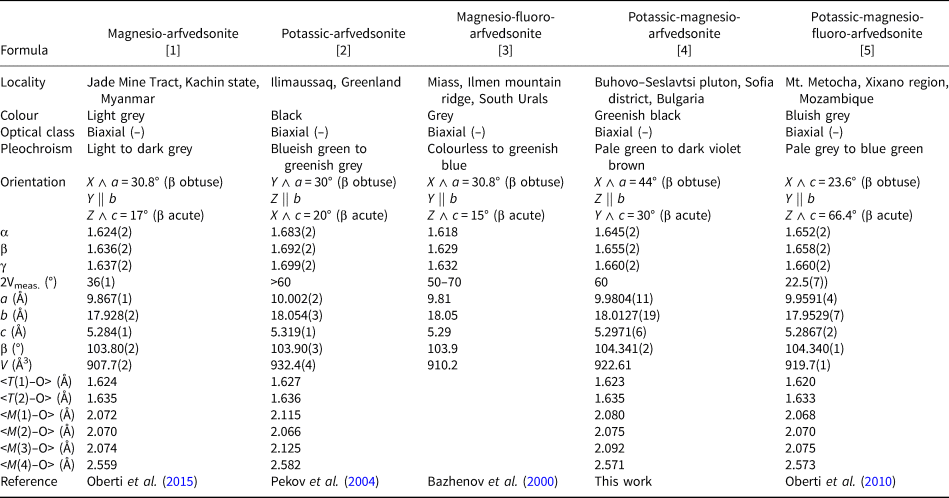
A brief summary of the mineral data of the known arfvedsonite end-members is reported in Table 8. With respect to its fluoro- analogue, potassic-magnesio-arfvedsonite has a longer value of the a and b edges and of the <M(1)–O> and <M(3)–O> distances, as well as a larger V; all these feature are in line with the substitution F–1(OH)1 at the O(3) site. With respect to magnesio-arfvedsonite, it has a longer a edge and a larger V, in line with Na–1K1 at the A site. With respect to potassic-arfvedsonite, potassic-magnesio-arfvedsonite has a shorter b edge and <M(1)–O> and <M(3)–O> distances, in line with the Fe–1Mg1 substitution at the same sites.
A comparison of the optical and crystallographic properties for the known end-members related to root name arfvedsonite.

Formulae:
[1] A(Na0.96K0.04)1.00B(Na1.57Ca0.40Fe2+0.02Mn0.01)2.00C(Mg4.26Fe2+0.19Fe3+0.41Al0.11)5.00T(Si7.99Al0.01)8.00O22W[(OH)1.98F0.02]2.00
[2] A(K0.67Na0.22)0.89B(Na1.95Ca0.05)2.00C(Fe2+3.29Fe3+1.26Li0.29Mn0.19Ti0.05Zn0.02Mg0.01)5.11T(Si7.76Fe3+ 0.13Al0.11)8.00O22W[(OH)1.81F0.18]1.99
[3] A(Na0.45K0.29)0.74B(Na1.57Ca0.43)2.00C(Mg4.16Fe3+0.60Al0.12Fe2+0.09Ti0.05Mn0.03)5.05T(Si7.88Al0.12)8.00O21.99W[F1.23(OH)0.78]2.01
[4] A(K0.86Na0.08)0.94B(Na1.74Ca0.25Mn2+0.01)2.00C(Mg2.67Fe2+1.42Fe3+0.76Ti0.12Mn2+0.03)5.00TSi8O22W(OH1.58F0.22O0.20)2.00
[5] AK0.98B(Na1.81Ca0.18)1.99C(Mg3.07Fe3+0.90Fe2+0.83Ti0.12Mn0.04Al0.01Zn0.01)4.98TSi8O22W[F1.03(OH)0.73O0.24]2.00
Based on the present knowledge of amphibole crystal chemistry (Oberti et al., Reference Oberti, Hawthorne, Cannillo, Camara, Hawthorne, Oberti, Della Ventura and Mottana2007), among the minor elements detected by LA-ICP-MS analysis, Li enters the (largest) M(3) site, whereas transition metals enter the M(2) site, following Fe3+. Strontium is expected to enter the M(4) site and substitute for Ca (Robert et al., Reference Robert, Della Ventura, Raudsepp and Hawthorne1993), as the amphibole richer in Ca from sample 154 (Dyulgerov and Platevoet, Reference Dyulgerov and Platevoet2006) characterises by its higher Sr content (Table 2).
Implications
The crystallisation of potassic-magnesio-arfvedsonite reflects the strongly peralkaline (Al deficient) and potassic character of the original magma in which K2O dominates over Na2O (the molecular K2O/Na2O ratio is 3.34 for sample 1x). Solely in such a chemical system it is possible to crystallise sodic amphibole with the A site completely filled by K. The whole-rock chemistry determines the composition of amphiboles, as the amount of K not accommodated in potassium feldspar can be allocated only in the amphibole. In fact, biotite is not a stable phase in a peralkaline environment (as confirmed by the almost complete replacement of biotite by amphibole) and incorporation of potassium into pyroxenes is impossible under low P at a crustal level (cf. a review in Perchuk et al., Reference Perchuk, Safonov, Yapaskurt and Barton2002). In peralkaline magmas, the determination of intensive variables is a challenging task, and the presence of potassic-magnesio-arfvedsonite may provide information on the conditions of crystallisation. Ernst (Reference Ernst1968) showed that a complete filling of the A site indicates high temperatures of crystallisation, >900°C. Dyulgerov and Platevoet (Reference Dyulgerov and Platevoet2006) constrained the crystallisation of the Buhovo–Seslavtsi pluton around or slightly above the NNO buffer. Significant X Mg and Fe3+ content are also in favour of crystallisation under relatively oxidising conditions. Moreover, the Mössbauer study presented in this work showed the presence of hematite and ilmenite associated with amphibole, which constrains crystallisation near the ilmenite–hematite buffer.
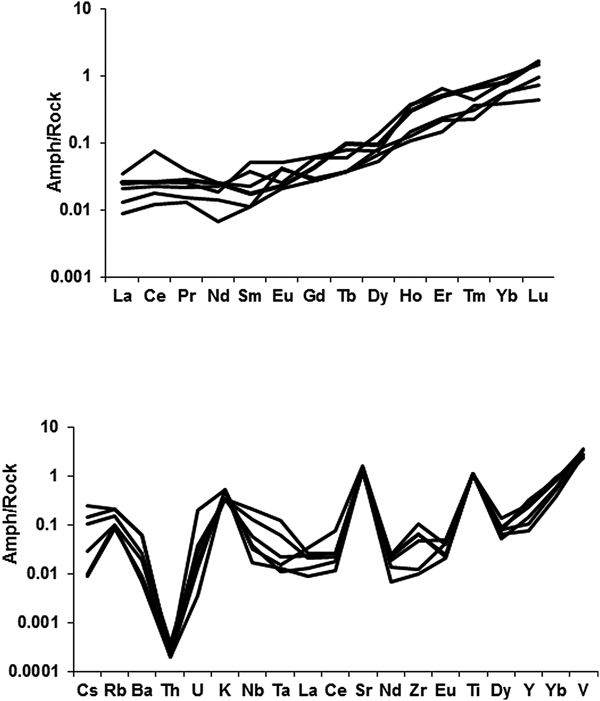
The results from LA-ICP-MS analyses showed that the crystallisation of the amphibole did not affect the trace-element distribution (Fig. 3); therefore, accessory phases are the main carrier of such elements in the peralkaline rocks. According to Table 2, only transition metals are likely to be in some extent controlled by crystallisation of potassic-magnesio-arfvedsonite.
Amphibole/Rock partitioning for selected trace elements and rare-earth elements for potassic-magnesio-arfvedsonites from samples 1x and 154. The rock composition (1x and 154) is from Dyulgerov (Reference Dyulgerov2005).

Supplementary material
To view supplementary material for this article, please visit https://doi.org/10.1180/mgm.2018.135
Acknowledgements
Funding to project DH 14/8 provided by National Science Fund (Ministry of Education and Science of Bulgaria) supported the preparation of the manuscript. Thorough review and useful suggestions of an anonymous reviewer and P. Leverett improved the quality of the text, editorial handling of S. Mills is appreciated.