Introduction
During domestication, crop plants had been selected by humans deliberately for desirable traits that were useful for cultivation. An array of traits were acquired or accumulated over generations in the present-day cultivated types that distinguished them genetically from their wild progenitors. Less or reduced seed shattering, seed dispersal mechanisms and dormancy, early maturity, hard seed, a decrease in seed phenol or tannin content, thicker seed coat, alteration in seed size, seed colour, etc. are some of the many examples of such traits. Germination of seed in the pod while still attached to mother plant prior to harvest is known as pre-harvest sprouting (PHS). PHS is more common in cereal crops such as wheat, barley, paddy, maize, sorghum, etc.; however, it is also a common phenomenon observed in some of the legume crops such as soyabean (Dougherty and Boerma, Reference Dougherty and Boerma1984), mungbean (Ahmad et al., Reference Ahmad, Khulbe and Roy2014), blackgram (Singh et al., Reference Singh, Khulbe and Panwar2012) and groundnut (Nautiyal et al., Reference Nautiyal, Bandyopadhyay and Zala2001). Among the legumes, the incidence of PHS is very high in Vigna species. Owing to the short crop cycle, low input requirement and ability to grow and survive in a wide range of environmental conditions, mungbean is suitable to be grown in all the seasons. Mungbean is cultivated in all the three seasons, i.e. in rainy (June–October), winter (October– February) and summer (March–June) in some or the other part of India. Prolonged rain and high relative humidity during maturity, especially during rainy season, contributes to premature germination, resulting in reduced yield and quality of seed/grain causing substantial economic loss to stakeholders. Yield reduction upto an extent of 60–70% is reported to occur in mungbean due to PHS (Durga and Kumar, Reference Durga and Kumar1997).
The major factors influencing tolerance to PHS are fresh seed dormancy (FSD), seed coat permeability or hardseededness, waxy coat in pod (Vijay and Gupta, Reference Vijay and Gupta2008), α-amylase activities (Mares and Mrva, Reference Mares and Mrva2014), altered response to hormones (Fang and Chu, Reference Fang and Chu2008) and of course all of these controlled by genes and quantitative trait loci (QTLs) (Shubing et al., Reference Shubing, Sunish, Jiarui, Meng, Harold, Jianming, Bikram and Guihua2013). FSD has been considered as the most important factor, which leads to PHS tolerance (Lin et al., Reference Lin, Horsley and Schwarz2008). The hardseededness is the phenomenon that protects seeds from germination by not imbibing water, thus increases tolerance to PHS (Gao et al., Reference Gao, Hu, Li, Yao, Meng, Dong, Zhao, Chen and Li2013). Persistent seed dormancy is an undesirable trait as it affects rapid and uniform emergence. However, seeds of mungbean lack FSD, therefore, a short period of dormancy of 10–15 days is desirable to reduce the loss caused by PHS. Hence, to incorporate a short period of dormancy through breeding has become important in mungbean improvement programmes for which identification of donor lines with optimum duration of FSD has become utmost important. Keeping in view the above points, the present investigation was undertaken to evaluate the genetic variation in pod loss due to PHS in cultivated and germplasm lines of mungbean, identify donors for PHS tolerance and study the relationship of PHS with different seed and plant morphological traits.
Materials and methods
The field experiment was conducted at ICAR-Indian Institute of Pulses Research, Kanpur during kharif 2014–15. Mungbean commercial cultivars (61) and germplasm accessions (102) were planted in replicated trials in RCBD (randomized complete block design). The cultivated varieties were grown in three rows of 4 m length while the germplasm accessions, owing to seed limitation, were grown in two rows of 3 m length. Observation on plant characters such as plant height, number of primary branches per plant, number of clusters per plant and number of pods per cluster were recorded in ten randomly selected plants in each plot. Pods of these genotypes were handpicked at harvest maturity and stored at 4°C to maintain FSD till the experiment was completed. Care was taken not to damage the pod wall while harvesting and handling. Observation on pod related traits such as, pod length, pod diameter, pod wall thickness and seed traits, i.e. seed length and seed width were recorded on ten pods and seeds, respectively in three replicates using an electronic digital caliper.
Water imbibition and germination of pods and seeds
Water imbibition by pods (WIPs) and seeds was recorded in three replications of ten pods and 50 seeds, respectively. Pre-weighed pods and seeds were placed in Petri dishes lined with water-soaked Whatman No. 1 filter paper in an incubator at 25°C. The pods were removed after 24 h and seeds after 6 h, blotted dry, weighed and were immediately placed back in Petri dishes for evaluation of seed germination in a pod (PHS value) and percent fresh seed germination (FSG), respectively. The amount of water imbibed was calculated by the gain in weight. Seed germination in a pod (%) and FSG (%) was recorded after 4 days of incubation. A number of germinated seeds on each replication (ten pods) was recorded and percent seed germination in a pod was calculated. Higher the PHS value, higher is the susceptibility and vice versa.
Alpha amylase activity
The 100 mg of mungbean seed was extracted in 10 ml of cold 10 mM CaCl2, and the supernatant obtained after centrifugation (12,000 g for 30 min) was used for amylase estimation. Starch solution of 1 ml each and enzyme extract was incubated at 27°C for 15 min. Following this, 2 ml of dinitro salicylic acid reagent was poured to stop the reaction and the reaction mix was heated for 5 min in water bath. The 1 ml of 40% sodium potassium tartrate was added to the solution and the final volume of 10 ml was made and absorbance was recorded at 560 nm (Sunayana et al., Reference Sunayana, Ramendra and Raj2013).
Statistical analysis
The PHS and FSG data were arcsin transformed and the statistical analyses were carried out on transformed value. Descriptive statistics, one-way analysis of variance (ANOVA), and principal component analysis (PCA) were carried out using 30 day's trial version of Minitab 17 software.
Results
Variation for PHS and FSG in mungbean genotypes
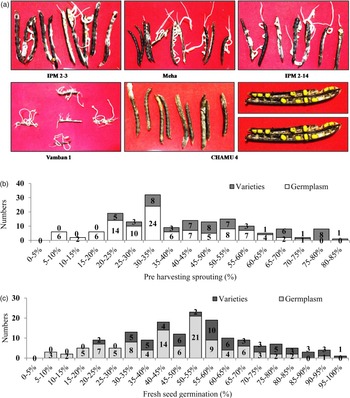
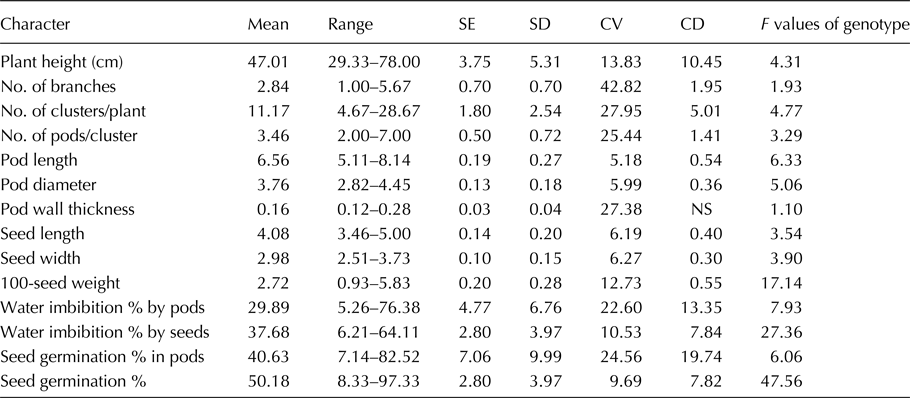
ANOVA revealed significant variation for all the plant, pod and seed traits except for pod wall thickness among 163 genotypes under study. The descriptive statistical details of all the traits are given in Table 1. All mungbean genotypes showed a wide range of variation in relation to PHS value. Out of 163 genotypes, 20 genotypes were classified as PHS tolerant (Table S1, Fig. 1) as they recorded PHS value of <20%. All these 20 genotypes were germplasm accessions. Among germplasm accessions, pod loss due to PHS was highest in Khargone 4–169 (74.34%) followed by Jalgaon 21 (70.44%), IC 2829 (69.47%), while the minimum pod loss was observed in Chamu 4 (7.14%), followed by Dopole (7.70%) and IC52061 (8.88%). Among the cultivated varieties, IPM 2–3 recorded the highest (82.52%) PHS value, followed by K 851 (78.97%), BM 2002–1 (76.98%) and Ganga 1 (76.84%), while Sujata (20.64%), SML 32 (21.01%) and ML 131 (21.83%) recorded the minimum PHS values. Similarly, the maximum FSG was observed in Vamban 1 (97.33%), followed by IPM 2–14 (94.67%), PDM 139 (93.33%), JBT/37/158 (92.00%) and IPM 2–3 (91.00%) and the minimum was observed in Chamu 4 (8.33%), CHAMAH 1 (8.33%), BGG 1 (9.57%), Dopole (10.33%) and IC 52061 (11.67%) (Table S1).
Variation in pre-harvest sprouting (PHS). (a) PHS susceptible IPM 2–3, IPM 2–14, Meha, Vambam 1 showing profuse PHS, PHS-tolerant Chamu 4 showing no PHS and Chamu 4 showing intact seeds inside the pod. (b) Distribution of 163 mungbean genotypes for PHS and fresh seed germination (FSG) (c). Data for PHS and FSG were recorded on the 4th day of incubation at 25 °C, 100% RH.

General morphological and biochemical parameters for various characters in 163 mungbean genotypes

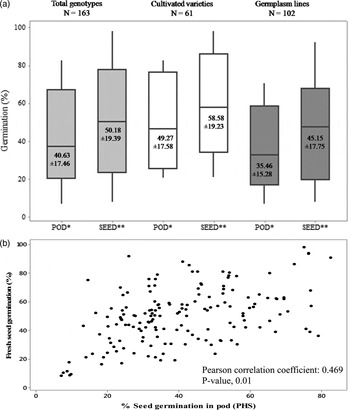
There was a significant difference between germplasm accessions and commercially available varieties in terms of their PHS and FSG values. The overall mean PHS and FSG values were 40.63 and 50.10, respectively. Cultivated varieties recorded higher PHS and FSG values of 49.40 and 58.52 as compared with 35.46 and FSG 45.07 of germplasm accessions, respectively (Fig. 2).
Comparison of germination ability. (a) The box plot illustrating the changes in germination (%) of seeds in pod and germination after separation from the pod (4th day of incubation); (b) correlation between fresh seed germination (FSG) and PHS. *, Germination of seed inside pod (PHS); **, FSG after removing from the pod.

Changes in α-amylase activity during germination in PHS-tolerant and -susceptible genotypes
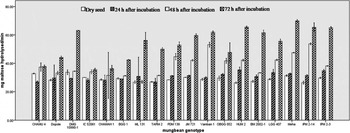
The α-amylase activity was measured on 0 (dry seed), 24, 48 and 72 h after germination in selected genotypes, which differed in PHS tolerance. The α-amylase activity at 0, 24, 48 and 72 h in 18 selected genotypes ranged from 26.29 to 33.69, 27.00 to 35.43, 26.93 to 53.74 and 35.64 to 69.90 mg maltose hydrolysed per min, respectively. Genotypes Chamu 4, Dopole, DMG 10990–1, IC 52061, Chamah 1 and BGG 1, which had low FSG and PHS values, also recorded low α-amylase activity than other genotypes, especially at 48 and 72 h after germination. These six genotypes showed an increase of 15.46–87.49% in α-amylase activity at 72 h, while remaining genotypes, which recorded very high FSG (57–98%) showed more fold increase in α-amylase activity of 61.35–149.45% at 72 h over the initial values (Fig. 3).
Variation in α-amylase activity with germination in 18 selected mungbean genotypes.

Estimates of genetic component and PCA analysis for PHS
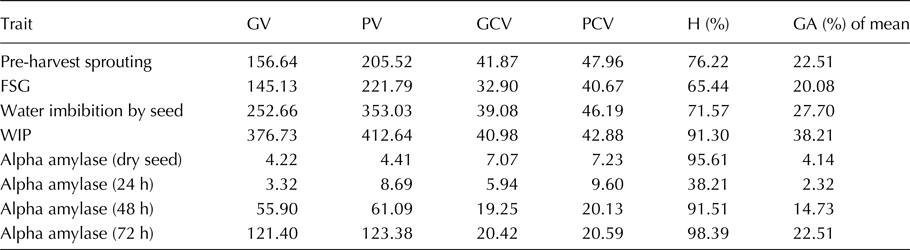
Estimates of genotypic and phenotypic variances, genotypic and phenotypic coefficient of variation, broad sense heritability and genetic advance for PHS, FSG, water imbibitions by seed, water imbibitions by pod and amylase activity are given in Table 2. In all cases, PCV were higher than GCV, indicating the environmental influence on such traits. Highest GCV (41.87) was observed for PHS, which indicates that this trait could be improved by simple selection. Estimates of broad sense heritability ranged from 38.21 (for α-amylase activity after 24 h of incubation) to 98.39 (for α-amylase activity after 72 h of incubation). PHS and FSG recorded the heritability of 76.22 and 65.44, respectively, indicating the possibility of improving these traits through breeding. Genetic advance as a per cent of mean ranged between 2.32 and 38.21 with α-amylase activity after 24 h of incubation recording least value and water imbibitions by pod recording the highest.
Genetic estimation of variance component, genotypic (GCV) and phenotypic (PCV) coefficient of variation, broad sense heritability (H) and genetic advance as a percent of mean (GA) for pre-harvest sprouting, fresh seed germination (FSG), water imbibition by seed, water imbibition by pod (WIP) and amylase activity in 163 mungbean genotypes

The PCA indicated six principal components (PCs) having eigenvalues >1, which together explained about 67% of the total variation among the 163 mungbean genotypes for 14 plants, pod and seed traits (Table S2). In PC1, which explained about 19% of the total variation, the most prominent traits were seed width, 100-seed weight, seed length and pod length. PC2 explained about 14% of the total variation, the most predominant traits being PHS, FSG, water imbibition by seed and WIP. Similarly, PC3 explained about 12% of the total variation, with major contribution from the plant morphological traits such as plant height, number of branches/plant and number of clusters/plant, whereas PHS, FSG, WIP, water imbibition by seed and pod wall thickness showed a negative correlation. In PC4, which explained for 8% of total variation, with a major contribution from a number of pods/cluster, PHS and FSG. PC5 explained about 7% of the total variation, the most predominant traits were pod length, number of pod/cluster and water imbibition by seed. PC6 explained for about 7% of total variation, with a major contribution from pod diameter, water imbibition by seed and pod length. Five genotypes recording the maximum and minimum PHS and FSG values, respectively, and these were clustered in distinct groups according to PC1 and PC2 (online Supplementary Fig. S1).
Discussion
Erratic and unusual distribution of rainfall is expected in the current scenario of climate change, especially at the time of crop maturity and harvesting and the loss incurred by PHS may increase in future. Though, seeds in mungbean are protected inside a pod, is very susceptible to PHS due to lack of FSD. Mungbean, being a short-duration crop (60–75 days), requires less inputs and very well fits in any cropping system (Pratap et al., Reference Pratap, Gupta, Tomar, Malviya, Maurya, Pandey, Mehandi and Singh2016). Susceptibility to PHS is perhaps the major limitation for its wide-spread acceptability. Much work has been done regarding PHS tolerance in cereals but not in pulses, particularly mungbean. Therefore, the main aim of the study was to check the variations in mungbean genotypes as the information generated could be used for studying seed dormancy and germination and mungbean improvement.
Among the 163 mungbean genotypes, in general, germplasm lines were more tolerant to PHS and recorded low FSG. During the process of domestication, seed characters were modified through conscious or unconscious selection. In most of the cases, such selection led to improvement in seed characters such as larger seed size, better nutritive value, reduction of toxic compounds, etc. However, some selection also lead to negative effects such as susceptibility to PHS or susceptibility to pests and diseases (Gemechu et al., Reference Gemechu, Endashaw, Muhammad, Emana, Kifle and Fassil2011) on the cost of improving other traits. PHS also resulted as a side effect of improving rapid and uniform germination by reducing dormancy. In legumes, occurrence of hardseededness (physical dormancy) is considered a negative trait as it hampers water imbibition making milling process difficult (Argel and Paton, Reference Argel, Paton, Loch and Ferguson1999). Therefore, selection has been made against hard-seededness, which makes the greengram seeds susceptible to PHS. Dormancy is considered as an undesirable trait and during the process of domestication and breeding; selection has been made against dormancy. Too low seed dormancy reduces seed quality and induces PHS if sufficient moisture is available. Therefore, the wild-type which did not undergo artificial selection has a higher level of dormancy than the cultivated types (Dorian and Robin, Reference Dorian and Robin2009). Wild and germplasm lines showing FSD had better PHS tolerance as has been reported in mungbean (Ahmad et al., Reference Ahmad, Khulbe and Roy2014) blackgram (Singh et al., Reference Singh, Khulbe and Panwar2012), rice (Sunayana et al., Reference Sunayana, Ramendra and Raj2013) and groundnut (Nautiyal et al., Reference Nautiyal, Bandyopadhyay and Zala2001).
The activity of α-amylase is low in dry mungbean seeds, but its activity gets induced rapidly and increases as the germination process proceeds. Reihaneh and Mehdi (Reference Reihaneh and Mehdi2011) reported an increase in α-amylase activity from 8.1 to 280.2 maltose unit/g dry matter at 0 and 72 h after germination in mungbean. In the present study, the highest α-amylase activity was recorded in the genotypes having high germination per cent and vice versa. High α-amylase activity in PHS-susceptible genotypes causes the starch to hydrolyse and thus converts high molecular weight amylopectin to low molecular weight amylopectin and amylase. The ratio of amylase and amylopectin determines the retro-gradation properties of starch and paste quality (Jane and Chen, Reference Jane and Chen1992). Such conversion of high molecular weight amylopectin to low molecular weight amylopectin during PHS causes an alteration in functional properties of starch, ultimately reducing the paste viscosity and lowering the quality of end product (Bean et al., Reference Bean, Keagy, Fullington, Jones and Mecham1974). Once endosperm is degraded, the grain loses its usefulness as a commercial product and is often utilized as a feed for animals. Premature sprouting also leads to reduced longevity or viability of seed after harvest (Gualano et al., Reference Gualano, Del-Fyo and Benech-Arnold2014). Our finding corroborated the earlier findings (Krishnasamy and Seshu, Reference Krishnasamy and Seshu1990; Sunayana et al., Reference Sunayana, Ramendra and Raj2013; Simsek et al., Reference Simsek, Ohm, Lu, Rugg, Berzonsky, Alamri and Mergoum2014) which reported that genotypes with higher seed germination and PHS susceptibility also had high α-amylase activity.
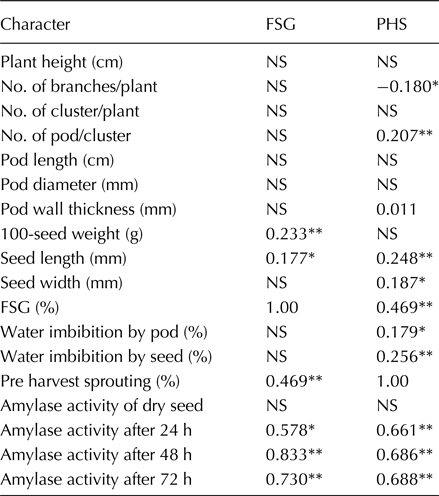
PHS tolerance is a quantitative trait, which is influenced by environment and is controlled by many genes (Bailey et al., Reference Bailey, McKibbin, Lenton, Holdsworth, Flintham and Gale1999). Therefore, this study was conducted to understand the association of different seed, pod and plant traits with PHS (Table 3). A direct association was observed between PHS value and FSG, with a correlation coefficient of 0.469 (P < 0.01). Despite the significant positive association between the seed germination in a pod (PHS) and after separation from the pod (FSG), the germination % was higher after separating the seed from the pod (Fig. 2). This is due to the mechanical or physical barrier provided by pod which restricts the availability of water to the seeds, hence preventing imbibition process and radicle protrusion. WIP is an important trait that directly influences PHS by making available the moisture to the seeds inside the pod to initiate germination. Positive and significant association of WIP with PHS suggested for the screening of genotypes with pods having high epicuticular wax content, as it has been reported to influence water absorption by pod (Cheralu et al., Reference Cheralu, Satyanarayana, Kulkarni, Jagdishwar and Reddy1999; Vijay and Gupta, Reference Vijay and Gupta2008). Other than epicuticular wax content, pod wall thickness also regulates water absorption by the pod. Significant negative association between pod wall thickness with WIP and number of sprouted seeds inside a pod has been reported earlier (Tekrony et al., Reference Tekrony, Egli and Phillips1980; Ahmad et al., Reference Ahmad, Khulbe and Roy2014), while Rao et al. (Reference Rao, Rao, Rao, Kumar and Nehar2007) found a positive and significant association. Thick pod wall leads to increased number of sprouted seeds inside the pod, since sufficient amount of moisture was available due to better absorption. Rao et al. (Reference Rao, Rao, Rao, Kumar and Nehar2007) suggested breeding for low-to-medium thick pod wall for PHS tolerance. However, no significant association was observed in the present study between pod wall thickness and PHS. Number of pods per cluster, seed length, seed width, FSG, water imbibition by seed and WIP showed a positive and significant association with PHS. Similar positive correlation of PHS with WIP, seed germination per cent and seed width has been reported by Ahmad et al. (Reference Ahmad, Khulbe and Roy2014). However, they found a non-significant association between water imbibition by seed and PHS. Presence of seed dormancy in the form of hard testa or hardseededness (inability of the seed to imbibe water despite sufficient moisture) is one of the mechanisms of regulating seed germination. Hardseededness is caused by the deposition of phenolics and suberin layers on palisade cells. Many mechanisms such as seeds response to temperature or habitat changes are involved in the release of physical dormancy caused by the hardseededness (Petr et al., Reference Petr, Vanessa, Matthew, Ales and Richard2014). Although molecular basis of hardseededness and its release has not been fully understood, positive correlation was found between phenolic content, the activity of catechol oxidase (Werker et al., Reference Werker, Marbach and Mayer1979), epicatechin levels (Zhou et al., Reference Zhou, Sekizaki, Yang, Sawa and Pan2010) and β-1,3-glucans deposition on neck region of plasmodesmata (Finch-Savage and Leubner-Metzger, Reference Finch-Savage and Leubner-Metzger2006) on hardseededness in legumes. Earlier findings corroborated with our findings of a positive association between hardseededness and PHS tolerance (Kueneman and Dassou, Reference Kueneman and Dassou1982; Imrie, Reference Imrie and Driscoll1983; Ahmad et al., Reference Ahmad, Khulbe and Roy2014). The difficulty in producing high-quality mungbean seed/grain in the humid tropical region because of weather damage and the chance of PHS could be mitigated by incorporation of hardseededness in the cultivated variety (Humphry et al., Reference Humphry, Lambrides, Chapman, Aitken, Imrie and Lawn2005). In Vigna species, lens or strophiole regulates the entry of water inside the seed (Kikuchi et al., Reference Kikuchi, Koizumi, Ishida and Kano2006). QTLs regulating water absorption have been identified in mungbean (Isemura et al., Reference Isemura, Kaga, Tabata, Somta, Srinives, Shimizu, Jo, Vaughan and Tomooka2012), azuki bean (Kaga et al., Reference Kaga, Isemura, Tomooka and Vaughan2008) and rice bean (Saravanakumar et al., Reference Saravanakumar, Kaga, Tomooka and Vaughan2004); however, there exists no common QTLs for water absorption by seeds in these species. Alpha amylase activity of dry seeds had no association either with FSG or PHS. However, a significant association between α-amylase activities was observed after 24, 48 and 72 h of germination with FSG and PHS. Therefore, the activity of α-amylase, especially after 48 and 72 h of germination could be used as an effective biochemical marker to screen a large number of mungbean germplasm against FSG and PHS.
Correlation of fresh seed germination (FSG) and pre-harvest sprouting (PHS) with different characters

*, Correlation is significant at the 0.05 level; **, correlation is significant at the 0.01 level.
The correlation studies were carried out using all the data sets of 163 genotypes for all the traits except for amylase activity where correlation studies were carried out using the data points of selected genotypes whose α-amylase activity was estimated.
It is expected that losses incurred by PHS will increase in future due to greater fluctuation in weather particularly rainfall at the time of maturation of the crop. Thus, identification of genes associated with FSD and incorporating the same to cultivated high-yielding varieties of mungbean would help to a greater extent to prevent the loss incurred by PHS. The level of diversity in seed germinability found in this study could be used for mungbean improvement programme. The PHS tolerant genotypes identified in this study could be utilized as a donor for mungbean improvement programme.
Supplementary material
The supplementary material for this article can be found at https://doi.org/10.1017/S1479262117000296
Acknowledgement
The authors are highly thankful to supporting staff of ICAR-IIPR for technical help during experiment.