To the Memory of Professor Ken Parry
We are honored here to contribute to the special issue on the work of our mentor, colleague, and friend – Professor Ken Parry. We believe this paper is probably one of the last pieces of work to which he will have contributed. The research and the initial drafts of this paper were prepared by Ken and the second and third authors while Ken was still actively teaching at Deakin Business School. After Ken's health began to deteriorate other matters became more pressing, and work on the paper was halted. This paper has resulted from a re-working of the initial drafts by the remaining authors. As you might appreciate, we do not fully know what Ken's intention was for this paper but we hope that we have done his work the justice that it deserves.
Introduction: Charismatic Leadership – Beyond Love and Hate
The fascination with charisma and leadership is long established (Beyer, Reference Beyer1999; Beyer & Browning, Reference Beyer and Browning1999; Bryman, Reference Bryman1992; Conger, Reference Conger1989; Conger & Kanungo, Reference Conger and Kanungo1987; Reference Conger and Kanungo1998; House, Reference House, Hunt and Larson1977; Kempster & Parry, Reference Kempster and Parry2013; Shamir, House & Arthur, Reference Shamir, House and Arthur1993; Shamir, Arthur & House, Reference Shamir, Arthur and House1994). Shamir, House and Arthur (Reference Shamir, House and Arthur1993), however, have sought to explain the complex interrelationship between charismatic leaders and their followers by focusing on the affective aspects of the charismatic relationship on followers. By using a modification of Shamir and Kark's (Reference Shamir and Kark2004) single-item graphic scale to rate different implicit notions of charismatic leadership, developed by Ken in his previous work (Parry and Kempster, Reference Parry and Kempster2014), we believe we add further to this understanding of charismatic leadership by exploring a link to a sense of belonging and the wider notion of community. We contribute even further by showing how charismatic leaders might be viewed both positively and negatively by followers explained through a sense of serving the community. We also believe our findings reinforce the argument that a knowledge of the activities of a leader, here a link to community, can strengthen the bond between leaders and followers and hence produce a manifested view of a charismatic figure.
Within our empirical investigation, therefore, we examine charismatic leaders through the views of their followers. Following Boas Shamir's work, and Parry and Kempster (Reference Parry and Kempster2014), we see charisma as a property that is bestowed by the followers rather than as a characteristic of an individual leader. This approach is in line with other contemporary approaches to the study of leadership (e.g., see Junker & van Dick, Reference Junker and van Dick2014; Oc & Bashshur, Reference Oc and Bashshur2013; Schyns, Meindl, & Croon, Reference Schyns, Meindl and Croon2007). The aim of our research here is to explore the underlying antecedents of charisma in more detail and, in particular, draw out the notion of belonging within the connection people feel towards those they see as charismatic leaders.
In order to explore this research aim, we build on the orientation of Ken's previous work (see Parry & Kempster, Reference Parry and Kempster2014) – most notably his mixed-method aesthetic narrative approach. In this work, Parry and Kempster sought to examine ‘followers’ implicit narratives of their lived experiences of charismatic leadership in organisational settings through metaphors (see also Parry, Reference Parry2008). The charismatic relationship as perceived through the experiences of followers was seen as a form of love story – not always positive, but certainly enduring. Parry and Kempster additionally gave this love story a sense of relational identification – an example offered was analogous to ‘a respected aunt’ (2014, p. 34). The insight offered to understand the charismatic leadership relationship was toward the follower-centric perspective: charisma is a gift from followers rather than a gift from God (2014, p. 23). It is toward the follower centric orientation of the charismatic leadership relationship we develop here. We extend beyond the notion of love to explore belongingness and sense of community within the charismatic relationship, similar to how Edwards (Reference Edwards2011, Reference Edwards2015) has linked the two to leadership more generally. Our underlying premise is that a sense of belonging and community that a follower feels towards a leader is a strong and enduring aspect of charismatic leadership.
The paper is structured as follows. First, we outline a psychoanalytical explanation of charismatic leadership. This allows us to open up an extension of the charismatic relationship to explore notions of belonging and associated aspects of belonging within a community that is encapsulated within the charismatic relationship. This leads us to our research question, which is to investigate whether there is a link to belonging through an attribution approach to charismatic leadership. We then outline our approach which is a mixed methods aesthetic narrative. The quantitative data is then outlined and analysed. We enrich the quantitative correlations with a qualitative interpretation of the sense of belonging and community that forms the charismatic leadership relationship. We conclude by discussing the implications of belongingness and community to the development of charismatic leadership theory.
Psychoanalytic Explanations of the Charismatic Relationship
Although the use of the word ‘charisma’ can be traced back at least as far as St. Paul (Joosse, Reference Joosse2014), its use in the leadership literature begins with Max Weber, who defined it in the following terms; ‘… a certain quality of an individual personality by virtue of which he is set apart from ordinary men and treated as endowed with supernatural, superhuman, or at least specifically exceptional qualities’ (Weber, Reference Weber1947, p. 329).
This description of leadership can be thought of in terms of individual personality characteristics, and therefore close to the original trait theory of leadership. However, when charisma was introduced into the leadership literature in the 1990s by House (Reference House, Hunt and Larson1977) and others it formed a break-away movement that was termed ‘new leadership’ theory since it attempted to re-invigorate a theory of leadership that had become moribund (Antonakis & Day, Reference Antonakis and Day2017, p. 58); trait theory having provided more explanations for leadership success than could be sustained by even the most ardent supporter of the approach.
House's original work (Reference House, Hunt and Larson1977) emphasised the direct influence of charisma on followers. These included; trust, unquestioning acceptance of and obedience to the leader's views, and affection for the leader. In other words, there was an emphasis on the emotional connection between the leader and follower, something which had been lacking in prior theory. House postulated that the effects of charisma were particularly strong when followers felt themselves to be in stressful situations from which they could not easily extricate themselves, and looked to the leader for some form of salvation. Later expanded the emotional aspect of leadership and charisma, and began to see the relationship between the leader and follower in terms of the effects on the sense of identity and self-worth of the follower (Shamir, Reference Shamir1991, Reference Shamir1992; Shamir, House, & Arthur,, Reference Shamir, House and Arthur1993). It is this later conception of the interaction of charisma, identity, and leadership that Ken and the other authors of this paper have adopted in this research project.
Here we contribute further by adding a sense of belonging as a key emotional response which we will address this in greater depth in the following section. In addition, followers' identification with, pride in, and willingness to sacrifice for the interests the group that the leader represents may also be strongly felt (Shamir, House, & Arthur,, Reference Shamir, House and Arthur1993). Klein and House (Reference Klein and House1995) went even further, stating that; ‘Charisma resides in the relationship between a leader who has charismatic qualities and those of his or her followers who are open to charisma, within a charisma-conducive environment.’ (Klein & House, Reference Klein and House1995, p. 183, emphasis in the original). As long as 20 years ago, Shamir (Reference Shamir1994, p. 266) was able to state; ‘Most recent writers about charisma agree that charisma should not be defined in terms of the personal qualities of the leader, but rather in terms of people's perceptions of and responses to the leader'.
Shamir based his approach on a motivational theory founded on the leader ‘strongly engaging followers’ self-concepts in the interest of the mission articulated by the leader’ (Shamir, House, & Arthur,, Reference Shamir, House and Arthur1993, p. 577). Thus ‘leadership is seen as giving meaningfulness to work by infusing work and organizations with moral purpose and commitment rather than by affecting the task environment of followers, or by offering material incentives and the threat of punishment’ (Shamir, House, & Arthur,, Reference Shamir, House and Arthur1993, p. 578). These behavioural changes on the part of followers cannot be explained if followers are seen as rational economic agents, or as ‘needs-satisfying’ entities. However, by adopting a psychological perspective it is possible for a charismatic leader to engender feelings of engagement amongst followers in two different ways (Conger & Kanungo, Reference Conger and Kanungo1987). Firstly, by the attribution those followers make, based on the perception of the leader's qualities and behaviours (e.g., a ‘utopian vision’, or the unconventional behaviour of the leader). Secondly, and more importantly for this study, the leader's unselfish motivation is seen as a method of establishing a charismatic relationship with followers. As Shamir states (Shamir, Reference Shamir1994, p. 267); ‘These behaviours demonstrate to followers the leader's commitment to the cause he or she advocates and his or her concern for followers or the collectivity, rather than for his or her own self-interests’.
The lack of self-interest on the part of the charismatic leader is central to our approach. O'Connor, Mumford, Clifton, Gessner, and Connelly (Reference O'Connor, Mumford, Clifton, Gessner and Connelly1995) made the distinction between personalised and socialised charismatic leadership. Personalised charismatic leadership is characterised as selfish, exploitative, nonegalitarian and self-aggrandizing, whereas socialised charismatic leadership is nonexploitative, empowering and selfless, with a regard for broader organisational goals and ideals (O'Connor et al., Reference O'Connor, Mumford, Clifton, Gessner and Connelly1995, p. 532). While the dark side of charismatic leadership has been recognised for many years (Aguilera & Vadera, Reference Aguilera and Vadera2008; Conger, Reference Conger1990; House & Howell, Reference House and Howell1992; Howell & Avolio, Reference Howell and Avolio1992; Howell & Shamir, Reference Howell and Shamir2005), we orient our study within socialised charismatic leadership, which has the aforementioned collective orientation. We shall return to this path of influence in the analysis of our findings.
This approach to charisma leads naturally to considerations of differences between followers, and the consequent strength of the effect of charisma for different classes (characteristics) of followers. Schyns, Meindl, and Croon (Reference Schyns, Meindl and Croon2007) developed a scale (the Romance of Leadership Scale; RLS) to measure this disposition and finds that there is considerable interpersonal variation among individual's response to charisma. Shamir (Reference Shamir1995) examines this aspect of leadership and finds that charismatic leadership can be found at all levels within the organisation, an important element in our findings. Accepting Shamir's position that leaders transform the ‘needs, values, preferences and aspirations of followers from self-interest to collective interests’ and to ‘become highly committed to the leader's mission’ (Shamir, House, & Arthur,, Reference Shamir, House and Arthur1993, p. 577), we should then be able to find evidence of a relationship between the followers and the leader. Our aim with this study is to contribute to a deeper appreciation for one important part of charismatic leadership that needs greater understanding: belonging.
Belonging and Leadership
Shamir, House, and Arthur, (Reference Shamir, House and Arthur1993) posited two mechanisms by which charismatic leaders engage followers: role modeling and frame alignment. Frame alignment refers to processes in which the followers and leaders values, beliefs and interests become congruent and complementary (House and Podsakoff, Reference House, Podsakoff and Greenberg1994). The unselfish motivation of the leader plays an important role in this process, and the follower attains a sense of belonging with the community that the leader has built. In other words, followers develop social identification where they identify with the group following the leader, and not just the leader themselves (Conger & Kanungo, Reference Conger and Kanungo1998; Shamir, House, & Arthur,, Reference Shamir, House and Arthur1993). It is the social identification with the group of followers that engenders feelings of belonging, as opposed to personal identification between individual leader and follower (Kark, Shamir, & Chen, Reference Kark, Shamir and Chen2003). Yet the twin concepts of personal and social identification are not unrelated. Howell and Shamir (Reference Howell and Shamir2005) draw from Hogg's (Reference Hogg2001) social identity theory to posit that charismatic leaders are often the ones who embody the prototypical attributes of the group. As such, a charismatic relationship can be constructed based on the group's collective endorsement of the leader. This in contrast to a personal identification where the follower perceives the charismatic leader as such based on an individual follower's view of the leader's personal qualities alone (Howell & Shamir, Reference Howell and Shamir2005).
Belonging is a human need and an affective state hence we have the need to develop social ties with others and maintain quality relationships, which, in turn, provide us with emotional nourishment such as positive affect (Baumeister & Leary, Reference Baumeister and Leary1995). Identification with a group and inclusion within the same can be a powerful motivator and our displacement from said groups can lead to a range of negative outcomes, both behavioural and emotional (Thau, Aquino, & Poortvliet, Reference Thau, Aquino and Poortvliet2007). Arguably this sense of belongingness and its emotional basis is an important factor in the development of emotional ties in the charismatic leadership relationship.
On the other hand, role modelling leads to the personal identification of the follower with the leader, and a sense of belonging to the community might not exist. From the early days of charismatic leadership research, personal identification with the leader has been regarded as a key factor determining whether a follower perceives a leader as charismatic. This view is shared by both psychoanalytic (Kets de Vries, Reference Kets de Vries, Conger and Kanungo1988) and behavioural approaches (House & Baetz, 1978). Personal identification is regarded as a one-on-one relationship, where an individual regards another as similar, sharing a sense of ‘oneness’ (Ashforth, Schinoff, & Rogers, Reference Ashforth, Schinoff and Rogers2016). Edwards (Reference Edwards2011, Reference Edwards2015), takes this further and makes an explicit theoretical link between notions of a sense of belonging and leadership. He does this through exploring the literature on community where there is a key connection with a sense of belonging that then informs the personal relations that we might call ‘community’. In his work Edwards (Reference Edwards2015) then takes a social view of how leadership is constructed in society through community ideals. Edwards (Reference Edwards2015, p. 30) goes on to suggest that a sense of belonging linked to notions of leadership is a complex and fluid inter-relationship with social aspects ‘…such as art, worker groups, heroes and heroines, language, history and geography’. It is one of these aspects that is of interest to us here in this piece of research – heroes and heroines. The connection to heroic individuals seems to resonate with leader–follower charismatic leadership relationship. The leader–follower relations, therefore, are informed by and, in turn, inform, notions of community and society and hence other phenomena we associate with society and community, such as charismatic leadership.
Methodological Approach
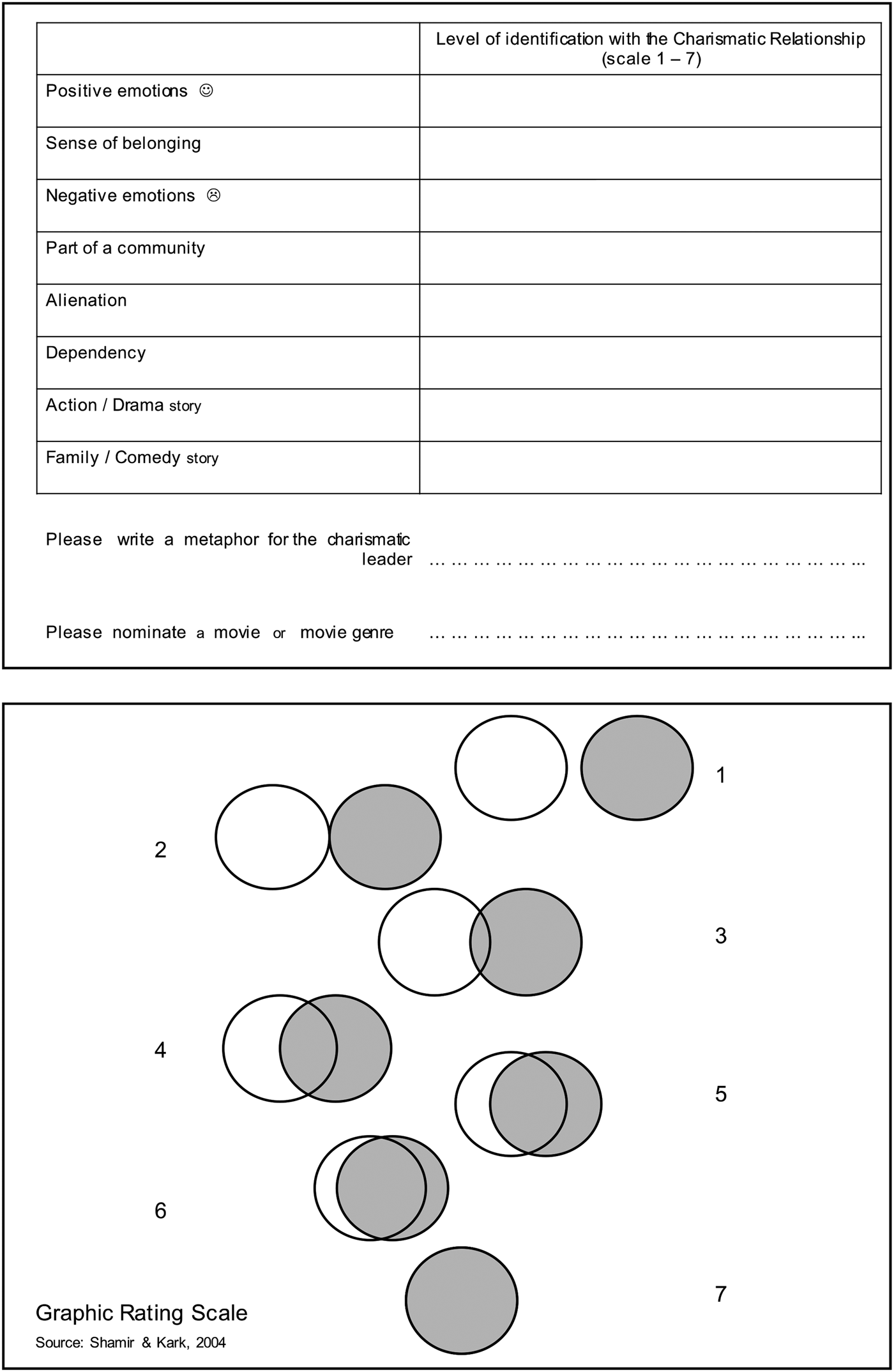
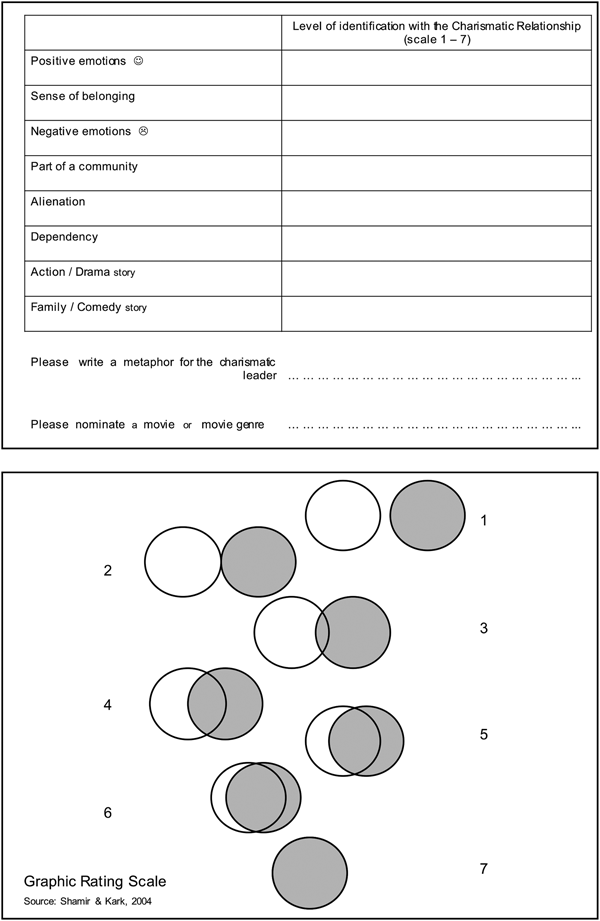
Following Parry and Kempster (Reference Parry and Kempster2014) we use Shamir and Kark's (Reference Shamir and Kark2004) single-item graphic scale to rate different implicit notions of charismatic leadership. In addition, participants were asked to write a metaphor for the charismatic leader and to nominate a movie or movie genre that captures the characteristics of the leader that they were describing (a copy of the survey is attached as Appendix 1). We thus employed a mixed-methods aesthetic narrative approach; soliciting information about the relationship between the leader and followers both in a verbal form as well as employing scales that allow for the analysis of the responses by means of rankings. The narratives that are used are thus not the narratives that are found within the organisation, but rather those that are specifically constructed to elucidate emotional responses (to the leader) that are at times difficult for participants to bring to the surface in conversations.
Stemming from Parry and Kempster (Reference Parry and Kempster2014), a mixed methods approach is deemed particularly suitable relative to purely qualitative (or for that matter purely quantitative) approaches. A mixed methods allows for the optimal integration of the best of the two; thus offering a far richer understanding of any complex relationship (Bryman, Reference Bryman2007). Arguably the strongest epistemological argument in favour of a mixed methods approach centres on its focus on methodological pluralism; advocating an eclectic view of alternative methods of enquiry to a problem that can be (and in many cases needs to be) examined via multiple lenses. This often results in a deeper enquiry with outcomes that are intrinsically superior to mono-method research (Johnson & Onwuegbuzie, Reference Johnson and Onwuegbuzie2004). In particular, the quantitative analysis in our paper allows for the objective identification of the two variables that, in the very least, appear to have a stronger bearing on a follower's sense of belonging to the leader relative to the other factors considered. These are the extent to which the leader is accepted to be part of a community and the extent to which the follower feels positive emotions towards the leader. The results of the quantitative analysis are statistically significant ensuring their portability to the general population extending beyond the particular pool of participants that was used for this study.
Furthermore, usage and interpretation of ‘aesthetic narrative’ in this paper are exactly along the same lines as Parry and Kempster (Reference Parry and Kempster2014). As a methodological approach, Ken particularly favoured aesthetic narrative mixed methods, which can provide a decomposition of charismatic leadership from the followers' perspective via the implicit narratives of their experiential understanding (in this case the movie genres). There are two reasons why movies were used as part of the survey. Firstly, we are interested in gathering information about the emotional relationship between the leader and follower; direct enquiry might not be the most efficient means of gathering such information. Respondents might find truthful answers to be socially embarrassing, or they might wish to place themselves in a more favourable social position. Movies provide a roundabout method of collecting more truthful responses. By placing an artefact (the movie) between the follower and the information that was being sort made any response appear to be an artistic preference rather than revealing an emotional connection.
In the particular context of our paper, an assessment of the followers' experiential understanding of shared experiences was elicited by providing the participants with publicly available examples of leadership in action via movies belonging to certain genres.
Since it is possible that the follower might not have a clear or coherent picture of any existing emotional attachment to the leader, the movie character may act as a metaphor. In addition, we directly ask the follower to supply metaphors for leaders. This approach embeds a relativist view of the world, as summarised by the following quotation, and allows more freedom of expression for responders; ‘Knowledge of reality, whether occasioned by perception, language, or memory, necessitates going beyond the information given. It arises through the interaction of that information with the context in which it is presented and with the knower's pre-existing knowledge. This general orientation is the hallmark of the relativist view objective world is not directly accessible but is constructed on the basis of the constraining influences of human knowledge and language. In this kind of view – which provides no basis for a rigid differentiation between scientific language and other kinds – language, perception, and knowledge are inextricably intertwined' (Ortony, Reference Ortony2002, p. 1).
Organisational aesthetics research is by no means new but is less developed than other methodological approaches. It offers a useful and promising way forward for researchers to develop richer understandings of follower's perspectives of charismatic leadership. As stated by Warren (Reference Warren2008, p. 560); “aesthetic elements of organization emanate from the “felt meanings” of organizational members—the perceptions and judgements that people make about their organizational lives based especially on their sensory encounters with the world around them”.
By providing the participants with publicly available examples of leadership in action via cinema, we were able to assess ‘felt meanings’ to shared experiences even if they experienced the movie at different times. Asking respondents to provide feedback on an external object or event as a ‘trigger’ is also one of the key tenets of organisational aesthetics research (Warren, Reference Warren2008). Cinema as a source of such external triggers has a history in leadership research (Billsberry & Edwards, Reference Billsberry and Edwards2008), particularly using metaphors derived from our personal understanding of cinema (Parry, Reference Parry2008; Wood, Reference Wood2002).
Data collection
Data were collected from five separate groups of middle managers who were participating in various Organisational Behaviour and Leadership classes as part of an MBA program in Lancaster in the UK and in Melbourne, Australia. The managers were mostly in full-time employment, and all currently held (or had recently held) managerial positions in firms or professional organisations.
The data were collected in two waves. Initially, the managers in the UK were surveyed, followed by a survey of similar managers in Australia. The participants were instructed to complete a questionnaire by considering a particular charismatic leader in their work environment. Participants were then asked to rank in pictorial terms (1 separate to 7 completing overlapping – see Appendix 1) the level to which the relationship was linked to the variables – positive emotions, sense of belonging, negative emotions, part of a community, alienation, dependency, an action/drama story and a family/comedy story. Participants were then asked to identify a metaphor for the charismatic leader and nominate a movie or movie genre.
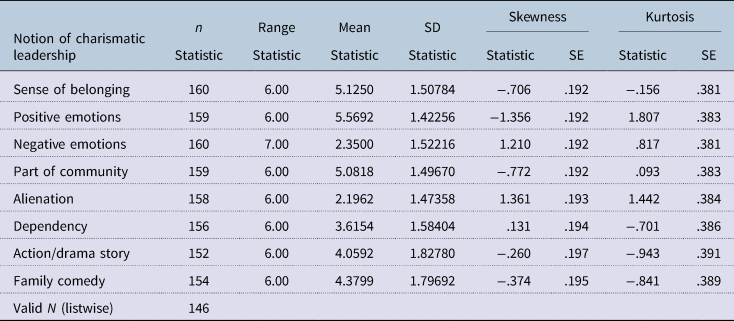
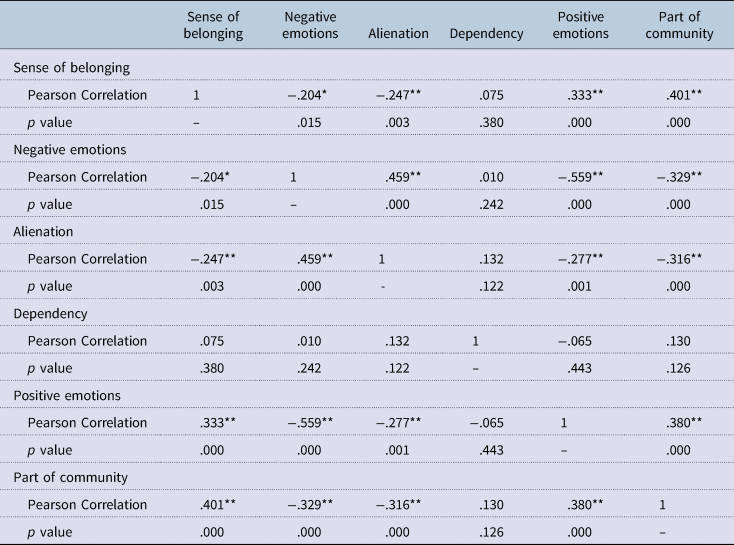
In general, the quality of the data collected was satisfactory. Seventeen participants did not list a movie or a movie genre, and of these 10 did not list a metaphor for a charismatic leader. Of the remaining participants, who all listed a movie or movie genre (143 participants), 11 did not provide a metaphor for a charismatic leader. Where a movie was mentioned by title, the characteristics of that movie as listed in the IMBD were used to classify the genre of the movie. A total of 103 different movie titles were given, with a number of repeated titles (Braveheart 5, Dead Poets Society 3, The Devil Wears Prada 2, Forest Gump 2). Where two movie titles were listed only the first was used in the analysis. We gave a code of ‘1’ to the two relatively close movie genres ‘Action’ and ‘Adventure’, a code of ‘2’ to ‘History’ and ‘Biography’, a code of ‘3’ to ‘Romantic’ and ‘Comedy’, a code of ‘4’ to ‘Crime’ and ‘Horror’ and a code of ‘5’ to ‘Family’ and ‘Drama’. A summary of the survey data is provided in Table 1 and the correlation matrix in Table 2. Although the variables are collected as discrete integers we have reported Pearson's r as the nature of the variables is inherently continuous. Surprisingly, 10 of the 15 possible pairs of variable had a significant correlation. We thus decided against an analysis based on clusters. The descriptive statistics of the variables of interests are displayed in Table 1.
Descriptive statistics of responses

Pearson's pair-wise correlation coefficients

Logistic regressions
As the numerical variables in our study are all either categorical or ordinal, we used a binary logistic regression model (also called a logit model) to search for meaning within the data. The logit model is one of the most useful techniques for handling categorical response data (Agresti, Reference Agresti2002). The dependent variable in a binary logit model can have only two values. The dependent variable in our logit model is the sense of belonging which a follower feels towards the leader. Although the raw scores for this variable were on a Likert-type scale, we ‘collapsed’ the scores less than the median to ‘0’ while those equal or above the median were ‘collapsed’ to ‘1’.
A logistic regression model can be used to estimate the effect of each of the independent variables on the probability of the dependent variable occurring. As with any regression model, the results of a logistic regression can also be affected by multi-collinearity (i.e., strong correlation between one or more of the explanatory variables). To check for possibly problematic multi-collinearity issues, we calculated the pairwise correlations between the explanatory variables (the pairwise product-moment correlation coefficients are shown in Table 2).
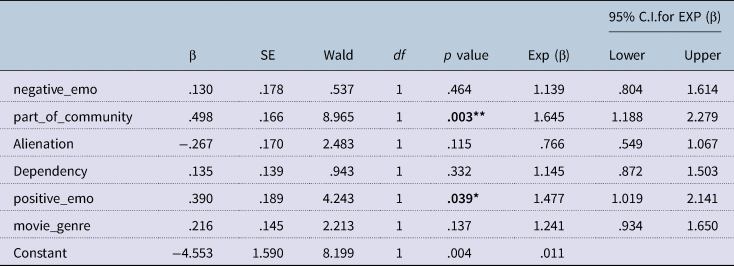
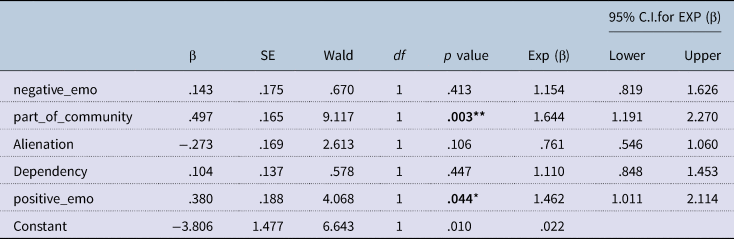
In the case at hand, we take the sense of belonging that a follower feels towards the charismatic leader as the dependent variable and examine the influence of each of the remain variables on this sense of belonging. We find that the probability of a follower feeling a sense of belonging to the leader is strongly dependent on only two factors; the extent to which the leader is considered to be part of a community (Exp [β] = 1.645, p value = 0.003) and the extent to which the follower feels positive emotions towards the leader (Exp [β] = 1.477, p value = 0.039) (see Table 3). Interestingly, neither negative emotions towards the leader, nor feelings of alienation or dependency have any statistical effect on the sense of belonging that the follower feels. The logistic regression results are shown in Table 3.
Binary logistic regression output table (with ‘movie genre’ as an explanatory variable)

** p value significant at the 1% level.
* p value significant at the 5% level.
The slope term (i.e., Exp [β]) in the logit model output is expressible as the ‘odds ratio’ of the individual regression coefficient. Thus the β associated with the follower identifying the leader as ‘part of the community’ (scored on a scale of 1–7) implies that a one-unit increase in the follower's score for this factor will make the score for ‘sense of belongingness towards the leader’ nearly 1.6 times more likely to fall above the median score (0.613/0.387). Similarly, the score for ‘sense of belongingness towards the leader’ will be approximately 1.4 times more likely to fall above the median score for a one-unit increase in the score for the ‘positive emotions’ factor. Interestingly, we found no discernible statistical effect on ‘sense of belongingness to the leader’ of any of the other input factors in our logit model, most importantly ‘negative emotions’.
Appropriate robustness checks were also performed (not reported here for the sake of brevity) to ensure that alternative coding arrangements of the movie genre did not significantly affect the regression outputs. A range of different coding schemes was applied in operationalisation of the ‘movie genre’ variable as one of the explanatory variables in the logistic regression model. This was done to ensure that the results obtained were not affected by any particular coding scheme. The logistic regression version that includes the ‘movie genre’ variable was re-run multiple times – each time with a slightly different coding arrangement. The regression results remained largely unaffected, thereby showing that coding differences in operationalising the ‘movie genre’ variable were not affecting the outcome in any significant way.
We ran two versions of the logistic regression model – one with and the other without the movie genre. Table 4 shows the results of the second version of the model that omitted the movie genre variable. In both versions of the logit model, the only explanatory variables that were statistically significant were ‘part of a community’ (significant at 1% level) and ‘positive emotions’ (significant at 5% level) (see Table 4). We suspect that although asking participants to choose a movie as a means to represent an emotional response to a charismatic relationship is a valuable tool, more information than the title of the movie is needed.
Binary logistic regression output table (without ‘movie genre’ as an explanatory variable)

**p value significant at the 1% level.
*p value significant at the 5% level.
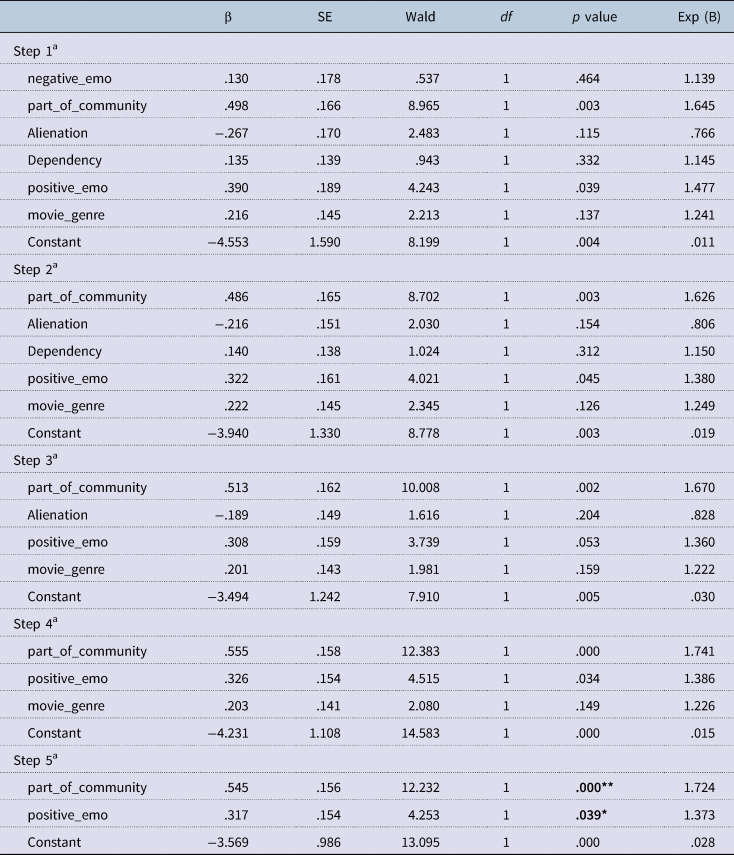
A robustness check based on correlation analysis (Table 2) was also performed to check for multicollinearity. An enhanced logistic regression model based on a backward conditional stepwise algorithm was run to resolve any latent multicollinearity issues. The output of the enhanced logistic regression model (with movie genre) is shown in Table 5.
Backward conditional stepwise logistic regression output table (with ‘movie genre’ as an explanatory variable)

a Variable entered in Step 1 (full model): negative_emo, part_of_community, alienation, dependency, positive_emo, movie_genre.
**p value significant at the 1% level in last step (Step 5).
*p value significant at the 5% level in last step (Step 5).
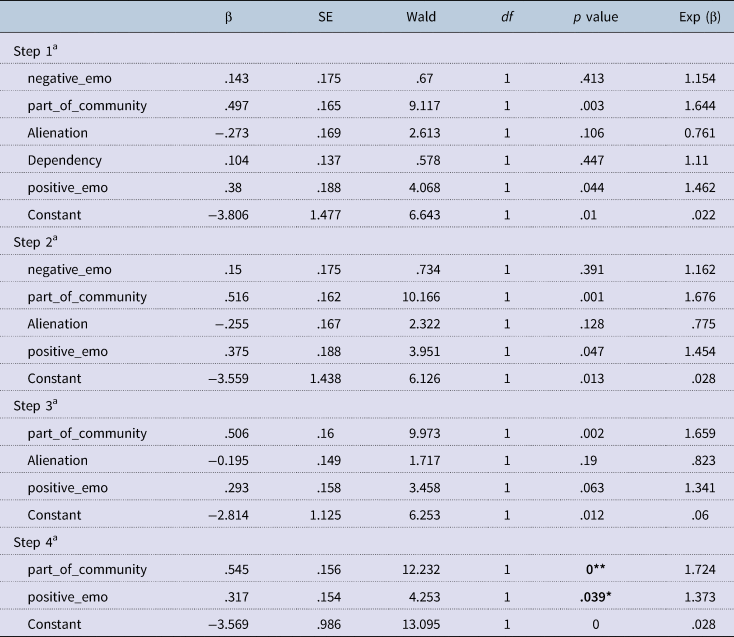
As with the standard logistic regression models discussed previously, we again ran a separate enhanced model that omitted the movie genre variable. The results are shown in Table 6.
Backward conditional stepwise logistic regression output table (without ‘movie genre’ as an explanatory variable)

a Variables entered in Step 1 (full model): negative_emo, part_of_community, alienation, dependency, positive_emo.
**p value significant at the 1% level in the last step (Step 4).
*p value significant at the 5% level in the last step (Step 4).
Both Tables 5 and 6 show that the only two explanatory variables found to be significant in the parsimonious version of the model (i.e., explanatory variables retained in the final step of the model) are part_of_community and positive_emo. These are the same variables that were found to be significant in the standard logistic regression models that we run previously. We, therefore, can conclude that multicollinearity is unlikely to have an impact on the parameter estimates and that the estimated model is robust with respect to multicollinearity.
Qualitative analysis
Observing phenomena through multiple lenses brings both clarity and richness to the analysis. We, therefore, conducted an analysis of the non-quantitative responses that were collected in the survey in terms of the prompt to ‘Please write a metaphor of the charismatic leader’. These responses were often succinct, and, at times, idiosyncratic (e.g., ‘banana’, ‘Kangaroo’). In order to analyse these responses, a conventional thematic coding was undertaken independently of the other data provided. Table 7 lists the 11 nodes that were formed from this analysis, together with examples from each node. The most popular metaphors/descriptions were concerned with the clusters ‘Knowledgeable guide’ (23% of the responses), ‘Strong leader, motivator’ (15%), and ‘Popular, likeable’ (14%). These together with most of the other clusters of metaphors can be seen to relate to either the affective nature of the relationship (positive emotions) or to the perceived social actions of the leader (part of a community). The examples of protective/nurturing metaphors are compelling; ‘a mother hen (how it guides, feed, and protect the offspring)’, ‘lighthouse – beacon lights up vision, sets direction to get thro murky waters’, and ‘mother bear with her cubs (nurturing)’.
Textual analysis of response to the prompt to ‘write a metaphor for the charismatic leader’

While the majority of the responses support the thesis that charismatic leaders generate a community around which followers can organise their actions, there were also strong negative metaphors, that perhaps describe the opposite side of affection; ‘like a glossy magazine because presents a political front and lacks depth/substance’, ‘she is like a poisonous spider on her web waiting for prey’, and ‘they get sh*t done and people like them’.
Discussion and Implications
Shamir's explanation of the manner in which charismatic leaders are able to influence their followers was speculative; ‘We recognise that the theory is speculative. However, we believe such speculation is warranted because it provides an explanation and accounts for the rather profound effects of charismatic leader behaviours demonstrated in prior research’ (Shamir, House, & Arthur,, Reference Shamir, House and Arthur1993, p. 590). Much empirical work has followed. Parry and Kempster (Reference Parry and Kempster2014) were able to demonstrate that this relationship can be characterised in terms of a love story. This analogy proves to be useful in understanding and working with charismatic personalities. In this paper we have been able to add to the understanding of this relationship by identifying an additional aspect; the sense of involvement with the community; which adds to the relationship and also strengthens its statistical tenability. In particular, this study has found that if a follower rates ‘being part of the community’ highly, then he/she is very likely to also report a ‘sense of belongingness towards the leader’. For example, after thinking of a charismatic personality, participants were asked to indicate their level of identification with various attributes associated with different emotional states (see Appendix 1). The relationship with ‘part of the community’ proved to be the most consistent relationship in the logit analysis. In other words, if a follower rates ‘being part of the community’ highly, then he/she is most likely to report a ‘sense of belongingness towards the leader’.
This finding can explain why followers can at the same time have negative feelings towards a charismatic leader while at the same time accommodating the leader's requests – in this instance not out of love, but from a sense of both the leader and the follower serving the same community. In the present study, social identification has the potential to influence personal identification. While Howell and Shamir (Reference Howell and Shamir2005) similarly point out that followers who have strong group identification are more susceptible to charismatic leadership, personal and social identification tends to be treated separately. The findings here suggest that in practice, the lines between personal and social identification are perhaps more blurred that previously thought and thus for charismatic leadership, feelings of belongingness may be influenced by both individual and group-level factors. As such, the lines between socialised charismatic leadership and personalised charismatic leadership may not be as distinct as originally argued by O'Connor et al. (Reference O'Connor, Mumford, Clifton, Gessner and Connelly1995). Further attention to this could be a fruitful area of future research.
The sense of involvement with the community finds an echo in the literature on distributed leadership (see e.g., Edwards, Reference Edwards2011). Thus charismatic leaders may provide a bridge to social identity for followers (Haslam, Reicher, & Platow, Reference Haslam, Reicher and Platow2010) or provide a sense of supportive network (Sarason, Reference Sarason1988). We, therefore, concur with Edwards (Reference Edwards2011, p. 309) that ‘Such aspects as ethics, values, symbolism, friendship and ultimately a sense of belonging reside outside as well as inside the organization’ and that leaders would be advised to make these aspects of their activities visible to followers. Our findings, together with those of Yagil (Reference Yagil1998), reinforce the argument that knowledge of the activities of leaders, in so far as they involve community activities, can be used to strengthen the bond between leaders and followers.
Our results, however, need to be interpreted with care; the sample is drawn for managers participating in higher education programs who are studying phenomena related to leadership. In addition, as Jacquart and Antonakis (Reference Jacquart and Antonakis2015) point out in a recent study, when performance signals are unclear the leaders are indeed evaluated in an inferential manner (i.e., how closely they match the prototype of a charismatic leader), however if performance signals are clear then leaders tend to be evaluated on that performance (and not on their charismatic qualities).
Furthermore, there is a limit in how we are interpreting a sense of belonging and the connection it has with leadership more generally and, in turn, notions and aspects of community. In this research, we have picked out one aspect of a complex and multi-layered social concept (see Edwards, Reference Edwards2015) – heroic individuals – for the purposes of the research. Hence it could be argued that we are limited by this contained view of belonging and would need to further explore its interconnections and fluidity with other aspects of social interaction such as art, friendships, space, and place. Additionally, the link between charismatic leadership and heroes and heroines needs further exploration and explanation, not to mention whether heroines get a look in at all in the masculinised interpretation of leadership (Ford, Reference Ford2010) and, maybe, in particular, charismatic leadership.
Lastly, we feel that it is deeply poignant that the ideas of Boas Shamir have been pursued by Ken Parry – both sadly died of cancer and were taken from us far too soon. Both were outstanding scholars whose contribution to the field of leadership provides an important legacy. Both have contributed to an understanding of the complexity of the charismatic leadership relationship. We hope the contribution of this paper in concluding Ken's empirical work to advance an appreciation of Shamir's theorisation of charismatic leadership will stimulate debate and enable subsequent avenues of research to follow.
Author ORCIDs
Gareth Edwards, 0000-0002-9770-6864.
Appendix 1
Copy of Survey Instrument.