Introduction
Litterfall and litter decomposition represent major processes in terms of transferring nutrients from vegetation to soils (Vitousek & Sanford Reference Vitousek and Sanford1986). Litterfall is composed of fallen leaves and plant reproductive parts, as well as small pieces of woody material (Clark et al. Reference Clark, Brown, Kicklighter, Chambers, Thomlinson and Ni2001). The leaf component is mostly senescent leaves that have already completed their life cycle and translocated their nutrients prior to falling. Decomposition of organic matter is one of the main mechanisms for releasing nutrients in terrestrial ecosystems, and this process plays an important role in regulating nutrient cycling rates (Fonte & Schowalter Reference Fonte and Schowalter2004, Smith & Throop Reference Smith and Throop2018). Climate, rather than substrate quality, has been reported to be the principal determinant of leaf decomposition across subtropical rain and dry forests (Ostertag et al. Reference Ostertag, Restrepo, Dalling, Martin, Abiem, Aiba, Alvarez-Dávila, Aragón, Ataroff, Chapman, Cueva-Agila, Fadrique, Fernández, González, Gotsch, Häger, Homeier, Iñiguez-Armijos, Llambí, Moore, Næsborg, Poma López, Pompeu, Powell, Ramírez Correa, Scharnagl, Tobón and Williams2022).
Greenfall consists of freshly fallen green leaves added to the litterfall as a result of physical damage to trees caused by hurricanes (Lodge et al. Reference Lodge, Scatena, Asbury and Sanchez1991), typhoons (Chen & Shaner Reference Chen and Shaner2018), extreme precipitation events (Pérez-Suárez et al. Reference Pérez-Suárez, Arredondo-Moreno, Huber-Sannwald and Vargas-Hernández2009), and insect (Risley & Crossley Reference Risley and Crossley1988) and small mammal (Smith & Throop Reference Smith and Throop2018) herbivory. Hailstorms can also cause greenfall (Alvarez et al. Reference Alvarez, Villagra, Rossi and Cesca2009, Gosz et al. Reference Gosz, Likens and Bormann1972, Veneklaas Reference Veneklaas1991). Greenfall leaves, which have not translocated their nutrients in anticipation of leaf abscission, contain higher nitrogen (N) concentrations than senescent leaves (Risley & Crossley Reference Risley and Crossley1993, Smith & Throop Reference Smith and Throop2018). Moreover, phosphorus (P) content has been reported as very high in greenfall (Lodge et al. Reference Lodge, Scatena, Asbury and Sanchez1991, Veneklaas Reference Veneklaas1991). High fluxes of N and P have been attributed to increased nutrient concentrations in litterfall collected after hurricane impact, associated with leaf fall occurring prior to nutrient resorption or retranslocation (Lodge et al. Reference Lodge, Scatena, Asbury and Sanchez1991, Reference Lodge, McDowell and McSwiney1994). Greenfall leaves have higher nutrient concentrations than senescent leaves. The litter quality is important because it constitutes the source of nutrients that will be integrated into the system; the greenfall may have higher rates of decomposition and can thus influence decay processes and nutrient cycling, as has been documented in tropical rainforest (Fonte & Schowalter Reference Fonte and Schowalter2004), pine-oak forests (Pérez-Suárez et al. Reference Pérez-Suárez, Arredondo-Moreno, Huber-Sannwald and Vargas-Hernández2009), and Appalachian forest (Risley & Crossley Reference Risley and Crossley1993). Greenfall leaf litter therefore contributes to nutrient recycling by adding extra nutrients via a nutrient pulse to the forest. Short-term pulses of litterfall may be responsible for disproportionately large nutrient pulses associated with canopy-level defoliation through leaf greenfall (Lodge et al. Reference Lodge, Scatena, Asbury and Sanchez1991, Reference Lodge, McDowell and McSwiney1994, Ostertag et al. Reference Ostertag, Scatena and Silver2003). Resource pulses are brief events of dramatically increased resource availability that combine low frequency (rarity), large magnitude (intensity), and short duration (brevity), and are widespread phenomena in nature (Yang et al. Reference Yang, Bastow, Spence and Wright2008). The importance of pulse dynamics in tropical forest research has been poorly documented; however, since extreme events such as severe hailstorms are predicted to become more frequent, the subject of nutrient pulses in tropical forests is one of increasing importance (see Lodge et al. Reference Lodge, McDowell and McSwiney1994).
Climatic alterations associated with climate change will produce increased temperatures and more of the most severe storms. In addition, hailstorm severity is expected to increase with climate change in most regions (Raupach et al. Reference Raupach, Martius, Allen, Kunz, Lasher-Trapp, Mohr, Rasmussen, Trapp and Zhang2021). Hailstones exceeding 2 cm in diameter are considered severe and can be destructive; however, hail is a small-scale phenomenon that occurs only rarely at any given location, making it challenging to observe (Raupach et al. Reference Raupach, Martius, Allen, Kunz, Lasher-Trapp, Mohr, Rasmussen, Trapp and Zhang2021). Hailstorms represent a phenomenon of importance that may become a major source of damage to both vegetation and fauna (Fernandes et al. Reference Fernandes, Yumi, Mendes de Sá, Sales, Quintino, Freitas and Caires2012, Narwade et al. Reference Narwade, Gaikwad, Fartade, Pawar, Sawdekar and Ingale2014). Severe hailstorms have caused the mass mortality of birds and mammals in Maharashtra, India (Narwade et al. Reference Narwade, Gaikwad, Fartade, Pawar, Sawdekar and Ingale2014), and intense damage to vegetation of rocky outcrops in Brazil (Fernandes et al. Reference Fernandes, Yumi, Mendes de Sá, Sales, Quintino, Freitas and Caires2012). In temperate zones, hailstorm damage has been documented for decades in forests, plantations and crops (Raupach et al. Reference Raupach, Martius, Allen, Kunz, Lasher-Trapp, Mohr, Rasmussen, Trapp and Zhang2021).
The phenomenon of hailstorms adding green leaves and nutrients to litterfall has been well-studied in temperate hardwood forests (e.g., Gosz et al. Reference Gosz, Likens and Bormann1972). However, in tropical forests, there is scarce information regarding the effect of hailstorm events on greenfall leaves and the dynamics of litterfall production and nutrient inputs. Certain studies have reported marked litterfall peaks in association with hailstorms. For instance, considerable peaks of litterfall production associated with strong hailstorms have been recorded in montane forests in Colombia (Veneklaas Reference Veneklaas1991) and in the Ñacuñán Biosphere Reserve, Argentina (Alvarez et al. Reference Alvarez, Villagra, Rossi and Cesca2009).
In our study area, hailstorm events do not take place every year and certainly do not occur in the same spot. Unexpectedly, two separate hailstorm events were recorded in the Spring of 2020 in sites where litterfall traps had been established since 2013 (Williams-Linera et al. Reference Williams-Linera, Bonilla-Moheno, López-Barrera and Tolome2021). The aim of this study was to determine the contribution of hail-caused greenfall leaves to litterfall production in a tropical cloud forest region. The objectives were 1) to compare greenfall versus senescent leaf contribution to the litterfall production, 2) to determine nutrient input to the system due to a hail-caused greenfall resource pulse standardized by day, month, and year, and 3) to determine the leaf decomposition rate. We hypothesized that greenfall leaves caused by hailstorm events will make a significant contribution to total litterfall, in terms of both leaf biomass and nutrient input (C, N, P) to the forest.
Methods
Study sites
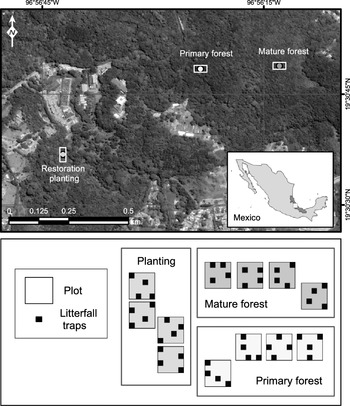
The study sites comprise two cloud forests (F1 and F2) and a restoration planting area (R) located 300–900 m apart in central Veracruz, Mexico (19°30′37″ N, 96°56′19″ W; elevation 1225–1300 m asl; Figure 1). The vegetation type is lower montane cloud forest. The soil is volcanic in origin and has been classified as an Andept. Mean temperature is 18 °C, and total annual precipitation is 1600 mm. The climate data are taken from the closest meteorological station located at 1320 m asl and <1 km from the study sites. The F1 is a primary cloud forest located in a 13 ha Ecological Park protected by Veracruz State. The F2 is a mature cloud forest >120 years old located in a 29 ha Sanctuary of Cloud Forest reserve, and the R is in a 4-ha ecological restoration planting, both are property of the Instituto de Ecologia (INECOL). The dominant tree species in the forests are Carpinus tropicalis (Donn. Sm.) Lundell, Clethra macrophylla M. Martens & Galeotti, Liquidambar styraciflua L., Quercus germana Schltdl. & Cham., Quercus xalapensis Bonpl., and Turpinia insignis Tul. (Williams-Linera & Tolome Reference Williams-Linera and Tolome1996, Williams-Linera et al. Reference Williams-Linera, Bonilla-Moheno, López-Barrera and Tolome2021). The tree species planted in 2012 in the restoration planting were Dendropanax arboreus (L.) Decne. & Planch., Magnolia dealbata Zucc., Juglans pyriformis Liebm., Quercus pinnativenulosa C.H. Mull., and Quercus sartorii Liebm. (Williams-Linera et al. Reference Williams-Linera, Bonilla-Moheno, López-Barrera and Tolome2021).
Location of the study sites in a cloud forest reserve and a restoration planting area in central Veracruz, Mexico. The design shows the location of the litterfall traps (black squares – not at scale) within plots in the forests and planting area.

Litterfall
Litterfall was collected on the last days of each month for three years, from June 2018 to May 2021. We used litterfall traps consisting of cone-shaped steel wire structures with an open circumference of 1.58 m and a height of 60 cm. The traps were placed randomly in four plots per site (16 traps in F1, 16 in F2, and 16 in R) at a minimum distance of 10 m apart, within a plot previously established in each of the three sites. A total of 48 collection traps were set up (Figure 1).
Hailstones size measurement
While conducting the litterfall study, two hailstorm events occurred. During both events, using a 12 Mpixels iPhone camera, pictures were taken in a shade coffee plantation located 1.5 km away from the study sites. Using the pictures, the 15 biggest hailstones were measured with the measuring tools of Adobe Acrobat Pro and a Python script to take into account the camera tilt with respect to the ground. In each picture, the tools used a known object’s dimension as a scale, in both cases, a blade of grass.
Greenfall during the hailstorm year
The morning after each event, the green leaves were easily distinguished within the traps, and these were separated from the senescent leaves and other litterfall components. The samples were transferred to the lab and placed in paper bags. They were oven-dried at 70 °C for 72 hours and then separated into different components, including leaves, flowers and fruits, woody material (branches <1 cm in diameter; Clark et al. Reference Clark, Brown, Kicklighter, Chambers, Thomlinson and Ni2001), and debris (undifferentiated material). Green and senescent leaves were sorted by species, genera, or as unidentified. To determine the greenfall contribution to the litterfall, we used the one-year subset of the database when the hailstorm events occurred (2020) and compared this with the previous and following years.
Nutrient input to the forest systems
Concentration of C, N, and P was analysed in combined samples per plot for each site in the greenfall and senescent leaf components of the litterfall collected in April and May 2020, after the hailstorm events. Carbon and N were quantified through complete combustion in a TruSpec Micro (LECO Corporation, Michigan, EUA), while foliar P was quantified with vanadate-molybdate reagent in a Spectrophotometer (Spectronic 200E, Thermo Fisher Scientific, Madison, USA). Determinations were carried out in INECOL using standard techniques (SEMARNAT 2002).
Content of C, N, and P was calculated as leaf biomass production per sample and site, multiplied by leaf concentration. We standardized C, N, and P content in the greenfall and senescent leaves to day (kg ha−1 d−1), month (kg ha−1 mo−1), and year (kg ha−1 y−1).
Leaf decomposition
Leaf decomposition rates were calculated using Litsea glaucescens (mountain laurel) and Quercus xalapensis (oak) green leaves collected in situ. We used litterbags, following the protocol of Ostertag et al. (Reference Ostertag, Restrepo, Dalling, Martin, Abiem, Aiba, Alvarez-Dávila, Aragón, Ataroff, Chapman, Cueva-Agila, Fadrique, Fernández, González, Gotsch, Häger, Homeier, Iñiguez-Armijos, Llambí, Moore, Næsborg, Poma López, Pompeu, Powell, Ramírez Correa, Scharnagl, Tobón and Williams2022). Since that study reported no differences between 52 μm and 1920 μm mesh, we used an intermediate mesh size (600 μm). Mountain laurel and oak leaves were dried at 70°C for 48 hours, and 1.00 ± 0.01 g of dry leaves were added to 10 × 10 cm litterbags. The sealed and labelled bags of each species were placed in the three study sites on October 13, 2020, in two burial environments (on the soil surface and at 15 cm soil depth), three plots, and two replications for each harvesting time. Bags were harvested at 3 and 7 months, based on Ostertag et al. (Reference Ostertag, Restrepo, Dalling, Martin, Abiem, Aiba, Alvarez-Dávila, Aragón, Ataroff, Chapman, Cueva-Agila, Fadrique, Fernández, González, Gotsch, Häger, Homeier, Iñiguez-Armijos, Llambí, Moore, Næsborg, Poma López, Pompeu, Powell, Ramírez Correa, Scharnagl, Tobón and Williams2022) who reported these times as appropriate to provide a robust estimation of the decay constant (k). Following retrieval, the bags were cut open and the contents removed, washed with water, dried at 70 oC for 48 h, and weighed to ±0.01 g. Bag values were averaged per plot per harvesting time for each site and environment. Remaining mass (%) and decay rates (k yr−1) were calculated per species, site, and environment to enable comparison among sites and between surface and belowground burial environments. Decay rates and disappearance times were calculated using the negative exponential decay model (Bernhard-Reversat Reference Bernhard-Reversat1982, Ostertag et al. Reference Ostertag, Restrepo, Dalling, Martin, Abiem, Aiba, Alvarez-Dávila, Aragón, Ataroff, Chapman, Cueva-Agila, Fadrique, Fernández, González, Gotsch, Häger, Homeier, Iñiguez-Armijos, Llambí, Moore, Næsborg, Poma López, Pompeu, Powell, Ramírez Correa, Scharnagl, Tobón and Williams2022).
Statistical analyses
The litterfall and leaf components collected monthly for three years (excluding greenfall) were averaged within plots. To examine the effect of site on total litterfall and senescent leaves, data were analysed using repeated-measures ANOVAs with site, year and the interaction site × year as fixed effect factors, and plot as a random effect factor. To test for differences in sites between senescent and greenfall leaf production in the hailstorm year, we used a repeated-measures ANOVA. Differences in nutrient concentration and content were tested with one-way ANOVAs. Data were tested for normal distribution using the Shapiro-Wilk test and log-transformed where appropriate to meet the statistical assumptions of normality in the data. When differences were significant, we applied Tukey’s HSD tests. Leaf decomposition was analysed as the remaining mass proportion and k (exponential rate of decline), using a repeated-measures ANOVA. Remaining mass was transformed using the arcsine square root of the proportion. Fixed effects were site, leaf species (substrate), and environment, the random effect was plot nested in site. Data were analysed using JMP Version 10.0.0 (SAS Institute, Cary, NC, USA).
Results
Climate and hailstorms
We used the period of three years as a framework in which to compare litterfall and greenfall production where year 2 was the hailstorm year (June 2019–May 2020). In these three years, total precipitation values were 1479, 1815, and 1844 mm, respectively (Figure S1A). The first hailstorm event took place on April 29 from 17:00 to 17:50 h, and hailstones were (mean ± SE) 2.8 ± 0.1 cm, up to 3.4 cm in diameter, and the second on May 16 from 19:20 to 19:40 h with hailstones 3.6 ± 0.1 cm, up to 4.3 cm. These two events were intense because hailstones were >2.0 cm diameter (Raupach et al. Reference Raupach, Martius, Allen, Kunz, Lasher-Trapp, Mohr, Rasmussen, Trapp and Zhang2021). Since hailstone size is a good proxy for damage potential (Box S1), the latter of shorter duration had greater strength. The damage was visible, leaves and fragments of leaves covered the paths and forest floor, leaves were teared, and shrubs in the forest understory were slightly damaged in their foliage.
Litterfall
Total annual litterfall production, excluding greenfall, was 9.98 ± 0.91 (mean ± SE), 10.08 ± 0.86, and 7.65 ± 0.61 Mg ha−1 y−1 in F1, F2, and R, respectively. Litterfall was similar in both forests, and it was higher than in the planting area. Litterfall production was similar in years 1 and 2 and higher than in year 3 (Figure S1B, Table S1A). Leaves followed the same trend as litterfall production, except that senescent leaf production in year 2 was higher than in years 1 and 3, which were similar between themselves (Figure S1C, Table S1A). Overall, senescent leaves represented the most important component of the total litterfall in the two forests and planting area (ca. 61%), whereas flowers and fruits, woody parts, and debris represented ca. 16%, 15%, and 9%, respectively.
Litterfall and greenfall production during the year of the hailstorm events
Greenfall leaf production was 95% of total leaf fall (green plus senescent leaves) on the day of the hailstorm (Figure 2a), 40% when expressed per month (Figure 2b), and 10% per year (Figure 2c). Greenfall leaves did not differ across sites, but total annual litterfall and senescent leaf components were statistically higher in F1 and F2 than in R (Table S1B).
Greenfall leaves caused by hailstorm events and senescent leaves standardized (a) per day of the event, (b) per month, and (c) per year. Leaves were collected in F1 (primary forest), F2 (mature forest), and R (planting area) during a year with two separate hailstorm events in central Veracruz, Mexico. Values are mean ± SE.

Tree species contributed to greenfall and senescent leaves in a similar proportion in each site (Figure S2). In the three sites, Quercus spp. were among the most represented leaves. In the forests most leaves belonged to the dominant tree species: Carpinus tropicalis, Clethra macrophylla, Platanus mexicana, Quercus spp., and Turpinia. insignis (Figure S2A, B). In the planting, most leaves were Acacia pennatula, Myrsine coriacea, Trema micrantha, and planted tree species such as Dendropanax arboreus, Juglans pyriformis, and Quercus spp. (Figure S2C).
C, N, and P concentration in greenfall and senescent leaves
Concentrations of C, N, and P differed across sites (Figure 3, Table S2A). The concentration of C was higher in forests than in the planting area and was higher in greenfall than in senescent leaves (Figure 3a). Nitrogen and P concentrations were higher in the planting area than in forests, but N and P concentrations tended to be higher in greenfall than in senescent leaves (Figure 3b, c).
Concentration of (a) carbon, (b) nitrogen, and (c) phosphorus in greenfall and senescent leaves in F1 (primary forest), F2 (mature forest), and R (planting area) in central Veracruz, Mexico. Values are mean ± SE.

C, N, and P content in the day, month, and year of the hailstorm events
When comparing the nutrient content contributed by greenfall and senescent leaves on the day of the hailstorm event, it was evident that a nutrient input pulse occurred with the greenfall leaves (Figure 4a–c; Table S2B). Carbon and N contents on the day of the hailstorm were statistically similar among sites, and P content was marginally higher in the planting area than in the forest sites (Figure 4a–c, Table S2B). When standardized to the month of the hailstorm events, total C and N inputs were lower in greenfall leaves than in senescent leaves (Figure 4d, e, Table S2C). It is interesting to note that P content per month did not differ significantly between greenfall and senescent leaves, but there was a marginal trend for higher P content in R than in forests (Figure 4f, Table S2C). When standardized to the year of the hailstorm events, we found that greenfall leaves still contributed ca. 12–14% C, N and P to the three sites (Figure 4g–i, Table S2D).
Content of carbon standardized per (a) day, (b) month, (c) year; nitrogen per (d) day, (e) month, (f) year; and phosphorus per (g) day, (h) month, (i) year as contributed by greenfall and senescent leaves in F1 (primary forest), F2 (mature forest), and R (planting area) in central Veracruz, Mexico. Values are mean ± SE.

Leaf decomposition
After 7 months, there was 49 ± 2% of initial mass (mean ± SE) at the soil surface and 50 ± 1% for the buried bags. In addition, the remaining mass after 7 months tended to be lower in R than in the forests and higher in Litsea (45%) than in Quercus (44%). On average, aboveground k was 1.31, and belowground k was 1.66. Leaf decomposition rates were 1.24, 1.63, and 1.59 in F1, F2, and R, respectively. However, both mass loss and k showed no statistical differences between burial depths and species, or across the sites. We therefore used the average of all measurements (k = 1.53, SE = 0.10) as the leaf decomposition rate for this study.
Discussion
The opportunity to study the effect of the hailstorms on greenfall leaf production and nutrient input was serendipitous. Since 1990, several studies have been carried out in these sites but hailstorms were not recorded within the forest (Williams-Linera et al. Reference Williams-Linera, Bonilla-Moheno, López-Barrera and Tolome2021, Williams-Linera & Tolome Reference Williams-Linera and Tolome1996). These hailstorms are very localized events in the central region of Veracruz. For example, on April 27, 2014, and April 10, 2020, heavy hailstorms affected the adjacent Xalapa City area, but none of those events reached the studied forests and planting area, according to data from the nearby meteorological station and the observations of the inhabitants of that area (GWL, pers. obs.).
Total litterfall for the three years of this study was 18% higher than that recorded in the same forest 30 years earlier (1990–1993, Williams-Linera & Tolome Reference Williams-Linera and Tolome1996). This parameter was 1% and 42% higher in the mature forest and planting area, respectively, than that recorded in 2013–2018 (Williams-Linera et al. Reference Williams-Linera, Bonilla-Moheno, López-Barrera and Tolome2021). The increased litterfall production may be influenced by forest age and related to changes in vegetation characteristics such as floristic composition and forest structure (Williams-Linera et al. Reference Williams-Linera, Bonilla-Moheno, López-Barrera and Tolome2021; Williams-Linera & Tolome Reference Williams-Linera and Tolome1996). Overall, values of litterfall and senescent leaf production were higher in forests than in the planting area; however, in the hailstorm year, senescent leaf production was higher than in both the previous and following years; we observed that, in general, the hailstorm events increased greenfall but also the production of senescent leaves and other litterfall components that were subsequently lower in year 3. A diminution of litterfall after hailstorms was also observed in a montane forest in Colombia, where the highest records of litterfall coincided with the occurrence of hailstorms, and the quantity of litterfall recorded in the subsequent week was the lowest of the entire study period (Veneklaas Reference Veneklaas1991). The increased litterfall in the hailstorm year may be attributed to the presence of leaves and other fine litter that are often trapped in the tropical forest crowns (Clark et al. Reference Clark, Brown, Kicklighter, Chambers, Thomlinson and Ni2001).
Greenfall leaves and contribution to litterfall
The greenfall leaf biomass was remarkably high (9–12% of total litterfall on an annual basis) considering that this contribution was the result of only two hailstorm events. Greenfall leaf production depended more on the intensity than on the duration of the hailstorm event. Veneklaas (Reference Veneklaas1991) recorded a hailstorm causing considerable damage in a lower montane rainforest, leaving the forest floor covered with leaf fragments. In Ñacuñan Biosphere Reserve, Argentina, litterfall varies seasonally but a litterfall peak was associated with a strong hailstorm (Alvarez et al. Reference Alvarez, Villagra, Rossi and Cesca2009).
Our study was unique in that we actually measured the greenfall produced by hailstorms. In general, previous research on greenfall has used leaves that were not collected in leaf litter traps, but rather directly collected from the plants with the objective of determining the contribution of nutrients to the litterfall made by the green leaves, either introduced by natural leaf fall (Pérez-Suárez et al. Reference Pérez-Suárez, Arredondo-Moreno, Huber-Sannwald and Vargas-Hernández2009) or cut by herbivores (Risley & Crossley Reference Risley and Crossley1988, Smith & Throop Reference Smith and Throop2018) or by experimentally adding green leaf fragments directly to the forest floor (Schowalter et al. Reference Schowalter, Fonte and Geaghan2011).
Greenfall leaves and nutrient resource pulse
In our study, concentrations of C, N, and P were 2.3%, 5.7%, and 18.1% higher, respectively, in greenfall than in senescent leaves. These concentrations also differed across sites, where N and P were higher in the planting than in forests. Several studies have reported that greenfall leaves are nutrient-rich since green leaves do not translocate nutrients in anticipation of abscission and thus contain higher N and P concentrations than senescent leaves (Fonte & Schowalter Reference Fonte and Schowalter2004, Lodge et al. Reference Lodge, Scatena, Asbury and Sanchez1991, Risley & Crossley Reference Risley and Crossley1993). Lodge et al. (Reference Lodge, Scatena, Asbury and Sanchez1991) reported that green leaves have higher nutrient concentrations than normal leaf litterfall, for those nutrients that are translocated during senescence. Veneklaas (Reference Veneklaas1991) compared fresh crown leaves versus recently shed litterfall leaves and reported higher concentrations of N and P. Similarly, a higher percentage of N in green than in senescent leaves has been reported in an arid ecosystem (Smith & Throop Reference Smith and Throop2018) and temperate forests (Risley & Crossley Reference Risley and Crossley1993). However, in our study, concentrations of N and P were not remarkably higher in greenfall than in senescent leaves. Since the relative contribution of tree species to greenfall and senescent leaves was similar, an explanation may be related to nutrient translocation. During senescence, about half of the N and P has been reported to be translocated from mature leaves (Aerts Reference Aerts1996, Wang et al. Reference Wang, Song, Liu, Quan and Wang2022). In addition, N and P concentrations declined in major tree species throughout the litterfall season (See et al. Reference See, Yanai and Fahey2019, Wang et al. Reference Wang, Song, Liu, Quan and Wang2022), and consequently, the timing of litter collection affects estimates of nutrient concentrations (Gosz et al. Reference Gosz, Likens and Bormann1972, See et al. Reference See, Yanai and Fahey2019, Wang et al. Reference Wang, Song, Liu, Quan and Wang2022). Leaves that become senescent later in the autumn would have lower concentrations of nutrients (Gosz et al. Reference Gosz, Likens and Bormann1972). In our sites, the dominant tree species are deciduous (e.g., Carpinus tropicalis, Liquidambar styraciflua, Quercus spp.), and leaf litterfall occurred throughout the year with a seasonal leaf fall peak between December and February (Figure S1). Thus, during the hailstorm events in April and May, litterfall senescent leaves had relatively high nutrient concentrations because translocation may have been low.
The contribution of C, N, and P through greenfall leaves to the cloud forest ecosystem has temporal variation. On per day basis, the ratio of the C, N, and P input pulse was about 20:1 greenfall to senescent leaves. Two hailstorm events were sufficient to raise the percentages of nutrient input into the system by 12.3% for C, 12.8% for N, and up to 14% for P, on an annual basis. The nutrient content contributed by senescent leaf litterfall to the ecosystem has been well documented, although few studies refer specifically to the nutrient input of greenfall leaves. In a temperate hardwood forest where green leaves fell in a hailstorm, the N and P contents in the greenfall leaves were 36.7% and 44.7%, respectively of the N and P in the total leaf fall (Gosz et al. Reference Gosz, Likens and Bormann1972). The contribution of green leaves to the annual nutrient input found in our study is similar to that found in a Mexican oak-pine forest, where two single extreme weather events (precipitation events) accounted for up to 18% and 11%, respectively, of the total annual N and P nutrient input to the ecosystem (Pérez-Suárez et al. Reference Pérez-Suárez, Arredondo-Moreno, Huber-Sannwald and Vargas-Hernández2009). Alvarez et al. (Reference Alvarez, Villagra, Rossi and Cesca2009) reported that green leaves associated with a strong hailstorm doubled the N content produced by senescent leaves alone, and thus the greenfall caused by storms could produce a pulse of N input. Several authors coincide in that greenfall is an important input mechanism of nutrients for temperate (Gosz et al. Reference Gosz, Likens and Bormann1972), deciduous, and mixed forests (Pérez-Suárez et al. Reference Pérez-Suárez, Arredondo-Moreno, Huber-Sannwald and Vargas-Hernández2009), lower montane rainforests (Fonte & Schowalter Reference Fonte and Schowalter2004, Lodge et al. Reference Lodge, Scatena, Asbury and Sanchez1991), and cloud forests (Veneklaas Reference Veneklaas1991). In our study, the significant contribution of nutrient input is related more to the biomass of greenfall leaves than to the concentration of C, N, and P in green compared to senescent leaves.
Leaf decomposition rates
We found that the remaining mass percentage and k did not differ significantly across sites, species, and environments. Therefore, the average remaining mass (45 ± 1.2%) and k (1.53 ± 0.10) values were applied to our study. With this decomposition rate, most (95%) of the greenfall leaves would be incorporated into the forest and planting area floor in ca. 1.93 years (disappearance time calculated from the negative exponential decay model). These values are within the range reported for 23 tropical montane forests worldwide (Ostertag et al. Reference Ostertag, Restrepo, Dalling, Martin, Abiem, Aiba, Alvarez-Dávila, Aragón, Ataroff, Chapman, Cueva-Agila, Fadrique, Fernández, González, Gotsch, Häger, Homeier, Iñiguez-Armijos, Llambí, Moore, Næsborg, Poma López, Pompeu, Powell, Ramírez Correa, Scharnagl, Tobón and Williams2022), where bay leaf losses are 59 ± 1% of the initial mass after 7 months and the k value is within the range of 1.12 - 2.52.
Greenfall has potentially major effects on decomposition dynamics since greenfall leaves increase the rate of decomposition and nutrient cycling (Risley & Crossley Reference Risley and Crossley1993, Smith & Throop Reference Smith and Throop2018). In lower montane rainforests, sudden high nutrient inputs act to modify nutrient cycling (Lodge et al. Reference Lodge, Scatena, Asbury and Sanchez1991), since greenfall has a major influence on decay processes and nutrient cycling in forests (Fonte & Schowalter Reference Fonte and Schowalter2004). Moreover, in different temperate systems, it has been found that even small inputs of greenfall leaves added to the leaf litter can have a disproportionate influence on the dynamics of decomposition and the speed of nutrient cycling (Risley & Crossley Reference Risley and Crossley1993, Smith & Throop Reference Smith and Throop2018). Recently, other authors have reported that green leaf traits are also significant contributors to decomposition and the functioning of forest ecosystems and proposed that an improved understanding of ecological functioning, particularly regarding the decomposition process in forests, could be gained by considering both green leaf and litter traits (Rawat et al. Reference Rawat, Arunachalam, Arunachalam, Alatal and Pandey2020).
Conclusions
At present, information regarding the effects of hail defoliation on tropical montane forests is limited, which is why our recommendation for future studies is to continue recording and analysing greenfall leaves as a result of hail events. More studies are needed on the impact of nutrient loss in greenfall on the plants themselves. Hailstorm events, so far fortuitous, could actually become more common and severe, in which case it is necessary to have appropriate research protocols in order to be prepared and to effectively record the events. It is also important to relate the results regarding the quantities of litterfall produced to studies of resource pulses and litter decomposition in order to gain a better understanding of the dynamics of these systems. This study demonstrated that, in a very short period of time (70 minutes), hailstorm events can produce a large contribution of green leaves to the total litterfall in forest systems, thereby generating nutrient pulses. This contribution of green leaves is particularly important, as it can directly influence the nutrient cycling of the forest. Hailstorms constitute a substantial contribution of green leaves at the time of the event and a subsequent source of extra C, N, and P as these leaves decompose and are incorporated into the system.
Supplementary material
To view supplementary material for this article, please visit https://doi.org/10.1017/S0266467422000475
Acknowledgements
We are grateful to Ferry Slik, Associate Editor, and two anonymous reviewers for helpful comments and suggestions that improved the manuscript. We thank Roberto Monroy for preparing Figure 1 and implementation of the Adobe measuring tools and Eric Williams for the development of the Phyton script to estimate hailstone diameters.
Financial support
This research received no specific grant from any funding agency, commercial, or not-for-profit sectors.
Conflict of interests
The authors declare none.
Ethical statement
None.