Introduction
The UK Government position volunteering as a route that can support health and social care services, with Norman Lamb (Minister of State for Community and Social Care 2010-2015) stating that a ‘great army’ of volunteers exists that can provide ‘some of the solutions to the challenges we face’ (Hardy, Reference Hardy2014). The debate around volunteering and its role in the future of European (Henrikson et al., Reference Henrikson, Koch-Nielson and Rosdahl2008) and global welfare states centres around ideas of civic engagement, participation and motivation that ultimately position volunteering as ‘a foundational block in the formation and sustainability of civil society across the world’ (Hustinx et al., Reference Hustinx, Handy, Cnaan, Brudney, Pessi and Yamauchi2010: 350).
At the same time, there has been an increasing policy focus on dementia in the UK due to over 850,000 people living with dementia, costing the UK an estimated £26 billion per annum (Alzheimer’s Society, 2014). By 2050, the number of people living with dementia globally will increase from 50 to 132 million (World Health Organisation, 2017). Social and economic impacts, as well as impacts for families and carers, are key concerns as organisations and governments around the world look for ways of supporting those living with dementia. This paper highlights an important, yet under researched, area of support: volunteering in dementia care and the role of volunteers in connecting home and community settings.
We present findings from a project exploring the role of volunteering in dementia and includes the often under-represented perspectives of those living with dementia. The concept of policy ‘assemblages’ (i.e. ways that ‘policies, personnel, places, practices, technologies, images, architectures of governance and resources are brought together and combined’ (Newman and Clarke, Reference Newman and Clarke2009: 15) is drawn upon to explore the boundaries between formal and informal volunteering. The findings give insight on how to improve policy and practice in dementia care from the perspectives of those with dementia across different home and community environments.
It has been noted that dementia care is particularly stressful and challenging for volunteers (Alzheimer’s Society, 2011) and, although relatively common, there is a surprising lack of information on volunteers in dementia care. A focus on dementia is important as an underdeveloped area with a ‘dearth of evidence or information to support this key agenda’ (Brown et al., Reference Brown, Tolson, Ritchie, Sharp, Syme, James and Tolson2017: 8). This paper offers insight to the role that volunteers play in supporting people with dementia and asks whether volunteers can ‘bridge boundaries’ between home and community.
The paper firstly outlines the fragmentation of current social policies in the area of volunteering and dementia care and argues that a more connected approach is needed. Volunteers and those living with dementia experience activity to be more of an ‘assemblage’ of support that links perceptions of home and community. The links between housing policy and dementia have wider implications for the definition and integration of volunteering within policy and practice in housing, health and social care sectors.
Fragmentation and ‘boundary problems’ in volunteering, housing and dementia policy
Social policy areas of housing, volunteering and dementia are traditionally disconnected. The role of volunteers in health, wellbeing and social care – especially the benefits – is well-developed (Naylor et al., Reference Naylor, Mundle, Weaks and Buck2013; Whittall et al., Reference Whittall, Lee and O’Connor2016; Darley, Reference Darley2018) but often topically led. For example, focusing on specific areas of activity such as sport (Ahn et al., Reference Ahn, Phillips, Smith and Ory2011), charities (Flores, Reference Flores2014; Darley, Reference Darley2018), faith-based organisations (Caputo, Reference Caputo2009) or certain demographics such as younger people (Hustinx et al., Reference Hustinx, Handy, Cnaan, Brudney, Pessi and Yamauchi2010; Gronlund et al., Reference Gronlund, Holmes, Kang, Cnaan, Handy, Brudney and Zrinscak2011) and older people (Kahana et al., Reference Kahana, Bhatta, Lovegreen, Kahana and Midlarsky2013; Tang, Reference Tang2016). Policy insight around volunteering includes the importance of government intervention and spending in relation to volunteer participation (Bartels et al., Reference Bartels, Cozzi and Mantovan2013), financial return on investment in volunteering, and wider community benefits including improved resilience and well-being (Paylor, Reference Paylor2011).
For policy relating to dementia, the role of volunteering is generally overlooked. For example, in the current Dementia Strategies the word ‘volunteer’ is completely absent in Scotland and England (Scottish Government, 2010; 2011a; Department of Health, 2009). This is despite the Scottish National Performance Framework including volunteering in their headline outcomes (Scottish Government, 2018a) and David Cameron’s ‘Dementia Challenge’ for 2020 (Department of Health, 2015). With millions of people volunteering in health and social care (3 million in England alone), volunteers play a critical role in a sustainable future by improving people’s experiences of care, improving public health and building links between services and communities (Naylor et al., Reference Naylor, Mundle, Weaks and Buck2013).
Housing policy is an important area as it shapes and supports the opportunities for those living with dementia, volunteers and carers to create positive home and community environments. The ‘home’ is an important concept linked with people’s identities, and is symbolic as well as being attached to their house and environment (Blunt and Dowling, Reference Blunt and Dowling2006). The notion of ‘home’ can have different meanings and constructions for older people, with people most often wishing to ‘stay at home’ as long as possible (Roin, Reference Roin2015). The notion of ‘home’ also relates to community and place attachment, which has been linked with positive health outcomes and community participation (Anton and Lawrence, Reference Anton and Lawrence2014). The ‘ageing-in-place’ social policy and health agenda has also increasingly been shown as important in how people construct positive home environments (Cristoforetti et al., Reference Cristoforetti, Gennai and Rodeschini2011). For those with a mental illness, attachment to place can also be a mediator for quality of life (Marcheschi et al., Reference Marcheschi, Laike, Brunt and Hansson2015). This reinforces the importance of supporting a positive home, community and environment around those living with dementia.
Despite the importance of home, place and community, consideration and comparison of the housing settings (in terms of care home, sheltered housing, extra-care housing, owner occupied houses, social rented homes) where volunteering takes place is a gap in current research. Although studies looking at dementia and housing have been conducted more widely (van Hoof et al., Reference van Hoof, Kort and van Waade2009; Brown et al., Reference Brown, Tolson, Ritchie, Sharp, Syme, James and Tolson2017), and in a variety of housing settings such as nursing homes (van der Poleg et al., 2014) and supported housing (Hancock et al., Reference Hancock, Woods, Challis and Orrell2006; Hadjri et al., Reference Hadjri, Faith and McManus2012), there has been limited engagement with the impact of that setting on the nature and extent of volunteering (with some exceptions cf. Kitwood et al., Reference Kitwood, Buckland and Petre1995; Wiersma and Pedlar, Reference Wiersma and Pedlar2008; Weyerer et al., Reference Weyerer, Shaufele and Hendlmeier2010). Recent social care reforms across the UK have also led to reductions in funding for social care services, highlighting the key role for volunteers in supporting families with dementia. In England, public spending in real terms on social care has reduced, as has the threshold for means-testing, resulting in fewer people receiving funded care services (Bottery et al., Reference Bottery, Varrow, Thorlby and Wellings2018). In Scotland, the push for self-directed support is changing the social care landscape within which volunteers are likely to play an important role (Scottish Government, 2018b). This is in a context where adequate housing is in limited supply, yet the housing setting is increasingly seen as important in supporting older people (Harding et al., Reference Harding, Parker, Hean and Hemingway2018).
Interestingly, the importance of volunteering is emphasised in the Scottish Housing Strategy, which acknowledges the importance of volunteer networks in building the capacity of people and community cohesion, with examples of volunteers as befrienders and partners linking communities, third sector and private sector organisations (Scottish Government, 2011b). However, although these strategies draw attention to the importance of volunteering within housing and dementia they do so in a separate, non-integrated policy context.
A further complexity includes ‘boundary problems’ within the nature of volunteer activity itself, such as between formal and informal participation (Hoad, Reference Hoad2002: 239). The definition between formal (in the context of an organisation or group) and informal volunteering (seen as ‘helping out’) (Henrikson et al., Reference Henrikson, Koch-Nielson and Rosdahl2008) is important in part due to the traditional focus of policy on formal volunteering and, subsequently, funding focusing on formal support structures. For example, the Scottish Volunteering Strategy specifically states that it ‘is focused on formal or organised volunteering, rather than more informal volunteering activities such as babysitting for a friend or checking on an elderly neighbour’. Formal volunteering is defined as:
“Volunteering is the giving of time and energy through a third party, which can bring measurable benefits to the volunteer, individual beneficiaries, groups and organisations, communities, the environment and society at large. It is a choice undertaken of one’s own free will, and is not motivated primarily for financial gain or for a wage or salary.” (Scottish Government, 2004: Sec 14)
Informal volunteering can also capture ‘unintended pathways’ and ‘informal and interpersonal routes into volunteering if they wish to engage with working class or disadvantaged volunteers’ (Bradford et al., Reference Bradford, Hills and Johnston2016). The current government approach to volunteering emphasises formal volunteering, which will privilege certain cultural characteristics (Williams, Reference Williams2003). The fragmentation of policy that supports volunteering in dementia care has challenges engaging with informal connections and relationships, which may result in overlooking structurally disadvantaged groups (Rutherford et al., Reference Rutherford, Bu, Dawson and McCall2019). Furthermore, informal volunteering may be lost as it is neither informal care (undertaken by family and friends) nor formal volunteering (in the context of an organisation). Therefore, policy fragmentation has consequences for supporting different volunteering activity.
Blurring and bridging as an ‘assemblage’ of connections
The literature has shown a disconnected picture of the policy environment around dementia and volunteering. However, Hoad (Reference Hoad2002) notes that the boundaries of volunteering with older people in the community are negotiated between organisations, professionals and individuals at local level. In terms of wider community engagement, Morris et al. (Reference Morris, Payne, Ockenden and Hill2017) show volunteers acting as a ‘bridge’ between communities of place and the care context in which they undertake their activities (in this case, a hospice setting). The policy focus on enabling people to stay at home for longer has opened up new avenues for the negotiation of social power within community relationships. In the example schemes explored by Hoad (Reference Hoad2002), dementia services had strict boundaries, yet volunteers were seen to also be negotiating new roles and relationships with the service users. These studies show the importance of policy, community and volunteers in making connections within the area of dementia care.
Relationships and connections that bridge boundaries are key in the emerging themes around volunteering with those living with dementia, which includes positive impact on both the volunteer and the person with dementia (Stewart et al., Reference Stewart, Barnfather, Neufeld, Warren, Letourneau and Liu2006; Beeson, Reference Beeson2003; Leggett et al., Reference Leggett, Zarit, Taylor and Galvin2010); how to develop successful relationships when volunteering with people with dementia (Sabir et al., Reference Sabir, Pillemer, Suitor and Patterson2003); and the importance of basic dementia awareness for volunteers (Kitwood, Reference Kitwood1997). An intergenerational approach to dementia care has also been seen to be mutually beneficial to young and old participants (Chung, Reference Chung2009). Charlesworth et al. (Reference Charlesworth, Sinclair, Brooks, Sullivan, Ahmad and Poland2017), Brooks et al. (Reference Brooks, Farquharson, Burnell and Charlesworth2014) and Smith and Greenwood (Reference Smith and Greenwood2014) note the importance of peer-support and carers’ relationships in the area of volunteering in dementia care.
In Australia, Gorur (Reference Gorur2011) saw this complexity in the policy process that led her to explore policy as an ‘assemblage’. Newman (Reference Newman, Higgins and Larner2017: 99) applies the concept of ‘assemblage’ that gives insight to the ‘ideological hybridity of neoliberalism… community, faith and family as mobilising forces’. It is a new way to look at spaces, power, and the breakdown of the binaries (Newman, Reference Newman, Higgins and Larner2017). Soaita and McKee (Reference Soaita and McKee2019: 1) go further to apply this process ‘assemblage’ to creating a sense of ‘home’ showing that the boundaries of the ‘home’ go beyond the physical bricks and mortar and are continually assembled (and disassembled) through activities and relationships. This enables the conceptualisation of the assemblage between individuals, the home and social networks in a local and national housing context.
Therefore, a useful approach to examine the connections between fragmented policy landscapes is utilising Newman and Clarke (Reference Newman and Clarke2009), Newman’s (Reference Newman2002; Reference Newman2008) and Soaita and McKee (Reference Soaita and McKee2019: 1) development of ‘assemblages’ in a social policy context focusing on the ‘home’. Agents of policy go beyond government and can include community organisations and voluntary organisations/groups, which suggests assemblages can be unstable, full of paradoxes and contradictions. This bridges temporal and spatial boundaries to frame networks, flows of people, ideas and things within neoliberal governance (Newman, Reference Newman2014). When exploring adult social care reform, Newman (Reference Newman2005: 14) notes that ‘people’s identities did not conform neatly to the institutional demarcations of service providers’. Newman and Vidler (Reference Newman and Vidler2006: 200) further highlight that the policy shift to the language of ‘consumerism’ in the care of older people then ‘produces tensions that are then devolved to service delivery organisations to resolve’. Therefore, the policy boundaries outlined earlier in the paper seem contrived when compared to the more integrated work done at individual, service and institutional level on the ground in relation to support in the community.
This area of contradiction, mediation and negotiation mirrors many of the challenges aimed at volunteering in dementia care. This framework places volunteers, carers, front-line professionals and volunteer organisations as central policy makers in the negotiation of the ‘assemblage’ around volunteering, housing and dementia. These ideas are explored now in the paper, which seeks to address the following question: Can volunteers ‘bridge boundaries’ between home and community for those living with dementia?
Methods
The role of volunteering in dementia care
The role of volunteering in dementia care project (2014-2017) undertook a series of investigations that included a literature review, secondary analysis, a survey and 60 qualitative interviews with volunteers, volunteer organisations, people living with dementia, and carers throughout Scotland and England. The inclusion of people living with dementia is important as other research such as ‘circles of support’ projects have noted that “opportunities to volunteer, get involved in research and other projects really help people to live well and feel included.’ (National Development Team for Inclusion, 2013: 2). Ethical approval was granted by the University of Stirling 7th November 2014. The methods employed included:
Online Survey
There was an online survey targeting organisations working with both people living with dementia and volunteers. The survey invitation was distributed via Alzheimer’s Society and Stirling Dementia Centre networks (DSDC). In total, the survey yielded 98 usable responses, including 34 organisations that carried out activities in Scotland (35%), 49 in England (50%), 9 in Wales (9%) and 15 in Northern Ireland (15%). There were also 3 organisations (3%) operating overseas (some operate in more than one country).
Secondary analysis
There was a secondary analysis of individual-level data giving background statistics to inform the qualitative analysis, with data drawn from the English Longitudinal Study of Ageing (ELSA) and Scottish Household Survey (SHS).
Qualitative, semi-structured interviews
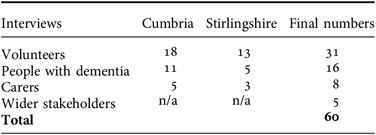
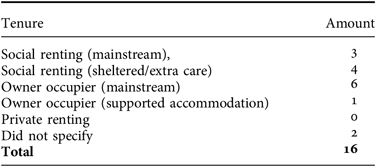
There were qualitative, semi-structured interviews with volunteers, carers and people living with dementia. An innovative network methodology developed by Rutherford and Bowes (Reference Rutherford and Bowes2014) mapped the formal and informal networks of people living with dementia. This was followed by semi-structured interviews with key stakeholders within volunteer and dementia agencies (see Table 1). Semi-structured interviews were conducted across two field sites in the UK: Stirlingshire (Central Scotland) and Cumbria (Northern England). These sites were similar in their urban/rural divide and had a variety of supportive networks to allow access through the regions (e.g. volunteer-involving organisations in the third and public sectors, and condition-specific initiatives). Sixty people were interviewed (average 60 minutes, ranging from 2.5 hours to 20 minutes) in a range of settings including extra-care and supported housing, specialist dementia care and those living at home (see Table 2). Participants were found through Alzheimer’s Society contacts in Cumbria and the Dementia Services Development Centre (DSDC) and University of Stirling contacts in Stirlingshire.
Qualitative interviews

Tenure of those living with dementia

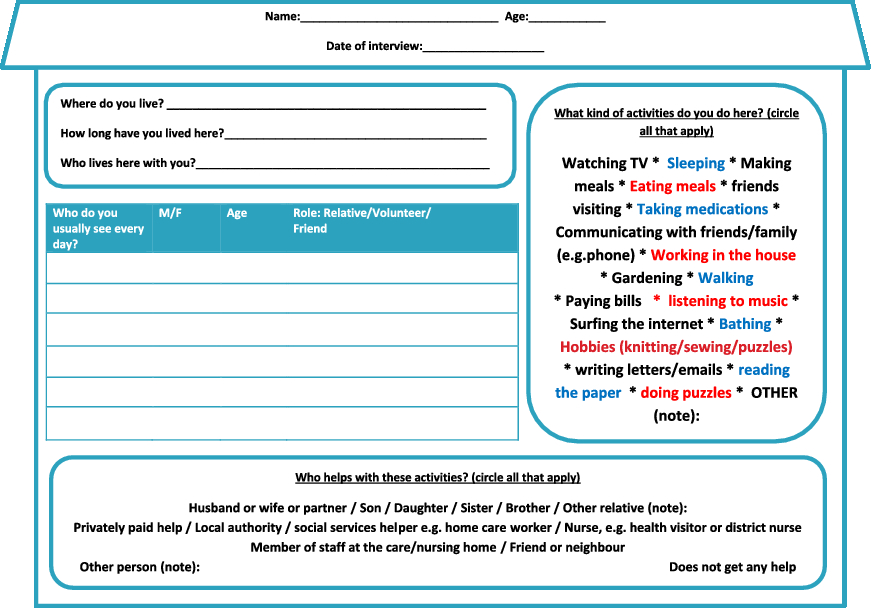
The interviews with people living with dementia focused on social networks and examined how volunteers were described and identified. The project utilised a visual tool to map support networks, including formal and informal care.
The tool captured activity within different housing settings, including supported and residential accommodation and support received from volunteers (see Figure 1).
Semi-structured interviews with volunteers supporting people with dementia focused on the understanding of volunteers’ motivations, experiences and the challenges they faced.
Data analysis: Interviews were audio recorded, fully transcribed and managed using NVivo. The data and coding led the research team to a structured, data driven, inductive approach to the findings in relation to the creation of some online guidance (see www.asume.co.uk). Thematic analysis (Ritchie et al., Reference Ritchie, Lewis, Nicholls and Ormston2013) was conducted by four members of the research team to compare, contrast and triangulate data, analysis and interpretation. For the quantitative data, analysis of the organisational survey was a descriptive approach as the sample size was relatively small. Both descriptive statistics and multiple regression models were employed in the analysis of the secondary survey data. All quantitative analysis was performed in Stata 14.
The following findings reference the data source and indicate specific types of participants. For the qualitative data, it notes where participants undertook interviews (Stirling or Cumbria), whether they were a man or a woman (M or F) and whether they were a volunteer, carer or person with dementia. Participant numbers are based on the timing of their interview (for example, the first volunteers who were a man and woman interviewed in Stirling are coded VolunteerF1, Stirling and VolunteerM1, Stirling). The following findings now set out insights from the quantitative analysis and organisational survey to show what volunteer activities, motivations and role in making connections.
Findings
Activity and motivations around volunteering in dementia care
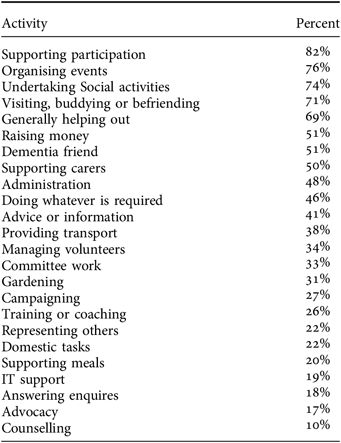
The organisational survey gives a wide range of activities that volunteers conducted in the area of dementia care, dominated by supporting participation in social or leisure activities (82%), organising events (76%), undertaking social activities (74%), visiting or befriending (71%), generally helping out (69%). By contrast, volunteers are less active in home care, such as gardening (25%), domestic work and meal support (20%), IT support (19%), or professional services like counselling (10%) (Table 3).
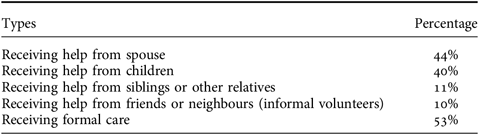
The secondary analysis (Table 4) showed about 10% of people living with dementia received help from informal volunteers, which is similar to the percentage of those receiving help from siblings or other relatives (11%). Using logit models around receipt of different sources of help as dependent variables, where dementia is the variable of primary interest, controlling for age, gender, ethnicity, educational qualification, housing tenure, and equivalised household, people diagnosed with dementia are significantly more likely to receive help from their children and relatives and to use formal care. However, there was no statistical evidence that dementia diagnosis is related to receiving help from volunteers.
Volunteer activities (organisational survey n = 98, participants could select more than one response)

Prevalence of different type of care or support for people living with dementia

Data source: ELSA (wave 5)
Further to the secondary analysis, the qualitative interviews and organisational survey give insight to volunteer motivations. Although not a focus of this paper, motivation is important to outline the drive behind volunteer activity and expected impact for volunteers and others.
Volunteers often described a sense of satisfaction and wellbeing that was derived from the idea that they were making a positive impact on individuals, much in line with the traditional ‘civic engagement’ motivations well examined in the volunteer literature (cf. Jones, Reference Jones2006). Findings were similar to ‘End of Life’ volunteering study that showed motivations to engage that include altruism; civic responsibility; leisure; personal gain; self-promotion; personal experiences relating to end of life care situations; making connections (with the cause) and feeling valid (Morris et al., Reference Morris, Wilmot, Hill, Ockenden and Payne2012). However, although ‘altruism’ was a key theme, volunteers acknowledged a two-way process that goes beyond altruism and particularly liked the sense of feeling needed:
And I just thoroughly enjoyed it. So for me, being a volunteer…I was learning. I was giving… If you can come away thinking, today I made someone happy or made them smile or I touched them or I reached them, for me that’s a really important aspect of working with people with dementia. You respect that person and somehow you make some meaning (VolunteerF11, Cumbria).
The qualitative data outlined a complex and dynamic set of motivations for volunteering, but an overriding theme was that they centred on social relationships and interaction:
It’s a social life you see as well as giving to people you are getting something in return (VolunteerF12, Cumbria).
..it’s become more than just a volunteers group, really, it’s just become a social event (CarerF4, Cumbria).
The importance of social interaction for volunteers was heightened in regards to their connection with people with dementia. Some of the volunteers framed this as an activity they were fulfilling as those living with dementia and their carers had lost social connections – or “making a connection where others have given up” (VolunteerF15, Cumbria). Other examples included wishing to connect with those living with dementia due to prior experience of dementia in the family, or trying to overcome feelings of guilt for perceptions of “not doing enough” when a relative or friend had had dementia in the past (VolunterF4, Cumbria). These volunteers were still motivated by ‘civic participation’ motivations but this was mixed with a set of dynamic motivations.
Within home and community settings impact was seen to come from one-to-one interaction with the person living with dementia. Importantly, it took a while for any impact to occur:
It happened quite slowly I remember. The first time I met the lady that I befriended we… We didn’t not get on but we didn’t click. And it’s funny how our relationships really, really blossomed because we’re very, very close. I almost see her as a family member now. Obviously trying to maintain that professional relationship, but we’re very close (VolunteerF3, Stirling).
Although formal and informal volunteering was often initially attached to a specific activity or person (either the person or the carer, or the organisation), volunteers often extended those activities over time to include a wider network and ‘repackage’ carers and those living with dementia together for volunteer support (i.e. volunteers saw those living with dementia and carers as combined group where supporting one supports the other).
Also I think for the carers, yes, they can talk about how they feel and they can talk about how they feel without being judged with each other and with you… So I think it’s about a 50/50 role really so I would say our use is we’re there for as much for the carers as for the people with dementia. It’s the same thing, really (VolunteerF, Cumbria).
Therefore, in the area of dementia care the barriers and boundaries between volunteers and carers were seen to develop and be renegotiated (similar to previous observations in Hoad, Reference Hoad2002). For volunteers, social activity dominated the areas they worked in and engaging, extending and creating social interaction was a priority for themselves, carers and people living with dementia.
Bridging and blurring boundaries
Those with dementia and their carers often had very diverse, complex networks. Several people with dementia discussed their neighbours and friends, but these were not considered formal volunteers. Those living with dementia rarely related to the word volunteer. Volunteers were simply people in their networks. This was often a result of a two way process where volunteers become integrated into the longer term networks of those they volunteered with, blurring the boundary between formal and informal volunteering:
So I befriended a couple and I still do that on a totally private, individual basis every now and then… because I enjoy their company and it gives them another dimension as well (VolunteerF10, Cumbria).
The analysis of the social network diagrams suggests that these circumvented both formal and informal networks. For example, one person with dementia in Cumbria noted her network of support included her spouse, daughter, privately paid help, friends and neighbours. Only with prompting of her carer, did she add the OT (occupational therapist) who ‘does stuff in the house’ and the word ‘volunteer’.
The organisational survey also highlights the diverse networks and blurred boundaries for those involved in volunteering with unclear between staff, volunteers, carers and people with dementia:
Again we do not see the need to make such a clear division between people suffering [sic] from dementia and other disabilities. We consider a family which includes someone with dementia are all affected and we try to provide a bridge between the home and the community where there is support and activities which include all the family and giving them an opportunity for encounters with people with differing challenges. Our cafe tries to extend a family setting so people can feel and be socially included (Organisational Survey, our emphasis).
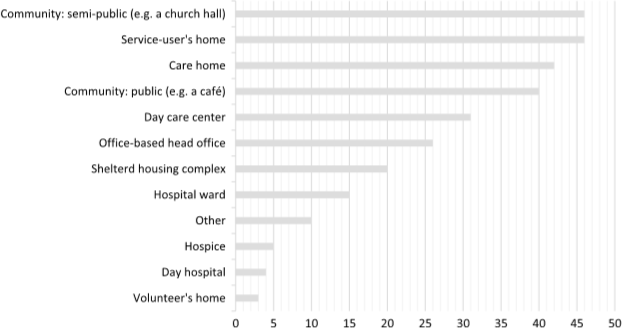
Volunteers were particularly well placed to move between dementia care settings, often becoming a conduit or ‘bridge’ for people living with dementia and carers into the wider community in a range of settings (Figure 2):
Interview guide and tool for those living with dementia

Volunteer activity settings (%)

Volunteers and those living with dementia sometimes saw volunteers (although perhaps framed as friends and neighbours) as a conduit between the private and public networks of those living with dementia and their carers. This came out particularly clearly in the networking analysis, where volunteers and those living with dementia and carers were mapping their networks between their home, streets, local and wider area.
Those with dementia discussed the people in their lives that crossed home, community, local area and wider boundaries. Participants (both volunteers and those living with dementia) often used arrows to show how their networking crosses over certain boundaries. In conjunction with writing and drawing their networks, they would often give a running commentary on how they bridged the divides through their different activities. For example, one volunteer in the Stirlingshire area saw her main contribution as supporting the person with dementia to leave their home, to cross the boundary of their front-door. She explicitly noted they visited public settings, such as cafes, to allow community interaction. As her family was so far away, the volunteer was the only social link to the outside world outside her home.
One interviewee living with dementia in Cumbria discussed his neighbours and old school friends that would visit, take him out to play bowls and check up with him. In particular an old school friend of his daughters who lived on the street, now a nurse, checked in often and ‘helped him out’. He mentioned this individual many times in the interview and it was clear this person volunteering their time and support meant a lot to the person with dementia – but would not be classed by those involved as a formal volunteer.
The networking exercise also provided further insights to how other settings, such as church, the local shops, supermarkets, parks and cafes linked with the variety of home settings such as care homes and individual households. It also clearly highlighted the important role of informal volunteers.
A key benefit of volunteer activity from the qualitative data was seen at community level, with volunteers having a key role in tackling isolation in the community. They saw themselves as having the potential to create a ‘safe space’ and combat stigma:
The way that they’re perceived by their own elderly community I think is so isolating and so difficult for relatives and carers, that I think to have somewhere like this which is a safe place where people can say what they want and react in a way nobody will find it unusual, is such a nice safe place. I think the community is pretty hard work on people with mental health problems and dementia generally so it was something I wanted to do really (VolunteerF3, Cumbria).
Volunteers here aimed to overcome multiple boundaries between place and communities to tackle barriers and improve outcomes such as social isolation for those living with dementia. The picture created by those living with dementia highlight the multiple services and organisations involved in support – private, third sector and public – that make up an ‘assemblage’ of services, all subject to different policies, supporting those living with dementia. Volunteer activity could be a key conduit within the ‘assemblage’ of relationships, policy implementation and negotiation of roles taking place.
An ‘assemblage’ of networks and connections
Volunteers found their networks and connections extended and renegotiated at individual and community level. The role of volunteer coordinators and organisations played a key support role in this:
[The volunteer coordinator is] so good at knowing everybody I think, that she’s very good at knowing who you’ll get on with. I’ve had three friends since and I’ve got on great with them all. So it’s been a really rewarding experience for me I would say. I find it quite a privilege now to do what I do because it is quite rewarding (VolunteerF7, Stirling).
Volunteers noted the friendships that were created were a key element of support in both volunteering roles and personal capacities. For some of the participants, it was down to the personal relationships they had with their coordinators that they were volunteering in dementia care at all.
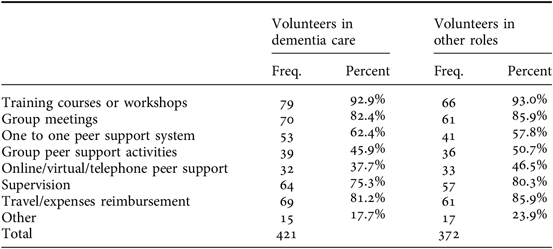
Table 5 shows the kinds of support which agencies provided for their volunteers (including training). Types of support provided to volunteers in dementia care were generally similar to that for volunteers in other roles. It was common for agencies to provide multiple types of support for their volunteers. On average, each agency provided around five different types of support; and there was no difference found between volunteers in dementia care and other volunteers.
Volunteer support for people with dementia, family members or carers and volunteers in other roles (organisational survey n = 98)

In one interview with a person living with dementia in Cumbria, she noted that her main activity is walking to the corner shop. She enjoyed this activity and could see the shop from her window (pointing it out to the interviewer), and enjoyed talking to the dog walkers and shop keeper. The shop had a post office, so she could send letters and parcels to friends. Her daughter (who was present in the interview) noted that she got nervous about her walking but a neighbour (who was a nurse) often popped in to help and the shop keeper knew to look out for her mother coming to the shop. In this example, informal volunteers supported the person with dementia to negotiate home and community settings.
However, there was protectiveness from those living with dementia and carers within their home space. For example, one person living with dementia in a mainstream social rented home was moved to a house closer to her daughter (also renting from the same social landlord). She was living independently due to the housing associations role in supporting key family and support networks. However, in the interview the suggestion of volunteers coming into her home was met with concern, worry and derision. This was reinforced by her daughter (also present for the interview) who noted she fiercely protected her independence and saw volunteers as organisational representatives who could interfere with that. So although our study shows potential for volunteers in the area of housing and dementia, this must be done with caution and sensitivity.
These challenges also varied by setting, for example between group and one-to-one sessions (e.g. in the home):
R: When they’re in a group [care home setting] it’s very difficult. You’ve got to deal with them individually because of this… There’s sex involved, there’s jealousies. They’re very private. They want you, and if you don’t give them exactly 100 per cent, forget it.
I: So that’s why you’ve not found those difficulties in the household level? Because you’ve got them one to one?
R: You don’t find that. No (VolunteerM1, Stirling).
This is another example of volunteering in this area being based on connecting with people at different levels and settings, which could be challenging depending on different environments. This highlights an ‘assemblage’ of interactions at individual, community and individual level.
Discussion
The visual tool exploring housing settings and connections highlighted that those living with dementia discussed people in their lives that crossed home, community, local area and wider boundaries. The negotiation of networks, space and relationships was a key role for volunteers in the area of dementia care. The role of volunteers in challenging boundaries at different levels is important, as social participation plays an important role in ‘successful ageing’ and, for those with dementia, supports positive cognitive function (Bourassa et al., Reference Bourassa, Memel, Woolverton and Sbarra2017).
Volunteers in dementia care experienced different pathways and routes into volunteering, with personal experience of dementia and being a key motivation. Volunteers were able to link people living with dementia and carers between home and community settings. The role of informal volunteers that support ‘bridging’ activities (such as shop keepers) and every-day interactions (the neighbour who is a nurse that ‘pops in’) were of central importance to those living with dementia. Bradford et al. (Reference Bradford, Hills and Johnston2016) show that informal volunteering captures ‘unintended pathways’ to volunteering. This informal support played an important role in networks, despite being neither formal volunteering nor informal care. In this study, the informal nature of pathways – such as the involvement of neighbours, the local shop keepers – were clearer when examined from the perspectives of those with dementia. From the perspective of those living with dementia, the dichotomy or comparison on formal and informal volunteering becomes less important. Therefore, the findings show an important role for informal volunteering and informal routes as pathways for volunteer activity in this sector.
The different home settings did affect the experiences of volunteering. Volunteers preferred one to one, non-institutional settings while those living with dementia could be defensive of their home spaces. Studies that have engaged with the differences between care settings indicate that volunteering engagement can vary and that the context is important in shaping activity. For example, Weyerer et al.’s, (Reference Weyerer, Shaufele and Hendlmeier2010) study found that there was a higher level of volunteer caregiver involvement and more social contact in specialist dementia settings compared to traditional care settings. Dementia care settings can also have extra challenges, where volunteers choose not to work with people with dementia due to fear and perceived stigma (Damianakis et al., Reference Damianakis, Wagner, Bernstein and Marziali2007). Interactions between volunteers, staff and people living with dementia is a key theme in all the different settings explored and must be supported in a context-sensitive way.
Supporting the importance of informal volunteering included how place and housing setting impacted on activities and interactions of volunteers. There is little known about housing sector related services for those with dementia, especially in the private sector (Brown et al., Reference Brown, Tolson, Ritchie, Sharp, Syme, James and Tolson2017) and this paper suggests that volunteers could be a link across housing tenure and environments. The results demonstrate that volunteers can connect those living with dementia with wider community settings, although this came with cautionary elements including not compromising or challenging home spaces.
The informal elements and ‘assemblage’ working within the dementia sector also highlights a fragility within the system as ‘assemblages’ can be vulnerable and fragile (Newman and Clarke, Reference Newman and Clarke2009). In this setting for volunteering in dementia care, ‘assemblages’ result in the care/social networks of people with dementia – they are how policy is enacted for people with dementia – and blurs the boundaries between the national strategies through the actual experiences of people with dementia and their families. That ‘assemblages’ bridge the temporal and the spatial to frame networks, flows of people, ideas, things (Newman, Reference Newman2014) is particularly pertinent from the perspectives of those with dementia. The findings provide ‘multiple arenas of politics and action’ (Newman, Reference Newman2012: 16) in the space of volunteering and dementia care, which is both fragile and powerful.
Conclusion
The project has shown a range of positive elements for volunteers, carers and people living with dementia from being connected with volunteering activities through a variety of settings. One of the most important roles is the ability of volunteers to be a ‘bridge’ or conduit between the community and people living with dementia and their carers.
The concept of ‘assemblages’ works well in framing the blurred boundaries between policy, people, home and community in relation to volunteer activity in the area of dementia care. Volunteers were seen to be in constant negotiation over their own roles and relationships with a variety of actors. For the person living with dementia who shared their perceptions of their networks, volunteers were simply part of an ‘assemblage’ of support. This challenged boundaries between settings, working categories (e.g staff, carer and volunteer) and dichotomies between formal and informal activities.
What this suggests is that there are multiple boundaries that are being blurred in the area of volunteering in dementia care. Definitions of volunteering and volunteering activity should be widened to include recognising and valuing the role of informal volunteering to capture the essential roles people play in ‘helping out’ those with dementia. The fragility of the current ‘assemblage’ between organisations, carers, volunteers, and people with dementia must be addressed. A focus on home settings and the environment will help support networking and connections between volunteers, carers and people living with dementia.
Acknowledgements
We would like to thank the Abbeyfield Research Foundation for funding this project and all the volunteers, carers, organisations and people with dementia that supported the data collection and dissemination of the ASUME website: www.asume.co.uk