Governance at formal international organizations (IOs) – such as the United Nations (UN) and Bretton Woods institutions – is widely accepted to be multilateral in character. These IOs lie at the core of a postwar order widely accepted as multilateral (Ikenberry Reference Ikenberry2003, Reference Ikenberry2009). Voting rights are allocated to member states and formal governing bodies make decisions according to agreed upon collective decision rules. Recent history demonstrates that even powerful states do not always get their way at the UN and other institutions. Our conceptual frames reflect this conventional wisdom. The practice of multilateralism within institutions is contrasted with unilateralism and bilateralism exercised outside institutions in trade and security policy, and with regard to foreign aid (Finnemore Reference Finnemore2005; Milner Reference Milner2006; Verdier Reference Verdier2008). In a similar vein, principal–agent approaches place primary importance on a collective principal made up of member states, for example, the UN General Assembly or World Bank Executive Board, to model relations between member states and IO bureaucracy. Collective principals are deemed ‘the most common type of principal we observe when analyzing IOs’ and bureaucratic agents are understood to be accountable primarily to these multilateral bodies (Lyne et al. Reference Lyne, Nielson and Tierney2006, 44).
The assumption that multilateralism characterizes IO governance is also reflected in the questions we ask concerning multilateral decline or crisis. Questions about multilateral decline emerge most often when powerful states exercise power unilaterally and pursue foreign policy outside international institutions (Kupchan and Trubowitz Reference Kupchan and Trubowitz2007). Others imply that multilateral crisis results from the absence of democratic accountability in current IOs (Zürn Reference Zürn2004). In both instances, however, the inquiries presume that IO governance involves a statist multilateralism.
Counter to the conventional wisdom, I propose that a different institutional form, defined by bilateral relationships between individual donors and IO bureaucracies, better characterizes governance at many contemporary IOs. Multilateralism is defined by rule-based collective decision making among three or more actors. When multilateralism is instantiated in IO governance, intergovernmental bodies composed of member states make collective decisions, and those decisions guide the activity of the IO bureaucracy and hold it accountable. This view of multilateral governance at IOs is consistent with collective principal models in which member states jointly contract with the IO bureaucracy. By contrast, multiple principal models provide an alternative governance structure that does not require collective decision making. In the context of IO governance, individual member states are not bound by the decisions of the collective, but are empowered to contract directly with the IO agent on an individual basis. The IO agent is guided by and held accountable through its bilateral relationships within individual donors, rather than through a single relationship with the intergovernmental body.
I argue that funding rules – the rules that specify how IOs are financed by member states and other actors – are a critical and often overlooked factor in producing IO governance. I forward a constitutive explanation that different funding rules produce different kinds of governance. Funding rules vary both within and across IOs. They can be mandatory or voluntary, and allow or prohibit restrictions by the donor. Well-functioning mandatory funding rules can be easily reconciled with conventional understandings of multilateralism that emphasize the importance of collective decision making. In contrast, voluntary funding systems – which many IOs rely upon – are difficult to reconcile with multilateralism. Restricted voluntary funding rules allow donors to dictate how the contributions they provide are used, which may not conform with priorities set by intergovernmental bodies. Funding decisions, which affect the size of the budget, distribute burden sharing across member states, and determine the substantive priorities of the IO, are detached from collective decision making and a critical accountability mechanism – the power of the purse – is decentralized to individual donors. This devolution of authority violates multilateralism by undermining the force of collective decisions and elevating the importance of individual ones.
After developing the argument regarding funding methods and governance the paper considers its implications for the UN System. I illustrate how UN governance has evolved over time as its system of financing has changed from one reliant almost exclusively on mandatory assessments with authority over budgetary matters vested in the General Assembly, to primary reliance on voluntary resources, increasingly restricted by donors. Today, a substantial and increasing portion of UN activity operates under a governance model in which UN agencies are influenced and held accountable through bilateral relationships with individual donors rather than through the multilateral governance ensconced in the UN Charter. In effect, we have an increasingly bilateral UN.
In making the argument my primary aim is to alter conceptual understandings of UN governance specifically, and of IO governance more broadly. Its contributions are as follows. First, the argument sheds new light on how IO governance is produced and demonstrates the relevance of funding rules in generating governance outcomes. Relaxing the multilateral assumption regarding IO governance also provides new insight into questions of multilateral decline. It allows that multilateral decline results not only from the reduced utilization of international institutions, but also from a decline in the practice of multilateral governance within the institutions themselves.
Second, the argument enriches scholarship related to institutional design, IO accountability and delegation theory. It highlights funding rules as a consequential component of institutional design and explicates the relationship between funding methods and accountability structures. In particular, the prevalence of restricted, voluntary funding at contemporary IOs makes clear the relevance of multiple principal models to depict the relationships between member states and IO bureaucracy. Third, it offers a nuanced understanding of UN governance in which multilateralism governs a shrinking portion of UN activity with an increasing portion governed through bilateral relationships with donors. Finally, the argument provokes a number of questions regarding the effects of a shift from mandatory to voluntary funding and from multilateral to bilateral governance. These include how the shift influences the substantive priorities and efficiency of UN programs, member states’ willingness to contribute to UN programs, and perceptions of institutional legitimacy.
The argument is delivered in four parts. The first section surveys literature on the concept of multilateralism and considers the structure of collective and multiple principal models in light of the conceptual literature. The second section proposes a constitutive explanation that emphasizes funding methods as an overlooked but essential factor in producing IO governance. I draw on the distinction between collective and multiple principal models to illustrate the different governance structures present under mandatory and voluntary funding schemes. The third section tracks change over time in how the UN is financed with an emphasis on demonstrating empirically that different methods of funding are indeed associated with different modes of governance. The fourth section concludes by highlighting the theoretical implications of the argument related to the relationship between multilateralism and IO governance, institutional design, and delegation in international politics.
Multilateralism and IO governance
A wide range of institutionalist scholarship assumes the multilateral character of formal IOs. Liberal international relations (IR) theorists understand multilateralism to be a defining characteristic of postwar institutions (Burley Reference Burley1993). Ikenberry (Reference Ikenberry2011, 68) regards ‘those who want to expand today’s system of multilateral governance arrangements’ as ‘champions of the UN, the WTO, and the rule-based international order’. Constructivist arguments regard formal IOs as specific instances of the fundamental primary institution of multilateralism (Reus-Smit Reference Reus-Smit1997). This section argues we have reason to question the multilateral assumption. I begin by reviewing conceptual literature on multilateralism. I adopt a definition of multilateralism as a primary institution that requires three or more actors to employ agreed upon rules to facilitate collective decision making and action. IO governance, represented by collective and multiple principal models, is then considered in light of this definition. Collective principal models are consistent with multilateralism, however multiple principal models violate its main tenets due to the absence of collective decision making. I argue that the dominant view in the delegation literature – that collective principal models typically provide the best representation of IO governance – is premised on the faulty assumption that voting rules accurately depict how influence is exerted over the IO bureaucracy. Finally, I propose that attention to funding rules provides a useful means to identify what kind of governance characterizes IOs because different rules produce different decision making and accountability structures.
Multilateralism is a primary institution in international politics. Primary institutions, like sovereignty and law, organize relations between states (Buzan Reference Buzan2004, 161ff). Multilateralism possesses quantitative and qualitative properties. Its quantitative element is straightforward; it requires that three or more states coordinate policies (Keohane Reference Keohane1990). This distinguishes multilateralism from unilateral action and bilateral relations. But as Finnemore (Reference Finnemore2005, 195) notes, multilateralism is ‘more than a numbers game’. For example, empire provides an alternative institutional form that coordinates relations between three or more states, but it does through coercive means, which does not conform to understandings of multilateral practice (Ruggie Reference Ruggie1992, 555–6).
Conceptualizations of multilateralism’s qualitative component vary. A prominent qualitative conception, John Ruggie’s treatment is particularly demanding. Ruggie (Reference Ruggie1992) defines multilateralism as an institutional form that coordinates relations according to ‘generalized principles of conduct’. These generalized principles, like most favored nation status, are applied equally to all members and applied consistently regardless of case-specific circumstances that arise. His definition also includes two corollaries: First, actors engaged in multilateralism share a socially constructed perception of indivisibility with regard to the range of actions being coordinated. Second, diffuse reciprocity logically follows from multilateralism (Ruggie Reference Ruggie1992, 571).
Ruggie’s concept has a number of strengths, including its attention to normative content, but its demanding nature also has the disadvantage of being out of step with conventional understandings of the term (Keohane Reference Keohane2006, 56). Two elements of the definition are problematic in this regard. First, the requirement that multilateralism necessarily requires inter-subjective understandings of indivisibility would seem to rule out many efforts to coordinate relations that we might otherwise identify as multilateral in character. For example, it is unlikely that members of the World Bank or the UN Development Program perceive their actions with regard to economic development as ‘indivisible’. Yet, ruling out the possibility that multilateralism is instantiated in the governance of the Bank and UNDP on this basis seems odd. Second, the requirement that multilateralism requires generalized principles to be applied ‘without regard to the particularistic interests of the parties or the strategic exigencies that may exist in any specific occurrence’, implies that any deviation from generalized principles for case-specific reasons means that relations otherwise regulated by such principles are not multilateral. Yet it would seem more consistent with conventional understandings to identify relations that deviate from generalized rules as violations of multilateralism, while allowing that relations that remain regulated by those rules retain their multilateral character.
As a result of these requirements, Ruggie’s concept is under inclusive relative to conventional understandings of multilateralism. However, at the same time, the definition leaves out explicit reference to collective action or decision making, which is a primary element in most scholarly and policy discussions of the term. For example, Keohane (Reference Keohane2006, 56) understands multilateralism to be ‘institutionalized collective action by an inclusively determined set of independent states’.Footnote 1 Perhaps in part for these reasons, other scholars emphasize some tenets of Ruggie’s concept while omitting others. Most prominently, scholars follow his emphasis on the coordination of relations based on generalized principles (or rules). In contrast to alternative institutional forms, rules are mutually agreed upon, rather than hierarchically imposed (Kahler Reference Kahler1992; Finnemore Reference Finnemore2005).
Agreed-upon rules facilitate collective decision making and action among states (Claude Reference Claude1958, 44–6; Ikenberry Reference Ikenberry2003, 539; Keohane Reference Keohane2006, 56). Indeed, collective decision making is considered a central principle of multilateralism (Lazarou et al. Reference Lazarou, Edwards, Hill and Smith2010, 8), and one that some regard as a practical drawback due to the often-high transaction costs associated with attempting to arrive at agreement (Claude Reference Claude1958, 44; Weber Reference Weber1992, 637). Ikenberry (Reference Ikenberry2003, 534) refers to such rule-based decision making as a defining characteristic of multilateralism, which distinguishes it from interactions based on ad hoc bargaining or straightforward power politics. This is not to say that multilateralism eliminates the role of power in decision making altogether. There are many instances in which mutually agreed upon rules favor powerful states; weighted voting rules at the World Bank and International Monetary Fund that privilege large economies provide prominent examples. Yet in contrast to ad hoc bargaining, mutually agreed upon rules provide predictability, and in contrast to ‘straightforward power politics’ they provide guaranteed voice opportunities and influence to weaker actors (Kahler Reference Kahler1992, 681–2).
From this discussion emerges a definition of multilateralism as a primary institution that requires that three or more actors employ agreed upon rules to facilitate collective decision making and action. This definition maintains the rule-based emphasis common to the conceptual literature, while conforming to conventional understandings of multilateralism common to scholarly and policy discussions. The definition retains a qualitative component, albeit a more modest one than Ruggie demands. Empires do not meet the requirements of the definition since rules are not mutually agreed upon and decision making is not collective. As a primary institution multilateralism can inhere in a wide variety of secondary institutions, for example in less formal groups of states, like the G8, and formal regional and global IOs, like the Organization of American States or UN. This section now moves on to consider whether multilateralism is instantiated in the governance of formal IOs.
Multilateralism and delegation
The conceptual literature on multilateralism has not directly examined how the realities of contemporary IO governance may facilitate or hinder multilateral practice. The ‘delegation turn’ in the study of IOs has been useful in explicating the relationships between member states and IO bureaucracy and highlighting the importance of both decision making and accountability structures in IO governance (Pollack Reference Pollack1997; Nielson and Tierney Reference Nielson and Tierney2003; Bradley and Kelley Reference Bradley and Kelley2008; Copelovitch Reference Copelovitch2010; Graham Reference Graham2014). When multilateralism is instantiated in IO governance, intergovernmental bodies engage in collective decision making according to agreed upon rules. But crucially, decisions must also be efficacious rather than hollow. That is, the collective decisions of intergovernmental bodies – as opposed to the individual decisions of member states or other actors – must guide the activities of the IO bureaucracy in practice and hold it accountable.
The delegation literature highlights two distinct models of IO governance, represented by collective and multiple principal models (Nielson and Tierney Reference Nielson and Tierney2003). Governance associated with collective principal models is consistent with the requirements of multilateralism. A collective principal includes more than one actor (e.g. a group of member states). Collective principals are commonly used to depict IO intergovernmental bodies in which ‘members come to a joint decision (according to some rule) and then enter into a single contract with an agent’ (Lake and McCubbins Reference Lake and McCubbins2006, 361).Footnote 2 Critically, a collective principal model does not allow individual members of the collective principal to contract or re-contract directly with the agent (Tierney Reference Tierney2008, 295). Contracting with the agent is contingent on mutual agreement among members of the collective. This conforms to the standard of multilateralism regarding decision making: member states act according to agreed upon voting rules to arrive at collective decisions. When these decisions guide IO activity and hold the bureaucracy accountable, governance is characterized by multilateralism.
Multiple principal models represent an alternative model of IO governance that offers a fundamentally different decision making and accountability structure. In a multiple principal model, ‘each principal enters into a separate contract with the agent’ (Lake and McCubbins Reference Lake and McCubbins2006, 361). In contrast to a collective principal model, collective decision making is not required to contract with the agent, to exert influence, or to hold it accountable. This injects a distinctly bilateral element into IO governance. Individual actors enter into bilateral relationships with the IO bureaucracy to initiate programs, and can exert control over the agent using rewards and punishments without reaching agreement with other member states. The absence of collective decision making violates multilateralism. Governance that reflects a multiple principal model can be understood to coordinate relations between an IO and three or more states, but it does not satisfy the qualitative requirements of the concept.
Which model approximates IO governance? Prominent scholars of the PA framework in IR assert, ‘collective principals are overwhelmingly the most common type of principal that we observe when analyzing IOs’ (Lyne et al. Reference Lyne, Nielson and Tierney2006, 49).Footnote 3 This assertion corresponds with an argument that formal rules matter when determining which delegation model properly depicts IO governance (Tierney Reference Tierney2008). Formal voting rules indicate that intergovernmental bodies make collective decisions according to agreed upon rules consistent with the CP model. However, the extent to which collective decisions influence and control the IO agent – that is, the extent to which those collective decisions actually govern IO activity – is far less certain.
One challenge comes from the literature on informal governance, which argues that formal rules provide an incomplete picture of how IO governance works in practice (Stone Reference Stone2013; Kleine Reference Kleine2014). For example, Stone argues that ‘International organizations operate according to two parallel sets of rules: formal rules, which embody consensual procedures, and informal rules, which allow exceptional access for powerful countries’ (Stone Reference Stone2008, 590). Under certain circumstances, for example, when the strategic interests of a powerful state are at stake, unilateral action can directly influence the agent (Stone Reference Stone2008; Urpelainen Reference Urpelainen2012).Footnote 4 Multilateralism can be said to characterize IO governance during ‘ordinary times’, but under certain conditions multilateral governance is effectively suspended and alternative forces prevail to influence IO policy and activities.
The informal governance literature provides an important corrective to institutional design scholarship that focuses exclusively on formal rules, but it also presents a significant empirical challenge. A severe disparity exists in our ability to identify formal rules relative to informal rules and practices (Tierney Reference Tierney2008, 286). Governing bodies, collective decision rules, and votes are formalized and explicit, written in constitutions and reported in organizational documents. By contrast, efforts to sidestep formal rules are often less transparent. So while powerful states exercise additional influence under certain conditions, the informal nature of their interventions makes it easy to dismiss them as exceptions to multilateral governance rather than as a systematic alternative.
This article provides a second corrective to literature on delegation and design, which have emphasized a truncated set of formal rules when theorizing IOs. Specifically, most scholarship relies on voting rules to approximate decision making and accountability between member states and IO bureaucracy. For example, while noting that control in institutions is ‘determined by a range of factors’, Koremenos et al. (Reference Koremenos, Lipson and Snidal2001, 772) focus on voting arrangements as the proxy for control at IOs. Similarly, applications of the principal–agent framework rely on decision rules to specify the appropriate model. However, voting arrangements are not the only formal rules that influence IO governance. The funding rules that govern contributions to IOs – mandatory vs. voluntary resources with or without restrictions – provide such an alternative. In contrast to informal rules and practices, funding rules are formal and explicit. In contrast to voting rules, funding rules specify whether the collective principal holds the primary mechanism of influence and control – the power of the purse – or whether that source of influence and accountability sits with individual donors. Where decisions over funding lie with individual donors, rather than with collective intergovernmental bodies, multiple principal models provide a more accurate representation of IO governance.
The next section elaborates the differences between mandatory and voluntary funding rules and proposes that they generate different decision making and accountability structures and thus constitute different kinds of governance. Principal–agent models are used to illustrate these differences. The collective principal model is useful in depicting mandatory funding schemes. However, a multiple principal model is more accurate in illustrating the relationship between member states and IO bureaucracy under voluntary funding schemes, particularly where reliance on restricted resources is high.
Constituting governance: funding rules and models of delegation
Although IR scholars often distinguish between regulative and constitutive rules, most (if not all) rules have both constitutive and regulative effects (Dessler Reference Dessler1989 454ff; Onuf Reference Onuf1989, 52). They regulate practices by telling actors what is permissible and also constitute practices by telling actors what is possible (Onuf Reference Onuf1989, 50). Funding rules are no exception. Their regulative character is perhaps more obvious. For example, they regulate member state behavior vis-à-vis IOs by stipulating member states’ financial obligations and specifying penalties if these obligations are not met. However, funding rules also have constitutive effects. This section elaborates how different kinds of funding rules constitute different kinds of governance.
The delegation models explicated above illustrate differences between mandatory and voluntary funding schemes. The choice of appropriate model to approximate IO governance hinges on whether governance emanates primarily from an intergovernmental body (i.e. the CP) or from individual donors (i.e. MPs). Others have noted the importance of funding decisions to exerting influence at IOs and in holding the IO bureaucracy accountable. Grant and Keohane (Reference Grant and Keohane2005, 36) note the importance of fiscal accountability at IOs. Similarly, Hawkins et al. (Reference Hawkins, Lake, Nielson and Tierney2006, 30) argue that financial power is used to sanction and reward IO staff through contraction and expansion of the budget.Footnote 5 Yet variation in funding rules within and across IOs has largely been overlooked as an important feature in IO design and its implications for governance have not been explored.Footnote 6
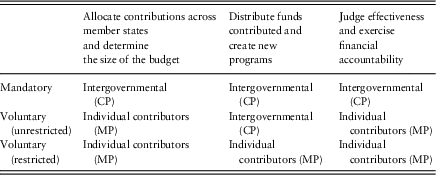
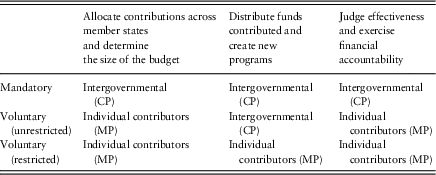
This section considers the relative authority of the collective principal (i.e. an intergovernmental body) and of multiple principals (i.e. individual donors) under mandatory and voluntary funding schemes across four areas, including the ability to (1) allocate contributions across member states and determine the size of the budget, (2) distribute financial contributions across programs and to create new programs, and (3) hold the IO bureaucracy accountable through their decisions. These comparisons indicate that the authority of the collective principal is higher under mandatory rules and lower under voluntary rules. In addition, it indicates that multiple principal models best represent governance at IOs funded primarily through restricted, voluntary funding rules.
Mandatory funding schemes
Mandatory funding schemes require states to make financial contributions to an IO as an obligation of membership. For example, at the UN, mandatory assessments (i.e. dues) are allocated using the capacity to pay principle articulated in the UN Charter, which takes into account economic strength in assigning shares. The formula is modified by a ceiling and a floor placed on the proportion any single member can pay to guard against tendencies by member states to ‘unduly minimize their contributions’ or conversely, ‘to increase them unduly for prestige’ (UN General Assembly 1946, A/80). All members are required to provide their share and withholding constitutes a breach of international law. This same mandatory system is reflected at many UN Specialized Agencies, including the Food and Agriculture Organization (FAO), International Labor Organization (ILO), World Health Organization (WHO) and UNESCO, as well as the IAEA.Footnote 7
In the context of delegation theory, intergovernmental bodies like the General Assembly constitute a collective principal (Nielson and Tierney Reference Nielson and Tierney2003). Consistent with the definition of multilateralism articulated above, the Assembly makes collective decisions according to agreed upon rules. At the UN’s founding and until pressure from the United States forced a change, a two-thirds rule governed all decisions related to the budget. This meant that the apportionment of assessments, the size of the budget, and the distribution of delivered funds and the creation of new programs, were approved by a two-thirds vote in the General Assembly where all member states are accorded equal voting rights. This is not to say that states with larger financial obligations cannot exert significant influence; however, to do so they must work within the constraints posed by collective decision making according to agreed upon rules. Critically, under mandatory rules the collective principal holds the power of the purse and serves as the locus of decision making authority, allowing it to reward and sanction its agent via expansion and retraction of the budget (Lake and McCubbins Reference Lake and McCubbins2006, 30). The first row in Table 1 summarizes the authority of an intergovernmental body under a mandatory funding system.
Authority of intergovernmental bodies (i.e. the collective principal) and individual contributors (i.e. multiple principals) under mandatory and voluntary funding schemes
Under conditions of high compliance with the mandatory regime, we can infer multilateral governance. However, not all mandatory systems enjoy high compliance rates. Although on paper the authority of the collective principal is clear, compliance with mandatory funding varies over time and across institutions. When member states contest the authority of collective decisions, multilateral governance is weakened and mandatory rules produce a kind of governance not dissimilar to that produced by unrestricted voluntary funding rules, discussed below. In these cases the ability of the collective principal to allocate burden sharing and determine the budget size is contested. However, the CP retains the ability to determine how contributed funds are dispersed across programs along with limited means to hold agents accountable.
Voluntary funding schemes: unrestricted and restricted
Unlike mandatory funding rules there is no legal obligation attached to voluntary funding systems (Archibald Reference Archibald2004, 318). The protections built into the mandatory system against the shirking of responsibility by member states, or conversely, attempts to increase influence by increasing contributions, are absent. The collective principal remains but its role is diminished. It lacks the authority to allocate funding requirements across members. Each state has the authority to determine whether and how much to contribute. As a result, the breadth of member state support for programs funded voluntarily can vary widely, with some gaining near universal support and some funded by a minority of members. The relevant intergovernmental body does not determine the size of the budget by multilateral decision; rather the budget is the aggregate outcome of decisions made by individual donors.Footnote 8
Unrestricted voluntary funds are those in which the donor does not earmark contributions for a specific use. We might think of unrestricted voluntary funding as a two-step process. In the first step, the collective principal sets organizational priorities and determines programs. In a second step, individual member states make decisions about whether to provide funding based on their own preferences. If a member state agrees sufficiently with the priorities and programs endorsed by the intergovernmental body, funds are provided, if not, there is no obligation to contribute. Individual donor decisions determine the size of the budget. The choice to reward or sanction the IO bureaucracy by providing or withholding funds, also lies with individual contributors (i.e. multiple principals). Importantly, however, since unrestricted rules preclude earmarking, the intergovernmental body maintains the authority to distribute funds according priorities they endorsed in step one of the process. Row 2 of Table 1 indicates the role of individual contributors (MPs) and the intergovernmental body (CP) under unrestricted rules.
In addition to granting individual members the authority to determine the size of their contributions, restricted voluntary systems allow members to place conditions on how funds are used. Freed from the obligation to provide support to programs endorsed by majorities, individual donors can dictate how their money is spent in ways that may or may not accord with priorities set by intergovernmental bodies [OECD 2010, 39–40; ECOSOC 2012]. An example helps to illustrate the point. In setting organizational priorities, the Executive Board of the WHO might unanimously support an agenda focused on building local health systems in developing states, thus constituting a multilateral decision. However, if major donors are not required to finance programs endorsed by the Executive Board, it does not follow that the decision will govern WHO policy. If major donors like the United States prefer to prioritize malaria programs rather than local health institutions, it is likely that these decisions – made by individual donors rather than by the multilateral decisions of intergovernmental bodies – will govern WHO programming in practice (Graham Reference Graham2011; Sridhar and Woods Reference Sridhar and Woods2013).
The accountability relationship between the collective principal and the IO agent is most clearly severed in the case of restricted voluntary funding systems where programs can be negotiated through a bilateral relationship between donor and IO staff. For example, UNEP explicitly encourages bilateral contracts with donors to supplement the multilateral aid it receives (UNEP 2012, 105). In these instances, donors hold the power of the purse and can act on their own determinations regarding effectiveness. The kind of governance produced by restricted, voluntary rules is distinctly bilateral. In a principal–agent framework, the centrality of individual decision making in voluntary funding schemes, especially in the case of restricted funds, fits a multiple principal model to illustrate the relationship between the IO and its member states.Footnote 9 Rather than sharing contracting power as members of a collective, each member is empowered to contract with the agent on an individual basis. For example, the United States, Japan, and Germany would serve as separate principals to the IO agent for the voluntary funds they deliver, each making decisions to contribute to different programs based on individual preferences.
This conceptualization provides clear guidelines for identifying multilateralism in IO governance. First, where we see high compliance with a system of obligatory contributions set by intergovernmental bodies acting according to agreed upon collective decision rules, governance is multilateral. To be sure, multilateralism does not imply that powerful states cannot engage in vote buying or arm-twisting to gain support for their preferred policies, nor does it imply effective governance. Rather, it simply implies that multilateralism is instantiated IO decision making and accountability structures. By contrast, when we see reliance on a system of mandatory contributions set by intergovernmental bodies with moderate or low compliance, multilateral governance is weakened. The collective principal retains control over how delivered contributions are used. However, when member states choose not to comply they effectively alter the budget size and burden sharing without the approval of the collective.
Second, at a minimum, to the extent we see reliance on voluntary funding we have reason to question the multilateral assumption regarding IO governance. Even under unrestricted voluntary schemes, intergovernmental bodies no longer dictate budget size or burden sharing across members. Authority over the power of the purse, a critical accountability mechanism, shifts from intergovernmental bodies to individual donors. When voluntary funding is restricted we have further reason to question the multilateral assumption. By devolving decisions over funding to individual donors, restricted voluntary rules effectively remove the authority of intergovernmental bodies to determine budget size, set priorities, and hold IO bureaucracy accountable via financial means. Rather, both funding levels and the selection of programs are influenced by a series of bilateral relationships between IO staff and individual donors, represented in a multiple principal model. Finally, and important to questions of multilateral decline, to the extent we see a shift from mandatory to voluntary funding and from unrestricted to restricted voluntary funding, there is a decline in multilateral governance. That is, multilateralism governs a decreasing proportion of an IO’s activity.
The UN System provides interesting terrain for these arguments for two reasons. First, it is vast, encompassing the UN proper, UN programs and funds, along with the non-Bretton Woods Specialized Agencies. A shift away from multilateral governance across such a broad and prominent set of institutions would be notable. Second, outside the Security Council, the UN is associated with a particularly pure form of multilateralism due to the equal allocation of voting rights across member states. Developing countries often express a preference for UN institutions due to perceptions that the interests of weaker powers are better represented at the UN as opposed to the World Bank, for example, where power is explicitly codified in formal decision making. Such perceptions rest on the primacy of formal voting rules in UN bodies. To the extent that voluntary funding undermines multilateral governance and decentralizes authority to donors, it undermines this common perception.
The next section examines the financing of the UN System over time. The aim is to demonstrate the relevance of the constitutive explanation of multilateral governance and to show not only that there has been a shift from reliance on mandatory assessments to voluntary schemes that are restricted by donors, but also that these different funding mechanisms are indeed associated with distinct governance structures. It does so drawing on primary source documentation from intergovernmental bodies at the UN and its Specialized Agencies and secondary accounts of UN politics from 1945 to the present time.
Financing the UN: 1946–2012
Since its inception the UN System has developed from a set of organizations reliant primarily on mandatory assessments to finance its activity to one primarily reliant on voluntary contributions, and increasingly on restricted voluntary contributions. This shift has reduced the authority of intergovernmental bodies governed by multilateral process and has significantly altered the accountability structure of many UN programs and agencies. The evolution in UN financing unfolds across three time periods. The initial period between 1946 and 1959–60 is characterized by two trends: First, by high compliance with the mandatory assessments scheme and second, by the creation of new programs outside the mandatory scheme. The decision to introduce voluntary funding represents a first step away from multilateral governance, reducing the authority of intergovernmental bodies over UN activity.
Between 1960 and 1990 the mandatory assessments system is consistently challenged; compliance rates decline and voluntary funding accounts for a growing portion of UN resources. However, the majority of voluntary resources are provided without restrictions with intergovernmental bodies retaining an important role in setting priorities, distributing funds and creating new programs. Finally, from 1990 to the current period there is an expansion in the use of restricted voluntary contributions, representing a new phase of UN development and a further step away from multilateral governance.
The mandatory assessments system, 1946–60
At its first session in 1946, the UN General Assembly formed a Committee on Contributions with the task of developing a scale of assessments (i.e. membership dues) based on two principles outlined in the UN Charter: collective financial responsibility among members based on capacity to pay. The Committee developed and recommended the first scale of assessments for UN Member States to the General Assembly. The Committee was guided by three factors in developing its formula: the comparative income per head of population, the temporary dislocation of national economies arising out of the Second World War, and the ability of Members to secure foreign currency (UN General Assembly 1946, A/80). The initial scale included a high rate of 49.89% for the United States. The United Kingdom was the second largest contributor at 10.5%, followed by the Soviet Union and France at 6 and 5.5%, respectively. Over time, the US rate was incrementally reduced with increases in Soviet dues and the addition of new member states compensating.
In addition to allocating assessments and consistent with Article 17 of the UN Charter, the General Assembly approved the size and content of the UN budget. Intergovernmental bodies at the UN Specialized Agencies (e.g. the World Health Assembly at the WHO or the General Conference at UNESCO) played equivalent roles at those Organizations. During the first 15 years of the mandatory assessments regime, member states paid their assigned UN dues. High compliance meant that General Assembly decisions governed budgetary matters. The breadth of support for the UN regular budgetFootnote 10 included all member states. Between 1946 and 1959, only Bolivia owed back UN dues in excess of 2 years’ contributions (UN General Assembly 1958, A/3890). Striking in the current era of UN budget deficits, in 1948 the UN reported a budget surplus of $1.3 million (United Nations 1949, 876–7). Each year the Committee on Contributions reported to the General Assembly on the collection of contributions for the previous 2 years. Compliance was extremely high. On average, 95.14% of UN dues were collected for the previous year and the percentage never fell below 91%. After 2 years, the average rate of collection rose to 98.59%.Footnote 11
During this period, member states – including both the Soviet Union and the United States – refrained from withholding funds to exert bilateral influence. They did so even in instances when they took issue with items included in the budget. For example, the Soviet Union routinely objected to items in the UN budget beginning in 1948, including the Committee on the Balkans, Korean and Greek Commissions and technical assistance programs (International Organization 1948, 75; 1949, 81; 1951, 162). The USSR also abstained from budget votes on those grounds, but always paid its dues. As early as 1952 the United States found budget increases approved at the WHO and UNESCO to be ‘undesirable’, with the State Department expressing concern about its inability to control budget votes (US Department of State 1952). Nevertheless, the United States continued to pay its full assessments at those Organizations. Stoessinger (Reference Stoessinger1964, 27) emphasizes the novelty of such a practice, noting that for members to, ‘accept the principle that a state can be legally bound to pay an authoritatively determined assessment in support of a given United Nations program is to restrict the right to use the financial weapon as an instrument of control’ (emphasis added). Other observers commented that the General Assembly’s role in approving the budget was ‘accepted with remarkably little difficulty by the Members’ in the first 15 years (Russell Reference Russell1966, 81).
The functioning of the mandatory assessments regime produced IO governance that conforms to our definition of multilateralism. UN intergovernmental bodies recommended and approved a scale of assessments based on agreed upon principles articulated in the Charter and voted using agreed upon decision rules. The collective principal – the General Assembly – served as the arbiter of UN activity. The mandatory nature of contributions combined with the two-thirds majority rules led to circumstances in which the UN’s largest contributors did not always agree with the size or content of UN budgets, or with the scale of assessments. Nevertheless, compliance rates were high.
The introduction of (unrestricted) voluntary funding
Throughout the 1940s economic and social programs that emphasized technical assistance received limited funds under the mandatory assessments system and developing countries were eager to expand UN activity in these areas. Others, including the Soviet Union and its constituent states, opposed the inclusion of development programs under the mandatory assessments regime, while the US position, shared by Canada, was open to expansion but with an emphasis on value and efficiency (Russell Reference Russell1966, 188–9; Jackson Reference Jackson1969). This division spawned innovation. The Assembly created the Expanded Program on Technical Assistance (EPTA) in 1949 to be funded by voluntary contributions rather than through processes associated with the UN’s regular budget. In 1958 a second voluntary fund for development, the Special Fund, was added.
The new voluntary programs were distinct from the mandatory regime in a number of ways. First, the principles of collective financial responsibility and capacity to pay that guided the scale of assessments under the mandatory scheme had no role under voluntary funding. There was no obligation to contribute and intergovernmental bodies (the General Assembly or boards created to govern new programs) did not have a role in distributing the financial burden across members. Second, intergovernmental bodies lacked authority to determine the size of the budget. At times, those holding leadership posts at the Expanded Program and the Special Fund provided targets for contributions, but these were not binding, and member states typically fell far short of the goals.Footnote 12
Reliance on voluntary funds meant that the breadth of support varied considerably across programs. As Stoessinger (1964: 213) notes, ‘some programs, such as the UNRWA and UNHCR, do not have a world-wide appeal, or are for political or other reasons shunned by certain governments’ (Stoessinger Reference Stoessinger1964, 213). By comparison, other voluntary programs proved extremely popular. UNICEF received support from nearly all UN members (Stoessinger Reference Stoessinger1964, 193). The Expanded Program and Special Fund did not initially enjoy wide support, but over time their reputation and popularity grew and they garnered support from former opponents (Allen 1957, 620).
Even for those programs receiving support from a large majority of UN members, the distribution of funds was distinct from allocations made under the mandatory assessments regime. Between 1950 and 1957 around 55% of Expanded Program and Special Fund contributions came from the United States, while little more than 3% came from the Soviet Union and Eastern European countries. During the same time period the United States and Soviet mandatory assessments were around 33 and 15%, respectively.Footnote 13
By creating the Expanded Program, and other similar programs that followed, the General Assembly created new bureaucratic agents that existed outside mandatory funding rules articulated in the UN Charter. This substantially increased funding for the UN. Indeed, as Figure 1 indicates, by 1960 voluntary contributions surpassed those provided under mandatory rules. However, the authority of the collective principal was now limited in important ways: it no longer determined the size of the budget or allocated burden sharing across member states. Although the Assembly would retain the formal right to eliminate programs, voluntary funding rules meant that in practice their financial solvency would depend on the decisions of a few members who provided the bulk of resources. Replenishment would depend on donor decisions – not those of the intergovernmental body – introducing a distinctly bilateral element into the accountability structure of the voluntary programs.
UN mandatory and voluntary funding contributions 1950–69 ($US millions). Source: Jackson (Reference Jackson1969).

Although the authority of intergovernmental bodies to influence the budget was reduced, they did maintain an important role in determining the content of new UN programs. New voluntary funds required that contributions be unrestricted. That is, donors were not allowed to dictate how their contributions were used. Indeed, considerable effort was made to distinguish UN programs from bilateral aid driven by political interests. The guiding principles regarding UN technical assistance declared the programs’ primary purpose would be to assist developing states to ‘ensure the attainment of higher levels of economic and social welfare for their entire populations’, and insisted that assistance ‘shall not be a means of foreign economic and political interference in the internal affairs of the country concerned, and shall not be accompanied by any consideration of a political nature’ (Sharp Reference Sharp1953, 348).
The Expanded Program and Special Fund provided assistance only after receiving requests from recipient states and possessed clear guidelines for approving projects. Observers at the time noted that, unlike US bilateral aid, which was increasingly dictated by military and political concerns, UN assistance came without similar political influence (Sharp Reference Sharp1953, 348). The Expanded Program became wary of the potential for bilateralism when the Soviet Union began making contributions in inconvertible rubles. There was concern that the USSR may directly coordinate with recipient states to apply for what was essentially Soviet aid through the Expanded Program. UN officials responded firmly to this practice, noting that, ‘to specify how, where, or for what purposes a country’s contribution would be used was specifically prohibited by the basic legislation of the program’ (Allen Reference Allen1957, 619). In March of 1954 the Soviet Union agreed to allow its contribution to be dictated by the requests received from recipients like all other contributions and in 1958 a new resolution prohibited the UN Technical Assistance Board from taking currency into account when planning programs or approving projects (Allen Reference Allen1957, 632).
How can UN governance best be characterized in the late 1950s? The near-universal support and high compliance rates with the mandatory assessments regime allow us to infer that IO governance with regard to the regular budget was consistent with multilateralism. However, the use of voluntary funds also expanded quickly during this period and by 1960 they constituted half of the UN budget (Jackson Reference Jackson1969). During the period, voluntary contributions remained largely unrestricted. The role of intergovernmental bodies was weakened, however they retained control over programming decisions.
Contestation of the mandatory regime and growth in unrestricted voluntary contributions
Although the portion of the budget controlled by the General Assembly had declined in relative terms, to this point the regular budget retained near universal support among the member states and functioned in ways consistent with multilateral governance. This changed between 1959 and 1960 when UN member states divided over the legality associated with mandatory assessments for peacekeeping operations. France and the Soviet Union, both significant UN contributors, withheld funds for two peacekeeping operations, the UN Emergency Force (UNEF) and the UN Operation in the Congo (ONUC). In doing so they contested the authority of the General Assembly to require payment for the missions and sent the UN into financial crisis.Footnote 14 After fiercely defending the mandatory regime but ultimately failing to persuade France or the USSR to comply, the United States too reserved the right to contest the authority of the Assembly. The US Ambassador to the UN, Arthur Goldberg, stated that the United States:
…Must make it crystal clear that if any member can insist on making an exception to the principle of collective financial responsibility with respect to certain activities of the Organization, the United States reserves the same option to make exceptions if, in our view, strong and compelling reasons exist for doing so (Goldberg Reference Goldberg1965).
French and Soviet intransigence and the American response – reserving the right to withhold where strong and compelling reasons existed for doing so – undermined the authority of UN intergovernmental bodies (i.e. the collective principal). The episode represented the first of many instances in which the authority of the General Assembly on budgetary matters would be contested.
During the same period, the use of voluntary resources continued to expand. Like EPTA and the Special Fund, subsequent programs dealing with economic, social, and environmental issues rely heavily if not entirely on voluntary funding: UNDP, UNICEF, the UN Population Fund and World Food Program are funded entirely by voluntary contributions. UNEP, UNHCR, and the UN Relief Works Administration receive small portions from the regular budget for administrative needs but are otherwise funded voluntarily (Mendez Reference Mendez1997, 284). Figure 2 shows the size of voluntary contributions relative to those provided under the mandatory regime. By 1986 contributions to UN organs (excluding the Specialized Agencies) more than tripled the size of the regular budget. With most UN institutions experiencing zero-growth regular budgets throughout the 1980s, reliance on voluntary funds increased considerably (Müller Reference Müller1997, 48/13).
UN Regular Budget and voluntary contributions to UN Organs 1986–2001 ($US millions) growth shown in real terms and excludes peacekeeping. Source: Alger (Reference Alger2006, 225).
By 1990 the mandatory assessments regime had broken down. Low compliance rates indicate that although the authority vested in the General Assembly had not changed on paper, in practice its authority to control budgetary matters was no longer broadly accepted. In addition, the majority of UN contributions were now voluntary. During this period the mandatory and voluntary systems had much in common. Neither could effectively dictate the level of overall funds or contributions from specific members. The power of the purse, perhaps the most useful mechanism of control available to principals, had shifted decisively from the collective principal (i.e. UN intergovernmental bodies) to multiple principals (i.e. individual donor states). This shift does not merely represent the decentralization of shared authority in the collective principal to individual authority across multiple principals. It also represents a redistribution of control from the one country, one vote principle reflected in UN decision rules, to a distribution of influence based primarily on the size of a state’s contribution. Despite these changes, intergovernmental bodies retained the authority to set strategic priorities for UN programs and to distribute funds according to those priorities because the majority of voluntary contributions remained unrestricted. This began to change in the 1990s.
The expansion of ‘restricted’ voluntary funds (1990–present)
Between 1990 and 2012 voluntary contributions to the UN grew significantly and virtually all growth has taken place in the category of restricted voluntary contributions. Restricted contributions are sometimes referred to as ‘earmarked’ or ‘non-core’ contributions and ‘unearmarked’ and ‘core’ refer to unrestricted resources. The use of restricted voluntary contributions was a relatively new phenomenon at the UN in the early 1990s. As Doug Lindores, former Senior Vice President of the Canadian International Development Agency, explains: ‘In the 1970s, core versus non-core was never an issue. The multilateral development system was based on the concept of shared resources and operations implemented according to strategic priorities of specific organizations’ (ECOSOC 2011).
Restricted resources are distinct from other voluntary contributions in many ways. First, they are not ‘pooled’ with unrestricted contributions. Indeed, the vast majority are not pooled at all. Although the UN encourages multi-donor trust funds, currently 88% of restricted resources are from a single donor and project specific (UN General Assembly/ECOSOC 2011, 28). Second, restricted resources allow the donor to designate which program its contribution will be used for. The UN had long resisted this practice both with regard to the regular budget and with early voluntary funds like the Expanded Program to avoid becoming a cover for bilateral assistance (Allen Reference Allen1957, 632ff). Third, with restricted funds, UN programs enter into bilateral contracts with individual donors, which are often accompanied by standards for evaluation and effectiveness that are separate from those imposed by intergovernmental bodies. Non-core funding involves ‘negotiating individual funding agreements and separate program and financial reporting for hundreds or even thousands of individual projects according to widely varying sets of requirements’ that often fall outside the normal managerial process of the organization or program (UN General Assembly/ECOSOC 2012, 25). In effect, programs funded by restricted contributions are accountable to individual donors (i.e. multiple principals), rather than to the relevant intergovernmental body (i.e. the collective principal).
Between 1994 and 2009 unrestricted voluntary contributions to the UN System were stagnant, decreasing by 2% in real terms. In contrast, restricted voluntary contributions grew by 208% (UN General Assembly/ECOSOC 2011, 27). The drop in the proportion of core resources has been precipitous for some UN programs. Core resources as a proportion of overall funding at UNDP, UNFPA and UNICEF collectively dropped from 79.7% in 1991 to 31.8% in 2007 (UN Secretariat 2009, 4). Figure 3 depicts change in the proportion of unrestricted and restricted resources in the UN System between 1994 and 2009.
Trends in core and non-core voluntary contributions (billions of constant US dollars). Source: UN General Assembly/ECOSOC (2011, 26).
Table 2 shows a similar trend at the UN Development Program indicating that restricted funds have grown more than 250% between 1995 and 2010 while unrestricted funds have grown by 9% over the same period. UN Specialized Agencies too, have grown in their reliance on restricted resources. Recent reports from the ILO and FAO note that ‘most voluntary contributions are earmarked to specific program or projects’ by the donor. The WHO estimates that ~80% of voluntary funds are earmarked, and at UNESCO, ‘all voluntary contributions’ were earmarked by donors (Yusef et al. Reference Yusef, Larrabure and Terzi2007).
UNDP, Contributions to Operational Activities for Development ($US billions)

Source: UN General Assembly/ECOSOC (2012, 20).
a Change is in real terms.
In recent years most major donors have demonstrated a preference to provide restricted resources. The top two contributors to UN development activities are the United States and the European Commission and they restrict 83% and 92% of their funding, respectively. Among the top ten donors, only two, the Netherlands and Germany, provide more than half of their voluntary contributions in the form of core funds. In the remaining group of Japan, the United Kingdom, Spain, Norway, Sweden, and Canada, all provide more non-core than core funding (ECOSOC 2011, 32).
By relying heavily on restricted voluntary contributions, the UN System takes another step away from IO governance characterized by multilateralism and toward a system of bilateral accountability relationships between donors and IO staff. The challenge posed to multilateralism by restricted contributions is clear in the definitions of core and non-core resources. The UN defines core resources as those that are ‘comingled without restrictions and whose use and application are directly linked to the multilateral mandates and strategic plans of the entities, which are approved by the respective governing bodies as part of an intergovernmental process’ (UN General Assembly/ECOSOC 2011, 13; emphasis added). In contrast, ‘non-core resources are mostly earmarked and thus restricted with regard to their use and application. The degree to which the use and application of non-core resources are subject to and aligned with the strategic plans approved by governing bodies is not direct’ (UN General Assembly/ECOSOC 2011, 13; emphasis added). The definitions imply distinct accountability structures: unrestricted resources retain a formal and direct relationship to mandates and decisions of intergovernmental bodies and restricted resources do not.
This characterization of restricted resources is echoed both within and outside the UN System. The OECD distinguishes non-core resources as having oversight and governance that is ‘not under the purview of the board of the organization in question’ (OECD 2010, 40). The OECD refers to non-core contributions as bilateral aid to reflect the reality that 88% of non-core resources are single donor and program-specific without a direct link to intergovernmental bodies. UNDP similarly refers to its ‘bilateral donors’ for non-core resources (UNDP 2011). The General Assembly has begun using the language of ‘bi-multilateral’ to refer to restricted resources (UN General Assembly/ECOSOC 2011, 25).
The evidence suggests further that it is not only on paper that accountability is distinct, but also in practice. The rise of restricted resources is now much discussed within the UN System and is viewed by both intergovernmental bodies and UN bureaucracies with concern. A recent UN Report notes that the use of non-core resources ‘is often seen as potentially distorting program priorities by limiting the proportion of funding that is directly regulated by intergovernmental governing bodies and processes’ (UN General Assembly/ECOSOC 2012, 12). This sentiment is found elsewhere in the UN System. Afshan Khan, the Director of the Public Sector Alliance and Resource Mobilization Office at UNICEF noted that the imbalance between core and restricted funding had important implications, including that ‘the proportion of programs regulated by the board was decreasing’ (ECOSOC 2011). At UNEP the Governing Council now encourages member states to contribute voluntary resources to a general Environment Fund rather than earmarked trust funds, ‘with a view to enhancing the role of the Governing Council in determining the program of work and priorities of the United Nations Environment Program’ (UNEP Governing Council 2007, 12). The WHO similarly promotes a core voluntary contributions account to reduce reliance on restricted funds, over which it notes ‘the magnitude of associated operations is determined by the special nature of the activity and the joint strategic decisions of the collaboration’ in contrast to situations in which WHO exercises ‘exclusive strategic and operational control’ (WHO 2011, 10). The ILO argues that growth in voluntary funding limits the flexibility of the Secretariat to pursue its priorities and a recent analysis of the IAEA notes the agency is increasingly ‘forced to allocate funds based on the desires of the donor state, and does not have the latitude to shift resources to meet program needs as they see them’ (Boursten and Semmel Reference Boureston and Semmel2010; ILO 2010, 9).
These concerns, voiced at numerous IOs, indicate the growing role of individual donor decisions in guiding IO activity and holding agents accountable. The prominence of individual decision making (as opposed to collective decision making) violates the requirements of multilateralism. In stark contrast to perceptions that the UN represents the heart of postwar multilateralism, today a significant and increasing portion of UN activity is governed through a system of bilateral relationships between UN agencies and individual donors represented in the multiple principal model. The funding scheme has been referred to as an ‘a la carte’ system in which donors adopt a ‘pick and pay’ approach to UN funding (Cardenas Reference Cardenas2000; Francioni Reference Francioni2000).
A bilateral UN
This article began by questioning the prevalent assumption that multilateralism characterizes IO governance. At the UN, attention to collective decision rules and the continued presence of intergovernmental budget committees belie the reality that today’s UN System relies substantially on voluntary contributions restricted by donors. This reliance has produced a de facto devolution in control from intergovernmental bodies to individual donors to make programming decisions and influence UN programs, violating the requirements of multilateralism. This is not to say that multilateral governance has disappeared, but rather that over time it has come to govern a shrinking portion of UN activity. Multilateral decline emerges not from unwillingness on the part of states to work through the UN, but rather from a decision on the part of member states not to practice multilateral governance within the UN System itself.
The argument sheds new light on the relationship between multilateralism and IO governance, institutional design, and delegation in international politics. First, the argument challenges the widespread assumption that IO governance is characterized by multilateralism. Multilateralism is instantiated in IO governance only when collective decisions exert control over IO activity. Voluntary funding arrangements release member states from the obligation to fund collective decisions made by intergovernmental bodies. Individual funding decisions are primary in determining the size of the IO budget, exerting influence over which activities are financed, and sanctioning and rewarding the agent via financial means. The reliance on individual decision making violates multilateralism. This is true even when we employ a modest definition that requires rule-based collective decision making rather than more demanding alternatives.
Second, funding rules represent an important yet overlooked element of institutional design. The argument demonstrates that reliance on voting rules to depict relationships between member states and IO bureaucracies can be misleading. Funding rules constitute different governance structures that can either complement or undermine voting rules. Mandatory funding rules reinforce collective decisions by requiring that financial support follow. Conversely, voluntary funding arrangements undermine collective decisions when member states do not provide financial backing. Under these circumstances, collective decisions are empty; they do not actually govern IO activity. Funding rules should be used as a standard, supplementary proxy for control in institutional design.
Third, for scholars interested in IO accountability and delegation theory, the UN cases indicate the relevance of accountability that is decentralized from intergovernmental bodies and is approximated by a multiple principal model. Recent scholarship suggests similar dynamics exist at other global IOs, like the World Bank, and regional IOs, including the EU and Organization of American States.Footnote 15 Multiple principal models provide distinct opportunities for both donor-principals and IO agents. The foreign aid literature conceives of a dichotomous choice: states provide aid through an IO (typically referred to as a multilateral channel) or a bilateral channel. Traditionally, this decision involves a tradeoff in control. The donor might choose to channel aid through an IO to increase legitimacy, but in doing so the donor loses the ability to control how the IO agent distributes aid. When IO designs include voluntary funding arrangements that allow earmarking, donors maintain this control (Reinsberg et al. forthcoming). As a result, individual decision making in the multiple principal model might allow donors to retain control while still benefitting from the legitimacy of the IO ‘brand’.
For IO agents, relationships with multiple principals provide both new opportunities and constraints. Freed from the necessity of majority approval at intergovernmental bodies, IO staff are empowered to appeal directly and strategically to narrow but powerful audiences in ways that benefit the organization by increasing funding and the scope of agent activities. As a result, IO staff may face incentives to support the designFootnote 16 of voluntary funding rules and lobby donors to increase voluntary contributions. At the same time, reliance on multiple principals creates incentives for agents to pursue popular programs that fall outside their mandate and create duplication (Taylor Reference Taylor1991). The experience of the Global Environment Facility (GEF) is instructive. Despite limited expertise, UNDP has been the most frequent implementing agency for GEF projects related to climate change adaptation. The result is unsurprising: evaluations by recipients indicate UNDP staff lack the necessary knowledge on climate change issues to properly guide project identification and design (UNFCCC 2010). In an evaluation of its own work, UNDP determined that its drive to pursue resources led to unproductive competition with UNEP and deterred coordination with other agencies (UNDP 2008, viii, 15, 74). In this way, the need to compete for funds and appeal to multiple principals may provide an alternative explanation for ‘pathological’ behavior in IO bureaucracies (Barnett and Finnemore Reference Barnett and Finnemore1999).Footnote 17
Finally, the argument raises questions regarding the effects of the move away from multilateral governance on IO programming and legitimacy. With regard to the latter, others note the unique legitimacy of multilateral practice (Pouliot Reference Pouliot2011). To the extent that bilateralism is perceived to replace multilateralism in IO governance, we might expect perceptions of legitimacy to decline. With regard to effects on IO policy, practitioners note that reliance on voluntary resources poses significant challenges for IO planning. However, the more difficult question is how reliance on restricted voluntary funds has influenced the priorities, content and effects of UN programs. Anecdotal evidence suggests shifts in program priorities and content have occurred. UNDP recently concluded that the continued disparity between core and non-core resources reduced its ability to provide assistance to a wide-range of program countries and issues that the aid market neglects (UNDP 2001). An evaluation of UN humanitarian aid between 1994 and 2002 indicates that reliance on voluntary funds contributes to a tendency for political and strategic interests to dictate what constitutes an emergency with one or two appeals for aid dominating the donor agenda (UN General Assembly 2002, 17). Similarly, observers of the WHO note that mandatory funds are aligned more closely with the global burden of disease than voluntary resources because the latter are aimed at diseases that capture the public’s attention, like HIV/AIDS or pandemic influenza (Gostin Reference Gostin2007; Sridhar and Gostin Reference Sridhar and Gostin2011). More broadly, in response to increasing concern regarding the effects of restricted contributions, the General Assembly has asked UN institutions to determine what constitutes a ‘critical mass’ of unrestricted resources, ‘below which their ability to deliver on core mandates would be significantly compromised’ (UNDESA 2012, 1).
Any costs associated with the shift to voluntary funding must surely be weighed against its benefits. There is little doubt that the voluntary funding scheme enabled the UN System to survive in the field of development. In its absence UN activities in these areas would likely have dried up as donors lost control of the General Assembly and the executive bodies of the Specialized Agencies. In this way, the move to a multiple principal model produced far more Western financing for global problem solving and development projects through the UN System than in the counterfactual situation where the voluntary funding scheme did not emerge. Ultimately, further inquiry is required to answer empirical and normative questions regarding the wisdom or folly associated with a move away from multilateral governance. But regardless of its effects, we must begin by recognizing that the relationship between multilateralism and IO governance must be carefully considered rather than presumed.
Acknowledgments
The author wishes to thank Zoltán Búzás, Sarah Bush, Simone Dietrich, Alexandru Grigorescu, Anne Holthoefer, Simon Hug, Robert Keohane, Ron Mitchell, Andrew Moravcsik, Michael Rubin, Tuan-Hwee Sng, Alex Thompson, Kevin Young, the IT Editors, and three anonymous reviewers, for their generous and constructive feedback. Earlier versions of this paper benefitted from presentations at the Princeton International Relations Faculty Colloquium and the Columbia University International Politics Seminar (CUIPS).