Introduction
Depression in the elderly is associated with impaired function, increased medical morbidity and mortality, and incident dementia (Steffens et al., Reference Steffens2006). Numerous studies have sought to determine the prevalence of depression among older adults (Robins and Regier, Reference Robins and Regier1991; Beekman et al., Reference Beekman, Copeland and Prince1999; Copeland et al., Reference Copeland1999; Steffens et al., Reference Steffens2000; Mojtabai and Olfson, Reference Mojtabai and Olfson2004). It is clear from such research that estimates of the prevalence of depression are dependent on both person-related factors and on methodological, non-person-related factors. Person-related factors include sample setting (community, outpatient clinic, inpatient hospital, nursing home), inclusion/exclusion for cognitive impairment, and the racial/ethnic composition of the sample. Methodological issues that may affect depression prevalence estimates include type of instrument used (e.g. depression screen, symptom checklist, or structured diagnostic interview), how one “counts” symptoms that may be attributable to either medical illness or depression, and the strategy employed to assess depression among more severely cognitively impaired individuals. Other important factors include representativeness, such as whether the study includes the “oldest-old,” (persons aged over 85) and sufficient numbers of ethnic minorities.
Population-representative studies that include the oldest-old may be particularly well suited to advance knowledge about depressive symptoms in late life. The Aging, Demographics, and Memory Study (ADAMS) was undertaken in order to determine the national prevalence of dementia and cognitive impairment without dementia in the U.S.A. (Langa et al., Reference Langa2005; Plassman et al., Reference Plassman2007; Reference Plassman2008). A clinical assessment of depression was included in ADAMS, allowing for an estimation of depression prevalence across a variety of population-representative demographic groups. Thus, the present study using the ADAMS sample sought to determine depression prevalence among older adults in the U.S.A., providing information across age strata, sex and various racial and ethnic groups.
Methods
The sample
The ADAMS sample was drawn from the larger Health and Retirement Study (HRS), an ongoing nationally representative cohort study of individuals born before 1954 that was designed to investigate the health, social and economic implications of aging in the U.S. population (Juster and Suzman, Reference Juster and Suzman1995; Soldo et al., Reference Soldo, Hurd, Rodgers and Wallace1997). The HRS began in 1992, and to date more than 30,000 individuals have been interviewed.
The ADAMS sample began with a stratified random subsample of 1770 individuals aged 70 years or older from five cognitive strata based on participants’ scores on a self-reported or proxy-reported cognitive measure from the most recent HRS interview (either 2000 or 2002) (Plassman et al., Reference Plassman2007). The three highest cognitive strata were further stratified by age (70–79 years vs. ≥80 years) and sex to ensure adequate numbers in each subgroup. Full details of the ADAMS sample design and selection procedures are described elsewhere (Langa et al., Reference Langa2005). The ADAMS initial assessments occurred between July 2001 and December 2003, on average 13.3 months (SD 6.9) after the HRS interview. Thus, participants were 71 years of age or older at the initial assessment.
As part of the ADAMS assessment, proxies (usually a spouse or adult child) provided information about the participant's cognitive and functional decline, neuropsychiatric symptoms, and medical history. Use of proxies to collect this information was particularly useful in cases where depression self-report data were unavailable, for example among some cognitively impaired individuals.
A total of 856 individuals, 56% of the nondeceased target sample, participated in all phases of the dementia assessment. A major concern in ADAMS, as in similar population-based studies, is the potential for selective nonparticipation to bias prevalence estimates. However, because the ADAMS sample was derived from the HRS sample, a wide range of health and social information was available to assess and correct for potential selection bias due to nonparticipation in our sample. Using logistic regression, we modeled the probability that a sample individual participated in the ADAMS assessment as a function of covariates, such as age, sex, education, marital status, HRS cognition scores, nursing home residency, and indicators of past or existing major health conditions. The results of this response propensity analysis were used to develop nonresponse adjustments to the ADAMS sample selection weights (Little and Rubin, Reference Little and Rubin2002). Population sample weights were then constructed to take into account the probabilities of selection in the stratified sample design and to adjust for differential nonparticipation in ADAMS (Heeringa et al., Reference Heeringa2007). In the present study, data on depression were available for more than 99% of the sample (i.e. 851 of 856 participants).
All study procedures were approved by the Institutional Review Boards at Duke University Medical Center and the University of Michigan, and informed consent was obtained from study participants or their surrogates.
Assessments
A nurse and a neuropsychology technician assessed all participants at their residence for cognitive impairment. The full details of the assessment and diagnostic procedures are described elsewhere (Langa et al., Reference Langa2005). In brief, the following information about the participant was collected from a knowledgeable informant: chronological history of cognitive symptoms, medical history, current medications, current neuropsychiatric symptoms, measures of severity of cognitive and functional impairment, and family history of memory problems. During the assessment, the participant completed a battery of neuropsychological measures, depression measures (see below), a standardized neurologic examination, a blood pressure measurement, collection of buccal DNA samples for apolipoprotein E (APOE) genotyping, and a 7-minute, videotaped segment covering portions of the cognitive status and neurologic examinations. We also sought medical record releases to obtain relevant neuroimaging and laboratory results from participants’ physicians.
Additional measures were obtained from the HRS (2000 or 2002, the wave prior to the individual's participation in the ADAMS). These measures included a comorbidity index based on the summation of prevalence of six chronic disease conditions (hypertension, heart disease, diabetes, stroke, cancer and chronic lung disease), estimated net worth, years of education, and a self-report of pain level coded as follows: Pain = 1 if participant reported having pain most of the time that is moderate or severe, or having pain that makes it difficult to do usual activities such as household chores or work; Pain = 0 if participant did not have pain, or if pain was only minor, and pain did not interfere with usual activities. Complete information about the chronic disease conditions measures in the HRS is available elsewhere (Fisher et al., Reference Fisher, Faul, Weir and Wallace2005).
A consensus expert panel of neuropsychologists, neurologists, geropsychiatrists, and internists reviewed all information collected during the in-home assessment and assigned final diagnoses. The consensus panel reviewed each case and assigned a diagnosis in two stages, first without and then with medical records. Diagnoses were divided within the three general categories: normal cognitive function, cognitive impairment without dementia, and dementia. The consensus panel used clinical judgment to assign the final diagnosis, based on established criteria for Alzheimer's disease and other dementias as well as cognitive impairment without dementia (Plassman et al., Reference Plassman2007).
Measures of depression in ADAMS
Depression was measured using the Composite International Diagnostic Interview–Short Form (CIDI-SF) for major depressive episodes (Kessler et al., Reference Kessler, Andrews, Mroczek, Ustun and Wittchen1998), as modified for use in the HRS (Steffick, Reference Steffick2000). The CIDI-SF is a structured diagnostic interview designed for use by trained nonclinician interviewers that screens for DSM-IV disorders (American Psychiatric Association, 1994). It asks about eight symptoms of major depressive disorder in the past 12 months. Individuals who endorse five or more symptoms meet the DSM-IV symptom criteria for a major depressive episode. It has been used extensively in large survey studies because prior analyses have shown that individuals who endorse five or more CIDI-SF symptoms for a minimum duration of two weeks have an 89% probability of meeting full CIDI criteria for a major depressive episode (Mojtabai and Olfson, Reference Mojtabai and Olfson2006).
We estimated the prevalence of major depression during the month preceding the interview by applying DSM-IVTR (American Psychiatric Association, 2000) criteria to the symptom data collected with the CIDI-SF. Similarly, we operationalized minor depression as suggested by DSM-IVTR. One response to screening questions on the CIDI-SF allowed subjects to indicate that the reason that they were not depressed was because they were taking antidepressant medications at the time. Thus, the CIDI-SF allows for a composite measure of depression that includes individuals meeting depression criteria as well as individuals who report taking an antidepressant medication. Of note, this algorithm would not have captured individuals on antidepressants who nevertheless endorsed depressive symptoms. We believe this method of combining reported depression symptoms with reported antidepressant use provides a better estimate of depression prevalence, and we have used this approach in a previous study (Norton et al., Reference Norton2006). However, as CIDI-SF diagnoses do not equate with DSM-IVTR diagnoses, we elected to classify the depressed group as having “CIDI-major depression” and CIDI-minor depression” in individuals whose diagnoses were derived from the CIDI-SF as opposed to a more standardized clinical interview. When including individuals with reported antidepressant use in estimates, we opted to refer to this as merely “depression” to avoid syndromal labels of major or minor depression. CIDI-SF data were available for 775 of 856 subjects.
Information on the participant's depressive symptoms was also collected using the Neuropsychiatric Inventory (NPI) (Cummings et al., Reference Cummings, Mega, Gray, Rosenberg-Thompson, Carusi and Gornbein1994), which was administered to a knowledgeable informant by a research nurse. The NPI was developed to assess psychopathology in dementia patients and evaluates 12 neuropsychiatric disturbances common in dementia, including depression. The severity and frequency of each neuropsychiatric symptom are rated on the basis of scripted questions administered to the patient's caregiver. NPI data were obtained on nearly the entire sample (over 95%). To facilitate DSM-IVTR major depression diagnosis, we used the NPI depression and apathy sections, including questions specifying the presence of symptoms for two weeks, and added questions regarding sleep, appetite, energy, concentration and psychomotor activity. For individuals missing CIDI-SF data, we used the depression scale of the NPI to estimate clinically significant depression. The NPI depression section also allows informants to indicate whether the subject was taking antidepressant medication. This question was only asked if informants answered “yes” to initial depression screening questions. While data on performance characteristics of the NPI depression section as a diagnostic tool for major depression are limited, there is some evidence that, as a screening measure, the NPI may overestimate major depression by informants of cognitively impaired older adults (Vilalta-Franch et al., Reference Vilalta-Franch2006). As a result, we specify “NPI-depression” for those with depression diagnosis derived from the NPI. NPI-depression data were available on 76 of the 81 individuals who were missing CIDI-SF data. Five of 856 subjects (less than 1%) had neither CIDI-SF nor NPI-depression data available. Among the informants who provided data for this analysis, 69% were women, 57% were adult children, 15% were spouses, and the majority of remaining informants were other family members.
We categorized depression in three ways, using: (1) the CIDI-SF for self-respondents (CIDI-major depression and CIDI minor depression); (2) the NPI for those who did not complete the CIDI-SF due to marked cognitive impairment or other reasons (NPI-depression); and (3) a combination of these two methods. In addition, we identified those who reported taking anti-depressant medications, as described above. Because of the differing methods of ascertainment and their relative shortcomings as tools for diagnosis of DSM-IVTR major and minor depression, in referring to overall depression prevalence estimates we use the more conservative term “depression.”
Statistical analysis
We stratified the sample by age, race, sex, and cognitive status (normal, cognitive impairment without dementia, dementia) and estimated the national prevalence of depression within each stratum using the ADAMS sample weights described above (Heeringa et al., Reference Heeringa2007). To examine characteristics related to the presence of depression, we used logistic regression to assess the association of demographic, cognitive, and other health variables. Variables in the models included age, sex (male = 1, female = 0), race (non-Hispanic black = 1, non-Hispanic white = 0), ethnicity (Hispanic = 1, non-Hispanic = 0), household net worth, years of formal education, cognitive status (dementia and cognitive impairment without dementia vs. cognitively normal), pain (1 = has moderate or severe pain, or pain that interferes with activities, 0 = no pain, mild pain, or pain that does not interfere with activities) and a summary comorbidity index comprised of a count from 0–6 of hypertension, heart disease, diabetes, stroke, cancer and chronic lung disease.
We conducted all analyses using SAS software, version 9.1.3 (SAS Institute, Cary, NC), and the special survey procedures, which account for the influence of weighting and the other features of the complex sample design on the variance estimates. The only exception was that we conducted the logistic regressions in Stata 10 SE (StataCorp, College Station, TX).
Results
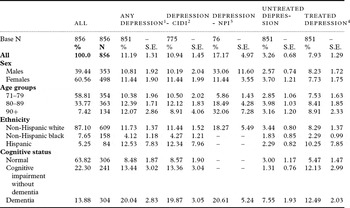
Depression data were available for 851 of the 856 (99.4%) of the ADAMS participants. Table 1 shows depression prevalence based on the different depression measures, by demographic characteristics and cognitive status. Overall, the population was about 60% female, 87% Caucasian, 7.6% African-American and 5% Hispanic. Among the three age groups, most subjects were in their 70s, about one-third were in their 80s and less than 8% were 90 or older. Most individuals (64%) were cognitively normal, 22% were cognitively impaired without dementia, and about 14% had dementia. In addition, Table 1 presents sample sizes for each of the demographic subgroups.
Characteristics of the study population and prevalence of depression

1Meets criteria for clinically significant depression (major depression, minor depression, or receiving treatment for depression) from the CIDI-SF if available, and if no CIDI-SF, then NPI)
2Reports based on CIDI-SF self-report for n = 775 who were cognitively able to self-report.
3Results based on NPI for those unable to provide self-report information.
4Subject volunteered in CIDI that he/she is taking an antidepressant; on NPI, the informant indicated subject is being treated for depression.
Note: All percentages in the table are weighted using the respondent-level sample weight.
CIDI-SF = Composite International Diagnostic Interview–Short Form; NPI = Neuropsychiatric Inventory
As shown in Table 1, there is some variability in depression prevalence depending on the measurement used. Combining all measures (major depression, minor depression, or receiving treatment for depression) from the CIDI-SF if available – and if no CIDI-SF, then using the NPI – we report a prevalence estimate of depression in the U.S.A. of 11.19% among individuals aged over 70. Among the 775 individuals with CIDI-SF data, 10.94% reported symptoms of major depression, minor depression or that they were taking medication for depression. Among those 10.94%, 8.0% reported receiving treatment for depression, and 2.94% were depressed but not taking any medication. We found nearly the same depression prevalence for men (10.19%) and women (11.44%, p = 0.5768). When we separated CIDI-SF scores into depression sub-categories, we again found similar rates for men and women, with 1.63% (S.E. = 0.65) prevalence of CIDI-major depression overall (1.73% (S.E. = 0.90) among men and 1.56% (S.E. = 0.91) among women, a 1.35% (S.E. = 0.61) prevalence of CIDI-minor depression overall, and a 8.00% (S.E. = 1.43) prevalence of depression treatment overall (8.05% (S.E. = 1.90) among men and 7.97% (S.E. = 1.86) among women). Rao-Scott χ2 tests did not show any statistically significant differences by sex (p > 0.05).
There were clear racial differences in CIDI-depression prevalence, with whites and Hispanics having nearly three times the prevalence of depression found in African-Americans. When examining sex and race, we found that Hispanic females had the highest rates of depression (18.1%), compared with 11.5% for white females and 5.1% for African-American females (p = 0.2706). White males had a prevalence of 11.4%, while the sample of African-American and Hispanic males was too small to estimate prevalence reliably.
There were 76 individuals who did not have CIDI-SF data but who had an informant who was able to provide NPI-depression data. Seventy of these individuals had moderate to severe dementia, and were therefore not able to provide reliable self-reports of their depression. We found a 17.17% depression prevalence overall in this group, with men in this group having three times the reported rate of depressive symptoms compared with women. Among Caucasian subjects 18% had NPI-depression symptoms, while the small numbers of African-Americans and Hispanics in this population precluded a reliable population estimate.
Overall, the prevalence of depression was 10.38% for individuals age 71–79 and 12.39% for those aged 80–89 (p = 0.3870). Of note, there were similar prevalence estimates (about 20%) for the groups with dementia, one using self-report CIDI-SF data and the other using informant-report NPI depression data.
Table 1 shows the percentages of respondents with untreated depression compared with those receiving treatment. Depression treatment was reported in about 8% of individuals based on either self-report from the CIDI-SF or informant-report from the NPI-depression section. The percentage was similar for men and women. African-Americans reported a lower rate of depression treatment compared with Caucasians or Hispanics (Wald χ2 = 8.675 (1), p = 0.0032). Depression treatment was similar across the three age groups, while those who were cognitively normal had less reported depression treatment than individuals with cognitive impairment or dementia. In general, our results showed that the majority of individuals with depression are receiving treatment, and the percentages of individuals with untreated depression are relatively small. The clear exception to this seems to be among those with dementia, where the percentage of individuals with dementia who have untreated depression is significantly higher than those who are being treated for depression (p<0.0001).
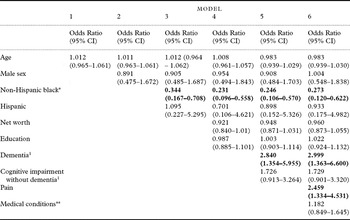
We examined a variety of socio-demographic and clinical variables potentially associated with depression in this sample. These included age, sex, race, net worth, education, cognitive classification, pain level, and medical comorbidity. Table 2 shows results from a series of logistic regression models of CIDI-diagnosed depression. Dementia diagnosis and pain severity were associated with increased frequency of depression, while black race was associated with lower rates of depression.
Logistic regression models of CIDI-diagnosed depression

*compared with non-Hispanic whites
**summary comorbidity index (0–6) of hypertension, heart disease, diabetes, stroke, cancer, chronic lung disease
1Reference group is cognitively normal/non-case
Discussion
In this study, we report prevalence estimates of CIDI SF-diagnosed major depression in the U.S.A. of 11.19% among individuals aged over 70. We found rates of depression based on sex, age, and ethnicity that merit further discussion. While women had a higher prevalence of CIDI-depression, the female-to-male ratio was 11.44%:10.81%, or approximately 1.06. Older men with dementia had depression by NPI report with nearly three times the frequency than older women with dementia. In terms of age, prevalence of depression was over 12% among those aged 80 and older, while septagenerians had an overall prevalence of 10.38%. For the three ethnic groups examined, depression rates were about three times higher among non-Hispanic whites and Hispanics compared with non-Hispanic blacks, the latter having a prevalence rate of about 4%. Finally, depression prevalence progressively increased with worsening cognitive impairment (from those with no cognitive impairment to cognitive impairment without dementia to dementia).
The depression prevalence rates across demographic variables (sex, age, and ethnicity) are the most striking and perhaps most surprising results of the study. Our finding of similar depression prevalence for men and women is at variance with prior studies that found higher rates of depression among women than men (Regier et al., Reference Regier1988; Steffens et al., Reference Steffens2000). The difference may be explained in part by the populations sampled in our study versus other studies. For example, the Cache County study included a homogeneous population of elders in northern Utah (Steffens et al., Reference Steffens2000). ADAMS is a more population-representative sample, so factors related to diversity of ethnicity and of socio-economic status (Murrell et al., Reference Murrell, Himmelfarb and Wright1983; Black et al., Reference Black, Markides and Miller1998) may equalize prevalence between the sexes. Prior studies found a lower prevalence of depression among the elderly compared with other age groups; our inclusion of cognitively impaired individuals may in part explain a prevalence rate that is higher compared with community-dwelling elders, as well as our finding of higher prevalence for individuals aged 80 and older compared with the rate in individuals in their 70s. Finally, the null sex effect may be due to sample size as evidenced by the rather broad confidence intervals for the sex odds ratio.
Previous studies have reported lower rates of depression among non-Hispanic blacks generally (Williams et al., Reference Williams2007) and in older adult populations in particular (Grunebaum et al., Reference Grunebaum, Oquendo and Manly2008). There have been variable reports for prevalence of depression among Hispanics with some studies reporting rates comparable to non-Hispanic whites (Williams et al., Reference Williams2007), and others showing lower rates (Riolo et al., Reference Riolo, Nguyen, Greden and King2005). Interestingly, one study suggested an age effect such that among those in the older cohort, there were no significant differences in risk for mood disorders between Hispanics and non-Hispanic whites, but in the younger cohort, Hispanics had significantly lower risk than non-Hispanic whites for mood disorder (Breslau et al., Reference Breslau, Aguilar-Gaxiola, Kendler, Su, Williams and Kessler2006).
Our finding of greater prevalence of NPI-diagnosed depression among cognitively impaired individuals and those with dementia compared with those with no cognitive impairment is also consistent with previous research. For example, one study reported a high prevalence of mood symptoms among patients with “cognitive impairment, no dementia” (Peters et al., Reference Peters2008). In a Brazilian cohort, 16% of those with cognitive impairment, no dementia had NPI-rated depression (Tatsch et al., Reference Tatsch2006). Among populations with dementia, prevalence of depression is high. One study of four Alzheimer's Disease Research Center populations found a prevalence of major depression of 22.5% to 54.4% across recruitment sites (Zubenko et al., Reference Zubenko2003). Major depression is common among patients with mild (11.5%) and moderate (10%) AD, but occurs at a lower rate in severe AD (4.5%) (Lopez et al., Reference Lopez2003). Depression symptoms are also common in patients with other forms of dementia, including vascular dementia (Sultzer et al., Reference Sultzer, Levin, Mahler, High and Cummings1993; Park et al., Reference Park2007), dementia with Lewy bodies (Klatka et al., Reference Klatka, Louis and Schiffer1996; Papka et al., Reference Papka, Rubio and Schiffer1998; Ballard et al., Reference Ballard1999), Parkinson's disease (Tandberg et al., Reference Tandberg, Larsen, Aarsland and Cummings1996; Weintraub and Stern, Reference Weintraub and Stern2005), and Huntington's disease (Folstein et al., Reference Folstein, Abbott, Chase, Jensen and Folstein1983). Finally, we found that depression prevalence increased with age when NPI depression data were used.
Major strengths of this study include a population-representative sample that allowed estimation of depression prevalence in the U.S. population by sex and across age and ethnic/racial groups. Another important feature is that the majority of the sample is community-based, with 718 of 856 assessments having been completed in the respondent's home. In addition, the study included both normal and cognitively impaired individuals in the same population representative sample, which facilitates comparison of depression prevalence in the presence and absence of clinically diagnosed cognitive impairment. Another strength is the connection of this study to the larger Health and Retirement Study, an established cohort of individuals with well-documented longitudinal demographic social, economic and health data. By using the wealth of data available from the HRS, we are able to adjust for non-response in the sample. In fact, this study extends previous work that utilized the HRS data to examine depression prevalence among middle-aged and older adults, citing a 12-month prevalence of major depression of 6.6% (Mojtabai and Olfson, Reference Mojtabai and Olfson2004). Unlike the present study, it does not appear that this previous HRS paper included individuals in the depressed group if they indicated that they were not depressed because of antidepressant use. The ability to combine the HRS data with depression and cognitive data in ADAMS provides a unique perspective on depression across a variety of socio-demographic strata and across a spectrum of cognitive function.
This study also has potential limitations worth noting. For example, despite the attempt to ensure a population-representative sample, the size of certain subgroups within the population was too small to estimate prevalence reliably. These included black and Hispanic males for the population overall. In addition, the small number (N = 76) of individuals from whom we had NPI informant reports for depression precluded estimates of depression among blacks and Hispanics.
Methodology related to our depression assessment may also represent a limitation for the study. We relied primarily on self-report structured interviews using the CIDI-SF, an instrument that has been shown to be valid in epidemiological studies, but may nonetheless fall short of diagnoses achieved through clinical interview. One advantage of our method is that we were able to capture those individuals with depressive disorder with low report of depressive symptoms due to current depression treatment. It is likely that combining individuals with depressive symptoms and those who report treatment is a strategy that provides a more accurate measure of depressive disorder (Norton et al., Reference Norton2006). However, our inability to determine whether reported depressive treatment was for major or minor depression forced us to collapse categories of major and minor depression into a single category of depression. It is also possible that the estimates of the frequency of depression treatment in the present study may be a slight underestimate of treatment given the algorithm in which participants reported treatment only if they indicated that they had no depressive symptoms due to receiving antidepressant treatment, and informants were only asked about treatment if they endorsed depressive symptoms on the NPI.
While inclusion of cognitively impaired individuals provides some advantages in terms of estimation of depression prevalence among all older adults, the methodological approach presents limitations as well. Our reliance on the NPI, an instrument whose performance characteristics in diagnosing syndromal depression is understudied, may provide a faulty prevalence estimate of major or minor depression in this population. Further, our method of combining CIDI-SF and NPI data to estimate overall depression prevalence must be mentioned among study limitations. These two instruments differ in several respects: subject-based versus informant-based, wording, and time frame of depressive symptoms. Combining the two scales thus may limit our ability to provide reliable diagnostic estimates. While lack of diagnostic clarity is a clear limitation, we believe that our strategy does provide a good estimate of clinically significant depression among a nationally representative sample of older Americans. However, the inclusion of depression based on antidepressant treatment data in our classification scheme may explain why our one-month depression prevalence is substantially higher than the 6.6% one-year prevalence previously reported in the HRS sample (Mojtabai and Olfson, Reference Mojtabai and Olfson2004).
A final potential concern is our opportunistic approach of estimating depression prevalence within the context of a study (ADAMS) whose primary aim is to characterize cognition and cognitive decline in an older population. Depression instruments in ADAMS were designed mainly to facilitate cognitive assessment. If depression were the major aim of the study, we would likely have chosen measures with greater diagnostic accuracy such as the Structured Clinical Interview for DSM-IIIR (SCID; Williams et al., Reference Williams1992). We discuss limitations of the instruments above. Another potential concern is that our prevalence estimates of depression may have been influenced by the oversampling in ADAMS of individuals with cognitive impairment, a group with increased risk for depression (Steffens and Potter, Reference Steffens and Potter2008). Such bias is unlikely because the complex sample weights used to estimate the depression prevalence were constructed to account for this issue.
In sum, the ADAMS cohort provides a population-based estimate of depression among older Americans. We found surprisingly similar depression prevalence between men and women. Non-Hispanic whites and Hispanics had much higher depression prevalence than blacks. Individuals with dementia had among the highest prevalence of current depression, which highlights the need for additional study on the social impact of this comorbidity. Future studies may also need to oversample among certain ethnic groups, e.g. black and Hispanic men, in order to obtain reliable depression estimates for these populations.
Conflict of interest
None.
Description of authors’ roles
Dr. Steffens participated in data collection and wrote the paper. Dr. Fisher was responsible for the statistical design of the study and for carrying out and writing up the statistical analysis. Dr. Langa participated in data collection and in the writing of the paper. Dr. Potter participated in data collection and in the writing of the paper. Dr. Plassman helped design the study and participated in data collection and in the writing of the paper.
Acknowledgments
The National Institute on Aging (NIA) provided funding for the Health and Retirement Study and the Aging, Demographics, and Memory Study (U01 AG09740), data from which were used for this analysis. The Health and Retirement Study is performed at the Institute for Social Research, University of Michigan.
Dr. Langa was supported by NIA grant R01 AG027010 and a Paul Beeson Physician Faculty Scholars award. Dr. Steffens was supported by NIMH grant K24 MH70027.