Introduction
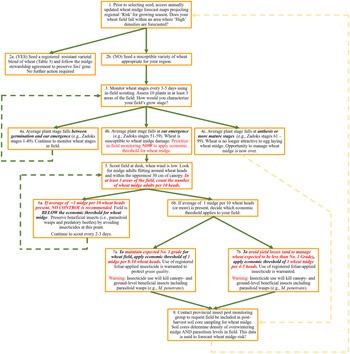
Orange wheat blossom midge (wheat midge), Sitodiplosis mosellana (Géhin) (Diptera: Cecidomyiidae), is an economically important pest of wheat (Triticum aestivum Linnaeus), with outbreaks reported in many countries in the Northern Hemisphere. Of Palaearctic origin and first recorded in eastern North America in the early 1800s (Felt Reference Felt1912), wheat midge has spread westwards and northwards to become established throughout the Canadian prairies (Ecological Framework of Canada 2021) and adjacent states in the United States of America. During an outbreak in 1983, crop yields in Saskatchewan, Canada, were reduced by approximately 30%, resulting in an estimated loss of $67 million CAD (adjusted to 2021 dollars; Olfert et al. Reference Olfert, Mukerji and Doane1985). Wheat midge continues to be a major pest in wheat in Canada and elsewhere. Here, we review the biology of wheat midge, its economic impact, and current management strategies for its control. Although we seek to provide a global perspective, we note that most of the recent work on wheat midge has been conducted in Canada. The intent of our review is to identify current and future control strategies, alone or in combination, to facilitate control of wheat midge. Our review highlights advances in knowledge and wheat midge management, with an emphasis on the last 25 years. An example of the wheat midge management decisions currently available in Canada and their implementation points during the growing season is summarised using a flowchart adapted from Ellis et al. (Reference Ellis, Bruce, Smart, Martin, Snape and Self2009).
Biology
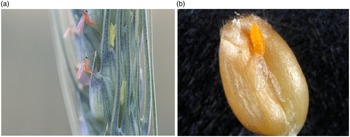
Adults (approximately 3 mm) and larvae of orange wheat blossom midge are characterised by their bright orange colouration (Olfert et al. Reference Olfert, Mukerji and Doane1985; Fig. 1A). Larvae feed on many members of the grass family (Poaceae). Reported host plants include barley (Hordeum vulgare Linnaeus), highland barley (H. vulgare var. nudum Hooker), oat (Avena sativa Linnaeus), rye (Secale cereale Linnaeus), slender foxtail grass (Alopecurus myosuroides Hudson), couch grass (Elymus repens Linnaeus), goosegrass (Roegneria kamoji Ohwi), Japanese brome (Bromus japonicus Thunberg), and triticale (X-Triticosecale Wittmack), but wheat species (T. aestivum, Triticum durum Desfontaines, and Triticum spelta Linnaeus) are the preferred hosts (Barnes Reference Barnes1932, Reference Barnes1941; Basedow Reference Basedow1972; Wright and Doane Reference Wright and Doane1987; Borkent Reference Borkent1989; Affolter Reference Affolter1990; Wise et al. Reference Wise, Lamb and Smith2001; Duan et al. Reference Duan, Jiang, Miao, Gong, Li, Wu and Luo2013a). Wheat midge is able to adapt to the seasonality of the crops predominantly grown in different parts of its geographic range. In Germany, Basedow (Reference Basedow1972) reported that wheat midge rarely attacked winter rye in areas where wheat was the predominant crop. However, in areas where winter rye made up 30–50% of crops planted, high infestations of wheat midge occurred (Brederlow Reference Brederlow1966; Basedow Reference Basedow1972). Basedow (Reference Basedow1972) showed that a majority of wheat midge collected from winter rye-growing regions emerged much earlier than those collected from wheat-growing regions. The ability to adapt to crop phenology in different regions was also observed with the wheat midge parasitoid, Macroglenes penetrans Kirby (Hymenoptera: Pteromalidae) (Basedow Reference Basedow1972). This ability could explain why wheat midge is primarily a pest of spring wheat in North America and winter wheat in Europe and much of Asia. However, this explanation is imperfect, and more research is needed, because it does not explain why wheat midge has not been reported as a pest in eastern North America for at least 50 years, where winter wheat is primarily grown (Lamb et al. Reference Lamb, Smith, Wise and McKenzie2016).
A, Female wheat midge ovipositing on wheat in early July near Girouxville, Alberta, Canada. Photograph by Shelby Dufton and Amanda Jorgensen, Agriculture and Agri-Food Canada – Beaverlodge. B, Wheat midge larva shedding exuvia on wheat kernel. Image used with permission from Shelley Barkley, Alberta Agriculture and Forestry.

Wheat midge has one generation each year, with eggs laid in late June or early July in North America on developing kernels in the wheat inflorescence (Olfert et al. Reference Olfert, Mukerji and Doane1985). Oviposition begins at dusk and continues throughout the night (Pivnick and Labbe Reference Pivnick and Labbe1993). Eggs hatch within five days (Olfert et al. Reference Olfert, Mukerji and Doane1985). Wheat midge have predominantly single-sex progenies, with less than 5% of their progenies containing both sexes (Smith et al. Reference Smith, Wise and Lamb2004b). The overall sex ratio for wheat midge progenies is 57% female (Smith et al. Reference Smith, Wise and Lamb2004b).
Damage to the crop occurs when larvae feed on the developing wheat kernel (Fig. 1B). Larvae feed for two to three weeks, causing the kernel to become shrivelled and distorted (Olfert et al. Reference Olfert, Mukerji and Doane1985; Ellis et al. Reference Ellis, Bruce, Smart, Martin, Snape and Self2009). Damaged kernels are also more susceptible to fungal diseases, including Fusarium graminearum Petch (Hypocreales: Nectriaceae) and Septoria nodorum Hedjar (Pleosporales: Phaeosphaeriaceae) (Oakley et al. Reference Oakley, Green, Jones, Kilpatrick and Young1994). Affected kernels reduce the yield, grade, and quality of the grain (Affolter Reference Affolter1990; Elliott et al. Reference Elliott, Mann and Olfert2009). Damaged kernels often weigh less and are lost during harvest and cleaning of the grain (Dexter et al. Reference Dexter, Preston, Cooke, Morgan, Kruger, Kilborn and Elliott1987).
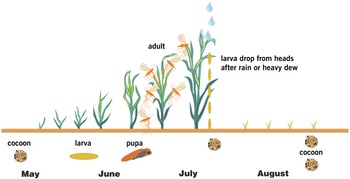
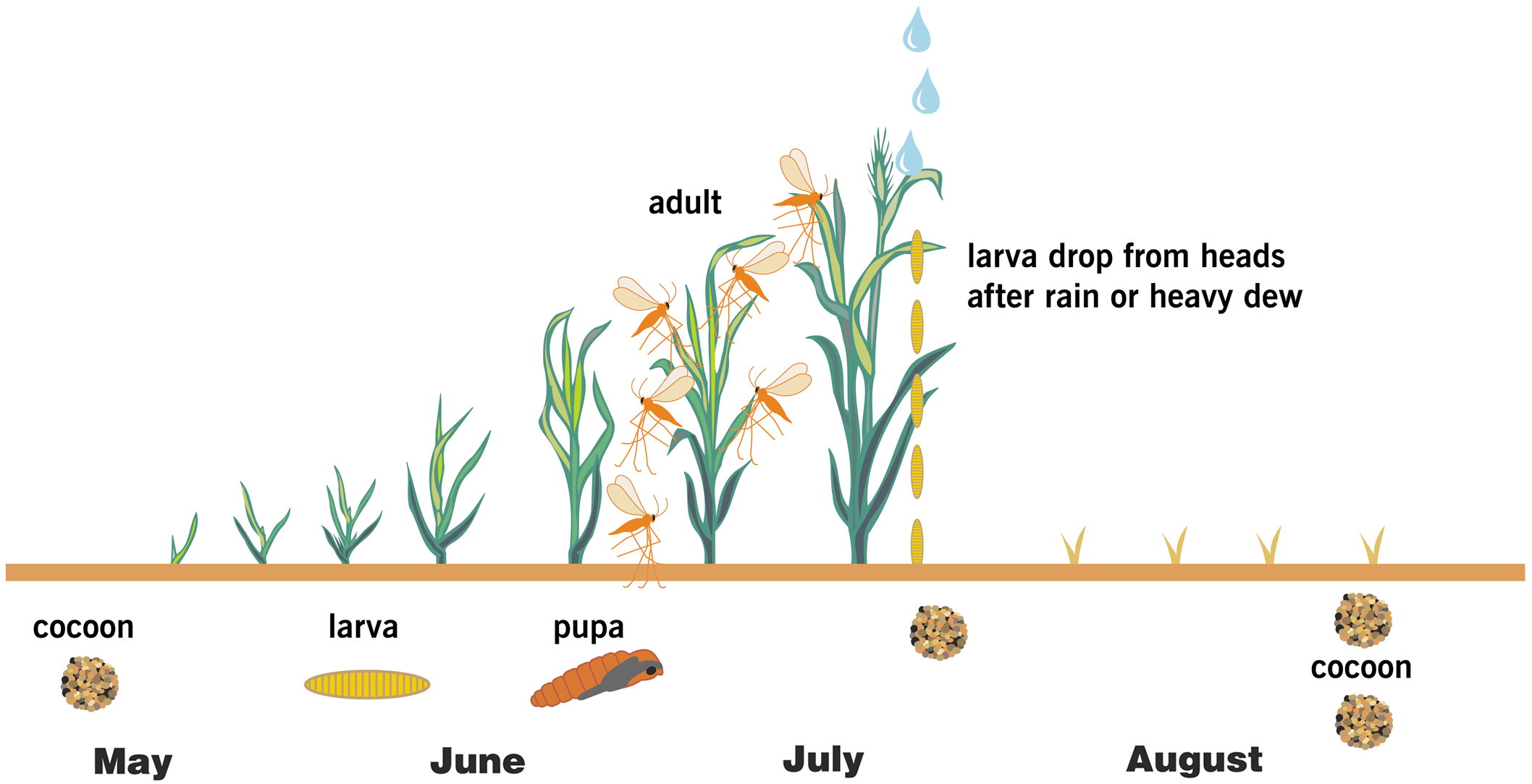
In response to moisture or rainfall events, mature third-instar larvae drop to the soil from the wheat head (Olfert et al. Reference Olfert, Mukerji and Doane1985; Affolter Reference Affolter1990; Fig. 2). Using a spoon-like structure called the spatula sternalis, mature larvae burrow into the ground to a depth of approximately 10 cm, where they spin a spherical cocoon and enter an obligatory diapause (Affolter Reference Affolter1990). In this diapausing state, larvae are able to survive soil temperatures of –5 °C for over five months and –10 °C for over three months (Wise and Lamb Reference Wise and Lamb2004). The parasitoid, M. penetrans, is also capable of surviving for extended periods at these temperatures (Wise and Lamb Reference Wise and Lamb2004). Cold hardiness allows both pest and parasitoid to persist in wheat-growing areas in western Canada, where soil can sometimes remain frozen from November to late April (Wise and Lamb Reference Wise and Lamb2004). Diapause is broken by a combination of three conditions: a period of at least 120 days at temperatures below 10 °C, an undefined period at temperatures above 0 °C, and a five-week period during which soil moisture is extremely high (Affolter Reference Affolter1990). If these conditions are met the following spring, which is typically the case, larvae move to the soil surface, pupate, and emerge as adults in late June or early July in North America (Fig. 2; Elliott et al. Reference Elliott, Mann and Olfert2009). Female wheat midge mate after emergence before dispersing to find sites suitable for oviposition (Smith et al. Reference Smith, Wise and Lamb2004b). For rearing wheat midge for research purposes, larvae are placed in a mixture of sandy and clay loam soils, stored at 2.5 °C for six months, and then held at 19 °C (day) and 17 °C (night) with a 16-hour photo period (Weeraddana et al. Reference Weeraddana, Wise, Lamb, Wolfe, Wist and McCartney2021).
Wheat midge lifecycle throughout the growing season in North America. Image used with permission from Extension Entomology, North Dakota State University, Fargo, North Dakota, United States of America.
Larvae may persist in their overwintering cocoons for up to 13 years, which reduces inbreeding within populations (Barnes Reference Barnes1952). An extended diapause or “superdiapause” occurs when conditions to break diapause are not met (Affolter Reference Affolter1990). Cocoons that remain in diapause permit mass-rearing wheat midge for research, where larvae are able to stay in cold-storage conditions (2.5 °C) for multiple years when field populations are low. However, in the field, flights of adult wheat midge may comprise multiple generations of overwintered larvae when conditions to break diapause are met (Barnes Reference Barnes1956). Larval persistence in the soil and the variable emergence of adults can make it difficult to forecast wheat midge densities from year to year (Barnes Reference Barnes1952).
Historical distribution and outbreaks of wheat midge
Believed to be Palaearctic in origin (Affolter Reference Affolter1990; Olfert et al. Reference Olfert, Elliott and Hartley2009; Doane et al. Reference Doane, Olfert, Elliott, Hartley and Meers2013), the current distribution of wheat midge includes many regions of wheat production, especially those between the 42nd and 62nd parallels (Affolter Reference Affolter1990; Olfert et al. Reference Olfert, Weiss and Elliott2016). Countries of reported occurrence include Algeria, Austria, Belgium, Bulgaria, Canada, China, Czech Republic, Denmark, Finland, France, Germany, Hungary, Ireland, Israel, Italy, Japan, Luxembourg, Montenegro, the Netherlands, Norway, Poland, Romania, Russia, Serbia, Slovakia, Sweden, Switzerland, Ukraine, United Kingdom, and the United States of America (European and Mediterranean Plant Protection Organization Global Database 2018; Fauna Europaea 2018). The following sections review information on the status of wheat midge and its economic impact by continent (Asia, Europe, and North America).
Asia
China. The earliest report of wheat midge in the literature is from China in the 1310s (Duan et al. Reference Duan, Wu, Luo, Miao, Gong, Jiang and Li2013b). The two largest outbreaks of wheat midge in China occurred in the northern part of the country in the 1950s and again in the 1980s. In the 1950s, Shanxi, Henan, and 10 other provinces experienced an outbreak resulting in a 30–50% reduction in wheat production and no harvest in some areas (Duan et al. Reference Duan, Jiang, Miao, Gong, Li, Wu and Luo2013a). The outbreak in the 1980s resulted in estimated losses of one billion kilograms of wheat each year (Ni and Ding Reference Ni and Ding1994). This second outbreak was exacerbated by removal of hexachlorocyclohexane as a control option in 1983 (Chinese Ministry of Agriculture 1989; 1991; Li et al. Reference Li, Cai, Shan and Zhu2001; Duan et al. Reference Duan, Jiang, Miao, Gong, Li, Wu and Luo2013a). Wheat production occurs mainly in the north of China, in the provinces of Anhui, Beijing, Hebei, Henan, Shaanxi, and Tianjin (Duan et al. Reference Duan, Wu, Luo, Miao, Gong, Jiang and Li2013b). Wheat midge populations have continued to spread further east and north in China each year with changing weather conditions and cropping practices (Gao et al. Reference Gao, Wang and Wang2009; Wu et al. Reference Wu, Zhao, Jiang and Duan2009; Miao et al. Reference Miao, Wu, Gong, He, Duan and Jiang2013). The area affected by wheat midge in China reached 2.7 million ha and 2.4 million ha in 2007 and 2014, respectively (Wu et al. Reference Wu, Zhao, Jiang and Duan2009; Wu et al. Reference Wu, Miao, Gong, Duan, Jiang and Li2014).
Japan. The earliest report of damage from wheat midge in Japan was in 1935 (Katayama et al. Reference Katayama, Fukui and Sasaki1987). Outbreaks were also reported for 1949 and 1952 (Katayama et al. Reference Katayama, Fukui and Sasaki1987). Due to the decline of wheat production in Japan, wheat midge was not found again until 1981, in Kyoto Prefecture (Katayama et al. Reference Katayama, Fukui and Sasaki1987). Katayama et al. (Reference Katayama, Fukui and Sasaki1987) reported that with the mechanisation of the harvesting process, wheat midge populations increased from year to year even when poor environmental conditions did not favour the pest.
Europe
Nordic Countries. Wheat midge is common throughout much of Europe, where it is predominantly a pest in winter wheat (Berzonsky et al. Reference Berzonsky, Ding, Haley, Harris, Lamb and McKenzie2003). Outbreaks of the pest were recorded as early as the late 1800s but also in the 1930s, 1950s, and the late 1970s in Sweden and Central Europe (Kurppa Reference Kurppa1989a; Skuhravá et al. Reference Skuhravá, Skuhravy and Jorgensen2006). The first record in Finland, in the 1930s, was reported on rye (Hukkinen and Vappula Reference Hukkinen and Vappula1936; Kurppa Reference Kurppa1989b), with subsequent outbreaks in 1983, 1985, 1987, and 1989 (Helenius and Kurppa Reference Helenius and Kurppa1989; Kurppa and Husberg Reference Kurppa and Husberg1989). Yield losses as high as 30–40% were reported in Finland in 1983 (Kurppa and Husberg Reference Kurppa and Husberg1989). In Denmark, heavy losses due to wheat midge were first reported in 1855, with subsequent outbreaks in 1894–1895, 1903, 1905, and 1936 (Skuhravá et al. Reference Skuhravá, Skuhravy and Jorgensen2006). Wheat midge is presently considered a minor pest in Denmark (Skuhravá et al. Reference Skuhravá, Skuhravy and Jorgensen2006).
Germany, Belgium, France, and the Netherlands. In Germany, wheat midge was first reported in 1930 (Barnes Reference Barnes1932), with subsequent outbreaks reported in 1977 (Basedow Reference Basedow1977b) and 2003 (Mölck Reference Mölck2006; Gaafar Reference Gaafar2010) in winter wheat. Serious outbreaks of wheat midge occurred in the early 2000s in Belgium and France (Rouillon et al. Reference Rouillon, Doucet and Taupin2006; Jacquemin et al. Reference Jacquemin, Mahieu, Berger and de Proft2008; Chavalle et al. Reference Chavalle, Censier, San Martin y Gomez and De Proft2019). High numbers of wheat midge were reported in the Netherlands in 1968 and 1969 and again in 1980 and 1984 (Daamen and Stol Reference Daamen and Stol1993).
United Kingdom. The earliest record of wheat midge in the United Kingdom was in 1741, in England (Webster Reference Webster1891). Outbreaks of wheat midge in the United Kingdom were recorded in 1916, 1920, and 1926 (Oakley Reference Oakley1994), with outbreaks of most serious concern in 1993 (Oakley Reference Oakley1994) and in 2004 (Bruce et al. Reference Bruce, Hooper, Ireland, Jones, Martin and Smart2007). In 1993, losses due to wheat midge damage exceeded $106 million CAD (adjusted to 2021 dollars; Oakley Reference Oakley1994). Crop losses in 2004 surpassed $181 million CAD (adjusted to 2021 dollars) despite applications of insecticides (Oakley et al. Reference Oakley, Talbot, Dyer, Self, Freer and Angus2005).
North America
United States of America. The wheat midge was initially reported and identified as a pest in North America in the early 1800s (Felt Reference Felt1912). It was recorded first in 1820 in northwestern Vermont and was a major pest in the state by 1828 (Fitch Reference Fitch1856). By 1830, larvae were found in fields in the state of New York, United States of America, where it became a pest of serious concern by 1832 (Fitch Reference Fitch1856). Initially, growers attempted to mow and dry wheat for hay while it was still green to destroy larvae developing in the wheat heads (Fitch Reference Fitch1856). This resulted in little success, and crops were “decimated” over the next few years, with few growers willing to grow the grain (Fitch Reference Fitch1856). In 1834, wheat midge became a problem in New Hampshire and Maine, United States of America (Fitch Reference Fitch1856).
Wheat midge was declared “the most terrible pest ever encountered by wheat growers” in 1854, when it reached such destructive levels that many fields were not harvested (Fitch Reference Fitch1856). Fitch (Reference Fitch1856) conservatively estimated a loss of $386 million CAD (adjusted to 2021 dollars) for wheat producers in New York State in 1854. It was during this year that wheat midge reached western Pennsylvania, Ohio, and eastern Indiana, United States of America (Fitch Reference Fitch1856). One management strategy encouraged at the time included attaching a sieve to winnowing machines or fanning mills to separate out wheat midge larvae to be destroyed later (Fitch Reference Fitch1856). Although many of the earliest records of wheat midge include a variety of identifications and different names, Felt (Reference Felt1921) concluded that these records referred to S. mosellana.
In the 1990s, an outbreak of wheat midge in North Dakota, United States of America resulted in a loss of $61 million CAD (adjusted to 2021 dollars) in gross revenue (Knodel and Ganehiarachchi Reference Knodel and Ganehiarachchi2016). Since 1995, wheat midge has been detected in all counties in North Dakota east and north of the Missouri River (Knodel and Ganehiarachchi Reference Knodel and Ganehiarachchi2016). Knodel and Ganehiarachchi (Reference Knodel and Ganehiarachchi2016) identified early seeding as one of the most useful methods of cultural control for wheat midge in North Dakota. The first reports of minor damage from wheat midge in Montana, United States of America were in the 1990s (Shrestha and Reddy Reference Shrestha and Reddy2019). Wheat midge was found in northern and central Montana from 2000 to 2004 (Shanower Reference Shanower2005). An outbreak with losses over $2 million CAD (adjusted to 2021 dollars) was recorded for Flathead County, Montana in 2006 (Stougaard et al. Reference Stougaard, Bohannon, Picard, Reddy, Talbert and Wanner2014). The distribution of wheat midge has expanded to the north, central, and eastern parts of Montana within the last decade (Shrestha and Reddy Reference Shrestha and Reddy2019). Wheat midge was reported in the mid-1900s from southern but not eastern parts of the state of Washington, United States of America (Reeher Reference Reeher1945). The current distribution and historical records for wheat midge may reflect separate introductions of the midge into western and eastern areas of North America (Borkent Reference Borkent1989).
Canada. Wheat midge was reported in Canada in the early 1800s and now occurs in wheat-growing areas from the east to west coasts. The first record of wheat midge in Canada occurred in Québec in 1819 (Sanderson Reference Sanderson1915). Fitch (Reference Fitch1856) believed, based on anecdotal evidence, that wheat midge was brought to Québec in unthreshed wheat transported from England and then reached injurious levels by 1834. As described by J.W. Dawson, “this destructive little creature ha[d]…extended its ravages” to what would later become the province of Nova Scotia by 1850 (Dawson Reference Dawson1850). Wheat midge was found in every part of Nova Scotia, causing an almost “total abandonment of wheat culture” in some cases (Dawson Reference Dawson1850). Recommendations to manage wheat midge at the time included cutting wheat early and collecting larvae from the chaff to reduce the following years’ populations (Dawson Reference Dawson1850). Wheat midge was first reported in western Canada in 1902 in Manitoba, Canada (Fletcher Reference Fletcher1902).
The earliest record of wheat midge in British Columbia, Canada comes from the Dominion Experimental Farms in 1914, where it was reported as “prevalent” [sic] in Agassiz (Hewitt Reference Hewitt1914). Severe outbreaks occurred in spring wheat from 1905 to 1908 in the Lower Fraser Valley, British Columbia (Hewitt Reference Hewitt1914), but wheat midge was not considered a noteworthy pest in the province until the 1950s (Allen Reference Allen1955).
Major outbreaks occurred in adjacent parts of the northern cropping areas of Saskatchewan and Manitoba in the 1980s (Olfert et al. Reference Olfert, Mukerji and Doane1985; Doane et al. Reference Doane, Olfert, Elliott, Hartley and Meers2013). Economically significant outbreaks spread throughout most of Manitoba and Saskatchewan by the 1990s (Elliott et al. Reference Elliott, Olfert and Hartley2011). Most of the wheat-growing areas in western Canada are now infested by wheat midge (Olfert et al. Reference Olfert, Elliott and Hartley2009).
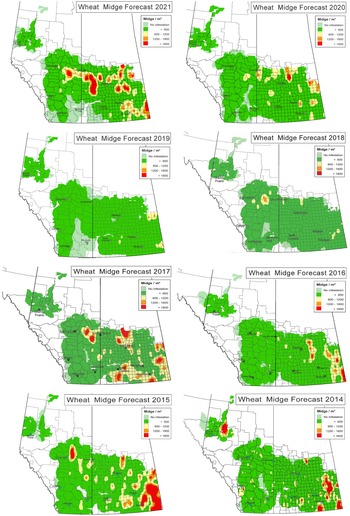
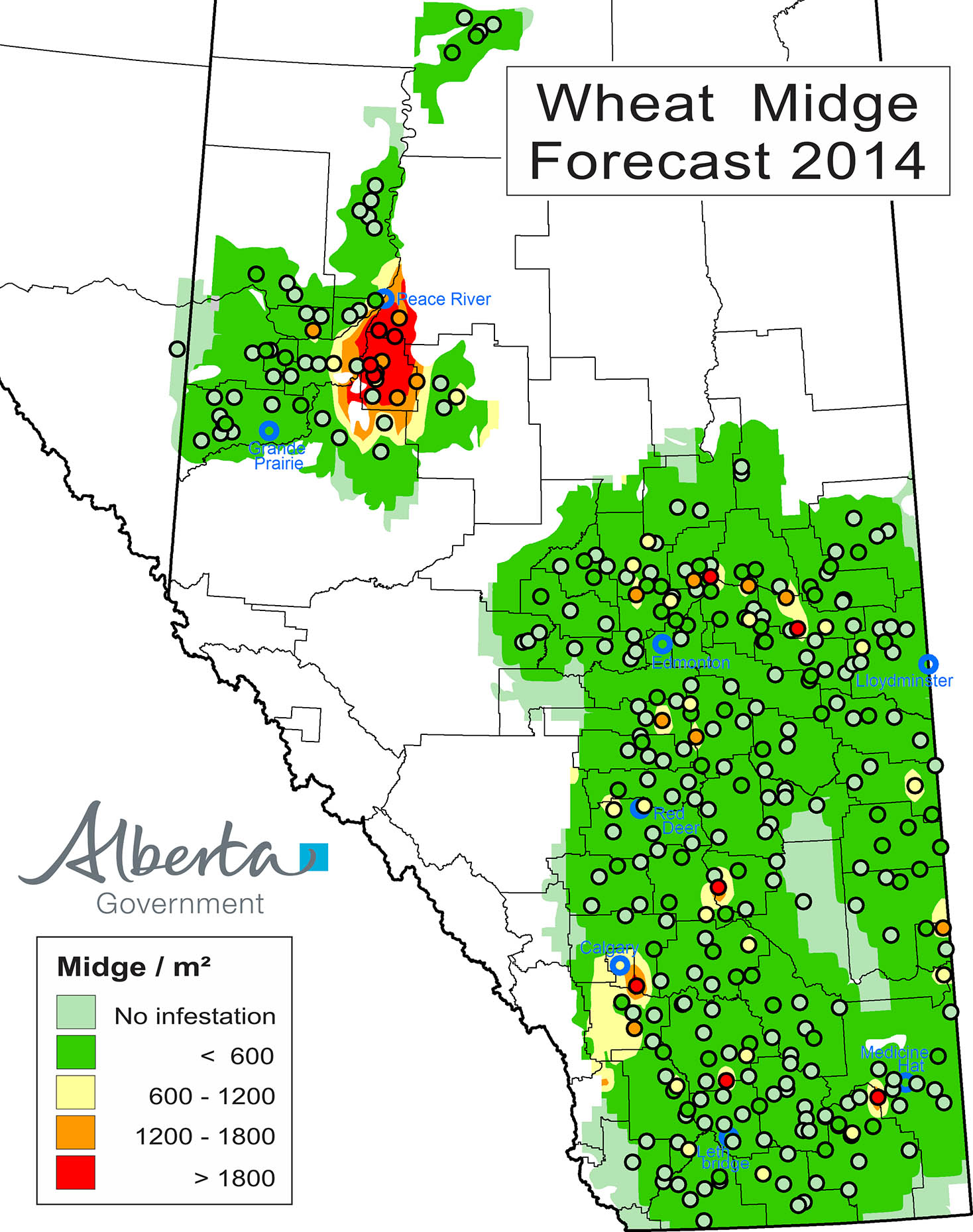
Most recently, wheat midge has expanded its distribution into the Peace River region of northern Alberta and British Columbia, Canada (Dufton Reference Dufton2019; Jorgensen 2019; Jorgensen et al. Reference Jorgensen, Otani and Evenden2020; Dufton et al. Reference Dufton, Laird, Floate and Otani2021; Jorgensen et al. Reference Jorgensen, Evenden, Olfert and Otani2021). Outbreaks of wheat midge were first reported in the region in 2011, although it was likely present before 2011 at undetectable levels (Meers 2011; Reference Meers2013). Wheat midge larvae were first detected near the communities of Rocky Lane and High Prairie, Alberta on CDC Teal and CDC Alsask cultivars in 2011 (Otani Reference Otani2011). Infestations were particularly high in the northeastern portions of the region, especially in 2014 (Alberta Agriculture and Forestry 2014; Fig. 3).
Forecast maps for the wheat midge throughout northern British Columbia, Alberta, and Saskatchewan, Canada from 2014 to 2021. Images created by David Giffen, Agriculture and Agri-Food Canada – Saskatoon and used with permission from Dr. Meghan Vankosky, co-chair, Prairie Pest Monitoring Network; Agriculture and Agri-Food Canada – Saskatoon. Pale green, no infestation; green, < 600 midge/m2; yellow, 600–1200 midge/m2; orange, 1200–1800 midge/m2; red, >1800 midge/m2.

Wheat midge has been able to establish and adapt wherever its preferred host crop is grown. Geographic barriers generally have slowed but not halted its range expansion into new regions. Introductions in North America may have been due to the accidental transport of the larval stage in unthreshed grain. The time between the arrival of wheat midge in an area and its change in status to that of “pest” is often delayed, sometimes by tens or hundreds of years. This delay likely reflects the time wheat midge takes to become established in an area, the time wheat production takes to reach a level where outbreaks affect human populations on a larger scale, and ideal environmental conditions for wheat midge emergence.
Wheat midge management
Cultural control
Cultural strategies for wheat midge control include alteration of the agroecosystem and the crop. Many of these strategies focus on favouring noncoincidence between the susceptible heading stages of wheat (Zadoks stages 50–59) and the presence of ovipositing adult wheat midge. Advanced heading can be achieved by using high seeding rates and early or late seeding to avoid overlap between adult populations of wheat midge and susceptible wheat stages (Basedow and Schutte Reference Basedow and Schutte1974; Zadoks et al. Reference Zadoks, Chang and Konzak1974; Elliott et al. Reference Elliott, Olfert and Hartley2011; Knodel and Ganehiarachchi Reference Knodel and Ganehiarachchi2016). In a Canadian study, larval densities were up to threefold higher and adult emergence was twofold higher in early-seeded wheat compared to late-seeded wheat (Elliott et al. Reference Elliott, Mann, Braun and Olfert2002). However, more recent recommendations include seeding wheat early to achieve advanced heading (Qu et al. Reference Qu, Wen, Zhao, Lu and Sun2006; Elliott et al. Reference Elliott, Olfert and Hartley2011; Duan et al. Reference Duan, Jiang, Miao, Gong, Li, Wu and Luo2013a). To reduce the buildup of wheat midge populations, Elliott et al. (Reference Elliott, Mann, Braun and Olfert2002) recommended that zero-till not be used in wheat production. Qu et al. (Reference Qu, Wen, Zhao, Lu and Sun2006) and Duan et al. (Reference Duan, Jiang, Miao, Gong, Li, Wu and Luo2013a) similarly recommended deep ploughing to reduce damage from wheat midge in China. Tillage reduced the number of overwintering larvae in the soil in the early spring (Elliott et al. Reference Elliott, Mann, Braun and Olfert2002). Golightly (Reference Golightly1952) suggested that deep ploughing delays emergence by burying larvae more deeply. Delayed emergence reduces overlap between ovipositing wheat midge and susceptible wheat stages. In China, it is recommended that spring irrigation should be reduced to avoid damage from wheat midge (Duan et al. Reference Duan, Jiang, Miao, Gong, Li, Wu and Luo2013a). Irrigation can factor into wheat midge emergence by providing ideal moisture conditions and should be avoided to reduce coincidence with susceptible stages.
A buildup of wheat midge populations can be avoided by not seeding the same field to wheat in consecutive years (Elliott et al. Reference Elliott, Olfert and Hartley2011; Duan et al. Reference Duan, Jiang, Miao, Gong, Li, Wu and Luo2013a; Knodel and Ganehiarachchi Reference Knodel and Ganehiarachchi2016). Upon emergence, female wheat midge mate and disperse up to 0.75 km (Hao et al. Reference Hao, Miao, Wu, Gong, Jiang and Duan2013) to find oviposition sites (Smith et al. Reference Smith, Wise and Lamb2004b). Rotating wheat with other crops in a field from year to year forces females to travel further to find a suitable host. Elliott et al. (Reference Elliott, Mann, Braun and Olfert2002) recommended growing canola, flax, or legumes on the Canadian prairies in fields where larval populations exceeded 1200 individuals per square metre. Reductions in spring fertiliser applications are recommended in China (Duan et al. Reference Duan, Jiang, Miao, Gong, Li, Wu and Luo2013a). Yuan et al. (Reference Yuan, Hua, Wu, He and Zhu2003) reported that fertiliser facilitated the development of wheat, increasing the density of wheat heads available to wheat midge in the field for oviposition. However, a higher number of heads due to tillering may result in a smaller proportion of damaged grain depending on the population of wheat midge in the area. Further research into the effects of fertiliser treatments on wheat midge is needed to explain this relationship.
Crop resistance
Antibiotic resistance. Current management of wheat midge includes the development and use of resistant wheat cultivars. In Canada, dead first-instar larvae in a bioassay of multiple winter wheat cultivars were the first indication of potential antibiotic resistance against wheat midge (Barker and McKenzie Reference Barker and McKenzie1996). Antibiotic resistance occurs when the traits of a host plant negatively affect the development of an insect (Smith Reference Smith2005). The source of this antibiotic resistance in wheat is now known to be the Sm1 gene, which was discovered while investigating sources of resistance for spring wheat (Lamb et al. Reference Lamb, McKenzie, Wise, Barker, Smith and Olfert2000; McKenzie et al. Reference McKenzie, Lamb, Aung, Wise, Barker and Olfert2002; Lamb et al. Reference Lamb, Smith, Wise and McKenzie2016). The Sm1 gene increases the production of phenolic acid in response to feeding damage, which kills the larvae (Ding et al. Reference Ding, Lamb and Ames2000; Abdel-Aal et al. Reference Abdel-Aal, Hucl, Sosulski, Graf, Gillott and Pietrzak2001; Harris et al. Reference Harris, Stuart, Mohan, Nair, Lamb and Rohfritsch2003). Other genes may be involved in different mechanisms of antibiosis (Blake et al. Reference Blake, Stougaard, Weaver, Sherman, Lanning and Naruoka2011), but breeding programmes have focused on the Sm1 gene to develop wheat midge-resistant cultivars of spring wheat (Vera et al. Reference Vera, Fox, DePauw, Smith, Wise and Clarke2013).
The Sm1 gene may be responsible for the resistance found in European and Asian wheat cultivars. Lamb et al. (Reference Lamb, Smith, Wise and McKenzie2016) proposed that the Sm1 gene may have been introduced into North America with the winter wheat cultivar, Mediterranean, which was brought to the United States of America from Italy in the 1880s (Clark et al. Reference Clark, Love and Gaines1927). In England, Oakley et al. (Reference Oakley, Talbot, Dyer, Self, Freer and Angus2005) found that winter wheat cultivars Brompton, Carlton, ELS 03-34, Kipling, Welland, and Welford met the criteria for antibiotic resistance. Ellis et al. (Reference Ellis, Bruce, Smart, Martin, Snape and Self2009) later demonstrated that the Sm1 gene was largely responsible for the resistance seen in cultivars Brompton, Carlton, and Welford. In 2021, 26 recommended wheat cultivars in the United Kingdom are believed to be resistant to wheat midge (Agriculture and Horticulture Development Board 2021). Chavalle et al. (Reference Chavalle, Jacquemin and De Proft2017) showed that 17 of 64 winter wheat cultivars registered for commercial use in Belgium were resistant to wheat midge, including the Aigle, Barok, Bodecor, Boregar, Farandole, Gallixe, Kundera, KWS Smart, Popeye, Lyrik, Reflection, Renan, Rubisko, Sherlock, Sy Epson, Tobak, and Universal cultivars. Other resistant cultivars reported in Europe include the German winter wheat cultivar, Skalmeje (Gaafar et al. Reference Gaafar, Volkmar, Coster and Spilke2011), and the Scottish winter wheat cultivar, Lear (Chavalle et al. Reference Chavalle, Censier, San Martin y Gomez and De Proft2015b).
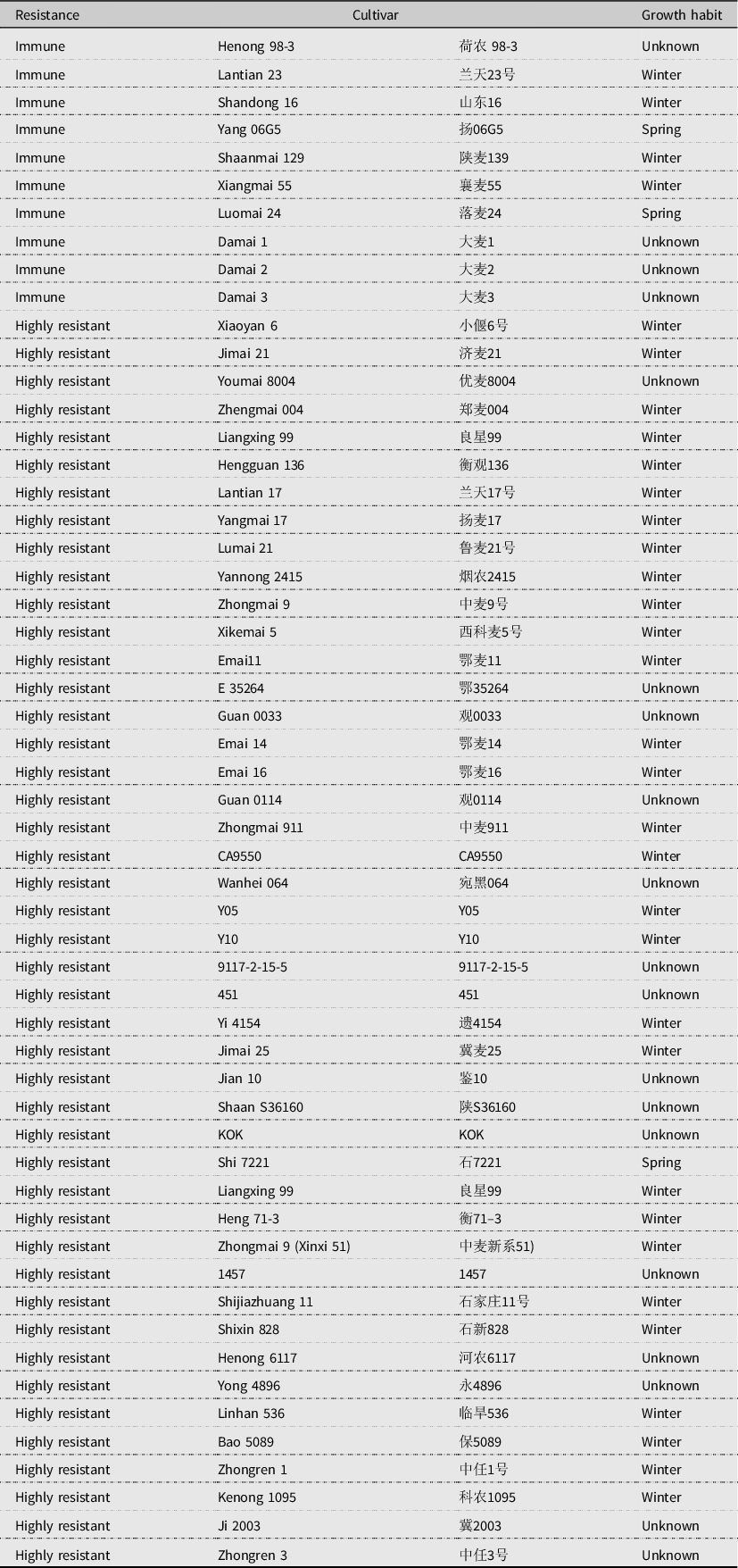
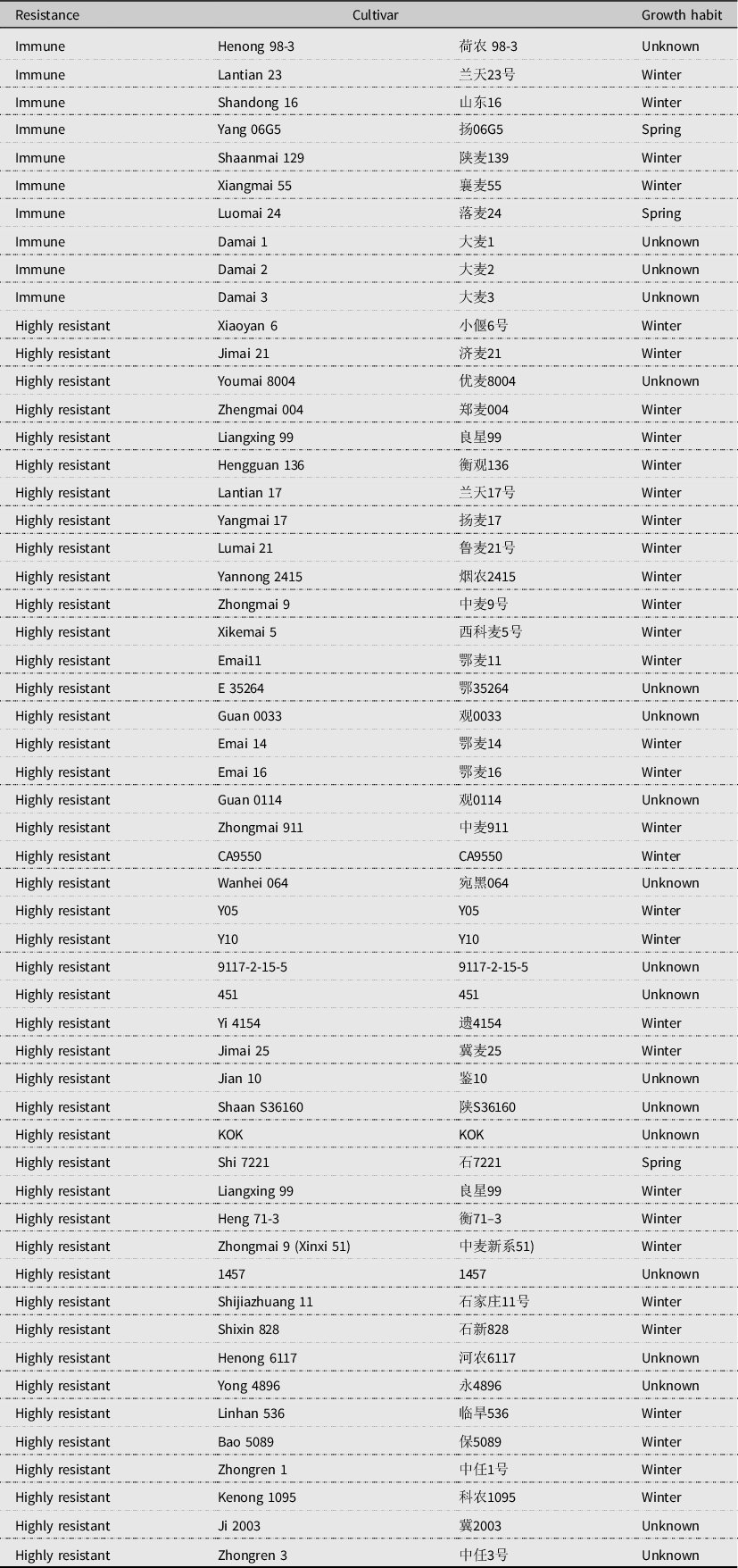
Sun et al. (Reference Sun, Ni, Ding, Qu and Zhang1998) and Shi et al. (Reference Shi, Qiu, Ma, Xu, Wu and Lu2002) concluded that phenolic acid played a significant role in the resistance of Chinese winter wheat cultivars. Guo (Reference Guo1989) devised a method to classify a cultivar’s wheat midge resistance based on comparing that cultivar’s estimated loss rate to the average estimated loss rate of all cultivars tested. Of 787 Chinese wheat cultivars tested, 56 were categorised in the “immune” or “high resistance” categories (Table 1; Li et al. Reference Li, Li and Cheng2004; Wen et al. Reference Wen, Zhao, Qu, Liu, Wang and Wang2007; Li Reference Li2012). A more efficient method developed in China to assess resistance uses the infested spike percentage, that is, the number of heads in a defined area infested by wheat midge (Wu et al. Reference Wu, Duan, Zhang, Liu, Liu and Jiang2013).
List of wheat midge-resistant cultivars tested in China using the grading method defined by Guo (Reference Guo1989). Immune: no wheat midge larvae detected; highly resistant: wheat midge larvae detected at 1–19% of the average intensity across all tested cultivars (Li et al. Reference Li, Li and Cheng2004; Wen et al. Reference Wen, Zhao, Qu, Liu, Wang and Wang2007; Li Reference Li2012).
Varietal blends were introduced into the market in Canada in 2010 to reduce selection pressures favouring the development of resistance by wheat midge to the Sm1 gene (Fox et al. Reference Fox, McKenzie, Lamb, Wise, Smith and Humphreys2010; Vera et al. Reference Vera, Fox, DePauw, Smith, Wise and Clarke2013). Varietal blends combine different cultivars of midge-resistant wheat and midge-susceptible wheat at a ratio of 9:1 to create an interspersed refuge (Smith and Lamb Reference Smith and Lamb2004; Smith et al. Reference Smith, Lamb, Wise and Olfert2004a, Reference Smith, Wise and Lamb2007; Vera et al. Reference Vera, Fox, DePauw, Smith, Wise and Clarke2013). Planting a small number of susceptible plants in the field allows a small proportion of the wheat midge population to develop without exposure to the Sm1 gene. Planting a blend of susceptible and resistant plants (rather than blocks of susceptible and resistant plants) increases the likelihood that females developing on susceptible plants will mate with males developing on resistant plants and vice versa. Working in combination, these factors are expected to slow the evolution of the Sm1 gene resistance (Harris et al. Reference Harris, Stuart, Mohan, Nair, Lamb and Rohfritsch2003; Smith et al. Reference Smith, Lamb, Wise and Olfert2004a, Reference Smith, Wise and Lamb2004b; Vera et al. Reference Vera, Fox, DePauw, Smith, Wise and Clarke2013). Small populations also serve as hosts to maintain a resident population of wheat midge parasitoids (Smith et al. Reference Smith, Lamb, Wise and Olfert2004a; Doane et al. Reference Doane, Olfert, Elliott, Hartley and Meers2013). Despite the use of varietal blends, the evolution of Sm1 resistance in wheat midge remains a concern. Small numbers of larvae able to survive on midge-resistant cultivars may result in the evolution of Sm1 gene resistance (Smith et al. Reference Smith, Wise and Lamb2007; Chavalle et al. Reference Chavalle, Jacquemin and De Proft2017). The first varietal blends available in Canada in 2010 included AC® Unity VB (varietal blend), AC® Goodeve VB, and AC® Glencross VB (Vera et al. Reference Vera, Fox, DePauw, Smith, Wise and Clarke2013). In 2011, AC® Fieldstar VB and AC® Glencross VB became available for commercial production in Canada (Elliott et al. Reference Elliott, Olfert and Hartley2011).
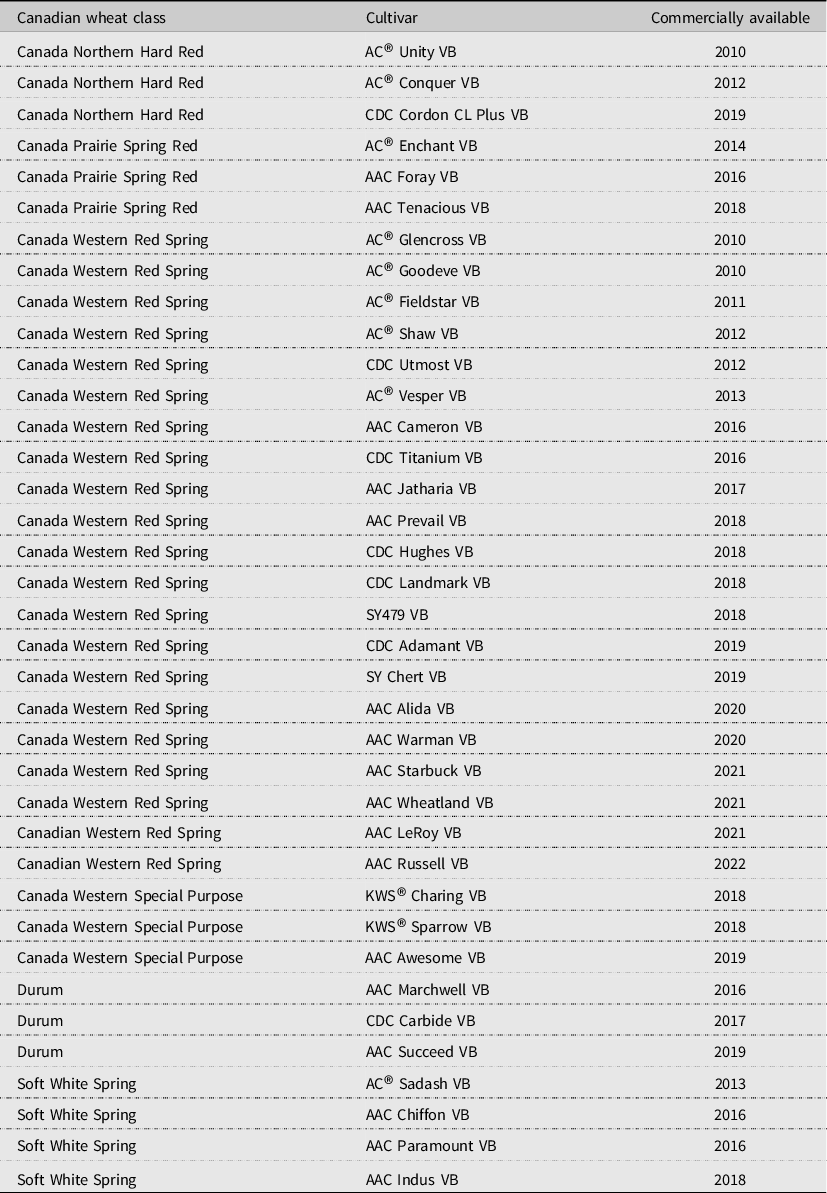
As of 2021, 37 wheat midge-resistant cultivars were available or soon to be available commercially in Canada (Table 2; Midge Tolerant Stewardship Team 2021), with additional cultivars available for use in the United States of America. The Midge Tolerant Wheat Stewardship Team was formed in Canada in 2010 to protect the technology behind the varietal blends and maintain the resistance provided by the Sm1 gene (Midge Tolerant Stewardship Team 2015). Any grower purchasing and using wheat midge-resistant cultivars must sign a stewardship agreement that maintains the interspersed refuge by limiting the use of farm-saved seed to a single generation (Midge Tolerant Stewardship Team 2015). Even with the incorporation of a portion of susceptible plants as a refuge, the use of these cultivars should be closely monitored for a breakdown of the resistance they convey. Since their introduction in 2010, cultivars with the antibiotic resistance conferred by the Sm1 gene have come to the forefront of wheat midge management. Each year, antibiotic-resistant cultivars comprise between 7% and 18% of the wheat acres grown in western Canada (Canadian Grain Commission 2015; Midge Tolerant Stewardship Team 2015; Canadian Grain Commission 2016; 2017; 2018; 2019; 2020). Resistant cultivars are typically sown when and where wheat midge populations are projected to occur. In the United States of America, planting of the resistant hard red spring wheat cultivar, Egan, is recommended (Blake et al. Reference Blake, Stougaard, Bohannon, Weaver, Heo and Lamb2014; Knodel and Ganehiarachchi Reference Knodel and Ganehiarachchi2016).
List of wheat midge-resistant cultivars currently available in Canada and the year they became commercially available (Midge Tolerant Stewardship Team 2021).

Antixenotic resistance. Antixenosis refers to plant traits that cause an insect to avoid the plant for feeding or oviposition (Kogan and Ortman Reference Kogan and Ortman1978). Antixenosis associated with reduced oviposition was first observed in certain lines of wheat in the early 2000s in Canada (Lamb et al. Reference Lamb, McKenzie, Wise, Barker, Smith and Olfert2000; Lamb et al. Reference Lamb, Wise, Smith, McKenzie, Thomas and Olfert2002b). Subsequent studies indicated that multiple genes are involved, that environment strongly influences phenotypic expression, and that these genes are not linked to the antibiosis gene Sm1 (Lamb et al. Reference Lamb, Wise, Smith, McKenzie, Thomas and Olfert2002b; Gharalari et al. Reference Gharalari, Fox, Smith and Lamb2009a; Thambugala et al. Reference Thambugala, Pozniak, Kumar, Burt, Wise and Smith2020). Antixenosis may be associated with chemicals that are either emitted by the plant or on the surface of the plant and that are used by female wheat midge to select oviposition sites (Lamb et al. Reference Lamb, Smith, Wise, Clarke and Clarke2001; Gharalari et al. Reference Gharalari, Fox, Smith and Lamb2009a, Reference Gharalari, Smith, Fox and Lamb2009b, Reference Gharalari, Smith, Fox and Lamb2011). Other researchers have suggested that physical traits or plant colour may be involved. In China, cultivars with a greater distance between the inner and outer glumes were less resistant to wheat midge (Ding and Guo Reference Ding and Guo1993). Additionally, wheat midge were found to lay more eggs on yellow–green wheat spikes without wax than on deep blue–green wheat spikes with thick wax (Cheng et al. Reference Cheng, Li, Li and Xin2003). Thambugala et al. (Reference Thambugala, Pozniak, Kumar, Burt, Wise and Smith2020) identified major quantitative trait loci for oviposition deterrence in the Canadian spring wheat cross, Super/BW278, one locus of which was mapped to the location of an awn inhibitor gene, suggesting that awns may hinder wheat midge oviposition. Clarifying the mechanism for this antixenosis may prove valuable, either alone or in combination with the Sm1 gene (Fox et al. Reference Fox, Thomas, Wise, Smith, Humphreys and Brown2009; Gharalari et al. Reference Gharalari, Fox, Smith and Lamb2009a), to develop resistant wheat cultivars.
Monitoring
Soil sampling. Larval densities in soil can be used to forecast wheat midge populations and damage in the following year. Thresholds to determine the occurrence of damage have been developed in Germany (6.00 or more larvae in 100 cm2 of soil collected in the spring) and China (8.07 pupae collected in 2000 cm3 of soil; Basedow Reference Basedow1980; Zhang et al. Reference Zhang, Qian, Ren, Yang, Gao and Zhang2015). In Saskatchewan, Doane et al. (Reference Doane, Mukerji and Olfert2000) determined that counts of cocoons from 15 soil cores (2.54 cm diameter × 15 cm depth) provided estimates of wheat midge populations in the soil with acceptable levels of precision and that cores should be collected in spring or autumn at peak soil populations. Soil core collection methods developed by Doane et al. (Reference Doane, Mukerji and Olfert2000) have been confirmed in northern Alberta, where cocoons collected in the fall were significantly related to adult wheat midge densities in the spring (Jorgensen et al. Reference Jorgensen, Otani and Evenden2020). However, it is important to note that soil sampling has been shown to be imprecise in some areas (Basedow and Schutte Reference Basedow and Schutte1974; Oakley et al. Reference Oakley, Cumbleton, Corbett, Saunders, Green, Young and Rodgers1998; Jorgensen et al. Reference Jorgensen, Otani and Evenden2020). A critical examination of the variability between geographic locations, environmental conditions, and prolonged diapause could provide much needed insight to help improve the predictive power of soil sampling techniques.
Pheromone traps. Pheromone traps have proven useful for making predictions of wheat midge populations and potential risk. Gries et al. (Reference Gries, Gries, Khaskin, King, Olfert and Kaminski2000) identified the female-produced sex pheromone (2S,7S)-nonanediyl dibutyrate that is used in commercial fields for wheat midge monitoring in North America and Europe (Bruce and Smart Reference Bruce and Smart2009; El-Wakeil et al. Reference El-Wakeil, Abdel-Moniem, Gaafar and Volkmar2013; Jorgensen et al. Reference Jorgensen, Otani and Evenden2020). A rubber septum loaded with 1 mg racemic mixture of the pheromone placed in a delta trap loaded with a sticky card is the most effective trap and dispenser design for monitoring flight phenology (Gries et al. Reference Gries, Gries, Khaskin, King, Olfert and Kaminski2000; Bruce et al. Reference Bruce, Hooper, Ireland, Jones, Martin and Smart2007). Pheromone traps placed at lower heights typically capture more wheat midge, with the most efficient at heights being 0.40, 0.20, and 0.55 m in China, Belgium, and Canada, respectively (Mircioiu Reference Mircioiu2004; Li et al. Reference Li, Cheng, Yu, Cheng and Wu2011; Chavalle et al. Reference Chavalle, Censier, San Martin y Gomez and De Proft2019).
Use of pheromone traps to predict damage has produced mixed results. Bruce et al. (Reference Bruce, Hooper, Ireland, Jones, Martin and Smart2007), Ellis et al. (Reference Ellis, Bruce, Smart, Martin, Snape and Self2009), and Mircioiu (Reference Mircioiu2004) found a positive correlation between damage from larval infestations and peak pheromone trap catches of male midges. However, Mircioiu (Reference Mircioiu2004) observed this correlation only in wheat fields seeded on wheat stubble. Jorgensen et al. (Reference Jorgensen, Otani and Evenden2020) found no significant relationships between the number of wheat midge larvae in heads and pheromone trap capture. When assessing fields where larval numbers in the soil are expected to be low (fields seeded to wheat on stubble other than wheat), pheromone traps have limited use as they capture only males (Chavalle et al. Reference Chavalle, Censier, San Martin y Gomez and De Proft2019). Wheat midge mate at their emergence sites, and then females disperse before they oviposit (Smith et al. Reference Smith, Wise and Lamb2007). Fields neighbouring sources of wheat midge may become infested despite low numbers of males caught on pheromone traps (Chavalle et al. Reference Chavalle, Censier, San Martin y Gomez and De Proft2019; Jorgensen et al. Reference Jorgensen, Otani and Evenden2020). If pheromone traps are used, trap placement is paramount in determining risk of attack. Ellis et al. (Reference Ellis, Bruce, Smart, Martin, Snape and Self2009) indicated that pheromone traps placed in nonwheat fields that were seeded to wheat in previous years provides a good indicator of risk.
In the United Kingdom, in-field scouting is recommended when 30 or more midge are recovered per pheromone trap per day, and an insecticide treatment is recommended when 120 midges or more are recovered per trap per day (Ellis et al. Reference Ellis, Bruce, Smart, Martin, Snape and Self2009). Pheromone traps are the most precise tool for monitoring the beginning and peaks of wheat midge flight patterns (Chavalle et al. Reference Chavalle, Censier, San Martin y Gomez and De Proft2019). Pheromone traps are particularly advantageous because they are very selective and result in little bycatch (Chavalle et al. Reference Chavalle, Censier, San Martin y Gomez and De Proft2019).
Sticky cards. Unbaited sticky cards are another method of monitoring for wheat midge. Sticky cards are easily accessible, inexpensive, and capture both male and female wheat midge. Jorgensen et al. (Reference Jorgensen, Otani and Evenden2020) found in northern Alberta that female wheat midge capture on yellow sticky cards was significantly correlated with larval populations, albeit this relationship was strongly driven by a single high-leverage data point. Wheat midge capture on yellow sticky cards was found to be a good predictor of yield loss in fields in China (Chen et al. Reference Chen, Li, Gao, Xue, Xiao, Liu and Wu2011a). Yellow sticky cards can also be used to monitor populations of the wheat midge parasitoid, M. penetrans (Affolter Reference Affolter1990; Jorgensen et al. Reference Jorgensen, Otani and Evenden2020). Chavalle et al. (Reference Chavalle, Censier, San Martin y Gomez and De Proft2019) found that in cases where soil infestation levels are low or unknown, either sticky traps or yellow water traps could be used to monitor wheat midge populations in Belgium but the latter was easier to use. An action threshold for 7.5 × 10 cm yellow sticky cards of four or more adult wheat midge per 10 cards has been developed for Manitoba (Lamb et al. Reference Lamb, Wise, Gavloski, Kaminski and Olfert2002a). For evaluating this threshold, cards are placed at the height of the wheat heads, where egg laying occurs (Lamb et al. Reference Lamb, Wise, Gavloski, Kaminski and Olfert2002a). However, the utility of this threshold for other regions is unknown because its efficacy has not been widely tested elsewhere. Sticky card colour has been tested in China, where purple sticky cards caught significantly more wheat midge than 14 other colours tested (Li et al. Reference Li, Ma, Liu, Wu and He2012). Further investigation to determine the ideal colour to attract wheat midge to sticky cards is warranted.
In-field scouting. Several countries have recommended action thresholds based on the number of ovipositing wheat midge adults per number of wheat heads. In Canada, application of foliar insecticides is recommended at densities of one or more adults per 4–5 wheat heads to prevent yield losses and at densities one or more adults per 8–10 heads to maintain an expected No. 1 grade (Saskatchewan Agriculture and Food 1993; Elliott et al. Reference Elliott, Mann, Braun and Olfert2002; Olfert et al. Reference Olfert, Elliott and Hartley2009; Gavloski Reference Gavloski2019; Canadian Grain Commission 2021) but only if the wheat is still susceptible to attack. This period of susceptibility corresponds to Zadoks stages 50–59 – that is, when the wheat head emerges from the boot (Zadoks et al. Reference Zadoks, Chang and Konzak1974; Elliott and Mann Reference Elliott and Mann1996). Between heading and anthesis (flowering) (Zadoks stages 60–69), wheat midge damage declines 35- to 240-fold (Elliott and Mann Reference Elliott and Mann1996). In Germany, the United Kingdom, and much of Europe, the current threshold is one adult per three heads for wheat destined for human consumption (Basedow and Schutte Reference Basedow and Schutte1973; Lescar Reference Lescar1977; Kurppa and Husberg Reference Kurppa and Husberg1989; Ramsden et al. Reference Ramsden, Kendall, Ellis and Berry2017). For wheat with the end purpose of milling or seeding, the threshold is one adult per six to seven heads (Kurppa and Husberg Reference Kurppa and Husberg1989; Ramsden et al. Reference Ramsden, Kendall, Ellis and Berry2017). Inspections should be carried out in the evening, when female wheat midge are active around the heads (Elliott and Mann Reference Elliott and Mann1996).
Chemical control. Using chemical control has many benefits in the short term, including kernel protection from wheat midge, improvements in yield, and better economic returns (Elliott Reference Elliott1988b; Chavalle et al. Reference Chavalle, Censier, San Martin y Gomez and De Proft2015b). However, monitoring for wheat midge and making the decision to use chemical control can be difficult because monitoring must occur at dusk, when wheat midge adults are flying (Pivnick and Labbe Reference Pivnick and Labbe1993; Chen et al. Reference Chen, Wu, Miao, Yu, Duan, Jiang and Du2011b). In addition, the effectiveness of insecticides is limited because contact insecticides cannot reach larvae under glumes on the seed surface (Elliott Reference Elliott1988b; McKenzie et al. Reference McKenzie, Lamb, Aung, Wise, Barker and Olfert2002).
Chemical control of wheat midge has been studied with several different insecticides, some of which are no longer commercially available. Early research reported effective control of wheat midge using permethrin, fenvalerate, deltamethrin, cypermethrin, cyhalothrin, bifenthrin, malathion, and methoxychlor (Basedow and Schutte Reference Basedow and Schutte1973; Kurppa and Husberg Reference Kurppa and Husberg1989). Emergency use registration was granted in 1984 for chlorpyrifos, dimethoate, methoxychlor, and permethrin to control a wheat midge outbreak in Canada (Elliott Reference Elliott1988a). Methoxychlor and permethrin were later delisted due to environmental concerns (Floate et al. Reference Floate, Bérubé, Boiteau, Dosdall, Van Frankenhuyzen and Gillespie2002), leaving dimethoate and chlorpyrifos as the only active ingredients registered for wheat midge control in Canada (Brook and Cutts Reference Brook and Cutts2019). Chlorpyrifos and lambda-cyhalothrin are commonly applied for wheat midge control in the United States of America, Belgium, and China and provide consistent increases in yield (Zhang et al. Reference Zhang, Liu, Tian, Xu and Cheng2014; Chavalle et al. Reference Chavalle, Jansen, San Martin y Gomez and De Proft2015c; Thompson and Reddy Reference Thompson and Reddy2016). Cypermethrin also has been shown to reduce losses in yield in both China and Belgium (Zhang et al. Reference Zhang, Liu, Tian, Xu and Cheng2014; Chavalle et al. Reference Chavalle, Jansen, San Martin y Gomez and De Proft2015c). In Germany, El-Wakeil et al. (Reference El-Wakeil, Abdel-Moniem, Gaafar and Volkmar2013) found that two synthetic pesticides, lambda-cyhalothrin and thiacloprid, and one botanical pesticide, Neem Azal, increased larval and adult mortality. Imidacloprid applied during the heading period provided up to 90% control in China (Duan et al. Reference Duan, Liu, Zhang, Liu and Wu2011).
Uniform application of insecticidal sprays over the wheat heads is recommended to ensure contact control of eggs, young larvae, and ovipositing adults (Basedow and Schutte Reference Basedow and Schutte1973; Olsson Reference Olsson1980; Oakley Reference Oakley1981; Lescar Reference Lescar1984; Kurppa and Husberg Reference Kurppa and Husberg1989; Elliott and Mann Reference Elliott and Mann1996; Zeng et al. Reference Zeng, Guo and Lu2001; Duan et al. Reference Duan, Liu, Zhang, Liu and Wu2011, Reference Duan, Jiang, Miao, Gong, Li, Wu and Luo2013a; Hao et al. Reference Hao, Miao, Wu, Wu and Cheng2014). Orienting nozzles on ground sprayers 40 degrees forwards, rather than downwards, and applying sprays at higher volumes can improve the uniformity of insecticide deposition on wheat heads (Elliott Reference Elliott1988a; Reference Elliott1988b). Elliott (Reference Elliott1988b) reported excellent control using aerial applications of dimethoate or chlorpyrifos applied when 55–60% of heads had emerged from the flag leaf, resulting in improved kernel quality, crop yield, and economic returns. More recently, in China, unmanned aerial vehicles have shown promising results as low-cost, highly efficient alternatives to manned aerial applications (Gao et al. Reference Gao, Zhang, Zhang, Niu, Zheng and Yuan2013; He et al. Reference He, Bonds, Herbst and Langenakens2017). Using this technology, Gao et al. (Reference Gao, Zhang, Zhang, Niu, Zheng and Yuan2013) achieved 81.6% control using bifenthrin.
In China, soil treatments were applied for wheat midge in the 1990s and well into the 2000s. Treatments were typically applied by mixing insecticide into the soil during the seeding period in autumn and during booting in the spring (Li et al. Reference Li, Wang, Ding and Zhang2000; Zeng et al. Reference Zeng, Guo and Lu2001; Duan et al. Reference Duan, Jiang, Miao, Gong, Li, Wu and Luo2013a). Gao et al. (Reference Gao, Liu, Zhu and Sun1992) applied 1 kg of lindane (hexachlorocyclohexane) powder to each 667 m2 of soil to achieve up to 99% control of wheat midge pupae. Li and Ren (Reference Li and Ren1987) found that a soil treatment of isofenphos-methyl provided 91% control of the pupal stage. Li et al. (Reference Li, Wang, Ding and Zhang2000) reported that a combination of methamidophos, methyl isofenphos, parathion emulsifiable concentrate, and hexachlorocyclohexane powder applied to soil reduced damage by wheat midge by more than 80%. However, chemicals previously approved to control soil-dwelling insects are being phased out. Hexachlorocyclohexane was banned in China in 1983, but restrictions were eased in the 1990s to allow its use on certain crops including wheat (Chinese Ministry of Agriculture 1989; 1991; Li et al. Reference Li, Cai, Shan and Zhu2001). Hexachlorocyclohexane was subsequently banned by the Stockholm Convention on Persistent Organic Pollutants in 2009 (United Nations Environment Programme (UNEP) 2009). Isofenphos-methyl, which has high mammalian toxicity, has been banned for use on fruits and vegetables in China since 2018 (Gao et al. Reference Gao, Zhang, Li, Kaziem, He and Yang2019; Gao et al. Reference Gao, Zhao, Shi, Zhang, Li and He2020); a ban on its use on cereals and other crops is expected in the next five years (CCM Data & Business Intelligence 2019).
Efforts have also been made to research botanical insecticides. In China, research on Jing yebao, a foliar insecticide derived from nicotine, provided 77–90% control of adult wheat midge and was less toxic to nontarget species when compared to traditional pesticides (Cheng et al. Reference Cheng, Li, Li, Li and Wang2000). A study in the United States of America found that the biopesticide jasmonic acid and the nematode Steinernema feltiae reduced larval populations of wheat midge, increased grain yield in spring wheat, and reduced kernel damage levels (Shrestha and Reddy Reference Shrestha and Reddy2019).
Because of their broad spectrum of action, judicious use of insecticides to control wheat midge is recommended to minimise their nontarget effects against natural enemies of wheat midge. In field experiments conducted in Germany, high wheat midge mortality rates were attributed to soil surface-dwelling predaceous arthropods (Basedow Reference Basedow1973). Basedow (Reference Basedow1973) suggested that large-scale use of broad-spectrum insecticides might increase pest populations by decreasing predator populations. Growers in the United Kingdom are advised to avoid nontargeted or unnecessary spraying for wheat midge to conserve their parasitoids (e.g., M. penetrans) and predators (e.g., spiders and dance flies, Platypalpus spp. (Diptera: Hybotidae); Bruce and Smart Reference Bruce and Smart2009). Despite its efficacy, Chavalle et al. (Reference Chavalle, Censier, San Martin y Gomez and De Proft2015b) recommend against use of chlorpyrifos because of its potential to suppress populations of wheat midge parasitoids. Elliott (Reference Elliott1988b) found that delaying insecticide applications by six days allowed producers more time to reassess the necessity of using foliar-applied broad-spectrum insecticides based on midge populations, increased the window of time for applying these insecticides, improved spray coverage, and reduced residual requirements. A delay of six days does not decrease levels of protection and control and could minimise the impact of insecticides on adult parasitoids (Elliott Reference Elliott1988b). However, applications of insecticide can still be detrimental to parasitoid and predator populations. Elliott and Mann (Reference Elliott and Mann1997) found that reducing the rate of application of chlorpyrifos from 0.40 kg to 0.24 kg active ingredient ha–1 did not lower the amount of control and protection provided by the insecticide. This reduction would help decrease the cost of control and reduce harmful effects on parasitoids and other natural enemies (Elliott and Mann Reference Elliott and Mann1997). Floate et al. (Reference Floate, Elliott, Doane and Gillott1989) found that residues on soil remained toxic to carabid beetles for up to 16 days. When implementing chemical control measures, effects on natural enemy populations should be considered.
Natural enemies
Generalist predators. Wheat midge larvae are vulnerable to predation when they drop from the wheat head to the soil surface in late summer to overwinter (Basedow Reference Basedow1973) and also when they pupate on the soil surface during the following spring (Floate et al. Reference Floate, Doane and Gillott1990; Fig. 2). In China, the following predators have been reported to prey on wheat midge: ants and spiders on the larval stages, robber flies (Diptera: Asilidae) on the adults, and six-spotted thrips, Scolothrips sexmaculatus Pergande (Thysanoptera: Thripidae), on the eggs (Duan et al. Reference Duan, Jiang, Miao, Gong, Li, Wu and Luo2013a). Floate et al. (Reference Floate, Doane and Gillott1990) showed 14 species of carabid beetles fed on wheat midge larvae under laboratory conditions. In the absence of alternative prey, Bembidion quadrimaculatum Linnaeus, Bembidion obscurellum Motschulsky, Agonum placidum Say, and Pterostichus corvus LeConte (all Coleoptera: Carabidae) killed an average of 9, 15, 43, and 48 larvae per beetle per day, respectively (Floate et al. Reference Floate, Doane and Gillott1990). In the field, daily predation was estimated to range from fewer than 1 larvae up to 86 larvae per square metre (Floate et al. Reference Floate, Doane and Gillott1990). Basedow (Reference Basedow1973) found that the carabid species Pterostichus vulgaris Linnaeus, Agonum dorsale Pontoppidan, and Loricera pilicornis Fabricius (Coleoptera: Carabidae) each consumed an average of about three larvae per individual per day under laboratory conditions. Spiders may also consume egg, larval, and adult stages of wheat midge (Barnes Reference Barnes1955; Basedow Reference Basedow1973). Li et al. (Reference Li, Wu and Cheng1997a) found that, of 12 predatory arthropods tested, highest daily predation was seen by Nabis stenoferus Hsiao (Hemiptera: Nabidae) and Oxytate parallela Simon (Araneae: Thomisidae), which consumed an average of 6.0 and 3.2 wheat midge daily, respectively. Holland and Thomas (Reference Holland and Thomas2000) assessed the impact of arthropod predation on wheat midge in fields in the United Kingdom. They concluded that predation had little effect on pre-existing larval numbers in the soil before oviposition in the spring but that it might reduce the size of larval populations of wheat midge returning to the soil (Holland and Thomas Reference Holland and Thomas2000).
Parasitoids. There are several reports of Hymenopteran wheat midge parasitoids from different countries. The parasitoid complex for wheat midge and the co-occurring species Contarinia tritici Kirby (Diptera: Cecidomyiidae) includes 27 species, based on the European literature (Johansson Reference Johansson1936; Klee Reference Klee1936; Barnes Reference Barnes1956; Speyer and Waede Reference Speyer and Waede1956; Prasad Reference Prasad1969; Affolter Reference Affolter1990). Affolter (Reference Affolter1990) showed that the two midge species had distinct complexes and that eight parasitoid species are specific to wheat midge in Switzerland. Chavalle et al. (Reference Chavalle, Buhl, San Martin y Gomez and De Proft2018) similarly reported that the parasitoid complex of the wheat midge in Belgium comprised eight hymenopteran species in two families: Pteromalidae: M. penetrans, Amblyaspis tritici Walker; Platygastridae: Euxestonotus error Fitch, Euxestonotus sp. Fouts, Leptacis sp. Foerster, Platygaster gracilipes Huggert, Platygaster nisus Walker, and Platygaster tuberosula Kieffer. In China, the parasitoid complex reported for wheat midge is distinct. Li et al. (Reference Li, Wu and Cheng1997b) reported four parasitoid species solely from wheat midge: Platygaster hiemalis Forbes (Platygastridae), Macroglenes conjungens Graham (Pteromalidae), Aphaereta sp. (Braconidae), and Kleidotoma psiloides Westwood (Figitidae). Duan et al. (Reference Duan, Jiang, Miao, Gong, Li, Wu and Luo2013a) additionally reported that Tetrastichinae spp. (Eulophidae) parasitise wheat midge larvae in China. Trichopria wasmanni Kieffer (Diapriidae), Episoda xanthoneula Foerster (Figitidae), and Spalangia sp. (Pteromalidae) have all been reported to parasitise both S. mosellana and C. tritici in China (Li et al. Reference Li, Wu and Cheng1997b). Of these species, only the ovo–larval endoparasitoids M. penetrans, P. tuberosula, and E. error have been reported in North America. These species oviposit into the eggs of their hosts, with emergence of the adult parasitoid from the midge larva (Olfert et al. Reference Olfert, Doane and Braun2003; Chavalle et al. Reference Chavalle, Buhl, Censier and De Proft2015a).
Macroglenes penetrans is among the most common parasitoids of wheat midge. Originating from Europe, it may have been introduced into North America with its host in the 1800s (Affolter Reference Affolter1990; Mason et al. Reference Mason, Olfert, Haye, Gariepy, Abram and Gillespie2017). Macroglenes penetrans was initially reported in Canada in the 1950s and again in the 1980s in association with outbreaks of wheat midge in Manitoba and Saskatchewan, respectively (Mason et al. Reference Mason, Olfert, Haye, Gariepy, Abram and Gillespie2017). Recently, it was reported to comprise all of the parasitoids (n = 2167) recovered from wheat midge larvae in the Peace River region of northern Alberta with the exception of a single specimen of an Inostemma species tentatively identified as I. walkeri Kieffer (Platygasteridae) (Dufton et al. Reference Dufton, Laird, Floate and Otani2021). Macroglenes penetrans is univoltine and is well synchronised with its host (Affolter Reference Affolter1990). Beginning in late May or early June in Europe and early July in Canada, M. penetrans emerges over a six-week period (Affolter Reference Affolter1990; Doane and Olfert Reference Doane and Olfert2008). Females search wheat heads for the eggs of wheat midge, laying one egg in the egg of the host (Affolter Reference Affolter1990).
Euxestonotus error is a Palaearctic species that likely also followed wheat midge into Canada from Europe, where the parasitoid is widely distributed (Affolter Reference Affolter1990; Mason et al. Reference Mason, Olfert, Haye, Gariepy, Abram and Gillespie2017). The first record of E. error in North America is from New York state in 1861 (Gahan Reference Gahan1933). Euxestonotus error was released as a biocontrol agent in Saskatchewan in the 1990s, but it did not establish (Doane et al. Reference Doane, Olfert, Elliott, Hartley and Meers2013). Specimens of E. error have since been reported in Montana (Echegaray et al. Reference Echegaray, Stougaard and Bohannon2016). Euxestonotus error is univoltine and highly specific to wheat midge (Affolter Reference Affolter1990).
Platygaster tuberosula also originates from Europe and was deliberately introduced to North America to help manage wheat midge (Doane et al. Reference Doane, Braun, Olfert, Affolter and Carl2001). Platygaster tuberosula was released as a biocontrol agent in Langenburg, Saskatchewan in 1993 and 1994 (Doane et al. Reference Doane, Braun, Olfert, Affolter and Carl2001; Olfert et al. Reference Olfert, Doane and Braun2003). Since its introduction, this parasitoid has become established near its release site in Saskatchewan (Olfert et al. Reference Olfert, Doane and Braun2003; Shanower Reference Shanower2005; Knodel and Ganehiarachchi Reference Knodel and Ganehiarachchi2016; Thompson and Reddy Reference Thompson and Reddy2016). It was also introduced in 2015 in Montana and is now reported as established (Van Driesche et al. Reference Van Driesche, Cock, Winston, Reardon and Weeks2018).
Parasitoids play a major role in the integrated pest management of wheat midge throughout the world and should be conserved when possible. Parasitism rates as high as 51% and 66% have been reported in the province of Shaanxi, China (Li et al. Reference Li, Wu and Cheng1997b). European parasitism rates vary between different countries, with parasitism from 0.1% to 72% reported in the United Kingdom, from 9.3% to 74.4% in Germany, from 0% to 50% in Switzerland, and from 3% to 100% in Belgium (Barnes Reference Barnes1956; Basedow and Schuette Reference Basedow and Schuette1982; Affolter Reference Affolter1990; Chavalle et al. Reference Chavalle, Buhl, San Martin y Gomez and De Proft2018). In Saskatchewan, average combined rates of parasitism by M. penetrans and P. tuberosula were observed at 64% in 2001 (Olfert et al. Reference Olfert, Doane and Braun2003). In Alberta, within-field parasitism of wheat midge larvae was found to range from 36% to 71% (Dufton et al. Reference Dufton, Laird, Floate and Otani2021). Parasitism rates by M. penetrans between 22% and 52% have been recorded for M. penetrans in North Dakota and Montana (Shanower Reference Shanower2005; Knodel and Ganehiarachchi Reference Knodel and Ganehiarachchi2016; Thompson and Reddy Reference Thompson and Reddy2016). Olfert et al. (Reference Olfert, Elliott and Hartley2009) estimated the value of wheat midge parasitoid populations in Saskatchewan to exceed $362 million CAD (adjusted to 2021 dollars) during the 1990s. Application of insecticides before parasitoid emergence reduces exposure of wasp populations (Elliott and Mann Reference Elliott and Mann1997). Application of insecticides at the lowest recommended rate reduces the risk of wasps being affected by residue toxicity (Elliott and Mann Reference Elliott and Mann1997).
Forecasting models
Phenological and bioclimatic models have been developed to gain insights on the biology and future geographic distribution of wheat midge and for use in integrated pest management programmes. These models are briefly reviewed here to illustrate the different approaches that have been taken.
Phenological models. Phenological models for wheat midge have been developed for Europe, China, and North America to predict the cessation of larval diapause in soil and the emergence of adults. These models typically incorporate aspects of accumulated degree-days above a threshold temperature in combination with precipitation.
In Europe, models have been developed for Germany, Finland, Belgium, and the United Kingdom. In Germany, the end of larval diapause is predicted to occur within five weeks following 220 degree-days above 3 °C from January 1 and after a rainfall event exceeding 5 L/m2 (Basedow Reference Basedow1977a; Reference Basedow1980; Basedow and Gillich Reference Basedow and Gillich1982). After cessation of larval diapause, a further 450 degree-days above 6 °C in moist soil is predicted for larvae to complete development and emerge as adults (Basedow Reference Basedow1977a; Reference Basedow1980; Basedow and Gillich Reference Basedow and Gillich1982). In Finland, adult emergence is predicted to occur after an accumulation of 370–400 degree-days above 5 °C from January 1 (Husberg and Kurppa Reference Husberg and Kurppa1988; Kurppa Reference Kurppa1989b). In Belgium, adult emergence is predicted to occur after an accumulation of 250 degree-days above 3 °C from January 1, followed by a period until mean daily temperatures rise above 13 °C and a rainfall event occurs, and then concluded with a further accumulation of 160 degree-days above 7 °C (Jacquemin et al. Reference Jacquemin, Chavalle and De Proft2014). In the United Kingdom, cessation of larval diapause is predicted when soil temperatures rise above 13 °C following a period of heavy rainfall, with adults emerging three weeks after a rainfall event (Oakley Reference Oakley1994; Oakley et al. Reference Oakley, Cumbleton, Corbett, Saunders, Green, Young and Rodgers1998).
In China, a model was developed using an artificial neural network that forecasted adult wheat midge abundance categories (low, medium, and high) with 100% accuracy for the five-year period it was tested (Zhang et al. Reference Zhang, Li and Zhao2003). Eight factors that affected the emergence of adult wheat midge from 25 years of data were the average temperature in January of the present year, the average temperature of February of the present year, the average temperature in July of the previous year, the average temperature of August in the previous year, the average rainfall in January of the present year, the average rainfall in July of the previous year, the average rainfall in August of the previous year, and the planting area ratio of susceptible to resistant wheat cultivars in the present year (Zhang et al. Reference Zhang, Li and Zhao2003). The reported accuracy of this model is impressive at 100% and requires validation with additional studies.
In North America, models have been developed for the state of North Dakota and for Canada. The North Dakota model uses a threshold temperature of 4.5 °C based on results for Canada and degree-days accumulating after March 1. It predicts the cessation of larval diapause and subsequent pupation after 232 degree-days, with 10% female adult emergence predicted to occur after 704 degree-days (Knodel and Ganehiarachchi Reference Knodel and Ganehiarachchi2016). Three models have been developed in Canada. The first model arises from a laboratory study and predicts 50% adult emergence following 306 degree-days above 9 °C from March 1 (Wise and Lamb Reference Wise and Lamb2004). The second model uses field data from the province of Saskatchewan and predicts 10% emergence of adults after 693 degree-days above 5 °C from March 1 (Elliott et al. Reference Elliott, Mann and Olfert2009). The third model incorporates trophic interactions among the host crop (T. aestivum), the pest (S. mosellana), and the parasitoid (M. penetrans) to better guide management decisions (Olfert et al. Reference Olfert, Weiss, Vankosky, Hartley and Doane2020).
Comparisons among different phenological models often yield contradictory results that potentially may identify important factors that are being overlooked. One such factor may be genetic variation between wheat midge populations across geographic regions (Jorgensen et al. Reference Jorgensen, Evenden, Olfert and Otani2021). Research in China, for example, identifies different haplotypes for wheat midge in different parts of that country (He et al. Reference He, Yuan, Wei and Yuan2006; Duan et al. Reference Duan, Wu, Luo, Miao, Gong, Jiang and Li2013b). Further work to characterise genetic variation in wheat midge across its global distribution may help to clarify discrepancies among phenological models to optimise pest management techniques.
Bioclimatic models. Bioclimatic models can be used to predict the establishment of an insect species in regions where it is not present. The MaxEnt model combines geographical data for wheat midge from 1950 and meteorological data from 1950 to 2000 to accurately predict the distribution of wheat midge in China’s wheat production areas (Wu et al. Reference Wu, Yu, Chen, Miao, Jiang and Duan2010). The model also predicts suitable conditions for midge establishment in midwestern North America, Europe, southern Russia, and Japan (Wu et al. Reference Wu, Yu, Chen, Miao, Jiang and Duan2010). CLIMEX® software (Hearne Scientific Software, South Yarra, Australia) was used to develop an ecological niche model that predicts areas of future establishment and suitability, based on parameters of temperature, diapause, light, moisture, heat stress, cold stress, wet stress, and dry stress (Olfert et al. Reference Olfert, Weiss and Elliott2016). Based on bioclimatic model predictions for North America, wheat midge populations may establish in the northern Canadian prairies, northern British Columbia, and isolated areas of Alaska, United States of America by 2030 in response to climate change (Olfert et al. Reference Olfert, Weiss and Elliott2016).
Benefits of forecast models. The economic benefits of phenological and bioclimatic models to wheat production are unclear. In Canada, annual risk maps are generated for the Canadian prairies using estimates of larval density per square metre collected from soil cores the year before from multiple sites in the provinces of British Columbia, Alberta, and Saskatchewan (Fig. 3). During the growing season, phenological predictions of adult emergence based on the model developed by Olfert et al. (Reference Olfert, Weiss, Vankosky, Hartley and Doane2020) are updated weekly. Risk maps and weekly updates are published by the Prairie Pest Monitoring Network (Prairie Pest Monitoring Network 2022) so that management practices can be anticipated and implemented. In North Dakota, predictions of adult midge emergence are accessible online to assess the risk of wheat midge affecting crops (Knodel Reference Knodel2021; North Dakota State University 2021). However, no formal process is in place to measure the adoption of this information by producers and whether use of this information leads to economic savings.
Recommendations for western Canadian producers
A decision support flowchart was developed with the goal of supporting western Canadian wheat producers and to illustrate the many factors involved in applying an integrated approach to wheat midge management (Fig. 4). The flowchart is designed to be read from the top, beginning with cultivar seed selection (Fig. 4, Box 1).
Decision support flowchart for western Canadian growers to manage wheat midge. Adapted from decision support model developed by Ellis et al. (Reference Ellis, Bruce, Smart, Martin, Snape and Self2009).

Forecast maps are one of the most practical and efficient tools available, enabling growers to make pre-emptive management decisions based on the predicted regional risk of economically damaging pest populations. By comparing the location of their field with geospatial forecast maps annually generated for the Canadian prairies, producers assess the risk of damaging densities of wheat midge for the upcoming growing season (Fig. 4, Box 1). The comparison enables a producer to decide where and which wheat cultivar to plant (Fig. 4, Box 1). If a field falls within a region forecasted to be at “high” risk for wheat midge, the producer is directed to plant a midge-resistant cultivar of wheat appropriate for the growing region (Fig. 4, Box 2a). Registered midge-resistant varieties have been available in Canada for the past 10 years (Table 2). Alternatively, if a field does not fall within a region forecasted to be at “high” risk, the producer is directed towards the decision to seed a susceptible cultivar of wheat that is regionally appropriate (Fig. 4, Box 2b).
Because susceptible cultivars of wheat require further wheat midge management, the producer is directed to assess their field every three to five days in three different areas of the field to determine wheat stage (Fig. 4, Box 3). If the average plant stage falls between germination and ear emergence (Zadoks stages 1–49), the producer is directed to continue to monitor plant stage (Fig. 4, Box 4a). As the average plant nears and enters the susceptible stages (Zadoks stages 51–59), daily monitoring is recommended. If the average plant stage falls at anthesis or beyond (Zadoks stages 61–99), the wheat is no longer susceptible to attack (Fig. 4, Box 4c) and wheat midge management not necessary (Fig. 4, Box 8). However, if the average plant stage is at ear emergence (Zadoks stages 51–59), the field is susceptible to wheat midge damage and in-field monitoring is required immediately (Fig. 4, Box 4b).
At this critical step, the producer is directed to visually assess in-field densities of ovipositing wheat midge adults on the heads in at least three areas of the field (Fig. 4, Box 5). Moving the vegetation may be necessary to determine whether or not the adults are flying or ovipositing. If less than one adult per 10 heads is present (Fig. 4, Box 6a), the producer is directed to continue monitoring. Alternatively, if one or more adults per 10 wheat heads are present (Fig. 4, Box 6b), the producer is directed to consider projected grain quality. Two economic thresholds are available to manage wheat midge at this point. If the field is expected to yield No. 1 Grade, the producer is directed to apply the threshold of one midge per 8–10 wheat heads (Fig. 4, Box 7a). Alternatively, if the yield losses are expected or managed wheat is projected to be less than No. 1 Grade, the producer is directed to apply the threshold of one wheat midge per 4–5 wheat heads (Fig. 4, Box 7b).
Scouting for wheat midge and determining threshold populations in wheat crops emphasise the ecological and economic benefits of preserving predators and parasitoids of wheat midge. Producers managing wheat midge at either threshold level are directed to contact their provincial insect pest monitoring group to request that their field be included in postharvest soil core survey sampling for wheat midge (Fig. 4, Box 8). These surveys assess regional densities of overwintering wheat midge and parasitism levels of the cocoons, and these data are used to generate the annual forecast maps for the following season (Fig. 4, Box 1).
Conclusions
Wheat midge is a widespread and economically important pest, management of which requires a comprehensive and multipronged strategy. Large outbreaks in the 1970s, 1980s, 1990s, and 2000s created a demand for a more thorough understanding of wheat midge biology and its management, and as a result, a wide variety of literature is now available on wheat midge. Our review covers literature from 12 countries spanning three continents (Supplementary material, Table S1). However, despite the amount of knowledge and research now available, the wheat midge remains a pest globally.
Chemical controls are relied on for wheat midge management but are continually under close scrutiny due to environmental and health concerns. Many products have been deregistered, with insecticides like chlorpyrifos recently banned or soon to be phased out (European Commission 2020; Health Canada 2021; United States Environmental Protection Agency 2021). Removal of certain insecticides will place heavier emphasis on other components of wheat midge management.
A robust number of resistant varietal blends available in Canada use antibiotic resistance and are complemented by a number of resistant cultivars in Europe and Asia, although more work is needed to identify the basis of resistance in the latter. The amount of information related to antixenotic resistance remains relatively low, and evidence differs for its source, which may be due, in part, to the regions and cultivars tested. Further and broader studies are needed to assess how both morphological characteristics and plant volatiles are related to antixenosis. Studies that involve quantitative trait loci mapping, similar to Thambugala et al. (Reference Thambugala, Pozniak, Kumar, Burt, Wise and Smith2020), are needed to identify how antixenosis and antibiosis might be used in tandem to manage wheat midge.
A number of monitoring methods and economic thresholds are available for the wheat midge. However, the efficacy of thresholds often differs between geographic locations, making it difficult to standardise an approach to making insecticide control decisions. Greater detail relating to the methods and data used to generate the available economic thresholds is needed. Studies validating the economic thresholds are necessary to protect both quality and yield in modern wheat cultivars. Furthermore, a dynamic economic threshold that includes natural enemies would allow producers to make more nuanced and informed spray decisions.
Phenological models and forecasts are crucial for management decisions before and during the field season. Other regions of the world might benefit from the inclusion of publicly available forecasts akin to those seen in North America. However, despite their success, a need remains for models that are more specific to different geographic regions. In addition, research into the economic value of models and their uptake by the public is crucial. This will provide a better picture of model practicality and worth to producers.
A final and important component of wheat midge management is the use of natural enemies to supplement and bolster the pest’s management. However, until more rigorous, field-based studies take place to determine the impact of predators, knowledge regarding their use is limited, with much information based solely on laboratory studies. Work on the role of predators as mortality factors of wheat midge may identify agronomic practices contributing to the preservation or augmentation of populations of certain species. Multiple successful introductions of wheat midge parasitoids have occurred in North America, and further introductions into areas of concern for wheat midge outbreak might prove beneficial. China hosts a parasitoid complex that is distinct from those found in Europe and North America, and additional candidate species for introductions may be found there. A balanced approach to pest management should take natural enemies into account. The future of wheat midge management ultimately lies in the use of a variety of complementary strategies and solutions.
Acknowledgements
Funding was provided through Agriculture and Agri-Food Canada A-base funding (WBSE Project J-001303.001.03: New tools for managing wheat midge). In addition, the authors thank Murray Braun, Dr. Bob Elliott, Sheila Wolfe, and Ian Wise. They also thank North Dakota State University Extension Entomology, Amanda Jorgensen, Shelley Barkley, David Giffen, and Dr. Meghan Vankosky for their contributions of figures to this review. The help of Dr. Francois Eudes and Amanda Jorgensen with translations of French-language literature is greatly appreciated.
Supplementary material
To view supplementary material for this article, please visit https://doi.org/10.4039/tce.2022.15.