All too often, society's most vulnerable individuals remain hidden in the shadows and their needs poorly understood and unmet. Recognizing that science should drive public policy, Ed Zigler left academia to be the first director of what is now known as the Administration on Children, Youth and Families in order to ensure that decades of empirical research could be directly applied to facilitate nurturing environments for all children. Although Dr. Zigler's academic pedigree includes the likes of William James, James Angell, John Watson, and of course, Harold Stevenson – all of whom helped shape his views on how the early social and family environments shape child development – it was his work with mentees such as Penelope Trickett (Trickett, Allen, Schellenbach, & Zigler, Reference Trickett, Allen, Schellenbach, Zigler, Tricket and Schellenbach1998) in the late 1970s and early 1980s that extended a direct application of these ideas to the scientific study of child maltreatment (CM). This pedigree continues to bear fruit even today, as evidenced by the fact that several of the authors on the current paper directly benefitted from Dr. Trickett's mentorship. As such, the attention to the early adverse environment coupled with the application of rigorous scientific methods, allows for Dr. Zigler's legacy to endure, not only in the research designs of today, but in the guidance of evidence-based policy-making of tomorrow.
Experiences of CM remain very common and disproportionally affect youth from low socioeconomic backgrounds. In the United States, 37.4% of youth are investigated for being maltreated before reaching the age of 18 (Kim, Wildeman, Jonson-reid, & Drake, Reference Kim, Wildeman, Jonson-reid and Drake2017) and 12.5% of youth become victims of substantiated maltreatment before reaching adulthood (Wildeman et al., Reference Wildeman, Emanuel, Leventhal, Putnam-Hornstein, Waldfogel and Lee2014). Perhaps even more strikingly, the most recent data regarding CM rates in the US suggest that reports of CM, the number of CM victims, and the number of CM fatalities have all been rising between 2013–2018 (US Department of Health & Human Services, Administration for Children and Families, Administration on Children, & Children's Bureau, 2020). Research over the past few decades has consistently identified CM as a potent early life stressor with the potential to disrupt family life and adversely affect youth development across a wide range of domains, including, among others, socioemotional development, academic success, and behavioral and physical well-being (Zigler, Finn-Stevenson, & Hall, Reference Zigler, Finn-Stevenson, Hall, Zigler, Finn-Stevenson and Hall2002). Although associations between experiences of CM and chronic disease risk and mortality have been reported, a more nuanced understanding of the neural, physiological, and molecular processes through which CM becomes biologically embedded and ultimately leads to poorer later life health and earlier mortality is needed (Shalev, Heim, & Noll, Reference Shalev, Heim and Noll2016). Such research will support prevention efforts designed to improve the behavioral and physical health of all children who experience adversity akin to CM (Zigler & Styfco, Reference Zigler and Styfco2000) as well as those in need of enrichment through early intervention (Zigler, Pfannenstiel, & Seitz, Reference Zigler, Pfannenstiel and Seitz2008).
To date, methodologically rigorous research on the biological mediators connecting CM to the behavioral and physical well-being of child and adolescent victims over time has been rare. This is in large part due to the logistic and methodological challenges involved in recruiting large samples of recently maltreated youth, a high-risk and highly vulnerable subgroup of the population, successfully guiding them through lengthy study protocols that include invasive biomarker collection, and retaining participants over time. Nonetheless, studying the impact of CM among recently exposed youth is essential given that exposure to CM is hypothesized to result in systematic shifts in the functioning of key neurobiological and physiological systems, thus leading to increased risks of adverse behavioral and physical health outcomes across individuals’ lifespans (e.g., Danese & McEwen, Reference Danese and McEwen2012; Heim, Entringer, & Buss, Reference Heim, Entringer and Buss2019; Nemeroff, Reference Nemeroff2016).
This paper details the methods used in the ongoing NIH-funded Child Health Study (P50HD089922; CHS) as part of which a large, state-wide longitudinal cohort of recently maltreated and nonmaltreated youth aged 8–13 is assembled and assessed every 2 years. The CHS was specifically designed to improve on the methodological shortcomings that have historically plagued much of CM research. This includes the previously identified need for prospectively following youth with a confirmed history of CM throughout development and for multilevel research examining the interplay between biological and behavioral mechanisms to better inform intervention research and reveal opportunities for reversibility (Peterson, Joseph, Feit, Institute of Medicine, & National Research Council, Reference Peterson, Joseph and Feit2014). Consequently, the CHS involves the recruitment of a large and representative sample of recently maltreated youth who are identified via recent involvement with Pennsylvania's Statewide Child Welfare Information System (CWIS) and are being followed prospectively. As part of the study, participants undergo in-depth assessments of multiple neural, physiological, and molecular mechanisms through which CM may impact youth development as well as behavioral and physical health. As outlined in Figure 1, the conceptual framework of the CHS incorporates a “mile-wide and mile-deep” approach that includes comprehensive, day-long, multilevel assessments of biological, behavioral, and environmental factors that are hypothesized to mediate the long-term influences of CM, and factors which function as important moderators such as gender, genotype, maltreatment type, onset, and chronicity.
Conceptual framework of the Child Health Study.

The goal of this paper is to share the valuable “lessons learned” in assembling this cohort and to support other research teams who are preparing to recruit, assess, and retain high-risk youth as part of study efforts that involve particularly demanding protocols. Although studies regarding the associations between early life adversity and later well-being are common, most have not focused on prospective assessments of youth from the most at-risk groups, let alone on detailed assessments of biological mediators. Our hope is that the information presented in this article will provide a blueprint for researchers considering similar approaches to help navigate issues relating to participant recruitment and retention, the successful collection of high-quality biological samples, and data security to advance more rigorous CM research.
The Child Health Study
Study design and sample
The CHS will recruit a cohort of 900 children aged 8–13 (50% males) with CWIS records of investigations for sexual abuse (n = 225), physical abuse (n = 225), or neglect (n = 225) within the past year, as well as a demographically matched group of comparison children (n = 225) screened via CWIS to ensure no history of child welfare involvement. To maximize sample representativeness, recruitment is targeting both urban and rural counties distributed across Pennsylvania. Based on the aggregate CWIS census in these counties we anticipate the sample being 40% White, 30% African American, 21% Hispanic, 5% biracial, and 4% other with ~50% lower family income (<30 K/year), ~35% moderate income (30–45 K/year), ~15% higher income (over 45 K/year), and ~50% single-parent households. The above age range was chosen because youth are: (a) old enough to undergo magnetic resonance imaging (MRI) for up to an hour without sedation, tolerate a blood draw, able to self-report symptoms, and provide uniformity for cognitive tests and dyadic tasks with caregivers, (b) young enough so that biological outcomes can be measured closely in time to experiences of CM, prior to the onset of many risky behaviors frequently following CM (e.g., substance use, sexual risk-taking), and so that post-pubertal maturation effects can be minimized, and finally because (c) enough youth within this age range enter protective services each year. Nonmaltreating caregivers accompany youth to Penn State's University Park campus where comprehensive assessments are conducted. Participating youth–caregiver dyads are asked to return two and four years following their first visit for follow-up visits.
The research team has access to youth's confidential full case records, which are being used to create a full classification index of lifetime CM exposure and type, allowing for the consideration of the chronology of CM exposure in terms of sensitive developmental periods and the consideration of exposures across multiple types of CM. The study further intentionally includes substantiated and unsubstantiated allegations of CM to increase generalizability of the sample. Prior research has shown that the risk for adverse health outcomes for investigated but ultimately unsubstantiated allegations of CM is similar to risk among youth exposed to substantiated reports of CM (Kugler et al., Reference Kugler, Guastaferro, Shenk, Beal, Zadzora and Noll2019). To date, nearly 450 youth and their caregivers have been recruited into the sample.
Legal and ethical considerations
There is an enduring tension between protecting individual and family rights on the one hand, and concern about child welfare on the other. In his early work fighting for universal prevention, Ed Zigler directly addressed this dilemma by suggesting that leaving vulnerable families out of observational research creates a gaping hole in our ability to meet their unique needs, thus resulting in a vast disservice to this population and the perpetuation of disparities for generations to come (Ripple & Zigler, Reference Ripple and Zigler2003). Capitalizing on these pioneering efforts, the CHS fully embraces the notion that all research focused on vulnerable populations must balance the ethics of individual privacy concerns with conducting relevant research with representative samples. For example, gaining access to child welfare records for the purpose of assembling a cohort representative of the larger maltreatment population is essential for conducting research that has the potential to result in sustained change in policies and practice within the child welfare space. Relying solely on self-reports of maltreatment and/or being unable to reach broad swaths of the child welfare population greatly increases the risk that study conclusions may be biased or not reflective of the unique struggles of maltreated youth (Shenk, Noll, Peugh, Griffin, & Bensman, Reference Shenk, Noll, Peugh, Griffin and Bensman2016). Consequently, opportunities for innovative strategies to improve the lives of children within the child welfare population will be missed. It has been argued that to refrain from studying the most vulnerable individuals in the population and using administrative data to gain insights into how best to serve children within the child welfare system is unethical (Brown, Chouldechova, Putnam-Hornstein, Tobin, & Vaithianathan, Reference Brown, Chouldechova, Putnam-Hornstein, Tobin and Vaithianathan2019; Kingsley & Mauro-Nava, Reference Kingsley and Mauro-Nava2017). Moreover, conclusions from nonrepresentative research are all too often challenged for having methodological flaws that can seriously harm the implementation of policy initiatives designed to increase and improve resources for protective services and intervention options for survivors. Even as Ed Zigler and his colleagues highlight the many policy barriers to rigorous research and the application of evidence-based policies in many jurisdictions access to child welfare information remains a logistical and legal challenge.
Recognizing this difficulty, our approach to gaining access to a representative sample has been both top-down and bottom-up. After familiarizing ourselves with various State statutes and provisions that allow the use of child welfare records for research and several informational meetings with the PA Secretary of Child Welfare, we established an official “research partnership” with the PA Department of Human Services in accordance with the Child Protective Services Law 23 Pa.C.S 6342. Subsequently, we arranged for in-person informational sessions with local county administrators within each PA county to explain our research partnership and introduce the study premise, procedures, and potential payoff for policy change. The importance of working closely with child welfare governing agencies (top-down) to address pressing questions that resonate with both front-lines caseworkers and administrative leaders (bottom-up) cannot be overstated and is paramount to conducting science that has the potential to impact entire systems.
Procedures
Families arrive at our research facility at 7:30 a.m. for their CHS visit, after having stayed the previous evening at a local hotel. Following an introduction to the study and providing informed assent (child) and consent (caregiver), youth first undergo a physical exam, followed by fasting whole blood collection via antecubital venipuncture by a trained phlebotomist. Following the child's blood draw, participating families receive breakfast on site and participate in the remaining study procedures over the course of the day, which ends at approximately 4 p.m. This includes the child's completion of the MRI protocol, multiple questionnaires for the caregiver and child, a videotaped Caregiver×Child interaction task, and the assessment of chronic caregiver stress via a semistructured interview, all interspersed with multiple breaks as well as art and science activities designed to educate and engage participants. The entire protocol was designed with an emphasis placed on making youth feel comfortable and safe.
Study measures
Child maltreatment history
The research team has access to youth's full CWIS case records, which are being used to create a full classification index of lifetime CM exposure via the maltreatment classification system (MCS) (Manly, Cicchetti, & Barnett, Reference Manly, Cicchetti and Barnett1994). As part of MCS coding, information about CM type(s), age of onset/offset, perpetrator(s), severity, and frequency/duration, are extracted for a comprehensive assessment of CM. Prior to coding participants’ case records, several members of the study team completed a two-day workshop about MCS coding and subsequently went through multiple rounds of practice coding until good reliability across the team was established. All cases are being independently coded by two study team members and discrepancies resolved by the full group during weekly meetings. Reliability across team members will be checked on an ongoing basis.
Physical health and regulation systems
Exposure to maltreatment not only strongly and robustly increases the risk for developing psychiatric diseases, including depression and anxiety disorders (Jaffee, Reference Jaffee2017), and impaired cognitive development, but also induces lifelong risk for chronic physical disease outcomes, including cardiovascular disease, obesity, diabetes, lung cancer, chronic pain, headaches, and immune-related diseases, resulting in reduced longevity (Anda et al., Reference Anda, Brown, Dube, Bremner, Felitti and Giles2008; Brown et al., Reference Brown, Anda, Felitti, Edwards, Malarcher, Croft and Giles2010; Dong et al., Reference Dong, Giles, Felitti, Dube, Williams, Chapman and Anda2004; Dube et al., Reference Dube, Fairweather, Pearson, Felitti, Anda and Croft2009; Irish, Kobayashi, & Delahanty, Reference Irish, Kobayashi and Delahanty2010; Noll, Zeller, Trickett, & Putnam, Reference Noll, Zeller, Trickett and Putnam2007). This link between maltreatment exposure during childhood and long-term disease risk throughout adulthood is assumed to occur due to persistent and profound effects of early stressors on the brain and its regulatory systems during sensitive periods of developmental plasticity. Such developmental programming effects of early adversity have been documented in preclinical and clinical studies at the neural systems level, the physiological level (i.e., endocrine, autonomic, immune, metabolic systems), and the molecular level (i.e., epigenome, transcriptome) (Heim et al., Reference Heim, Entringer and Buss2019). Such effects of early adversity are dependent on complex Gene×Environment interactions. In particular, variations in candidate genes that are relevant to stress regulation and neural plasticity have been found to significantly moderate the effects of early adversity on disease risk and the corresponding endophenotypes. However, to date no published study has attempted to prospectively map trajectories of such biological embedding across multiple systems of regulation in children to predict adverse behavioral and physical health outcomes following exposure to maltreatment across a wide range of maltreatment types and considering genetic risk factors. It has been suggested that such biological embedding involves increased cortisol responses to the maltreatment experience in the genetically vulnerable child. This increased secretion of cortisol could lead to epigenetic modifications in glucocorticoid-responsive genes and, consequently, increased stress reactivity, immune activation, and ultimately neurotoxic effects and behavioral changes (see Heim et al., Reference Heim, Entringer and Buss2019; Klengel et al., Reference Klengel, Mehta, Anacker, Rex-Haffner, Pruessner, Pariante and Binder2013). Therefore, the CHS includes detailed assessments of neural, neurobiological, physiological, and molecular mechanisms to investigate associations between CM and later health and well-being outcomes (see Table 1).
Measures of youth physical health and biological embedding mechanisms

CM = child maltreatment; CpG = cytosine nucleotide–phosphate–guanine nucleotide; EDTA = ethylenediaminetetraacetic acid; ELISA = enzyme-linked immunosorbent assay; FOV = field of view; GRAPPA = generalized autocalibrating partially parallel acquisition; HPA = hypothalamic–pituitary–adrenal (axis); IL = Interleukin; MRI = magnetic resonance imaging; PCR = polymerase chain reaction; TNF = tumor necrosis factor.
Youth and caregiver behavioral health
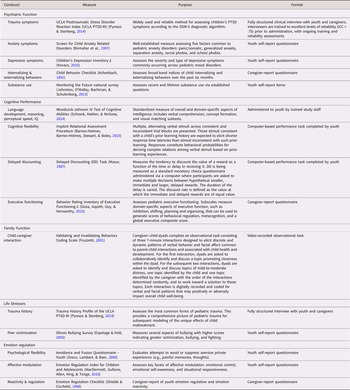
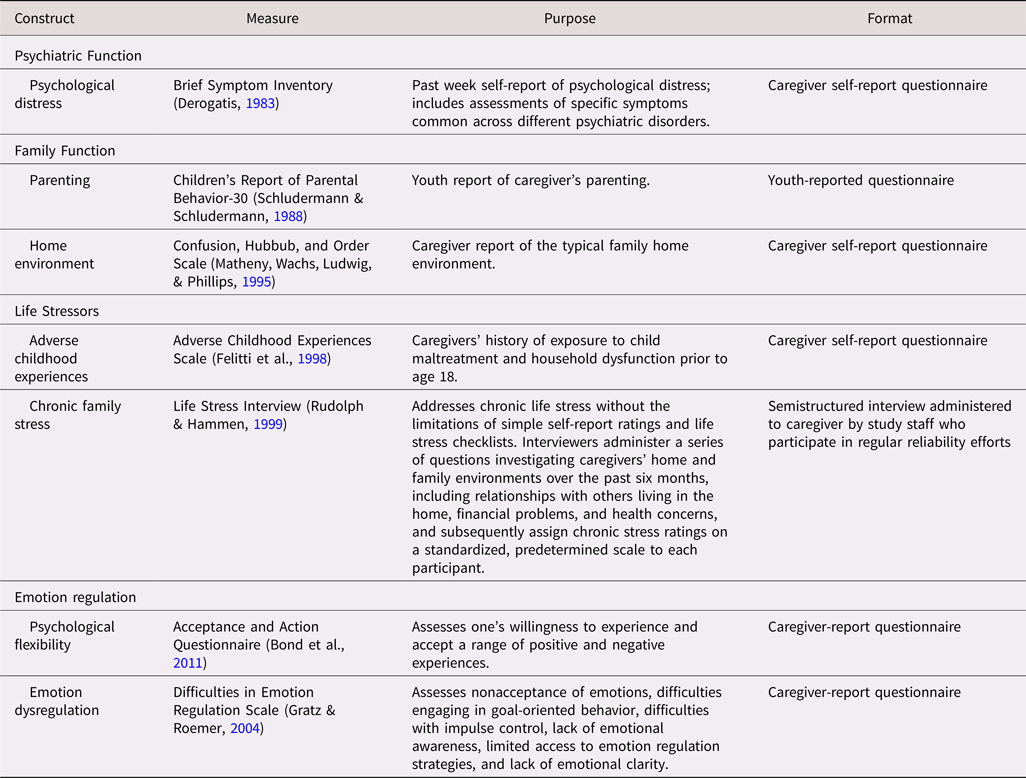
The CHS protocol includes the detailed assessment of several youth and caregiver outcomes (e.g., psychiatric function, cognitive performance) and potential moderators (e.g., life stressors) in the behavioral health domain. See Tables 2 and 3 for youth and caregiver behavioral health measures, respectively. Throughout, an effort has been made to employ widely used, standardized, and state-of-the-art measures to facilitate the collection of high-quality data and to maximize our ability to compare resulting data to existing research.
Youth behavioral health measures

DSM-5 = Diagnostic and Statistical Manual of Mental Disorders, fifth edition; ICC = intraclass correlation; PTSD = posttraumatic stress disorder
Caregiver behavioral health measures

Lessons learned and suggestions for future research
Getting buy-in from counties to begin recruitment
Perhaps the most essential aspect of doing research within the child welfare system is getting buy-in from state and local leadership and front-line caseworkers. Thus, the research should be translatable, meaningful, and impactful in ways that will enhance the ability to improve policies and practice, provide leverage to extend programming/funding/appropriation, and ultimately improve the lives of families. To ascertain buy-in from front-line workers, separate informational sessions were conducted with caseworkers and intake workers. Once county administrators agreed to allow families within their local systems to take part in the study, we began the recruiting procedures within that county.
Obtaining buy-in hinged in large part on communicating the translatable impact of the study, its uniqueness, and why it was needed. Considerable time and effort was spent explaining that the CHS represents a major NIH-funded study that will: (a) raise the bar for scientific rigor through high-quality, well-controlled, prospective research aimed at elucidating malleable mechanisms (biological and behavioral) that impact the lifelong well-being of CM survivors; (b) inform intervention opportunities directly relevant to the prevention of many pressing public health concerns, including substance abuse, teen pregnancy, and disease processes; (c) promote intervention in key windows of vulnerability and/or opportunities for reversibility by virtue of the prospective, longitudinal study design. We also emphasized that, although the study is not an intervention per se, participants in the study will be assessed every two years and referrals will be made for physical and behavioral health concerns, educational delays, and other indicated individual and family problems as necessary. Finally, with families’ permission, resulting de-identified data will be linked to other administrative data (including Medicaid, education, juvenile justice) that will allow predictive models to estimate the economic costs and public health impact of CM across multiple systems. These models will be utilized to estimate the cost/benefit of prevention and treatment and drive legislative policy to increase appropriate investment in the child welfare system as a whole.
Reaching and enrolling eligible participants
Studying children who have been maltreated is difficult and time-consuming. Families are often transient, have limited access to voicemail, and cell phone numbers change. Family environments are frequently chaotic, with caregivers having to juggle multiple and changing jobs, suffering financial hardship, and requiring behavioral health services or other advocacy needs. This highlights the need for trained team members to be involved in the recruitment process. Recruiters must be persistent (within reason) at leaving informative voice messages, establishing multiple avenues of contact (e.g., email, landlines, work and cell phones, alternative contacts, etc.) in order to maximize recruitment success. To give up too quickly on difficult-to-reach families creates inherent bias towards higher functioning families in the sample, making it less representative of the child welfare population as a whole. Use of address-tracking systems, such as Accurint®, is invaluable for locating families whose address information may be out of date. Due to the need to get protocols for the above strategies in place and intensively training recruiters accordingly, the initial recruitment pace for the CHS was slower than anticipated. This was despite the fact that all had experience with child welfare research and had previously worked on other NIH-funded studies focused on CM survivors. Only two years into the protocol period did we reach full capacity, successfully recruiting and bringing 10–15 families to the Center each week.
Enrolment into the study must happen as proximally to CM exposure as possible to minimize influences of CM experiences on youth health and development. Prior exposures cannot be ruled out, of course, but will be captured when coding the information contained in youth's CWIS case records. Thus, youth are enrolled within one year of the date of case dispensation; that is, substantiation status. Nonetheless, we do not contact families until at least 3 months after dispensation to be sensitive to the possibility that families may be in a period of shock and disruption. After 3 months, families are sent an open letter of invitation on Department of Human Services letterhead and signed by their local (county) administrator. These letters offer families the ability to opt out of further contact and have their names removed from our contact list. If families do not opt out, we send a subsequent letter from our office once again explaining the study and reiterating their eligibility. These second letters also include an opt-out option. If families do not call the toll free number to opt-out within two weeks, we contact families via phone to begin the recruitment process.
Reducing the possibility of re-traumatization and/or stigma among these youth is of paramount importance. Consequently, the study is explained to eligible families as a research program focused on child health for which children from “all walks of life” are eligible, including families that might have been involved in the child welfare system. Children are never identified as “abused” or “neglected” and the assessment process during the actual visits (e.g., the UCLA Trauma History Profile) merely probes but does not require disclosure of any trauma. In short, we never assert that we know a child's history and do not directly address this fact during recruitment.
Identifying and recruiting appropriately matched comparison subjects
The ability to compare CM survivors to a group of their peers who have not endured CM is essential. Comparison youth are recruited from the same counties as maltreated children and individually matched to at least one maltreated child based on age (±1 year), race (minority/nonminority), gender, income level, and region within the State using a stratified block design. We advertise via local print media, social media, flyers at community centers, pools, electronic school list serves, and local radio stations. We have arrangements with several school districts in target areas to distribute flyers. Because the most challenging part of identifying matched comparisons has been reaching eligible individuals from lower income brackets – that is, families living in poverty who are interested in participating and have no history of prior involvement with the child welfare system – we have worked to identify schools serving large numbers of low-income students and specifically targeted these schools.
Interested families call the study line and complete an initial screening to ascertain basic demographic information for matching purposes and other child and caregiver information that might preclude eligibility (e.g., developmental delay; caregiver does not speak or understand English). In addition, the caregiver provides verbal consent that allows us to search the statewide child welfare data system to confirm the absence of previous child welfare involvement. This is to minimize contamination in the comparison sample, which has been shown to significantly reduce effect size estimates in studies enrolling comparisons who were not excluded according to such stringent criteria (Shenk et al., Reference Shenk, Noll, Peugh, Griffin and Bensman2016).
Data security and sample composition
The volume of data gathered in this study is immense. Since we get identifiable data from the State child welfare system to identify eligible families and gather sensitive data as part of the protocol, much of these data are required to be on secured, nonnetworked data servers. Months of planning and working with our Office of Sponsored Programs, Office of Compliance, and Office of General Council resulted in a comprehensive data security plan that protects these sensitive data at a very high level consistent with NIST 800-053 compliance (i.e., HIPAA, Health Insurance Portability and Accountability Act and FERPA, Family Educational Rights and Privacy Act compliant). The transfer of data from the State and County systems along with the housing of identifiable information is regulated by the data safety plan in order to protect our data from being vulnerable to a breach and ensure that only vetted, trained, and qualified members of our research team have access within our secured space and from our secured server. This is in addition to the study space itself, the Center for Healthy Children, being protected by swipe access that is only granted to individuals once they have successfully completed PA state and FBI criminal record checks.
Once identified recruitment data reach the secured server, addresses are preprocessed for completeness. Attempts are then made to find complete and viable addresses through Accurint® searches if families’ contact information is incorrect or incomplete. We then organize eligible families by the primary type of abuse or neglect as indexed in their case files, although more comprehensive information regarding CM exposures, such as exposure to multiple types, is being tracked. Contact information is added to the recruitment database based on the type of abuse and other characteristics of the child and/or family that will ensure that we have balanced cells for the final sample composition. We continually monitor the sample composition and populate the recruiting database in accordance with these balancing requirements. Since recruiters and interviewers are blind to group membership, only the Principal investigators, the project coordinator, and the data manager are privy to this prioritization and to group membership.
Facilitating and maximizing participation
Given the challenges faced by these families, it is our experience that participation is only possible for many of these families if travel to the study site and related logistics can be arranged for them. This takes many forms, including reimbursing participants for mileage and meals on the day they are traveling. However, many families do not have access to personal transportation and other arrangements need to be made for them (e.g., bus, ride share services, Penn State fleet service, train, flights, etc.). A related complication has been the need for childcare for other siblings. It became apparent over the course of the study that it is necessary to reimburse families for childcare and to have contingency plans in case they travel to the study site with additional family members in tow (sometimes unannounced).
Similarly, addressing concerns around last-minute cancellations and “no-shows” have been important from the start and we have had to revise the timeline for following up with scheduled participants and confirming visits. Due to the logistics involved in organizing transportation for participants, most visits are scheduled at least two weeks in advance. Following up with participants and confirming the visit one week in advance and again on the day prior to traveling for the study has been necessary. In addition, study staff speak with families the evening before the study visit once they have arrived at the hotel. An unintended, yet positive, side effect of having participants arrive the night before the visit and stay overnight at a local hotel has been that the study team is made aware no later than the night prior to a visit if a family has unexpectedly not checked in at the hotel, conserving valuable resources and staff time. Having families travel from the hotel to the Penn State University campus via a shuttle bus also guarantees that visits consistently start at the same time of day, which is important for completing the entire visit protocol on schedule.
The inclusion of earlier and more frequent reminder calls, emphasizing the effort and resources required for scheduling a family, covering daycare expenses, arranging transportation for families, and offering Saturday visits have substantially reduced our no-show rate. Nonetheless, many families need to cancel and reschedule their initial study visits, most commonly due to childcare and transportation plans falling through, unexpected family emergencies, and changes to work schedules. Consequently, we recommend overscheduling by about 25%.
Maximizing youth's agreement to and completion of venipuncture protocol
Successfully obtaining peripheral whole blood from youth, many of whom have never undergone venipuncture, is often challenging. When working with recent CM survivors, typical concerns become amplified and even greater sensitivity is needed. We include several efforts to increase youth's agreement to and completion of the venipuncture protocol. All youth are given the option of having anesthetic cream placed on their arms to numb the area in advance of the blood draw. Blood draws take place in a dedicated room that has the feel of a physician's office. In addition to the phlebotomist, a study team member is present in the room throughout the procedure and helps distract youth through conversation or through visual aids, such as a “Finding Waldo” poster on the wall next to the phlebotomy chair. Although all of our main study team members were trained and experienced phlebotomists, of the first 30 participants, only 18 (60%) agreed to and completed the blood draw, a major hurdle given the main study aims. Subsequently, the decision was made to involve outside phlebotomists from a local clinic who are scheduled separately for each study visit. Although this further increased the logistics associated with an already complex protocol, our success rate is now exceptionally high (>90%). Having dedicated phlebotomists to perform only the blood draw has been remarkably helpful. Primary study staff have further reported that it is easier for outside phlebotomists to perform the blood draw and that building rapport with youth is easier for main study staff if they do not have to negotiate with youth the part of the visit that youth tend to be the most apprehensive of.
Guiding youth through the MRI protocol
To date, the project has been exceptionally successful at collecting high-quality MRI data from our participants. Of the first 400 participants recruited into the cohort, 335 (83.8%) completed the MRI scan. Most youth who did not complete the MRI scan were ineligible due to having braces or the presence of other MRI contraindications. Of those who completed the MRI, 92% of sessions resulted in complete and viable scans (i.e., scan data of sufficient quality for analysis). Several strategies have been implemented to achieve such a high rate of successful scanning. First, the welcome package that participants receive prior to their visit includes age-appropriate information about MRI scans. During the visit, children and their caregivers watch a short video further familiarizing them with the MRI procedure. Upon arrival at the on-campus MRI facility, we first explain the functional probe (i.e., the Affective Processing and Executive Control paradigm) to youth outside the scanner and give them a chance to practice the task on the bench. They then practice the paradigm again in the mock scanner; that is, a “scanner” that simulates the appearance, bore size, and sounds of the 3T magnet but is not functional. In addition to desired task training effects, this helps acclimatize participants to the scanner environment, thus reducing anxiety in the real scanner and increasing study compliance and success. During the 45-minute scanning session itself, we have added measures to help distract participants where possible. For example, during the diffusion tensor imaging acquisition, participants are given the option of watching an age-appropriate video, such as animation or a nature documentary. Finally, our imaging procedure includes frequent communication with the child during the session. Research associates check in with the participant at the start and end of each scan to ensure they are comfortable and to provide reminders about what type of scan is coming next.
Making a rigorous protocol acceptable to families and maximizing retention
Given the lengthy and demanding protocol, one of the greatest challenges is to make it not only acceptable to families, but also enjoyable so that they feel invested enough in the study to remain in touch and return for future visits. Consequently, our protocol has been designed such that the research tasks are manageable for even the youngest children in the cohort (8-year-olds) and interspersed with sufficient breaks and fun and educational activities that actively engage youth. Specifically, for every 2.5 hr of study-related assessments, we are including 1 hr of “unstructured” time. This includes simple breaks, providing breakfast and lunch, mini tours of campus, and a hands-on educational science experiment. Each child also receives a CHS “passport” in which they collect stamps for tasks they complete (e.g., the blood draw, the MRI scan). Following their participation in the MRI protocol, youth also receive a custom-made t-shirt onto which a research assistant has ironed an image of the child's own brain. Youth are also asked to actively engage with the Center for Healthy Children's space by: (a) placing a pin on a map of Pennsylvania in the county from which they are visiting, and (b) by decorating the back of one of their hands using a number of appropriate toys, paints, and accessories. Subsequently, a photograph of their hand is taken, printed, and displayed on one of the walls near the entrance of the Center adjacent to the photographs of the hands of the other study participants. This helps our participants feel connected to the Center and ongoing research.
In addition, we have found the following to be important for purposes of retention: (a) hiring study staff with ample experience working with high-risk individuals and who are skilled at building rapport with youth; (b) consistently pairing families with and being contacted by the same interviewer, to facilitate long-term connections, allow for better rapport-building, and provide long-term stability; (c) implementing follow-up telephone calls every 8 months, or twice in between each in-person visit, to maintain current contact information and stay in touch with participating families; (d) reimbursing families $160 for participating in the day-long CHS protocol and $10 for completing each of the interim follow-up phone calls; and (e) sending handwritten, personalized birthday cards to youth enrolled in the cohort. We receive continual feedback regarding how much the children love getting these cards and it is clear that this method of contact is impacting the success of our ability to stay in touch with families.
Addressing reports of child maltreatment and indications of psychiatric distress
Conducting research with the CM population requires that study personnel are prepared, capable, and supported when allegations of CM as well as indications of psychiatric distress are inevitably made known. Our approach is to address these situations directly by conducting careful assessments and active screening across CM and comparison conditions. This approach requires that any response follows the statutes, policies, and best practice standards governing the conduct of research with the CM population and the health and safety of all children.
Reports of child maltreatment
Our data collection procedures involve the administration of an established lifetime trauma history screen that directly assesses the presence of the four most common types of CM: physical abuse, sexual abuse, neglect, and psychological abuse. The trauma screen is administered with children and caregivers separately to minimize any potential reporting bias that may occur with another family member in the room. Study personnel are trained to high standards for administering the trauma screen and responding to positive endorsements of all CM types. Upon endorsement of any type of CM, staff with a reasonable suspicion that the alleged maltreatment occurred and has not been reported to Child Protective Services are required by law and University policy to make such a report. This process has been aided by the drafting of an Institutional Review Board (IRB)-approved document informed by best practice standards for youth involved in child welfare (Lee, Fouras, & Brown, Reference Lee, Fouras and Brown2015) and containing step-by-step procedures for making a report of CM that is compliant with State mandatory reporting laws and University policy. This document includes information on how to ask questions that elicit additional information about the incident without biasing responses; assessing the current risk for maltreatment; guidelines on how to approach caregivers and participants about the need to make a report; and the phone numbers and email addresses needed for meeting the requirements of making a report to State and University officials. Training staff in these procedures before data collection, while providing on-call support as needed, has ensured that personnel are prepared to handle this difficult situation with the utmost care and concern for the safety of research participants.
Psychiatric distress
Our inclusion criteria require that study participants are placed with a nonoffending, custodial caregiver and have been living in a stable environment with that caregiver prior to enrollment. These requirements have the potential to mitigate any transient psychiatric distress following exposure to CM and the familial disruption that can result. However, psychiatric distress is present in the CM population, as it can be in the general pediatric population. Therefore, a detailed screening procedure has been developed to assist study personnel in recognizing and responding to indications of psychiatric distress, including global distress as well as suicidal risk. This procedure was developed according to best practice guidelines for the assessment of posttraumatic stress, depression, and suicidal behavior in children and adolescents (American Academy of Child and Adolescent Psychiatry, 2001; Birmaher & Brent, Reference Birmaher and Brent2007; Cohen, Reference Cohen2010). In the event that a participant expresses suicidal ideation, either verbally or based on any screening item assessing suicidal intent, a suicide-risk action plan that has been approved by the IRB is implemented by study personnel. The action plan includes follow-up questions designed to triage the level of risk exhibited by the participant from high, to moderate, to low and help determine if hospitalization is required. The form also includes procedures and recommendations commensurate with each risk category, including encouraging families to discuss current psychiatric symptoms with existing providers, identifying professional resources within the family's community to initiate care if it is not already being provided, and notification of emergency services in the case of imminent threat to self or others. These recommendations are also provided to all participants expressing or indicating global psychiatric distress or simply a desire to initiate professional services in their local community. All concerns related to the psychiatric distress of research participants and corresponding action plans are made in consultation with an on-call, licensed clinical psychologist with specialized expertise in treating serious mental health disorders in the pediatric and CM populations.
Addressing extensive demands for and on staff at all levels
Staffing needs for a data collection effort of this size are quick to exceed anticipated needs. Currently, the CHS relies on the dedicated work of six faculty members; ten full-time staff members including interviewers, laboratory managers, a project manager, and a data manager; three phlebotomists on “standby;” four graduate students; and approximately 20 undergraduate research assistants each semester. This highlights the need for full-time, dedicated project management personnel to coordinate across investigators, staff, students, and locations, specifically, in our case, the Center for Healthy Children, the MRI facility, three laboratories, and Quest Diagnostics.
Working closely with families, many of whom have experienced extreme and recent hardships, is emotionally demanding for interviewers, especially as participants frequently disclose multiple incidences of CM and other trauma. Similarly challenging, yet unavoidable, is the need for staff to be ready to address all manners of problems that arise during visits but cannot be anticipated in advance; this includes dealing with cases of bed bugs, head lice, additional family members arriving unannounced at the study site and other, unexpected events. Preventing staff burnout is an ongoing concern. Providing support and training for staff, time to process difficult cases, and celebrating project milestones are important for staff well-being and making staff feel that they are an important part of the project. For the same reason, we never assign more than four visits a week and one Saturday visit per month to individual staff members.
Conclusions
The goal of this article is to provide helpful information for other researchers embarking on similar research endeavors focused on successfully recruiting and working with high-risk youth. To this end, we shared lessons regarding how to get buy-in from counties for recruitment of CM cases, reaching and enrolling eligible participants, identifying and enrolling appropriately matched comparison subjects, data security, facilitating participation in a day-long study protocol and youth agreement for completion of venipuncture and MRI protocols, enhancing retention efforts, and, finally, addressing demands on study personnel. The CHS represents ongoing research, the results of which will be reported over upcoming years. By virtue of being integrated in the larger context of the P50 Capstone Center and Penn State's Child Maltreatment Solutions Network, the CHS will be able to take advantage of associated Administrative and Outreach cores in reaching its translational goals and bringing about real change to policies and the lives of CM survivors. Although costly and labor intensive, this kind of research is indispensable for mitigating the established adverse effects of CM on victim's lifelong health and well-being.
The CHS represents a step in the right direction and its many strengths, including prospective, longitudinal assessments of a large cohort of youth recruited closely in time to being investigated by child welfare services and the focus on in-depth biological measures, stand to move the field forward. Knowledge gained from this rigorous science will be used to formulate new hypotheses regarding how the biological embedding of CM impacts health and development, setting the stage for long-term lifespan follow-up whereby windows of vulnerability or opportunities for reversibility can be illuminated. Moreover, the collection of comprehensive, multilevel biological and behavioral data across development will facilitate the development of empirically derived algorithms that can advance the science of cumulative lifetime stress and our understanding of the interplay between biology and behavior in the quest for better health. As such, a strong focus on translating research findings into practice will be essential if we are to bring about lasting change to support the health and well-being of CM survivors. This should include the development of effective intervention strategies that utilize knowledge gained about the biological embedding of CM, a review of the responses to CM by the State and various involved agencies to better support CM victims, and efforts to leverage knowledge gained as part of basic research to specifically investigate opportunities for reversibility of the adverse health consequences of CM. As one of the pioneers and early advocates of evidence-based child welfare policy making, the legacy of Ed Zigler will help inform these research-to-policy efforts and his success in doing so inspires those that follow to do the same, even in the face of shrinking public resources and competing public health priorities.
Acknowledgment
The content is solely the responsibility of the authors and does not necessarily represent the official views of the National Institutes of Health.
Financial Statement
Research reported in this publication is supported by the National Institutes of Health, Eunice Kennedy Shriver National Institute of Child Health and Human Development under Award Number P50HD089922.
Conflicts of Interest
None.