


Scholars from a variety of disciplines contend that allegiances and group affiliations, from nationalism and religious identities to ethnic and kinship ties, powerfully affect attitudes and behavior. One such identity is partisanship, which political scientists have hypothesized is an active force shaping how individuals evaluate and interact with the political world (in the United States: Campbell et al. Reference Campbell, Converse, Miller and Stokes1960; more recently, Bartels Reference Bartels2002; abroad: Brader and Tucker Reference Brader and Tucker2001; Dancygier and Saunders Reference Dancygier and Saunders2006; Whitefield and Evans Reference Whitefield and Evans1999). Evidence presented to support the importance of partisanship includes the strong correlation between partisanship and political opinions (vote choice: Bartels Reference Bartels2000; Campbell et al. Reference Campbell, Converse, Miller and Stokes1960; Fiorina Reference Fiorina1981; Miller Reference Miller1991; assessments of the economy: Bartels Reference Bartels2002; Erikson Reference Erikson2004; Wlezien, Franklin, and Twiggs Reference Wlezien, Franklin and Twiggs1997), the divergence among conflicting partisans in interpretations of common events (Bartels Reference Bartels2002; Gerber and Huber Reference Gerber and Huber2010; Lupia Reference Lupia1992; Rahn Reference Rahn1993; Zaller Reference Zaller1992), preferences for biased political information (Lau and Redlawsk Reference Lau and Redlawsk2001; Redlawsk Reference Redlawsk2002), and the persistence over time of partisan affiliations (Alwin and Krosnick Reference Alwin and Krosnick1991; Green, Palmquist, and Schickler Reference Green, Palmquist and Schickler2002; Jennings and Niemi Reference Jennings and Niemi1974; Niemi and Jennings Reference Niemi and Jennings1991). Across accounts, both political and beyond, a common thread is the claim that affiliations and identities cause the outcomes associated with holding a particular allegiance.
The claim that party identification is more than a summary of political attitudes or a “standing decision” regarding candidate choice, but instead might play a causal role in attitude formation, is consistent with the large body of work in social psychology demonstrating the power of social identification to alter attitudes and behavior. According to social identity theorists, it is a common human tendency, perhaps evolutionary in origin, for individuals to distinguish between in-groups, those to which they belong, and out-groups (Sumner Reference Sumner1906). Belonging leads to formation of a group-based social identity that includes emotional attachments to the group and a tendency to favor the in-group (Tajfel Reference Tajfel and Tajfel1978; Tajfel and Turner Reference Tajfel, Turner, Worchel and Austin1986). Individuals who perceive themselves as members of a group may also internalize the group's norms and values and use these as a guide for their own attitudes and behaviors (Brewer and Brown Reference Brewer, Brown, Gilbert, Fiske and Lindzey1998). Following Weisberg and Greene (Reference Weisberg, Greene, MacKuen and Rabinowitz2003), among others, and applying this logic of social identity formation to partisanship suggests that identifying with a party may be akin to forming a social identity as a member of that party and, as a consequence, may cause the individual to adopt the party's values and develop more favorable attitudes toward the party's candidates and causes.Footnote 1
There is substantial empirical support for the general theoretical claim that group influences and group membership can cause attitudes and behavior. Numerous studies suggest that the pressure to conform to group norms, especially when the behavior in question may be observed by others, can have large effects on individual behavior (e.g., Asch Reference Asch and Guetzkow1951; Cialdini Reference Cialdini2001; Cialdini and Goldstein Reference Cialdini and Goldstein2004; Gerber, Green, and Larimer Reference Gerber, Green and Larimer2008). Previous research supports the specific claim that an individual's social identity leads to in-group bias (Mullen, Brown, and Smith Reference Mullen, Brown and Smith1992). For example, experimental work on social identity shows that increasing the salience of in-group versus out-group distinctions can increase in-group bias (see Yamagishi et al. Reference Yamagishi, Mifune, Liu and Pauling2008) and, in the context of politics, discrimination along ethnic lines appears to increase when elections make those ethnic ties more salient (Michelitch Reference Michelitch2010). In this vein, both national identities and self-categorization (e.g., when checking particular boxes that describe one's racial and ethnic identity on the census) may have a possible role in shaping subsequent opinions.
One of the most compelling demonstrations of the power of social identification is found in research testing the “minimal-group paradigm” (Tajfel et al. Reference Tajfel, Flament, Billig and Bundy1971). In this line of research, laboratory experiments are performed that begin by creating groups based on the most trivial and contrived differences, such as merely informing subjects that they have been randomly assigned to a group. After establishing group identities, researchers then observe subsequent attitudes and behavior. They find that, among other things, subjects give in-group members more positive ratings than equivalent out-group members (Brewer Reference Brewer1979; Brown, Tajfel, and Turner Reference Brown, Tajfel and Turner1980; Mullen, Brown, and Smith Reference Mullen, Brown and Smith1992) and resource allocations are biased toward members of the in-group (Tajfel et al. Reference Tajfel, Flament, Billig and Bundy1971).
Returning to the specific focus on partisanship, although many previous studies undertake to measure whether and to what extent partisan identities shape political views, there are some important limitations to existing empirical approaches. A persistent concern regarding existing research is the possibility that the observed correlation between partisanship and politically relevant outcomes may originate in unobserved factors that are correlated with (or cause) both partisan identities and beliefs (Bartels Reference Bartels2000; Fiorina Reference Fiorina2002). Further, causality may flow in both directions, with partisanship reflecting political attitudes and events as well as causing them (Allsop and Weisberg Reference Allsop and Weisberg1988; Beasley and Joslyn Reference Beasley and Joslyn2001; Brody and Rothenberg Reference Brody and Rothenberg1988; Converse Reference Converse1976; Fiorina Reference Fiorina1981; Franklin and Jackson Reference Franklin and Jackson1983; Kessel Reference Kessel1968; MacKuen, Erikson, and Stimson Reference MacKuen, Erikson and Stimson1989; Norrander and Wilcox Reference Norrander and Wilcox1993; Weisberg and Smith Reference Weisberg and Smith1991). Although scholars have implemented a variety of research approaches in an attempt to disentangle correlation from causation (using lagged partisanship as an independent variable: Bartels Reference Bartels2000; Bartels Reference Bartels2002; Carsey and Layman Reference Carsey and Layman2006; Goren Reference Goren2005; using state registration laws as an exogenous factor: Burden and Greene Reference Burden and Greene2000), we identify in existing research several persistent threats to unbiased measurement of causal effects. Thus, although previous research has shown that measures of partisanship have large and robust predictive power in statistical models of a variety of political outcomes, we argue that existing studies have not demonstrated that these relationships reflect the causal influence of these affiliations. In the next section, we review prior contributions to the literature on the causal effect of partisanship and describe how our approach differs from previous efforts.
We perform an experiment to assess whether partisanship has a causal effect on political attitudes. Although we employ a field experiment and focus on a different form of group identity, our design parallels the basic approach used in the laboratory by psychologists studying the effects of group affiliation using the minimal group approach. We employ a randomized intervention that generates a group affiliation (in this case, partisanship) and we then examine the effect of this affiliation on attitudes and reported behaviors (in this case, political attitudes and behaviors). Our experiment was fielded in the state of Connecticut during the 2008 presidential primary election season. Although all registered voters may vote in any general election, Connecticut has a closed primary system in which only voters affiliated with a party can vote in that party's primary. We performed a pretreatment survey of a sample of registered independents (those who were not formally registered with either the Democratic or Republican party and who also indicated they did not already consider themselves Democrats or Republicans) and, based on their response to an item that asked which party the respondent felt closer to, we classified some respondents as “latent” Democrats or Republicans (alternatively, in the language of Keith et al. Reference Keith, Magleby, Nelson, Orr, Westlye and Wolfinger1992, these are “closet partisans”). Treated individuals received a mailing reminding them of the need to register with a party to be permitted to participate in that party's upcoming presidential preference primary. Four months after our intervention, we returned to the field to survey subjects about their partisanship and other attitudes. These data were supplemented with information about party registration and turnout gathered from the Connecticut voter file.
We found that treated latent partisans, who by definition identified with neither party just months prior, were more than seven percentage points more likely to identify with their previously latent parties than those assigned to the control group. Treatment group responses to the standard seven-point party identification scale also became more polarized. Our intervention is the first that we are aware of to induce partisan feelings over long periods of time and outside of the laboratory setting. (The intervention also increased party registration with the party of one's latent partisanship by more than eight percentage points and turnout in the primary election by more than four percentage points.) We then employ this randomly induced partisanship to test key theoretical arguments about the role of partisanship in shaping political opinions and behaviors. We find that in addition to heightened partisan identities, treatment group members were increasingly partisan in their voting choices and evaluations of partisan figures and institutions. Thus, randomly induced variation in partisan identities yields changes in attitudes and planned voting decisions consistent with claims that partisanship is an active force shaping how citizens behave in the political world. Moreover, as there are many situations in a typical person's daily life where the state or other organizations ask the individual to designate or affirm a group identity, our findings suggest that it is worth considering whether these procedures themselves might affect people's attitudes.
The remainder of this article is organized as follows. First, we review the prior empirical literature and highlight the methodological concerns motivating our experimental design, and then describe the experiment. Next, we present results demonstrating that our treatment altered partisan identity (as well as party registration and voter turnout) and partisan views. Given the variety of behavioral and attitudinal effects arising from our intervention, we also consider whether the causal impact of our experimental manipulation operated through changes in party identification or through some other mediating mechanism. Some of our treatment effect estimates have large standard errors. In the final section, we discuss some of the important limitations of our analysis and conclude.
RESEARCH DESIGN, CAUSAL INFERENCE, AND THE EFFECT OF PARTISANSHIP
In this section, we discuss the barriers to causal inference in existing research and describe an alternative technique for measuring partisanship's effects. The earliest and most common approach to demonstrating the effects of partisanship on political attitudes or behavior relies on cross-sectional data (or a pooled series of cross sections). Those data are then used to estimate a regression of the following form:

where Y is the outcome of interest for individual i (e.g., intended vote choice), X is partisanship, M is a vector of measured control variables (M for measured variables), and ɛ is the error term. There are many important studies that follow this estimation approach, including the classic studies in The American Voter. However, analysis employing this specification is vulnerable to biased estimation of β, the effect of partisanship on outcome Y, in a variety of circumstances. The most important threats to inference originate in (a) omitted variable bias due to unobserved differences across individuals (unobserved heterogeneity) and (b) endogenous partisanship.Footnote 2
Unobserved heterogeneity will bias estimates of β if there are any factors not included in M that are correlated with X and also affect Y. We label these unmeasured factors U (for unmeasured variables). In most survey settings, factors in U include variables such as wealth, heredity, personality, educational and employment experience, and parental socialization. These sorts of variables are both hard to measure accurately (even when attempts are made) and likely to have consequential effects on Y. Without including all the factors that might plausibly affect Y and are also correlated with or cause partisanship (and therefore belong in M but are instead left in U), analysis exploiting observed variation in partisanship cannot rule out the alternative that partisanship (and therefore β) merely proxies for correlated but unmeasured factors. Consistent with this concern, analysts regularly find that including additional variables in M reduces the estimated effect of partisanship (β) on political opinions and behaviors (e.g., Fiorina Reference Fiorina2002).
Endogenous partisanship also poses a threat to causal interpretation of estimates of β. Regression analysis cannot distinguish the effect of X on Y from the effect of Y on X. If Y is a measure of political preferences, it is reasonable to anticipate that Y might affect another choice, partisan identity. Thus, one cannot rule out the possibility that it is instead opinions that cause partisanship.
Returning to omitted variable bias, one approach designed to address concerns about unmeasured factors (U) that shape both partisanship (X) and the outcome of interest (Y) is employing panel data in which the same respondent is interviewed multiple times (e.g., Bartels Reference Bartels2000). The relationship between changes in partisanship and changes in Y can then be used to estimate β without bias originating in U, but this requires the restrictive assumption that the change in the unmeasured factors is not related to the change in partisanship.Footnote 3, Footnote 4 If U changes, or if the effect of U on X or Y varies, however, then β may still be biased. Thus, the plausibility of this research strategy hinges on whether there are convincing explanations for why the respondent's partisanship changed and why the sources of those changes would not also affect attitudes, a consideration typically neglected in this research.
In practice, panel estimates of β are considered candidates for causal interpretation when it is reasonable to assume that the change in X (in this case partisanship) is due to changes in some factor that does not directly affect Y. However, it is quite plausible that observed changes in partisanship over time are due to changes in factors that are unmeasured (U), such as life experiences (e.g., parenthood), wealth changes, changes in the views of close friends and relatives, or changes in religious beliefs, and any of these might cause changes in both partisanship (X) and Y. Alternatively, U may remain constant, but the nature of political conflict might vary, thereby causing U to now affect both X and Y differently. For example, in a political context where issues of taxation are more salient, wealthier individuals might hold different policy views and feel closer to one party than when social issues are the focus of the political agenda.Footnote 5
The researcher may offer arguments as to why the change in partisanship (or, in the cross-sectional approach, the level of partisanship) is uncorrelated with the regression error. However, it is important to recognize that this lack of correlation is ultimately an untested assumption. Moreover, even if this omitted variable issue is overcome, the panel approach still cannot resolve the uncertainty about the direction of causality. When the dependent variable is respondent attitudes, it may be the case that changes in Y (attitudes toward political issues) cause variation in partisanship rather than the other way around. This difficulty is observed in Jacoby (Reference Jacoby1988), which examines the relationship among the perceptions of party positions on issues, a respondent's own issue attitudes, and strength of partisanship. Jacoby reports that the degree to which attitudes are predicted by the respondent's perceptions of a party's candidate's positions increases with the respondent's strength of party identification. This is consistent with the idea that stronger party identification produces stronger attitude agreement, as well as with the alternative explanation that respondents report being stronger partisans when they agree more with their party's candidates.
Two important recent papers use survey data from multiple periods to assess the relationship between party identification and political attitudes. In contrast to the panel approach, which examines the effect of change in partisanship on change in attitudes, this work measures whether change in attitudes between two points in time is predicted by the respondent's partisanship measured at the first point in time.Footnote 6 Because partisanship is measured prior to the attitude change, this approach avoids the danger that an observed correlation between changes in partisanship and changes in attitudes is driven by attitude changes generating a change in partisanship. Goren (Reference Goren2005) uses this design and finds that political values (such as an index measuring support for limited government) are predicted by lagged partisanship when controlling for lagged measures of the value, a finding that is interpreted as evidence that partisanship causes a change in values. Carsey and Layman (Reference Carsey and Layman2006) employ a similar approach but examine a different set of issue attitudes. Again, the central idea is that if the change in values or attitudes is predicted by partisanship in the first period, this suggests that the change was caused by partisanship.
Although this strategy has appeal, it suffers from several potential limitations. First, a correlation between the change in the respondent's measured attitudes and lagged partisanship could arise due to measurement error. Suppose the political attitude (say, support for cutting taxes) is the product of the interaction between some stable underlying value toward government and measurement error due to survey design idiosyncrasies or the particular events in the news or on the political agenda at the time of the survey (e.g., whether the issue of the day is a tax cut for the wealthy). Even if the underlying value is stable, the measured attitude at any point in time will be a noisy measure of the underlying value and will also be correlated with the lagged measured attitude, with each measured attitude affected by survey design and context effects. If partisanship is also (partially) a function of the respondent's stable underlying value (i.e., if Republicans are on average those who believe in smaller government), then partisanship is another noisy measure of the underlying value. Because regression analysis will typically minimize the prediction error in current measured attitudes by placing weight on both of the available noisy measures of the underlying value (lagged measured attitudes and lagged partisanship), a regression of the current attitude on lagged partisanship and lagged attitudes will place some weight on lagged partisanship even if partisanship does not have any effect on the movement in the attitude over time.Footnote 7
Second, the regression estimates may be spurious due to omitted variable bias. To consider the research design in a slightly simplified form, suppose that the researcher performs a regression of the change in attitudes on lagged partisanship. The coefficient estimate on partisanship from this bivariate regression will capture the effect of lagged partisanship on the change in attitudes, as well as the net effect of all omitted variables that are correlated with partisanship and that also predict the change in values. For example, partisans tend to have discussion networks with similar partisans (Huckfeldt and Sprague Reference Huckfeldt and Sprague1987). If more Democratic (Republican) social environments tend to move respondents in a more liberal (conservative) direction, this will produce an upward bias in the estimated effect of partisanship if the model does not account for these discussion patterns. Similarly, if respondents’ life experiences during the period are correlated with their partisanship (which is plausible given that partisans display correlated religion, race, income, region, occupation, etc.), there will be omitted variable bias if these changes also affect attitudes. More generally, any omitted variable that is correlated with partisanship and also causes changes in attitudes over time will cause bias.
Third, this research design cannot accurately measure the short-run effects of partisanship on attitudes. If a change in partisanship causes individuals to update their attitudes relatively quickly, a regression of attitudes at time t + 1 on attitudes and partisanship both measured at time t will be unable to detect changes in attitudes that occurred at the same time as the change in partisanship because they will already be accounted for in the measure of attitudes at time t. In this case, the estimated effect of lagged partisanship may substantially understate the effects of partisanship on attitudes if those effects occur relatively quickly.
To overcome the difficulties with observational strategies, what is needed to estimate the effect of partisan identity (X) on a political outcome of interest (Y) is a means to create variation in partisanship (X) that is independent of changes in opinions or those unmeasured factors (U). The desirability of a source of exogenous variation in partisanship was recognized decades ago. In an innovative early study, Page and Jones (Reference Page and Jones1979) use American National Election Studies (ANES) cross-sectional data to study the relationship between party identification and policy preferences, candidate evaluations, and vote choice. They focus on the possibility that party identification may be affected by political attitudes and candidate evaluations (see also Jackson Reference Jackson1975). As Page and Jones repeatedly emphasize in their study, once it is recognized that partisanship may be correlated with omitted variables or measurement error (and therefore the regression disturbance term), estimating the effect of partisanship (or other potentially endogenous variables) on candidate evaluations requires strong assumptions.
To solve the omitted-variables problem, Page and Jones propose using the respondent's report of the party of her mother and father as an instrument for the respondent's party identification. Although parent party identification is predetermined, satisfying the exclusion restriction requires that, conditional on the other included variables, any differences in the outcome variable for those with Democratic parents versus those with Republican parents stem solely from differences in the respondent's own party identification. This strong requirement is unlikely to be satisfied. For example, parental party identification is likely to be a function of socioeconomic differences that may also shape the respondent's own attitudes and persistent social influences. In addition to obvious class effects on opinions, these social factors, including ethnic and religious group membership, neighborhood characteristics, and characteristics of friends and relatives, may also have direct effects on subject attitudes. If these variables are not perfectly controlled for, the effect of partisanship estimated using parental partisanship will be biased. More generally, in the absence of a convincing model of how parental partisanship is determined and transmitted, it is difficult to evaluate whether the instrument can be understood as perturbing only a respondent's partisanship. An additional problem arises when the instrument is subject to measurement error. As Katz, Neimi, and Newman (Reference Katz, Neimi and Newman1980) show in the British case, survey respondents appear to change reports of their parents’ partisanship over time to reflect their current political leanings. This suggests that even if parental partisanship did satisfy the exclusion restriction, measured parental partisanship would be contaminated by the same forces that move both attitudes and partisanship.
Our experiment instead examines the consequences of an exogenous change in partisanship. This is distinct from what is done in the important earlier papers that, rather than induce variation in partisanship, interact partisanship with experimental treatments. Examples of this prior work include Rahn (Reference Rahn1993) and Tomz and Sniderman (Reference Tomz and Sniderman2005), each of which investigates partisanship in a laboratory or survey setting. In both studies subjects are treated to examine whether, among other things, partisanship affects responses to the treatment. These studies demonstrate that those with different partisanship exhibit different treatment effects, but this method does not examine random variation in partisanship and therefore is unable to establish that the different treatment effects are caused by differences in partisan identity rather than, for example, factors correlated with partisanship, such as differences in prior beliefs, experiences, genetics, or other omitted variables.Footnote 8
By contrast, Cowden and McDermott (Reference Cowden and McDermott2000) report on a series of innovative laboratory experiments that attempt to manipulate partisanship. In one experiment, for example, undergraduates were assigned to role-play either a pro- or an anti-Clinton position, an intervention that Cowden and McDermott report failed to move party identification. A second similar experiment also did not alter partisanship. Because these manipulations did not induce changes in partisanship, they cannot be used to test whether changes in partisanship affected attitudes.
We perform an experiment designed to build on these earlier efforts. We employ an experimental treatment that induces variation in partisanship, after which we measure the effects on voter attitudes. Setting aside for the moment the question of how one might create such variation, suppose that a sample of “latent” partisans exists, with some leaning toward the Democratic Party (D = 1, 0 otherwise) and others leaning toward the Republican Party (R = 1, 0 otherwise). We define latent partisans as individuals who, when initially asked if they identify with a party, say they are Independent, but respond to a follow-up question by responding that they are closer to one of the parties. For purposes of exposition, we first consider the case where the sample consists only of latent Democratic partisans. Additionally, for notational convenience, we scale partisanship by setting initial partisanship (partisanship at time t, Xit) to 0 for the latent partisans.
Next, suppose there exists some treatment (T = 1 if treated, 0 otherwise) that can be randomly applied to these latent Democratic partisans to induce some to more fully express or “trigger” those partisan leanings. Given that Xit is normalized to 0, if individuals in both the treatment and control groups are surveyed pretreatment (at time t) and posttreatment (at time t + 1), the change in partisanship for subject i is Xit +1 − Xit = Xit +1. A consistent estimate of the average effect of the treatment on partisanship (the intent-to-treat effect of T on X) can then be obtained from

where β1 is the intent-to-treat effect on partisanship for latent Democrats and M are pretreatment covariates included to increase efficiency and correct for any imbalance on observed measures that exists after randomization. In the context of an experiment on attitude change, controlling for covariates that explain initial attitudes, which tend to be quite stable absent experimental intervention, reduces sample size requirements by making it easier to detect treatment effects (Duflo, Glennerster, and Kremer 2006, 3924). Note that in this specification we also measure other covariates (M) prior to the random assignment.Footnote 9 Using the same notation as in (2), we can estimate the intent to treat (ITT) effect of T on Y (attitudes) using the equation

Here we include Yit on the right-hand side for the same reason we include other covariates: to increase efficiency and address any remaining imbalance on this initial attitude that remains after randomization.
The ITT estimates provide unbiased measures of the effect of being assigned to the treatment on both partisanship (T on X) and attitudes and behavior (T on Y). We are also interested in the effect of partisanship on attitudes and behavior (X on Y). The experimental treatment can be used to estimate the effect of X on Y if some additional assumptions are made. The critical assumption is that the treatment, T, has no direct effect on Y, and also does not cause any other changes that might indirectly affect Y, except through changes in X. In this case, and if T affects X, then T may be used as an instrumental variable for X. The assumption regarding how T affects Y is labeled the exclusion restriction and it implies that T can be omitted from an equation that explains Y as a function of X. The ITT estimates the effect of T on Y and X and does not rely on the exclusion restriction. However, the interpretation of the experimental results as the effect of X on Y requires that the restriction holds. We discuss this assumption in greater detail below, when we consider the mechanisms by which T might affect Y.
We assume that the exclusion restriction holds and we estimate the effect of X on Y using the following pair of equations:

and

To ease exposition, we have so far restricted our presentation to the case where the latent partisans are all of one party. Our empirical sample, however, includes both Democratic and Republican latent partisans. The notation presented above can be adjusted to permit the statistical model to include the entire sample. First, let partisanship at time t + 1 take on the value 1 if a respondent's posttreatment partisanship is equal to his or her pretreatment latent partisanship and 0 otherwise. Assuming that the treatment effect is the same for latent partisans of both parties, the ITT estimate of T on X can be estimated by

where pretreatment measures of latent partisan identity (Dit = 1 if latent Democrat, 0 otherwise) and observables (Mit) are included for efficiency. Turning next to the ITT effect of T on Y for the pooled sample, define Y so that it measures the degree of correspondence between latent partisanship and the outcome measure. Thus, individuals score more highly when their expressed opinions match their partisan leanings. For example, Y is maximized when the Democratic subject has a positive view of the Democratic candidate and when the Republican subject has a negative view of the Democratic candidate. If we assume that the effect of the treatment on opinions is the same (in terms of increasing the concordance between latent partisanship and opinions) for latent Democrats and latent Republicans, (3) can be rewritten as

Finally, under the exclusion restriction, we estimate the effect of X on Y using the system of equations

where we instrument for X using the random assignment of T:

As previously discussed, under the assumption that T affects Y only through its effect on X, the two-stage least-squares estimate of β1 will then provide a consistent estimate of the effect of changes in partisanship on changes in opinions. Of course, this leaves unresolved the question of how one might randomly induce variation in partisanship, the topic to which we now turn.
EXPERIMENTAL PROTOCOL
The basic requirements of the experiment are, first, to randomly produce strengthened partisan identities and, second, to measure the effect of the randomly induced changes in partisanship on salient political attitudes and opinions.
There are several important hurdles to surmount in creating random variation in partisan affiliation. First, we must identify a pool of respondents amenable to fuller expression of underlying partisan tendencies. Second, and perhaps most critically, we must develop a means of inducing changes in partisanship that can be randomly applied to some individuals but not others. Third, we must be able to measure changes in outcomes associated with changes in partisanship before other actors (e.g., candidates in political races) who might also condition their behavior on a respondent's newly activated party affiliation can impose additional treatments on those individuals.
We are able to address these concerns by exploiting some features of the 2008 presidential primary in Connecticut. For ease of exposition, it is useful to divide our experiment into three stages, outlined in Table 1.
Experiment Outline

Phase 1 of our experiment involved identifying a pool of latent partisans. Our initial sampling frame was all registered, but formally unaffiliated, voters listed in the Connecticut voter file. Because we wanted to be able to reach these individuals by both telephone and mail, we eliminated from this list all records where telephone or address records were invalid or inconsistent. We also removed records where the address or telephone number appeared three or more times in the voter file to make it easier to target specific individuals and to avoid temporary housing where respondents were more likely to have moved.Footnote 10, Footnote 11 To improve the efficiency of our experiment, we focused our sample on voters we believed to be more amenable to partisan conversion: Those who were younger (18–49, inclusive) and had recently participated (who voted in any election in 2006, 2004, or 2002 or were less than 21 and had registered after 2000). In early 2008 (January 11–16), we fielded a telephone survey to measure the latent partisanship and pretreatment opinions of this subset of registered voters.
Partisanship was measured using the standard branching ANES instrument in which respondents were initially asked “Generally speaking, do you think of yourself as a Republican, a Democrat, an independent, or what?” Respondents who chose either the Democratic or Republican Party were then asked “Would you call yourself a strong [Democrat/Republican] or a not very strong [Democrat/Republican]?” All other respondents were then asked “Do you think of yourself as closer to the Republican Party or to the Democratic Party?” We classify as latent partisans those respondents who declined to identify with the Democratic or Republican Party when asked the first question, but stated that they felt closer to either party in response to the follow-up question.Footnote 12 In our random sample of unaffiliated registered Connecticut voters there were 975 latent Democrats and 565 latent Republicans.Footnote 13 Additionally, we identified 808 independents (those who in response to the second question refused to express a preference for either major party or specified “other”).Footnote 14
Phase 2 of our experiment had the effect of randomly inducing a small subset of these unaffiliated voters to alter their registrations to affiliate with one of the parties. In Connecticut, unaffiliated voters cannot vote in either the Democratic or Republican presidential preference primary without first formally registering with the respective party. All of the respondents in our sample were thus initially ineligible to participate in the February 5, 2008 primary. We sent a treatment letter to a 50% random subset of the experimental participants.Footnote 15 We mailed letters on January 22, 2008 that reminded the recipient of the upcoming election and explained the need to affiliate with a party in order to participate in the party's presidential primary. Each letter, which was accompanied by a blank party affiliation form,Footnote 16 included the following text:
In 2008, the Democratic and Republican Presidential preference primaries will be held on February 5th and the general election will be held on November 4th. Polls will be open from 6 AM to 8 PM on both primary and election days.
Based on the most recent voter registration records, you are not currently affiliated with a political party. I wish to remind you that in Connecticut, unaffiliated voters cannot vote in primary elections. If you wish to vote in a party's primary, your registration records must show that you are affiliated with that party. If you have recently amended your registration status to affiliate with a party, please disregard this notice.
To affiliate with a party, please fill out and return the enclosed voter registration form to your town's registrar of voters.
Note that the letter provides voters with information about their registration status, the upcoming primary, and the need to register with a party to participate in the primary. Our treatment, therefore, lowered the cost of changing one's registration, made individuals aware of the impending primary, and provided information about a potential benefit of party affiliation. Although the letter is nonpartisan, the letter made it easier for those who wanted to exercise their right to vote in a primary to do so and, as a result of receiving the letter, a portion of treated respondents decided to affiliate with a party.Footnote 17 We detail the size of this effect in the next section.
Phase 3 of our experiment involved measuring the effect of the treatment on various outcomes of interest, including party identification and opinions. Data come from two sources. The first is a telephone survey we conducted in June 2008 of all respondents for whom we initially measured pretreatment partisanship in our January 2008 survey (we label this second survey the postsurvey). Of the 1,540 latent partisans we initially surveyed, we were able to obtain a second survey measure of partisanship for approximately 479, or about 31%.Footnote 18 The survey took place soon after 2008 primary turnout and changes in party registration were added to the Connecticut voter file, minimizing our concern about effects originating in targeted communications in response to turnout or changes in party registration. Measures included on the survey are detailed in an online Appendix (available at http://huber.research.yale.edu) and include most of the questions asked on the baseline survey as well as planned vote intention for the November 2008 election, evaluations of important historical partisan figures, measures of various forms of political behavior, and reports of campaign contact. The second data source is the Connecticut voter file, an updated version of which was provided to us by state election officials on June 25, 2008. The voter file allows us to track all respondents in our original sample and to obtain an accurate measure of their registration and turnout behavior.Footnote 19
We refer to the sample of respondents who were latent partisans in the first survey, who completed substantial portions of both surveys, and who were deemed to have valid addresses (see footnote 11) as our focal sample. (For this sample, means and standard deviations for variables used in our analysis appear in Table A3 in the online Appendix.) There are 418 respondents in this sample, approximately 65% of whom are latent Democrats. We note that this is not a large sample and, consequently, that detecting treatment effects, if they exist, may be difficult. Nonetheless, because our design employs a pretreatment survey of attitudes, we can leverage those data to more readily detect changes in attitudes, should they occur. Additionally, an important advantage of experimental interventions relative to observational research is that random assignment substantially reduces concerns about unobserved heterogeneity. Consequently, the standard errors associated with estimates of treatment effects in analysis of randomized experiments properly reflect imprecision associated with sampling variability, rather than concerns about model selection and omitted variables (Gerber, Green, and Kaplan Reference Gerber, Green, Kaplan, Shapiro, Smith and Massoud2004).
Before we proceed, it is also useful to briefly highlight elements of the context in which our experiment was conducted. Our data gathering and experimental intervention bracketed both the 2008 Connecticut presidential primary and the ongoing nationwide presidential nominating contests. Given the salience of these races, this political environment may have increased the effects of our experimental intervention relative to what would have occurred when campaigns were less salient or the race in question was viewed as less important (e.g., a state legislative seat). At the same time, such an environment may also have naturally drawn many latent partisans to reconsider their partisanship apart from our intervention, in which case the treatment may have had smaller effects in this context. Additionally, this environment may have had different effects across the two parties. In particular, contrary to initial expectations early in the 2008 primary season that Hillary Clinton would easily win the Democratic nomination whereas the Republicans would be fighting into the spring, the Democratic race for the nomination was much closer than the Republican race. In Connecticut this was reflected in the greater effort by the Democratic campaigns to mobilize voters,Footnote 20 higher turnout rates in the Democratic primary (51% compared to 37% for the Republican contest), and Obama's victory by 4.1% over Clinton relative to McCain's 19.1% margin over Romney.Footnote 21 Again, the likely effects of these differences on our experiment are ambiguous. On the one hand, latent Democrats who received the mailings may have seen greater reason to reflect upon their partisanship than Republicans because the Democratic primary appeared more consequential. On the other hand, the Democratic candidates were already quite active in the state, and that activity may have encouraged persuadable latent Democrats to alter their partisanship without our intervention. In our control group, 9.7% of the latent Democrats registered with the Democratic Party, whereas only 2.8% of the latent Republicans registered with the Republican Party. Despite these differences, in our focal sample, we find modest differences in interest in the primary across the two parties—the proportion of latent Democrats who were highly interested was 58%, whereas among latent Republicans it was 50%.
RESULTS
In this section, our analysis proceeds in two phases. First, we briefly examine the effect of our treatment on party identification, party registration, and voter turnout. Having verified that our treatment did in fact induce changes in party identification, our second step is to test whether those induced changes in partisanship were accompanied by corresponding changes in political attitudes.
We examine separately two sets of attitudinal outcomes: (1) Voting decisions and evaluations of political figures and (2) opinions on salient political issues. To foreshadow our findings, the results show that our treatment induced individuals to alter their reports of future and past voting behavior as well as their evaluations of the parties in a manner consistent with their change in partisanship. However, we find little evidence that changes in partisanship result in changes in opinions on salient political issues. (We consider below whether this last result reflects issues of timing and issue selection.)
Treatment Effect on Party Identification, Party Registration, and Turnout
Table 2 shows the effect of the preelection mailing on self-reported partisanship as measured using the June 2008 survey. Overall, treated individuals were more likely to self-identify with their latent parties than those in the control condition. We analyze two measures of changes in partisan identification: (1) the proportion of those respondents who postidentify with their latent presurvey partisanship (a binary measure that is coded 1 if a respondent now stated that “generally speaking” s/he thought of her/himself as of that party and 0 otherwise) and (2) the standard seven-point party-ID measure scaled so that it is directional relative to a respondent's presurvey latent partisanship (coded so that 7 = the respondent now strongly identified with his or her presurvey latent partisanship and 1 = the respondent now strongly identified with the opposing party). We present these results both for the entire sample of latent partisans and broken down by initial political leaning.
Effect of Being Sent Mail on Party Identification

Note: OLS coefficients with robust (Huber/White) standard errors in brackets. ***denotes p < .01, **p < .05, *p <.10, two-tailed tests. Sample is selected from respondents interviewed in presurvey who had valid addresses and had not moved before treatment was applied and who also completed party identification measure in postsurvey. See text for details of sample construction.
In columns (1) through (3) we analyze the entire sample of latent partisans and present results from three specifications where the dependent variable is the binary measure of partisan affiliation (these regressions follow equation (2′)). In the column (1) specification, which in addition to the treatment assignment indicator includes only an indicator for whether a respondent was a latent Democrat (rather than Republican), we see that the estimated effect of the mailing was to increase posttreatment identification with the previously latent party by 8.1% (p < .05, one-tailed test). Adding additional demographic covariates from the voter file in the column (2) specification reduces this estimated effect somewhat to 7.5% (p < .05, one-tailed test).
In column (3) we include a series of pretreatment survey measures, which other than interest in the primary are scaled to reflect the alignment of those responses with the respondent's pretreatment latent partisanship. (Higher values indicate that a respondent's presurvey opinions coincided more with his or her latent partisanship. So, for example, the variable “Presurvey 2000 vote aligned with presurvey latent partisanship” is coded 1 for latent Democrats [Republicans] who reported voting for Gore [Bush] in 2000, and 0 for all others.) In this specification we find that the mailing increased self-reported party identification by a similar estimate of 7.3% (p < .05, one-tailed test). We note that the three estimates are statistically indistinguishable. To demonstrate that these results are not substantially different across the two parties, in columns (4) and (5) we present the column (3) specification broken down by whether the respondent initially leaned toward the Democrats (column 4) or Republicans (column 5). We find that the estimated effects of the treatment on partisanship are 8.0 and 7.0%, respectively, which are both similar to one another and indistinguishable from the results reported in column (3) (although indications of statistical significance change with the reduced sample sizes—p = .06 and p = .14, respectively).
Columns (6) through (10) mirror the specifications and samples from (1) through (5), substituting as the dependent variable the seven-point scale measured relative to presurvey latent partisanship. For the entire focal sample (latent partisans), the coefficients range from 0.225 to 0.233 with a maximum p-value less than .01. Substantively, these estimates suggest that being sent the letter moved a respondent about one-fourth of a unit between any two of the seven categories in the scale measure of partisanship. As before, breaking the sample down by latent partisanship also produces estimates that are similar across the parties and indistinguishable from the pooled estimates.
To give a greater sense of the effect of the treatment on reported partisanship throughout the entire distribution of partisan leanings, we also present our data graphically. Figure 1 displays the postsurvey party identification scale by treatment status and presurvey partisan leaning. Panel (A) is for latent Democrats. The distribution of posttreatment partisan leanings for control group members appears on the left and that for treated individuals appears on the right. The partisan identification scale goes from a low of strong Democrat to a high of strong Republican. Note that among latent Democrats, the treatment group has a distribution of partisan identity that is to the left (or to the more Democratic end) of the control group. Among latent Republicans, shown in Panel (B), the pattern is reversed, with the treatment distribution to the right of that of the control.
Postsurvey Party Identification by Presurvey Party Identification and Whether Sent Mail: (A) Among Presurvey Latent Democrats; (B) Among Presurvey Latent Republicans

These data reveal two other interesting patterns. First, on average, our treatment induced respondents to become strong, rather than weak, partisans. Comparing differences between treatment and control on the seven-point partisanship measure scaled relative to pretreatment partisanship, we find that treatment group members are about eight percentage points more likely to identify as strong or weak partisans of the party they previously leaned to. Of this eight–percentage point increase in partisanship, three-fourths (6% of the 8%) is among strong partisans. In short, when our experiment induced partisanship, it tended to produce strong rather than weak partisans. The second observation gleaned from patterns in the control group is that partisanship is not entirely stable. Overall, only about 60% of the latent partisans were still latent partisans of that party in the postsurvey. Of those 40% of respondents whose partisanship changed, fully 18% had converted to become partisan identifiers (13% weak and 5% strong), true independents were 13% more prevalent, and nearly all of the remaining 8% now leaned to the other party.
In addition to affecting partisanship, our intervention also increased rates of party registration and participation in the 2008 presidential primary. These results are reported in Table 3. In column (1) we examine for the focal sample the effect of the treatment on whether or not a respondent changed her party registration to formally affiliate with the party she previously leaned to (1 = yes, 0 = no). In column (2) we focus on whether a respondent voted in the 2008 presidential primary (1 = yes, 0 = no). Both outcomes are measured using data from the June 2008 Connecticut voter file. In columns (3) and (4) we repeat the party registration analysis, this time breaking the sample down by the respondent's initial latent partisanship. Similarly, in columns (5) and (6) we examine turnout broken down by pretreatment latent partisanship.
Effect of Being Sent Mail on Party Registration and Primary Turnout

Note: OLS coefficients with robust (Huber/White) standard errors in brackets. ***denotes p < .01, **p < .05, *p < .10, two-tailed tests. Sample is selected from respondents interviewed in presurvey who had valid addresses and had not moved before treatment was applied and who also completed party identification measure in postsurvey. See text for details of sample construction.
For this sample, we find that the mailing increased the rate at which respondents changed their party registration to match their pretreatment latent partisanship by about nine percentage points (p < .01, one-tailed test). Columns (3) and (4) show that these effects are similar across the two parties (8.1 and 9.0 percentage points, respectively, for the latent Democrats and Republicans). We also find that the treatment increased turnout in the 2008 presidential primary by 4.6 percentage points (column (3), p < .05, one-tailed test), about half the size of the effect on the increase in party registration with the previously latent party. This increase in turnout is large relative to the effects of most impersonal communications. (By contrast, door-to-door canvassing increases turnout by five to ten percentage points; see Gerber and Green [Reference Gerber and Green2000]). In columns (5) and (6) we see that these effects are slightly larger among latent Republicans than latent Democrats—5.0% versus 3.6%—but the point estimates are not statistically distinguishable from one another, the pooled result, or zero.
Overall, these results show that the treatment caused important changes in both political behavior and party identification. Most importantly for our purposes, we see that the letter induced recipients to increasingly identify themselves as partisans and to more fully express their previously latent partisanship. On the behavior side, we also find evidence that latent partisans reacted to the letter by formally registering with the party they felt closer to and being more likely than controls to vote in the presidential primary.
Treatment Effect on Opinions
Table 4 presents estimates from a series of models examining the effect of the treatment letter on voting decisions and evaluations of political figures (columns (1) through (9)) and salient policy opinions (columns (10) through (12)). The results suggest that the manipulation of partisanship induces corresponding partisan-tinged differences in reported voting decisions and evaluations of political figures, but is not accompanied by similar movements in policy opinions. We examine these results in greater detail here.
Regression Analysis of Effect of Being Sent Mail on Political Opinions

Note: OLS and 2SLS (Instrumenting for aligning party identification with latent partisanship using treatment status) coefficients with robust (Huber/White) standard errors in brackets. ***denotes p < .01, **p < .05, *p < .10, two-tailed tests. Sample is latent partisans in presurvey who had valid addresses and had not moved before treatment was applied and who also completed postsurvey. See text for details of sample construction.
Table 4 contains 12 columns. The models explain four different outcome variables and there are three regression models for each of the outcomes. The first regression in each of the triples (columns (1), (4), (7), and (10)) is the ITT effect of treatment (being sent the letter) on the particular political outcome variable (this is the equation (3ʹ) specification, described in Research Design, Causal Inference, and the Effect of Partisanship). The remaining columns report the results of two-stage least-squares estimation of the effect of partisanship on political attitudes and behavior (based on the system of equations (4ʹ) and (5ʹ)).
In columns (1) through (3), the dependent variable is an additive scale of the alignment between a respondent's latent partisanship and postsurvey responses to four questions (candidate choice in 2000, planned vote in November 2008, and evaluation of the Democratic and Republican parties). Results by individual item for this Voting and Party Alignment Scale and other indices appear in online Appendix Table A4. The 0.274 in column (1) indicates that the treatment letter increased the degree of alignment between partisanship and these opinions. This coefficient is statistically significant at standard levels with a p-value of .03. (Given that we expect effects, if any, to manifest in the direction of greater agreement between a respondent's latent partisanship and subsequent opinions, we report one-tailed hypotheses tests in the text here and at the bottom of the table.)
Assuming that the effect of the treatment letter on the alignment scale is mediated through the increased partisanship we documented in Table 3, we measure the effect of partisanship on party alignment in opinions in the second and third columns of Table 4. In column (2) we use the dichotomous measure of partisanship (whether the respondent now identified with their previously leaning party) and in column (3) we rely on the seven-point variable (toward the direction of the previously leaning party) to scale our average treatment-on-the-treated effects. The 3.8 in column (2) (p = .07) implies that identifying with one's latent party increases a respondent's scale score by about 4 points on the 10-point scale. The 1.2 in column (3) (p = .03) means that a 2-point move on the party ID scale (from feeling closer to one's latent party to feeling strongly that one is of that party) increases a respondent's index score by about 2.4.
There are several ways to benchmark the magnitude of these results. Here, we focus on interpreting them relative to the observed opinions of weak and strong partisans. For this analysis, we turn to our posttreatment survey and examine the opinions of latent partisans who were not treated as well as a similar sample of strong and weak partisans (using partisanship measured at the first survey) who were never treated and who were also interviewed a second time. We choose these comparisons because they help to shed light on debates about whether our sample of latent partisans is in fact already quite partisan in its views (e.g., Keith Reference Keith1986) and to discern the relative importance of partisan conversion. To begin with, among this sample of untreated individuals, we find that latent partisans have an average Voting and Party Alignment Scale (the same dependent variable used in columns (1) through (3) specifications) of 2.4, whereas for weak partisans it is 2.6 and for strong partisans it is 3.2. By this metric, although weak partisans are more partisan than latent partisans, this difference (about 0.25) is not statistically significant at conventional levels (p = .13, one-tailed test), perhaps in part because of small sample size (N = 336). By contrast, the 0.86 difference between latent and strong partisans is statistically significant (p < .01), as is the 0.61 difference between weak and strong partisans (p = .02, one-tailed test).
Focusing on the Table 4, column (3) specification, each one-unit increase on the partisanship scale (in the direction of one's latent partisanship) is predicted to increase the Voting and Party Alignment Scale score by 1.22 units. Earlier we noted that our intervention increased the overall incidence of partisan identification by eight percentage points, with a six–percentage point increase in strong identification. Applied to the estimates here, a conversion from leaning to weak partisan increases the average Voting and Party Alignment Scale to 3.6, which would place those respondents in approximately the 70th to 83rd percentile of observed scale scores among never-treated weak partisans. A conversion from leaning to strong partisans yields a predicted scale score of 4.8, or in the 76th to 95th percentile among never-treated strong partisans. Averaging these two effects by the relative frequency of each type of partisan conversion (0.75 × 2.44 + 0.25 × 1.22), the induced change in partisanship increases the average alignment score from 2.4 to about 4.5, which would place these respondents in the 79th to 95th percentile of the scale distribution among all never-treated partisan identifiers (weak or strong).
Another useful comparison is to estimate the column (3) specification as an OLS regression using data from the control group. That is, instead of using treatment assignment as an instrument, we simply examine the effect of changes in partisanship in the control group (which occurred without the researcher's intervention) on postsurvey attitudes. The estimated coefficient on the change in the seven-point measure of partisanship from this regression is 0.426 (S.E. = 0.111, p-value < .01, N = 204), which is smaller than the experimental estimates reported in column (3).Footnote 22 As we note above, one concern with observational data is that estimated coefficients may overestimate the effect of partisanship. Given this concern, the size of the experimental estimates is surprising. We offer a few explanations for this result. First, because there was no intervention that led to a shift in partisanship, a larger proportion of changes in reported partisanship in the control group may be due to measurement error, which would dampen the observed effect. (This sort of error could arise if, for example, some proportion of respondents were not carefully considering their responses to the partisanship items when taking the survey.) Second, the standard errors for the experimental estimates are large. Consequently, a sizable portion of the experimental treatment effect may be due to sampling error. A related concern is that although the two-stage least-squares estimates are consistent, the modest first-stage effect of the experiment on party identification raises the possibility of bias (the F statistic is 3.16 [p = .08] for the exclusion of the instrument in the first stage in column (2) and 6.38 [p = .01] for the first stage in column (3)). Although the instrument is weaker than ideal, for “just identified” instrumental variable models with a weak instrument, Monte Carlo studies show that the estimator is approximately median-unbiased and the confidence intervals have relatively accurate coverage rates (Angrist and Pischke Reference Angrist and Pischke2008, Reference Angrist and Pischke2009). Third, our experiment estimates the average treatment effect for the subset of individuals who change their partisanship due to the experimental treatment, but this effect may be different from the average effect of changing partisanship for the entire population. Indeed, it is possible that the type of person for whom partisanship is easily manipulated is also the type of person who readily changes his or her political attitudes. The large standard errors and the potentially atypical set of individuals for whom the treatment effect is measured both stem from the same feature of our experiment, the relatively small increase (relative to the control group) in the share of the treatment group induced to change their partisanship. This suggests that our experiment would have benefited substantially from a significantly larger sample size.
These caveats aside, the effects we find are substantial and important changes in attitudes. On average, the treatment induced a change in attitudes that closed the gap between latent and weak partisans. If we instead rely on the exclusion restriction and examine the effect of changes in expressed partisanship, we find that treated individuals became substantially more partisan in their views than even the average weak or strong partisan who was never treated. Thus, although these “closet” partisans may already hold views that are somewhat partisan, conversion to full-fledged partisan identifiers nonetheless has substantial effects on their opinions. More generally, these results provide the first evidence that exogenously induced changes in partisanship are accompanied by movements in political opinions. This pattern is consistent with the claim that partisanship affects voting decisions and perceptions of political figures.
In Table A5 in the online Appendix we report the robustness of this result to differences in model specification. In particular, that table shows the original specification from column (1) of Table 4 followed by specifications in which the presurvey alignment measures are collapsed into a single index (column (2)), the dependent variable is constructed as the difference between the postsurvey and presurvey alignment index (column (3)), various independent variables including pretreatment opinions are excluded (columns (4) and (5)), and the sample is divided into latent Democrats (column (6)) and latent Republicans (column (7)). Across these specifications the magnitudes of the estimated treatment effect and significance levels are highly consistent, although models in which we partition the sample into smaller subsamples by latent partisanship are associated with more imprecise estimates (one-tailed p-values of .08 and .13).
Returning to Table 4, in columns (4) through (9) we test the robustness of these results to the inclusion of additional items in our Voting and Party Alignment Scale. In columns (4) through (6) we add measures of the degree of agreement between a respondent's latent partisanship and evaluations of Congress and President Bush, whereas in columns (7) through (9) we also add the degree of alignment in evaluations of two iconic partisan figures: Former presidents Carter (a Democrat) and Reagan (a Republican).Footnote 23 In general, the results with these changes can be characterized as follows: The size of the estimated effect increases (which is not surprising given that the range of the scales being used also increases), but the standard errors increase by slightly larger proportions than the coefficients. p-values in columns (4) through (6) range from .05 to .08, whereas in (7) through (9) they range from .09 to .12.
The effects of our treatment do not appear to extend to personal policy opinions on important issues of the day. In columns (10) through (12) of Table 4 we present results where the dependent variable is an index of the alignment between a respondent's expressed personal policy opinions and his or her latent presurvey partisanship. (The four policy items deal with policy in Iraq, taxing the rich, and evaluations of retrospective economic performance and unemployment rates.) These results show little evidence that the letter induced policy opinion polarization. The estimated coefficients are small in size, are negative, and have large standard errors (the smallest p-value [two-tailed] is .60).
The effects of our treatment are far larger for the Voting and Party Alignment Scale than (the null findings) for the Policy Evaluations Alignment Scale. On one hand, these patterns may be informative about the reach of the effects of partisanship, with larger effects manifesting for objects with immediately clear partisan content (i.e., voting, evaluations of the parties themselves, etc.) relative to issues that are not immediately partisan (in this case, Iraq, health care, and the economy). Alternatively, however, the pattern we observe may be due to timing or the context in which our experiment was conducted. On the timing front, the claim that individuals adjust their personal policy preferences in response to their party identification often describes a long-run process of adjustment (perhaps driven by elite cueing or selective exposure to different forms of media or campaign communications) or the role of partisanship in guiding opinion formation on newly-emergent issues (Levendusky Reference Levendusky2009). We measure only relatively short-term responses on persistent issues (e.g., whether rich people should pay for services for poor ones), and so we cannot judge whether a similar pattern would arise with emergent issues or over longer periods of time. In this case, the correlation between partisanship and issue positions found in other research could be due to the longer run consequences of partisanship, effects that will not be detected in this design. On the context side, we face a difficulty in that by June 2008 the national economy was nearly universally seen as performing poorly, and so our ability to discern the effects of partisanship on economic perceptions is rather muted (for example, among the never treated strong and weak Republicans we reinterviewed in June, only 8% believed Bush had improved the unemployment rate and none believed the economy had gotten better in the last year).
To summarize, we have found that receipt of the letter informing the recipients about the need to be affiliated with a party in order to vote in that party's primary increased partisan identity, partisan registration, voter turnout, and partisan evaluations of political figures.Footnote 24 This provides support for the hypothesis that partisanship actively shapes political views. However, because our intervention affected a variety of behaviors and attitudes, our experiment cannot definitively sort out the mechanism that led from letter receipt to increased partisan views. Was it the increased partisan allegiance that increased partisan attitudes? In the next section we discuss potential mechanisms for generating these effects in greater detail.
DISCUSSION OF MECHANISMS
Our intervention caused both a shift in partisanship and changes in opinions. Due to the use of random assignment, we can be confident, subject to sampling error, that the treatment caused these two types of effects. However, the conclusion that opinion changes are due to changes in partisanship rests on an exclusion restriction that we have not yet evaluated. The assumption is that our treatment letter can only have influenced partisan attitudes via its effect on partisan identity. In this section, we examine this assumption by considering different plausible mechanisms by which the treatment letter might affect partisan attitudes. Some of these mechanisms are consistent with the theory that party identification shapes partisan attitudes and some are not.Footnote 25
Table 5 summarizes two broad accounts of how the treatment letter might have affected partisanship. The first type of account explains how the treatment letter could have affected political attitudes via changes in information flows, and the second considers how the letter could have affected partisan attitudes by changing internal thought processes. Each of these main alternatives has subaccounts. For each subaccount, we assess whether it is consistent with the theoretical view that partisanship has a causal effect on partisan attitudes.
Potential Causal Pathways by Which Treatment Induced Changes in Partisanship and Attitudes

Table 5 suggests three ways in which the treatment letter could have affected the information that individuals receive. Account 1A suggests that the letter caused changes in registration, which caused parties or candidates to target the new partisans with mailings or face-to-face persuasion efforts. But this is unlikely. The Connecticut voter file was updated to include registration and turnout in the primary election only near the end of April, and we surveyed the subjects in late June. We are also unaware of any active campaign efforts during that brief window, a fact that is unsurprising given the season (late spring) and Connecticut's solid Democratic status for the upcoming general election.
In order to further test Account 1A, we created an index of campaign treatment, comprised of four items measuring whether a respondent received a request for money or was contacted by a campaign via telephone, mail, or face-to-face campaigning. Results of this analysis appear in column (1) of Table 6. (Results by individual item for this index appear in online Appendix Table A6.) The coefficient on being sent the mailing is negative and statistically insignificant, suggesting that those who received the mailing were no more likely to receive information from campaigns. Therefore, we doubt that campaign communication is the source of the increased partisan views based both on our experimental design and on the empirical evidence about the effect of the treatment on campaign contact.
Regression Analysis of Effect of Treatment on Participation, Political Interest, and Reported Campaign Treatment

Note: OLS coefficients with robust (Huber/White) standard errors in brackets. ***denotes p < .01, **p < .05, *p < .10, two−tailed tests. Sample is latent partisans in presurvey who had valid addresses and had not moved before treatment was applied and who also completed postsurvey. See text for details of sample construction.
Account 1B suggests that the initial choice to identify with a party shapes how the individual seeks out and processes information. In the language of The American Voter, partisan identity raises a “perceptual screen” that causes individuals to seek out information that confirms their initial (somewhat partisan) views as well to discount information that might be contrary to those views. Because this account suggests that the individual changes how he or she gathers or processes information to reaffirm some initial partisan identity, it is a causal account of how partisanship shapes opinions. Although we have no evidence bearing on this mechanism, Account 1B is consistent with the theoretical notion that party identity shapes partisan attitudes.
Account 1C suggests a final way in which the treatment letter might alter the political information individuals receive: In reminding respondents that an election is under way, the treatment letter might have caused individuals to pay greater attention to politics. Information subsequently acquired might lead individuals to bring their party identification into line with their attitudes, or it might cause parallel changes in both partisanship and attitudes. This account is consistent with the claim that in a campaign environment, individuals are motivated to seek out information about which party best represents their policy preferences (Lau, Andersen, and Redlawsk Reference Lau, Andersen and Redlawsk2008)—information that is increasingly available over the course of an active campaign (Gelman and King Reference Gelman and King1993). It is also consistent with the argument that partisanship is a “running tally” updated in response to changes in beliefs about the parties. Insofar as the treatment letter stimulated these processes, one could not interpret the results in Table 4 as evidence that party identification causes partisan attitudes.
Although we cannot rule out this possibility, we believe it is unlikely in our experiment for two reasons. First, we find that our treatment is associated with shifts in reports of past partisan behavior [i.e., voting in the 2000 election; see online Appendix Table A4, column (1); available at http://huber.research.yale.edu]. This suggests a pattern of partisan projection, rather than a simple updating by the voter about which party is more representative of his or her policy ideals. Second, we find no evidence that the treatment letter led individuals to pay more attention to politics. This evidence, based on questions in the posttreatment survey, is presented in columns (2) through (5) of Table 6.
We focus here on three measures of political behavior—seeking out political information, trying to persuade others, and donating to a campaign—and a single measure of political engagement—interest in the November election. We find no evidence that the mailing increased information search (the coefficient on treatment status is negative in column (2)), efforts to persuade others (the p-value of the treatment status coefficient is .90, two-tailed, in column (3)), or campaign giving (a negative coefficient in column (4)). The mailing may also have slightly depressed interest in the general election (column (5), p-value = .13, twotailed test). Overall, then, there does not appear to be much evidence that the treatment letter induced either information search, or engagement with the campaign more generally, as one would expect if information search were generating changes in both partisanship and attitudes.
We turn now to a second broad class of mechanisms, which suggest that the treatment letter may set off psychological processes that affect partisan identity even if information processing is unaffected. These mechanisms are suggested by social identity experiments that show that engaging in a group act can enhance group identity, and by the work of Tesser (Tesser Reference Tesser1978; Tesser and Leone Reference Tesser and Leone1977) on the polarizing effect of “mere thought.”
Account 2A posits that registering with a party in order to vote in a primary is the kind of group activity that creates group identity. If, in addition to registering with a party, an individual votes in a party primary, the motivation to adopt a partisan identity is presumably still stronger. Although we have no direct evidence for this mechanism in our data, it seems plausible this mechanism contributes to the effects we measure.
Account 2B is closer to Tesser's “mere thought” result. The idea here is that the treatment letter induces individuals to think more deeply about their partisanship, and that this thought leads them toward stronger partisan identities. This mechanism suggests that partisanship may increase whether individuals actually register or not, and it further suggests that “pure” (or nonleaning) independents (as well as latent partisans) may strengthen their identities in response to the treatment letter. In the case of independents, the act of reflection (as induced by the treatment letter) followed by rejection of the opportunity to affiliate may reaffirm the subject's independence and thereby strengthen his or her identity as an independent. If this strengthening also affects opinions, it provides additional evidence that changing one's registration and voting are not necessary to induce changes in partisanship or attitudes.
Our data enable us to test this conjecture regarding independents. Our experiment treated a random subset of pure independents and surveyed them again in our June 2008 survey. These pure independents were individuals who, at the time of the first survey, both did not identify as Democrats or Republicans and did not report feeling closer to either party in a follow-up question. Prior research suggests that these individuals often have social identities as independents (i.e., as nonpartisans; see Greene Reference Greene1999 and Miller and Wattenberg Reference Miller and Wattenberg1983). It is not possible for these subjects to strengthen their identity as independents by either registering or voting—these individuals were both already formally unaffiliated and could not vote in the primary as such.
In columns (1) and (2) of Table 7 we present models where the dependent variable is a binary measure of independent identification, coded 1 if a respondent self-identified as a pure independent in the postsurvey and 0 otherwise. Per the column (1) specification, those in the treatment group are 13.4% (p = .03, one-tailed) more likely to self-identify as independents. In the column (2) specification that includes covariates from the voter file the estimate is 10.7% (p = .07, one-tailed). These results show that among those who considered themselves pure independents at the time of the first survey, the treatment letter further strengthened this independence. Just as our treatment increased the partisanship of latent (closet) partisans, it increased the independence of these pure independents.
Effect of Being Sent Mail on Party Identification and Political Opinions among Pure Independents

Note: OLS and 2SLS (Instrumenting for being a pure independent in the postsurvey using treatment status) coefficients with robust (Huber/White) standard errors in brackets. ***denotes p < .01, **p < .05, *p < .10, two-tailed tests. Sample is pure independent respondents interviewed in presurvey who had valid addresses and had not moved before treatment was applied and who also completed postsurvey. See text for details of sample construction.
Did this strengthening of group identity produce a change in pro-group attitudes consistent with the pattern we observed among latent partisans? In columns (3) and (4) we consider this possibility. A first step is to construct a measure of independent (or antipartisan) views. The measure we present is the cumulative favorability of both parties, measured as the sum of evaluations of each party in the postsurvey (positive evaluations are positive, negative evaluations are negative).Footnote 26 If being an independent means rejecting both parties, we would expect the strengthening of (an independent) group identity to produce a more negative evaluation of both parties, moving the index in the negative direction. This is the result we find. In column (3), the treatment decreased favorability of both parties by about 0.28 units (p = .05, one-tailed), whereas in column (4) the decrease in favorability is 0.25 (p = .09, one-tailed). Focusing on the column (3) result, this change in evaluations of the parties is about 23% of the observed standard deviation in the measure in this sample. If we instead instrument for this increase in independent identification in a manner analogous to what we did in Table 4, we find in columns (5) and (6) that becoming more independent is associated with a slightly greater than two-point decrease (p-values of .10 and .14, respectively) in the evaluation of both parties. In summary, these results provide evidence that it is possible to increase both group identity (in this case, as an independent nonpartisan) and group-centered views (in this case, opposition to either party) without any change in registration or the act of voting.
We note also that, for pure independents, changes in attitudes took place despite the lack of a campaign to promote independent views or any change in registration or increase in voting. Thus, it seems unlikely that changes in campaign-initiated messages produced these changes, as suggested in Account 1A.
To summarize: Two of these accounts (1A and 1C) suggest that the treatment letter might have set off processes by which changes in information flows lead to altered political attitudes, which in turn drive increases in partisanship, but neither account is supported by empirical tests (in Table 6). Three other accounts propose mechanisms by which partisan identities shape attitudes. Accounts 1B and 2A, though theoretically warranted, could not be tested in our data, whereas Account 2B could be tested in our data and supports the view that identities shape attitudes. Our examination of theoretical mechanisms is thus consistent with our interpretation that the change in attitudes we observe was due to a change in partisan identity.
CONCLUSION
This article presents evidence that changes in partisanship can be induced in the field and that those changes in partisanship produce an increase in partisan-tinged attitudes. We drafted a letter that reminded unaffiliated but registered voters that their eligibility to participate in a party's presidential primary hinged on their willingness to register with that party. This letter was sent to a randomly selected subset of registered Connecticut voters who were unaffiliated with either party but who also described themselves as independents who felt “closer” to either the Democratic or Republican party. Receiving this letter caused a substantial increase in self-reported partisan identification in the direction of this latent partisanship and a similar increase in partisan-tinged views. Our findings support the theoretical argument that partisanship is a group identity that induces individuals to evaluate members of their group more favorably than members of opposing (party) groups. This effect does not appear to carry over into personal policy opinions, although this may be because we survey on already salient policy issues or because the period between our treatment and postsurvey measure of policy opinions is four months, which may be insufficient for the longer-term effects of partisanship on information acquisition and elite cue-taking to manifest. Nor does partisanship appear to be immediately related to increased personal political involvement, a finding that again may suggest the persistent effects of partisanship may be confined to turnout or may be similarly delayed in developing (e.g., if caused by subsequent targeted campaigning).
Turning to other questions, we argue that the basic design we propose can be used to study a variety of important questions about partisanship. For example, do partisans seek out different sorts of political information (selective exposure), evaluate the information transmitted by political elites differently (cue-taking and source attribution), or receive differential campaign treatments (strategic targeting of campaigns)? We are currently exploring the last question, but future experiments with larger sample sizes and different and more widely-spaced survey instruments could provide panel studies of media consumption and over-time opinion changes associated with changes in partisanship. Indeed, it may be the case that the effects we find understate the long-term changes associated with changes in party identification and formal affiliation because of other factors that reinforce these initial changes.
Our research has several notable limitations. It is a single and relatively small study of induced changes in partisanship in Connecticut during a particularly compelling presidential primary season. Although we have no reason to believe that the particularities of this political context affected our results, a larger sample and treatments on different populations would provide insights into the robustness of this finding for different populations and across different electoral contexts. Indeed, the latent partisans that were converted to active partisans may be more or less amenable to attitude change than other groups with different levels of attachments to one party or another.
More generally, measuring the effect of party identification experimentally rests on the experiment producing exogenous variation in partisanship. Although our intervention did cause a statistically significant change in partisanship, this effect was only modest. One unfortunate consequence of this modest change in partisanship was that we did not obtain particularly precise estimates of the effect of changes in partisanship on attitudes. The effects reported in Table 4 are large but imprecisely measured. Further, some of the results are significant at conventional levels (those on the Voting and Party Alignment Scale), whereas others are not (the Policy Evaluations Alignment Scale). We argue that taken together these results present a coherent picture of how partisanship might influence attitudes. That said, an alternative possibility is that the divergence in results across dependent variables is due instead to sampling variability. Overall, given the large standard errors, caution is in order.
Returning to the larger theoretical questions that motivate our inquiry, we believe our research provides new evidence for interpreting the consistent relationship in survey data between partisanship and voting decisions and evaluations of partisan figures as causal. In an experimental setting outside of the laboratory, we have demonstrated an ability to randomly strengthen partisan affiliations and have shown that those induced changes in partisanship are accompanied by corresponding changes in political opinions and planned and reported behaviors. Our results imply that partisanship is an active force that causes changes in important political outcomes even prior to the imposition of partisan-targeting by political campaigns and other actors. Our findings thus suggest that partisanship may deserve a place as an independent source of political decisions and opinions, and our work implies more broadly that group allegiances influence individuals to adopt like-minded attitudes. Thus, although the particular focus of our inquiry is on partisan identification in the American context, the results we report may provide guidance in understanding the relative causal effects of other identities in other contexts, including national, ethnic, religious, and other forms of politically relevant self-categorizations.
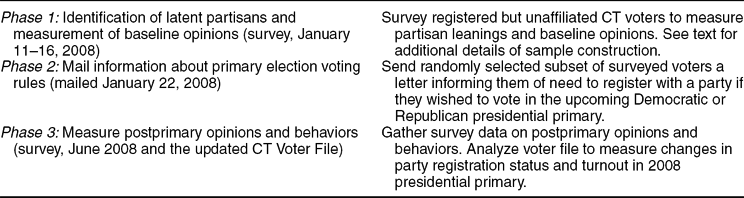
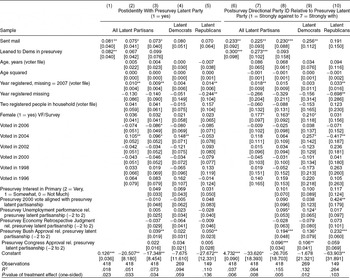
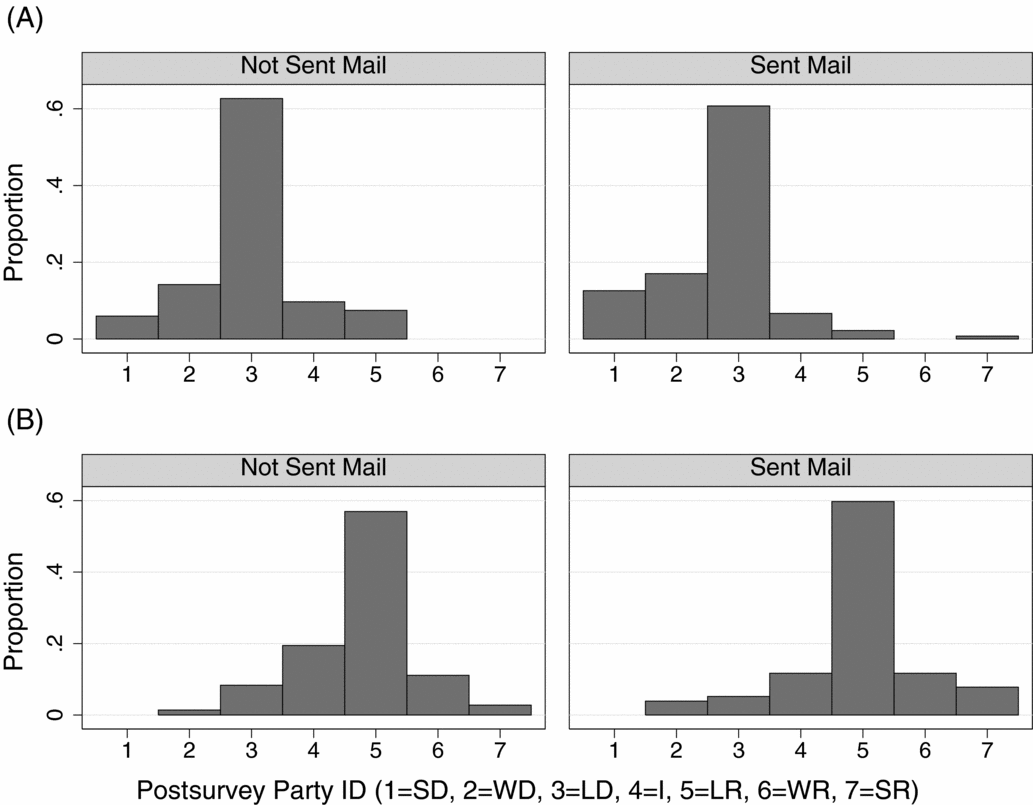
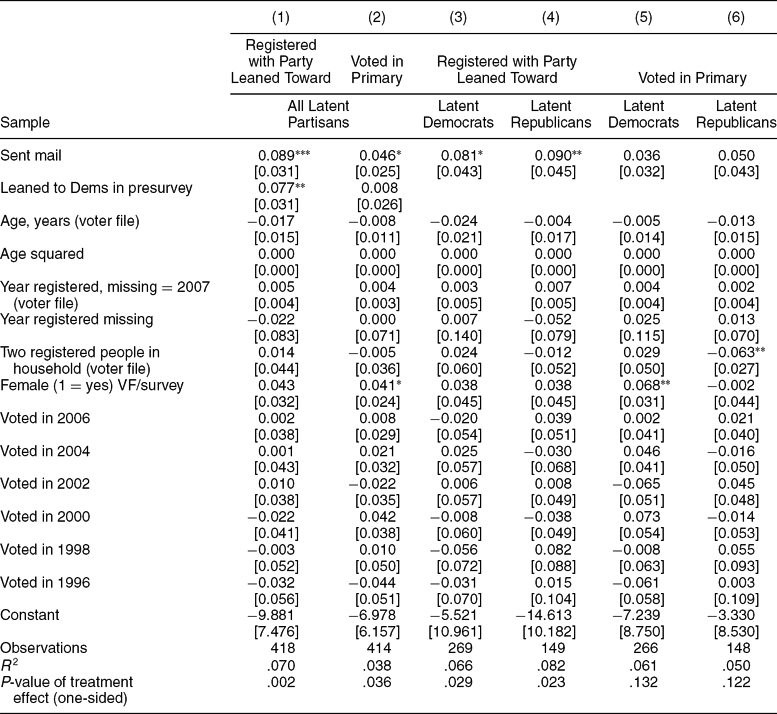

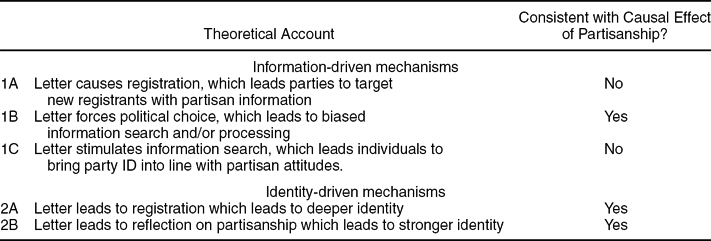
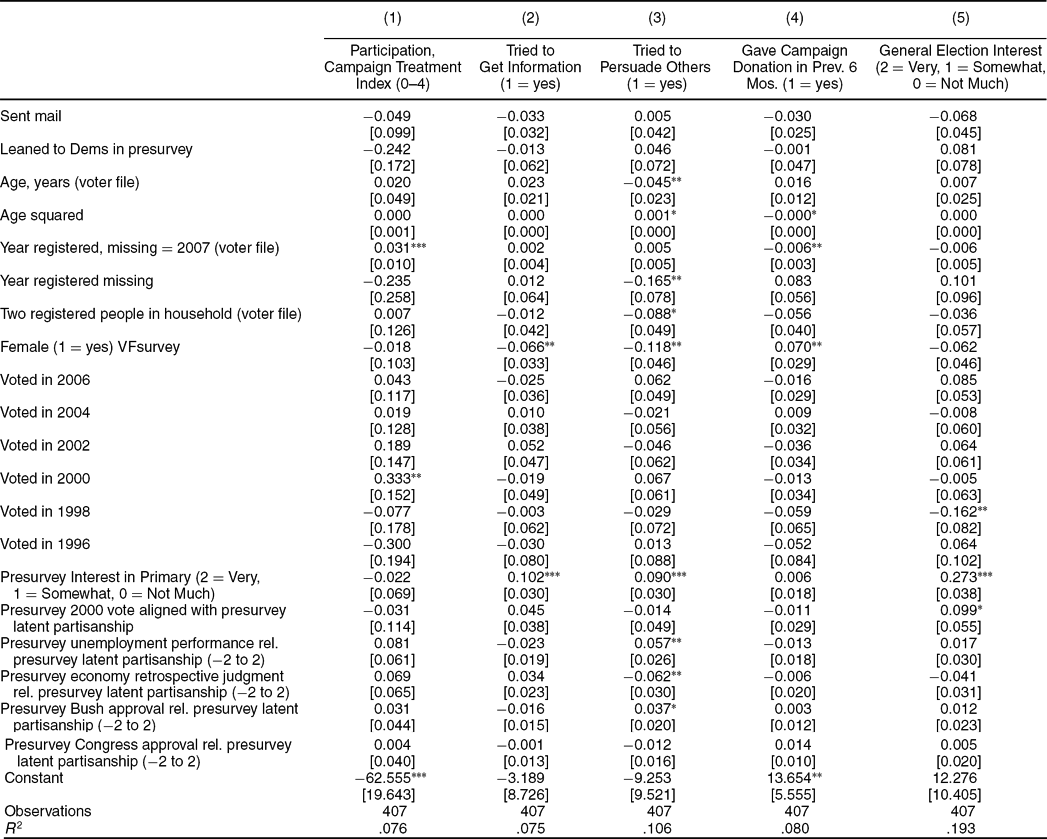
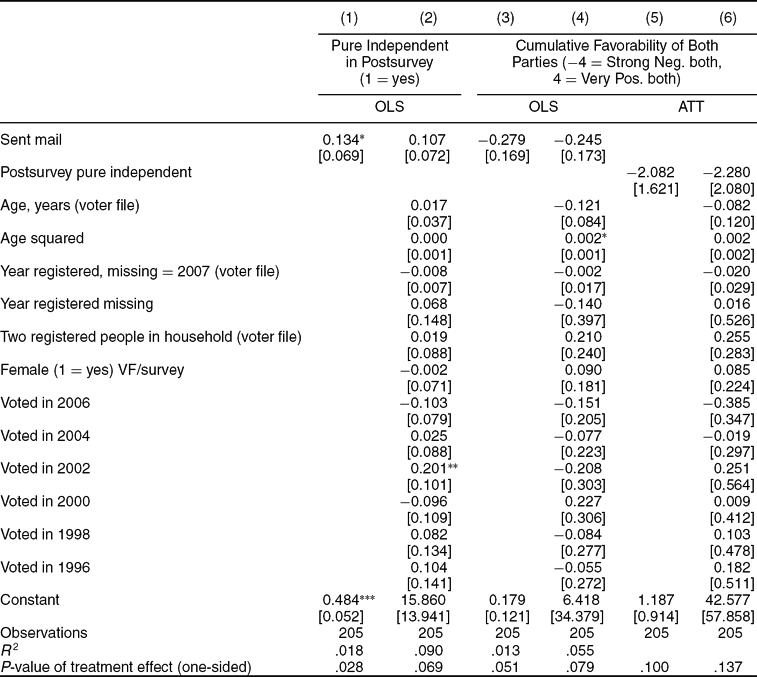



Comments
No Comments have been published for this article.