Introduction
In 1965, in its 12 December issue, the Italian weekly news magazine L’Europeo published a series of articles under the title ‘The Woman in Italy’. Wanting to discover ‘what had changed [for women] from after the war to today,’ the articles examined a variety of topics – work, marriage, fashion and beauty – in order to give readers a better understanding of who exactly was the Italian woman of 1965. One clear change noted by this investigation was the growing relationship between women and consumer culture. The magazine stated that this relationship had brought significant changes to women’s daily lives and their aspirations. The invasion of American beauty products (even products that did not come from the US were nonetheless identified as being American) contributed to this important postwar development.
Nerio Minuzzo’s article on beauty, la bellezza¸ in this issue of L’Europeo, provides a descriptive and insightful portrait of ‘the typical beauty of 1965’. He writes:
The age is indefinable: eighteen or twenty-five? Straight hair, too blond or too dark; the chin and cheeks appear as if they have been engraved by a futuristic chisel … eyes enhanced by eyeshadow, eyelids that bat rapidly under the weight of unnatural eyelashes.
Emblematic beauty but everyday and stereotypical, devoid of citizenship, circulating in Via Veneto like it does in Chelsea or on the Kurfürstendamm. Beauty [that is] codified and proposed with infinite iterations by the information media, in the pages of women’s magazines, on television screens and advertising posters, living alongside us, [and ] serially repeated, at all levels (1965, 54).
Minuzzo’s critical and perceptive depiction raises an important question: how did beauty products come to have such a strong influence on women that, according to him, a majority of them used these products to create an image of themselves that was ‘ordinary’ and ‘stereotypical’? This question takes on even more significance when considering that 20 years earlier, female beauty and its related products were the reserve of a small, select group of privileged upper-class women, and were also vehemently opposed by the Fascist regime and Catholic Church. The confluence of several key cultural, social, and economic changes following the Second World War made ‘female beauty … a product of wide consumption’ (Minuzzo 1965, 54). As a result, previous notions and images regarding female beauty in the Italian peninsula were challenged, transformed, and standardised.
One important factor contributing to this change was the revival of major Italian publishing houses and their weekly women’s magazines immediately following the end of the war. These popular magazines had a significant influence on their largely upper-middle and middle-class female readers. As Adam Arvidsson has noted, these magazines’ contents, especially the advertisements, provided a ‘schooling in modernity’ for their female readership, advising women on how to behave and on what decisions to make as they navigated their way through their country’s transition to a modern, industrial, consumer-based society (2003). The dominance of American cosmetics and their attendant images of beauty in the pages of the women’s magazines promoted the idea that the youth, radiant personality, elegance and ability to attract the opposite sex of Hollywood actresses and Mrs Consumer – the modern postwar suburban white middle-class American housewife – were components of a new model of beauty and femininity to which Italian women were supposed to aspire.
By the time of Minuzzo’s article and L’Europeo’s investigation into the ‘Italian Woman of 1965’, being beautiful and using the appropriate consumer products to do so were prominent norms and practices among Italian women. In analysing beauty product advertisements from one of the most popular women’s magazines of the period, Annabella, the article articulates the components of the American beauty ideal and illustrates how these notions broke with previous Italian ideas of beauty. Moreover, the article also examines how this new ideal promoted democratic consumer capitalist values – freedom of choice, individualism, and affluence – which had an important political and cultural significance in Italy’s Cold War struggle. Overall, the American conception of beauty introduced to Italy new and different understandings of beauty and femininity – an elegant and refined, yet assertive, youthful, sexually self-confident, and above all, consuming woman – that sought to influence the country’s female population and the way in which they fashioned and identified themselves – as the Italian ‘Mrs Consumer’ – in the important periods of redevelopment and polarised political, social, and cultural struggle in Italy.
Beauty in the United States and Italy
It was in the interwar period that the American beauty ideal achieved international popularity, as images and products of American consumerism spread throughout the world. The Modern Girl, the urban, independent, fashionable, consuming American woman who unashamedly used makeup to create a beautiful and attractive personality for herself, and the glamorous Hollywood female star of the 1930s, represented this beauty ideal that significantly influenced foreign women’s self-identity and public appearance. Despite the international popularity of these models, not all foreign governments were pleased with their influence and the new beauty ideal associated with them. This was especially true in Italy, a country with a long historical relationship between beauty and Italian identity. According to Stephen Gundle, the centrality of beauty to Italian public culture and its close relationship with Italian identity dates back to the masterpieces of the great Renaissance painters and poets (2007, xviii). Since that period of great intellectual and cultural output, notions of beauty were used to define Italian female identity. In a country accustomed to the presence of foreign models due to Italy’s long history of foreign rule, the arrival of the Modern Girl and Hollywood film stars in Fascist Italy was nothing new. However, their popularity among young Italian women combined with the rise in new public commercial and leisure spaces, in which women could show off their best adaptations of American models, were viewed by the Fascists as an unwanted invasion and development. Ultimately, the Modern Girl and Hollywood actresses were threats to the regime’s control over Italian women.
The new American beauty models challenged ideals that Mussolini and the Fascists had constructed and propagated in order to create a strong national identity that tied women to the state. The most noticeable differences between the American and Fascist models of beauty were in women’s aesthetic appearance and body type. On one end of the spectrum were the Modern Girl and Hollywood actresses – independent, thin, cosmopolitan, and ‘decadent’ women who used cosmetic products. The Fascist regime referred to this image as donna crisi, or ‘the crisis woman’. On the other end of the spectrum was donna madre, or ‘the mother woman’ – the robust, fertile, rural Italian woman preferred by the regime (De Grazia 1992, 73, 211–212). This battle between modernity and traditional female images persisted throughout the Fascist period, thus signalling Mussolini’s failure to produce a ‘model of Italian beauty that was widely appreciated either inside or outside the country’ (Gundle 2007, 106).
The Fascists’ excessive emphasis on nationalism and national identity negatively affected Italians and their sense of nationhood (Duggan 2008, 532). Moreover, it made Italian identity, including beauty ideals, open to foreign influence in the postwar period. The modern, elegant, youthful, and beautiful female consumer of postwar America – Mrs Consumer – provided a desirable model of female beauty and, ultimately, self-identity for Italian women. How did Italian women come into contact with this American ideal? They encountered it in the popular weekly women’s magazines of the postwar period, which had a significant cultural and social influence on their readers.
Italian women’s magazines and the American woman
In Italy, women’s magazines first appeared in the mid-nineteenth century after unification and thus sought to create a national, female public. The interwar years of the twentieth century witnessed the proliferation of periodicals aimed at women. These magazines contained sections on domestic advice, entertainment news, short stories, fashion, and other popular culture items, bringing the public and private spheres together and also fostering the bond between women and consumerism that became full-blown after the Second World War (Bochicchio and De Longis 2010, 14–20). It was during the postwar period that Italy’s women’s press came into its own and ‘became a gigantic business counting tens of millions of readers’ (Passerini 1994, 337). At the start of the 1960s, for example, Italian women’s magazines had a total circulation of 6,845,000 copies (Forte 1966, 114).Footnote 1 The Mondadori publication, Grazia, was the leading magazine with 350,000 copies while Annabella, published by Rizzoli, came in second place with 300,000 copies (Forte 1966, 114). The magazines’ popularity and success meant that they had a prominent place in the lives of their readers – primarily upper-middle and middle-class women – acting as advice guides for them.
The postwar period not only experienced a dramatic growth in the women’s press, but also an increasing presence in these publications of images and articles related to the United States and the ‘modern American woman’. The magazines’ reporting on this modern woman frequently highlighted her role as a consumer, serving to ‘break down women’s resistance to spending money and integrate them more fully into their roles as consumers’, as Jennifer Scanlon has suggested in her analysis of the magazine Ladies’ Home Journal in early twentieth-century America (Reference Minuzzo1995, 13, 16). This connection made between women, consumerism, and modernity was a popular trope in American images that represented modernity. After the Second World War, the US’s leadership position, the Cold War struggle with the Soviets, and a weakened Western Europe made American women and the images of them that circulated the globe ‘icons of freedom and progress’. According to Emily S. Rosenberg, they represented the ‘semiotic equation … America=modernity=consumption=freedom=modern women’ (1999, 490, 487). Postwar Italian women’s magazines subscribed to this equation by promoting the active consumption of American modernity in all of its material forms, as well as the freedom women experienced while doing so.
Specifically, the magazines’ advertisements played a primary role in orienting the publications’ readerships towards desiring the modern American beauty ideal and buying the cosmetics that would enable them to achieve this ideal. Advertisements constituted a significant portion of these postwar magazines. For example, between 1953 and 1963 many of these periodicals had either doubled or tripled their advertising space. Grazia’s ad space increased from 28.9 per cent of the magazine’s contents to 43.7 per cent, while Annabella’s increased from 20.3 per cent to 39.5 per cent (Forte 1966, 82).
The process of transmitting American beauty ideals through magazine advertisements was more than a simple one-way flow from the US to Italy, as has been noted by Ferdinando Fasce and Elisabetta Bini (2015).Many of the agencies that managed the cosmetic companies’ advertising accounts were part of transnational advertising networks in which multiple actors with different nationalities – American, British and Italian, as in the case with the J. Walter Thompson (JWT) agency in Italy – were responsible for the creation or transformation of the product advertisements and for their diffusion throughout the Italian peninsula (2015). Although multiple actors were involved in this process of transnational cultural exchange, the finalised advertisements and their messages endorsed a clearly American beauty ideal.
Beauty advertisements in Annabella in the two decades after the war promoted the aesthetic aspects of the ‘American dream’ to its female readers. Annabella, one of the most popular women’s magazines in postwar Italy, was founded in 1933 as Lei: rivista di vita femminile and published by the Rizzoli publishing company. In 1938, the periodical was renamed Annabella due to the Fascist regime’s hostility to the use of ‘Lei’ as the formal form of ‘you’. Publication of the magazine was suspended for a little over a year (1 July 1944 to 5 July 1945) due to the war. When it returned to newsstands, Annabella focused on traditional themes found in women’s magazines before the war: beauty, fashion, cooking, domestic decoration, and current events (Cannella and Puccinelli 2011, 377, 379). The magazine also maintained Lei’s precedent of featuring internationally inspired images of modern, cosmopolitan women.Footnote 2
Annabella and its beauty advertisements, which were dominating presences in the magazine, utilised the image and equation described by Rosenberg to sell modern American beauty. These advertisements endorsed an American beauty ideal that symbolised glamour, affluence, youth, happiness, sex appeal, and well-being. Beyond the aesthetic aspects, advertisements for American cosmetics also promoted characteristics inherent to the US’s democratic, consumer capitalist society, such as freedom of choice and the primacy of the individual. As such, the periodical ‘schooled’ readers on how to create attractive, modern, radiant, and elegant personalities for themselves, encouraging readers to aspire to achieve this new ideal and to become like the American Mrs Consumer even though the social conditions of middle-class women of the two countries were different.Footnote 3
The glamour factory
Just as Hollywood films flooded the Italian market following the end of the war, Hollywood actresses, the ultimate representatives of American beauty, were dominant presences in Annabella’s beauty advertisements in the first postwar decade.Footnote 4 Italy’s social transformations brought these stars, le dive, closer to their admiring public than ever before. Sociologist Francesco Alberoni wrote at the time: ‘During the late 1930s and the 1940s the star reproduced characters and symbols of the leisure class. After the war, the relationship gradually changed, the class structure fell, the size of society grew, therefore, the star became much closer to the public: it was like she was the one [of them] who had made it’ (1965, 42). This increased proximity rendered the stars’ words, opinions, and advice more authoritative and credible.
Beauty product companies and the advertising agencies they hired took advantage of this new proximity by having Hollywood stars appear as spokeswomen for the cosmetics. In the advertisements, these women, whose elegant, bright personalities and appearance were manufactured by the studio system, advised readers on how they too could construct a personality that was worthy of Hollywood stardom and its beautiful, luxurious lifestyle. In so doing, the actresses, who were commodities themselves, encouraged Italian upper-middle to middle-class women to adopt the ‘American way of life’ and its beauty ideals (Gundle 2008, 192).
Elizabeth Taylor, Rita Hayworth, Deborah Kerr and other actresses promoted products such as face powder, lipstick, and eye shadow that promised to hide natural imperfections of the face, give users a new, fresh look, and create an exciting, attractive, and irresistible personality. The advertisements were particularly appealing because they ‘revealed’ Hollywood’s beauty secrets by making the same products used by the stars available to the general female public.
The Max Factor Company played a key role in spreading the Hollywood beauty ideal throughout the Italian peninsula and in democratising beauty in the country. Max Factor, a Polish cosmetician who had immigrated with his family to the United States in 1904, was the makeup artist to the stars. When he began working in the Hollywood film industry in 1914, he was the first person to use makeup specifically designed to be seen on film (Willet Reference Arvidsson2010, 115–116). In the late 1920s, Max Factor and Company began selling products that had been specifically made for the screen to the general public (Basten 1995, 61). In so doing, Max Factor ‘revealed’ Hollywood beauty secrets and made them accessible to film fans in the US for the first time. This meant that women were able to buy the same products used by their favourite film stars, thus permitting them to imitate the actresses’ appearances.
In postwar Italy, the company took advantage of the end of the Fascist regime and an increased presence of American culture to make its cosmetics similarly appealing and accessible. A Max Factor advertisement for its Color Harmony Line in Annabella highlighted the novelty of the company’s products in Italy and the Hollywood beauty it bestowed upon users. In the advertisement, Rita Hayworth told readers that ‘grand news’ had come from Hollywood, saying:
I am happy to tell you that all of the celebrated beauty products of Max Factor Hollywood, in the harmonies created by him, and his ‘Touch-Up Service’ are now available in Italy. You can participate in the beauty secrets that Max Factor has revealed to all of the stars and American women (Annabella, 10 October 1948).
Hayworth’s announcement made it clear that thanks to the arrival of Max Factor cosmetics in Italy, for the first time, ordinary women could be as beautiful and glamorous as the stars.
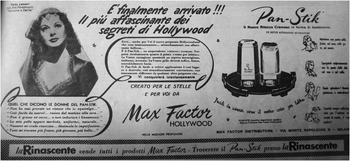
A significant number of Max Factor advertisements in Annabella also reinforced this concept of uncovering the magic of Hollywood beauty by using the movie tie-in advertising method. The advertisements, featuring testimonials from actresses and references to their latest films, seemed to promise readers that now any ordinary middle-class woman could make herself up to be as charming and attractive as the actresses were in their films. In one advertisement, Hedy Lamarr as Delilah in Cecil B. DeMille’s Samson and Delilah, told readers: ‘It has finally arrived!!! The most fascinating of secrets of Hollywood … [Pan-Stik Makeup] created for the stars and for you by Max Factor Hollywood’ (Annabella, 21 October 1951) (Figure 1). In another advertisement, readers were assured that if they used Max Factor Pan-Cake Makeup their faces ‘[would] assume the delicate aspect of porcelain’ like Elizabeth Taylor’s visage in Father of the Bride (Annabella, 11 March 1951). Other advertisements for Max Factor lipstick and Pan-Cake Makeup guaranteed women that they would have ‘fresh and attractive’ lips like Dorothy Lamour’s in The Greatest Show on Earth or a ‘new, exciting beauty [and] fresh and natural appearance’ similar to Deborah Kerr’s in Quo Vadis (Annabella, 15 February 1953, 15 March 1953). The connection between makeup, actresses and their films, and Hollywood beauty established in these advertisements promoted the idea that using Max Factor cosmetics permitted the magazine’s readers to easily achieve the same beautiful, film-worthy look of Hollywood’s glamour goddesses.
Max Factor Pan-Stik advertisement, Annabella, 21 October 1951. Source: Centro Documentazione Periodici Rcs Mediagroup, Milan, Italy

Advertisements also spoke to the wide accessibility of Max Factor cosmetics. The company’s advertisement for its lipstick featuring Dorothy Lamour, for example, highlighted the product’s affordability by informing readers that ‘Max Factor’s prices are accessible to all purses’ (Annabella, 15 February 1953). At this time, Italy had not yet begun its ‘economic miracle’ in which Italian incomes rose significantly, so the advertisement’s discourse encouraged women who could not yet afford the products to desire them and, eventually, to buy them when they were able to. This direct reference to the products’ affordable prices created the idea that beauty and makeup were no longer solely the reserve of a select, small group of wealthy women, and instead were accessible to Italian women beyond the upper class: beauty had become democratised. Therefore, when Italian incomes did begin to increase in the late 1950s and into the 1960s, Italian middle-class women could engage in an American-influenced beauty routine.
The firmly established link between the term ‘Hollywood’ and extraordinary, irresistible, fascinating beauty prompted non-American makeup manufacturers to draw a connection between their products and the American film industry. In short, they sought to take advantage of the social capital that Hollywood held in postwar Italy to make their products profitable. For example, non-American cosmetic manufacturers used the term ‘Hollywood’ in the naming of their products. Paglieri, an Italian manufacturer, sold a face powder named ‘Velluto di Hollywood’. The company advertised that the powder ‘had the same characteristics as those Hollywood compacts’ (Annabella, 7 January 1951). Other beauty products, such as foaming bath soap, also appropriated the term ‘Hollywood’ despite their foreign or unknown national origins. Company names were another way in which manufacturers tried to use Hollywood’s social capital for their financial benefit. For example, a face cream manufacturer named itself Harlow, a clear reference to the first Hollywood blonde, Jean Harlow.
While companies such as Paglieri sought to profit from the popularity and the high regard for Hollywood, they also distinguished their products from actual American brands by creating cosmetics that were more suitable for their Italian clientele. In the ‘Velluto di Hollywood’ advertisement, Paglieri also noted that their product was better suited for ‘the nature of the Latin woman’s delicate complexion’ (Annabella, 7 January 1951). As a result, the face powder would create a ‘perfection never reached before’ (Annabella, 7 January 1951). This action highlights the important process of cultural adaptation that occurred in many aspects of the transnational cultural exchange between the United States and Italy. As illustrated in Paglieri’s adaptation of an American idea and product, Italian firms themselves had agency, changing American models rather than submissively accepting them and producing carbon copies of the models.
American advertising agencies that operated in Italy, such as JWT and McCann Erickson, also adapted American and other foreign advertisements to make their messages more suitable for the Italian market. Beginning in the late 1950s, the research and creative departments of the JWT Milan branch worked together to ‘adapt or invent new catchy phrases, befitting both JWT’s tried-and-cut editorial style and the power levels of literacy and understanding of the Italian public’ (Fasce and Bini 2015, 14). For example, in an advertising campaign for Anglo-Dutch company Unilever’s Lux soap, JWT replaced the ‘detached diva-like’ woman promoting the product with one who caressed her face, since research had shown that ‘Italian Lux customers attributed particular emotional value to the act of caressing their own faces’ (Fasce and Bini 2015, 14). By making this change, the agency had hoped to give a more ‘human’ quality to the model who would persuade Italian women to buy Lux soap.
Another factor that provided resistance to the Americanisation of beauty in postwar Italy was the presence of competing models namely those coming from the Catholics and Communists, who shared a mistrust of the overall model of American consumerism being transmitted to the country.Footnote 5 In response to the invasion of American beauty culture, the two groups mediated its influence and novelty through their popular publications, such as Famiglia Cristiana and Noi Donne, rather than completely rejecting American beauty models. This was done by offering selected criticism and praise of the American beauty ideal in articles and responses to readers’ letters that were in line with important Catholic and Communist beliefs: modesty and religious morality for Catholics; collectivism, equality, and financial morality for Communists. They created their own variations of the individualistic American consumer model and its female protagonist by promoting a modern, consuming woman that engaged in a beauty routine, yet remained loyal to the core ideological beliefs of the Church and Communism. Therefore, this partial opposition provided a form of resistance to the American beauty ideal.
Despite these examples of agency and resistance, Hollywood, and more generally, American beauty ideals, still maintained a strong presence in Italian society.
Beauty and benessere
Beauty advertisements in Annabella also promoted the concept of well-being, or benessere, contending that engaging in a complete head-to-toe beauty routine was crucial for maintaining one’s health, sense of serenity, and fascinating personality. For example, a promotional piece in the magazine for Elizabeth Arden cosmetics told readers that ‘a beautiful presence [is] a mirror of health’ (‘Terza Lezione Beauty School,’ Annabella, 30 September 1962, 15). It also contended that ‘a healthy and sensible life combined with a daily beauty routine [are] the ways that make [women] nice, pleasing to the eye, cordial, and full of charm’ (‘Terza Lezione Beauty School,’ Annabella, 30 September 1962, 15). The idea of well-being was composed of characteristics such as prosperity, affluence, abundance, and modernity, that defined postwar consumer American society and its female representative, Mrs Consumer. In the advertisements, well-being and its component parts could be found in references made to the time-saving, fashionable, and elegant qualities of the cosmetics, as well as in the variety of types and brands of products advertised in the magazine’s pages.
Advertisements for numerous cosmetic products that varied in type, quality, and brand represented the abundance of goods that characterised the prosperous, booming American mass consumer society. The products advertised were designed for the visible body parts that contributed to defining a woman’s personality. In the magazine’s pages readers could find face creams for day and night use and those that concealed wrinkles or made them disappear altogether; body cream; lipsticks and nail polishes of various shades; makeup for the eye – eye liner, mascara, and eye shadow; hair care products – hair spray, hair color, and even a combination of the two (Helena Rubinstein’s Hair Color Spray); and hair removal cream. These products were manufactured by various cosmetic companies such as Max Factor, Elizabeth Arden, Pond’s, Helena Rubinstein, Lara Scherk, and Helene Curtis.
This immense product variety and volume also represented the American democratic ideal of ‘freedom of choice’ that the United States promoted in the Cold War period. The wide range of beauty products advertised to Italian women was a distinct change from the period before and during the war. During this time, restrictive Fascist policies, traditional Catholic views towards cosmetics, and wartime exigencies deprived the majority of these women of the ability to engage in such an extensive beauty routine, or any kind of routine at all. In the decades following the war, however, an increased number of women were now able to choose from an extensive range of cosmetics in order to create a beautiful, complete, and healthy personality (Scarpellini 2011, 152–153). The abundance of beauty products advertised in Annabella’s pages and the multitude of choices they offered to readers promoted Italian women’s democratic right of ‘freedom of choice’, and hence the prominent postwar association between beauty, well-being, and freedom.
The focus of makeup advertisements on a product’s time-saving aspects symbolised its modernity. Typically, the new time-saving cosmetics were advertised as being a transformation of several makeup products and application procedures into one product and one easy application step. For example, the woman featured in Revlon’s Contempera advertisement told Annabella’s readers:
It’s easy to be beautiful … Thanks to ‘Contempera’ I discovered the secret of complete and instant makeup, the secret of an ideal makeup. Now, thanks to ‘Contempera’ and only to ‘Contempera’, I am perfectly made-up in an instant. No longer the old procedure, first moisturising cream, then foundation, then powder, ‘Contempera’ is the fusion of moisturiser, foundation and powder scientifically [created] to give my face a velvet and seductive look (Annabella, 1 October 1961).
Helena Rubinstein’s Cover Fluid and Max Factor’s Crème Paff also promised to simplify a woman’s beauty routine. Rubinstein’s product was advertised as being ‘immensely easy’ to use, while Max Factor claimed that its Crème Paff was a ‘modern miracle’ that allowed women to create ‘an accurate and perfect face in the same time it takes to prepare a cup of instant coffee’ (Annabella, 17 April 1960, 22 September 1957). As is evident from these advertisements, many new postwar cosmetics were intended to be efficient and easy to apply. They claimed to simplify, streamline, and reduce the time devoted to a daily beauty routine, giving women more time to dedicate to their families or themselves. Furthermore, the advertisements contended that buying and using Revlon’s Contempera, Max Factor’s Crème Paff, and other time-saving cosmetics was crucial for any Italian woman seeking to not only make herself beautiful, healthy, and happy, but also to be identified as a modern woman fully immersed in Italy’s increasingly modernising society.
While using these time-saving cosmetics perhaps demonstrated a woman’s modernity, it typically did not give women more time for themselves as was suggested by the advertisements. As has been pointed out, the new consumer objects of the period, especially domestic appliances, that were promoted as modern, easy to use, time-saving products, in reality tended to elevate the expectations of women, requiring them to spend more time doing those domestic chores and tasks from which they were supposed to be relieved (Cowan 1983). In the same way, the availability of new beauty products and the significant increase in their advertisement in the postwar period served to elevate many Italians’ expectations of female beauty – women were expected to make themselves up like the women in the advertisements or like Hollywood stars.
This was especially true for women who worked in the service sector – an area in which female employment increased in the postwar period – where beauty became an important requirement for finding a job (Willson Reference Asquer2010, 118). For example, a female supermarket employee said that where she worked, ‘[the] managers looked at everyone from head to toe and the beautiful ones had a job, the others did not’ (‘La bellezza non si copia’, Noi Donne, 24 August 1963, 6).
References to a product’s elegant nature in beauty advertisements symbolised postwar America’s and more specifically, Mrs Consumer’s prosperity. Beyond the ability of a specific product to make a woman aesthetically elegant, the products’ packaging could also contribute to giving women a touch of style, grace, and refinement – attributes typically associated with the well-to-do. Several advertisements highlighted a product’s stylish and luxurious packaging. In this way, the makeup container itself became a fashion accessory that was as glamorous and chic as a bejeweled necklace or bracelet.
The promotion of the cosmetic container as fashion accessory featured prominently in Max Factor advertisements. For example, the company’s Cipria came in ‘an elegant new artistic white and gold plastic box’ and its Crème Puff was packaged in ‘an elegant and indestructible ivory case’ (Annabella, 6 February 1949, 9 May 1954). Additionally, consumers could purchase Max Factor’s Hi-Society makeup in either an ebony or tortoise shell coloured oval case (Annabella, 1 November 1959). These Max Factor advertisements, as well as those of other companies, made reference to specific colours or materials – gold, ivory, ebony – that were associated with a stylish luxury that was previously available only to the wealthy. However, the advertisements contended that middle-class women would be able to obtain this air of affluence by purchasing these cosmetics.
Illustrations or photos of affluent women representing an elegant, refined, and elevated beauty ideal were also featured in Annabella’s beauty advertisements, promoting the link between elegant beauty, prosperity, and benessere. Many of the advertisements attributed these women’s elegance to their respectability, as well as to their fashionable qualities; they were women who remained abreast of the latest fashion trends and wanted makeup that complemented their sartorial choices. For example, advertisements highlighted the fact that the models wore lipstick colours ‘of the new fashion’ and of ‘high fashion,’ and eye makeup shades that were not only ‘attractive and of good taste’ but that ‘respond[ed] as much to the boldest fashion whims as to the desire for a discreet maquillage’ (Annabella, 29 March 1959, 4 March 1950, 29 January 1961). By using fashionable, chic makeup, these women were depicted as being composed and perfect, exuding a respectable elegance that signified prosperity and well-being.
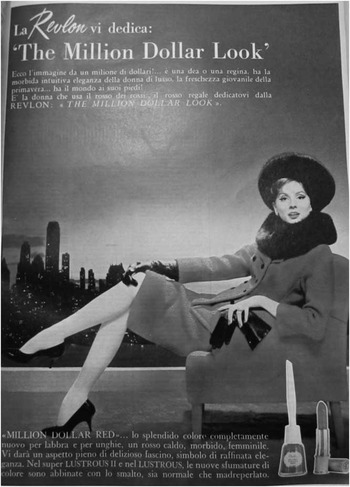
Another advertisement technique that helped to endorse the connection between elegance and affluence was that of directly referencing sums of money that only the wealthy possessed. This technique was employed in Revlon’s ‘Million Dollar Look’ campaign. One advertisement for the makeup line, for example, featured a picture of a woman in a red suit, fur hat and collar with red painted nails and red lips elegantly lounging in a chair with the New York skyline in the background (Figure 2). This woman was, as the advertisement said, ‘the image of a million dollars! ... she is a goddess or a queen, she is the soft intuitive elegance of a woman of luxury, the youthful freshness of spring … she has the world at her feet’ (Annabella, 27 October 1963). While the red lipstick and nail polish advertised were certainly not expensive, nonetheless, simply using these products could potentially give women ‘an aspect full of delicious charm, [and a] symbol of refined elegance’ – a ‘million dollar look’ (Annabella, 27 October 1963). In other words, an expensive appearance that was not reflected in the products’ prices. This increased possibility of obtaining an affluent elegance by using reasonably priced makeup products illustrates the increased accessibility to and democratisation of beauty in postwar Italy.
Revlon Million Dollar Look advertisement, Annabella, 27 October 1963. Source: Centro Documentazione Periodici Rcs Mediagroup, Milan, Italy

‘Gli uomini possono invecchiare; le donne no!’: youthFootnote 6
The tagline from a Helena Rubinstein advertisement – ‘Men can age, women can’t!’ – perfectly encapsulates one of the most important aspects of the American beauty model: youth. According to this ideal, being or appearing young made a woman beautiful, while visible signs of ageing detracted from her beauty and consequently hindered her chances of social and financial success. Therefore, beauty advertisements in Annabella prominently promoted youth as a crucial component of being beautiful.
A significant number and wide range of products advertised in the magazine’s pages promised to give women a youthful appearance. Helena Rubinstein’s lipstick line Indélibase, for example, promised to give women’s lips a ‘soft, moist, and young look that made them attractive’ while its Young Look and Minute Make-Up products had ‘a natural and young tone’ (Annabella, 26 July 1953, 17 May 1959). In fact, the lipstick in the Young Look collection claimed to give one’s lips ‘the freshness of flowers in bloom’ (Annabella, 17 May 1959). Estée Lauder also sold cosmetics that bestowed youth on users, among them the company’s Youth Blend, which promised women ‘a fresh, healthy, youthful radiance … so natural that it [seemed] to spring “from inside”’ (Annabella, 31 May 1964).
In addition to giving women a youthful appearance, beauty products also claimed to maintain a woman’s youth once she had reached that ‘certain age’ – usually 30.Advertisements featured skin care products with names such as ‘Erace’, ‘Calice di Giovinezza’, and ‘Estoderme Youth-Dew’ (Annabella, 5 June 1955, 30 November 1958, 28 July 1963). Products such as these promised to revitalise one’s skin and remove unwanted blemishes, crow’s feet, and wrinkles, with their advertisements telling readers that they could aesthetically ‘remain young after the age of 30’ (Annabella, 24 February 1957). One Revlon advertisement even went so far as to tell readers that ‘there aren’t any age limits’ to being beautiful as long as women used the company’s Renaissance Treatment Collection that would give their skin ‘a youthful beauty that was not possible to have before now’ (Annabella, 21 October 1965). Persuasive text such as this was, of course, accompanied by pictures of women with the clearest, blemish-free skin ever seen. For example, a Helena Rubinstein advertisement for the company’s skin cream contained a picture of a youthful, wrinkle-free woman holding a baby (Annabella, 23 November 1958). In the context of beauty, this image of mother and child implied that Rubinstein’s Skin Life cream would make a woman’s skin look and feel just like a baby’s. In other words, she could still be attractive and beautiful even after becoming a mother.
‘Oggi mi ha guardato!’: sex appealFootnote 7
In addition to appearing young, elegant, healthy, and affluent, being beautiful also meant being able to attract men; simply put, to have sex appeal. Both Hollywood films and wartime pin-ups featuring voluptuous American actresses and models introduced into Italy new ideas of sexual appeal that largely concentrated on the female body. The bodies of postwar Hollywood actresses Rita Hayworth and Marilyn Monroe are prime examples of this new sensuality contained in the American beauty model. Both women represented a real-life version of the ‘pin-up girl’, ‘the healthy, American cheerleader type – button-nosed, wide-eyed, long-legged, with ample hips and breasts, and above all with the open, friendly smile that discloses perfect, even, white teeth’ (Gundle 2007, 110). This new sexual beauty spoke to Italians’ desires to move on from the ravages of war. Hayworth’s curvaceous figure both physically and symbolically ‘filled the demand in post-war Italy for a dream of abundance and freedom’, making her, as well as other voluptuous actresses, popular figures in the country (Gundle 2007, 110). This popularity was influential in making bodily sensuality an important aspect of Italians’ notions regarding female beauty.
In order to complement this new focus on the body, cosmetic companies promoted their products’ seductive qualities to show readers that an elegant, attractive face was necessary for women to reach their full sex appeal potential. Their advertisements made it clear that having a voluptuous body was not enough; a woman had to have a sexy, beautiful face too.Footnote 8 It was as if the companies were asking women: ‘Without a made-up face, how can you expect to attract a man’s attention?’ Makeup and beauty treatments for the face were advertised as being crucial components in creating a woman’s sexual allure.
Revlon advertisements, in particular, highlighted their products’ potential ability to make women sexually desirable. In the 1950s, Revlon’s sexually bold advertisements, such as those for its ‘Fire and Ice’ lipstick campaign that ‘portrayed a fantasy of the “high class tramp” who somehow you know [is] really a nice girl’ had, as Kathy Peiss writes, ‘definitively changed the sexual resonance of cosmetics advertising’ (Peiss 1998, 245, 249). Previously, cosmetic advertisements featured a restrained and implicit female sexuality. They ‘acknowledged women’s sexuality but contained it safely in the story of a heterosexual romance and marriage … relying on double entendre and flirtation’ (Peiss 1998, 249). Revlon made sexual desire explicit, putting it front and centre in its advertisements. Typically, a picture of a solitary, ‘self-absorbed – or self-sufficient – woman’ with moist, lush lips, vibrantly coloured eyelids, and a ‘come-hither’ expression, unaccompanied by men, was the main focal point of the advertisements (Peiss 1998, 251). These women were in control of their sexuality and well aware of how to use it to get the man they wanted.
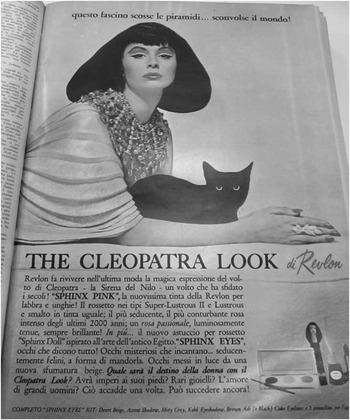
Revlon advertisements attributed a woman’s sex appeal to a magical, enchanting, fascinating, and mysterious face. The company’s Touch and Glow makeup claimed to make a woman’s skin so splendid and young that it would be as ‘seductive as the magic of candlelight’ while its Love-Pat makeup ‘render[ed] [her] complexion enchantingly perfect’ (Annabella, 12 May 1957, 10 February 1957). Revlon’s Sphinx Kit, consisting of lipstick, nail polish, and eye makeup, promised to give women a seductive, sexually appealing ‘Cleopatra Look’ – ‘mysterious eyes that enchant … nail polish [that is] the most seductive … intense pink, a passionate pink’Footnote 9 (Annabella, 4 November 1962). Moreover, the ‘Cleopatra Look’ advertisement spoke of the products’ potential ability to win men over: ‘What will the Cleopatra Look woman’s destiny be? Will she have empires at her feet? Rare jewels? The love of great men? That happened once. It can happen again!’ (Annabella, 4 November 1962) (Figure 3). The presence of the ‘self-absorbed or self-sufficient’ seductress alongside the advertisements’ text endorsed the idea that making oneself up, in addition to having a voluptuous body, was fundamental for eliciting sexual desire from men and, ultimately, for being beautiful.
Revlon Cleopatra Look advertisement, Annabella, 4 November 1962. Source: Centro Documentazione Periodici Rcs Mediagroup, Milan, Italy

In promoting this sexually confident woman, the beauty advertisements were endorsing a beauty ideal that seemed to go against the postwar desire to stabilise the traditional gender roles that had been disrupted during the interwar and war periods: the virile male breadwinner and the submissive housewife. While the components of the American beauty ideal outlined above created a sexually self-assured, confident, assertive woman, the bottom line remained – as is suggested by numerous advertisement taglines like the Elizabeth Arden one above – that women were making themselves up to attract men, not to free themselves from male power. Therefore, the American beauty ideal complemented its primary representative, Mrs Consumer, who was the ‘angel of the hearth’ dedicated to serving her husband and children.
Learning how to be beautiful
In order for women to successfully create a look and personality for themselves that replicated those advertised in Annabella, they had to be instructed on the proper beauty techniques, most of which derived from the States. While the magazine’s columns gave beauty advice to readers, cosmetic companies used their advertisements to ‘school’ women on how to be beautiful. Advertisements such as Max Factor’s Pan-Stik advertisement featuring Hedy Lamarr often contained step-by-step illustrations of the proper way to apply a specific product (see Figure 1) (Annabella, 21 October 1951). Other advertisements informed readers that an instructional guide was included with the purchase of the specific product. These instruction manuals played a significant role in promoting a standardised beauty model in Italy that reflected the American beauty trends and ideals discussed above.
In addition to this hands-off teaching method, several cosmetic companies established bricks-and-mortar beauty salons or sales boutiques within department stores throughout the Italian peninsula. While Max Factor, Estée Lauder, and Revlon all had their own stores or boutiques in Italy, Elizabeth Arden was the name most closely associated with the concept of the beauty salon, a place where women went to be pampered, made beautiful, and to learn the best and most suitable beauty routines for themselves. By the 1960s, the company had 116 stores worldwide, several of which were located in Italy, and which were prominently advertised in Annabella. Known for their red door, Arden’s salons could be found in the most elegant and high-end shopping districts in the country, most notably on Via Montenapoleone in Milan and in Rome’s Piazza di Spagna (Annabella, 30 January 1955). The company also opened boutiques in the most well-known Italian department store, La Rinascente (‘Una Porta Rossa anche alla Rinascente’, Annabella, 28 July 1966). The salons’ and boutiques’ locations signified the elegant, respectable, and high-end nature of Arden’s cosmetics. Indeed, it was Arden, along with other early twentieth-century cosmetic moguls, who ‘[took] “beauty culture” out of the realms of snake oil salesmanship and into the realms of respectability’ (Woodhead Reference Asquer2003, 2). She created, packaged, and advertised cosmetics in such a way that signified their belonging to the upper echelons of American society.
The extensive, luxurious beauty treatments and pampering women received at Arden’s salons also contributed to making a beauty routine and makeup use respectable. Arden created the ‘total beauty’ concept – going to a salon to receive a head-to-toe beauty treatment that not only made one beautiful but restored or gave one a sense of serenity, happiness, and youthfulness. Women at the salons could receive ‘oxygen facials, deep tissue massage, exfoliation, depilation, eyelash dyeing, freckle-bleaching, manicures, pedicures, self-tanning, metabolic testing, naturopathic water treatments, heat treatments, [and] paraffin waxing’. They could also attend ‘yoga, gymnastics, deportment, grooming, stretch and anti-stress classes and even fencing classes’. Further, clients were able to eat a health-conscious yet delicious meal at one of the salon’s ‘light-diet dining rooms’ and finish their day with makeup lessons and a visit to the ‘in-house hairdresser’ (Woodhead Reference Asquer2003, 6). Although customers at Arden’s La Rinascente boutiques could not receive the same extensive pampering, they could receive specialised advice on ‘the most correct way to make oneself up according to the proper type, age, and means’ from three expert beauticians (‘Una Porta Rossa anche alla Rinascente,’ Annabella, 28 July 1966).
While women learned important techniques to make themselves beautiful at the salons and boutiques, these beauty centres also promoted one of Arden’s most important concepts – individual gratification. Woodhead writes that Arden firmly believed that
women deserve time for themselves. That women need some pampering. That women who spend time on a beauty regime that makes them feel better about themselves are not being self-indulgent or vain. That a beauty regime, good grooming, ‘putting one’s face on’, a healthy lifestyle, vitality and above all the confidence that these things give, are essential tools for coping with life in today’s combative, competitive, often cruel world (Woodhead Reference Asquer2003, 9–10).
Therefore, Arden’s call for women to frequent her salons and engage in a beauty routine as a means of feeling good about themselves was a call for individual gratification. This promotion of the individual was one of American consumer capitalism’s defining characteristics. Postwar developments in the US that emphasised a privatised, individually focused lifestyle, such as an increased dedication to leisure activities – going on vacation and participation in recreational activities – and the construction of single-family suburban homes, are prime examples of this notion.Footnote 10 As such, the salons’ existence in Italy represented the presence of an American-derived beauty ideal whose concepts were in contrast to contemporary and traditional Italian beliefs – Catholic, Communist, and Fascist – that prioritised the good of the group, or the nation in the case of Fascism, over that of the individual. Therefore, the invasion of American cosmetics and their attendant ideals, such as benessere, freedom of choice, and individual gratification, played an important cultural and political role in postwar Italy by promoting a democratic consumer capitalist lifestyle to Italian women that was distinct from that which existed in Italian society before the end of the war.
Conclusion
Overall, in the two decades following the end of the Second World War, advertisements of American female beauty in Annabella promoted a new and distinct beauty ideal in Italy to which Italian women were supposed to aspire. These advertisements called for Italian women to be glamorous, youthful, elegant, healthy, and sexually appealing – all important components of the postwar American beauty ideal. Additionally, the advertisements also endorsed key tenets of democratic consumer capitalism – freedom of choice, affluence, abundance, and individual gratification – that contrasted with other social models, such as those promoted by the Communists and Catholics, competing for prominence in Italian society. As such, products coming from the States not only sought to influence the way in which Italian women aesthetically fashioned themselves, but also in how they identified themselves – as the Italian ‘Mrs Consumer’, a modern made-up, fashionable woman exercising her democratic right to participate in Italy’s growing consumer capitalist society.
Acknowledgements
I would like to thank Brenda Stevenson, Geoffrey Symcox, Kathryn Norberg, Robin D. G. Kelley, and John Agnew for their support of this project and the anonymous reviewers for their helpful comments on an earlier draft of this article. I also would like to thank Sonia Orlandi and Silvia Magistrali for their help with my research on Annabella.
Notes on contributor
Jessica L. Harris received her PhD in History from the University of California, Los Angeles in 2016. Her research interests include the intersection of gender and consumer culture in the United States and Italy after the Second World War. She is currently working on a book that examines the development and growth of an American influenced mass consumer-based society in postwar Italy and its effect on Italian women from the upper to middle-classes. Jessica works as a research associate for UCLA’s History Department.