





1. Introduction
There are phases in stellar evolution when large amounts of circumstellar (CS) matter are found near stars of all masses. Such phases may last a different amount of time, depending on the star’s mass or the arrangement of components in binary/multiple systems. The CS material may be represented by neutral or ionized gas and ensembles of molecules combined in dusty particles. In massive stars, possible formation mechanisms of the CS matter include stellar winds, and mass transfer between components in multiple systems, as the pre-main-sequence stage of their evolution is typically hidden by the natal star-forming cloud.
Although there are many early-type supergiants in the Milky Way, only a small fraction of them exhibit the B[e] phenomenon. The phenomenon was discovered almost 50 years ago by Allen & Swings (Reference Allen and Swings1976) in 65 Galactic Be stars and planetary nebulae and defined as the presence of forbidden (e.g., [O <sc>i</sc>], [Fe <sc>ii</sc>], [N <sc>ii</sc>]) and permitted emission lines (e.g., H <sc>i</sc>, Fe <sc>ii</sc>) in the optical spectra of B–type stars along with large IR excesses due to CS dust.
Initial studies revealed that these properties were found in some members of five stellar groups: pre-main-sequence Herbig Ae/Be stars, symbiotic binaries, compact planetary nebulae, supergiants, and FS CMa type objects (Lamers et al. Reference Lamers, Zickgraf and De Winter1998; Miroshnichenko Reference Miroshnichenko2007). The nature and evolutionary state of the former four groups were already known, while the fifth group was recognized nearly two decades ago on the basis of common features (strong line emission and a fast decline of the IR flux past  $\lambda \sim 10-30~\mu$m toward longer wavelengths). These features were hypothesized to be due to the CS matter created in ongoing or past mass-transfer in binary systems, because single stars with the observed luminosities from a few hundred to
 $\sim$30,000 L
 $_{\odot}$ that correspond to a mass range (
 $\sim2-20$ M
 $_{\odot}$) seem to be incapable of producing the sufficient amount of CS material (see Miroshnichenko et al. Reference Miroshnichenko, Zharikov and Manset2023, for a recent review).
Supergiants with the B[e] phenomenon (hereafter sgB[e]) are defined by locations in the Hertzsprung-Russell diagram (HRD) beyond the main-sequence and high luminosities ( $\log$ L/L
 $_{\odot} =5.1\pm0.2$, Miroshnichenko Reference Miroshnichenko2007). Their fraction in the original list of Galactic objects (Allen & Swings Reference Allen and Swings1976) was small. Lamers et al. (Reference Lamers, Zickgraf and De Winter1998) mentioned 2 bona-fide such objects (CPD-52
 $^{\circ}$9243 and GG Car) and 3 probable ones (MWC 300, MWC 349A, and HD 87643). Miroshnichenko (Reference Miroshnichenko2006) listed 6 objects (
 $\eta$ Car, MWC 349, CPD-52
 $^{\circ}$9243, MWC 300, RY Sct, and 3 Pup), while mentioning seven (probably GG Car was mistakenly forgotten).
The differences in classifying objects as sgB[e]s were mostly due to uncertainties in their luminosities that stemmed from unknown distances and veiling of photospheric lines by a strong CS continuum. It has been much easier to classify similar objects in the Magellanic Clouds because of a well-known distance and a low interstellar extinction. Nearly a dozen of sgB[e]s were discovered in the LMC and SMC by Zickgraf et al. (Reference Zickgraf, Wolf and Stahl1986). The locations of LMC and SMC sgB[e]s in the HRD are shown in Figure 1 of (Lamers et al. Reference Lamers, Zickgraf and De Winter1998). The Galactic sgB[e]s were typically referred to as analogs of those from the Clouds. A recent survey of sgB[e]s found beyond the Milky Way was published by Kraus (Reference Kraus2019).
 $\eta$ Car was historically considered a sgB[e] before it was classified as a Luminous Blue Variable (LBV). Some other Galactic LBVs (e.g., AG Car and HR Car) also exhibit IR excesses, but only at
 $\lambda \sim 60-100~\mu$m. The absence of a near-IR excess resulted in not classifying them as objects with the B[e] phenomenon.
2. Enlarging the original list of sgB[e]
Although the number of stars in the original search done by Allen & Swings (Reference Allen and Swings1976) was large (700 objects), some potential B[e] candidates went missing. In particular, an object that was later recognized to show the B[e] phenomenon (HD 327083) was found by Carlson & Henize (Reference Carlson and Henize1979), a few more were revealed by Dong & Hu (Reference Dong and Hu1991) using a positional cross-correlation of a catalog of Galactic early-type emission-line stars (Wackerling Reference Wackerling1970) and the IRAS Point Source Catalog (Helou & Walker Reference Helou and Walker1988). For a more detailed description of these findings, see Miroshnichenko (Reference Miroshnichenko2007).
The IRAS survey expanded the wavelength coverage of the stellar spectral energy distributions further in the IR spectral region that allowed finding new observational features of objects with the B[e] phenomenon. Miroshnichenko (Reference Miroshnichenko2007) analyzed IRAS fluxes of these objects from Allen & Swings (Reference Allen and Swings1976) and Dong & Hu (Reference Dong and Hu1991) and found that a noticeable number of them exhibited a strong decrease in flux at  $\lambda = 60~\mu$m (see Figure 1 in Miroshnichenko Reference Miroshnichenko2007). This feature pointed to a lack of cold dust around the stars and provided a separation criterion from pre-main-sequence objects, which still retained distant remnants of their protostellar clouds, and part of the foundation of the FS CMa group (see above). This study along with several previous investigations of individual objects conducted in the early 2000’s (see Table 1) resulted in enlarging the list of Galactic sgB[e].
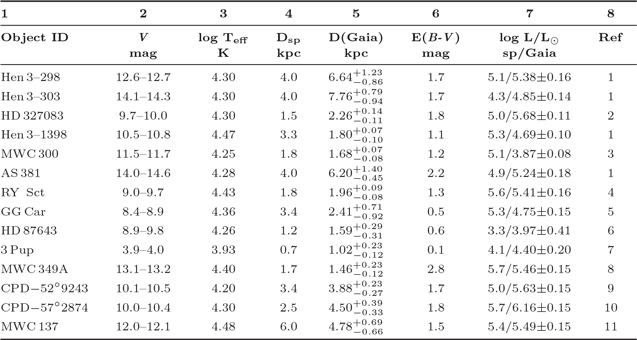
Parameters of a sample of Galactic sgB[e] objects.

Table 1 Long description
A table with 11 rows and 8 columns listing parameters of a sample of Galactic sgB[e] objects. The columns are labeled as follows: Object ID, V mag, log T_eff K, D_sup kpc, D(Gaia) kpc, E(B-V) mag, log L/L_sun, and Ref. Each row provides specific values for each object ID. For example, the first row lists Hen 3-298 with V mag ranging from 12.6 to 12.7, log T_eff of 4.30 K, D_sup of 4.0 kpc, D(Gaia) of 6.64 plus or minus 1.23 kpc, E(B-V) of 1.7 mag, log L/L_sun of 5.1 plus or minus 0.16, and Ref 1. The table includes various objects with their respective parameters and references.
Column information: 1 – an example of the object’s ID, 2 – V–band brightness limits from the ASAS SN database (Kochanek et al. Reference Kochanek, Shappee and Stanek2017), 3 – effective temperature in K, 4 – spectroscopic distance in kpc, 5 – Gaia DR3 distance in kpc, 6 – color-excess from combined CS and interstellar extinction, 7 – bolometric luminosity derived from spectroscopy versus one from the Gaia DR3 distance, 8 – Reference to the fundamental parameters derived from spectroscopy:
1 – Miroshnichenko (Reference Miroshnichenko2007), 2 – Nodyarov et al. (Reference Nodyarov, Miroshnichenko and Khokhlov2024), 3 – Wang et al. (Reference Wang, Weigelt and Kreplin2012), 4 – Men’shchikov & Miroshnichenko (Reference Men’shchikov and Miroshnichenko2005), 5 – Porter et al. (Reference Porter, Grant and Blundell2021), 6 – Millour et al. (Reference Millour, Chesneau and Borges Fernandes2009), 7 – Miroshnichenko et al. (Reference Miroshnichenko, Danford and Zharikov2020), 8 – Hofmann et al. (Reference Hofmann, Balega and Ikhsanov2002), 9 – Cidale et al. (Reference Cidale, Borges Fernandes and Andruchow2012), 10 – Domiciano de Souza et al. (Reference Domiciano de Souza, Driebe and Chesneau2007), 11 – Esteban & Fernandes (Reference Esteban and Fernandes1998).
Note: The luminosity derived from the Gaia DR3 distance also uses the ASAS SN average V–band magnitude and bolometric corrections appropriate for the T $_{\rm eff}$ shown in column 3.
At that time, determination of the objects’ luminosities was primarily based on spectroscopic distances, as the parallaxes measured by the HIPPARCOS mission were either too uncertain or unavailable due to large distances and low brightnesses of the majority of objects with the B[e] phenomenon. Nevertheless, diffuse interstellar bands present in the objects’ spectra and existing relationships of the interstellar extinction with distance in their directions allowed reasonably reliable distance and hence luminosity estimates. Currently, Gaia DR3 parallaxes (Bailer-Jones et al. Reference Bailer-Jones2021) provided more accurate distances for some sgB[e] that still need to be checked for systematic errors due to the presence of possible stellar companions or asymmetric CS structures. The existing data for the most recognized Galactic sgB[e]s are summarized in in Table 1.
3. Recognized binary systems and objects with uncertain classification
Most objects listed in Table 1 were found or suspected to be binary systems. Orbital periods have been derived for HD 327083 (107.7 days, Nodyarov et al. Reference Nodyarov, Miroshnichenko and Khokhlov2024), RY Sct (11.1 days, Djurasević et al. Reference Djurasević, Zakirov and Eshankulova2001), GG Car (31.01 days, Porter et al. Reference Porter, Grant and Blundell2021), 3 Pup (137.5 days, Vaidman et al. Reference Vaidman, Nurmahametova and Miroshnichenko2025). Signatures of a K-type companion were found in the spectrum of AS 381 (Miroshnichenko et al. Reference Miroshnichenko, Bjorkman and Chentsov2002), Millour et al. (Reference Millour, Chesneau and Borges Fernandes2009) detected a companion of HD 87643 with interferometry, and Wang et al. (Reference Wang, Weigelt and Kreplin2012) suspected binarity in MWC 300.
Another example of a binary system not included in Table 1 is CI Cam from the original list of B[e] stars. Its orbital period of 19.41 days (Barsukova et al. Reference Barsukova, Borisov and Burenkov2006) was suggested from the detection of periodic positional variations of the He <sc>ii</sc> 4686 Å emission line, which is supposed to form in the CS medium of the secondary companion that is much fainter than the  $V \sim 11.6$ mag primary. This object has been considered a sgB[e] in many studies, although the distance toward it was estimated from 1 to
 $\sim$10 kpc. Recent analysis of TESS data showed that part of the photometric variability is due to radial pulsations that constrained the primary component’s mass and ruled out its supergiant status (Barsukova et al. Reference Barsukova, Burenkov and Goranskij2023).
At the same time, it is still unclear whether MWC 349A, a close visual binary (separation 2.4 arcsec), is physically connected to a fainter companion MWC 349B (Manset et al. Reference Manset, Miroshnichenko and Zharikov2017). The remaining objects (Hen 3–298, Hen 3–303, CPD $-52^{\circ}9243$, and CPD
 $-57^{\circ}2874$) show no convincing signs of binarity.
Some of the mentioned objects do not seem to be genuine massive stars, because of potential effects of mass transfer in binaries that may significantly alter their masses and luminosities. For example, 3 Pup shows an absorption-line spectrum of an A3–type supergiant, but its evolutionary history suggests that this binary began its evolution as a 6.0+3.6 M $_{\odot}$ pair, where the initially less massive companion gained nearly 5 M
 $_{\odot}$ from the more massive one, which became an extremely hot (T
 $_{\mathrm{eff}} \sim 50,000$ K) compact star with a less than 1 M
 $_{\odot}$ mass (Miroshnichenko et al. Reference Miroshnichenko, Danford and Zharikov2020). A much larger Gaia DR3 distance compared to the spectroscopic one (although uncertain, see Miroshnichenko et al. Reference Miroshnichenko, Bjorkman and Grosso2005) brought the luminosity of Hen 3–303 very close to the average one for sgB[e]s. At the same time, although neither spectroscopic nor Gaia luminosity of HD 87643 is close to those of sgB[e]s, it is still considered a member of the sgB[e] group (Millour et al. Reference Millour, Chesneau and Borges Fernandes2009).
The evolutionary stage of a few objects is still uncertain. MWC 137, MWC 300, Hen 3–303, and HD 87643 still appear in studies of pre-main-sequence stars (e.g., Shridharan et al. Reference Shridharan, Mathew and Arun2023). However, MWC 137, which is surrounded by a large nebula Sh 2–266, was rather convincingly shown to be a high-luminosity object by Esteban & Fernandes (Reference Esteban and Fernandes1998) and Muratore et al. (Reference Muratore, Kraus and Oksala2015). Also, Hen 3–303 is listed in the SIMBAD database as a Long-Period Variable candidate. All these facts reflect complicated properties of the Galactic population of sgB[e]s.
4. Nature of Galactic sgB[e]s
Numeroustudies of Galactic B-type stars of high luminosity without CS dust (e.g., Verdugo et al. Reference Verdugo, Talavera and Gómez de Castro1999; Weß mayer et al. 2022, to name a few) show that those with  $\log$ L/L
 $_{\odot} \ge 5.0$ exhibit emission-line spectra that are typically represented by the H
 $\alpha$ line only. Since the B[e] phenomenon is evident in only a very small fraction of such stars, certain special conditions need to be present in these systems. One possibility is binarity, which has been proven to be the case in a big fraction of the sgB[e] group members and candidates. More specifically, only binary systems of a certain range of masses and orbital separations may pass through this evolutionary stage.
Another possibility that has recently been suggested for explaining the properties of objects with the B[e] phenomenon invokes scenarios with merging stars. Hirai et al. (Reference Hirai, Podsiadlowski and Owocki2021) proposed to explain the formation of the Homunculus nebula around  $\eta$ Carinae by a stellar merger in an unstable triple system. Moranchel-Basurto, Korčáková, & Chametla (Reference Moranchel-Basurto, Korčáková and Chametla2023) investigated MHD simulations to explain disk-like CS envelopes of FS CMa objects, which these authors consider to be post-mergers in binary systems. A number of sgB[e] described in this paper is mentioned as potential merger products by the latter authors.
5. Conclusions
The B[e] phenomenon is a remarkable manifestation of a hot star radiation processed by large amounts of CS matter distributed in an extended area. Investigation of all groups that exhibit the phenomenon expands our knowledge of stellar evolution and triggers exciting discoveries. Despite recent progress in studying stars with various methods, even those discovered long ago continue to present new puzzles and testing our understanding of physical processes that take place in stars and their environments. The complexity and dynamics of many B[e] objects require frequent attention with a multitude of observing techniques and sophisticated modeling tools.
In particular, frequent all-sky photometric surveys provided constraints on the optical brightness variability of sgB[e]s. However, a lack of medium- and high-resolution spectroscopic observations hampers studies of spectral line positional variations and detections of possible companions, while rare photometric observations in the IR spectral region prevent studies of the temporal behavior of CS matter. Although most bright sgB[e]s ( $V \le 12$ mag) have been found, there are still potentially undiscovered such objects among fainter stars with IR excesses. Another outcome of recent studies of B[e] objects is that both types of them, which produce CS dust during their recent or current evolutionary stages (sgB[e]s and FS CMa objects), may represent products of evolution of binary or multiple systems with a certain range of masses and orbital separations.
6. Acknowledgements
This research was funded by the Science Committee of the Ministry of Science and Higher Education of the Republic of Kazakhstan under Grant No. AP23484898 and Project No. BR24992759 “Development of the concept for the first Kazakhstani orbital cislunar telescope - Phase I”, financed by the Ministry of Science and Higher Education of the Republic of Kazakhstan. A. S. M. acknowledges support from the College of Arts and Sciences and the Department of Physics and Astronomy of the University of North Carolina Greensboro.

 Open access

