The extraordinary occupation sequence of the Godwin Ridge, investigated in 2008–9 as part of the Over Narrows phase of the Barleycroft/Over Quarry project, has been discussed elsewhere and its final publication will appear shortly.Footnote 1 Flanked by palaeochannels on all sides, this c 575m-long Pleistocene sand ridge lay within the floodplain of the River Great Ouse, just above Earith, where the river debouches into the south-western Cambridgeshire peat fens (Fig 1).Footnote 2 When excavated in its near-entirety, with intensive sampling of its buried soil cover, more than 70,000 artefacts were recovered from some 700 hand-dug metre-square test pits across an area of 5.4ha (Fig 2), suggesting a total finds population in excess of a million. This surface sampling allowed for detailed nuancing of the Mesolithic to Iron Age sequence. Of the thirty-five individual sites or occupation events identified, more than half registered only as horizontal finds spreads, with no subsurface traces whatsoever.
Project and sub-site location map. Drawing: Andrew Hall

(top) The Over Narrows, showing the three main palaeochannel ridges; (middle) the Godwin Ridge sample grid; (bottom) plans of the Late Bronze Age and Iron Age phases. Drawing: Andrew Hall
Our concern here is primarily with the elevated western end of the ridge, which crested at 3.00m OD and was the site not only of intensive Mesolithic and Late Bronze Age activity, but also of a remarkable later Iron Age ritual complex, notable for its various votive ‘packages’ and riverside human mortuary- and bird-related rites. While the focus of this paper is primarily on these last aspects, the Bronze Age use of the ridge needs to be outlined first. This is justified on the grounds that this included a major Late Bronze Age midden settlement that may, at times, have hosted assemblies from the broader area, this being relevant to its later, Iron Age, use. Even so, there seems no question of settlement continuity between these periods, the ridge having negligible evidence of Early Iron Age activity. Instead, the archaeological sequence of this mid-stream floodplain locale, with its distinct niche environment, is marked by episodic permanent settlement and more frequent visitation, as well as the occasional gatherings of larger social groups.
A Late Bronze Age midden settlement
The Godwin Ridge was investigated at the same time as a similar, but much larger, ‘ridged’ terrace-island immediately to the south, the O'Connell Ridge. While the latter was not so intensively sampled, four collared urn-associated round barrows were excavated (one preceded by a Beaker cemetery), as well as two pond barrows (Figs 1 and 3). Various Neolithic and Early Bronze Age artefact scatters and occupational pit clusters were excavated on both ridges and both had Middle Bronze Age enclosures. The Godwin Ridge had a long strip-compound arrangement, with only a few traces of contemporary settlement, while the O'Connell Ridge had a field system and channel-side settlement (Fig 2). Thereafter, the co-relationship between their sequences stopped. To all intents and purposes, occupation ceased on the O'Connell Ridge and it was abandoned to rising marsh levels, while the higher, mid-stream Godwin Ridge to the north saw intensive Late Bronze and later Iron Age activity.
Evidence for Late Bronze Age usage of the Godwin Ridge mainly registered within its thick covering of sandy loam buried soil. Four distinct artefact scatters were defined along its length (spreads LBA1/2–5; Fig 2), with the westerly spreads being the most extensive; it is with these that we will be concerned. Here the buried soil was between 250 and 600mm thick, and within spread LBA3 the upper profile was distinctively coloured dark brown to black and its matrix included humified organic matter, with fine bone and charcoal fragments; it had, in other words, the qualities of ‘dark earth’. In total, some 6,150 sherds of post-Deverel Rimbury plainware pottery were recovered;Footnote 3 within the two western spreads they occurred in average densities of c 14 per metre-square (105 sherds/724g being the highest per metre value). It is estimated that the ridge's surface deposits would thus have comprised in excess of 85,500 Late Bronze Age sherds (as opposed to only c 200 found in the features of that phase).
Only one spread – that within the west-centre of the ridge (LBA3; c 2,000 sq m) – had any density of associated features, here consisting of traces of three to five contemporary roundhouses, plus diverse posthole settings and scattered pits. This spread alone is estimated to have contained upwards of 29,500 sherds and it is puzzling that there are so few features associated with such a quantity of surface material. It can only be assumed that any features that had existed were too shallow to penetrate through to the sand/gravel geology and were impossible to see in the dark-stained buried soil that lay 0.30–0.50m deep above the natural. Substantial portions of that soil horizon were dug carefully by hand in the hope of distinguishing features, but to no avail. The soil was also subjected to micromorphological analyses, chemical testing and geophysical survey; magnetic susceptibility scanning revealed the probable imprint of a roundhouse and a small square structure, although these did not register as below-soil features. As discussed below, the disarticulation of the midden settlement's strata may well have been a result of subsequent Iron Age horticulture.
Based on Brudenell's pottery analyses,Footnote 4 the average test pit density at the Godwin Ridge was just over 100g of pottery per metre-square. This is much less than the c 500–5,000g per metre-square of such major middens as Potterne, East Chisenbury, Runnymede and Whitchurch.Footnote 5 Even so, this is a substantial quantity given that most ‘standard-type’ settlements of the period (ie,. lacking surface spreads) generate assemblages of fewer than 5,000 sherds and many yield only very low finds numbers. Yet recent evidence from some of these latter site types suggests that at least some of these originally had relatively dense surface deposits. At, for example, the Toll House site in Broom, Bedfordshire, as redeposited within the fill of a later ditch, there were sherd densities of 27–56 per metre-segment (an average of 40).Footnote 6 Similarly, midden-type deposits survived in the upper profiles of the large pit-wells in the later Bronze Age complex at Striplands Farm, Longstanton, Cambridgeshire, at densities of 50–200 sherds per metre-square, with the highest values in excess of 250.Footnote 7 This demonstrates that some settlements of the period had surface deposits whose densities approached what is commonly held to be midden-like levels.Footnote 8 Viewed in this light, while the Late Bronze Age spreads at Godwin Ridge may not be considered particularly extraordinary, the settlement's mid-stream location and intensity of occupation certainly is. In many respects it could only be comparable to the island/eyot occupations at Whitecross Farm, Wallingford (Oxfordshire), and Runnymede on the Thames.Footnote 9 The critical difference is that the Godwin Ridge settlement lay at a much greater remove from any potential arable farmland that could have sustained a mid-stream community. Charred wheat grains occurred within the samples but – in contrast to Early and Middle Bronze Age usage of the site, when arable agriculture was certainly practised upon both ridges – the Late Bronze Age community was probably not self-sufficient. There simply would not have then been enough dry land mass, and at least a proportion of its foodstuffs would have had to be acquired elsewhere.
It is estimated that in total (ie, sampling factored) the ceramic finds from this period of the use of the ridge equate to a minimum of 7,350 vessels, or around c 24 pots a year for the 300 years of the site's use from 1100 to 800 cal bc. This could represent four to five households if the ridge had been occupied continuously during this entire span, but 150 years of occupation by eight to ten households may well be more likely.Footnote 10 Neither should we assume that all this material was generated exclusively by a permanently resident community; the ridge may well have seen seasonal gatherings, perhaps relating to fishing (some fish bone having been recovered from the settlement's contexts, including carp and eel). Certainly, agricultural subsistence would not have been the settlement's raison d’être, with access to riverine trade and its resources being more likely.
The animal bone from the Late Bronze Age features is dominated by cattle, with pig coming a distant second (82.6 and 12 per cent respectively); the assemblage is noteworthy for the paucity of sheep. The same is true of the Middle Bronze Age contexts (46.2 per cent cattle, 23 per cent pig and 7.7 per cent ovicaprid).Footnote 11 Of interest, though, is that the bone from the west-centre scatter's buried soil had a much higher frequency of pig – 31.5 per cent – which is comparable to, and characteristic of, that period's major midden sites (generally 28–33 per cent).Footnote 12
Only one Late Bronze Age feature yielded human bone: a pit containing the cremated fragments of an adult skull, tooth and long bone.Footnote 13 It is certainly possibly that some of the human remains from within the buried soils on the ridge's western half – especially those alongside the northern channel edge – might be Bronze Age too, but (as outlined below) all those that were dated proved to be Iron Age.
Iron Age ridge-end rituals
In total, some 2,800 sherds of Middle/Late Iron Age pottery were recovered along the length of the ridge. Just over 500 were wheelmade, of which about 200 dated to the Late Iron Age, the rest being ‘Romanising’ wares (thirteen sherds of first-century ad Roman pottery were also recovered). Of the assemblage as a whole, only 278 sherds occurred in cut features, with the remainder deriving from surface contexts.
The Iron Age finds scatters were less extensive than those of the Late Bronze Age (Fig 2); their artefact densities were generally much lower and they lacked ‘dark earth’-type deposits. There was a minor central spread (IA3) without any underlying features and another at the eastern end, associated with a few pits, that is likely to have related to seasonal fishing (IA4; fish bone was concentrated in the surface deposits and features there). The focus of activity was, however, clearly at the higher, western end (IA1/2) where a small (7.0m in diameter) roundhouse (Str. 18) was set upon the crown of the ridge within a minor L-plan compound (Figs 3 and 4). While there was also a contemporary six-poster off to one side (Str. 19), this seemingly domestic setting can only be considered modest, belying the finds numbers on that part of the ridge. It is conceivable that this was the sometime residence of the ‘guardian’ of the adjacent ritual complex, though ritual usage of the area probably lasted for far longer than these structures. Thus the significance of this complex has nothing to do with studies of ‘formal’ shrine architecture,Footnote 14 but rather lies in the evidence for the ritual and mortuary practice.
Godwin Ridge: (top) aerial photograph looking north with the entire length of the ridge exposed and, in the foreground, the Low Grounds barrows; (middle) looking west across the Iron Age roundhouse set in a compound at the western end of the ridge, showing palaeochannel deposits flanking the left-hand (northern) side; (bottom) north-western ridge-side palaeochannel deposits showing excavated water-washed sands and buried soil horizons from which the human bone was derived. Photographs: Ben Robinson (top), Dave Webb (middle) and Marc Vander Linden (bottom)
Godwin Ridge, western end, showing the distribution of ‘special finds’ and Iron Age features (1–16 indicate the main human bone groups). Drawing: Andrew Hall.
Because of rising groundwater levels, only c 1ha of the ridge-top would then have been available for use (>2.00m OD; Fig 2); this is generally thought to be too small a holding for a single household's sustenance.Footnote 15 Given this, and the underwhelming character of the settlement evidence, it can be questioned whether the ridge saw year-round occupation at this time. Set against this is the quantity of cereal (and chaff) present in some of the environmental samples and the evidence for arable cultivation in a nearby pollen core. This, combined with the results of the soil-micromorphological analyses, prompts the suggestion that strata within the previous Bronze Age midden horizons may have been disarticulated through later horticulture. Be that as it may, it would still be difficult to see the ridge as having ‘normal’ occupation, if for no other reason than that there was insufficient dry space to pasture herds.
The ritual activities at the end of the ridge focused upon the northern riverside and a dumped-soil platform (7 × 10m in extent, 0.15–0.30m thick; Fig 4, F.214). The platform's foundation layer contained the remains of four dismembered horses (Fig 5, top), and the disarticulated/partially articulated remains of a dog, two cows, a pig and twelve sheep, suggesting that a ritual purpose had been intended from the outset even if, at times, the platform may also have served as a fishing station (large quantities of fish bone – including pike, carp and perch – were recovered from its matrix).
Godwin Ridge, the riverside platform (F.214), showing (top) the animal bone foundation layer and (below) (1) the near-complete left scapula of a bittern (Botaurus stellaris); (2) a fragment of a right distal tarsometatarsus of a marsh harrier (Circus aeruginosus); (3) the proximal articulation of a right scapula of a Dalmatian pelican (Pelecanus crispus); (4) the complete right femur of a raven (Corvus corax) with a cut mark on the shaft near the proximal articulation. Photographs: Marc Vander Linden (top) and Chris Stimpson (bottom)
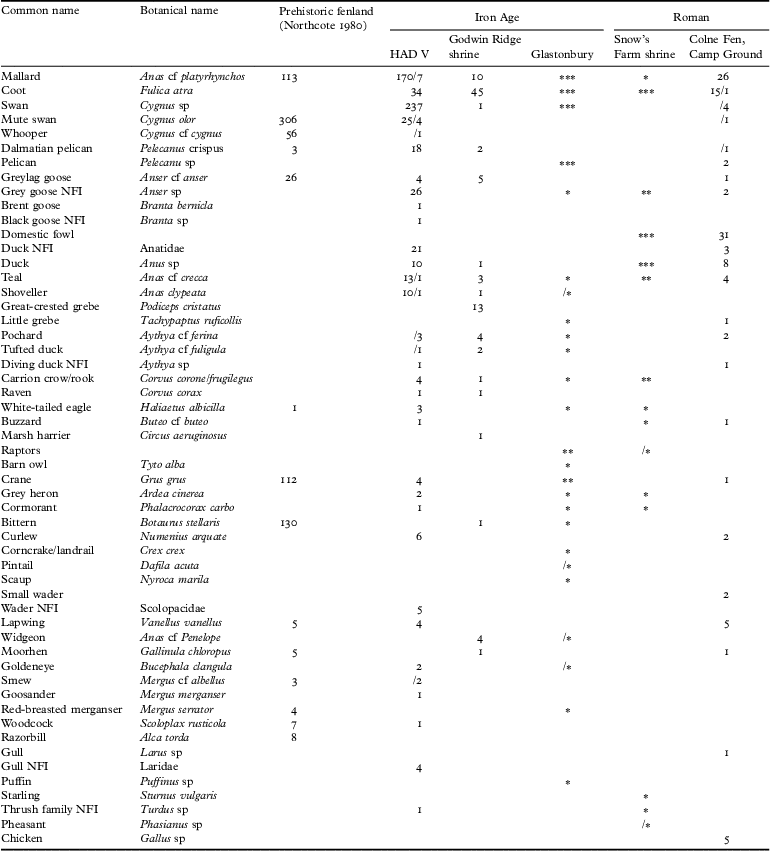
Also associated with the platform were the bones from at least fifteen different wild bird species, mostly coot, mallard, other ducks and great-crested grebe; swan, heron, bittern, crow and marsh harrier were also present,Footnote 16 as was a Dalmatian pelican, a bird even larger than a swan that once bred in Britain (Table 1; Fig 5, bottom).Footnote 17 The bones were disarticulated, while some were broken or displayed signs of butchery, suggesting that at least some of the birds had been eaten or otherwise utilised.
Major bird-bone assemblages from generic prehistoric ‘fenland peat’ collections and Iron Age and Romano-British sites. Numbers represent numbers of identified specimens; *=one listed occurrence, **=2–4 occurrences and ***=5+; NFI = not possible to identify precise species; oblique symbol (/) = distinguishes number of definite from number of possible bone identifications attributable to that species (thus 170/7 = 170 definite, 7 possible)
The platform was excavated in metre-squares in order to enable standard finds distribution plotting and their sieved retrieval, even though this was not the best way to elucidate the platform's formation processes. Accordingly, the extent of in situ deposition, as opposed to scraped-up occupation debris (the latter attested to by the recovery of 450 worked flints), is unclear.Footnote 18 Nevertheless, the platform certainly incorporated great quantities of material, including more than three-quarters of the Iron Age animal bones (1,426 pieces). Similarly, c 1,460 sherds, 51 per cent of the Iron Age pottery assemblage, were recovered from the platform. With 68 per cent being wheelmade wares, this represents a minimum of 134 vessels (out of 331 over the whole site). This is a large amount of material given how few features were represented.
Three copper-alloy brooches occurred close to each other within the platform's matrix (Fig 4), comprising a Thistle and a Colchester brooch and a rare, near-complete, Nauheim-type of late second- or earlier first-century bc date.Footnote 19 Nearby, at the riverside, there was an unequivocal ‘ritual package’, a discrete group of three antler weaving combs. The ritual nature of these weaving comb and brooch ‘trios’ was all the more apparent as no other comparable items were recovered from the ridge.
Incontestable evidence of the site's ritual activity was found in the amount of human remains.Footnote 20 There were eighty-nine skeletal elements (refitting pieces counting as one) across the western half of the ridge, with the majority (fifty-six) deriving from the north-western end, where most (forty-eight) were spread across an area measuring 15 × 20m (Figs 3 and 4). The vast majority of the material was loose and disarticulated. Altogether, portions of seven skulls were recovered from at least five adults, including a male and two females. It needs, however, to be emphasised that this is a minimum body count, given the recovery from sampled surface deposits rather than from cut features.
Canine gnawing was recorded on one tibia. There were also cut marks on a scapula and a humerus (Fig 6, bottom) and a chop mark on a rib. These occurred on fresh bone, with no evidence of healing, suggesting that they were made at around the time of death, arguably in relation to dismemberment. The most marked ‘modification’ involved a polished occipital portion of an adult's skull found along the northern channel side. Apart from shallow knife incisions, this included drilled holes arranged in a near-four-square pattern (Fig 6, top). With diameters of 7.1–8.5mm, these were drilled post-mortem with a rotating blade; the accompanying knife marks presumably relate to the skull's skinning and cleaning beforehand.Footnote 21
Godwin Ridge, human remains: the hole-bored skull (top) and the cut-modified humerus (bottom). Photograph: Dave Webb
There are regional parallels for aspects of these practices. The enclosure at Wardy Hill, Coveney, on the Isle of Ely, produced evidence of bodily dismemberment, and both it and the nearby Hurst Lane compound had polished skulls associated with their main roundhouses.Footnote 22 A cut-marked and polished skull fragment came from the main entrance of the compound at the nearby Haddenham HAD V settlement.Footnote 23 A hole-bored skull is reported from Earith, and others are known from Fenland Iron Age sites.Footnote 24
An Early Iron Age date was obtained from a worked timber immediately beside the hole-bored skull along the northern palaeochannel edge (Fig 4): human bone group (HBG) 7 (OSH/260/65; Wk-10209): 2570±48 bp/840–520 cal bc. This was thought likely to be some centuries too early, the skull's association with the timber being the result of the bone sinking through the channel's waters. Two Middle Iron Age dates subsequently achieved from human bone are considered more likely to be representative: HBG 8 (OVE07 [816]; OxA-24640): 2181±28 bp/362–171 cal bc; and HBG 11 (OVE08 [2195]; OxA24641): 2160±27 bp/358–111 cal bc. Two further dates were obtained from the human remains found within the vicinity of the main Late Bronze Age midden settlement (in case they were of that date), and both proved to be later still: HBG 14 (OVE07 <3509>; Beta-341495): 1840±30 bp/cal ad 20–130; and HBG 16 (OVE08 <3328>; Beta-341496): 2050±30 bp/350–320 and 210–90 and 80–50 cal bc.
One would be hard pressed to find direct parallels for the Godwin Ridge ritual platform. The fen-edge Iron Age gravel platform – with an inhumation probably of the same date nearby – north of Flag Fen's timber causeway might be one.Footnote 25 More directly comparable, but of earlier, Bronze Age date, are the human remains from a Thames-channel sandbank in the Eton Rowing Lake excavation.Footnote 26 Glastonbury's human remains could also be cited for their frequency, especially of skulls, and the fact that so many of those skulls were ‘modified’, with a number occurring in the ‘watery morass’ beyond the settlement's palisade.Footnote 27 However, on other grounds, the site that resonates most closely with the Godwin Ridge finds is the neighbouring Haddenham HAD V Iron Age settlement compound (Fig 1).Footnote 28 Here, the inhabitants were involved in trapping quantities of beaver for their pelts, in reed collection for thatch and in the seasonal collection of the eggs of large birds. Fowling was also widely practised, attested by the hundreds of swan, coot, mallard and goose bones, as well as those of Dalmatian pelican, white-tailed eagle and a crane (Table 1).Footnote 29 These wild animals and birds did not feature in that settlement's rituals, which instead primarily consisted of house-foundation deposits of young sheep and goats. Accordingly, HAD V's focus on wild wetland procurement seems to represent a rare, site-specific, economic activity, while its ritual behaviour derives from a broader-based social currency (similar roundhouse-foundation deposits of sheep and goats have been recovered from other fen-edge settlements of the period, such as Colne Fen; see below).
It could, in theory, be argued that the status of Godwin Ridge platform's birds was akin to its fish – the birds had nothing to do with ritual activity and were just procured at this locale.Footnote 30 Yet fowling is unlikely to have occurred at such a single focal point in the same way as fishing might. Moreover, this could be further countered by the evidence from the nearby Snow's Farm Romano-Celtic shrine (HAD III),Footnote 31 which had been built upon an earlier Bronze Age round barrow, with a rectangular ditch dug around that monument's circle. The shrine buildings were again relatively unassuming – an octagonal structure with pad foundations was later replaced by a rectangular post-built structure. However, not only did this see an extraordinary series of head-and-hoof sheep deposits (some of which had coins placed in their mouths), but there were widespread middens deriving from animal sacrifice and subsequent feasting. Some 2,600 bird specimens were found among its 33,000 animal bones. As would be expected in a shrine of the Roman period, the birds were predominantly domestic fowl,Footnote 32 but the assemblage also included such wild birds as pelican, coot, duck and geese (as at HAD V), plus buzzard, cormorant, heron and crow or rook (Table 1).Footnote 33 All were thought to have been sacrificed, with the wild birds perhaps performing a role as winged messengers. Pelicans and swans weigh more than 10kg apiece and, by their size, such large birds are broadly equivalent to a lamb or even a sheep (Fig 7). Like the animals, these would originally have amounted to complete carcass offerings (most being subsequently consumed) and could, therefore, have been used for entrail augury. The shrine's possible imperial associations, through putative links with the renowned Willingham Fen hoard, have been explored,Footnote 34 but what is relevant here is the degree to which its associated deposits allow for the nuancing of rural ritual activity distinctive to the fenland environment and festive mass gatherings. Until the discovery of the Godwin Ridge setting, it was assumed that wetland bird sacrifice was a distinctively Romano-British practice; we now seem to have an earlier precedent.
Birds feature prominently in this and other reconstructions of the Glastonbury Lake Village. The depiction of the species here (left) is not entirely accurate, however: the Dalmatian pelican is shown as being half the size of the herons, whereas this is a very large bird, larger than a swan, weighing more than 10kg and broadly equivalent in terms of ‘sacrifice’ size to a lamb or even a sheep, as the silhouettes of a Dalmatian pelican, sheep and coot (shown at their correct relative scales) indicate. Drawing: Rutley Reference Rutley1924, 31
Prehistoric bird bones incidentally recovered through peat digging and identified by Northcote (Table 1) give an indication of naturally occurring bird fauna in the fens. This shows that the Godwin Ridge and Snow's Farm shrine assemblages appear to be representative of what would have been present in the local wetland context, except that there are more cranes and bitterns in the natural landscape.Footnote 35 The birds from these sites are also broadly comparable to the material from Glastonbury (Fig 7),Footnote 36 though the great-crested grebes and the marsh harrier are unique to Godwin Ridge. Also noteworthy is the paucity of larger birds. By contrast with HAD V, Godwin Ridge had only one swan bone and two pelican bones. In early Irish and western Scottish folk culture, swans were birds of omen; their slaughter was taboo and would bring bad luck.Footnote 37 This taboo was clearly not observed at HAD V (or Glastonbury), but it may account for the small number of swans represented at all these shrines, despite the fact that the local marshes must have held large numbers.Footnote 38 Crow and raven bones were also few in number at the two wetland sites, in marked contrast to the ritual role ascribed to these species elsewhere.Footnote 39 Indeed, no species is exclusive to both the ritual-site contexts (Table 2), and the two assemblages suggest that ‘birds’ may have been treated fairly generically, perhaps with a distinction between smaller and larger species (Fig 7). Though the feathers of some might well have been more highly valued than others, the rarity at which birds were taken might have inhibited overt individual species ritual selection or symbolic association.Footnote 40
Common bird-bone context-representation, based on Table 1, excluding Northcote and Glastonbury material and those birds whose species cannot be specified; ‘-only’ = species exclusive to listed site categories, eg all/both Iron Age sites, etc. None of these species is exclusive to only both ritual/shrine contexts. Otherwise, of the single-site entries (ie, exclusive to 1 site only), 13 are of Iron Age date, with 7 being Roman; this essentially mirrors the overall period representation: 38 Iron Age, 31 Roman

It is worth asking whether Haddenham's Snow's Farm shrine had any manner of Iron Age predecessor comparable to that at Godwin Ridge. A limited quantity of Late Iron Age pottery was recovered from the buried soil of the pre-shrine barrow, and the possibility was raised in the published report that a small nearby later Iron Age enclosure (HAD IV) might have been some kind of shrine.Footnote 41 This tentative suggestion now looks erroneous, and that enclosure is instead regarded as a ‘robustly ditched’ roundhouse setting, of a type more common in the Midlands than the fen-edge. However, in recent years, an unequivocal shrine has been recovered in the course of the fieldwork at Colne Fen, Earith, located 2km north of where the Ouse enters the fens (Fig 1). Seven Iron Age settlement compounds have been investigated there (Fig 8), in addition to two major Romano-British settlements – one (the Camp Ground) a great inland barge-port with more than sixty buildings, the other arguably a state farm.Footnote 42 One of the Iron Age settlements, whose occupation saw direct continuity with the subsequent barge-port complex, included a formal shrine. Though there was some doubt as to whether it was Late Iron Age or of earliest Roman date, its rectangular plan, with entrances at either end of its long axis (Figs 8 and 9), is widely paralleled in Late Iron Age contexts elsewhere.Footnote 43 Although there seems no doubt of its shrine attribution on the basis of its architecture, it had no clearly ritual-related deposits. In this it was the direct opposite of the Godwin Ridge setting, where ritual process was the distinguishing factor rather than its building form. In light of this, the Godwin Ridge site might be better considered as some manner of sanctuary rather than a shrine per se.
Iron Age settlements in the environs of the Godwin Ridge complex: (left) location of Colne Fen's Iron Age compounds (see Fig 1); (1) the Camp Ground's Iron Age settlement; (2) Barleycroft Farm Plant Site compound; (3) Colne Fen's Rhee Lakeside North; (4) Site IV; (5) Site I. Drawing: Andrew Hall
Colne Fen: (top left) the Site IV in-house inhumation; (top right and below) the shrine. Drawing: Andrew Hall; photograph: Gwil Owen
Colne Fen's Iron Age settlements also provide additional context – albeit largely negative – for the bird evidence from Godwin Ridge and HAD V. In contrast to the more than 625 bird bones recovered from the latter, only a handful were forthcoming from the Colne sites of that period. With a maximum of six from any one settlement, collectively they represent less than 1 per cent of the number of identified species. These low frequencies are entirely typical of most sites of the period within the region (and the low representation of ‘the wild’ in general).Footnote 44 Admittedly, none of these sites were dug to the intensity of the Haddenham compound (nor that project's Romano-Celtic shrine) or the Godwin Ridge site, all of which saw extensive sieving of their deposits. The latter point is crucial, as it has recently been shown that bird bones are grossly under-represented – by a factor of one in seven – when hand-digging is deployed alone, compared to those recovered through sieving.Footnote 45 Yet at least one of the main Iron Age sites at Colne Fen was intensively sampled (Fig 8.1) and it, moreover, underlay the Camp Ground's Roman barge-port complex from whose Late Roman phases substantive bird remains were recovered using the same techniques (Table 1). We can, therefore, be assured that the sites do truly provide negligible evidence of fowling, and those bird bones that were present are probably best considered as ‘incidental takes’. Indeed, the same is also true of the one other major Iron Age settlement dug as part of the Barleycroft/Over programme (and thereby in a directly comparable landscape/environmental context as the Godwin Ridge ‘shrine’; Figs 1 and 8.2). Also extensively sieve-sampled, out of a total of 1,315 animal bones (NISP: number of identified specimens present), only four were of birds – crane, swan and two possible Corvidae (0.7 per cent).
These same sites also highlight the extraordinary nature of the human remains at Godwin Ridge. Just one skull fragment and a neonate humerus were present at the Barleycroft/Over settlement discussed above, with the same number, an adult skull and femur, occurring at HAD V. Though a similarly low number of loose human remains were encountered on four of the Colne Fen sites of the period (see Fig 8), variability was evident there. A pit within one of its southern square-plan compounds (Compound O) included 130 disarticulated pieces from an adult female (but, perhaps tellingly, not the skull), while the complete, slightly flexed, inhumation of a child of around five years of age occurred in another adjacent enclosure. Two crouched burials within the northern, Camp Ground, settlement (Fig 8.1) were of Iron Age date; in the case of Site IV (Fig 8.4), the crouched burial of a mature female occurred within the interior of a Middle Iron Age roundhouse (Fig 9, F.334) and has been dated to 360–160 cal bc (OxA-15793).Footnote 46
The Godwin Ridge Iron Age mortuary evidence is of major importance and clearly resonates with, for example, earlier skull finds from the Thames.Footnote 47 While the polished and hole-bored skull was probably delivered unto the river as a ‘used’ object in its own right (eg, as a suspended bowl or ladle), the other evidence suggests that bodies were being dismembered upon the ridge itself.Footnote 48 Though it would appear that skulls were, thereafter, separately selected for watery deposition, other bodily parts may also have been put into the river.
Living mid-stream/bodies to waters
Located as they are mid-stream in the River Great Ouse, the Late Bronze Age and later Iron Age settlements on Godwin Ridge cannot by any means be considered ‘typical’. Although directly connected to wider worlds via the river, the isolation of the setting – surrounded by palaeochannels and in a floodplain – is a defining characteristic. The ridge lay between 0.5 and 1km from the nearest expanse of viable agricultural land, and people would have resided there year-round only for a very specific reason; otherwise they must have visited the locale for trade, seasonal procurement and/or ritual activity.
Without radiocarbon dating all the loose human remains from the ridge, we can only speculate whether any might actually be Late Bronze Age in date. The same question arose when, in 2011, a 160m-long stretch of the Marlow Ridge (1.1ha in area) was investigated, just north east of the Godwin Ridge and separated from it by a palaeochannel. Though the finds densities here were not as great as those at the Godwin Ridge, they were still considerable, and usage of the ridge was again attested for all periods from the Mesolithic to the Iron Age (Fig 10). Here, aside from the watching brief recovery of single large skull fragment, five deposits of loose human bone were recovered from buried soil contexts (including a mandible and two skulls, one of the latter in the form of cremated fragments).
The Over Narrows, showing the distribution of Iron Age settlement/usage and riverside skull finds across all three of the palaeochannel ridges. Drawing: Andrew Hall
The interment of bodies and parts thereof within marshland ‘wet-edge’ peats has, of course, a long (pre-)history.Footnote 49 Within the region, Healy and Housley's dating of skeletons recovered from Norfolk's fen-edge suggests an earlier Bronze Age origin for these practices.Footnote 50 Although most of the remains found at Bradley Fen, Whittlesey, are assigned to the Middle and later Iron Age – including both ‘loose’ material and various forms of inhumation – human remains also apparently occurred at its ‘edge’ from the Middle Bronze Age onwards.Footnote 51 While Early to Middle Bronze Age and even Neolithic skulls are known from the Thames, the majority of its human remains are, nonetheless, Late Bronze Age to Middle Iron Age,Footnote 52 and this coincides with the era of maximum metalwork deposition within ‘watery places’.Footnote 53
Based on the pottery and the radiocarbon dates recovered from the Godwin Ridge riverside platform area, the human bone deposition would appear to have been a phenomenon of the Middle to Late Iron Age, with bird sacrifice probably largely occurring during the Late Iron Age and into the third quarter of the first century ad. Although having clear affinities to the Roman rites of bird sacrifice attested at Snow's Farm, the pottery styles, the absence of domestic Galliformes and the absence of Roman metalwork all point to bird sacrifice at Godwin Ridge as an earlier, not fully Romanised, ritual practice. It is worth adding that, roughly coinciding with the southern limits of Scored Ware pottery distributions, these reaches of the Lower and Middle Ouse lay to the north of the Aylesford–Swarling core zone.Footnote 54 Accordingly, ‘formal’ Late Iron Age behaviours and practices inspired by the Roman world should not necessarily be assumed in such a ‘beyond’ context.Footnote 55
The limitations of the excavation's surface-deposit sampling method and the effects of river currents mean that we can have no means of gauging the total numbers involved in mortuary rituals at the ridge. What is clear is that they were significantly greater than the one or two individuals now regularly found on settlements of this period. In turn, such meagre settlement-based interments cannot represent the bulk of their inhabitants. Neither could the numbers involved here have been drawn exclusively from the small population of the ridge. Instead, bodies from further afield were evidently brought to the river. The quantity of human remains recovered from these mid-stream ridges suggests that, at least locally, the riverine deposition of bodies and body parts associated with animal/bird sacrifice and, probably, feasting was one of the period's main interment rites.
Acknowledgements
This paper has benefited greatly from the comments of Grahame Appleby, Ian Armit, FSA, Marcus Brittain, Matt Brudenell, Colin Haselgrove, FSA, Vida Rajkovača and Niall Sharples, FSA, with Dale Serjeantson, FSA, providing invaluable insights and assistance. More generally, over the decades of the Barleycroft/Over Project I have been grateful for the input and support of many, particularly Rachel Ballantyne, Richard Bradley, FSA, Steve Boreham, Mark Edmonds, FSA, Duncan Garrow, Kasia Gdaniec, Ian Hodder, FSA, Jonathan Last, Mark Knight, Josh Pollard, FSA, Marie Louise Stig Sørensen, FSA, Robin Standring, Jonathan Tabor, Andy Thomas and Marc Vander Linden, FSA. That said, foremost in this listing should be Brian Chapman and Hilton Law (and colleagues) at Hanson Aggregates for their inspired co-operation throughout.