1. Introduction
The twentieth century saw two proposed formal explications of the concept of a “scientific theory.” First, according to the syntactic view of theories, a theory is a set of axioms in a formal (usually first-order) language. This view was so dominant during the first half of the twentieth century that Hilary Putnam dubbed it the “received view.” But during the 1960s and 1970s, philosophers of science revolted against the received view and proposed the alternative semantic view of theories, according to which a theory is a class of models. Thus, Bas van Fraassen states that “if the theory as such, is to be identified with anything at all—if theories are to be reified—then a theory should be identified with its class of models” (Reference van Fraassen1989, 222). Within a few short decades, the semantic view has established itself as the new orthodoxy. According to Roman Frigg (Reference Frigg2006, 51), “Over the last four decades the semantic view of theories has become the orthodox view on models and theories.” One only has to glance at recent writings on the philosophy of science to verify Frigg's claim: the semantic view is now assumed as the default explication of the notion of a scientific theory.
The received view was an attempt to give a precise explication of a vague concept. The view was, accordingly, judged by exacting standards, and it failed to meet these standards. It would be natural to assume, then, that the semantic view fares better when judged by these same standards—else, why do so many philosophers see the semantic view as superior to the syntactic view? Regrettably, philosophers have been too quick to jump onto the semantic bandwagon, and they have failed to test the semantic view as severely as they tested the received view. In this article, I put the semantic view to the test, and I find that it falls short. In particular, I show that the semantic view makes incorrect pronouncements about the identity of theories, as well as about relations between theories. Consequently, the semantic view must be fixed, as must any position in philosophy of science that depends on this inadequate view of theories.
2. What Is at Stake
If you were to make a list of the top 10 most important philosophical questions, I doubt that the syntactic versus semantic view of theories would be near the top. But of course, logical connections do exist between one's preferred explication of the concept of a scientific theory and one's views on the big questions about the nature of science and of scientific knowledge—these connections just lie a bit below the surface. Thus, I devote this first section to bringing these connections to the surface, in hopes that it will motivate the reader to engage seriously with the more arcane discussion to follow.
First, I recall why some philosophers claim that the scientific realism-antirealism debate hinges in part on the tenability of the semantic view of theories. Second, I discuss some consequences of the semantic view of theories in the philosophy of the particular sciences.
2.1. Scientific Realism and Antirealism
Versions of the semantic view were already present in the work of the Dutch philosopher Evert Beth as well as in the early work of Patrick Suppes. But these philosophers did not press the semantic view into the service of a particular philosophical agenda. The semantic view first became philosophically charged in the 1970s, when Bas van Fraassen used it to rehabilitate antirealism in philosophy of science.
At times, van Fraassen has indicated that his version of antirealism stands or falls with the semantic view of theories—or at least that his version of antirealism leans on the semantic view of theories. For example, in responding to a criticism of the observable-unobservable distinction (which is presupposed by van Fraassen's antirealism), Muller and van Fraassen ascribe blame to the syntactic view of theories: “we point to a flaw in these and similar criticisms [of the observable-unobservable distinction]: they proceed from the syntactic view of scientific theories whereas constructive empiricism is and has always been wedded to the semantic view” (Reference Muller and Fraassen2008, 197). Thus, the syntactic view supposedly provides premises for an argument against constructive empiricism, and rejecting the syntactic view allows one to neutralize these objections.
The semantic view has not only been thought to help constructive empiricism. Some (e.g., Ronald Giere and Fred Suppe) have also found the semantic view to be helpful for elaborating a realist philosophy of science. But perhaps the most interesting and nontrivial application of the semantic view is in developing a structural realist philosophy of science.
Recall that structural realism is the view that (stated loosely) what is important in a scientific theory is the structure that it posits or describes. In particular, suppose that T is a scientific theory that we believe to be true. What sort of attitude is this belief in T? In old-fashioned realism, believing T means believing in the existence of the entities in its domain of quantification and believing that they stand in the relations asserted by the theory. But, as we very well know, old-fashioned realism makes it look like we change our minds about ontology during every scientific revolution. Thus, structural realism counsels a modified attitude toward T; namely, we should believe that the world has the structure that is posited by T.
Since James Ladyman's seminal article, many structural realists have hitched their wagon to the semantic view of theories. Ladyman urges that “the alternative ‘semantic’ or ‘model-theoretic’ approach to theories, which is to be preferred on independent grounds, is particularly appropriate for the structural realist” (Reference Ladyman1998, 417). Ladyman then suggests that structural realists adopt Giere's account of theoretical commitment: to accept a theory means believing that the world is similar or isomorphic to one of its models. For example, a model of the general theory of relativity is a four-dimensional Lorentzian manifold; thus, believing the general theory of relativity means believing that space-time has the structure of a four-dimensional Lorentzian manifold. In the words of Paul Thompson, “the application of the model(s) to a particular empirical system requires the extra-theoretical assumption that the model(s) and the phenomena to which they are intended to apply are isomorphic” (Reference Thompson, Matthen and Stephens2007, 495). Others, such as van Fraassen, claim that isomorphism cannot hold between a model and the world because “being isomorphic” is a relation that holds only between mathematical objects. Nonetheless, van Fraassen and all other semanticists claim that a theory is adequate to the extent that one of its models “represents” the world.
2.2. The Semantic View Applied to Particular Sciences
The semantic view of theories has trickled down into the consciousness of the next generation of philosophers of science. Many of these next-generation philosophers of science style themselves as “philosophers of X,” where X is some particular science—for example, philosophers of physics, philosophers of biology, philosophers of psychology. Moreover, these philosophers imbibed the semantic view with their mother's milk, and their Ausbildung influences, for better or for worse, their judgment of issues in their subdisciplines. In this section, I remind the reader of some of the more obvious ways in which the semantic view manifests itself in the philosophy of the particular sciences.
2.2.1. Philosophy of Biology
The semantic view of theories has played a visible and central role in the philosophy of biology since the 1980s. Already in 1979, John Beatty mounted a criticism of the “received view” of evolutionary theory (Reference Beatty1979, Reference Beatty, Asquith and Giere1980), and in her 1984 PhD thesis, Elisabeth Lloyd claims that “a semantic approach to the structure of theories offers a natural, precise framework for the characterization of contemporary evolutionary theory. As such, it may provide a means with which progress on outstanding theoretical and philosophical problems can be achieved” (Reference Lloyd1984, iii). Suffice it to say that some of the most important recent work in the philosophy of biology has rested on, or drawn on, the semantic view of scientific theories.Footnote 1
2.2.2. Philosophy of Psychology
The semantic view of theories has also changed the landscape in the philosophy of psychology, which is centrally concerned with questions of how the mind can be reduced to the brain—or, rephrased in the lingo of philosophers of science, of how naive folk theories of the mind can be reduced to neuroscience. But when we ask what it means to say that one theory is reducible to another, the answer we give will depend on our conception of what a “theory” is. As pointed out by Jordi Cat, “the shift in the accounts of scientific theory from syntactic to semantic approaches has changed conceptual perspectives and, accordingly, formulations and evaluations of reductive relations and reductionism” (Reference Cat and Zalta2007). As a specific example of Cat's claim, John Bickle (Reference Bickle1993) applies the semantic view of theories to support a claim that neuroscientific eliminativism is “principled” (see also Hardcastle Reference Hardcastle, Hull and Forbes1994). Similarly, in a recent discussion, Colin Klein (Reference Klein2011) argues that multiple realizability arguments depend for their plausibility on the syntactic view of theories and that, from the perspective of the semantic view, these arguments are unmotivated.
2.2.3. Philosophy of Physics
Up to this point, I have attempted only to describe cases in which philosophers have explicitly claimed that the semantic view of theories makes a difference for some other philosophical thesis or position. But now I want to make my own claim about the importance of the semantic view: in application to the philosophy of physics, the semantic view of theories has led to false conclusions. One such conclusion is
Model isomorphism criterion for theoretical equivalence. If theories T and T′ are equivalent, then each model of T is isomorphic to a model of T′.
To see what is meant by this criterion, let's look at a couple of cases where it has been tacitly invoked.
First, Jill North applies a sort of isomorphism criterion when she argues that Hamiltonian mechanics and Lagrangian mechanics are inequivalent theories. She says that “the equivalence of theories is not just a matter of physically possible histories, but of physically possible histories through a particular statespace structure. Hamiltonian and Lagrangian mechanics are not equivalent in terms of that structure. This means that they are not equivalent, period” (North Reference North2009, 79). In other worlds, the statespaces of Hamiltonian and Lagrangian mechanics are nonisomorphic; therefore, the two theories impute different structure to the world; therefore, the two theories are inequivalent.
Similarly, Erik Curiel applies a version of the model isomorphism criterion to argue that Hamiltonian and Lagrangian mechanics are inequivalent or, more particularly, that Hamiltonian mechanics does not have the resources to describe all the facts that Lagrangian mechanics describes. Curiel says, “the family of kinematically possible evolutions of a dynamical system, in so far as they are characterized by interactions with no prior assumption of a geometrical structure … cannot be naturally represented as Hamiltonian vector fields on phase space, for by definition an affine space is not isomorphic to a Lie algebra over a vector space. It follows that there is no analogous structure in the Hamiltonian representation of a system isomorphic to a dynamical system's family of interaction vector fields” (Reference Curiel2009, 20). In other words, Lagrangian mechanics imputes affine structure to the world, but Hamiltonian mechanics does not impute affine structure; therefore, these theories are inequivalent.
The model isomorphism criterion should seem obviously correct to a structural realist who elaborates that position in terms of the semantic view of theories. For according to semantic structural realism, to accept a theory is to believe that the world is isomorphic to one of its models. Thus, if two theories posit different structure (e.g., one posits affine structure, and one posits Lie structure), then they cannot both provide accurate representations of the structure of the world.
But if you think about it for a moment, you will see that this view cannot be correct. For example, Heisenberg's matrix mechanics is equivalent to Schrödinger's wave mechanics. But a matrix algebra is obviously not isomorphic to a space of wave functions; hence, a simpleminded isomorphism criterion would entail that these theories are inequivalent. So, something goes seriously wrong if we take the semantic view of theories seriously.
3. Preliminary Precisifications
Before I begin my argument against the semantic view of theories, I should clarify the terms that I will be using. The semantic view of theories claims that
(S 1) A theory is a class of models.
In the earliest articulations of the semantic view, the word “model” was taken to denote some sort of mathematical object. Many philosophers of science now disagree that models should be mathematical objects. Those views will not be subject to the critique that I develop in this article. My critique is aimed at views that try to explicate the concept of a scientific theory using the concepts of contemporary mathematics.
So, within the bounds of mathematics, what is a model? We begin with the standard “elementary” concept due to Alfred Tarski. If L is a (one-sorted) first-order language, then an L structure consists of a set S (the domain of quantification) as well as an assignment  for each n-place predicate symbol R of L. A first-order theory in L consists of a set T of sequents. Here, a sequent is of the form

where  is a sequence of variables containing all the free ones in ϕ, and
 is a sequence of variables containing all the free ones in ψ. I assume that the reader is familiar with the definition of when an L structure
 satisfies a sequent. If
 satisfies all sequents in T, then it is said to be a model of T.
When semanticists say that a theory is a class of models, then they must not intend exactly the Tarskian definition of “model” because then their definition would be circular. (A theory would be a class of models … of a theory.) But to a first approximation, the semanticists are just saying that
(S 2) A theory is a class of L structures, for some language L.
This second definition might still be unacceptably language bound in the eyes of van Fraassen: “The impact of Suppes’ innovation is lost if models are defined, as in many standard logic texts, to be partially linguistic entities, each yoked to a particular syntax. In my terminology here the models are mathematical structures, called models of a given theory only by virtue of belonging to the class defined to be the models of the theory” (Reference van Fraassen1989, 366).
So, van Fraassen would have us revise the definition of “model,” or more accurately, of “structure”: structures are not mappings from languages to (the category of) sets but are simply the resulting “structured sets.” In other words, one way to get a class of models (in van Fraassen's sense) is to take a first-order theory T and construct its class Mod(T) of models. But once we have arrived at Mod(T), we should throw away the ladder: we should forget that we used the language L in order to define the class of models. More generally, any other class  of mathematical structures will also count as a theory—we do not even need a first-order language L to begin with.
But what sorts of things are allowed to be in the class of models? What is a mathematical structure? The first-order case provides a paradigmatic example of a mathematical structure: an n-tuple of the form 〈S, R 1, … , R n−1〉, where the Ri are relations on the set S. Granted, for a structure such as 〈S, R 1, … , R n−1〉, we can easily find a language L for which it is an L structure. But there are more complicated cases of mathematical structures—such as topological spaces—that cannot be derived in this way from a first-order language.
At present, semanticists seem to prefer the account of mathematical structures given in Nicholas Bourbaki's Theory of Sets (see Da Costa and French Reference Da Costa and French2003). But the argument of this article will not depend on any nuances about the notion of a mathematical structure. For my argument to go through, I only need the semanticist to grant a weak sufficient condition on theory-hood: the class Mod(T) of models of a first-order theory T is (the mathematical part of a) theory in their sense.Footnote 2
4. Identity Crisis for Theories
I first show that the semantic view gives an incorrect account of the identity of theories. Its failure here is complete: it identifies theories that are distinct, and it distinguishes theories that are identical (or at least equivalent by the strictest of standards).
According to the semantic view, a theory is a class of models. So, if you encounter two classes of models, say  and
 , under what conditions should you say that they represent the same theory? The Anglo-American semanticists/structuralists (e.g., Giere, Ladyman, Suppe, van Fraassen) have been reasonably averse to the technomania of their predecessors, and so it is no surprise that they have not offered any sort of explicit definition of the form

(X)  is the same theory as
 if and only if (iff) …
Perhaps the closest we can find to such a definition is Suppe's claim that “the theories will be equivalent just in case we can prove a representation theorem showing that  and
 are isomorphic (structurally equivalent)” (Reference Suppe and Newton-Smith2001, 526). But Suppe's suggestion just pushes the question back one level—we must now ask what it means to say that two classes of models are “isomorphic” or “structurally equivalent.” In fact, this section will show that there is no good notion of isomorphism between classes of models, and so the semantic account fails to provide a satisfactory account of the identity of theories.
Consider the following three proposals for defining the notion of an isomorphism between  and
 , in ascending order of strictness:
(E: Equinumerous)  is the same theory as
 iff
 ; that is, there is a bijection
 .Footnote 3
(P: Pointwise isomorphism of models)  is the same theory as
 , just in case there is a bijection
 such that each model
 is isomorphic to its paired model
 .
(I: Identity)  is the same theory as
 , just in case
 .
By seeing how these three proposals fail, it will become clear that it is impossible to formulate good identity criteria for theories when they are considered as classes of models.
4.1. The Semantic View Identifies Distinct Theories
We begin by considering criterion E, which says that theories  and
 are equivalent iff their sets of models
 and
 are isomorphic, qua sets. That criterion is intuitively far too permissive: it will equate too many theories. Let's drive this point home with a simple example from propositional logic. In what follows, we use T or T′ to denote theories of first-order logic, where their individual languages (not assumed the same) are implicitly understood. When we need to be explicit, we write L(X) for the language of theory X.
Example: Propositional Theories
Let L(T) be a propositional language with a countable infinity of 0-place predicate symbols (i.e., propositional constants) p 1, p 2, … . We work throughout with classical logic, so L(T) is equipped with connectives  . Let T be the empty theory in L(T), that is, the theory whose only consequences are tautologies. Let L(T′) add to L(T) a new propositional constant q, and let T′ be given by the infinite set of axioms
 .
Fact. Let  be the set of models of T, and let
 be the set of models of T′. Then
 has the same cardinality as
 .
Proof. Obviously T has  models, that is, truth valuations. For T′, let
 be a truth valuation. On the one hand, if
 , then
 for all i. On the other hand,
 is consistent with any assignment of truth-values to the
 . Thus, T′ has
 models. QED
Thus, criterion E tells us that T and T′ are the same theory. But these theories are intuitively inequivalent, and our intuition here is backed by the standard account of definitional equivalence of (syntactically formulated) theories.
Definition. Let T and T′ be theories. Let  be a map of the underlying languages that takes variables to variables and n-ary predicate symbols to wffs (well-formed formulas). Then, F can be canonically extended to map terms of L(T) to terms of L(T′) and formulas of L(T) to formulas of L(T′). We say that F is an interpretation of T in T′, just in case for each axiom
 of S,
 is a theorem of T′.Footnote 4
Of course, if there is no interpretation of T into T′, then the two theories cannot be definitionally equivalent.
Definition. Let T and T′ be theories, and let  and
 be interpretations. We say that G is a weak inverse of F, just in case for each wff ϕ of L(T), GF(ϕ) is T-provably equivalent to ϕ, and for each wff ψ of L(T′), FG(ψ) is T′ -provably equivalent to ψ. If there is a weakly invertible interpretation
 , then T and T′ are said to be definitionally equivalent.
Fact. The theories T and T′ are not definitionally equivalent.
Proof. Suppose for reductio ad absurdum that  and
 give a definitional equivalence. Then Gq is a T atom under the implication relation. Indeed, if
 , then
 . Since q is an atom relative to T′ provability, either
 or
 . In the former case,
 ; in the latter case,
 . Thus, Gq is an atom relative to T provability, which is a contradiction.Footnote 5 QED
To summarize this example, there is a standard criterion of equivalence of syntactically formulated theories, namely, definitional equivalence. By this criterion, the theories T and T′ are inequivalent. But the semantic view of theories reduces T and T′ to their respective sets of models, Mod(T) and Mod(T′), and these two sets are isomorphic (i.e., equinumerous). Moreover, the semanticist cannot distinguish Mod(T) from Mod(T′) on the grounds that the former consists of mappings from the language L(T) and the latter consists of mappings from the language L(T′). Indeed, the semanticist has precluded reference to language in individuating theories. Therefore, the semantic view identifies theories that should be treated as distinct.
Example: From Propositional to Predicate
The semanticist might not know how to respond to the previous example: when he thinks of a “model,” his paradigm example is an L structure, where L is a predicate language. Since the previous example uses 0-place predicates (i.e., proposition symbols), one might worry that it is not typical. However, we can easily modify the example to overcome this worry.
Let L(T) be the language with a countable infinity of 1-place predicate symbols P 1, P 2, P 3, … , and let T have a single axiom  (there is exactly one thing). Let L(T′) be the language with a countable infinity of 1-place predicate symbols Q 0, Q 1, Q 2, … , and let T′ have axioms
 as well as
 for each
 .
Clearly T and T′ have the same number of models, so they are equivalent according to criterion E. What is more, every model of T is isomorphic to a model of T′ and vice versa. Indeed, a model of T has a domain with one object that has a countable infinity of monadic properties, and model of T′ also has a domain with one object that has a countable infinity of monadic properties. Therefore, T and T′ are equivalent according to criterion P.
And yet, T and T′ are intuitively inequivalent. We might reason as follows: the first theory tells us nothing about the relations between the predicates, but the second theory stipulates a nontrivial relation between one of the predicates and the rest of them. Again, our intuition is backed up by the syntactic account of equivalence: the theories T and T′ are not definitionally equivalent. Therefore, both E and P identify theories that they should not.
Example: Categorical Theories
For this example, we recall that there is a pair of first-order theories T and T′, each of which is κ categorical for all infinite κ, but they are not definitionally equivalent to each other.Footnote 6 By categoricity, for each cardinal κ, both T and T′ have a unique model (up to isomorphism) with domain of size κ. Thus, there is an invertible mapping that pairs the size-κ model of T with the size-κ model of T′. Hence, the equinumerosity criterion E would entail that T and T′ are equivalent theories. What is more, for each cardinal number κ, T has a unique model of cardinality κ and T′ has a unique model of cardinality κ. Therefore, for each model m of T there is a model m′ of T′ and a bijection (isomorphism of sets)  . Thus, every model of T is isomorphic to a model of T′, and by criterion P they are the same theory—even though they fail to be definitionally equivalent.Footnote 7
4.2. The Semantic View Distinguishes Identical Theories
We have just seen that the semantic view would equate theories that are intuitively distinct. We will now see that the semantic view also makes the opposite mistake: it would distinguish theories that are intuitively equivalent.
Begin with the most stringent criterion I, which says that no two distinct sets of models can represent the same theory. Such a criterion is prima facie too strict because it would not allow for the same theory to admit alternative axiomatizations in distinct languages L and L′. Consider the following example.
Example: Autosets versus Groups
An autoset is a set with a transitive action on itself. The theory of autosets can be formulated in a language L(T) with a single binary function symbol  , for which we use infix notation. Let T be given by the following three axioms:

A model of T is an autoset.
The theory of groups can be formulated in a language L(T′) with a binary function symbol  , a unary function symbol i, and a constant symbol e. Let T′ consist of the standard group theory axioms: associativity, identity, and inverses.
By the lights of criterion I, the theories T and T′ are distinct. After all, a model of T is a pair 〈S,  〉, and a model of T′ is a quadruple 〈G,
 , i, e〉. Two is not equal to four, so the class of autosets is not identical to the class of groups.
But a simple exercise in abstract algebra shows that the theory of autosets is definitionally equivalent to the theory of groups. In particular, T entails that the predicate

is uniquely satisfiable; hence, T defines a constant symbol e. Similarly, T entails that the relation

is functional, and hence T defines a function symbol i. In other words, although an autoset is not a group, each autoset carries definable group-theoretic structure (an identity element and an inverse function). But the very notion of definability is not available via a purely semantic approach: the notion of definability presupposes reference to the language in which the theories were formulated.
Thus, criterion I fails to allow intuitive cases of theoretical equivalence—cases that are supported by the syntactic notion of definitional equivalence. Does the liberalized criterion P fare any better? If two theories are equivalent, does it follow that each model of the first is isomorphic to a model of the second? The following two examples provide a negative answer, thereby establishing that even criterion P is too strict.
Example: Boolean Algebras
Let  be the class of complete atomic Boolean algebras (CABAs); that is, an element B of
 is a Boolean algebra such that each subset
 has a least upper bound
 and such that each element
 is a join
 , where the
 are atoms in B. Now let
 be the class of sets.
What does the semantic view say about the relation between the theories  and
 ? Obviously
 , so criterion I entails that these theories are inequivalent. Furthermore, an arbitrary set S cannot be equipped with operations that make it a Boolean algebra; for example, there is no Boolean algebra whose underlying set has cardinality 3. Thus, there are structures in the class
 that are not isomorphic to any structure in the class
 . Hence, criterion P entails that these two theories are inequivalent.
I claim, however, that the “theory of sets” is equivalent to the “theory of complete atomic Boolean algebras.” Indeed, to each set S, we can associate a CABA, namely, its power set  with the operations of union, intersection, and complement. Furthermore, the set
 of atoms of
 is naturally isomorphic (as a set) to S. In the opposite direction, to each CABA B we can assign a set, namely, the set
 of its atoms, and it follows that B is isomorphic (as a Boolean algebra) to
 . To summarize, there is a pair of mappings
 and
 that are inverse to each other, up to isomorphism.
The previous example might not have convinced the semanticist to change his ways. He might be willing to bite the bullet and say that the theory of sets is not equivalent to the theory of CABAs. The problem is that we have not given an independent reason for thinking that these are equivalent theories. We fix this problem with the next example in which we again display two theories T and T′ whose models are not individually isomorphic but where now T and T′ can be proved to be definitionally equivalent.
Any interpretation  between theories gives rise naturally to a map
 between their models. To see what is going on here, consider two prominent classes of examples. First, let L(T′) result from adding a new relation symbol to L(T), but let
 and let
 be the obvious “embedding” of L(T) into L(T′). Then F* takes a model of T′ and “forgets” what that model assigned to the new relation symbol. Second, let
 , but let T′ result from adding some new axioms to T, and let
 be the interpretation of T into T′ that results from the identity map on
 . Then F* takes a model of T′ and shows us that it is also a model of T.
Thus, interpretations induce model maps, and, in particular, definitional equivalences induce model maps.
Proposition. A definitional equivalence of theories does not necessarily entail that these theories have isomorphic models. In particular, there are first-order theories T and T′ and a definitional equivalence  . Furthermore, for any definitional equivalence
 , there is a model m′ of T′ such that the cardinality of m′ is not equal to the cardinality of
 .
Proof. Let T be the empty theory formulated in a language with a single binary predicate R. Let T′ be the empty theory formulated in a language with a single ternary predicate S. Myers (Reference Myers and Mycielski1997) proves that there is a definitional equivalence consisting of maps  and
 .
Now we prove that there is no definitional equivalence  such that
 for all models n of T′. For this, we only need the simple fact that definitional equivalences are conservative with respect to isomorphisms between models; that is, if
 , then
 .Footnote 8 Now let A be the set of isomorphism classes of models n of T′ such that
 . Let B be the set of isomorphism classes of models m of T such that
 . Clearly B is a finite set that is larger than A. By conservativeness,
 is larger than A; hence, there is an
 such that
 . But then
 and
 . QED
From this proposition, we draw a crucial interpretive corollary:
Theoretical Equivalence Is Global: An equivalence between two classes of models is not necessarily induced pointwise by isomorphisms of individual models.
That is, two classes of models  and
 might be equivalent even when there is no sense in which individual models in
 are isomorphic to individual models in
 .Footnote 9
Before proceeding, we draw two further philosophical corollaries. First, the global nature of equivalence shows the incorrectness of the model isomorphism criterion for theoretical equivalence. Recall that the model isomorphism criterion would rule two theories inequivalent if the models of the one theory are not isomorphic to the models of the other theory. (I claimed that such a criterion is at work in recent arguments for the inequivalence of Hamiltonian and Lagrangian mechanics.) But we have seen that definitionally equivalent theories need not have pairwise isomorphic models. Therefore, pointing out that two theories have nonisomorphic models does not settle the question of whether those theories are equivalent.
Second, the globality of theoretical equivalence spells trouble for structural realism—at least those versions that cash representation out in terms of isomorphism or similarity. According to these versions of structural realism, a theory is true just in case it accurately represents the structure of the world, or more precisely,
A theory is true just in case it has a model m that is isomorphic to the world w.
But which formulation of the theory should we choose? Suppose that the theory could be formulated either by the class  or by the class
 of models but that (as in the case above) the models in
 are not isomorphic to the models in
 . Then which formulation of the theory should we use to evaluate the isomorphism claim? If the world is isomorphic to a model in
 , then it is not isomorphic to a model in
 .
Of course, a standard realist response to this problem would be to assert privilege for a certain formulation of the theory. Although there might be a mathematical equivalence between the classes  and
 , the realist will take one of the classes as dividing nature at the joints. But such a response will hardly be attractive to a structural realist, who would not ascribe ontological import to differences of formulation.Footnote 10
5. Relations between Theories
We have already shown that the semantic view fails miserably at individuating theories: it conflates distinct theories, and it is blind to some equivalences between theories. But one might hope that these are only failures in theory and that, in practice, the semantic view gets things right. What I mean here by “in practice” is the use to which philosophers of science put the semantic view of theories. Philosophers of science have used the semantic view to support their views of the observable/unobservable distinction and of intertheoretic reduction, among other things. One might hope that the failures of the semantic view noted above do not taint these more consequential discussions or the conclusions drawn therefrom. But I have bad news: the semantic view also gives wrong answers about when one theory is a subtheory of another and about when one theory is reducible to another. All in all, conclusions drawn from the semantic view of theories are completely unreliable.
Let us look closely now at the famous motivating example given by van Fraassen (Reference van Fraassen1980). Consider the following geometric axioms:
A1. For any two lines, there is at most one point that lies on both.
A2. For any two points, there is exactly one line that lies on both.
A3. On every line, there lie at least two points.
A4. There are only finitely many points.
A5. On any line, there lie infinitely many points.
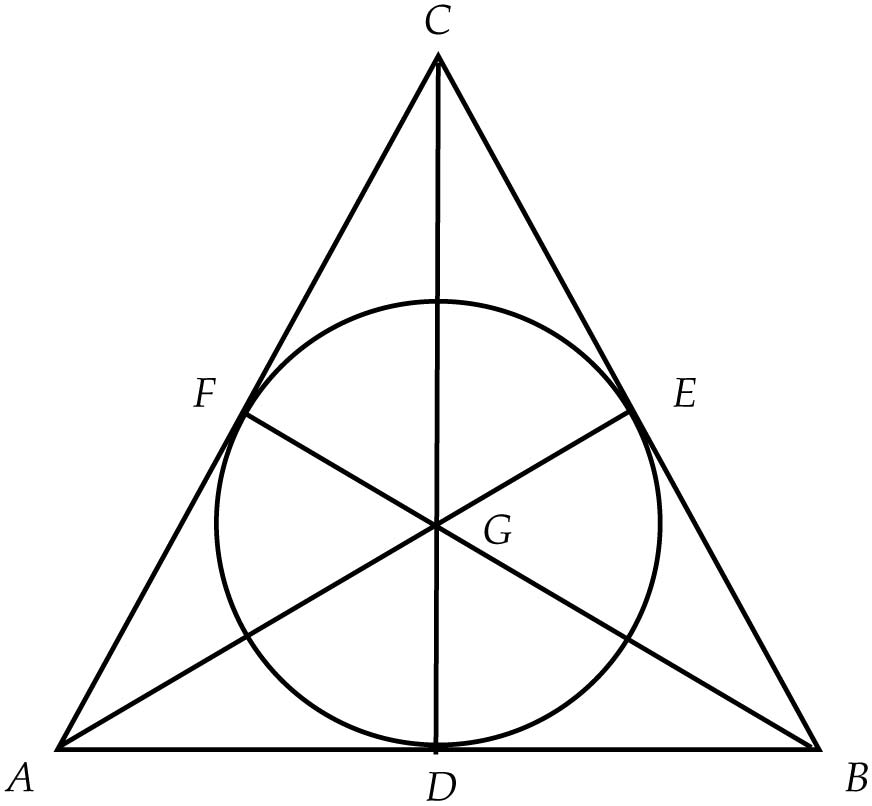
Van Fraassen then defines three theories: the core theory T 0 has axioms A1, A2, and A3; theory T 1 results from adding A4 to the core theory, and theory T 2 results from adding A5 to the core theory. Figure 1 shows that both T 1 and T 2 are consistent: the diagram m 1 consisting of just the seven points A–G is a model of T 1, and the entire drawing m 2 is a model of T 2.
Seven-point geometry.

According to van Fraassen, a semantic approach gives an account of the relationship between these theories superior to that given by a syntactic approach. In particular, he claims, first, that a syntactic view can see only that T 1 and T 2 are inconsistent: “logic tells us that [T 1 and T 2] are inconsistent with each other, and there is an end to it” (van Fraassen Reference van Fraassen1980, 43). In contrast, van Fraassen claims that a semantic view sees interesting relationships between T 1 and T 2: in particular, each model of T 1 is embeddable in a model of T 2: “that seven-point structure can be embedded in a Euclidean structure. … This points to a much more interesting relationship between the theories T 1 and T 2 than inconsistency: every model of T 1 can be embedded in (identified with a substructure of) a model of T 2. This sort of relationship, which is peculiarly semantic, is clearly very important for the comparison and evaluation of theories, and is not accessible to the syntactic approach” (43–44). Thus, a semantic view is supposed to show its superiority as a means for analyzing relations between theories.
In the years since van Fraassen first used “embeddability” to formulate constructive empiricism, several philosophers have been at pains to argue that embeddability—and other interesting relations between theories—can also be explicated via syntactic means (see, e.g., Turney Reference Turney1990). If that is so, then the syntactic approach can do just as much as the semantic approach. But I wish to take a harder line: I claim that the semantic approach cannot explicate the relation of embedding between theories.
What does it mean to say that the seven-point model m 1 is embeddable in the Euclidean model m 2? What is the definition of “embedding” that is being used? Obviously, an embedding cannot be just any function; for example, the function that maps everything to a single point is not an embedding. Similarly, an embedding cannot simply be a one-to-one map because such maps could also mess up geometrical relations.
The claim that m 1 can be embedded into m 2 is true in context, namely, the context of the background theory T 0. In particular, if we think of m 1 and m 2 as being represented by drawings on transparencies, then there is a rigid motion that carries m 1 on top of m 2. But “rigid motion” is a theory-laden concept: it denotes a transformation that preserves the relations definable in the core theory T 0. Generalizing from this example, we derive the following takeaway point:
Theory dependence of embedding. The notion of a “permissible embedding” of one structure/model into another structure/model depends on some background theory. In particular, “m is embeddable into m′” is a relation between models m and m′ of a single theory.
An obvious corollary of the theory dependence of embedding is that “embeddable” is not a relation that holds between models of two different theories, and so this notion cannot immediately be used to explicate concepts such as “empirical adequacy of a theory” or “reducibility of one theory to another.”
On a conciliatory note, I do grant that there is an interesting relation between van Fraassen's theories T 1 and T 2, but the relation probably should not be called “embeddability” since that term already has a technical use in model theory, as a relation between models of a single theory. Rather, T 1 and T 2 are both, by definition, specializations of the theory T 0. That is, they result from T 0 by adding some axioms. Whenever a theory T′ is a specialization of T, then there is obviously a syntactic interpretation map  , namely, the identity map. In the case at hand, we thus have two interpretations

and these yield model maps

Furthermore, since “line” can be defined in terms of pairs of distinct points, for each model m 1 of T 1, there is a model m 2 of T 2 such that  is embeddable (relative to the theory T 0) into
 .
In short, the models of T 1 can be compared with the models of T 2 because they can both be thought of as models of the common core theory T 0, which comes equipped with a notion of an embedding between its models. But without the syntactically specified theory T 0, we would not know how to compare models of T 1 with models of T 2.
To further clarify issues here, it might help to look at a simpler example that shares the relevant features of van Fraassen's example. Consider the following two theories:

Following van Fraassen's line of reasoning, we might say, on the one hand, there is no interesting syntactic relation between E 2 and E 3; they are simply inconsistent. On the other hand, each model of E 2 can be embedded in a model of E 3, an important fact that is visible only from a semantic perspective. Is this a good analysis of what is going on here?
Let's unpack the example. For each  , define the first-order sentences
 (there are at most i things),
 (there are at least i things), and
 (there are exactly i things). Then for all
 with
 ,

Note also that  is pure existential, that is, a string of existential quantifiers applied to a quantifier-free sentence. In particular, E 3 results from
 by adding a single existential axiom. From these facts, we note the obvious further fact that both E 2 and E 3 result from adding axioms to
 :
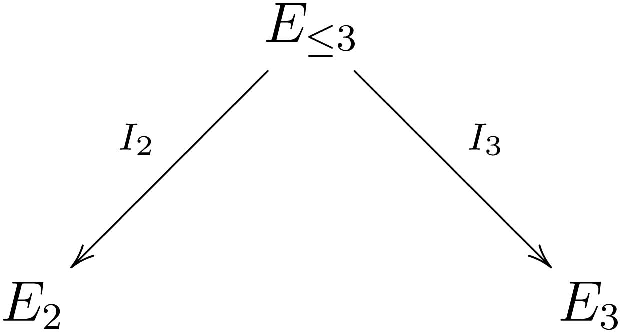
as depicted in the diagram of interpretations (fig. 2), where I 2 and I 3 are the identity interpretations. Thus, we conclude:
There is an interesting syntactic relation between E 2 and E 3; namely, they are specializations of a common theory  ; moreover, E 3 results from adding a pure existential axiom to
 .
Diagram of interpretations.

I claim further that any interesting semantic relation between E 2 and E 3 is nothing but a mirror image of this basic syntactic relation.
Incidentally, the considerations of this section point to yet another fatal defect in the pointwise isomorphism criterion P for theoretical equivalence. Recall that criterion P says that two classes of models  and
 should be deemed equivalent, just in case there is a bijection
 such that each model
 is isomorphic to its paired model
 . We have just seen, however, that the relation “m is embeddable in m′” is theory dependent. For the same reasons, the relation “m is isomorphic to m′” is also theory dependent since what counts as an “isomorphism” will depend on the theory in question. Thus, criterion P cannot possibly give an adequate account of the identity of theories.
6. Theories versus Formulations
We turn to a final purported advantage of the semantic view of theories: the semantic view is supposed to be language independent. Any nontrivial first-order theory admits alternative formulations. First, within a single language L, a given theory can be axiomatized in distinct ways, say, with axiom set T or axiom set T′. Of course, such a superficial difference can be remedied by taking a theory to be a set of sentences that is closed under the consequence relation; thus,  is the same theory. A more serious difficulty is posed by theories T and T′ formulated in different languages; that is,
 .
Frustration with trying to give conditions for equivalence between theories in different languages may be responsible for the semanticists search for “invariant” formulations of theories. According to Suppe, “theories are not collections of propositions or statements, but rather are extra-linguistic entities which may be described or characterized by a number of different linguistic formulations” (Reference Suppe1977, 221). Similarly, van Fraassen indicates that the class of models is the invariant that lies behind different formulations: “while a theory may have many different formulations, its set of models is what is important” (Reference van Fraassen2008, 309). Even more strongly, Muller and van Fraassen state: “In the semantic approach, we pride ourselves on not being so languagebound as one was during the hegemony of the syntactic view. Here a theory is not identified with or through its formulation in a specific language, nor with a class of formulations in specific languages, but through or by a class of models” (Reference Muller and Fraassen2008, 201). Finally, van Fraassen attributes the failure of the syntactic view of theories to its attachment to formulations rather than to the underlying invariant: “In any tragedy, we suspect that some crucial mistake was made at the very beginning. The mistake, I think, was to confuse a theory with the formulation of a theory in a particular language” (Reference van Fraassen1989, 221).
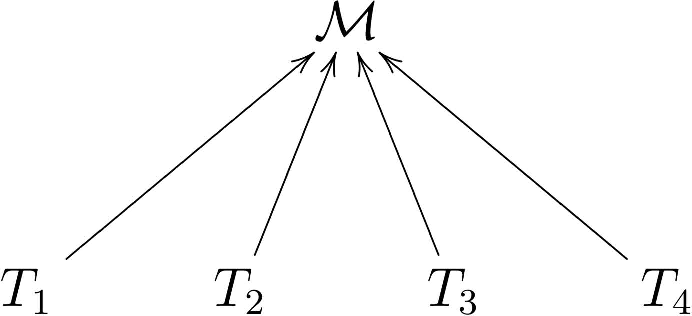
Thus, the picture given by semanticists is of a many-to-one relationship between formulations of a theory in a particular language (syntax) and a single class of models (semantics). Figure 3 shows such a picture in which T 1, T 2, … are theory formulations, and  is the ‘invariant’ class of models. Thus, the semanticists think of the relation between syntactic axiomatizations and classes of models as many-to-one and analogous to the relation between coordinates and underlying geometric objects or to the relation between sentences and propositions.
Many formulations, one class of models.

The picture of the class of models as an ‘invariant’ carries some initial plausibility—witness, for example, the case of different axiomatizations of group theory or different axiomatizations of vector space theory. Why would we call two different syntactic theories different formulations of the same theory unless they had the same class of models? But that is misleading: in interesting cases of alternative formulations, not only are the formulations different but so are the very classes of models.
But there is a correct picture lurking in the neighborhood: when we say, correctly but imprecisely, that two theories T and T′ have the “same” models, we mean that the models of T are somehow interconvertible with the models of T′. For example, every group can be converted into an autoset by “forgetting” its inverse operation and its identity element; similarly, every autoset can be converted into a group by defining an identity element and an inverse function. In fact, model theorists have a name for this sort of interconvertibility: it is called “mutual definability.” However, the notion of definability requires reference to language, and so it is not available on a pure semantic view of theories.
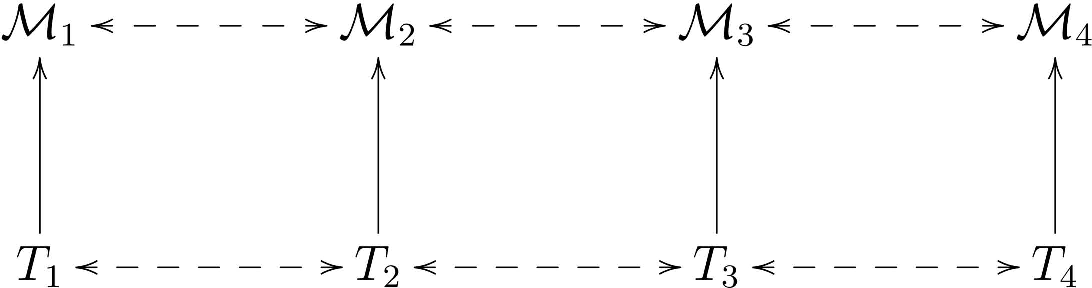
As we have now detailed at great length, there are equivalent theories (e.g., different axiomatizations of group theory) that have distinct classes of models. Thus, as opposed to the many-to-one picture, a more accurate picture of the relation between syntactic structures and semantic structures (for a single theory) is shown in figure 4. Here, the dashed arrows are supposed to indicate some sort of equivalence, a notion that should be discussed at greater length. On the bottom (syntactic) row, we already have many good examples of equivalence, such as different axiomatizations of group theory. And for the top (semantic) row, we also have some fairly simple but uncontroversial examples of equivalence, for example, models of group theory versus models of autoset theory.
Many formulations, many classes of models.

7. Esquisse d'un Programme
The semantic view of theories is plagued by many ills. But can it be cured? Should we try to cure it? Some might say that the problems here are caused by overtechnicalizing the concept of a scientific theory, that is, with trying to provide a formal analysis of the concept. Such seems to be the view of Gabriele Contessa: “Philosophers of science are increasingly realizing that the differences between the syntactic and the semantic view are less significant than semanticists would have it and that, ultimately, neither is a suitable framework within which to think about scientific theories and models. The crucial divide in philosophy of science, I think, is not the one between advocates of the syntactic view and advocates of the semantic view, but the one between those who think that philosophy of science needs a formal framework or other and those who think otherwise” (Reference Contessa2006, 376). I agree and disagree. I agree that the debate between syntactic and semantic views is less significant than was advertised by the semanticists. However, Contessa's implication is that we have to make an either-or choice between a “formal framework” for philosophy of science and some alternative. But what would “informal philosophy of science” look like? Should the informal philosopher of science eschew all use of mathematical notation or concepts? But how then should the informal philosopher of science discuss quantum mechanics or general relativity or string theory?
Indeed, there is another crucial divide that lies even deeper than the one indicated by Contessa: the divide between those who want to give a unified framework for all the sciences and those who do not aspire for such a framework. For those who do not aspire for a unified framework, it would be legitimate to employ a formal framework for those sciences that themselves employ a formal framework (e.g., mathematical physics) and a less formal framework for those sciences that themselves are less formalized (e.g., evolutionary biology).
Patrick Suppes famously said that “philosophy of science should use mathematics, and not meta-mathematics” (quoted in van Fraassen Reference van Fraassen1980, 65). But metamathematics is part of mathematics. And there is no clear distinction to be drawn between the two approaches. Furthermore, for some sciences, there is no distinction to be made between discussing a scientific theory “in its own language,” or we might say “on its own terms,” and discussing a scientific theory “in formal language.” Philosophers of science should not be afraid of using all the tools that scientists use, including mathematical logic.
Indeed, the defects in the semantic view that I have identified are not due to overmathematization per se; rather, these defects are due to inadequate mathematization. More precisely, the semantic view was not wrong to treat theories as collections of models; rather, it was wrong to treat theories as nothing more than collections of models. Beginning with a syntactically formulated theory T, we can construct its class Mod(T) of models. But we have more information than just the collection of models: in particular, we have information about relations between these models. For example, any sentence ϕ induces a relation on Mod(T), namely, the relation “m assigns the same truth value as m′ to ϕ.” There are other such relations, but none of these relations can be seen if we reduce a theory to a bare set of models.
This point has long been known to mathematicians and logicians; indeed, this point is a straightforward corollary of Stone's duality theorem for Boolean algebras. Given a propositional theory T, consider its set Mod(T) of models. Can we recover T from Mod(T)? Does the set Mod(T) contain as much information as the syntactic object T? Obviously not: as we have seen, there are distinct theories T and T′ whose sets of models Mod(T) and Mod(T′) are indistinguishable qua bare sets. How then should Mod(T) and Mod(T′) be distinguished from each other? That was the question that Marshall Stone took up in the 1930s, and Stone's answer was that Mod(T) and Mod(T′) have natural topological structure in terms of which they differ. In particular, define a topology on Mod(T) by saying that a sequence (m i) of models converges to a model m, just in case for each sentence p, the truth value  converges to the truth value
 . Then the theory T can be recovered (up to definitional equivalence) by extracting the compact open subsets of the topological space Mod(T). In other words, the topological space Mod(T) does contain all the information as the syntactic object T.
Fine, you might say: for the trivial case of propositional theories, we could rehabilitate the semantic view of theories by taking a theory to be a structured set of models, namely, a topological space of models. But this strategy obviously will not work in the general case because Stone's theorem only works for propositional theories.
But here there is good news to report: generalizations of Stone's duality theorem have been proved by Michael Makkai (Reference Makkai1993) and more recently by Steve Awodey and Henrik Forssell (Forssell Reference Forssell2008; Awodey and Forssell Reference Awodey and Forssell2010). The technical details of these results are far too complex to summarize here. Suffice it to say, however, that the question of what structure is naturally possessed by a class of models is highly nontrivial and calls for some serious (meta)mathematical research. Furthermore, the outcome of these investigations holds interest for anyone who wishes to understand the identity criteria for (formalized) theories and the relations that can hold between (formalized) theories—in particular, for all philosophers of the exact sciences. Despite philosophy of science's recent trend toward deformalization and imprecision, (meta)mathematicians continue to provide us with invaluable tools for discussing philosophical issues with clarity and rigor. We have only ourselves to blame if we do not take advantage of these tools.
 . These spaces have the same cardinality but are not homeomorphic.
 is a bijection but not necessarily an isomorphism of models. But there is no definition of isomorphism between models of different theories. See the next section, especially the final paragraph.
 , then
 .