INTRODUCTION
Competition for shared above-ground (light) and below-ground (water and/or nutrients) resources is one of the main processes that structures plant communities and maintains species diversity (Tilman Reference TILMAN1982). In closed-canopy tropical forests, competition is thought to be primarily for light, with species differing in shade tolerance (Coomes & Grubb Reference COOMES and GRUBB2000, Poorter Reference POORTER, Burslem, Pinard and Hartley2005). Competition for below-ground resources in high-light areas, however, may also be intense and experiments have revealed that below-ground competition may limit the recruitment and growth of plants, particularly in tropical forests that are nutrient poor or have seasonal droughts (Barberis & Tanner Reference BARBERIS and TANNER2005, Coomes & Grubb Reference COOMES and GRUBB2000, Lewis & Tanner Reference LEWIS and TANNER2000, Ostertag Reference OSTERTAG1998).
Lianas (woody climbers), abundant throughout the tropics (Bongers et al. Reference BONGERS, PARREN and TRAORE2005, Gentry Reference GENTRY, Putz and Mooney1991), may reduce tree recruitment, fecundity, growth rates and survival, as well as alter the successional trajectories of gap-phase regeneration (Schnitzer & Bongers Reference SCHNITZER and BONGERS2002, Schnitzer et al. Reference SCHNITZER, DALLING and CARSON2000, Stevens Reference STEVENS1987). Many studies of liana-induced competition have focused on their above-ground effects (Clark & Clark Reference CLARK and CLARK1990, Schnitzer et al. Reference SCHNITZER, DALLING and CARSON2000), probably because of the obvious effects of mechanical stress that lianas exert on trees and of the suppression of growth and survivorship of trees by shading with their large leaf areas (Cai et al. Reference CAI, POORTER, CAO and BONGERS2007a, Darwin Reference DARWIN1867, Putz Reference PUTZ1983). However, lianas can efficiently forage for water and nutrients due to their well-developed root and vascular systems, and thus may compete effectively with trees for below-ground resources (Dillenburg et al. Reference DILLENBURG, WHIGHAM, TERAMURA and FORSETH1993, Reference DILLENBURG, TERAMURA, FORSETH and WHIGHAM1995; Pérez-Salicrup & Barker Reference PÉREZ-SALICRUP and BARKER2000, Schnitzer et al. Reference SCHNITZER, KUZEE and BONGERS2005). The diverse responses of liana effects seem to be related to the light requirement of tree species they colonized. Lianas affect saplings of non-pioneer tree species more frequently than pioneer species (Clark & Clark Reference CLARK and CLARK1990, Putz Reference PUTZ1984) and might promote pioneer establishment in gaps by prolonging the gap life and by reducing competition from shade-tolerant species (Schnitzer et al. Reference SCHNITZER, DALLING and CARSON2000, Toledo-Aceves & Swaine Reference TOLEDO-ACEVES and SWAINE2007). It is also likely that tree seedlings will display a differential response to competition depending on the availabilities of the above- and below-ground resources (Coomes & Grubb Reference COOMES and GRUBB2000, Royo & Carson Reference ROYO and CARSON2006). For example, Svenning et al. (Reference SVENNING, FABBRO and WRIGHT2008) demonstrated that direct competitive interactions are weak and relatively unimportant among understorey shade-tolerant seedlings in humid tropical forest in Panama. However, Lewis & Tanner (Reference LEWIS and TANNER2000) showed that below-ground competition for nutrients limited seedling growth and increased mortality in both low- and high-light environments in a nutrient-poor tropical wet forest in Brazil. In contrast, in high-light areas such as treefall gaps and young secondary forests, where lianas are often very abundant (Putz Reference PUTZ1984, Schnitzer et al. Reference SCHNITZER, DALLING and CARSON2000, Reference SCHNITZER, PARREN and BONGERS2004), their competition to the seedlings and saplings of trees is probably extremely intense. Lianas caused strongly negative effects on trees during regeneration in canopy gaps (Schnitzer et al. Reference SCHNITZER, KUZEE and BONGERS2005, Toledo-Aceves & Swaine Reference TOLEDO-ACEVES and SWAINE2007, Reference TOLEDO-ACEVES and SWAINE2008a, Reference TOLEDO-ACEVES and SWAINEb). In addition, in the forest understorey at Los Tuxtlas it is unlikely that lianas might affect tree regeneration because lianas climbed on tree seedlings only rarely (Vleut & Pérez-Salicrup Reference VLEUT and PÉREZ-SALICRUP2005).
As forest fragmentation and disturbance increases, liana abundance is increasing in the tropics and its role in tropical ecosystems will be stronger (Phillips et al. Reference PHILLIPS, MARTINEZ, ARROYO, BAKER, KILEEN, LEWIS, MALHI, MENDOZA, NEILL, VARGAS, ALEXIADES, CERON, FIORE, ERWIN, JARDIM, PALACIOS, SALDIAS and VINCETI2002, Schnitzer & Bongers Reference SCHNITZER and BONGERS2002). Unravelling to what extent lianas can affect tree growth, and the underlying mechanisms, is important to understand the competitive role of lianas in forests (Schnitzer & Bongers Reference SCHNITZER and BONGERS2002). In this study, we tested the relative strengths of above- and below-ground effects of liana competition on seedling performance of three tree species differing in shade tolerance in two contrasting irradiances.
Specifically, we tested the hypotheses that, first, liana competition will negatively affect tree performance. Second, the relative importance of above- and below-ground competition in the interactions between liana and tree seedlings shifts with light availability. In low light we expected that above-ground competition (i.e. shoot competition) by the liana causes a strong effect on seedling development while below-ground competition (i.e. root competition) from lianas will be insignificant. In contrast, in high light, we expect below-ground competition to have strong effects. Third, we hypothesized that lianas affect seedlings of shade-tolerant tree species more strongly than those of light-demanding tree species because of the low ability of shade-tolerant tree seedlings to use abundant resources.
METHODS
Experimental design
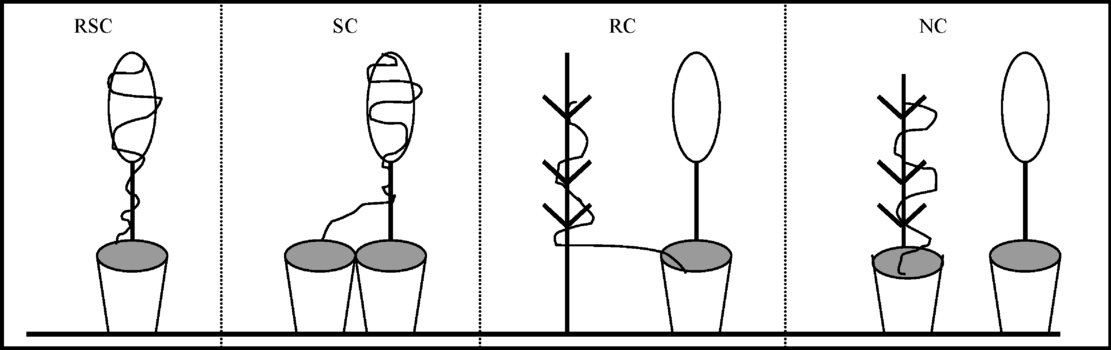
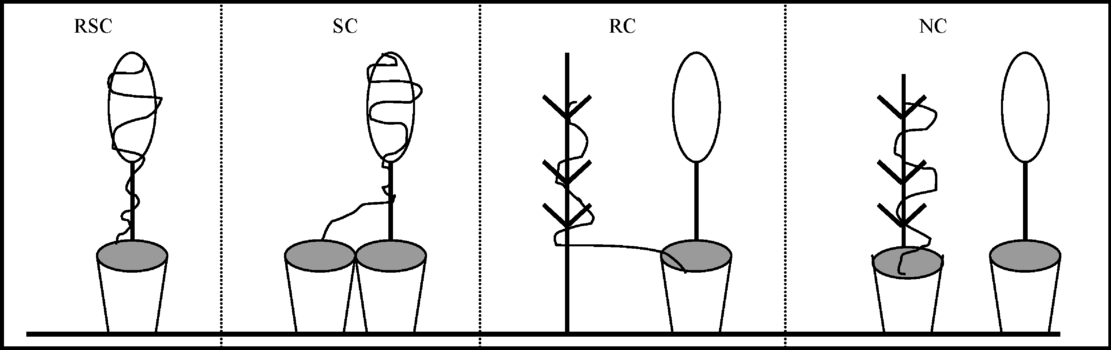
The experiment was conducted in shade houses in Xishuangbanna Tropical Botanical Garden (21°6′N, 101°5′E, 600 m asl), Chinese Academy of Sciences, Yunnan, south-west China. The climate of Xishuangbanna is dominated by a south-west monsoon, with a distinct dry season from November to April. The mean annual temperature is 21.7 °C and mean annual precipitation is 1500 mm, 80% of which falls during the wet season. We manipulated above- and below-ground competition by differently assembling the liana and tree seedlings with four competition treatments for each species (Figure 1): root and shoot competition (RSC, both above- and below-ground competition), root competition (RC, only below-ground competition), shoot competition (SC, only above-ground competition) and no competition (NC). We used a 4 × 2 factorial design for each of three tree species, where the factors and their levels were: four competition treatments (RSC, RC, SC and NC) and two light irradiances (4% and 35% photosynthetic photon flux density, PPFD, of full sun light, in shade houses created using neutral-density screen on a steel frame). Lianas were supported with dry bamboo shoots in RC and NC treatments (Chen et al. Reference CHEN, CAO and CAI2008). The PPFD in the shade houses was measured with LI-190 SA quantum sensors connected to an LI-1400 data logger (Li-COR, Lincoln, NE, USA) over four sunny days.
Schematic representation of four types of competition treatments between tree and liana Byttneria grandifolia seedlings. RSC, root and shoot competition, RC, root competition, SC, shoot competition, NC, no competition.
We selected three tree species which are common in the local forest reserve and differed in shade tolerance. Litsea dilleniifolia P. Y. Pai & P. H. Huang (Lauraceae) is a slow-growing mid-canopy species and is the most shade tolerant among the three species. Pometia tomentosa (Bl.) Teijsm. & Binn. (Sapindaceae) is an intermediate shade-tolerant upper-canopy tree that is found in both understorey and canopy gaps. Bauhinia variegata L. (Caesalpiniaceae) is a fast-growing, non-pioneer light-demander, typically found in high-light areas (Cai et al. Reference CAI, POORTER, CAO and BONGERS2007a). The liana species used as competitor is Byttneria grandifolia DC. (Sterculiaceae), a fast-growing, light-demanding twiner, which often covers the canopy of trees in gaps or edges of forests. Seedlings of the four studied species were collected from a nearby rain forest during April 2005, at the start of the rainy season, and were planted in a nursery with nearly 10% full sun light. The mean height of seedlings of the four species ranged from 12.7 to 33.9 cm (Byttneria: 12.7 ± 3.9 cm, Bauhinia: 21.1 ± 2.9 cm; Litsea: 22.2 ± 3.0 cm; Pometia: 33.9 ± 2.3 cm, n = 10–12). All seedlings were transplanted to clay pots (18 litres in volume) according to one of the four competitive combinations. The seedlings were grown in pots with substrates consisting of forest surface soil fully mixed with river sand 2:1 by volume. The forest soil was used to provide a substrate with a natural composition of macro- and micronutrients. The river sand improves the texture leading to adequate drainage, and facilitated harvests of the whole root system, including fine roots. After 1.5 mo adaptation in 10% light (Weinig & Delph Reference WEINIG and DELPH2001), 20 randomly selected pots for each treatment were moved to each of the two shade houses with 4% and 35% full sunlight respectively. All pots were rotated at a 20-d interval to avoid rooting into ground and local variation in light availability. To unify soil nutrient and soil water conditions among species and treatments we fertilized all pots 1 mo after transplanting with 20 g NPK slow-release compound fertilizer (Osmocote, Scotts, Marysville, OH, USA) and watered all plots on days without rain to maintain the soil near field capacity. Weeds were removed regularly and insecticides were used when necessary. At the end of the experiment, the leaves of the potted plants under both light levels were healthy and green.
Measurements
At the end of the experiment, the light-saturated CO2 assimilation rate was measured under ambient CO2 concentrations (c. 400 ppm) and temperature (25 °C) using a portable Li-6400 photosynthesis system (Li-6400, Li-Cor) on uppermost, fully expanded sun leaves at mid-morning, between 9 h and 11 h. PPFD was set at 800 and 1200 μmol m−2 s−1 in low and high light, respectively, with the built-in LED-B light source. Light-response curves showed that these were sufficient to saturate photosynthesis for all species. Eight to ten plants per species in each treatment were harvested and oven dried at 80 °C for 2 d to determine dry mass of roots, stem and leaves at the beginning of the experiment (June 2005). All plants were harvested for the final biomass measurement after 15 mo (September 2006) and separated into roots, stems (including petioles) and leaves. Measurements recorded included: main stem length, stem diameter at 10 cm above the soil surface, and leaf area. Total leaf area of each plant was measured with a leaf area meter (Li-Cor3000, Li-Cor). Stem height was recorded with a ruler and stem diameter at 10 cm above the soil surface was measured with a caliper. The following growth parameters were calculated from the basic measurements: relative growth rates in biomass (RGRB = (lnW2 – lnW1)/(T2 – T1), where W2 and W1 are the final and initial-dry weight per plant and T2–T1 is the time interval), relative growth rate in height (RGRH), relative growth rate in diameter (RGRD), leaf mass ratio (LMR, g leaf per g plant), stem mass ratio (SMR, g stem per g plant), root mass ratio (RMR, g root per g plant), specific leaf area (SLA, cm2 leaf per g leaf) and leaf area ratio (LAR, cm2 leaf per g plant).
Statistical analysis
For each measured variable, data were analyzed by two-way ANOVA with light and competition treatment as main fixed factors plus a light × competition interaction term. Differences of all parameters among the four competition combinations were tested by a one-way analysis of variance (ANOVA) and followed by Tukey multiple comparison test for each tree species. Data were checked for normality and homogeneity of variances, and a log10 or arcsine square-root transformation was applied when necessary to satisfy the assumptions of ANOVA. Statistical analyses were performed with SPSS 11.0 (SPSS, Chicago, IL).
RESULTS
Responses of liana Byttneria grandifolia to the competition with trees
After 15 mo of growth, most of the liana seedlings had grown over 2 m in length, with the mean total biomass of 44.3 and 162.1 g, and the mean total leaf area of 3623 and 8954 cm2, in low and high light, respectively. The mean relative growth rate in biomass (RGRB) of the liana seedlings was significantly affected by light level (F1,3 = 285, P < 0.001) and were 1.27 and 1.22 times those of the mean values of the host tree seedlings in low and high light, respectively. Competition by tree seedlings significantly reduced RGRB (F1,3 = 84.3, P < 0.001) of the liana seedlings, and in high light this reduction was stronger than in low light (22.6% vs. 14.3%). There were strong interactions of light and competition on the RGRB of the liana species (F1,3 = 9.7, P < 0.001).
Light and competition effects of liana on relative growth rates of tree seedlings
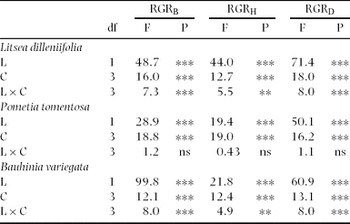
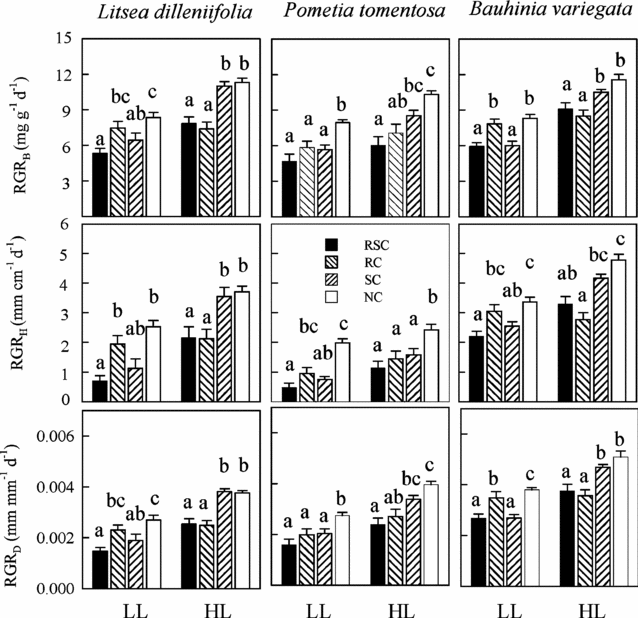
Light and competition significantly interacted in their effects on relative growth rate variables for Litsea and Bauhinia (Table 1), implying that the responsiveness to competition differed with light availability. The competition from liana seedlings suppressed RGRB, RGRH and RGRD of all tree seedlings, but the extent of reduction depended greatly on light level (Figure 2, Table 1). In low light, shoot competition (SC) caused greater decreases in growth than root competition (RC) for all three tree species, but not always significantly (Figure 2). RGR of seedlings with both root and shoot competition (RSC) and SC was lower compared to the seedlings with RC. The negative effects of the competition treatments increased in the sequence RC<SC<RSC.
Result of two-way ANOVA assessing the effects of light (L), competition (C) and their interactions on the relative growth rate in biomass, height and diameter (RGRB, RGRH and RGRD) of three tree species in response to a competing liana Byttneria grandifolia. ns = not significant at P > 0.05, ** P < 0.01, *** P < 0.001.

Relative growth rate (mean ± SE, n = 8–10) in seedlings of three species in response to a competing liana Byttneria grandifolia under different light and competition treatments. Significant differences (at P < 0.05) among the competition treatments in the same light level are indicated by different letters. RGRB, relative growth rate in biomass, RGRH, relative growth rate in height, RGRD, relative growth rate in diameter. RSC, root and shoot competition; RC, root competition; SC, shoot competition; NC, no competition. LL, low light; HL, high light.
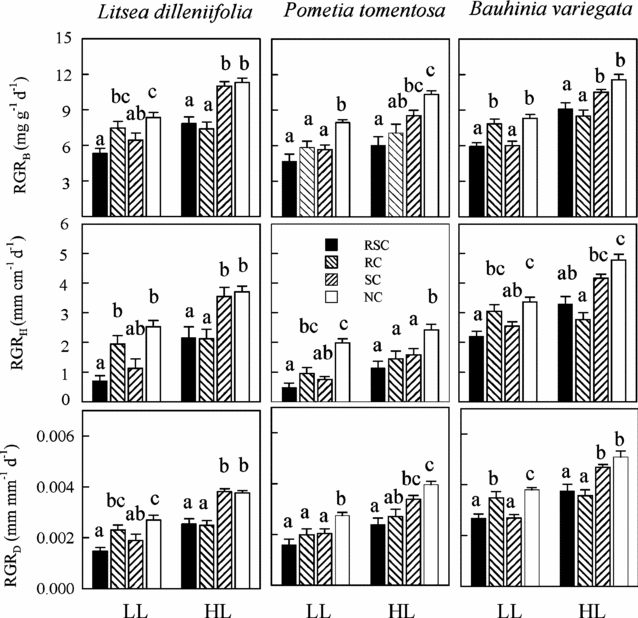
However, in high light, RC and RSC had similar effects on RGR of all three tree seedlings. RC instead of SC strongly inhibited the growth. RC resulted in up to 40% decline in growth but there were no differences in RGR between SC and NC. The response of growth to different competition treatments in the two light environments was remarkably similar among the three species.
Light and competition effects of liana on leaf and whole plant characteristics of tree seedlings
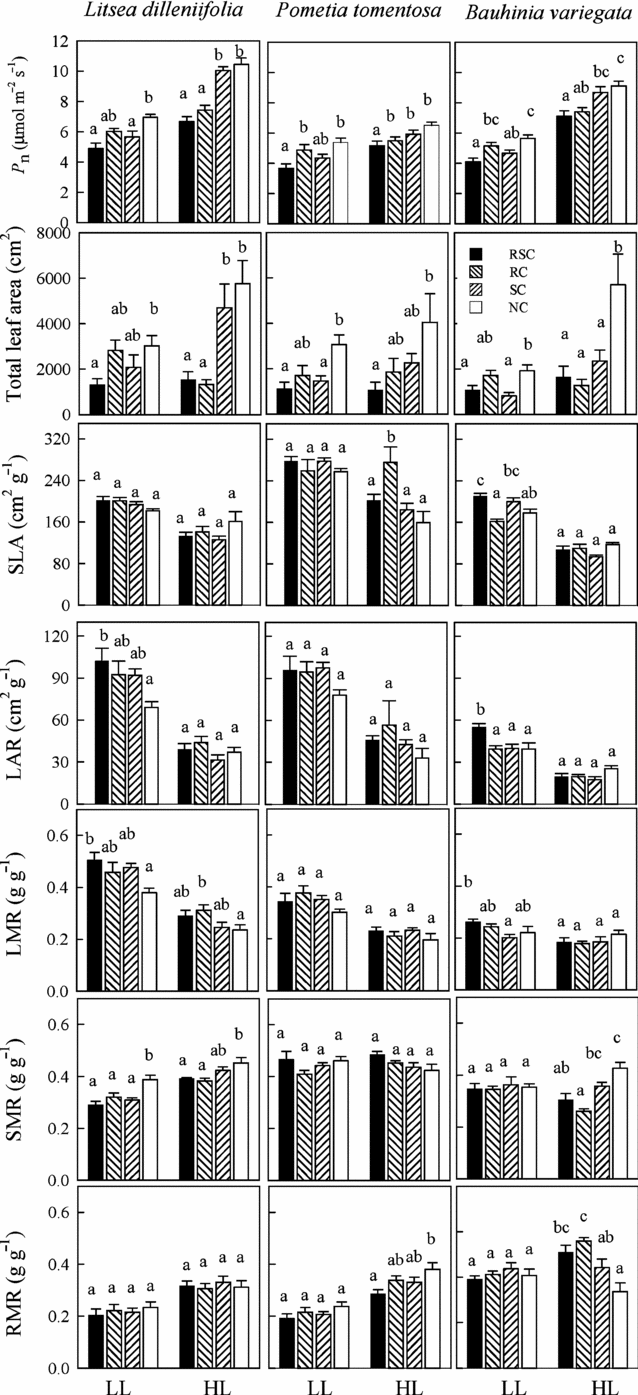
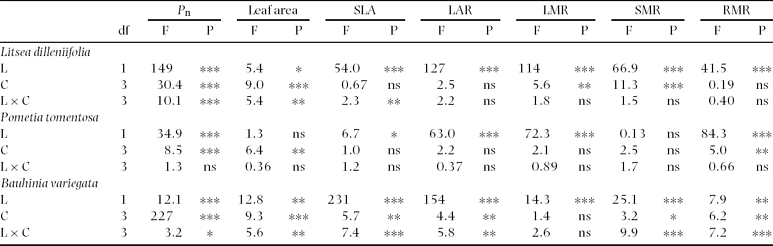
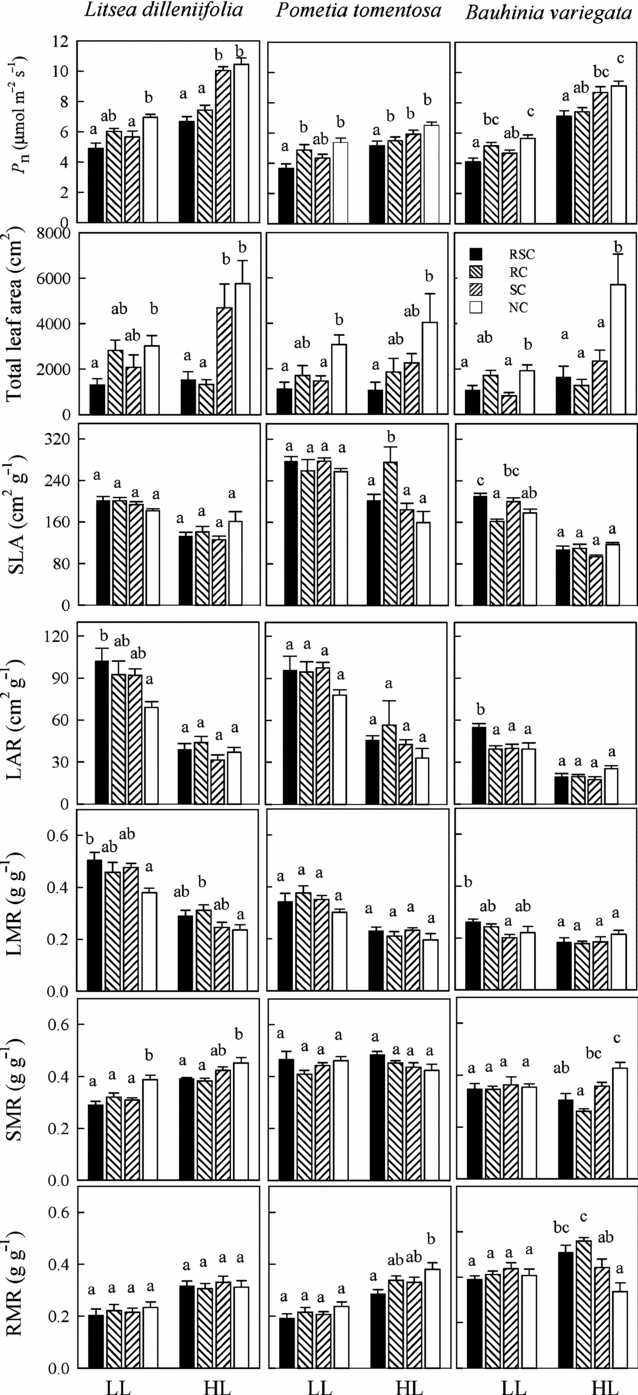
Light, competition, and their interactions had significant influences on the photosynthetic capacity (P n) of all three tree species (except interaction effects of Pometia) (Table 2, Figure 3). The significant light-competition interactions on P n of Litsea and Bauhinia (Table 1) implied that the responsiveness to competition differed with light availability. In low light, P n of three tree species declined significantly when grown under RSC and SC treatments, while no such decline was found under RC treatment. In high light, RSC and RC instead of SC caused great decreases in P n.
The light-saturated photosynthetic rate in leaves (P n), morphological traits and biomass allocation (mean ± SE, n = 8–10) in seedlings of three tree species in response to a competing liana Byttneria grandifolia under different light and competition treatments. Significant differences (at P < 0.05) among the competition treatments in the same light level are indicated by different letters. SLA, specific leaf area, LAR, leaf area ratio, LMR, leaf mass ratio, SMR, stem mass ratio, RMR, root mass ratio. RSC, root and shoot competition; RC, root competition; SC, shoot competition; NC, no competition. LL, low light; HL, high light.
Result of two-way ANOVA assessing the effects of light (L), competition (C) and their interactions on leaf light-saturated photosynthetic rate (P n), morphological traits and biomass allocation in seedling of three tree species in response to a competing liana Byttneria grandifolia. SLA, specific leaf area, LAR, leaf area ratio, LMR, leaf mass ration, SMR, shoot mass ratio, RMR, root mass ratio. ns = not significant at P > 0.05, * P < 0.05, ** P < 0.01, *** P < 0.001.
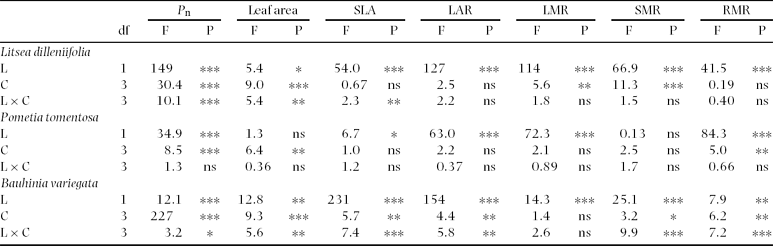
Light had significant effects on plant morphology and biomass allocation of all three species, except for the total leaf area and stem mass ratio (SMR) of Pometia. In high light, leaf mass ratio (LMR) decreased by 33.8% but root and stem mass ratio (RMR and SMR) increased on average by 31.8% and 6.3%, respectively. In response to liana competition, tree seedlings often grew with smaller leaf areas (Figure 3, Table 2). Specific leaf area (SLA) and leaf area ratio (LAR) of the three species were lower in high light compared to low light. Competition effects of liana on these parameters were generally low (Figure 3), with the light-demanding Bauhinia in low light showing the strongest effect.
The three species differed in biomass allocation in response to competition (Figure 3, Table 2), as expected. For example, liana competition significantly affected LMR and SMR for Litsea, SMR and RMR for Bauhinia, but only RMR for Pometia. There were significant interactions of light and competition on all morphological traits and biomass allocation patterns of the light-demanding Bauhinia except for LMR, whilst only few interactions were significant for the two shade-tolerant species (Table 2).
DISCUSSION
Liana competition had generally a strong effect on growth and on leaf and plant characteristics of the three tree species that we studied. Seedlings grown without liana competition had significantly higher growth rates than those grown with lianas after a period of about 15 mo, mainly due to a reduced leaf photosynthetic capacity and leaf area. This demonstrates that lianas hinder growth of tree seedlings, in line with our first hypothesis. These findings were largely identical among the three species, in contrast to our third hypothesis, and are consistent with other studies claiming that neighbouring lianas reduced tree seedling and sapling growth via above- and below-ground competition for shared resources (Chen et al. Reference CHEN, CAO and CAI2008, Dillenburg et al. Reference DILLENBURG, WHIGHAM, TERAMURA and FORSETH1993, Reference DILLENBURG, TERAMURA, FORSETH and WHIGHAM1995; Pérez-Salicrup & Barker Reference PÉREZ-SALICRUP and BARKER2000, Schnitzer et al. Reference SCHNITZER, KUZEE and BONGERS2005, Toledo-Aceves & Swaine Reference TOLEDO-ACEVES and SWAINE2007).
The relative importance of above- vs. below-ground competition from lianas changed with light level. In low light, above-ground competition (i.e. shoot competition) by the liana caused a strongly negative effect on seedling development while below-ground competition (i.e. root competition) from lianas was insignificant. The liana adequately competed for light in the light-limited low-light condition: their leaf areas were relatively large (mean leaf area of the liana seedlings was 2.36 times those of the host tree seedlings), and their leaves covered a large part of the seedling crown (c. 40% of the crown of each of the harvested tree seedlings, Y.-J. Chen & Z.-Q. Cai pers. obs.). Meanwhile, the absence of a significant below-ground competition effect in low light suggests that in our experiment light is a more critical factor than below-ground resources in limiting the growth of seedlings. This partly may be the result of our fertilizer addition which reduced nutrient scarcity. This supports the classical view that, in the low-light conditions of the forest understorey of tropical rain forests, below-ground competition for nutrients and water is insignificant for growth rate and survivorship of seedlings (Coomes & Grubb Reference COOMES and GRUBB2000, Ostertag Reference OSTERTAG1998, Svenning et al. Reference SVENNING, FABBRO and WRIGHT2008), while above-ground competition for light is acute and may partly explain community structure (Bongers & Sterck Reference BONGERS, STERCK, Newbery, Prins and Brown1998, Poorter et al. Reference POORTER, BONGERS, STERCK and WOLL2003, Reference POORTER, BONGERS and BONGERS2006). More recent studies, however, confirmed that below-ground competition does play a significant role as well: trenching or fertilizer addition substantially increased sapling growth, even in low-light conditions (Barberis & Tanner Reference BARBERIS and TANNER2005, Cahill Reference CAHILL2002, Coomes & Grubb Reference COOMES and GRUBB1998, Lewis & Tanner Reference LEWIS and TANNER2000). There is some evidence indicating that lack of significant competition effects may be related to the availability of light and soil nutrients: Coomes & Grubb (Reference COOMES and GRUBB2000) suggest that woody seedlings require a minimum of light resources in order to respond to soil nutrient changes. In our experiment, nutrient supply is appropriate (indicated by the healthy leaves of the seedlings) and probably non-limiting in the first period of the experiment, and water availability was controlled as non-limiting, supporting the importance of above-ground competition in low light (4% of full sun, comparable to the light level in the forest understorey, cf. Canham et al. Reference CANHAM, DENSLOW, PLAN, RUNKLE, SPIES and WHITE1990). In contrast, in high light (35% of full sun), below-ground competition has a greater effect than above-ground competition, maybe as the result of increasing nutrient limitation over the time period of the experiment. This suggests that treefall gaps in forests may result in a shift of the relative importance of above- compared with below-ground competition through a switch in the most limited resource (light to water and nutrients), in line with our second hypothesis. These switches are relative as various studies (Denslow et al. Reference DENSLOW, ELLISON and SANFORD1998, Lewis & Tanner Reference LEWIS and TANNER2000, Ostertag Reference OSTERTAG1998) have reported a reduction in competition intensity related to nutrients and water in forest canopy gaps.
The importance of liana competition for below-ground resources supports the findings of previous studies (Dillenburg et al. Reference DILLENBURG, WHIGHAM, TERAMURA and FORSETH1993, Pérez-Salicrup & Barker Reference PÉREZ-SALICRUP and BARKER2000, Schnitzer et al. Reference SCHNITZER, KUZEE and BONGERS2005, Toledo-Aceves & Swaine Reference TOLEDO-ACEVES and SWAINE2007). In open conditions (e.g. treefall gaps, secondary forest) where light is abundantly available, the demand of nutrients and water by the rapidly growing vegetation is also higher, mainly due to higher respiration and photosynthetic rates in leaves. In such conditions below-ground competition is expected to have strong effects on seedling performance (Coomes & Grubb Reference COOMES and GRUBB2000). This, however, is not always the case. In semi-deciduous forest gaps in Ghana the light-demanding liana Acacia kamerunensis indeed significantly reduced the growth of tree seedlings, but the shade-tolerant liana Loeseneriella rowlandii had no effect (Toledo-Aceves & Reference TOLEDO-ACEVES and SWAINE2008b), possibly due to low growth of Loeseneriella and thus low nutrient and water demand.
Biomass allocation patterns changed with light as expected, with lower LAR, lower LMR and higher RMR in high light (Cai et al. Reference CAI, CHEN and BONGERS2007b, Poorter Reference POORTER2001, Reference POORTER, Burslem, Pinard and Hartley2005). With competition the patterns changed depending on species and parameter, as hypothesized. Patterns of biomass allocation and architecture in response to variation in resource availability are well documented, but surprisingly few studies have described plant morphology in response to competition (Cahill Reference CAHILL2003). An altered morphology may constrain the ability of plants to respond to competition (Burton & Bazzaz Reference BURTON and BAZZAZ1995). Similar results on changes in allocation and leaf characteristics were also found in other studies (Dillenburg et al. Reference DILLENBURG, TERAMURA, FORSETH and WHIGHAM1995, Lewis & Tanner Reference LEWIS and TANNER2000, Schnitzer et al. Reference SCHNITZER, KUZEE and BONGERS2005). In contrast, Toledo-Aceves & Swaine (Reference TOLEDO-ACEVES and SWAINE2008a) reported that tree seedlings differing in shade tolerance did not respond to liana competition by altering their biomass allocation patterns. Sometimes, such changes in biomass allocation in response to competition have been attributed to changes in plant size rather than to adaptive plasticity (Cahill Reference CAHILL2003, Reynolds & Antonio Reference REYNOLDS and ANTONIO1996, but see Shipley & Meziane Reference SHIPLEY and MEZIANE2002).
Although the debate on the relative importance of above- and below-ground competition has continued for many years, no consensus has been reached yet (Barberis & Tanner Reference BARBERIS and TANNER2005, Coomes & Grubb Reference COOMES and GRUBB2000, Dillenburg et al. Reference DILLENBURG, WHIGHAM, TERAMURA and FORSETH1993, Reference DILLENBURG, TERAMURA, FORSETH and WHIGHAM1995; Lewis & Tanner Reference LEWIS and TANNER2000, Schnitzer et al. Reference SCHNITZER, KUZEE and BONGERS2005). The contrasting findings of these studies were partly due to differences in research conditions (in forest or grassland), the plant sizes and species used (both target and neighbouring species, e.g. grass, trees or lianas were used as neighbours) and the intensity of competition. The relative availability of above- and below-ground resources (light, water and/or nutrients) differed greatly among the sites studied, from extremely nutrient-poor (Coomes & Grubb Reference COOMES and GRUBB1998, Lewis & Tanner Reference LEWIS and TANNER2000) to highly fertile soil (Ostertag Reference OSTERTAG1998, Twolan-Strutt & Keddy Reference TWOLAN-STRUTT and KEDDY1996), and from dark understorey (Ostertag Reference OSTERTAG1998) to heterogeneous, high-light conditions (Schnitzer et al. Reference SCHNITZER, KUZEE and BONGERS2005). Under such contrasting conditions opposite results would be expected to occur. Secondly, different target species or the use of only a few species may make it difficult to generalize the conclusions. Finally, inconsistent methodologies may account for variance among the studies. McPhee & Aarssen (Reference MCPHEE and AARSSEN2001) showed that the extent to which above- and below-ground competition interact remains uncertain because of the limitations of design, particularly the lack of control for apparatus effects (i.e. effects of the above- or below-ground physical partitions themselves on target or neighbour performance). Several studies did not determine the shoot competition directly: often the difference between solely root competition and full competition is interpreted as the intensity of solely shoot competition (Barberis & Tanner Reference BARBERIS and TANNER2005, Cahill Reference CAHILL2002, Schnitzer et al. Reference SCHNITZER, KUZEE and BONGERS2005, Twolan-Strutt & Keddy Reference TWOLAN-STRUTT and KEDDY1996, Wilson & Tilman Reference WILSON and TILMAN1993). And in some studies only the above-ground part of seedlings was taken into account (e.g. Schnitzer et al. Reference SCHNITZER, KUZEE and BONGERS2005), leading to a partial view on competition. As Zobel & Zobel (Reference ZOBEL and ZOBEL2002) wrote: ‘It is impossible to understand the behaviour of plant individuals (species) in a competitive environment without considering the response of a plant individual as a whole.’
In conclusion, liana competition reduced the photosynthetic capacity, leaf areas and growth and modified morphological traits and biomass allocation of all three tree species (including light-demanding and shade-tolerant ones), in line with our hypotheses. In low light, above-ground competition had the strongest effects, while in high light below-ground competition was most important. Our study thus provides evidence that the relative importance of above- and below-ground competition in the interactions between lianas and trees at the critical seedling stage in the regeneration shifts with light availability. In the highly dynamic environment of most tropical forests this may have profound implications for competitive balances among co-occurring species.
ACKNOWLEDGEMENTS
We thank Wen B. and Ma H. for plant material collections and Chen Y. for the field work and measurements. Three referees and the JTE editor provided constructive comments which improved the manuscript. This work was financially supported by a grant (30500065) from the National Natural Science Foundation in China and sandwich PhD grant from Wageningen University, the Netherlands.