Introduction
The decline and disappearance of local breeds has been described sufficiently (FAO, Reference Hodges1992, Reference Rischkowsky and Pilling2007a; Simon and Buchenauer, Reference Simon and Buchenauer1993; Alderson, Reference Alderson2003; Gandini et al., Reference Gandini, Ollivier, Danell, Distl, Georgoudis, Groeneveld, Martyniuk, van Arendonk and Woolliams2004). The decline of such breeds can be attributed, to some extent, to the failure of markets and the failure of institutions to provide advise to decision-makers. The main causes of this decline include: (1) the widespread use of a few highly productive breeds; (2) the mechanization of farming, which has meant that animals are no longer needed for draught power; and (3) the increasing abandonment of agricultural land in many marginal areas, where the majority of local breed populations are concentrated (Cicia, d'Ercole and Marino, Reference Cicia, d'Ercole and Marino2003). In regions outside Europe, the main causes of the loss of local breeds can be assigned to policies implemented by governments, development projects and private companies that promote the use of international breeds either as pure-breeds or via cross-breeding to “improve” local breeds (Köhler-Rollefson and Mundy, Reference Köhler-Rollefson and Mundy2010).
The first legally binding international instrument containing provisions to conserve agro-biodiversity was the Convention on Biological Diversity (CBD) (Article 8c), signed in 1992 at the Earth Summit in Rio de Janeiro. At the Rio Summit, Agenda 21, a plan of action to be undertaken by stakeholders at global, national and local levels was adopted. Agenda 21 included a chapter (Chapter 14) dealing with the promotion of sustainable agriculture and rural development, which covered issues related to the conservation and development of animal genetic resources (United Nations, 1993). Thus, society's increasing awareness of the loss of biodiversity, included awareness of the decline in livestock diversity.
Since the time of the Earth Summit, international debate was initiated and efforts have increasingly been made at global, regional and national levels to promote the role of livestock and their products in food security and rural development and to prevent the erosion of animal genetic resources (Ligda and Zjalic, Reference Ligda and Zjalic2011).
It is recognized that there is a need to enhance monitoring, characterization and research on the adaptive characteristics of local breeds. Specific actions are included in the Global Plan for Action for Animal Genetic Resources (FAO, 2007b). Within the framework of the Global Plan of Action, countries have developed, and others are in the process of developing, national plans for management of animal genetic resources. Furthermore, local initiatives are being taken by livestock keepers, producers and other stakeholders, focusing mainly on the promotion of local breeds by increasing their share in the market, but also by focusing on their role in management of the environment, and in the culture and history of their regions.
The material presented at the EAAP Session “Strategies to add value to local breeds”, and in this special issue, covers various strategies that have been used to add value to local breeds in different countries and regions with the aim of increasing their competitiveness and their sustainability in the long term. This paper aims to present a general overview of these strategies, illustrated with examples, and to analyse their strengths and weaknesses in relation to the environments where they are implemented.
Strategies for adding value
The design of appropriate strategies for adding value to local breeds and thereby ensuring viable future for them has been a major concern for development agencies, breeders' associations and individual breeders. The management of local breeds is a complex issue that involves a range of different stakeholders, who have diverse economic, social, environmental and technical objectives. The stakeholders include direct users (livestock keepers, producers, manufacturers and consumers) and indirect users (the community, i.e. the inhabitants of rural areas who receive benefits from livestock farming). Obviously, the interests of various stakeholders may differ. Farmers and producers mainly focus on increasing the profitability of primary production, manufacturers and retailers are interested in adding value to the primary product and consumers are primarily interested in the safety and quality of the product. Price, and ethical and cultural issues are also important, to varying degrees, for various groups of consumers. It can be argued that, in the long term, society is the key stakeholder defining the framework in which livestock production is practised (Woolliams et al., Reference Woolliams, Berg, Maki-Tanila, Meuwissen and Fimland2005).
The papers in this issue present case studies that feature a number of different species, breeds and countries. The strategies described can be grouped into three categories:
-
1. linkage of local breeds to traditional products and/or tourism/agritourism;
-
2. promotion of local breeds in specific farming systems, such as organic production, conservation grazing, silvipastoral systems and small-scale low-input farms and hobby farms; and
-
3. general strategies focusing on the promotion of local breeds, (marketing, legislation, organizational issues and raising public awareness) (Papachristoforou, Koumas and Hadjipavlou, Reference Papachristoforou, Koumas and Hadjipavlou2013).
These strategies are interrelated and overlapping. The first two categories cover more specific initiatives, while the third focuses on enabling factors.
Valorization strategies can also be distinguished according to whether they originate as collective actions or as individual initiatives (Lauvie, Lambert-Derkimba and Casabianca, Reference Lauvie, Lambert-Derkimba and Casabianca2013). Collective actions involve farmers grouped into cooperatives or associations and companies that process products.
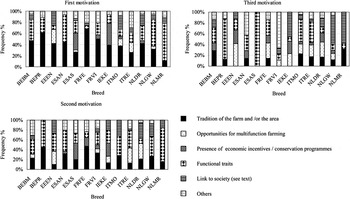
Gandini et al. (Reference Gandini, Avon, Bohte-Wilhelmus, Bay, Colinet, Choroszy, Díaz, Duclos, Fernández, Gengler, Hoving-Bolink, Kearney, Lilja, Mäki-Tanila, Martín-Collado, Maurice-van Eijndhoven, Musella, Pizzi, Soini, Toro, Turri, Viinalas and Hiemstra2010), describing motivations and values associated with 15 local cattle breeds in Europe, state that most farmers keeping these breeds need development of activities that promote and help farming of such breeds. Among the three main reasons given for keeping local cattle breeds (see Figure 1), farmers ranked the functional traits of such breeds most highly, followed by tradition and the availability of external support. The relatively low importance given to external support from conservation programmes might indicate that such support is generally inadequate as a means of encouraging farmers to continue keeping local breeds.
Three main factors motivating farmers to keep local cattle breeds. Source: Gandini et al. (Reference Gandini, Avon, Bohte-Wilhelmus, Bay, Colinet, Choroszy, Díaz, Duclos, Fernández, Gengler, Hoving-Bolink, Kearney, Lilja, Mäki-Tanila, Martín-Collado, Maurice-van Eijndhoven, Musella, Pizzi, Soini, Toro, Turri, Viinalas and Hiemstra2010).

It is important to note that the circumstances of different breeds and different countries vary greatly, which indicates that actions aimed at promoting local breeds should be flexible and adaptable to local requirements.
Links to traditional products and/or tourism/agritourism
Linking a breed to a specific product or products is considered to be an effective way of increasing the breed's value, provided specific and well-defined steps are followed. There are several instruments in the European Union that can be used to promote such initiatives.
Increasing scientific knowledge of breed characteristics and the quality of their products – both nutritional characteristics and flavour – is a fundamental step in the development of a brand name for a product. Numerous studies describe the identification of product-quality traits in specific breeds as the initial step justifying the linkage of the breeds to the products and/or production systems.
Sanz et al. (Reference Sanz, Alberti, Blasco, Ripoll, Alvarez-Rodriguez, Bernues, Olaizola, Zaragoza, Rodellar, Martin-Burriel, Picot, Congost, Abril and Vijil2013) discuss the example of the Serrana de Teruel cattle breed of Southern Aragon, Spain, from the perspective of defining the standard requirements for a labelled meat product that will support a conservation programme in the medium term. Along with studying carcass and meat quality in three commercial categories, the authors investigated the opinions of farmers and consumers regarding “Serrana de Teruel” beef.
Karatosidi et al. (Reference Karatosidi, Marsico, Ligda and Tarricone2013) describe two quite diverse cases: Italian Podolian cattle and Greek Katerini cattle. The former is found in the southern part of Italy (Abruzzo, Basilicata, Calabria, Molise and Apulia) and the latter (which has a population of only 217 heads) in Thessaly, Greece. The paper aims to compare the quality parameters of the two breeds and propose a plan for conservation of the Katerini through certification of meat quality.
Lauvie, Lambert-Derkimba and Casabianca (Reference Lauvie, Lambert-Derkimba and Casabianca2013), in comparing two pig breeds, the Nustrale and the Blanc de l'Ouest, show that local breeds can have very contrasting development dynamics, even if they belong to the same species and are kept in the same national institutional context. These different dynamics are attributed to local specificities in the agro-food system.
Comparing the Nustrale with the Cinta Senese breed (from Tuscany, Italy), both of which are subject to applications for protected designations of origin (PDOs), Casabianca et al. (Reference Casabianca, Maestrini, Franci and Pugliese2010) show that the attractiveness of keeping both breeds has increased because of developments in product marketing. However, in both cases, the question of the environmental impact of the production units has not really been addressed by the projects.
An interesting case study from Morocco, related with the development of a Protected Geographical Indication (PGI) product for lamb meat under the name “Viande Agneau Béni Guil”, was presented by Fagouri at a FAO Workshop (19–21 November, Reference Fagouri2012, Rabat, Morocco). The group of producers involved in this initiative belong to the National Association of Sheep and Goat Breeders (ANOC). The actions taken include:
-
1. description of the main characteristics of the product (breed, age, live weight, carcass weight, composition, etc.) and the production system;
-
2. description of different types of products within the PGI; and
-
3. description of other specific characteristics such as the taste of the meat.
It is important to establish the criteria that justify the link between the product and the region (historical data), to define the production zone (altitude, climate, vegetation, etc.) and to list the operations that take place in the specific zone (selection, lambing, weaning, slaughter, etc.). All these steps should be clearly defined and ensure traceability of the product. Nevertheless, it is important to bear in mind that when a group of producers (farmers and manufacturers) start the process of establishing a PGI, the product already exists and is already recognized by consumers as a unique product that is connected to the region.
Furthermore, Araba, Chatibi and Casabianca (Reference Araba, Chatibi and Casabianca2012) analyse the importance of connection to the market in conservation of a local cattle breed in Morocco and the difficulties that breeders from a mountainous area far from large towns have in accessing remunerating markets.
In the case of the Tunisian Sicilo-Sarde Breed Association, a group of enthusiastic farmers succeeded in doubling the income coming from milk production by improving the production level (supported by research) and capitalizing on market opportunities for cheese production. Development of the dairy-sheep sector led to the establishment of a new collecting centre in Beja, linked to an artisanal dairy processing plant under the name of “Fromagerie artisanale de Béja”. The possibility of another collection centre and artisanal processing plant in Mateur region is being considered. These products were developed as part of the FAO project (TCP 3202). The “Noire de Thibar” sheep breed of Tunisia provides another example of an organized process that aimed to identify meat-quality characteristics that could be used to distinguish the product from similar products from other breeds (Slimene et al., Reference Slimene, Ouhichi, Chammakhi and Loukil2013).
Promote the use of local breeds in specific farming systems
A key element of strategies that aim to take advantage of the roles of local breeds in specific farming systems (e.g. for low-input and organic production systems) is improving knowledge of these roles. The evaluation of the performance of breeds in specific production systems may reveal characteristics that can be used to increase their value. The suitability of traditional breeds for low input and organic production systems depends on a balance between productivity, suitability for outdoor production and conformity with market demands. The review of Leenhouwers and Merks (Reference Leenhouwers and Merks2013) groups traditional pig breeds into two categories: (1) a group of prolific breeds with good finishing performance (e.g. Saddlebacks and Pulawska); and (2) breeds that are kept for specialized meat production (e.g. Iberico and Cinta Senese). The breeds belonging to the first category are suitable for organic production, especially when crossed with conventional breeds (e.g. Large White, Landrace and Duroc), while breeds of the second category are not suitable for commodity organic production, because of their low fertility and high carcass fatness. However, the latter group of breeds are suitable for production of breed-specific products, as shown by the case of the Nustrale and the Cinta Senese breeds (Casabianca et al., Reference Casabianca, Maestrini, Franci and Pugliese2010).
Cassandro (Reference Cassandro2013) addresses the question of valuing the environmental benefits that may be obtainable from the use of local breeds. The example focuses on lower greenhouse gas emissions of local cattle breeds, which are low input animals characterized by modest body weight. According to the author, local Italian cattle breeds studied are expected to have 10 percent lower daily methane emissions per kg of metabolic body weight than “cosmopolitan” breeds (Holstein–Friesian, Brown Swiss and Simmenthal). It is argued that such factors should be taken into consideration when defining the traits upon which local breeds should be evaluated and that local breeds should not be evaluated merely as food providers, but also as providers of public goods.
Papachristoforou, Koumas and Hadjipavlou (Reference Papachristoforou, Koumas and Hadjipavlou2013) provide another example of the use of local breeds for environmental purposes: in this case, Segurena sheep and Malaguena goats are used to clear forest in a mountainous area in Andalusia, Spain, and the farmers receive incentives for providing the service. Another example from Spain, in which local breeds are used in silvipastoral systems that link production and nature conservation, is described by Olea and Miguel-Ayanz (Reference Olea and Miguel-Ayanz2006), who provide detailed information on major components of the Spanish dehesa system in which local livestock plays an important role in use of natural pastures and in preserving the ecosystem's biodiversity. In Austria, the risk of avalanches in the high Alps is reduced by keeping grazing animals on steep slopes above the tree limit (Berger, Reference Berger2010). In Ireland, native cattle and sheep breeds are being looked at for their role in grazing specific habitats of environmental interest and in France local breeds are used for landscape management (mountains, wetlands) and for protecting Mediterranean forests against fire (Ligda and Zjalic, Reference Ligda and Zjalic2011).
The use of local breeds by small-scale and hobby farmers should also be considered in valorization strategies. Examples from Europe include the Kempen Heath sheep in the Netherlands, which is not only kept for heath management, but also for wool and meat. Meat products from Kempen Heath sheep, together with Drenthe Heath sheep, are sold under the Slow Food label (http://www.slowfood.com). Different organizations and networks, such as Slow Food,Footnote 2 the ELBARN ProjectFootnote 3 and the World Initiative for Sustainable Pastoralism,Footnote 4 encourage and support small-scale and low-input production from local breeds.
General strategies
The selection process and the diffusion of genetic gain are important issues in management of local breeds and indirectly in all efforts to increase their value. Breeding programmes for local breeds are threatened by various forces, including competition from more productive and widespread breeds, economic constraints (lower demand for selected semen, lower return on investment) and the use of breeding animal exchanges. Labatut et al. (Reference Labatut, Girard, Astruc and Bibé2013) provide important information on this topic, describing the situation of three local dairy sheep breeds from the Western Pyrenées of France. These three breeds (Manech Red Face, Manech Black Face and Basco Bearnaise) are used for production of Ossau-Iraty cheese. The results presented by the authors highlight the importance of the availability of breeding animals (specifically young ewes) and collective organization of the market for breeding animals for conservation of local breeds and for improving their competitiveness. These findings support the contention that it is necessary to take into account not only the genetic aspects of breeding programmes but also the organizational dimension. One suggestion that needs further investigation is the organization of a data bank on the animals provided by the nucleus flocks and a system for providing data to and accessing data from the data bank.
Related to the above is the management of local breeds and interaction with strategies for valorization of local breeds. Lambert – Derkimba et al. (2013) describe the cases of six local cattle breeds, five of which are connected to at least one PDO. Different approaches are followed depending on the goals of the breeders, which might be regarded as a drawback for development of breeds with small population sizes. The example of the Vosgienne breed illustrates this conflict. For breeders that sell milk to the dairy industry, the selection criterion is milk yield, while for those that process cheese on-farm, the most important selection criterion is specific milk quality that is needed for cheese production. When all the breeders are involved in production of a PDO product, as in the case of the Tarentaise breed and Beaufort PDO cheese, a consensus on selection objectives is easier to reach (Lambert-Derkimba et al., Reference Lambert-Derkimba, Minéry, Barbat, Casabianca and Verrier2010). An interesting example of breed valorization is illustrated in the same paper by the case of the Aubrac breed, which is used in a cross-breeding scheme with the Charolais breed to produce calves for the Italian fattening chain. This has led to an increase in demand for Aubrac cows, which are easy calving, have good mothering abilities and are able to make use of a harsh environment. The different labels used to valorize female calves and older animals generate better prices for meat and have contributed to keeping the breed in use in the region (Lambert-Dekirmba et al., 2013).
The examples show that there is more than one way to valorize a breed. A valorization strategy should reflect real situation of the breed. Clearly, this requires an in-depth understanding of the breed, the production system and other relevant factors.
The organization of the “Noire de Thibar” sheep meat sector in Tunis (Slimene et al., Reference Slimene, Ouhichi, Chammakhi and Loukil2013) involves a producers group – which supports the organization of farmers, determines the production plan and organizes collection and sorting of lambs, and delivery of animals to the slaughterhouse – and a quality group representing the operators involved in the production process (farmers, slaughterers, meat companies and distributors). These operators will decide on the quality mark, whether a geographical indication or a collective trademark.
Marketing is an important element of valorization strategies for local breeds. It includes the steps that need to be taken to identify special characteristics of the targeted breed and its products, as well as market research, actions that facilitate access to new markets, awareness raising among consumers and so on. Marketing requires good knowledge of the breed and its production system. Institutional and legal frameworks may support the development of marketing initiatives and increase the efficiency of efforts undertaken by local communities.
Agritourism is another relevant activity. It is not a strategy for adding value to local breeds, but should be regarded as a distinct sector of agricultural activities that provides a favourable environment for sustainable development of local breeds and promotion of their products by increasing demand in the local market and economic activities in the local region.
In several countries in Europe (e.g. Austria, Ireland, Sweden and Switzerland), local rare breeds are considered to be tourist attractions and can generate a certain amount of income at sites visited by tourists. Farm parks in the United Kingdom carry out important work in the field of conservation and many provide educational services. Some of them are approved by the Rare Breeds Survival Trust (an NGO) and are involved in the conservation, breeding and promotion of rare breeds (www.rbst.org.uk) (Ligda and Zjalic, 2010).
Key factors in the success of valorization strategies
Strategies for adding value to local breeds vary according to the species, the characteristics of the breeds and their production systems, the nature of existing markets, the dynamics of breeders' associations or other stakeholders, the goals of the stakeholders, etc.
The successful implementation of any strategy requires use of reliable information on characteristics of the product and the production method. It is also necessary to ensure reliability of the process. Methods and systems for adding value to local breeds, range from the use of trademarks or official designations, to initiatives exploiting the breeds' non-direct use values, such as those associated with their cultural or environmental roles.
The main points that emerged from analysis of the cases examined are summarized in this section. It is not possible to offer straightforward guidelines that can be applied in all cases. Factors that are strengths for local breeds in one set of circumstances, may be weaknesses in others.
Factors related to the production environment
Local breeds have been raised for many years, or even centuries, in specific locations and have developed hardiness and adaptedness to these production systems. The main advantages of local breeds originating from this link between the breed and the production system, which can be analysed in terms of the production system are; the breed, the production of typical products for specialized markets, or values related to the ecosystem or cultural heritage.
Production system
The importance of the production system refers to the specific characteristics of the management system and the natural environment in which the breeds are raised. In principle, it is recognized that a breed is more likely to survive in the long term if it has a clear role in a sustainable production system. In this context, detailed information on production environment is required. The adaptation of local breeds to specific environment is important in the context of climate change, as many livestock production systems will face various stresses related to more extreme weather, new disease challenges, etc. The systematic description of breeds' production environments allows performance data to be better interpreted, and can be used for breed comparisons and also as an indirect means of characterizing the adaptations that a breed is likely to have developed as a result of the selective pressure imposed by its production environment (Pilling, Reference Pilling, Pilling, Rischkowsky and Scherf2008).
Breed-specific traits and products
One of the main reasons why farmers abandon local breeds is their lower productivity in comparison with other breeds. However, detailed information on production and other traits of local breeds is often not available and therefore our knowledge of the real potential of these breeds is limited. Appropriate performance-recording systems for local breeds might identify traits that could provide justification for breed conservation and promotion. In this context, numerous studies have investigated the quality of milk and its properties for cheese production, or traits related to meat quality and fat composition, as these traits may provide a basis for diversifying products. However, other traits, such as those related to longevity and other functional traits, which for the moment are not regularly recorded, are also very important for economic viability of local breeds (Gandini et al., Reference Gandini, Maltecca, Pizzi, Bagnato and Rizzi2007). Therefore, it is important to increase efforts to extend recording to such traits, in order to include them in selection programmes for local breeds and thereby promote successful implementation of valorization strategies.
Special products and marketing systems
The development of niche markets for distinctive livestock products opens new opportunities for promoting the economic viability of local breeds. In a majority of the cases under consideration, the process of valorizing the breed has been linked to production of a typical product for a niche market. This is explained by the fact that, in general, local breeds are connected to specific regions, and are thus related to specific production systems. These links are exploited in developing strategies for marketing labelled products. European Legislation provides a number of schemes under which distinctive products can be registered, including (PDO and PGI. These schemes do not explicitly imply that a product should originate from a specific breed, but numerous local breeds nonetheless benefit from these schemes, which require traditional production systems in specified locations and thereby promote the continued utilization of respective local breeds (Zjalic et al., Reference Zjalic, Rosati, Dimitriadou and Murelli2010).
Key means of promoting success in marketing strategies include ensuring that local producers are involved from the beginning of the process and undertaking a strengths, weaknesses, opportunities, trends (SWOT) analysis that provides information on the product itself, relevant market demands and trends and the prospects for entering new markets. Box 1 presents a list of factors to be considered in developing a trademark (Lund, Reference Lund2010).
Factors to be considered in developing a trademark.
-
• Existence of a sustainable breeding programme
-
• High and stable product quality
-
• Transparency in the chain from producer to consumers
-
• Animal health
-
• Animal welfare
-
• Aesthetics
-
• Use of the breed in nature management
-
• Environmental sustainability
-
• Historical significance of the breed or production systems
-
• The breed's capacity to utilize natural resources
-
• The breed's links to handicrafts and the maintenance of recipes and other traditions
-
• National obligations
Non-direct use values
As discussed above, many local breeds play roles in protection of the environment, cultural heritage, etc. Non-direct use values – i.e. values arising from all uses of livestock other than the production of meat, milk, wool, fibre, etc. – may become increasingly important. Examples include services such as landscape management and protection of forests from fire. Local animal breeds can make a positive contribution to landscape and environmental management. Grazing animals play an important role in maintenance and regeneration of pastures, heaths and moorlands. However, it should be noted that in some cases PDO requirements do not ensure any protection for the environment, as Casabianca et al. (Reference Casabianca, Maestrini, Franci and Pugliese2010) show for outdoor extensive pig production. Therefore, it is necessary to reconnect the pieces of the chain: land–plants–animals–people. In this context, local breeds can be important motivations for holding people in rural areas and mountains. They help agro-tourism and are connected to the traditions and cultures of their local areas. Gandini and Villa (Reference Gandini and Villa2003) propose a methodology for analysing the cultural/historical value of local breeds, which includes seven parameters: antiquity, agricultural systems, role in landscape, gastronomy, folklore, handicrafts and presence in forms of higher artistic expression.
General environment
Legal and institutional framework
The sustainable future of local breeds is threatened when their products are not clearly differentiated from products obtained from imported or other mainstream breeds or when traditional processing methods are not adapted to changes in society. Building the institutional framework is a long-term process, mainly because of the need to reach a collective agreement. Furthermore, the initial costs of building such frameworks are higher for small- and medium-sized communities.
Improving the institutional framework and the services provided by administrative and extension services will empower local initiatives and help provide the tools needed by farmers to protect their production systems and incorporate new technologies and innovation into traditional processing methods and thereby ensure quality of their products and their differentiation in the market. Technical support to farmers may, depending on the circumstances, be a strong point or a weak point in a valorization initiative. As noted above, we need to improve our knowledge of local breeds in order to understand their potential and the possibilities for their development. In this context, the role of technical support is important: for performance recording, for implementing management and breeding schemes and for setting selection objectives. Furthermore, technical support will help farmers and processors to identify the steps that need to be taken to harmonize production with the needs of society, while maintaining the traditional characteristics that give the product its special and unique character.
In developing common policies, common factors that affect breed sustainability regionally (e.g. the age of farmers, the state cooperation among farmers and the level of awareness in society) should be considered. However, because there is a lot of variation between breeds and countries, it is also important to develop tailor-made support measures for each individual case (Hiemstra et al., Reference Hiemstra, Diaz, Duclos, de Haas, Mäki-Tanila, Martin, Pizzi, Soini and Gandini2010).
Roles and responsibilities of stakeholders
In livestock production different stakeholders are involved and interact with different interests and concerns on production and utilization of local breeds. Some general recommendations regarding the responsibilities of all partners – from national authorities and policy makers, to farmers' organizations and individual farmers – in implementation of valorization strategies are provided in Box 2.
Stakeholder responsibilities in development of valorization strategies.
National animal genetic resources authorities and National Coordinators for the Management of Animal Genetic Resources:
-
• Raise awareness and maintain interest among politicians and in markets
-
• Learn and use lessons from “success stories” and “failures”
-
• Contribute to the development of knowledge on production and product-quality traits, functional traits, welfare, animal behaviour, etc
-
• Initiate further research and trials to expand knowledge
-
• Identify sources of support
-
• Promote contact and understanding between farmers and authorities
General authorities and policy-makers:
-
• Bear in mind that animal genetic resources are a national obligation too! just like animal health and trade regulations
-
• Stimulate political interest and show enthusiasm by using existing business-development programmes
-
• Emphasize the importance of animal genetic resources, biological diversity and landscape maintenance in plans and strategies
-
• Encourage the development of regional competence centres
-
• Develop guidelines on how to keep “small breeds” in a “big society” with regard to rules and regulations
Industry and farmer organizations:
-
• Develop the will and competence to market products based on local breeds
-
• Contribute to increasing the status of local breeds by promoting value addition
-
• Motivate farmers to build and use networks
-
• Challenge research and development institutions to build the knowledge necessary for further development of new products
Farmers:
-
• Search for inspiration and knowledge
-
• Build competence
-
• Be aware of quality demands
-
• Cooperate and build networks
-
• Build businesses slowly, but surely
Research and development activities
Research activities enhancing our knowledge of production systems, the characteristics of breeds and products, product valorization and marketing (including the consumers' points of view) are a necessary part of developing valorization strategies for local breeds. Research initiatives address all aspects of local breeds, from investigating their special characteristics, adaptive traits and resistance to diseases, to defining product-quality traits. These initiatives are complemented by development activities undertaken by local or regional development offices and stakeholders, which provide an appropriate environment for success. Research work is necessary in order to justify why a given strategy should be used to add value to a local breed, i.e. to explain the link between the breed and the region, the unique characteristics of the breed's products or the environmental benefits provided by the breed. Research also needs to investigate new possibilities for local breeds in a changing environment – climatic changes, changing social concerns about environmental matters and animal welfare, etc. – as well as the inclusion of new traits in selection objectives, new recording methods, etc. Several research opportunities exist in this field at European level (e.g. (EC) No. 870/2004 AGRI GEN RES) and at international level (several activities are supported by FAO or other international organizations). Research activities organized at regional level contribute to the assessment of common problems and challenges and can propose solutions that can be applied regionally. The DoMEsTIcFootnote 5 project (Mediterranean biodiversity as a tool for the sustainable development of the small ruminant sector: from traditional knowledge to innovation) implemented within the ARIMNetFootnote 6 framework is relevant to the topic of valorization of local animal genetic resources in four countries of the Mediterranean region, as the project focuses on strategies to support the sustainable development of production systems and contributes to increasing the value of local breeds, their commercial valorization, their use in agriculture and their positive effect on rural economies (Ligda, Reference Ligda2012). Another activity relevant to Mediterranean countries is the GALIMED project (Genetics of adaptation of cattle livestock and production systems in the Mediterranean area), which implements an original approach combining population genetics and livestock farming knowledge in order to genetically characterize the adaptation of Mediterranean cattle breeds to agro-climatic conditions on both sides of the Mediterranean Sea (Laloe, Reference Laloe2012).
Local environment
Competition from high yielding breeds
The main threat to a local breed is that it may be substituted by another breed, either directly or by cross-breeding. The reasons for such substitutions are linked to the fact that non-local breeds often have higher production levels and are therefore preferred by farmers or to the fact that farmers may have easier access to breeding animals from these breeds than from local breeds. The reasons for the unpopularity of local breeds should be investigated in order to see whether these reasons are valid. Competition can, however, also be considered from a different point of view, i.e. from the perspective of adaptability to specific production environments, potential for production of typical products, potential for exploiting niche markets, etc. Considering such factors may produce major arguments in favour of local breeds.
Availability of breeding stock and services
The availability of breeding animals and services constitute an important factor of the capacity of a local breed to face competition from other breeds, for which the production and diffusion of breeding animals may be organized in a better manner. When artificial insemination is not widely used, as is the case in several local breeds, breeding organizations should concentrate on improving management of the market of breeding animals. Labatut et al. (Reference Labatut, Girard, Astruc and Bibé2013) provide useful information on this topic discussing the organizational aspects of breeding programmes and the practices of farmers.
Organization of breeders and other stakeholders
Successful implementation of a breeding strategy requires organization among the breeders. Breeders face various challenges related to genetic management, the implementation of selection programmes, the management of inbreeding and the diffusion of genetic gain and threats posed by competition from other breeds. Given that a breed is a collective good, developed over many years by natural selection and human intervention, it is easy to understand that collective organization of farmers plays an important role in valorization. Farmer organization is affected by the general environment in which farmers and other stakeholders operate. Good organization can create opportunities for a breed, but organizational problems can be a major threat. The papers under discussion describe several organizational issues related to various valorization strategies.
In cases of the valorization of local cattle breeds in France through the development of PDO products, Lambert-Derkimba, Lauvie, and Verrier (Reference Lambert-Derkimba, Lauvie and Verrier2013) discuss the question of compromise between the objectives of breeders and those of other stakeholders, and show that stakeholder diversity does not guarantee compromise, because diversity brings additional points of view to the process.
A breed is not static, but dynamic. It is not only a biological entity – it also has a social and economic dimension. Breeders are not the only actors involved in strategies for adding value to local breeds. Other actors include manufacturers, retailers and consumers, who may have diverse targets. Breeders should consider the views of all these actors, as all steps in this process are important in increasing the value of a local breed.
Relevant stakeholders include both representatives of the individual breeders and, organizations involved in selection and production of the targeted breed. The valorization of a local breed depends on orientation of these stakeholders and the success of the initiatives they generate. As described by Lauvie (Reference Lauvie2007), such initiatives may concern local landscape maintenance, livestock production systems, valorization of products, direct selling or short supply chains.
Supply chain and access to the market
Understanding the supply chain – all local actors from producer to consumer – is an important step. In the case of local breeds, the main points to consider include the capacity to provide a regular supply of products to the market, to gain a distinct position in the market and to identify new potential markets. Prerequisites and key factors that enable farmers to access the market need to be carefully checked and defined when developing marketing strategies for local breeds. A list of these factors is presented in Box 3.
Key questions for developing a marketing strategy.
-
• Can the farmer's idea be the starting point for a regional concept that involves cooperation with other producers?
-
• Is it possible to document the product's uniqueness?
-
• Are there brands and certification systems that the farmer's products could fit into?
-
• Have factors such as expected profits, costs and marketing needs been analysed well enough?
-
• Does the farmer have the financial strength to survive the process?
-
• Is there a training or business-development programme in which the farmer can participate?
-
• Is the farmer aware of all relevant rules and regulations and how he or she may be affected by them?
-
• Is any specific research needed to identify “promotable” traits?
-
• What will be the best sales channel for the products, initially and as the market grows?
In this process, all local stakeholders, even if they have different short-term objectives, according to their position as farmers, processors, retailers or consumers, should try to compromise, with the aim of achieving the main objective (common to all actors in the medium and long term) of providing a sustainable future for local breeds and for the region.
Conclusions
Successful (or unsuccessful) experiences in different countries and with different breeds should be further exploited by exchanging information and promoting its use. In this context, regional workshops could contribute to the development of new initiatives involving more breeds and new actors.
PDO or PGI protection based on the use of local breeds is a valuable tool for local development, as such initiatives help to maintain economic activities in the respective region by supporting activities connected with the labelled products and with tourism. Do we have enough tools to use to promote trade marks? Numerous examples are available from small-scale/speciality/unconventional production. Local breeds often have a unique and special story connected with local history or culture, or with adaption to a particular climate or landscape. They may also have special qualities such as an easily recognizable appearance or unique behavioural, fibre, milk or meat qualities. All the special characteristics and qualities of local breeds should be exploited in order to find new roles for the breeds.
Activities that add value to local breeds also support biodiversity and promote local heritage and tradition. These non-direct use values are linked to the roles of local breeds as providers of public goods. This raises the question of whether and how farmers should be compensated by society for keeping these animals.
Information on local breeds should not be restricted to the farming sector, but diffused through society as a whole. This will contribute to enhancing society's knowledge of local breeds and increase awareness and appreciation of the work done by farmers.
However, despite the widely agreed statement that animal genetic resources are a national obligation, and their conservation, use and development should be regulated, just like animal health and trade, still the discussion in several aspects is open. Questions that need to be addressed include: Should society support farmers for keeping local breeds? What should be done when a breed reaches the level of self-sustainability? And, in contrast, if a breed cannot become self-sustained, is it legitimate that society should continue to support farmers for an indefinite period, or is it more reasonable to let the market solve the situation?