Listeria monocytogenes is a ubiquitous food-borne pathogen responsible for causing listeriosis a fatal disease of public health concern. List. monocytogenes infections are particularly dangerous to certain risk groups, including, pregnant women, the elderly, newborns and immunocompromised patients (Liu, Reference Liu2006; Vanegas et al. Reference Vanegas, Vasquez, Martinez and Rueda2009). Symptoms of the listeriosis are flu-like, yet may result in severe complications, such as meningitis, septicemia, spontaneous abortion or listeriosis of the newborn and a high fatality rate 30% (Gasanov et al. Reference Gasanov, Hughes and Hansbro2005; Vanegas et al. Reference Vanegas, Vasquez, Martinez and Rueda2009). List. monocytogenes can be found in unprocessed foods of animal origin and also in some processed and ready-to-eat foods, which is caused by post-processing contamination (Oravcova et al. Reference Oravcova, Trnčikova, Kuchta and Kaclikova2008). Currently, most European countries have a zero tolerance policy regarding the presence of List. monocytogenes in certain food categories. Therefore, the detection method should be sensitive enough to detect List. monocytogenes at levels as low as one cell per gram of food material (Oravcova et al. Reference Oravcova, Trnčikova, Kuchta and Kaclikova2008). Several large outbreaks of listeriosis have been associated with contaminated food such as, vegetables, dairy products (e.g. soft cheeses, pasteurized milk) and meat products, on which List. monocytogenes can multiply even at low temperatures (Chaturongakul & Boor, Reference Chaturongakul and Boor2006; Vanegas et al. Reference Vanegas, Vasquez, Martinez and Rueda2009). Reports of listeriosis in which raw whole milk or cheeses were implicated dated since 1980's in the United States (FDA, 2007). Because of the particular characteristic of List. monocytogenes to survive at low temperatures, it is especially threatening for the dairy industry if fast and reliable methods are not employed (Vanegas et al. Reference Vanegas, Vasquez, Martinez and Rueda2009).
Many different enrichment broths and selective media have been adapted in the past fifty years for selective cultivation of Listeria species. Detection and isolation remains complicated due to the inability of researches to identify a single procedure sensitive enough to detect List. monocytogenes in all types of foods within a reasonable amount of time (Gouws & Liedemann, Reference Gouws and Liedemann2005). Despite these challenges, classical cultivation techniques still remain the official method used although many rapid molecular methods exist. The traditional method comprises selective enrichments (24–48 h) and isolation on selective media (48 h), followed by serological and/or biochemical species-specific identification. The recommended standard method for isolation of List. monocytogenes takes five days to confirm a negative result and up to 10 days to confirm a positive result (Grady et al. Reference Grady, Sedano-Balbas, Maher, Smith and Barry2008; Vanegas et al. Reference Vanegas, Vasquez, Martinez and Rueda2009). By using PCR the detection time is shorter. The use of an alternative method for detection and identification of List. monocytogenes would be of great value for the food industry in Croatia due to the existence of faster methods that allow the knowledge of the incidence of this pathogen in domestic unpasteurised milk, fresh cheese and cream of raw milk due to its high consumption among the rural population of Croatia. Results of List. monocytogenes detection using standard microbiological and biochemical detection methods (API-Listeria test) were evaluated and compared with molecular PCR method, to evaluate the use of PCR in the detection of List. monocytogenes in food products. The purpose of this study was to detect. List. monocytogenes in domestic unpasteurised milk, fresh cheese and cream of raw milk taken from four different district of Zagreb-Croatia using standard microbiological and PCR methods in order to know the incidence of this microorganism in this area of the country. Our results can be of great information for government entities in order to develop a risk assessment for this type of product.
Materials and Methods
Bacterial strains and culture conditions
List. monocytogenes ATCC 2356 and Bacillus cereus ZMPBF 3078 were obtained from the culture collection of the Department of Biochemical Engineering, Laboratory for General microbiology and Food microbiology, University of Zagreb. The strains were stored at −70°C in the Brain Heart Infusion (BHI) broth (Merck, Darmstadt, Germany) with 30% (v/v) glycerol. Inoculants of the controls used in PCR reaction, i.e. List. monocytogenes ATCC 2356 (positive control) and Bacillus cereus ZMPBF 3078 (negative control), were prepared by inoculation of a loopful of glycerol stock culture into 5 ml BHI broth and incubated in a shaking incubator at 37°C for 18–24 h.
Milk products and selection of Listeria strains
Milk products (180) including: domestic unpasteurised milk, fresh cheese and cream of raw milk, were obtained from four different district of Zagreb-Croatia. Milk products were enriched by two-step culture according to EN ISO 11290-1 (Anon. 2005) and Listeria strains were isolated after each enrichment step. Identification was carried out using Listeria selective agar PALCAM (Merck). Identity of the isolated Listeria strains was confirmed by API-Listeria (bio-Merieux, Marnes-la-Coquette, France) and specific PCR (Frece, Reference Frece2007; Pozaić, Reference Pozaić2008; Markov et al. Reference Markov, Frece, Čvek and Delaš2009).
Growth media
List. monocytogenes strains were detected using a two-step selective enrichment procedure according to EN ISO 112900-1 (Anon. 2005) followed by subculturing on PALCAM agar (Merck). A milk product of 25 g was added to 225 ml half strength Fraser broth (Oxoid CM895) with supplement SR156 (Oxoid). Samples were homogenized with a stomacher (Seward stomacher 400) for 30–60 s and then incubated at 30°C for 24 h. This served as the primary enrichment phase. From this primary enrichment, 0·1 ml was then inoculated into 10 ml Fraser broth and incubated at 37°C for 24–42 h in a shaking incubator. This served as the secondary enrichment. The cultures obtained from each enrichment step were plated on the selective agar media PALCAM and incubated at 37°C and examined after 24 h and after further 24 h for characteristic colonies. On the PALCAM agar, the olive-green colonies with black halos were identified as List. monocytogenes colonies. The colonies which were identified as presumptive as List. monocytogenes on PALCAM agar and were also confirmed as Gram positive, catalase positive, motility test positive, CAMP test positive with Staphylococcus aureus, rhamnose positive and xylose negative were then tested by PCR and API-Listeria test.
API-Listeria test procedure
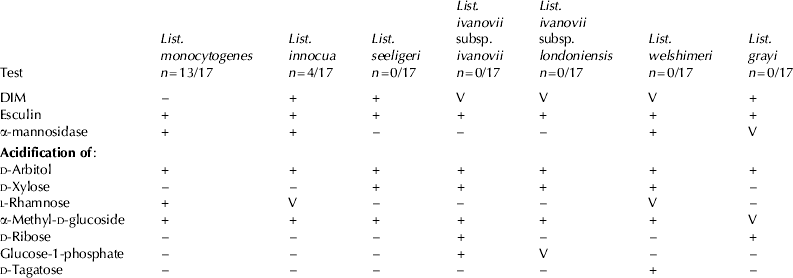
The API Listeria system (BioMerieux, la Balme-les-Grottes, France) consists of the following 10 tests: differentiation between List. innocua and List. monocytogenes, based on the presence or the absence of arylamidase (DIM test), hydrolysis of esculin, presence of α-mannosidase, and acid production from d-arabitol, d-xylose, l-rhamnose, α-methyl-d-glucoside, d-ribose, glucose-1-phosphate, and d-tagatose. Bacteria were removed from a 24 h culture on PALCAM agar with a pipette and suspended in 2 ml sterile distilled water (BioMerieux) to an opacity of the Macfarland 0·5 standard. Sterile water (5 ml) was poured into the tray to create a moist atmosphere, and then the reaction strip was removed from its packaging and placed in the tray. The bacterial suspension was then distributed into the 10 microtubes (100 μl for the DIM test and 50 μl for the other cupules). Afterward, the strip box was closed and incubated at 37°C for 18 to 24 h. After incubation, one drop of ZYM B (supplied by the manufacturer) was added to the DIM test and allowed to react for 3 min; then all of the reactions were read. Reactions were determined according to color changes as indicated in the manufacturer's instructions. Typical Listeria profiles on the API Listeria strip are reported in the Table 2.
PCR
Seventeen strains (Table 1 & 2), identified as List. monocytogenes by API-Listeria test, or suspected to be List monocytogenes because of their appearance on the selective agars, were prepared for the PCR reaction. Each reaction was performed in a volume of 50 μl with the following components: 10–100 ng purified chromosomal DNA (chromosomal DNA was isolated following a protocol: bacterial pellet was resuspended with 1 ml sterile distilled water, vortexed and centrifuged for 5 min at 14 000 r.p.m. After discarding the supernatant, 200 μl of B-buffer (2% Triton X-100, 1% SDS, 100 nm-NaCl, 10 nm-tris-HCl pH 8·0, 1 mm-EDTA pH 8·0), 0·3 g glass beads and 100 μl chlorophorm/isoamylalcohol were added. The tubes were vortexed for 5 min, 200 μl TE buffer was added in the mix. After centrifuging for 5 min at 14 000 r.p.m., 400 μl of the supernatant was transferred to a new Eppendorf tube, 800 μl ethanol (96%) was added, and the tubes were kept at −20°C for 20 min. After another centrifugation (5 min at 14 000 r.p.m.), the supernatant was discarded and 50 μl TE-buffer and 3 μl RNAse solution was added. After mixing shortly, the tubes were incubated at 60°C for 30 min. Then, 100 μl ethanol was added, the tubes were incubated at −20°C for 10 min, followed by centrifugation and discarding the supernatant, pellets were vacuum dried for 10 min, 30 μl TE-buffer was added and the pellets were kept at −20°C). (Frece et al. Reference Frece, Kos, Svetec, Zgaga, Mrša and Šušković2005, Reference Frece, Kos, Svetec, Zgaga, Beganović, Leboš and Šušković2009; Markov et al. Reference Markov, Frece, Čvek and Delaš2009); 50 pmol of each hlyQF/R oligonucleotide (5′-CAT GGC ACC ACC AGC ATC T-3′) and (5′-ATC CGC GTG TTT CTT TTC GA-3′), (Rodriguez-Lazaro et al. Reference Rodriguez-Lazaro, Hernandez, Scortti, Esteve, Vasquez-Boland and Pla2004a; Pozaić, Reference Pozaić2008); 50 pmol of each dNTP; 1·5 mmol l−1 MgCl2; 5 μl 10× Taq buffer and 0·5 U Taq polymerase (Boehringer GmbH, Mannheim, Germany). The amplification was carried out in DNA termocycler, Mastercycler personal (Ependorf), using the following conditions: first, the denaturation step at 95°C for 5 min., followed by 35 cycles consisting of: denaturation at 95°C for 30 s, annealing at 55°C for 20 s, extension at 72°C for 20 s. Final extension was carried out at 72°C for 2 min. The amplified DNA was analyzed by gel electrophoresis on a 1% agarose gel stained with ethidium bromide. A 125 bp ladder (Promega) was used as a reference marker. The gel was viewed using UV transillumination at a wavelength of 254 nm.
Comparison of the results obtained on PALCAM agar, API-Listeria test and PCR for ability to identified Listeria monocytogenes in 180 milk products (domestic fresh cheese, cream and unpasterised milk). Results are shown as percentage of samples positive for List. monocytogenes

Identification scheme of Listeria species on the API Listeria system as provided by the manufacturer
n=number of colonies (out of a maximum of 17) which are presumptive positive as Listeria species on PALCAM agar

+, positive reaction; -, negative reaction; V, variable reaction
Results and Discussion
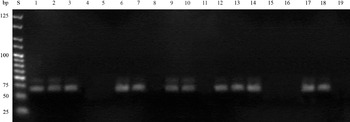
Detection of List. monocytogenes in food can be difficult as these bacteria are normally found in very low numbers in the presence of heterogeneous microflora. The most frequent Listeria isolates from food are List. monocytogenes and List. innocua (Oravcova et al. Reference Oravcova, Trnčikova, Kuchta and Kaclikova2008). Ideally, enrichment procedure and selective medium should allow only the target organisms to concentrate. But two-step selective enrichment according to EN ISO 112900-1 (Anon. 2005) is not selective for List. monocytogenes and enables a good growth of all Listeria species (Oravcova et al. Reference Oravcova, Trnčikova, Kuchta and Kaclikova2008). Therefore, different identification methods were used in this study for identification of List. monocytogenes. The ability of selective plating media (PALCAM) was compared with API Listeria test and PCR method. There are some disagreements of the results. Of the total number of food samples tested, 27·6% were identified as presumptively positive for Listeria species, using PALCAM agar, by characteristic colonies (olive-green colonies with black halos; Table 1). The coexistence of several Listeria species on the same food is not unusual, and often the incidence of other Listeria species is higher than that List. monocytogenes itself (Gilot & Content, Reference Gilot and Content2002). It has been shown that the non-pathogenic species List. innocua outgrows the pathogenic species List. monocytogenes by a wide margin during enrichment in both UVM and Fraser broths (Rodriguez-Lazaro et al. Reference Rodriguez-Lazaro, Hernandez, Scortti, Esteve, Vasquez-Boland and Pla2004a, Reference Rodriguez-Lazaro, Hernandez and Plab; Gouws & Liedemann, Reference Gouws and Liedemann2005). This makes selection of suspect colonies for confirmation from PALCAM agar all the more difficult, since the incidence of non-pathogenic strains is higher than that of List. monocytogenes and all species demonstrates the same phenotype. This may explain why negative results were obtained from PCR when using presumptive positive colonies from PALCAM agar (Table 1, Fig. 1).
Agarose gel electrophoresis of the PCR amplification products of various samples of milk products presumptively positive for List monocytogenes on PALCAM agar or on API-Listeria test. Colonies were subcultured onto a non-selective agar before DNA extraction. Lane S- 125 bp DNA ladder, lane 1- standard strain List monocytogenes ATCC 2356 (positive control), lane 2- fresh cheese (PALCAM, API), lane 3- fresh cheese (PALCAM, API), lane 4- fresh cheese (PALCAM), lane 5- fresh cheese (PALCAM), lane 6- unpasterised milk (PALCAM, API), lane 7- unpasterised milk (PALCAM, API), lane 8- unpasterised milk (PALCAM), lane 9- unpasterised milk (PALCAM, API), lane 10- unpasterised milk (PALCAM, API), lane 11- unpasterised milk (PALCAM, API), lane 12- cream of raw milk (PALCAM, API), lane 13- cream of raw milk (PALCAM, API), lane 14- cream of raw milk (PALCAM, API), lane 15- cream of raw milk (PALCAM, API), lane 16- cream of raw milk (PALCAM), lane 17- cream of raw milk (PALCAM, API), lane 18- cream of raw milk (PALCAM, API), lane 19- Bacillus cereus ZMPBF 3078 (negative control).

As well as not always being reliable, conventional bacteriological methods for the detection and quantification of List. monocytogenes are laborious and time-consuming and require individual biochemical confirmation (like API test) of the species in a number of isolated colonies. These drawbacks are overcome by PCR-based methods, which are highly specific and can very accurately quantify target DNA (Rodriguez-Lazaro et al. Reference Rodriguez-Lazaro, Hernandez, Scortti, Esteve, Vasquez-Boland and Pla2004a).
Concerning the growth and appearance of Listeria species, there were some false positive results on PALCAM agar, because the API Listeria test confirmed the identification of 21·3% of food samples positively as List. monocytogenes (Table 1 & 2). Equivocal profiles from API Listeria test were reported by McLauchin (Reference McLauchin1997) in the case of List. monocytogenes isolated from food, although in his study he concluded that the API Listeria kit was easy to use, relatively rapid, shelf stable and useful for both specialist and non-specialist laboratories. Disagreements of the results based on the appearance of List. monocytogenes on different selective media, and other methods were reported by other authors (Vaz-Velho et al. Reference Vaz-Velho, Duarte and Gibbs2001), comparing the ability of Oxford, PALCAM, enhanced haemolysis agar, API Listeria test, emphasized the importance of using more than one protocol for the detection of List. monocytogenes. Primers used for PCR amplification specifically targeting listeriolysin O gene, described as highly selective and sensitive for all List. monocytogenes strains (Rodriguez-Lazaro et al. Reference Rodriguez-Lazaro, Hernandez, Scortti, Esteve, Vasquez-Boland and Pla2004a). The primers recognized the targeting band of 64 bp of the questioned isolates, confirming they are List. monocytogenes strains (Fig. 1). A conventional PCR was used for the amplification of 17 suspected strains of List. monocytogenes with specific primers for the DNA fragment of listeriolysin O (hlyA) gene designed to target the 64 bp band of List. monocytogenes strains (Fig. 1). PCR is seen to be more reliable than conventional identification since it is based on stable genotypic characteristics rather than relying on biochemical or physiological traits. With bacterial adaptation to different environments causing similarities in phenotype, as well as resistance to ingredients in enrichment and selective media, the transition from conventional methods of detection to genetic methods should be carried out. PCR method proved to be reliable, cost effective and time saving.
The presence of List. monocytogenes found in domestic unpasteurised milk, fresh cheese and cream of raw milk in this study constitutes a potential hazard for the consumers due to the cultural habits of this population and its preference to buy these product in markets. As a result, these domestic milk products are consumed in large quantities by the risk groups and because Croatia is recognized for its traditional domestic milk products the incidence of this bacterium in this type of products should be reduced.
The contamination of these products could be attributed to the practices of sanitary management of the animals, the food provided to the cows in which the bacterium can multiply and the water supply. The presence of the pathogen in the environment, where the milk is kept can form biofilms, a source of contamination reported by other authors (Harvey et al. Reference Harvey, Keenan and Gilmour2007; Vanegas et al. Reference Vanegas, Vasquez, Martinez and Rueda2009).
It is important to point out that the number of positive samples in this study, although low, continues to be an important number due to consumption habits of inhabitants. The PCR method proved to be highly selective and sensitive for detection List. monocytogenes.
This research was financially supported by The Ministry of Science and Technology of Republic Croatia (Project: 058-0582184-0432 “Mycotoxins in food and feed in the territory of the Republic of Croatia“).