Introduction
Trichospilus diatraeae Cherian & Margabandhu, 1942 (Hymenoptera: Eulophidae) is a gregarious pupal parasitoid mainly of many Lepidoptera (Bouček, Reference Bouček1976). It has been recorded as a parasitoid of the families Crambidae (Cherian and Margabandhu, Reference Cherian and Margabandhu1942), Noctuidae (Ètienne and Viette, Reference Ètienne and Viette1973), Pyralidae (Ètienne and Viette, Reference Ètienne and Viette1973; Bouček, Reference Bouček1976; Bennett et al., Reference Bennett, Glenn, Yaseen and Baranowski1987), Nymphalidae (Bouček, Reference Bouček1976), Geometridae (Bennett et al., Reference Bennett, Glenn, Yaseen and Baranowski1987), Pieridae (Torres-Bauza, Reference Torres-Bauza1994), Arctiidae (Paron and Berti-Filho, Reference Paron and Berti-Filho2000) and Oecophoridae (Oliveira et al., 2005).
In 1963, T. diatraeae was imported from India to Trinidad and Tobago (Antilles) and the USA using Diatraea spp. (Lepidoptera: Crambidae) as hosts (Bennett et al., Reference Bennett, Glenn, Yaseen and Baranowski1987). Trichospilus diatraeae was released to control pests of grasses in Senegal, with Chilo suppressalis Walker (Lepidoptera: Crambidae) as host (Bordat et al., Reference Bordat, Breniere and Coquard1977). Ètienne and Viette (Reference Ètienne and Viette1973) and Ètienne (Reference Ètienne1975) reported T. diatraeae in the Reunion and Mauritius Islands parasitizing the sugarcane pests Melanitis leda L. and Hedylepta indicata F. (both Lepidoptera: Crambidae), as well as Polydesma umbricola Boisduval (Lepidoptera: Noctuidae) and the conifer pest Trichopolydesma collutrix (Geyer) (Lepidoptera: Noctuidae). This parasitoid was used for the biological control of noctuid cotton pests in Madagascar using Ephestia kuehniella Zeller (Lepidoptera: Pyralidae) as a host for multiplication (Bournier, Reference Bournier1975). On the Comores Islands, Brenière et al. (Reference Brenière, Bordat, Vercambre, Hamza and Renand1985) released T. diatraeae against the maize pest Chilo partellus Swinhoe (Lepidoptera: Crambidae). Tests with T. diatraeae were carried out in the USA to control the corn borer Diatraea lineolata Walker (Lepidoptera: Pyralidae) (Rodriguez-del-Bosque and Smith, Reference Rodriguez-del-Bosque and Smith1989). Betbeder-Matibet (Reference Betbeder-Matibet1990) studied the mass rearing of Chilo sacchariphagus Bojer (Lepidoptera: Crambidae) to produce T. diatraeae as biocontrol agent. This parasitoid was recorded in Dismorphia spio Godart (Lepidoptera: Pieridae) pupa on Inga vera (Willd.) (guaba) (Leguminosae) (Mimosoideae) in Puerto Rico (Torres-Bauza, Reference Torres-Bauza1994).
Lepidopteran pests can cause significant damage to eucalyptus plantations in Brazil (Zanuncio et al., Reference Zanuncio, Alves, Santos and Campos1993, Reference Zanuncio, Mezzomo, Guedes and Oliveira1998, Reference Zanuncio, Guedes, Zanuncio and Fabres2001; Bernardino et al., Reference Bernardino, Zanuncio, Zanuncio, Lima and Serrão2007). Euselasia eucerus (Hewitson) (Lepidoptera: Riodinidae), also reported as Euselasia apisaon (Dalman) (Zanuncio et al., Reference Zanuncio, Garcia, Santos, Zanuncio and Nascimento1990; Murta et al., Reference Murta, Ker, Costa, Espírito-Santo and Faria2008), is a native insect to Brazil, and its caterpillars are commonly found on Eucalyptus spp. Its population grows rapidly, causing outbreaks in eucalyptus plantations in São Paulo, Rio Grande do Sul, Santa Catarina and Minas Gerais States (Zanuncio et al., Reference Zanuncio, Nascimento, Garcia and Zanuncio1994). The developmental cycle of E. eucerus is completed on Eucalyptus trees. The adult female lays its egg clusters on leaves. Caterpillars show gregarious behaviour and pupate on leaves (Zanuncio et al., Reference Zanuncio, Garcia, Santos, Zanuncio and Nascimento1990). Euselasia eucerus eggs are naturally parasitized by Trichogramma maxacalii Voegelé & Pointel, Trichogramma demoraesi Nagaraja and Trichogramma acacioi Brun, Moraes & Soares (all Hymenoptera: Trichogrammatidae). Its caterpillars and pupae are predated by Podisus nigrispinus (Dallas), Brontocoris tabidus (Signoret), Supputius cincticeps (Stål) and Alcaeorrhynchus grandis (Dallas) (all Heteroptera: Pentatomidae), and the entomopathogenic fungus Paecilomyces fumosoroseus (Wize) infects its pupae (Brun et al., Reference Brun, Moraes and Soares1983; Oliveira et al., Reference Oliveira, Zanuncio, Pratissoli and Cruz2000; Murta et al., Reference Murta, Ker, Costa, Espírito-Santo and Faria2008). Despite having all these natural enemies, there is no specific biocontrol agent against the pupal stage used under field conditions. Currently, there is no specific mass-rearing system for Trichogramma spp. in place for control of E. eucerus in Brazil. The predator bugs can feed on larval and pupal stages of E. eucerus, and these species can be reared under ambient conditions. However, the number of predators produced is low considering the size of the eucalyptus plantation area in Brazil and the dispersion capacity of the pest in the field. Moreover, complementary action of different natural enemies can achieve better control levels in the field.
The objective of this study was to evaluate the impact of T. diatraeae as a pupal parasitoid of the eucalyptus defoliator E. eucerus as a potential alternative to chemical control of the pest.
Materials and methods
Parasitoids used in this study were originally collected on pupae of Iridopsis sp. (Lepidoptera: Geometridae) in eucalyptus plantations in Curvelo, Minas Gerais State, Brazil, in 2009. Since then thereafter, a laboratory culture has been maintained, using pupae of Thyrinteina arnobia (Stoll) (Lepidoptera: Geometridae) as hosts. Zaché et al. (Reference Zaché, Wilcken, Dacosta and Soliman2010) described the parasitoid rearing technique in detail. Euselasia eucerus eggs were collected in eucalyptus clonal plantation in Anhembi, São Paulo State (Brazil). Larvae were reared under ambient conditions on Eucalyptus urophylla S.T. Blake (Myrtaceae) leaves. Upon pupation, 15 pupae were offered to T. diatraeae females in a 1:1 (parasitoid:host) ratio for 72 h. Thereafter, the females were removed, and containers with E. eucerus pupae were maintained in a climatic chamber at 26 ± 2°C, 60 ± 10% relative humidity and a 12 h photophase. The following parameters were determined: level of parasitism, number of emerged and not emerged parasitoids and duration of the egg–adult cycle. The pupae of E. eucerus were dissected to evaluate the non-emerged parasitoids.
Results and discussion
The level of parasitism reached 100%, with an emergence rate of 86.6%. A mean of 168.4 ( ± 0.33 SE) parasitoids per pupa emerged, while only 1.1 ( ± 0.34 SE) parasitoids per pupa did not emerge. The T. diatraeae egg–adult cycle was 18.4 ( ± 0.98 SE) days in E. eucerus pupae.
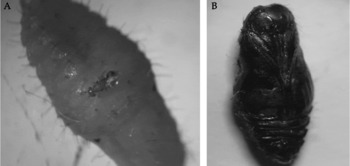
These results demonstrate for the first time, under controlled conditions, the ability of T. diatraeae to parasitize the pupae of E. eucerus, a species of the Riodinidae family (Fig. 1). In Brazil, the introduction of T. diatraeae is believed to have been accidental, and its first occurrence was recorded in 1996 on pupae of Arctiidae (Lepidoptera) in Piracicaba, São Paulo State (Paron and Berti-Filho, Reference Paron and Berti-Filho2000). In 2001, the parasitoid was reported on the pupae of Cerconota anonella (Sepp) (Lepidoptera: Oecophoridae) in soursop Annona muricata L. (Annonaceae) plantations in Planaltina, Distrito Federal (Brazil) (Oliveira et al., 2001). With regard to lepidopteran forest pests in Brazil, T. diatraeae was collected from a pupa of T. arnobia on eucalyptus in Minas Gerais State (Pereira et al., Reference Pereira, Zanuncio, Tavares, Pastori and Jacques2008). In 2010, Zaché et al. reported parasitism of T. diatraeae in a pupa of the eucalyptus defoliating looper Melanolophia consimilaria (Walker) (Lepidoptera: Geometridae), a pest that pupates in the soil. More studies are needed to determine the potential of T. diatraeae for the biological control of lepidopteran pests in Brazilian eucalyptus plantations, as this biocontrol agent could possibly reduce the use of chemical and biological insecticides for pest control in eucalyptus.
A, Trichospilus diatraeae female parasitizing a Euselasia eucerus pupa; B, emergence hole of the parasitoid in a mummified pupa

Acknowledgements
We are grateful to the Coordenação de Aperfeiçoamento de Pessoal de Nível Superior for funding this study and Eucatex Forest Company for allowing insect pest collections in the field.