The ascent of the ancient Khmer empire to its apogee in the twelfth century is attested in the vast, unprecedented expansion of ceremonial architecture under Jayavarman VII. In a long reign from 1182/83–c.1218 CE, the king built the temple complexes of Ta Prohm, Preah Khan, Banteay Kdei, Bayon and Banteay Chhmar, as well as the 9 sq. km walled city of Angkor Thom.Footnote 1 His architecture projected powerful new concepts in what French historians called the ‘Bayon style’, named after the towering Buddhist state temple erected at the heart of Angkor Thom. Several of the king's temples went through different construction phases as religious and ceremonial demands on space evolved, and during the last building phase large, open, pillared halls adorned with female dancing figures were added to all his temples on the main axis, creating the final approach to the temple.Footnote 2
French scholars remained unsure of their function and chose the term salles aux danseuses (‘halls with dancers’), based on the reliefs of dancing female figures carved into the architraves and pillars of the halls.Footnote 3 The structure and positioning of large, open pillared halls erected on the axial entrances to Jayavarman's central sanctuaries recall the Indian maṇḍapa design of colonnade and sculptural pillars set in large temple compounds. Maṇḍapa literally means ‘the one that protects the decoration’.Footnote 4
Focusing on the halls with dancers, a distinct architectural feature of Jayavarman VII's temples, this article explores the possibility of a link between the architecture, associated inscriptions, dance and music ritualsFootnote 5 evolving in Angkor and the contemporary Indian Chōḷa temples that housed several maṇḍapas. The article argues that the architecture of the halls with dancers worked in tandem with ritual practices to provide a symbolic and possibly actual space for encountering the divine.
Plan and design of the ‘halls with dancers’
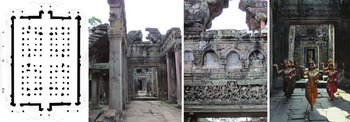
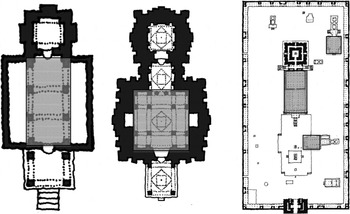
Both Ta Prohm and Preah Khan have such pillared structures situated at the eastern axis and principal approach to the main sanctuary (Fig. 1). They are rectangular cruciform structures with approximately one hundred pillars dividing the space into four courtyards with surrounding galleries. The central bay of the hall corresponds in width to that of the central sanctuary. Two side aisles are half the width of the central aisle. Several female figures in ardhaparyaṇka (half cross-legged)Footnote 6 dance posture adorn the columns and gopura (ornamental entrance) friezes. The halls with dancers are set between large water tanks between the second and the third enclosure walls of the temple complexes. They would have been covered with high barrel-vaulted roofing as can be seen today in the restoration work at Ta Prohm.
‘Hall with dancers’ at Preah Khan temple. From left, typical plan (© O. Cunin); interior space of the hall; female dancer motif on the friezes; dance performance in the hall (© Jaroslav Poncar-Poncar.de)

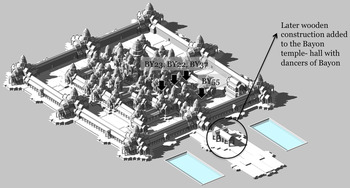
At the Bayon temple, according to Olivier Cunin, in the last phase a long causeway was built to project out from the main eastern entrance and was lined with nāga balustrades and flanked with artificial water tanks. A raised platform in the shape of a Greek cross (Fig. 2) was later built onto the causeway and a large, pillared wooden structure added.Footnote 7 This open wooden hall, in front of the eastern gopura and sanctuary BY55, composed the final approach to the central sanctuary of the temple. As the wooden structure of Bayon temple was positioned on the axial approach to the central sanctuary, like the halls with dancers in the king's other temples, this building classifies alongside the others, by its structure and positioning, as a ‘hall with dancers’.
Computerised three-dimensional reconstruction of the Bayon Temple (© O. Cunin)

The halls with dancers are a prominent architectural feature and are noteworthy for two reasons: they contain finely carved reliefs of several hundred female dancers and they are a dateable architectural element distinctive of the final phase of the king's construction programme. Jayavarman's purpose in providing this sacred space on an unprecedented scale as the final addition to these temples has yet to be studied.
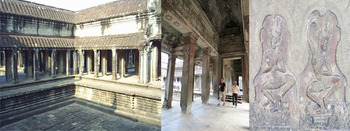
The new architectural feature of a spacious hall with dancer motifs in fact first appears at the temple of Phimai, in what is today northeast Thailand, where there is a cruciform terrace surrounded by a gallery before the main sanctuary. Fifty years later, a similar design appears on a much grander scale in the cruciform galleries of Angkor Wat, again on the axis (this time western) to the main sanctuary. These galleries, accompanied by water tanks, have a large architrave with dancing female figures (Fig. 3). Somewhat similar designs are found in the succeeding temples of Preah Khan of Kompong Svay and Beng Mealea. Whatever their ritual function, these halls were an innovation started and maintained by the Mahīdharapura dynasty of kings Jayavarman VI (c.1080–1107 CE), Sūryavarman II (1111–1145/1150 CE) and considerably enhanced in scale by Jayavarman VII.
Cruciform open-pillared gallery next to the water tanks in Angkor Wat; space of the cruciform gallery under barrel vaulted roof with dancers on friezes; the dancer motif on the columns

Under Jayavarman VII, the female dancing figures occur on an unprecedented scale, notably in the Bayon temple.Footnote 8 Khmer epigraphy tells us that dance was a significant aspect of Jayavarman's temples and dancers were held in high esteem.Footnote 9 They were embedded in the social and religious fabric of Cambodia.Footnote 10 We have no dedicatory stele for the Bayon and no palm leaf ritual text has survived to guide us, but the reliefs of the Bayon depicting dance performances with musicians and varied musical instruments form an important visual resource for the study of Khmer temple dance. In addition there are two thirteenth-century Chinese sources: the report of Chinese emissary Zhou Daguan who spent a year in Angkor, and the chronicle of Zhao Rugua, the Chinese superintendent of maritime trade in Canton.
Since the architectural feature of the hall with dancers shows striking similarity to the Indian ma ṇḍapa feature, let us understand the maṇḍapa in Indian temple architecture.
Maṇḍapas in Indian temple architecture
In India early temples had a modest vestibule (ardhamaṇḍapa) in front of the central sanctuary (garbhagṛha), where priests and devotees would gather for prayer and offerings. From the eighth century onwards, maṇḍapas were built in place of the vestibules and on a grander scale. By the eleventh century, with the spread of the devotional movement in most regions of India, maṇḍapas extending out from the sanctuary sometimes contained up to 1,000 pillars, as at the Minakshī temple, Madurai, South India.
During the Chōḷa period (c.985–1267 CE), temples in South India developed from small shrines and simple places of worship into grandiose, courtly cultural establishments and religious institutions. Inscriptional evidence tells us about how Rājarāja Chōḷa (r. 985–1014 CE) utilised the pre-existing social structure of village assemblies and craft guilds for his new temple programme. Hundreds of text reciters, dancers, musicians, lamp holders, carpenters, goldsmiths, actors, tailors and watchmen were employed to keep the temples functioning.Footnote 11 The maṇḍapa was thus borne out of the need for congregation areas and formed an interesting dialectic between employment creation and the new ritual practices, including dance and music, which were to evolve from the still thriving devotional bhakti movement.
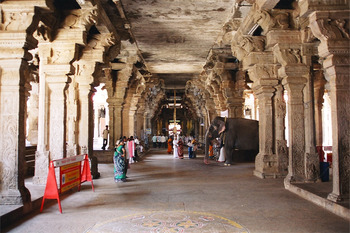
Maṇḍapa space of the Raṅgnātha temple, 10th–11th century (© Y. Giridhar Appaji Nag-CC-BY-3.0, giridhar@appaji.net)

Scholars assume that the maṇḍapa housed festivals, gatherings for recitations and dance performances.Footnote 12 The iconography of cymbals, drums and dance sculptures on the walls of Bṛhdīśvara temple is suggestive of such performances. Zhao Rugua, the official who controlled the Chinese trade system from southern China, noted in his 1225 CE account on trade partners that the Chōḷa king retained ‘10,000 dancing girls’ in the twelfth or early thirteenth century.Footnote 13 Dance became an essential part of the temple institution under the Chōḷas.Footnote 14 The temples of Bṛhdīśvara, Gangaīkondācholāpuram, and Raṅgnātha contain several maṇḍapas and display abundant dance images.Footnote 15 The temples became large walled complexes with multiple shrines, long corridors and several concentric enclosures entered through towering gateways. Inside the walls were several semi-open maṇḍapas such as rangavīlāsamaṇḍapa, nātyamaṇḍapa, bhogamaṇḍapa, kalyāṇamaṇḍapa, mahāmaṇḍapa to support the growing functions of the temple establishment. Sometimes a maṇḍapa was added at a later date to an existing temple to specifically create a sacred space for devotional music and dance, as in the case of Raṅgnātha temple at Śrīrangam in Tamilnadu.Footnote 16 Dance became one of the sixteen important offerings to the deity.Footnote 17
The Indian maṇḍapa, whether small or large, is usually laid out as a single processional aisle leading to a raised platform on which the deity rests or where a performance may be offered to the deity. The central aisle of the maṇḍapa is usually the same as that of the central sanctuary, as in Angkor.
The development of Indian maṇḍapas from the 7th to 12th centuries. From the left, eight-pillared maṇḍapa of the 7th century Tarappa Basappa temple, Aihole, Karnataka; sixteen-pillared maṇḍapa of the 11th century Kalleśvara temple, Kukkanur, Karnataka; many pillared maṇḍapa of the 11th century Bṛhdīśvara temple of Rājarāja Chōḷa at Tanjore. (All the temple plans © Adam Hardy, The Temple Architecture of India, 2007)

Why would an Indian maṇḍapa and a Chōḷa temple model be relevant to the study of Jayavarman VII's halls with dancers?
Maritime trade connections: The Chōḷas and Sūryavarman I
The spread of new Indian culture and thought among the states of Southeast Asia, following trade routes, was a continuous process that evolved and was constantly renegotiated.Footnote 18 By the ninth century CE, there is evidence of Indian merchant guilds trading with Sri Lanka and Southeast Asia.Footnote 19 The inscriptional record attests to the presence of Indian Brahmins in the courts of Khmer kings from the eighth century onwards, who acted as royal advisors, officiantsFootnote 20 and sometimes as acknowledged authorities on art and music.Footnote 21 These ties continued under Rājarāja and Rājēndra I (1012–1044 CE), as the Chōḷas extended their hegemony over South India from the ninth to thirteenth centuries and dominated trade around the Bay of Bengal.Footnote 22 In these centuries the kingdom of Angkor for the first time extended its boundaries to include central Thailand and the northern part of the Malay Peninsula. It became the dominant power around the Gulf of Siam and across mainland Southeast Asia under Sūryavarman I (r. 1002–1049 CE) and his successors.Footnote 23 During his reign, the Khmer king sent a gift of a chariot and a precious stone to Rājēndra Chōḷa with a request for a military alliance.Footnote 24 Kenneth Hall views this gesture as a culmination of Cambodia's tenth and eleventh century economic development under Sūryavarman I. The gifts were intended more to establish commercial trade relationships (and possible ritual diplomacy) between the two growing powers rather than to secure military help.Footnote 25 The inscriptional records refer to travelling Khmer merchants and also confirm the participation of foreign merchants in the activities of Khmer commercial centres in this period.Footnote 26 The impact of these trade exchanges was accompanied by a new wave of cultural influence in the Khmer cultural realm. Some royal endowments to temples were transacted through merchants.Footnote 27 The Khmer temples became increasingly complex, much like the Chōḷa temples, with multiple shrines, several galleries, long corridors, open pillared halls, and concentric structures entered through towering gateways as in case of Angkor Wat and the temples of Jayavarman VII. The reliefs of Angkor Wat include traces of exported luxury fabric from India, which was the most common trade good,Footnote 28 along with some dance imagery showing uncommon Khmer postures which can only be explained as of foreign (probably Chōḷas?) influence. Much as in the Chōḷa temples, the inscriptions in Jayavarman VII's temples mention festivals, dependent village manpower, cooks, goldsmiths, garland makers, lamplighters, tailors, and several other servants, including thousands of dancers.Footnote 29
Jayavarman VII's temples: Preah Khan, Ta Prohm and Bayon
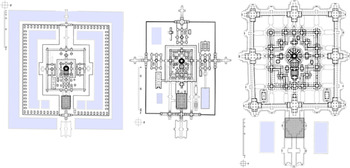
Jayavarman VII's temples were huge, walled enclosures like that of the Chōḷas, housing multiple shrines and with maṇḍapa for ceremonial feasts in the royal calendar. We find small, open pillared vestibules immediately before the central sanctuary in Ta Prohm, Preah Khan and Bayon (Fig. 6).Footnote 30 The exact purpose of such vestibules is not known, but they may have housed the paraphernalia of the priests and officiants who performed the rituals within. The larger space created by the ‘halls with dancers’ between the outer gopura and the sanctuary is identical to the small vestibule before the sanctuary, but greatly enlarged, indicating a need for space involving many more people. Possible uses for the ‘hall with dancers’ space would be to engage the laity of the surrounding large temple complex in festivals, celebrations, recitations and ritual dance.
Jayavarman VII temples showing the small gathering area in front of the sanctuary similar to the hall with dancers. From left, Ta Prohm, Preah Khan and Bayon (© O. Cunin)

Caṅkrama or ritual dance halls?
Thomas S. Maxwell argues that the dedicatory inscription K.908 from Preah Khan suggests the ‘hall with dancers’ served not for dance rituals but for the solemn meditative purpose of ‘caṅkramas’ or ‘ambulatories’ — passageways used by monks for meditation, prostration and reading sacred texts.Footnote 31 As this counters the Chōḷa temple model it requires investigation. Caṅkramas are monastic ambulatories recalling the Buddha's walk in the third week after his enlightenment as per the Buddhist biographies. The ancient stūpa at Bharhut has a relief of an early Buddhist pillared caṅkrama with hanging flower garlands. Below the flower garlands we see hand-prints, which suggest monks were making prostrations there. Prostration was highly recommended by monastic authorities not only as a spiritual exercise but also as the only form of physical exercise undertaken by monks — as many Nepalese, Tibetan and Chinese monks do today for hours on end around the Mahābodhī temple at Bodhgayā.
In Angkor, the word caṅkrama occurs for the first time in the Preah Khan inscription, according to the index of George Cœdès’ collected volumes of Cambodian inscriptions.Footnote 32 The inscription first uses the word in line A58 to describe the causeway built by Hanuman's monkey army to reach Lanka in the Rāmāyaṇa epic. Then in line B5 it says there are ten gods (devas) in the caṅkramas.Footnote 33 In the second instance too, the word appears to refer conventionally to a causeway in the sense of promenade but without specifying its location.Footnote 34
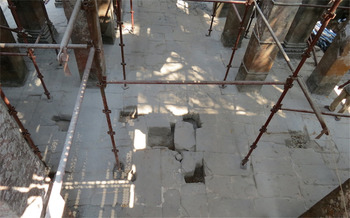
Maxwell claims these caṅkramas with the ten gods (devas) are to be found in the hall with dancers. This interpretation requires further analysis for such meditation areas for monks are never found on the main axis of a temple, but in a quieter places (‘in seclusion’ as Maxwell himself says) at some distance from the main sanctuaries and the daily traffic of ritual activity they generate. There are at least five problems to seeing the Preah Khan hall with dancers as a cloister for monks meditating and venerating the ten deities: (i) there are no traces of stone sanctuaries for gods in the hall with dancers numbered PK68 by Cunin;Footnote 35 (ii) the décoration of female dancers in the ardhaparyaṇka dancing posture at eye-level on its pillars and in the carved friezes would hardly be appropriate to meditation activity; (iii) there is no temple architectural precedent for caṅkramas being built on the main axis to the main sanctuary; (iv) there is enough space for a dozen dancers to perform as the central aisle is 5 m wide (performances by classical dance troupes are sometimes held in them today for tourists; (see Fig. 1); (v) restoration work at Ta Prohm temple has uncovered holes for securing three pedestals in the centre of the cruciform hall with dancers that probably housed portable festival images of gods, mentioned in the Preah Khan inscription,Footnote 36 to whom a dance performance would have been offered (Fig. 7).
The central intersection of the Ta Prohm ‘hall with dancers’ with three pedestal locations

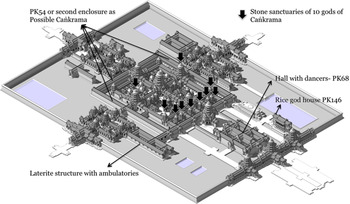
Where then were the caṅkrama for meditation and prostration by monks? One possibility is a location nearby that appears to offer four pillared, cloister-like ambulatories with reasonable seclusion that have access to the sanctuaries of ten gods.Footnote 37 This location, called the ‘second enclosure’, was numbered PK54 by Cunin and possibly constructed in woodFootnote 38 at the time of the inscription stele, is placed beside a row of monks’ cells, making it an appropriate location for meditation.
Caṅkrama walkways illustrating ten shrines at Preah Khan in the second enclosure (analysis following © O. Cunin's drawing)

This relocation of the cloister-ambulatory and the sanctuaries for ten gods in the second enclosure of the temple permits us to return to the previous standard assumption in Maurice Glaize's classic French guidebook Les monuments du groupe d'Angkor that the halls with dancers were possibly associated with ritual dance ceremonies performed in temples.Footnote 39
We cannot know the exact nature of the ceremonies or rituals, or the number of people using the space, but the halls do provide the largest covered, unencumbered spaces constructed in stone all over Angkor. In Preah Khan, building PK146 (next to the hall with dancers structure) has been interpreted as the house of the rice god. If we agree with that, this building could have served as the symbolic centre in the distribution and offering of newly harvested rice;Footnote 40 in which case the adjacent hall with dancers (PK68) could been the location for a dance ritual during the rice festival. Is the construction of these two structures belonging to the same building phase,Footnote 41 indicative of their dependency? Rice, the staple nourishment and major taxable commodity of a ‘rice empire’ like ancient Cambodia, is today still annually celebrated by the ‘good crop dance’ and ‘pestle dance’ at the beginning of the harvest. Toni Samantha Phim and Ashley Thompson have shown the strong link between dance, fertility and rice in their study of Dance in Cambodia in the modern context.Footnote 42 In twelfth and thirteenth century Angkor the annual rice festival, according to Zhou Daguan's contemporary account, is presented as the greatest annual celebration of the earth's fecundity where rice was burned as an offering to all the Buddhas.Footnote 43 In this context, it is not surprising to see the hall with dancers in the vicinity of the rice god's abode. The central pediment relief deity of the impressive edifice of the rice god (at PK146) is lost, but its motifs of dancers are still in place. Jayavarman VII's Banteay Kdei and Ta Prohm temples in Angkor have similar structures with thick square pillars next to their halls with dancers, which suggests the rice festival was celebrated in all temples and presumably all over the kingdom.
Temple inscriptions in Old Khmer often mention the Sanskrit word utsava or festival along with the descriptions of various spectacles, inside the temple complexes.Footnote 44 Words like pañcotsava (five religious festivals), mahotsava (the great festival), and mahānavamī (Hindu festival of Dussehra) occur throughout the Angkor period as royal celebrations. This seems to be in concurrence with a post-Angkorian Khmer tradition whereby the monarchs, during great festivals, entertained their subjects with games, music and various spectacles such as drama and puppetry.Footnote 45
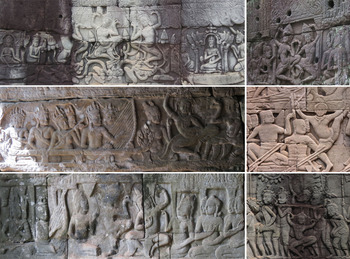
The reliefs of the Bayon temple give us rare insights into the everyday life of the Khmers. The major reliefs at the eastern entrance of the temple, in the galleries of BY22, BY23 and BY37, which are just beyond the hall with dancers, show dancers, musicians, spectacles and acrobatic performances (see Fig. 9). These are the most informative images as they show the dance performance in various contexts such as in an architectural setting of a nāga balustrade terrace (similar to the one at the entrance of the Bayon) or floating pavilions, or pillared halls (resembling a hall with dancers), sometimes surrounded by a courtly audience and sometimes accompanied by musicians. These depictions show a wide range of activities from acrobatic circus-like performances, courtly dances, martial art demonstrations, dances of victory in military processions, parades, and portrayals of independent dancing figures. Such depictions of performances correspond to Zhou Daguan's eyewitness account of royal processions.
Each time the king came out all his soldiers were gathered in front of him, with people bearing banners, musicians and drummers … followed by women … they wore clothes with floral design and flowers in coiled up hair …. There were also women of the palace carrying gold and silver utensils from the palace and finely decorated instruments made in exotic and unusual styles … then there were carts drawn by goats deer and horses … next came the king's wives and concubines in palanquins and carts … Last came the king.Footnote 46
Bayon reliefs of galleries BY22, BY23 and BY37 depicting dances, games, parades and processions

The dancing figures depicted in the context of actual performances on the reliefs of Bayon and Angkor Wat show striking similarity to the dancing figures carved on the hall with dancers. Since these reliefs depict everyday city life it seems plausible that the dancing figures of the halls with dancers may refer to the idealised humans, dancing from devotion?
Dance and music tradition of Angkor
The earliest evidence of dancing in Cambodia specifically associates this art with funerary rites and the realm of ancestor spirits. Dancers, musicians and musical instruments are the primary motifs in the elaborate ornamentation of the large bronze kettledrums found from southern China to Indonesia, including sites in Cambodia from at least fifth century BCE.Footnote 47 Victor Goloubew's ethnographic research concluded that the use of drums and dancing at ceremonies such as funerals was believed to assist the deceased in gaining rebirth in the spirit world.Footnote 48 The twentieth-century account of the cremation ceremony of king Sisowath (1927) and king Monivong (1941) was largely a dance rite of rebirth into an ancestral world.Footnote 49 This association of dancers with the king's remains was probably an ancient link. Dancing figures appear on the walls of the Leper King terrace in Angkor, which Cœdès considered to be built for the funerary rites of Jayavarman VII in c.1219 CE.Footnote 50
Dance was associated with pre-Angkorian and Angkorian temples, especially with the temples dedicated to the ancestors. When the Angkorian king, or a high official, founded a temple to house the spirit of a deceased ancestor, dancers were installed in a conjoining temple. At Preah Kô, for instance, Yaśovarman I (r. 890–c.910 CE) offered a great number of beautiful dancers, singers, reciters, musicians, players of viṇā and other instruments, skilful at beating the clappers and a great number of handsome, mature men skilful in dance and the other arts, well dressed and adorned with ornament.Footnote 51 When he dedicated the temple of Lolei (893 CE) to the worship of his ancestors, the king consecrated ‘men and beautiful women without blemish, skilful in song and dance’.Footnote 52 Yaśovarman himself was an accomplished dancer.Footnote 53
In addition to the funerary and ancestral aspect of the music and dance, there is evidence for dramatic performance from the time of Funan/Zhenla.Footnote 54 A ninth-century Khmer inscription mentions the word bhanni, which means ‘a dramatic performance with recitation’.Footnote 55 The Ta Prohm inscription mentions how Jayavarman VII paired the Buddhist practice of dāna (charity) and śīla (proper conduct) with the performances by dancers attached to the temple,Footnote 56 possibly referring to performances of dramatised Buddhist stories. The inscriptional records mention the words vāca Footnote 57 and gandharva, meaning reciter performing a divine service and, indicating a class of singers performing at temples respectively. Khmer and Sanskrit epigraphy mentions the words kralā rāṃ and raṅga, which Saveros Pou has translated as playhouse and dancing-hall, respectively.Footnote 58 Dramatic entertainment with some recitations continues today with the popular Rāmāyaṇa theatre, called the lkhon khol.
There is some evidence to suggest that the temple dance was an offering and perhaps a celebration as Jayavarman VII offered two gold Naṭarājas to the śivalinga of Preah Khan. Maxwell believes that such dancing images were used as utsavamūrtis or festival images, much like their Indian counterparts.Footnote 59 The Preah Khan inscription mentions that when the festival of Pālguhṇa (February to March) is celebrated every year 122 deities are on display.Footnote 60 These would be festival replicas brought in on palanquins from other temples in Angkor and received at the entrance of the temple with much fanfare. We know that images of dancing Śiva were indeed carried in palanquins in Angkor.Footnote 61 Based on the inscriptional record, Pou has suggested that the dancers of a ballet group performed for effigies of Śiva during ceremonies held in the temple precincts.Footnote 62
The pedestal bases uncovered by the Archaeological Survey of India (ASI) in the Ta Prohm hall with dancers possibly would have been for the installation of such images. The reliefs at Banteay Chhmar depict the Bayon face tower god and standing portable image of Viṣṇu being carried out by people in a palanquin and in a procession respectively.
From the above data, we can safely say that dance formed a part of the offerings and rituals, communal and festival celebrations, military parades and processions in Angkor.
Dance and music in Khmer inscriptions
Inscriptions from the third to ninth centuries in Cambodia list female dancers, female musicians, female singers, male musicians and male dancers donated to or belonging to the temple as ‘slaves of the God’. One of these inscriptions says the gifts offered to a temple included female dancers, who were assigned exclusively to the main deity of the temple.Footnote 63 Another inscription lists offerings to a Śiva temple, including seven female dancers, eleven female singers and four female musicians.Footnote 64 Another says a Śiva temple received nine male musicians, nine female dancers, seven female singers, three female dancers and six female singers.Footnote 65 Several words in the inscriptions refer to musical instruments,Footnote 66 dance, the dance profession, recitations, and the performances of actors and buffoons in ceremonies.Footnote 67 It should be added that subsequent iconography, mainly of Angkor Wat and Bayon, shows many more musical instruments.Footnote 68
Judith Jacob has pointed out that the names of all gods, kings, priests, musicians and dancers are all written in Sanskrit in the inscriptions, while the names of those associated with temple maintenance are written exclusively in Old Khmer.Footnote 69 Unlike the slaves who bore Khmer names such as ‘cat’, ‘dog’ or ‘stinking’, dancers and musicians names in Sanskrit include Vasantamallikā (‘spring jasmine’), Taṅvangī (‘slender limbed’), Gandharvagīta (name of the male musician with a sweet voice), Sakhīpriyā (beloved lady friend),Footnote 70 clearly indicating their significance in the temple and possibly courtly sphere, much as among the Chōḷa temple dancers.Footnote 71 Pou's study of the inscriptions has further categorised the proper names based on the specific performance, technical competence and physical qualities. It is an illuminating account of the sociological connotations of these dancers and musicians.Footnote 72
The Angkorian period is conventionally dated from 802 to c.1400 CE. The number of dancers in the state temples increased steadily through this period. By Jayavarman VII's reign, there are records of thousands of dancers serving in temples as an offering to the spirits who influenced the cosmic interaction of earth and water and the fertility of the land.Footnote 73 Jayavarman VII installed 615 female dancers in Ta Prohm,Footnote 74 a temple dedicated to his mother, 1,000 dancers in the Preah Khan, dedicated to his father, and 1,622 dancers in other temples throughout the kingdom.Footnote 75
Status of dancers in society
Pou says musicians and dancers in the Angkorian period formed a temple community organised as a varṇa rpaṃ or a corporation of dancers. A tenth-century inscription mentions one such varṇa belonging to Lady Tan Pañ, who was in charge of the dancers of the high-ranking patron of the inscription, probably a king.Footnote 76 Khmer musicians and dancers acquired high status in society as they were addressed as ‘vāp’, the equivalent of ‘Sir’, for instance Sir Myān, Sir Rājadāsa or Sir Ānanda dancer. They were also landowners and held positions as high dignitaries at courtFootnote 77 much like the Chōḷa temple dancers.Footnote 78 One varṇa called khmuk vrah kraal arcana, seems to have been associated with the cult hall (hall with dancers?) and was entrusted with ringing the temple bells.Footnote 79 Based on the epigraphic evidence Ian Mabbett thinks that varṇas were largely ceremonial orders, controlled by the kings to ensure their ritual position and royal power in the society.Footnote 80
The 1225 CE chronicle Zhufanzhi, by Zhao Rugua, the Chinese superintendent of maritime trade in Canton, is an important document on medieval geography and ethnography. Even though the chronicle is based on hearsay from traders and merchants rather than on visits to the countries engaged in maritime trade, it gives us an impression of what was different about the temple rituals in Angkor.
[In Chen-la, i.e. Cambodia] the people are devout Buddhists. In the temples there are 300 foreign women [Khmer women]; they dance and offer food to the Buddha. They are called a-nan [Skt. ānanda].Footnote 81
Peter Sharrock has associated the word a-nan with the four-stage consecration cycles of Hevajra-tantra and suggests an esoteric role for dancers in the temple rituals.Footnote 82 The Hevajra-tantra is accurately depicted in a series of ritual bronzes during Jayavarman VII's reign.Footnote 83 But it is also possible that the word a-nan is indicative of the group of Ānanda dancers that Pou mentions, since the dance tradition continued in the following centuries. Either way, the temple dancers had honoured status at temple rituals as virtually all these dancers and musicians were endowed with rice fields or water sources and exempted from paying temple taxes.Footnote 84 There are also many bronze figures in museum collections that indicate a ritual context for dance.Footnote 85 All these dancing figures have characteristics which distinguish them from the other class of heavenly figures — usually flying figures of apsaras or standing devatās.
The dancing god of the Chōḷas and Jayavarman VII: Śiva Naṭarāja and Hevajra
Around the eleventh century, the Chōḷas started extending their kingdom through a system of incorporative kingship, in which sovereignty was shared with subregional and local leaders as subordinates. It included people from all strata of society. Crucial to this process was the inclusion of local deities into the mainstream Hindu pantheon, such as the inclusion of Śiva Naṭarāja. In her study of Śiva Naṭarāja, Padma Kaimal argues:
Naṭarāja's association with the town (of Cidambaram) deeply rooted in the autochthonous cults of popular, non-orthodox Hinduism may have made Naṭarāja quite an effective god through whom to appeal to the population of a region in which the non-hierarchical and intensely personal religious tradition of bhakti had flourished for centuries.Footnote 86
The dancing Naṭarāja was elevated from its local origins to the emblem of the Chōḷa kings during their period of expansion and its cult continued to evolve, transforming a Tamil local deity into a Sanskritic god of broader significance who was more precisely suited to the ambitious dynasty and its powerful religious community.Footnote 87 Naṭarāja exemplified what Hermann Kulke calls a ‘royalising’ deity, one whose identity and worship contributed directly to the reputation and authority of the affiliated king.Footnote 88 There was a widespread emphasis on dance throughout the Chōḷa temples, but by replacing the earlier non-dancing images of Viṣṇu and Śiva with dancing Naṭarāja at the royal temple of Bṛhdīśvara, Rājarāja I declared its importance in Chōḷa politics.Footnote 89 As Chōḷa fame increased over the course of the centuries, sculptures of Naṭarāja were rendered with increasing frequency in the Kāverī delta, which the Chōḷas aspired to control.Footnote 90
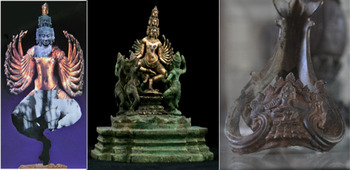
Whether Hevajra, the Heruka-type peripheral, dancing Buddhist deity who gained importance during Jayavarman VII's reign, played a role similar to that of Naṭarāja is a question worth pursuing. Hevajra is a fierce tantric Buddhist deity first known from one of the major texts of mature Vajrayāna Buddhism called the Hevajra-tantra.Footnote 91 This eight-headed, sixteen-armed deity is usually depicted, in ardhaparyaṇaka posture, and surrounded by a circle of eight dancing yoginīs, following the iconography of the text.Footnote 92 In the text and in the Tibetan tradition Hevajra is depicted in a sexual union with his consort Nairātmya at the centre of his maṇḍala, but in Cambodia Hevajra always dances alone or within his circle of yoginīs. Khmer Hevajra images do not illustrate either the violent or sexual side of the deity. The dancing pose of Hevajra is similar to that of the Khmer Śiva Naṭarāja and seems to be strongly influenced by the dancing Indic deities of Śaivism.Footnote 93
Though the earliest known image of this deity in Cambodia is from the late eleventh century, its popularity increased under Jayavarman, and many bronzes, stone statues, ivory sculptures and other ritual objects such as libation conches were produced during his time.
Judging by the number of images of Hevajra found around Angkor and on various sites on the Khorat Plateau in Thailand … it would seem that a cult of this important tantric divinity was practised from the 11th century onwards. Since no relevant literature is available, not even a stray reference on a carved inscription, nothing certainly can be said regarding this cult.Footnote 94
The large cult statue of Hevajra, found outside the west gate of Jayavarman VII's fortified city of Angkor Thom, clearly indicate the royal status of the deity.Footnote 95 Featuring Hevajra at the royal capital, Jayavarman VII placed the dancing god of Buddhism at the geographic centre of the king's political realm, declaring its importance in the world of Khmer politics.
From left, 3 m-high Hevajra, reconstructed by Peter Sharrock; Hevajra dancing with his yoginis bronze (National Museum of Cambodia, Ga. 2494 © Emma Bunker); and Hevajra libation conch (National Museum of Cambodia)

After the death (c.1150 CE) of Sūryavarman II, the builder of Angkor Wat, the empire had fallen into chaotic civil unrest.Footnote 96
In such conditions, the new king Jayavarman VII brought Buddhism as the state religion for the first time in Angkor, which was predominantly Śaivaite. This was achieved partly by means of royally subsidising religious foundations and partly through bringing hostile or indifferent populations under some form of control.Footnote 97 As Michael Vickery suggests, considerable resentment must have built up against him among the disaffected members of the Brahmanical elite.Footnote 98
Jayavarman's temple complexes include many Hindu deities, but the central sanctuaries are always Buddhist. The unusual feature of his state Buddhism was that it was not imposed at a stroke, but rather was allowed to evolve throughout his long reign.Footnote 99 Is it possible that the new religion was slowly unveiled with gradual inclusion of the populace? The annual Phālguna festival at Preah Khan where several gods from the Khmer provinces were displayed was clearly intended to be seen as a demonstration of political unity expressed through the symbolism of religious ritual.Footnote 100
The architectural evidence, plus rare contemporary reports, show that Jayavarman VII's temples were equipped for a full annual calendar of festivities with richly furnished icons and spaces provided for ceremonial music and dance. Bernard-Philippe Groslier saw Jayavarman's temples and the final stage of the Bayon as exoteric means to engage the people in the king's cult, much as was happening in Chōḷa south India.Footnote 101 Cambodia's permanent change from centuries of state Śaivism to state Buddhism was achieved by the year 1300 CE, according to Zhou Daguan's account, when Cambodians had turned to Buddhism in large numbers.Footnote 102 Zhou Daguan reported in 1297 CE:
Every month there is an event … 4th month there are ball games … in the 5th month of the year, there is water to welcome Buddha, when Buddhas throughout the country, far and near, are all brought together and taken into the water, where they are bathed in the company of the king … In the 8th month there is ‘ailan’ a dance that selected female dancers performed daily in the palace. There are boar and elephant fights as well ….Footnote 103
Conclusion
The earlier scholarship on the ‘hall with dancers’ has looked at it from a merely decorative perspective. The design and the motif of the dancer began during the Mahīdharapura dynasty and was systematically developed during the long reign of Jayavarman VII. The approach adopted for this article can be called ‘coherentist’ for, while remaining close to the material record, it explores the politico-religious horizon of the contemporary Chōḷas as a necessary complementary source of evidence. Signs of coherence with the material have been sought in both local and nonlocal contexts. I have argued for an analogy of the ‘hall with dancers’ with Indian temple maṇḍapa, suggesting similar symbolic and ritual functions of this architectural feature within the temple complexes of Jayavarman VII.
Whether it was Rājendra Chōḷa I or Jayavarman VII, rulers maintained institutions and participated in ceremonies that continually renewed their legitimacy as upholders of the cosmic order. Legitimating activities such as military campaigns or meetings of the court could be episodic, but the most important forms of legitimation were the long-term support of religious institutions such as temples or monasteries and the engagement of the laity in public ceremonies.
King Jayavarman VII set his temples in large walled compounds, as did the contemporary Chōḷa kings. The Bayon state temple was constructed at the heart of the new city of Angkor Thom, where access for the populace was unobstructed by moat or wall. The sheer size of the king's temple foundations suggests a strong trend towards urbanisation and consolidation of the state by periodically bringing large representations of the provincial population to the centre for festivals.Footnote 104
Although no local inscription in Angkor specifically identifies the sacred space in which this host of festivities and celebratory performances took place, the architectural and iconographic evidence points firmly towards a ‘hall with dancers’, constructed at the main axis and in the outermost enclosure of the temple. Further, like the Chōḷa Śiva Naṭarāja, we see the importance of dancing Hevajra during Jayavarman VII.
Given the number of inscriptional records, it is enough to indicate that, even though dance and music existed in Cambodia since Funan times, they were used and elevated in the temple rituals during Jayavarman VII's reign in lavish festivals that appear to have touched deep Khmer cultural roots and achieved a historical shift to Buddhism.
It is likely that under Jayavarman VII, a local culture continued to develop that was far more influenced by local Cham traditions, given the king's Cham connections, than by artistic developments in the Indian subcontinent, but this article has looked at the architectural feature of the hall and the dancer's motif from a distinctly Indian angle. It would certainly be interesting to look at the representation of the Cham Śiva, which shows iconographic similarities to the dancing Śiva of Prasat Phnom Rung, the dancers of Trà Kiêu and the female dancing figures in ardhaparyanka posture in Bayon-type monuments.