Introduction
Cowpea (Vigna unguiculata [L.] Walp.) is an important food and protein source in sub-Saharan Africa (Murdock et al., Reference Murdock, Coulibaly, Higgins, Huesing, Ishiyaku, Sithole-Niang, Kole and Hall2008). Burkina Faso and Niger, two of the main cowpea-producing countries in Africa, in the year 2008 produced 537,600 tonnes (DPSAA, 2010) and 1,569,000 tonnes (FAOSTAT, 2008), respectively. The average yield ranged from 210 kg/ha in Niger to 625 kg/ha in Burkina Faso (computed from FAOSTAT data, 2008) compared with the potential of 2 tonnes/ha (Singh et al., Reference Singh, Chambliss, Sharma, Singh, Mohan-Raj, Dashiell and Jackai1997). This gap is due to numerous factors, including biotic and abiotic stresses limiting the potential of cowpea production. Insect pests are the most severe biotic constraints for cowpea production (Singh et al., Reference Singh, Jackai, Dos Santos, Adalla and Singh1990). Among them, the legume pod borer Maruca vitrata (Fabricius) (Lepidoptera: Crambidae) is a key pest in the West African region, causing yield losses of 20–80% (Singh et al., Reference Singh, Jackai, Dos Santos, Adalla and Singh1990).
Development of pest-resistant varieties has always been a priority, but the lack of M. vitrata resistance in the available cowpea germplasm has prevented the successful development of highly resistant cultivars. Genes conferring resistance to M. vitrata were found to exist in some wild Vigna species (Jackai et al., Reference Jackai, Padulosi and Ng1996), but attempts made to transfer these genes to cultivated cowpea have so far been unsuccessful (Fatokun, Reference Fatokun, Fatokun, Tarawali, Singh, Kormawa and Tamò2002).
The recent transformation of cowpea with Bacillus thuringiensis (Bt-cowpea) expressing the Cry1Ab toxin for the control of M. vitrata appears to be promising (Popelka et al., Reference Popelka, Gollasch, Moore, Molvig and Higgins2006; Chaudhury et al., Reference Chaudhury, Madanpotra, Jaiwal, Saini, Kumar and Jaiwal2007; Adesoye et al., Reference Adesoye, Machuka and Togun2008). The sustainability of such a new technology relies on an effective, preventive insect resistance management (IRM) plan. Currently, viable IRM plans are based on a high dose of the expressed toxin to kill all the heterozygotes and create a non-transgenic spatial refuge. The refuge areas allow susceptible individuals a place to escape selection pressure by the treatments by lowering the proportion of homozygous-resistant genotypes in the population (Onstad, Reference Onstad and Onstad2008). Alternative host plants of the target pest can also serve as a so-called ‘natural refuge’. Scouting for the wild host plant of M. vitrata in West Africa revealed several wild leguminous plants (Tamo et al., Reference Tamo, Arodokoun, Zenz, Tindo, Agboton, Adeoti, Fatokun, Tarawali, Singh, Kormawa and Tamò2002; Arodokoun et al., Reference Arodokoun, Tamò, Cloutier and Adeoti2003). One of these plants, Sesbania pachycarpa D.C. (Fabaceae: Papilionoideae) is widely distributed in West Africa (Berhaut, Reference Berhaut1976; Merlier and Montegut, Reference Merlier and Montegut1982; Bakasso and Zongo, Reference Bakasso and Zongo2000). Sesbania pachycarpa is a weedy species growing near cowpea fields and used by Sahelian farmers in West Africa for diverse purposes including the making of roofs, fences, mats and medicines (Ndoye et al., Reference Ndoye, Tomekpe, Dreyfus, Dommergues, Macklin and Evans1990). Thus this study aims to investigate the occurrence of M. vitrata on S. pachycarpa, to determine if the latter can act as an effective refuge for cowpea.
Materials and methods
Study sites
The study was carried out in Burkina Faso and Niger. In Burkina Faso, the trial was conducted at Farako-ba in the Sudanian zone (latitude: 11°11′N, longitude: 04°18′W). The total rainfall was 1120 mm in 2008 and 864 mm in 2009. In Niger, the experiment was conducted at Maradi in the Sahelian zone (latitude: 13°46′N, longitude: 07°08′E). The total rainfall was 370.3 and 447.4 mm in 2008 and 2009, respectively. The Niger location is a suspected non-endemic zone and the Burkina Faso location is a known endemic zone for M. vitrata (Ba et al., Reference Ba, Margam, Dabire-Binso, Sanon, McNeil, Murdock and Pittendrigh2009).
Experimental design and layout
The study was carried out over two consecutive rainy seasons in 2008 and 2009 at both locations. We monitored M. vitrata on cultivated cowpeas and S. pachycarpa using a randomized complete block design including four treatments and four replications. The treatments included three varieties of early, intermediate and late cowpea flowering plants and a plot of S. pachycarpa. In Burkina Faso, the varieties used included KVx 404-8-1 (60 days), KVx 61-1 (70 days) and Moussa local (85 days), which represented the early, intermediate and late maturing varieties, respectively, while in Niger the varieties included IT 97k-499-38 (60 days), TN-256-87 (90 days) and Dan-Dame (100 days) for the early, intermediate and late maturing varieties, respectively. Replicates for each treatment were planted in a 16 m by 4.4 m plot, using two seeds in each planting spot with an intra-row spacing of 0.4 m and inter-row spacing of 0.8 m. A total of 21 lines of twelve spots were planted per treatment for each replication. A space of 2 m was left between the treatments and between adjacent blocks. Mineral fertilizers were applied to the entire plot before planting according to the recommended scheme of each country (100 kg/NPK 15-15-15 per ha in Burkina Faso and 50 kg/ha diammonium phosphate in Niger).
Infestation of flowers by M. vitrata
At flowering, all the flowers of one randomly chosen line were collected twice a week and placed into plastic vials containing 70% ethanol and examined for the presence or absence of M. vitrata larvae. For S. pachycarpa, additional observations were carried out on young shoots and shoot-tips because M. vitrata larvae are reported to occur on shoot-tips of Sesbania species (Huang et al., Reference Huang, Peng and Talekar2002, Reference Huang, Peng and Talekar2003). Maruca vitrata larvae were detected by the presence of webbing and excreta in the damaged holes of attacked organs. Data on flower infestation were taken until harvest.
Adult M. vitrata light trap catches
To demonstrate the presence of adult M. vitrata in the region (i.e. potentially capable of laying eggs on the plants under investigation), during the time of the larval observations, we also monitored the flight of the adult moths using one light trap per location. The light trap was located 1 km away from the experiment. The light traps utilized a 500-W mercury vapour white incandescent bulb positioned above a wire mesh cage (1.38 × 1.38 m base and 1.93 m height), which rested on a metal support set 2.43 m above ground level. At each location, the trap was emptied daily and all M. vitrata adults were collected and placed into plastic vials containing 70% ethanol.
Data analysis
ANOVA was performed for the number of M. vitrata larvae on each of the cowpea varieties and S. pachycarpa using SAS software (version 8, 2001). For each year, a comparison was made between the varieties and the separation of the means was done using the Student–Newman–Keuls test at 5% significance level.
Results
Infestation of flowers by M. vitrata
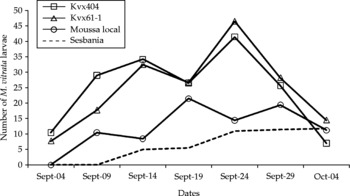
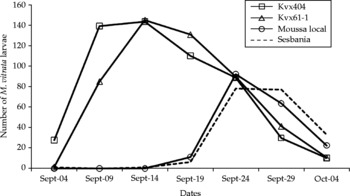
In Burkina Faso in 2008, the overall population of M. vitrata larvae was significantly higher on the early and intermediate maturing varieties of cowpea compared with the late maturing variety and S. pachycarpa (F = 6.12; df = 3; P = 0.003) (Fig. 1). The same trend was observed in 2009 (F = 6.97; df = 3; P = 0.0057) (Fig. 2). The percentage of the M. vitrata population for each plot from S. pachycarpa ranged from 20 to 40% of each of the cowpea varieties for the same areas. The M. vitrata populations overlapped in all of the three varieties and S. pachycarpa for the overall season regardless of the year.
Maruca vitrata larval infestation on three cowpea varieties (Kvx404, Kvx61-1 and Moussa local) and Sesbania pachycarpa during the 2008 growing season in Farako-ba, Burkina Faso

Maruca vitrata larval infestation on three cowpea varieties (Kvx404, Kvx61-1 and Moussa local) and Sesbania pachycarpa during the 2009 growing season in Farako-ba, Burkina Faso

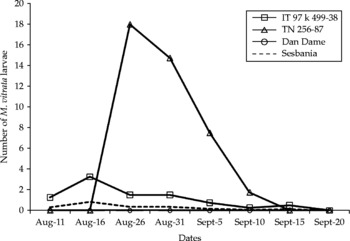
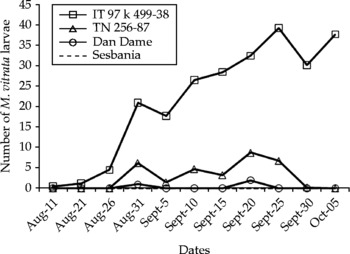
In Niger in 2008, M. vitrata larvae occurred mainly on the intermediate maturing variety of cowpea with significant numbers (F = 16.53; df = 3; P = 0.036) compared with the other cowpea varieties and S. pachycarpa (Fig. 3). In 2009, the early maturing cowpea variety had significantly higher numbers of M. vitrata larvae compared with the other cowpea varieties (Fig. 4). No M. vitrata larva was recorded on S. pachycarpa throughout the growing season.
Maruca vitrata larval infestation on three cowpea varieties (IT 97k 499-38, TN 256-87 and Dan Dame) and Sesbania pachycarpa during the 2008 growing season in Maradi, Niger

Maruca vitrata larval infestation on three cowpea varieties (IT 97k 499-38, TN 256-87 and Dan Dame) and Sesbania pachycarpa during the 2009 growing season in Maradi, Niger

Adult M. vitrata light trap catches
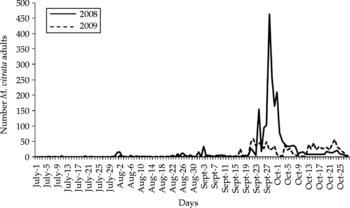
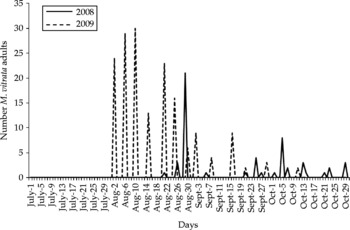
The number of M. vitrata adults captured in the light trap showed inter-year variability in both countries (Figs 5 and 6). The duration of the flight period extended from early August to late October. In Burkina Faso, a total of 4216 M. vitrata adults were caught in the light trap in 2008 and 3134 adults were caught likewise in 2009. In Niger, the overall capture increased from 53 adults in 2008 to 170 adults in 2009.
Adult Maruca vitrata catches in the light trap in Farako-ba, Burkina Faso, in 2008 and 2009

Adult Maruca vitrata catches in the light trap in Maradi, Niger, in 2008 and 2009

Discussion
Regardless of the year, M. vitrata larvae and adults were more abundant in the experimental location in Burkina Faso compared with the one in Niger. The observed differences in the incidence of the pest may be explained by the rainfall pattern, the site in Burkina Faso being located in the Sudanian zone, which is more humid than the Niger site (located in the Sahelian zone). This is in accordance with previous studies in Burkina Faso, which demonstrated that M. vitrata is more active in the Sudanian zone (Ba et al., Reference Ba, Margam, Dabire-Binso, Sanon, McNeil, Murdock and Pittendrigh2009). Based on our current findings, we may consider M. vitrata as a minor pest of cowpea in the Maradi region, at least during the two cropping seasons of our study. Under these circumstances, it appears very unlikely that Bt-cowpea will be deployed in this region. Thus the discussion on the potential of Sesbania to act as a refuge will focus on findings from Burkina Faso.
The use of refugia of non-sprayed or non-transgenic plants is considered central to managing resistance to pesticides in arthropods (Gould, Reference Gould1998). Refugia can be comprised of non-transgenic plants, the primary host for the targeted insect pest, and perhaps any other significant host of the insect pest. Weeds that are alternative hosts to arthropod pests can serve as a food source that does not reinforce the selection of resistance genes. Models based on studies on maize suggest that increased habitat diversity, which could include weedy vegetation, should reduce the rate of spread of rotation-resistant western corn rootworm (Onstad et al., Reference Onstad, Crowder, Isard, Levine, Spencer, O'Neal, Ratcliffe, Gray, Bledsoe, Di Fonzo, Eisley and Edwards2003). Several studies reported the utilization of wild host refuge for resistance management in transgenic crops (Zhang and Tang, Reference Zhang and Tang2000; Tan et al., Reference Tan, Chen, Li and Zhang2001; Wu et al., Reference Wu, Feng and Guo2004; Abney et al., Reference Abney, Sorenson and Bradley2007; Jackson et al., Reference Jackson, Bradley, van Duyn, Leonard, Allen, Luttrell, Ruberson, Adamczyk, Gore, Hardee, Voth, Sivasupramaniam, Mullins and Head2008). Our results obtained in Burkina Faso indicate that larvae of M. vitrata were consistently present in S. pachycarpa during the rainy season and overlapped on this host and cultivated cowpea, demonstrating that S. pachycarpa may host a substantial proportion of the M. vitrata population available to attack cowpea fields. In fact, the percentage of the M. vitrata population collected from S. pachycarpa ranged from 9 to 13% compared with the population observed on the three cowpea varieties together. Up to 13% of the M. vitrata population being hosted by S. pachycarpa may probably not be sufficient to meet the requirement of 20–30% recommended for non-transgenic crop refugia (Gould, Reference Gould1998; Nibouche et al., Reference Nibouche, Guerard, Martin and Vaissayre2007) if a single Bt-gene is used in transgenic cowpea. However, it may be more than sufficient for a two-toxin pyramided cowpea. However, S. pachycarpa represents only one potential wild alternative host. Other wild alternative hosts, combined with S. pachycarpa, may provide for a sufficient refugia; a hypothesis that remains to be tested.
It is also recommended for the refugia crop to be located close to the transgenic crop to maintain effective inter-mating among susceptible and resistant individuals. Based on these considerations, S. pachycarpa may act at least as a partial refugia in the West African agro-ecosystem. For such an unstructured refuge strategy there is, however, the need to further investigate all M. vitrata host plants and identify the area covered by each of the plants compared with cowpea. Another consideration that needs to be addressed is related to the gene flow within M. vitrata populations as a function of the host plant. The above issues have been reported as critical in unstructured refuge strategy based on wild host (Bourguet et al., Reference Bourguet, Bethenod, Trouve and Viard2000; Tan et al., Reference Tan, Chen, Li and Zhang2001; Vialatte et al., Reference Vialatte, Dedryver, Simon, Galman and Plantegenest2005).
Future work should place emphasis on the survival of M. vitrata larvae on S. pachycarpa in comparison with their survival on cowpea. It is the relative numbers of adults emerging from the two species that will determine, along with the relative area, the value of S. pachycarpa as a wild refuge for IRM.
Conclusion
The study has demonstrated that S. pachycarpa is a potential natural refugia for M. vitrata and so could be part of an IRM strategy for Bt-cowpea farmers in selected areas of West Africa. This weed is an alternative host plant for M. vitrata, which grows abundantly in the wild in these countries. In areas where M. vitrata is endemic, encouraging the growth of S. pachycarpa may be a cost-effective way to provide an important refuge to delay the onset of resistance in this pest population.
Acknowledgements
This study was made possible through the support provided to the Dry Grains Pulses Collaborative Research Support Program (CRSP) by the Bureau for Economic Growth, Agriculture, and Trade, US Agency for International Development, under the terms of Grant No. EDH-A-00-07-00005 supporting work by B.R.P. (PI), I.B. (co-PI) and C.L.B.-D. (co-PI). The opinions expressed herein are those of the authors and do not necessarily reflect the views of the US Agency for International Development or the US government. The authors are grateful to technicians Herve and Mayaki who collected the field data.