Introduction
Madonna: ‘I certainly think she references me a lot in her work. And sometimes I think it is amusing and flattering and well done. [. . .] [Her songs seem to be a] statement about taking something that was in the Zeitgeist, you know, 20 years ago, and turning it inside out and reinterpreting it.’Footnote 1
Speculation about Lady Gaga's compositional strategies has been widespread, explored by fans and critics alike in reviews that question her apparent tendency to borrow.Footnote 2 Our goal in this article is to examine Lady Gaga's borrowings in order to interpret her intertexts for their cultural and historical significance. We take as our object of enquiry her second EP (extended play) release, The Fame Monster (2009), a collection that is particularly well suited to an exploration of musical intertextuality due to the range of styles and genres that are represented in its eight tracks. Specifically, we focus on two songs that illuminate the scope of Gaga's musical expression and intertextual strategies: 1) ‘Alejandro’ (track 2), a gothic Euro-pop song featured as the third single of the EP, which reached no. 5 on the Billboard Hot 100 charts; and 2) ‘Speechless’ (track 4), a power rock ballad that, despite not being released as a single, reached no. 1 on the US Billboard Hot Single Sales charts.Footnote 3 These two songs offer not only contrasting features in genre and style, but also explore contrasting cultural and historical contexts through their intertexual references. In order to address the significance of these songs, our analyses are based on a framework informed by theories of intertextuality and genealogy.
The concept of intertextuality has its roots in literary theory, but has been transferred successfully to musical contexts.Footnote 4 Simply defined for this article, we understand intertextuality to comprise the web of interrelated creative elements that link a text to other texts. In the case of a popular song, we understand the text to comprise both music and lyrics and we see these two aesthetic domains of sound and word as constitutive of the popular music song. Given how daunting a task it would be to identify all the musical cues in Lady Gaga's song recordings, we do not claim that our analyses are comprehensive catalogues of referential content, but rather bring forward selected references that expose striking similarities in formal, structural, and gestural content.
To be sure, the selection or recognition of intertextual references – that is, the identification of elements or materials that suggest a connection to or borrowing from another work – is always already an interpretive process. In this regard, we adopt John Frow's perspective:
The identification of an intertext is an act of interpretation. The intertext is not a real and causative source but a theoretical construct formed by and serving the purposes of a reading. There are no moments of authority and points of origin except those which are retrospectively designated as origins and which, therefore, can be shown to derive from the series for which they are constituted as origin.Footnote 5
Frow's approach to intertextuality is in keeping with the approach that we take here; that is, we do not make any claims for the absolute authority of the intertextual relationships we explore, but rather offer the analyses as interpretive readings of the song materials that aim to account, in a systematic way, for the music and its referential elements and qualities.
Foucault explains the extent to which texts operate within a larger discursive context in The Archaeology of Knowledge (1972):
The frontiers of a book are never clear-cut: beyond the title, the first lines, and the last full stop, beyond its internal configuration and its autonomous form, it is caught up in a system of references to other books, other texts, other sentences; it is a node within a network.Footnote 6
Foucault's conception here of a network of texts created in and through a system of references is readily applicable to the work of Lady Gaga, whose songs feature many intertextual ‘borrowings’. As we show, these borrowings have been systematically and strategically chosen, creating links to a network of songs from specific musical genres and cultural contexts.
In addition to his thinking about larger discursive contexts, Foucault's approach to history and, more specifically, historicization strongly influences our interpretive framework. That is, our approach integrates theories of intertextuality with a historicizing approach that Foucault refers to as genealogy. For Foucault, this sort of approach sets out to identify the systems of thought and regimes of truth, power, and knowledge that constitute social institutions and cultural forms. Although a thorough review of his theoretical contributions to discourse analysis is clearly beyond the scope of this article, we will identify the aspects of Foucault's thinking that have influenced our approach.
Drawing on Nietzsche, Foucault develops the concept of an ‘effective history’ or ‘genealogy’ in an attempt to understand the processes in and through which certain forms of knowledge are constituted as truth and others are not. He calls these processes ‘truth games’ or ‘the games of truth’.Footnote 7 He conceives of genealogy as a way of uncovering and, ultimately, understanding forms of knowledge that have been either ignored by or excluded from dominant discursive fields.Footnote 8 For Foucault, genealogy became the ‘method of strategically disseminating such [forms of] knowledge so that [they] can be effective for people's struggles’.Footnote 9 In our study of Lady Gaga's borrowings, we transfer the principles of Foucault's genealogical approach to the study of popular music in order to examine the cultural and historical knowledge that Gaga both recalls and reworks in and through her intertexts. The genealogical approach allows us to pose questions such as: What cultural histories does Lady Gaga invoke with her borrowings? What ‘truth games’ does she work to dismantle? What subjugated knowledge does she attempt to access, activate, and reclaim in order to address silenced subjectivities?
It should now be clear that we do not undertake this study merely to identify the musical references on which Lady Gaga relies or to prove that she has or has not infringed on copyright. Our goals are, rather, to reflect on the larger cultural strategies at work in Gaga's musical intertextuality while considering the historical narrative she articulates in and through her creative practices. Gaga manipulates a range of genres and styles, creating songs that emulate the exemplars of those genres and styles. Our analysis suggests that Gaga manipulates and connects with significant historical tracks, creating a highly charged musical expression that communicates multilayered cultural messages.
Intertextuality in Popular Music
Our approach to intertextual analysis is informed by a number of scholars who have transferred the concept to popular music analysis. Mark Spicer applies an intertextual framework developed for classical music by Robert Hatten to the popular music domain. Mobilizing Hatten's terms, Spicer distinguishes stylistic intertextuality (an intertextual connection without specific work references) from strategic intertextuality (an intertextual relation based on deliberate work references), and aims to show how both ‘stylistic and strategic references contribute to the meaning of the new piece’.Footnote 10 This distinction between stylistic and strategic intertextuality allows the analyst to identify not only direct quotations and formal references, but also the more general stylistic qualities of a musical performance. In the case of Lady Gaga's work, we find her to be engaging in both of these intertextual contexts; that is, while some of her gestures and compositional structures can be identified as direct strategic references, there are also clear examples of stylistic imitation, as she invokes distinctive aspects of the performance styles of other artists, for instance, through her vocal expression, instrumental texture, and production factors.
Serge Lacasse writes extensively on the popular music intertext by developing Gérard Genette's notion of transtextuality, a concept that accounts for the complete set of relationships that connects a text to other texts and comprises several categories of textual references and contexts.Footnote 11Intertextuality identifies the presence of a text within another in the specific instances of quotation, plagiarism, and allusion; this suggests identifiable and localized borrowing, which we will show to be particularly pertinent in the analysis of Lady Gaga's intertexts. We also engage Lacasse's understanding of Genette's concepts of paratextuality (referring to the set of materials and artefacts that surround and complement the text, such as the title, artwork, images, and formatting of the text) and metatextuality (comprising the critical commentary and interviews that link one text to another).Footnote 12 Lacasse's formulation thus allows for a comprehensive consideration of the popular song text and its references to other texts, not only in the materials and expressive elements that are embedded in the text (intertext), but also in the potential links and connections that are evident in the surrounding materials. These related materials include the images, design, and formatting of the text (paratext) in addition to critical commentaries, reviews, analyses, and interviews with the artist (metatext).
Our intertextual analyses aim to investigate the treatment and manipulation of the borrowed materials, their surrounding critical and material contexts, as well as their integration – as a system of references – into the compositional design and performance expression of Lady Gaga's songs. This allows for a view into Gaga's aesthetic craft as a composer and, furthermore, as a facilitator and developer of genre and style. Taking our consideration of the song's intertext to a deeper interpretive level, we also aim to unveil the aspects of Gaga's intertextuality that connect her work to significant cultural and historical contexts. This cohesive approach allows for a thoroughgoing understanding of the broader implications of the borrowings and, by extension, for more far-reaching interpretive conclusions. As Frow suggests:
What is relevant to textual interpretation is not, in itself, the identification of a particular intertextual source but the more general discursive structure (genre, discursive formation, ideology) to which it belongs. This has implications for the kind of knowledge we should expect to be relevant to the reading of texts. It suggests that detailed scholarly information is less important than the ability to reconstruct the cultural codes which are realized and contested in texts.Footnote 13
Frow's conception of intertextuality resonates with our approach for his understanding of the text as culturally and historically contingent. As he establishes:
the concept of intertextuality requires that we understand the concept of text not as self-contained structure but as differential and historical. [. . .] Texts are therefore not structures of presence, but traces and tracings of otherness. They are shaped by the repetition and the transformation of other textual structures.Footnote 14
Frow's notion of the ‘tracings of otherness’ resonates particularly well with Foucault's concept of genealogy, to which we will now turn.
Genealogy
We use the concept of a critical genealogy in order to map the references and discern the messages that emerge in and through Gaga's cultural production. In Foucault's terms, a critical genealogy allows the historian to reveal how games of truth and regimes of power and knowledge are both productive of and produced by culture. Foucault's genealogical approach is summarized here by Clare O’Donnell:
Later in a lecture delivered in 1976 Foucault describes genealogy as a form of research aimed at activating ‘subjugated’ historical knowledge, that is, knowledge which has been rejected by mainstream knowledge, or which is too local and specific to be deemed of any importance. In this account, he characterizes archaeology as the process of unearthing and analyzing subjugated knowledge and genealogy as the method of strategically disseminating such knowledge so that it can be effective for people's struggles.Footnote 15
The notion of subjugated knowledge, to which Foucault refers, is a form of knowledge that has been buried under dominant forms of knowledge production and dissemination.Footnote 16 More specifically, the process of uncovering subjugated knowledge is intended to explore the historically specific relationship between truth, knowledge, and power. Foucault suggests, following Nietzsche, that knowledge and truth are produced by struggles both between and within institutions, fields and disciplines and then presented as if they are eternal and universal.Footnote 17
Our analysis of Lady Gaga's songs demonstrates that her popular music intertexts convey messages about human identities that have been subjugated in popular music history. Her multiple references trace a pathway of connections to works that bear social significance for human rights issues. We will argue that, by incorporating these references into her own compositions and performances, she is calling upon her listeners to recognize the genealogical make-up of her music and, ultimately, to interpret the cultural narrative to which she actively contributes.
Intertextual and Genealogical Framework
In the interest of developing an approach that integrates intertextuality and genealogy, our analytic and interpretive objectives for each of the songs we have chosen from The Fame Monster will be as follows:
Metatextuality and paratextuality:
• to engage with the critical reception and interview materials (metatext) as well as the complementary artefacts (paratextual materials) associated with the song in order to identify the principal themes and cultural concerns that contribute to the song meanings and effects.
Stylistic and strategic intertextuality:
• to identify the musical and lyrical features of the song that are connected to past musical works and to examine the artist's treatment and transformation of the borrowed materials;
• to distinguish strategic and stylistic intertextuality; that is, to consider not only references to content and structure but also to modalities of vocal expression, instrumental texture, and production.
Genealogy:
• to reflect upon the social messages and cultural positioning of the artists from whom the materials are borrowed;
• to discern how multiple borrowed materials in a given song are interconnected and interrelated to create a network of texts;
• to consider the cultural contexts of the borrowings in order to illuminate, in combination with the historical contexts, the genealogy of each song and thus to reveal the artist's efforts to dismantle particular cultural histories and produce powerful counter discourses.
In sum, our exploration of Lady Gaga's borrowings will include a reflection on how Gaga forges her cultural messages by mobilizing and manipulating references that yielded a particular cultural impact. In so doing, not only does she communicate cultural messages to her audience, but she also constructs her own stylistic and genre-based lineage, writing herself into music history. Our interpretations recognize her authorial agency and attribute to her a deliberate and strategic effort to build texts that transform earlier works and develop what Frow would refer to as ‘tracings of otherness’.Footnote 18 We will demonstrate how her intertexts connect her to social groups for whom she frequently advocates at public events and artistic venues. To begin, however, we will establish the key themes that Lady Gaga explores in The Fame Monster album as foundational contexts for the song analyses that follow.
The Metatext: Contextualizing The Fame Monster
In the critical reception of The Fame Monster, several themes come into focus. Most notably, the two themes that are represented in the album title itself – fame and the monstrous – shape the metatextual materials that pertain to the work; that is, the critical discussions and reviews of the album as well as the interviews with the artist. In addition to these two key themes, the metatext also reveals an emphasis on the musical stylistic and aesthetic influences that characterize Lady Gaga's work. A final theme that we find crucial to the reception of Lady Gaga's artistic work is activism, as she consistently mobilizes her music and performance art to declare her support for human rights and the LGBTQ (lesbian-gay-bisexual-transgender-queer) community.
Fame
Lady Gaga explicitly highlights the theme of fame in her works, The Fame (2008) and The Fame Monster (2009). With respect to the 2009 EP, she claims that, ‘The new songs are about the dark side of fame. They deal with the fact it's now impossible for me to go out without being recognized. The desire for fame knows no limits and this fascinates me.’Footnote 19 Here we see Gaga discussing the negative effects of celebrity status, which is something that she does in a good deal of the publicity and reviews of The Fame Monster. A thematic treatment of the dark side of fame emerges in a number of performances that took place during the autumn of 2009, coinciding with the EP release (November 2009). For instance, at her live performance of ‘Paparazzi’ (The Fame) at the Video Music Awards in September 2009, she takes the song's theme of fame-mongering to an extreme conclusion by presenting herself covered in blood and hanging by a rope at the end of the song. In an interview about this performance, she declares, ‘I wanted to say something about how the celebrity sort of has this inevitable demise that we love to watch.’Footnote 20
The Monstrous Other
In her promotion of The Fame Monster, Gaga claims, ‘I want to exist in a separate space – a Gaga space, a Monster space.’Footnote 21 She maintains that her performance art is meant to liberate her audience members from their own struggles with social marginalization – or, more simply put, otherness – and that her aesthetic and musical explorations are meant to celebrate her own reception as a ‘freak’ when she was younger.Footnote 22 As Gorgan comments in her review of ‘Dance in the Dark’, Lady Gaga is ‘not afraid to break boundaries and challenge people's perception of “normal”’.Footnote 23 Corona sees Gaga's aesthetic of otherness as a strategy that allows her to ‘build a sense of subcultural membership among the fans’.Footnote 24 In other words, Gaga gains fan loyalty and cultural capital by mobilizing the monstrous because it serves as a vehicle through which the other is empowered and liberated from hegemonic social conventions and constraints.
Influence
Critical reviews of The Fame Monster abound with attempts to identify the major influences on Gaga's work. She identifies Freddie Mercury as an important figure (and it is important to remember that the name Lady Gaga owes its origins to the Queen song ‘Radio Gaga’), as well as David Bowie and Andy Warhol:
Freddie was unique – one of the biggest personalities in the whole of pop music. He was not only a singer but also a fantastic performer, a man of the theatre and someone who constantly transformed himself. [. . .] It is all about him and David Bowie. This flash drawn on my face is a reference to him. Or Andy Warhol. In his time, he did exactly what I’m doing today. He makes art for the masses that is nevertheless taken seriously.Footnote 25
As she responds to the criticism that she has borrowed from the artists who have influenced her, she says:
I could go on and on about all of the people I have been compared to – from Madonna to Grace Jones to Debbie Harry to Elton John to Marilyn Manson to Yoko Ono – but at a certain point you have to realize that what they are saying is that I am cut from the cloth of performer, that I am like all of those people in spirit.Footnote 26
With these remarks, Gaga turns a potential criticism of imitation or derivation into a way of establishing connections with legendary artists and, in doing so, securing for herself an equal status to them. In the interviews that took place around the time of The Fame Monster release, she is also typically complimentary of the artists who have influenced her, as in this comment about Madonna:
I genuinely love her so much. [. . .] She could never be replicated and, yes, I’m Italian, I’m from New York, and not for nothing, it's not my fault that I kind of look like her, right? So, look, if anything, it's more annoying to me that people would insinuate that I don't like to be compared to her. [. . .] She's wonderful and inspiring and liberating, and she's certainly inspired my album, as did David Bowie, as did Prince, as did Michael Jackson, as did Grace Jones, and I would never take that away.Footnote 27
The major figures to which Gaga owes inspiration are well-established artists with a clearly defined role in the history of popular music; furthermore, they are key figures in the cultural history of subverting sex and gender categories.
Activism
As mentioned in relation to the theme of the monster, Gaga's mobilization of the figure of the freak allows her to build a following among socially marginalized groups. In her interview for Fuse and Billboard, she recounts her experience of ‘being an outcast growing up, wanting her show to liberate people from whatever is holding them back or making them feel like a freak’.Footnote 28 Gaga describes her treatment of this theme in an interview with Ellen:
Well, I’ll say, the whole point of what I do, the monster ball, the music, the performance, I want to create a space for my fans where they can feel free and they can celebrate, because I didn't fit in at high school and I felt like a freak. So I like to create this atmosphere for my fans where they feel like they have a freak in me to hang out with, and they don't feel alone.Footnote 29
In her interview for Billboard, she also declares, ‘I got into the music business to liberate, from whatever it is that's chaining you, imprisoning you, or making you feel like a freak sometimes, and that you don't fit in. My shows, my music, it's all part of a performance art piece that's designed to liberate.’Footnote 30 Gaga's interest in liberation is made manifest both on and off the stage. She is, without a doubt, an activist and this is made clear in and through both her gay rights platform and her body revolution platform. What is more, in the month before the release of The Fame Monster, Lady Gaga was invited to perform at the US Human Rights Campaign national dinner (10 October 2009), where President Obama delivered the keynote address and spoke about his ‘Don't Ask, Don't Tell’ campaign. Choosing John Lennon's ‘Imagine’ as her performance piece that evening, she changed the lyrics to suit the occasion, singing ‘It isn't equal if it's sometimes / I want a real democracy’.Footnote 31 The following day (11 October 2009), she spoke at the National Equality March in Washington, declaring:
We must demand full equality for all. They say that this county is free, and they say that this country is equal. But it is not equal if it is sometimes. Obama, I know that you are listening. ARE YOU LISTENING? We will continue to push you and your administration to bring your words of promise to a reality. We need change now. We need action now. [. . .] As a woman in pop music, as a woman with the most beautiful gay fans in the whole world, to do my part, I refuse to accept any misogynist and homophobic behavior, lyrics or actions in the music industry.Footnote 32
Contexts in Summary
The critical reception of Lady Gaga is characterized by numerous references and comparisons to other artists and their music; that is, she is accused of extensive borrowing, she is positioned as next in line to figures such as Madonna, and she is held up as an innovator in terms of genre and style which, invariably, involves relating her work to other legendary artists. In what follows, we will demonstrate how these metatextual themes come together at the intra-intertextual and extra-intertextual levels to create a coherent cultural message. Put simply, we understand Lady Gaga's intertexts to build a network of texts in which the themes of fame, monstrosity, influence, and activism are used to communicate cultural messages. By de-subjugating the musical genealogy of her songs, we argue that she mobilizes her multiple intertexts in order to saturate her music with stories of social marginalization, and to question regimes of truth, power, and knowledge that constitute the socially marginalized as others.
Intertext 1: ‘Alejandro’ and the Thematics of Otherness, Subjugated Self-Expression and Liberation
In its critical reception, the song ‘Alejandro’ drew comparisons to Abba's ‘Fernando’, Ace of Base's ‘Don't Turn Around’, and Madonna's ‘La Isla Bonita’.Footnote 33 Our analysis will show that these influences are indeed present in ‘Alejandro’, not only in the Euro-popFootnote 34 and Latin pop styling, but also through specific structural and design elements, including tonal references, melodic and harmonic features, rhythmic effects, and formal organization. Our analysis demonstrates that the driving musical influences are Abba and Ace of Base, although Gaga subjects the ideas borrowed from these artists to a darker interpretation of the Euro-pop style, one that leads the musical aesthetic into the genre of Industrial Goth.Footnote 35
‘Alejandro’ opens with a distinctive melody (Example 1a) taken from the ‘Czardas’ of Vittorio Monti (1904), a virtuoso violin work based on a traditional Hungarian folk dance that circulated in gypsy (Roma) culture. The ‘Czardas’ in B minor (transposed from the original D minor) begins with a leap to f♯2, which is ornamented by its upper neighbour g2 and subsequently descends, through e2– d2– c♯2, to an ornamented tonic b1. This reduced melodic structure bears a striking resemblance to a song that is frequently cited in relation to ‘Alejandro’ – Ace of Base's 1994 hit single ‘Don't Turn Around’ from their album Happy Nation/The Sign (1992).Footnote 36 The resemblance is immediately apparent in the choice of key, the tessitura, and pitch emphasis of the introductory synthesizer melody [00:10] transcribed in Example 1b:Footnote 37 the B minor opening of ‘Don't Turn Around’ leaps to the high f♯2, which is ornamented by its upper neighbour g2 and then closes with a descending gesture, e2–d2– c♯2. Our point is not that Ace of Base borrowed from the ‘Czardas’; rather, given Gaga's direct quotation of the ‘Czardas’ as well as her formal modelling of ‘Don't Turn Around’, we find it compelling to speculate that she heard a similar tonal and melodic effect between the ‘Czardas’ and the Ace of Base song intro.
Lady Gaga, opening violin reference to Vittorio Monti's ‘Czardas’. Excerpt from ‘Alejandro’ © 2009 Sony/ATV Music Publishing LLC and House of Gaga Publishing Inc. Used by permission. All rights reserved.

Ace of Base, ‘Don't Turn Around’, intro [00:10]. © 1985, 1986 by Editions Sunset Publishing, Inc., Albert Hammond Music and Realsongs. Used by permission. All rights reserved.
This speculation is supported by several additional formal references to ‘Don't Turn Around’. Immediately following the ‘Czardas’ quotation, the song proper begins with an introduction that suggests a connection to the Ace of Base song: the ‘Alejandro’ intro [00:33], transcribed in Example 1c, features a vocal melody (delivered on the sublingual syllable ‘uh’) that condenses the tonal outline described above into a highly simplified melodic line – both melodies leap from b1 to f♯2, both emphasize the gesture f♯2– e2– f♯2, and both ultimately lead to a cadence on d2–c♯2, supported by dominant harmony (F♯). Added to this similarity in pitch and harmonic structure is the spoken delivery of the opening lyrics. In ‘Alejandro’, the spoken delivery begins during the second statement of the ‘Czardas’ melody [00:14], and expresses a sentiment of heartbreak as Gaga proclaims, ‘I know that we are young, and I know that you may love me, but I just can't be with you like this anymore, Alejandro’. During this passage, Gaga's voice is compressed and filtered to create a distant but focused effect. ‘Don't Turn Around’ also begins with a compressed and filtered spoken lyric, ‘I will survive, without you’ [00:04], and then, following the instrumental phrase, the vocalist declares, ‘don't tell me that you want to leave’ [00:17].Footnote 38
Lady Gaga, ‘Alejandro’, intro [00:33]. © 2009 Sony/ATV Music Publishing LLC and House of Gaga Publishing Inc. Used by permission. All rights reserved.

These two musical texts can be seen to interrelate on a number of levels: the introductory key of B minor, the tessitura and pitch structure of the intro melody, the delivery of spoken text and, in the lyrical domain, the theme of broken love and separation. It is important to point out that the references to ‘Don't Turn Around’ do not comprise direct copies, but rather constitute a substantive reworking of the original materials: ‘Alejandro’ refers to the ‘Czardas’, which shares a pitch structure with ‘Don't Turn Around’. Gaga's musical text develops strategic and stylistic intertextual links to both sources.
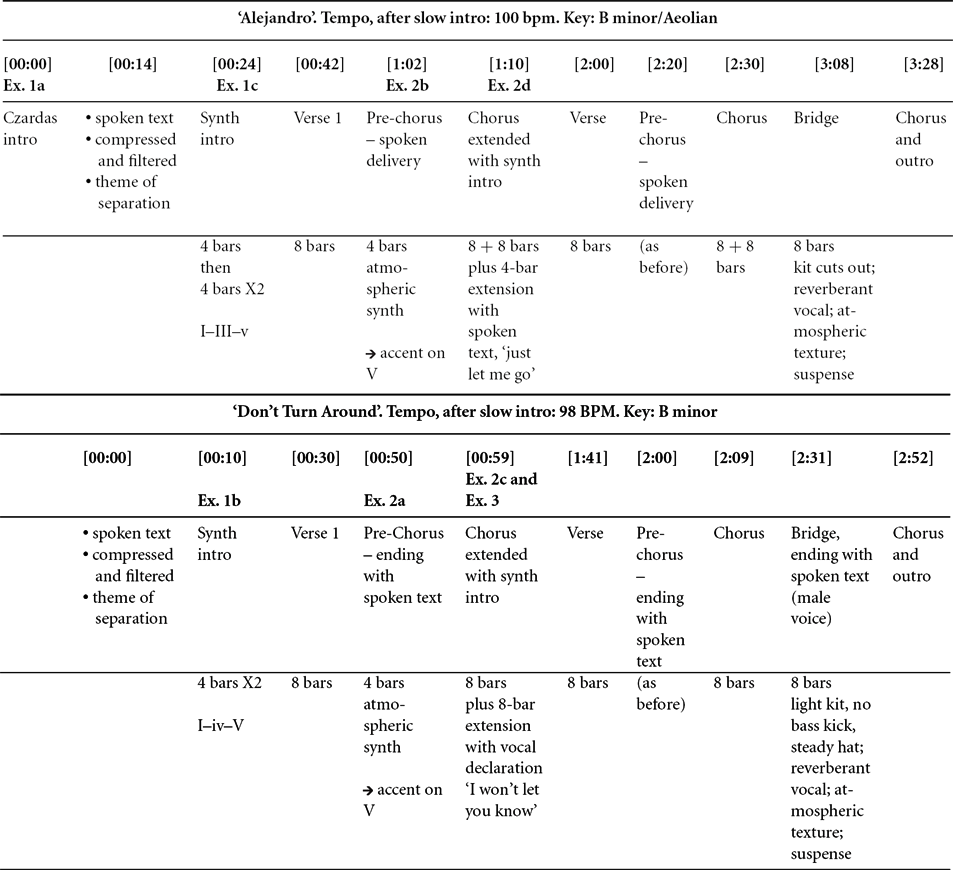
In addition to the gestural similarities discussed above, ‘Alejandro’ and ‘Don't Turn Around’ follow the same formal structure, one that is common in popular music, but nevertheless notable for its strategic application here. The formal structures of the two songs are charted in Table 1. Following a repeated four-bar synth intro, each song features an eight-bar verse, followed by a four-bar atmospheric pre-chorus that comes to an accented stop on the dominant harmony; each chorus is extended with a return to the synth intro and a vocal declaration; a second statement of the verse, pre-chorus, and chorus (not extended this time), then closes with an eight-bar bridge and final chorus section; the bridge passages evoke a feeling of suspense as the percussive accents disappear and the reverberant vocal is supported by an atmospheric synth texture. The common formal (strategic) structure and affective (stylistic) design solidifies the intertextual relationship between the two songs. Having already commented on the links between the intro sections, we turn now to moments in the pre-chorus, chorus, and bridge that reveal additional resemblances.
Formal comparison of ‘Alejandro’ and ‘Don't Turn Around’
‘Alejandro’ and ‘Don't Turn Around’ are also formally linked by their pre-chorus structures. Both pre-choruses (Examples 2a and 2b) feature vocal emphasis on the pitches G–F♯–E (although ‘Alejandro’ is an octave lower), both are directed towards the harmony of the dominant with the seventh (E) in the melody, and both come to a metrically and texturally accented stop on V (F♯ minor in Gaga's B-aeolian context) that anticipates the arrival of the chorus.
Ace of Base, ‘Don't Turn Around’, pre-chorus [00:50]. © 1985, 1986 by Editions Sunset Publishing, Inc., Albert Hammond Music and Realsongs. Used by permission. All rights reserved.
‘Alejandro’, pre-chorus [1:03]. © 2009 Sony/ATV Music Publishing LLC and House of Gaga Publishing Inc. Used by permission. All rights reserved.
One of the most striking connections between the two songs is the chorus hook. ‘Don't Turn Around’ (Example 2c) features a hook [00:59] that repeats g1 then steps down f♯1–e1– d1. The pitch emphasis of the ‘Alejandro’ chorus [1:10] is very similar, as the gesture begins on g1, falling to f♯1 and then d1 (Example 2d). The aural similarity is striking as both lyrics begin with the word ‘Don’t’ on the pitch g1. Gaga does not maintain the Em–Bm harmonic pattern from the Ace of Base song, but rather cycles through the two-bar progression G–D–A–Bm, which can be heard as VI–III–VII–i in B aeolian or possibly as IV–I–V–vi in D.
Ace of Base, ‘Don't Turn Around’, chorus [00:59]. © 1985, 1986 by Editions Sunset Publishing, Inc., Albert Hammond Music and Realsongs. Used by permission. All rights reserved.

‘Alejandro’, chorus [1:10]. © 2009 Sony/ATV Music Publishing LLC and House of Gaga Publishing Inc. Used by permission. All rights reserved.

With this harmonic progression, Gaga exploits an opportunity to develop another strategic element in the ‘Alejandro’ intertext: the turn to the A major harmony (the third chord in the chorus progression) occurs at the lyrical mention of the male names in the song, that is, ‘Alejandro’ [1:14], ‘Fernando’ [1:19], and ‘Roberto’ [1:19]. The A major support for these names points the listener to Abba's 1976 song ‘Fernando’, which cadences on A major when the name is invoked in the chorus [1:31]. An emblematic song for the Swedish group, ‘Fernando’ was their first non-album single release, selling over ten million copies.Footnote 39 The English version of the song suggests a theme of battle and liberation, and in its original Swedish, the lyrics were about lost love.Footnote 40 Gaga's song connects to Abba not only through the strategic ‘Fernando’ reference, but also through the recording style of the vocal. Abba's vocals tend to be layered and lush, creating the effect of depth and occupying the full breadth of the stereophonic spectrum. In Gaga's track, we hear a similar production style as the voice is forward and present due to the volume while a sense of depth is created through reverb.
Lady Gaga's choice of A major harmony in the chorus (G–D–A–Bm) can also be traced to the final section of the ‘Don't Turn Around’ chorus. The latter features a repetition of the progression iv–i in B minor until the chorus is extended in a progression Em7–C–A7–Bm (reduced in Example 3). The pattern creates an intensification of musical purpose at the same moment that the lyrics declare the subject's intention to keep her feelings to herself (‘But I won't let you know’ [1:19]). The A major chord is not only marked as an affective harmonic shift in the chorus, but continues, into the bridge section, to support a lyrically significant departure. As the harmony moves back and forth between E minor and A major (iv and VII of B minor), the lyrics address the desire of the subject to state what is really on her mind (‘I wish I could scream out loud that I love you’ [2:33]). To amplify the impact of the shattered communication in the relationship, a spoken text passage, delivered by a male vocal, addresses the pain felt by the male lover as he walks away, ‘too proud to turn around’ [2:48].
‘Don't Turn Around’, chorus harmonic progression [00:59].
While the Ace of Base version of the song reveals a female subject struggling with her pride as she is left by a male lover, in her version of the ruptured relationship, Lady Gaga's ‘Alejandro’ inverts the gender roles: the female subject is the one to reject her lover, advising him not to call her name anymore. With this role inversion, Gaga displays her ongoing commitment to progressive gender politics, and performance art that is ‘designed to liberate’.Footnote 41 Despite the gender role reversal, the bridge [3:08] of Gaga's song (Table 1) achieves a comparable sonic effect to the Ace of Base bridge. Much like the latter song's bridge, Gaga creates a texture that is characterized by a similar feeling of suspended activity as the kit cuts out, turning the focus to a reverberant vocal with atmospheric synth effects. In both songs, the ‘floating’ feeling of the bridge is succeeded by a final chorus statement and outro. In the lyrical development, ‘Alejandro’ mobilizes this feeling of suspense to express the spirit of her refusal of his attention. Gaga's alternation between the names Alejandro and Fernando during the bridge contributes to the sense of suspense by raising questions about identity and destabilizing the relationship: ‘Don't bother me. . . / Alejandro / Don't call my name. . . / bye Fernando.’ Once again, Gaga makes evident her creative commitment to progressive female sexual agency.
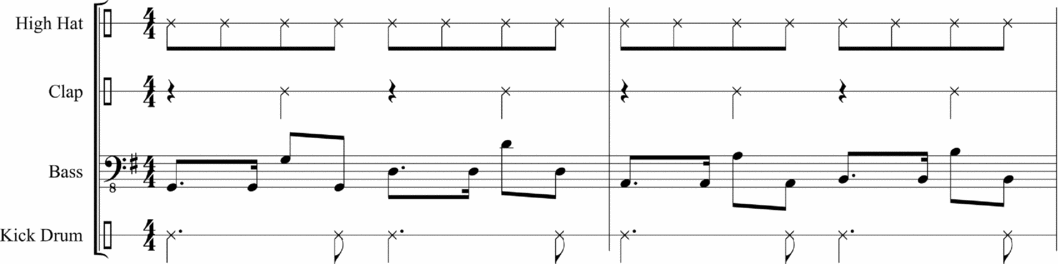
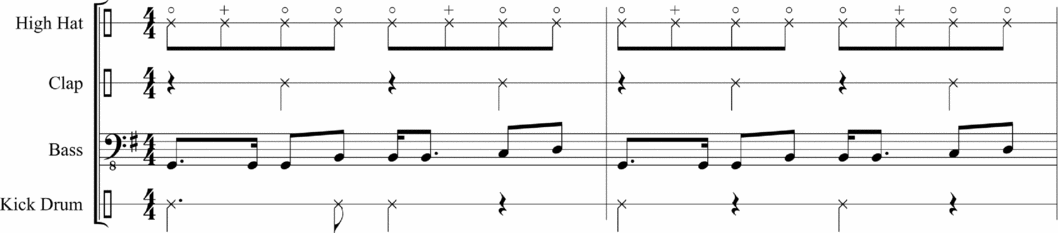
We have shown the melodic, harmonic, and formal elements of ‘Alejandro’ to create a strategic intertext with Ace of Base's ‘Don't Turn Around’. However, the songs are not as clearly connected at the level of rhythmic feel and metric design. The backing beat or groove of ‘Alejandro’ is more stylistically linked to that of another Ace of Base hit song, ‘The Sign’, also from the album Happy Nation/The Sign.Footnote 42 Although both ‘The Sign’ and ‘Don't Turn Around’ feature a tempo (98 bpm) that is comparable to the tempo of ‘Alejandro’ (100 bpm), the driving rhythmic pattern of ‘Alejandro’ is closest to ‘The Sign’. The rhythmic connection is felt most strongly in the chorus of ‘Alejandro’ where the bass, kick drum, high hat, and handclaps offer the pattern indicated in Example 4a, a confluence of rhythmic layers that creates a similar effect to the kit activity in ‘The Sign’ (Example 4b). Gaga's stylistic realization of this groove is heavier and more aggressive than the Ace of Base version. Her high hat has a grainy and gritty sound, as compared with a more playful sound in the Ace of Base track, which features a groove-enhancing ‘chick’ (an open-close pedal effect on the hat) on the last semiquaver immediately before each backbeat clap. Where Gaga's bass is heavier and reverberant as it delivers a very direct statement of the chord roots (G–D–A–Bm), the Ace of Base bass line delivers a 1990s funk groove with a lighter and more melodic sound, especially in the context of the sparse bass and drum aesthetic. The backbeat claps in Gaga's recording are aggressive and direct, while the Ace of Base backbeat is once again more playful and relaxed. A comparison of the kick drum once again yields consistent analytic results as Gaga's kick is heavy and reverberant while it delivers the insistent one-bar pattern, compared to the Ace of Base kick, which is lighter, further back in the texture, and more varied in its two-bar delivery. These comparative remarks are intended to illuminate the stylistic development of the materials that Gaga borrows. She offers her homage to Ace of Base's Euro-pop style and to their hit song ‘The Sign’, but brings the borrowed elements into her own song with a heavier, more aggressive contemporary sound.
‘Alejandro’, chorus, rhythmic transcription.
‘The Sign’, rhythmic transcription.
In addition to its connection to the Ace of Base rhythmic groove, it is important to address the Latin pop feel of the pattern that drives the rhythm in the ‘Alejandro’ chorus. We hear two strong connections in this regard, both of which have considerable purchase in the LGBTQ communities: Shakira's hit song, ‘Whenever, Wherever’, which was the lead single from her first English-language album (Laundry Service, 2001) and served as her international breakthrough;Footnote 43 and Madonna's ‘La Isla Bonita’, her fifth single from the chart-topping True Blue album, and her first song in a Latin pop style.Footnote 44 The Shakira and Madonna songs are linked to ‘Alejandro’ through the Latin styling and rhythmic patterning, as well as the lyrical content, which can be seen to resonate with the exoticism that is suggested by ‘Alejandro’. With respect to rhythm, Shakira's Latin groove (Example 4c) has a similar bass line to ‘Alejandro’, although with its drier four-on-the-floor kick drum and backbeat snare, combined with the background congos and shakers, it offers a more organic and natural aesthetic. Madonna's 1980s version of Latin pop styling features a more synth-pop sound, although with Latin features such as the castanets, maracas, and a cabasa instead of the steady hats (Example 4d transcribes the bass part only). With respect to lyrics, in both of these Latin pop songs, the female subject fantasizes about finding love in a foreign land: Shakira sings, ‘Lucky you were born that far away / So we could both make fun of distance’ and Madonna proclaims, ‘I fell in love with San Pedro / Warm wind carried on the sea, he called to me.’ Gaga's lyrics do not directly channel desire for a so-called ‘exotic other’, but rather problematize the relationship with this other by showing the subject to be making a choice (‘You know that I love you, boy / Hot like Mexico, rejoice / At this point I gotta choose / Nothing to lose’).
Shakira, ‘Wherever, Whenever’, rhythmic transcription.
Madonna, ‘La Isla Bonita’, bass line transcription.

Through its evident connections to Abba and Ace of Base, as well as to Shakira and Madonna, Lady Gaga situates ‘Alejandro’ in a Euro-pop and Latin pop lineage of successful artists and songs. The associations extend beyond the strictly musical or genre-based connections to the social meanings associated with the songs. The song lyrics in question (‘Don't Turn Around’, ‘The Sign’, ‘Fernando’, ‘Whenever, Wherever’, and ‘La Isla Bonita’) convey stories about lost love as well as tropes of recognition, liberation, and exoticization.Footnote 45 Gaga creates her intertext as a vehicle to communicate the story of courage in gay relationships by exploring self-reflexive themes and by signalling her connection to past songs that were attributed cultural status within the gay community. Perhaps this is signalled most clearly in Gaga's selection of the title for the song, ‘Alejandro’, which cues us to Abba's ‘Fernando’. The latter was not only a mainstream hit in 1976, but has also retained its cultural reach into and impact upon the gay community.Footnote 46 To return momentarily to the metatextual contexts of the album, we can receive Lady Gaga's ‘Alejandro’ intertext as an instance of her self-declared activism for the human rights of marginalized others. Through both strategic and stylistic intertextual contexts, she links her song to the genealogies of these other works, she provides ‘tracings of otherness’ and calls upon her listeners to engage with the meanings that reside in the earlier texts.
The opening reference to the ‘Czardas’ in ‘Alejandro’ takes us into the Roma world of the gypsy, which connotes a people who live outside the dominant culture and who were, at different points in history, both rejected and subjugated. The ‘Czardas’ quotation is only heard in the first section of the song, but it nonetheless paints a very particular picture of otherness and social difference. The exoticism that the ‘Czardas’ reference connotes is reinforced by the links to the genres of Euro-pop and Latin pop.
The extraordinary saturation of musical borrowings in ‘Alejandro’ compels the listener to reflect upon the resulting cultural connections and interrelations. This analysis has revealed a convergence of materials that derive from works which explore common social concerns and that combine in Gaga's artistic expression to yield a coherent and powerful cultural message about the challenges of difference and acceptance, subjugation, and liberation.
Intertext 2: ‘Speechless’ and the Thematics of Love, Liberation and Social Inclusion
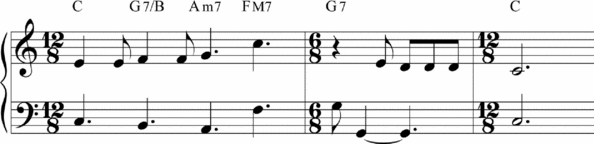
‘Speechless’ is a rock ballad with an anthemic quality that was heralded as one of the strongest tracks on The Fame Monster, with critics comparing her vocal expression to the work of Freddie Mercury.Footnote 47 With that aspect of the metatext in mind, we find one of Queen's greatest hits, ‘Somebody to Love’ (A Day At The Races, 1976) to have much in common with ‘Speechless’, including tempo (74 bpm), powerful vocals, piano chords with bass underpinning, steady hat, clipped backbeat snare and downbeat cymbal crashes, and overdriven lead guitar (reminiscent of Lynyrd Skynyrd's ‘Freebird’, 1973).Footnote 48 Added to these instrumental factors, which can be considered examples of stylistic intertextuality, the songs are also linked by an instance of strategic intertextuality: the descending harmonic progression (C–G7/B–Am7–FM7–G7–C) of the intro and refrain [00:49] in ‘Somebody to Love’ (Example 5) can be strongly identified with the signature progression (C–G/B–Am–F–G) of the intro and chorus [00:53] to ‘Speechless’ (Examples 6a and 8a). Furthermore, the central question of Queen's lyric (‘Can anybody find me somebody to love’) concerns an outsider who struggles to find love and free expression, a theme that emerged as an important part of The Fame Monster metatext.
Freddie Mercury, ‘Somebody to Love’, refrain. © 1976 Queen Music Ltd. Used by permission. All rights reserved. (Transposed from A♭ to C) [00:49]
‘Speechless’, introduction. © 2009 Sony/ATV Music Publishing LLC and House of Gaga Publishing Inc. Used by permission. All rights reserved.
In addition to Freddie Mercury, we hear Gaga's ‘Speechless’ intertext to be forging a strong connection to John Lennon's ‘Mind Games’ (Mind Games, 1973) and Elton John's ‘Your Song’ (Elton John, 1970). Gaga promoted these connections in the live dissemination of the song during the period that surrounded the release of The Fame Monster album on 18 November 2009.Footnote 49 That is, in her live performances, Gaga makes explicit links to John Lennon and Elton John, thereby offering visual cues to the content of her intertext. In the analytic discussion that follows, we explore first the connections to John Lennon, and then turn to her work with Elton John.
Even before the official debut of ‘Speechless’ at the Los Angeles Museum of Contemporary Art, Gaga introduced a segment of the song during a live performance of John Lennon's ‘Imagine’ at the Human Rights Campaign National Dinner on 11 November 2009.Footnote 50 Before singing ‘Imagine’, Gaga offered a poignant speech about human rights. Her staging (white grand piano) and accessories (small dark sunglasses) offered a clear homage (at the paratextual level) to John Lennon.
In her HRC performance of ‘Imagine’, Gaga injects an explicit segment from ‘Speechless’, interweaving materials from her own song into Lennon's in a seamless presentation. Due to a number of common musical features between ‘Imagine’ and ‘Speechless’, including tempo (74 bpm), keyboard texture, key (C major) and melodic range, Gaga establishes, with this performance, a smooth connection between the songs. She modifies Lennon's simple alteration between I and IV at the lyric, ‘No need for greed or hunger / Just the brotherhood of man’, to feature a stepwise descent from I to IV (bass line: C–B–A–G–G♭–F), followed by a return to V. This modification of Lennon's harmony signals change, which she confirms in the subsequent statement of a passage from the ‘Speechless’ coda that includes the descending bass line G–G♭–F–E–C–B–A. She does not sing the ‘Speechless’ lyrics to this passage (‘And after all the drinks and bars that we’ve been to’), but rather substitutes new lyrics in keeping with the ‘Imagine’ framework: ‘Imagine all the people sharing in the world / With nothing to hate and nothing to think / Just people to love’. From this passage – which is musically based in ‘Speechless’ but lyrically grounded in ‘Imagine’ – she then returns easily to Lennon's song, continuing with the gesture ‘You may say, I’m a dreamer’. In this live performance of ‘Imagine’, Gaga unequivocally forges an intertextual pathway between ‘Speechless’ and the work of John Lennon, and in doing so, signals once again her commitment to the themes of liberation and social inclusion that lie at the heart of ‘Imagine’.
That intertextual pathway includes not only ‘Imagine’, but also another well-known Lennon track. Picking up where the thematic conception of ‘Imagine’ (1971) left off, Lennon's title track from his album Mind Games (1973) promoted a new world order. John Lennon and Yoko Ono announced the birth of ‘Nutopia’ at a press conference on 1 April 1973, symbolizing the new conceptual country with a white flag, and declaring the recognition of no boundaries and no passports.Footnote 51 The album was recorded and released in November 1973, following a difficult period of political and personal efforts as Lennon fought his own immigration case. The lyrics of ‘Mind Games’ promote peace, love, and unity, concepts earlier developed in ‘Imagine’. In the analytic discussion that follows, we illustrate some striking strategic and stylistic connections between ‘Speechless’ and ‘Mind Games’.
The opening two bars of ‘Speechless’ establish a dynamic vocal presentation in relation to the overdriven guitar, accompanied by piano, rhythm guitar, and kit. The vocal call on ‘how’ features a strong and lush vocal delivery, which interacts with the sustained, round sound of the lead guitar, while the kit provides cymbal crashes on beats 1 and 3 and an aggressive fill on the backbeats. The introductory four bars feature a descending bass line in C major that moves down the tonic scale to the subdominant, F, and then rises chromatically to G (Example 6a). The forceful opening sets the stage for an indefatigable Gaga performance.
Gaga's introduction shares some prominent elements with John Lennon's introduction to ‘Mind Games’, a rallying social anthem in its own day.Footnote 52 Also in C major, and moving at a comparably moderate tempo, ‘Mind Games’ begins with a descending scale progression in the bass that continues to the low C (Example 6b). The guitar, doubled by the Hammond organ, offers the call that Gaga uses for her vocal line, repeating the melodic pattern G–A–E. The rate of harmonic change within the strongly defined 4/4 metre, combined with the tempo and gradual intensification of rhythmic activity towards the end of the four-bar phrase, comprise the stylistic common ground between ‘Mind Games’ and ‘Speechless’.
Lennon ‘Mind Games’, introduction. © 1973 Lenono Music. Used by permission. All rights reserved.
Following the introduction, the verse of ‘Speechless’ continues to pay homage to the melodic and harmonic structure of ‘Mind Games’. Gaga's verse melody (Example 7a) and Lennon's A section (which immediately follows his introduction) both emphasize the melodic span from e1 down to a; Gaga delivers her lyrics mainly within this range, closing the second statement of the phrase (not shown) with the vocal call (G–A–E) that we heard in the introduction of both songs. Lennon's vocal melody (Example 7b) opens with the gesture G–A–(C)–E and explores the range from e1 to a. Harmonically, Lennon's bass moves again through the descending C major tonic scale, repeating this descent every four bars for the sixteen bars of the chorus. Gaga works within a more limited harmonic range, by beginning on the sixth degree A instead of the tonic C, moving down chromatically to the fourth degree and then back to the dominant. The harmonic progressions are thus different in realization, however, we illustrate below how Gaga manipulates her materials to develop and maintain multiple references simultaneously, creating a network of relations within her complex intertext.
‘Speechless’, verse 1[00:13]. © 2009 Sony/ATV Music Publishing LLC and House of Gaga Publishing Inc. Used by permission. All rights reserved.
Lennon, ‘Mind Games’, A section [00:15]. © 1973 Lenono Music. Used by permission. All rights reserved.
To complete the formal comparison of the two songs, the chorus section of ‘Speechless’ [00:53] can be compared with Lennon's B section [1:15]. Lennon begins strikingly on the high g1 and moves gradually down to a, while the bass descends from tonic C down to D to close on the unresolved harmony of a secondary dominant of V (Example 8b). Gaga also descends vocally from g1 to the low a (notably through F♮ rather than F♯), as her bass moves through the descending tonic scale to F, then rises to F♯ and ultimately to G; although she closes on V compared with Lennon's V of V, her progression (Example 8a) also creates an open harmonic phrase structure.
‘Speechless’, chorus [00:53]. © 2009 Sony/ATV Music Publishing LLC and House of Gaga Publishing Inc. Used by permission. All rights reserved.
Lennon, ‘Mind Games’, B section [1:15]. © 1973 Lenono Music. Used by permission. All rights reserved.
Although ‘Speechless’ reveals a strong intertextual pathway from John Lennon's ‘Imagine’ and ‘Mind Games’, there is yet another significant relationship to explore in the ‘Speechless’ intertext, one that was made explicit at her live performance at the 52nd Grammys in 2010.Footnote 53 Following a choreographed presentation of ‘Poker Face’, Lady Gaga falls into an incinerator and emerges, seated with Elton John at a pair of pianos in an industrial and Goth-stylized setting. While he introduces the chorus theme at the piano, her first statement, ‘Take my picture Hollywood, I wanna be a star’, affirms the theme of fame developed in her Fame and Fame Monster recordings. The two artists deliver an abridged form of the song that eventually segues into lines from Elton John's well-known ‘Your Song’ (1970) in a seamless connection.Footnote 54 In the context of the Gaga's Fame Monster metatext, the selection of ‘Your Song’ has strong symbolic value: Elton John performed ‘Your Song’ at the Concert for Diana (July 2007) to mark the tenth anniversary of her death; he also performed ‘Your Song’ in duet with Billie Joel at the Concert for New York City (October 2001), immediately following the events of 9/11.Footnote 55
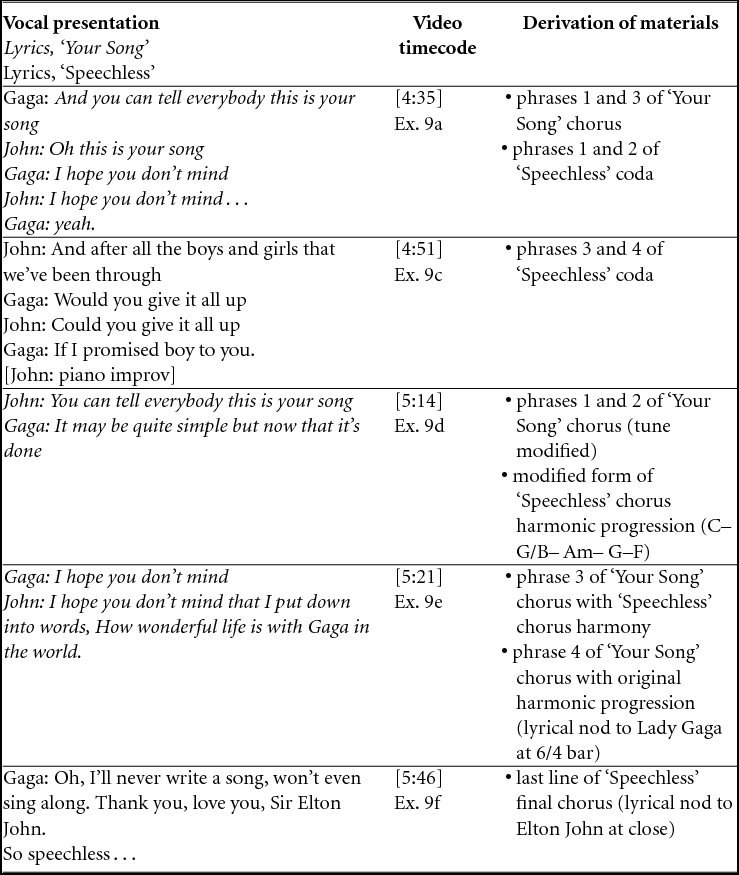
The abridged live performance of ‘Speechless’ comprises verse–bridge–chorus–coda–final chorus, with the coda and final chorus serving as the site of the intertextual references to ‘Your Song’. As the two artists deliver steady chords on the paired pianos, the harmonic underpinning primarily remains that of the ‘Speechless’ coda while the vocal presentations alternate between passages from the ‘Your Song’ chorus and passages from the ‘Speechless’ chorus and coda. Table 2 charts the vocal presentation (showing the lyric passages from ‘Your Song’ in italics) and the derivation of the materials from both songs.
Summary of vocal content in the final coda and chorus of ‘Speechless’ live performance with Elton John, Grammys 2009.
The merging of the two songs is made possible by the similarity of the original materials. As this final section of the live performance begins (at [4:35] in the iTunes video download), the first and third phrases of the chorus melody from ‘Your Song’ are presented over the harmonic progression of the first phrase in the ‘Speechless’ coda: F–E7–C–G/B–Am (Example 9a). Elton John's original chorus material is modified slightly to adjust to the new harmonic context, although the melody retains the emphasis on a1–g1 as the apex of the melodic contour. The transcription in Example 9b of the original phrasing from Elton John's chorus melody facilitates our comparison between the original version and the live performance. In the live performance, the Elton John melody is modified to fit the new harmonic context, but the gestures map easily into that new context and the melodic outlines and gestures are easily recognizable and comparable. In particular, the original melodic pattern a1–g1–a1–c2 in phrase 3 of ‘Your Song’ is clearly retained in the live version.
‘Your Song’, chorus phrases 1 and 3 with ‘Speechless’ coda progression.

Elton John, ‘Your Song’, chorus material (transposed from E♭ to C). © 1969 Dick James Music Limited. Used by permission. All rights reserved.
Directly on the heels of that material juxtaposition (Example 9a), Gaga delivers a complete statement of the second phrase of her ‘Speechless’ coda. This direct presentation of her own material allows the listener to hear the comparable melodic outline and patterning in Gaga's melody (Example 9c) in relation to the transformed ‘Your Song’ chorus melody (Example 9a).
Lady Gaga, ‘Speechless’, coda phrases 3 and 4. © 2009 Sony/ATV Music Publishing LLC and House of Gaga Publishing Inc. Used by permission. All rights reserved.
Following a short interlude of piano improvisation, Elton John and Lady Gaga present phrases 1 and 2 of the ‘Your Song’ chorus, each phrase harmonized by a progression derived from the ‘Speechless’ chorus (Example 9d). The original ‘Speechless’ chorus descends C–G/B–Am–G–F (Example 8a), where here the progression is modified to be C–G/B–F6–F. Immediately following this phrase, Elton John continues with the third phrase of his chorus (Example 9e), now closer to his original melodic expression, but supported by the harmonic progression of the ‘Speechless’ chorus (C–G/B–Am–F). In the final passage, John seizes the opportunity to present the melodic and harmonic material from his ‘Your Song’ chorus and to offer a nod to Gaga in the statement, ‘How wonderful life is, with Gaga in the world’. Gaga returns the compliment by closing the duet with the final phrase from her original song, maintaining the melodic and harmonic content of that phrasing, but also nodding to John with the remark, ‘I’ll never write a song, won't even sing along, thank you, love you, Sir Elton John’ (Example 9f).
‘Your Song’ chorus phrases 1 and 2 with ‘Speechless’ chorus progression
‘Your Song’, chorus phrase 3 with ‘Speechless’ chorus progression.
‘Speechless’, final phrase. © 2009 Sony/ATV Music Publishing LLC and House of Gaga Publishing Inc. Used by permission. All rights reserved.

In addition to these structural (strategic) features, Gaga shows herself to be a vocal chameleon in her stylistic references to Elton John's song. Compared to her recorded performance on The Fame Monster, her live performance with Elton John adds many more vocal effects that match her singing with Elton John's style. This is especially exemplified in her clipping of words, a rougher tone production and slightly sloppy or unfocused pronunciation of words (i.e., unclear consonants and modified vowels). We notice this imitation especially near the beginning of the performance: ‘I can't believe how you looked at me with your James Dean glossy eyes.’
With ‘Speechless’, Gaga channels the rock ballad to create a dramatic and emotional expression that situates her firmly in the tradition of 1970s rock vocalists (i.e., Freddie Mercury, John Lennon, and Elton John). She crafts an anthemic ‘call-to-arms’ aesthetic to create an intertext with ‘Somebody to Love’, ‘Imagine’, ‘Mind Games’, and ‘Your Song’. By invoking this particular genealogy, that is, by ‘building a text that transforms earlier works’ (Foucault), Gaga channels the quest for unbiased love and a new world order that promotes equality and fairness. The ‘Speechless’ intertext stands as a powerful piece of sociomusical activism that sustains a ‘subjugated historical knowledge’ (Foucault) and speaks to her audience with ‘tracings of otherness’ (Frow). Listening to ‘Speechless’, as we process its lyrical promise of love even in the face of adversity and loss, the intertext invites us to connect to Freddie Mercury's outsider who hopes to find acceptance and commitment, to Lennon's quest for a Utopian society where acceptance reigns, and to Elton John's celebration of the act of expressing pure devotion through music and word. Gaga's anthemic intertext conjures the social and historical significance of her iconic predecessors and their enduring cultural expressions.
Closing Remarks
In closing, we would like to return to the question with which we began, that is, to speculate on the meaning of Lady Gaga's borrowings. Richard Middleton's understanding of the popular music intertext offers an interesting perspective on the multiple voices that are integrated into the work of Lady Gaga. Invoking Bakhtin's concept of creativity, Middleton states: ‘Authorship for him is less a singular originary intention, more a space in which the interrelationships of the dialogic voices, at once characters in the text and fragments of subjectivity, are played out.’Footnote 56 It is perhaps in her creation of such a dialogic space that her innovation lies, as she works fluidly within multiple styles, references multiple artists, allowing for multiple musical voices and subjectivities to interrelate in a complex intertextual dialogue.
One could argue, in the spirit of analytic reduction, that with her Fame Monster intertexts, Lady Gaga contradictorily mounts her own case for fame by allying herself with highly successful artists and songs. The compositional interweaving of multiple references to successful popular hits allows Gaga to adopt a star persona that is allied with the legends of popular music. She does not limit herself to one genre or stylistic reference, but rather explores a range of genres and styles and thus a range of other artists and songs. In this regard, she could be seen as ‘The Fame Monster’, an artist devouring the effects of popular music, yielding a new idiom that pushes boundaries and creates new contexts for popular, even iconic, works. This position would be in keeping with the accusations of plagiarism that persist in the popular reception of Lady Gaga.
We would posit, however, with such a hyper-saturation of intertextualities at work here, that her work exceeds the category of plagiarism. We find that Gaga's intertexts point, instead, to a questioning of epistemology and the metanarratives of gender and subjectivity in ways that are coherent with the postmodern aesthetics that she appears to embrace. Despite our methodological emphasis on tracing the multiple sources of Lady Gaga's texts, our analytic findings ultimately lead us to appreciate the depth of compositional and production complexity that emerges in her recordings. She may indeed model her songs on other songs, yet she does not strictly copy any single work, but rather shapes a sophisticated fusion of multiple source elements of design and structure within recording textures that are richly layered and detailed. She also contributes to the advancement of popular genres as she demonstrates her borrowings at the level of genre and style, injecting into existing genre contexts her own innovative manipulations of performance idioms, cultural references, and recording styles.
Finally, we would like to reflect briefly on the methodological approach and analytic model developed in this study. We have blended Foucault's conception of genealogy with music-theoretical models of intertextuality in order to develop a framework for the analysis of the popular music intertext that seeks to understand the histories that are invoked by the textual network of references. With Spicer's distinctions of strategic and stylistic intertextuality, we differentiate specific borrowings from stylistically connected musical gestures and performance features. From Lacasse's musical development of Genette's intertextual parameters, we discern the multiple layers of a text, including the metatextual reviews and interviews and the paratextual materials and artefacts that surround the text. These tools for the analysis of the intertext enable the identification of the borrowed and transformed materials and lead us to the recognition and appreciation of their historical contexts. Ultimately, the full exploration of the genealogy of each song allows the analyst to uncover the cultural significance of the borrowings in order to appreciate the depth of the critical commentary and social discourse that is at work in the musical text.