

Introduction
Political scientists traditionally view the state as the dominant actor in the provision of public goods like environmental protection. States seek to achieve this objective by enacting environmental laws that firms (or other polluting actors) located in their jurisdictions are mandated to comply. There is an impressive literature on what types of laws and implementation strategies encourage compliance.Footnote 1 Yet increasingly over the last several decades, “regulations” have also been supplied by private actors who cannot compel firms to subscribe to them. Under what conditions would firms participate in these non-mandatory regulatory systems?Footnote 2 We examine this important dimension of the contemporary regulatory landscape, namely voluntary programs (also described as private regulation, self-regulation, or certification systems) that function alongside governmental regulations. Such programs have been sponsored by business associations, activist groups, and even governmental agencies.Footnote 3
The popularity of voluntary programs can seem puzzling. After all, standard public policy textbooks teach that governments step in to provide public goods because markets fail to do so.Footnote 4 Pollution reduction via voluntary programs means that firms are voluntarily incurring private costs to provide for environmental public goods. Such costs can be substantial.Footnote 5 Even in instances where costs are non-monetary in nature, participation in these programs can be risky because it creates a potential liability and outlines expectations against which external stakeholders can hold participating firms accountable. Thus, from both scholarly and policy perspectives, it becomes instructive to examine what incentivizes firms to join voluntary or private certification systems.
More broadly, our paper seeks to advance the literature on regulatory compliance. Scholars note frequent geographic variations in regulatory compliance and environmental performance.Footnote 6 Typically, poor or marginalized communities tend to receive disproportionate levels of public bads like pollution.Footnote 7, Footnote 8 This can be attributed to many factors. For one, wealthier communities are better able to advocate and lobby for their interests,Footnote 9 including lobbying for a cleaner environment.Footnote 10 Because firms recognize the relationship between wealth and political power, they may be more attentive in their compliance efforts depending on where a facility is located. This holds for developed economies as well for developing countries. For example, Pargal and WheelerFootnote 11 show that Indonesian firms tend to reduce their pollution levels more when their facilities are located in wealthier communities.
We extend the debate on geographic variations in provision of environmental public goods from the realm of public regulation to the realm of voluntary certification systems.Footnote 12 While there is a literature looking at variations in uptake between developed and developing countries,Footnote 13 scholars have paid less attention to variations within individual countries. We begin with the empirical observation that private certification rates are higher among firms located in major cities than in other areas. As we show, these differences in certification uptakes are not simply an artifact of different industrial sectors (with different propensities to certify) tending to locate in urban and non-urban areas. The policy implication is that efforts to promote voluntary certification programs may inadvertently privilege urban residents, who asymmetrically enjoy the benefits of a cleaner environment, while residents of other areas remain more neglected and vulnerable. In developing and transitioning countries, where rural areas tend to make up an important proportion of the total population and where environmental protection is a crucial issue, the existence and pervasiveness of such disparity is especially problematic.
How might the political agency of key stakeholders mitigate the structural pressures that lead to this observed urban bias in private certification? We suggest that this geographical bias reflects a political market failure rooted in inadequate stakeholder scrutiny of firms’ activities. In the absence of such scrutiny, firms have incentives to limit their efforts to voluntarily supply environmental public goods to areas where powerful interests reside. Active stakeholder monitoring serves as a countervailing force because it can give voice to the less powerful and force firms to respond to their concerns.
We engage with research suggesting that firms’ decisions to participate in certification programs are driven by relationships with different domestic and international stakeholders.Footnote 14 This is important if: (1) stakeholders exercise different levels of power over firms, and (2) they influence urban areas in ways that are different from rural areas. Resource dependenceFootnote 15 and business strategy literaturesFootnote 16 advise firms to carefully map their stakeholders, identify the ones that enjoy greater power, and develop appropriate political or non-market strategies to address their concerns. If so, which stakeholders play key roles, either in driving or in mitigating these geographic disparities in certification uptakes?
Using data from the World Bank Enterprise Survey (WBES) covering 44,134 firms in ninety-three developing or transition countries, we provide the first (to our knowledge) global, firm-level evidence on the adoption of voluntary certification standards. We focus on the most widely recognized voluntary standards: ISO 9001 and 14001, which have been established by the Geneva-based International Organization for Standardization (ISO), the global leader in the standardization movement. ISO 9001 and 14001 standards certify firms’ quality and environmental management practices and follow similar approaches, both asking firms to focus on internal management systems that are then subjected to external third-party verification. ISO 9001 was launched in the 1980s, and ISO 14001, which was launched in the mid-1990s, sought to replicate the ISO 9001 template in the sphere of environmental management. Both at the firm level and at the reporting level, these standards tend to go together and involve the same set of actors.
Our intuition is that an urban bias reflects a failure in the “market for virtue.”Footnote 17 Because political and economic elites tend to reside in urban areas, firms can be expected to be attentive to their preferences. However, scrutiny by media, NGOs, effective regulatory enforcement, and foreign ownership of corporations can create countervailing incentives for firms, thereby obliging them to take into account the consequences of their activities in non-urban areas as well. Thus, the observable implications are that urban bias is mitigated when key stakeholders—civil society, independent media, state regulators, and multinational owners—have the freedom or capacity to scrutinize the negative externalities of firms’ activities across the entire geographic scope of their countries.
Where few environmental civil society groups are active, where media is repressed or primarily state-owned, where governmental regulators are limited by weak regulatory capacity, and where firms are not exposed to monitoring by foreign owners, these stakeholders are less likely to exercise scrutiny altogether. However, in countries with larger communities of environmental civil society groups, free and independent media competing for stories, well-functioning regulatory systems, and larger a presence of multinational corporations (MNCs), these public and private stakeholders are able to exercise scrutiny more effectively, thereby ameliorating the urban bias in the uptake of private certification systems.
We find evidence consistent with these arguments. Modeling private certification decisions as a function of both firm-level and country-level factors, we find interactive relationships between certification, the geographic locations of firms in urban or non-urban areas, and several variables that capture the presence, strength, or capacity of key stakeholders. We find that the urban bias is larger in countries with fewer environmental NGOs, a more repressive media environment, and weaker regulatory institutions, and also larger for firms with no foreign ownership. Conversely, in countries or firms where those factors hold the reverse values, the urban bias disappears.
These findings not only extend the study of urban bias to the private provision of public goods, they also offer rigorous new evidence confirming the importance of stakeholder scrutiny in shaping firm's decision making, and of the abilities of public, private, and non-governmental scrutiny to play similar roles. Whereas past research has emphasized the importance of stakeholder scrutiny on how many firms in a jurisdiction embrace private certification, we demonstrate that scrutiny also shapes which firms make such decisions, helping to level spatial inequalities that would otherwise emerge.
Environmental governance: literature and theory
Pollution reduction and environmental protection are examples of public goods; that is, they tend to be non-excludable (i.e. non-paying consumers cannot be prevented from accessing or enjoying them) and non-rivalrous (i.e. consumption by one consumer does not preclude consumption by others). Because the provision of public goods might require specific actors to incur private costs, governments enact laws to compel them to bear these costs. While the apparatus of environmental laws and regulations has grown to respond to the complexities of environmental challenges, many scholars have questioned the empirical validity and normative assumptions behind state-centered of governance.Footnote 18 Ronald CoaseFootnote 19 famously challenged the theory of externalities that had provided the intellectual rationale for environmental regulations, suggesting that private bargains between the polluter and pollution recipients could achieve the same outcomes (although crucially limited by transaction costs). Elinor Ostrom'sFootnote 20 book, Governing the Commons, also questioned the dominant regulatory narrative by highlighting how communities can create, monitor and enforce rules systems for sustainable exploitation of common-pool resources.
Alongside and sometimes inspired by both Coase and Ostrom, another group of scholars have looked at the role of non-governmental programs or private authority regimes as regulatory vehicles for environmental protection. Indeed, such regimes have emerged across issue areas including food products, occupational safety, quality control, labor standards. Firms participating in these voluntary regimes, programs, or “clubs”Footnote 21 are expected to adopt environmental stewardship practices that exceed governments’ legal requirements. In return, program membership allows participants to signal their stewardship commitment to stakeholders who cannot otherwise fully observe or comprehend participants’ internal practices. These stakeholders can use this signal, brand, or seal of approval as a low-cost mechanism to identify environmental stewards.Footnote 22 In theory, voluntary certification programs make possible a virtuous exchange between firms pursuing environmental protection and stakeholders seeking to identify and reward environmental stewards.
Yet, it is important to differentiate these certification programs from Coasian bargains and Ostrom's communitarian common property regimes. While these certification systems seek to correct the failure in the market for virtue,Footnote 23 unlike Coase, they do not constitute private bargains between firms and populations subject to pollution. Indeed, voluntary programs are quasi-public regimes sponsored by a range of stakeholders; in most cases pollution “recipients” play at most marginal roles in their creation or design. Unlike Ostrom's common property regimes that deploy communitarian actions to address environmental problems primarily by defining and enforcing property rights over open access resources, private certification initiatives are not necessarily aimed at solving common-pool resource problems via communitarian action. Rather, they represent efforts towards the private provision of public goods, not as mechanisms towards the sustainable harvesting of common pool resources.
Who sponsors these voluntary programs? Trade associations and professional bodies have been active in establishing them, often as part of self-regulatory efforts.Footnote 24 Such programs have also been sponsored by activist groups and even governmental agencies.Footnote 25 For instance, the United States’ Environmental Protection Agency has been a pioneer in sponsoring such voluntary programs, with about sixty and counting under its belt.Footnote 26 The crucial point is that there is an impressive range of actors that by themselves or in collaboration with other actors (multi-stakeholder initiatives), have become suppliers of private or non-mandatory regulation.Footnote 27
Sponsorship of the program solves the “supply” side problem: there are actors willing to invest resources in establishing these collective action systems. The second and perhaps the more intricate challenge is to convince firms to join them—after all, they impose private costs and are not required by law. Indeed, the diffusion of these programs has been a subject of active scholarly scrutiny, especially the study of the variations in their uptake across countries.Footnote 28 Scholars have focused on a range of drivers, including those located in the domestic sphere and in the international sphere. While most studies examine country-level certification counts, few use firm-level data that is global in scope to examine the uptake of voluntary certifications standards.
Drawing on the World Bank's Enterprise Survey (WBES), we examine a panel of 44,134 firms across ninety-three economies to explore the variations in the uptake of the most widely recognized private standards: ISO 9001 and 14001, which certify firms’ quality and environmental management practices. From firms’ perspectives, these standards are very similar because they focus on internal processes and systems coupled with third-party verification of compliance by accredited auditors, a process that can impose substantial costs on firms.Footnote 29 There is a robust industry of auditors that offer certification services, including combination services for firms seeking certification to both standards.Footnote 30
Enter urban bias. A quick analysis of the WBES data reveals that certification uptakes are higher in major cities and urban areas. Across all countries in our dataset, the average rate of certification is 27.6 percent for firms located in either capital cities or cities of over one million in population. Outside of these major cities, the average rate of certification is only 20.3 percent. However, this difference of 7.3 percent also varies a great deal from country to country. In some countries, like Azerbaijan and Ecuador, it is over 20 percent, reflecting a much larger disparity in average certification rates. In others like the Czech Republic and the Philippines, however, the urban bias is even reversed, with higher certification rates outside of major cities.
What incentivizes firms to favor these areas in seeking reputational gains via membership in voluntary certification programs? To explore this subject, we draw on the well-established literature on urban bias in development policy, including classic work by Bates as well as others.Footnote 31 Scholars note that industrialization processes increase both the wealth concentration and population share of urban areas. This incentivizes politicians and policymakers to curry favor with this growing, and often assertive, constituency. Because public goods create asymmetric benefits,Footnote 32 politicians strategically deploy state resources at their command in order to direct resources disproportionately toward policies that favor urban areas.
However, urban bias arising from the private decisions of firms has important conceptual differences from the well-known urban bias in development policy. The provision of public goods by governments via policy mechanisms, and by firms via membership in certifications standards, each respond to different forces. Whereas governments might respond to electoral concerns, interest group pressure, or the threat of protest, any disparities in the private provision of public goods represent the aggregation of numerous decentralized decisions taken by individual firms. Yet such individual firm decisions should also respond to the influence and importance of different stakeholders. Where urban interests are influential among the set of relevant stakeholders—either as consumers, employees, owners, or sources of informal pressure—such decentralized private decisions may nonetheless recreate a pattern of urban bias despite the absence of centralized government decision-making.
Thus, if firms signal their commitment to environmental and quality stewardship by joining private standards in response to pressure from external stakeholders, and stakeholders exercise different levels of power over firms, the empirical challenge is to isolate the effects of specific stakeholder mechanisms that shape the observed urban bias.
Mechanisms to mitigate urban bias
We focus on stakeholder scrutiny as a key influence on firms’ decisions to seek private certification, and build on previous work by noting the frequent spatial disparities in such scrutiny. In many developing countries, the attention of key political, economic, and social observers is dominated by cities, and often ignores the countryside—a point made by Kalyvas in the context of studying civil wars.Footnote 33 We extend this notion to firms, such that private actors outside of major cities may face reduced scrutiny of their environmental performance, leading to fewer incentives to seek private certification. Only where key stakeholders have the incentives and the capacity to extend their scrutiny of private actors into more rural areas will the resulting differential be mitigated. We focus on four key sets of stakeholders that shape the scrutiny over environmental issues faced by firms: (1) civil society groups; (2) media; (3) regulators; and (4) foreign owners.
Scholars note the role of civil society scrutiny as an important driver of firm behavior, including adopting private regulatory initiatives.Footnote 34, Footnote 35 Civil society groups are able to scrutinize and publicize negative externalities of firms’ activities, and exert pressure on firms to demonstrate their environmental and quality credentials. Like many actors, such groups may face resource constraints or attention biases that limit their focus to major cities. However, as the number of groups in a given country increases, they face incentives to specialize or differentiate such that some will be able to devote resources beyond urban areas. This may also take the form of competition between groups in the “market” for attention from the media or international stakeholders. We thus expect different patterns of firm behavior in countries with vibrant environmental civil society sectors. As countries have greater numbers of environmental NGOs, which seek to make their mark in the advocacy field by exposing environmental wrongdoings, the ability and incentives of the civil society sector to undertake scrutiny outside of major cities will increase, thereby reducing the urban bias.
Hypothesis 1:
A higher number of environmental NGOs will mitigate the urban bias in ISO certifications.
An independent and free media (including print, broadcast, and internet freedom) also plays an important watchdog function probing wrongdoings by firms in both urban and rural areas. Mass media are an important stakeholder for firms and play a major role in shaping firms’ financial, marketing, environmental, and social policies.Footnote 36 Media can offer both carrots and sticks. They can highlight important achievements and contributions of these firms towards environmental and social stewardship, or the high quality of their products. These reputational gains bestowed by the mass media can sometimes translate into concrete payoffs including increases in firms’ market capitalization.Footnote 37 Media can wield sticks as well, by targeting especially harmful industries and hazardous practices or even targeting specific firms.Footnote 38 Naming and shaming activities that impose reputational sanctionsFootnote 39 can pressure firms into adopting higher social and environmental standards. Importantly, the well-known tendency for urban bias in media attention suggests that any individual media organization may devote more attention to environmental issues in major cities than in rural areas. However, as a country has more—and more independent—media organizations, competition and differentiation will create incentives for some among them to devote scrutiny to issues beyond major cities, thus contributing to the equalization of scrutiny across those divides. Further, in countries with greater media freedom, media organizations will have greater capacity to access areas beyond major cities as well.
Hypothesis 2:
Free and independent media will mitigate the urban bias in the uptake of ISO certifications.
Firms face scrutiny by both non-governmental actors and by governmental actors. The urban bias in certification might be attributed to the fact that regulatory agencies and regulators tend to be located in urban areas (especially the capital city), and may have difficulty extending their activities beyond these areas in countries with weak regulatory capacity. Studies show that domestic regulatory pressures encourage firms to join quality and environmental standards.Footnote 40 Because regulatory agencies are often headquartered in urban areas, regulators have easier access to firms in cities. Amengual,Footnote 41 for example, highlights the difficulty that inspectors in Argentina face even in transportation to sites for inspection. Where regulatory capacity is weak, the geographic disparities in regulator access are likely to be magnified, contributing to greater urban bias. Because firms that face higher levels of real or perceived regulatory scrutiny will be more inclined to signal their compliance to high environmental and quality standards via joining ISO 9001 and 14001 systems, the varying capacity of regulators should be related to such geographic disparities.
Hypothesis 3:
Higher levels of regulatory quality will mitigate the urban bias in the uptake of ISO certification systems.
This urban bias can also be ameliorated by the influence of MNCs that serve as important instruments of diffusing corporate practices, technologies, and norms from their countries-of-origin (home countries) to host countries in which their foreign operations are located,Footnote 42 as well as serving as monitors of subsidiary firm practices.Footnote 43 Further, given the legal issues about the lack of due diligence in environmental operations of overseas subsidiaries—such as the use of inferior environmental technologies and practices, by adopting common corporate practices such as ISO 9001 or 14001 across subsidiaries, MNCs could demonstrate “due diligence” in their operations.Footnote 44
MNCs may also be motivated to certify all their operations because they face greater scrutiny (in relation to domestic firms) from regulators and NGOs and civil society groups.Footnote 45 At home, they may face demands from NGOs to demonstrate that their overseas operations are as “clean” as home operations. Furthermore, MNCs are also under pressure to ensure that their suppliers adopt similar management practices; indeed, there is some work suggesting that MNCs actively encourage their suppliers to adopt superior management practices which mimic the ones outlined in ISO management systems.Footnote 46 While there are increasing levels of “south-south” FDI, resulting in firms in developing countries with multinational owners not based in the “global north,” these owners may still encourage certification as a way to mitigate agency failures, ensure high-quality management systems, and signal their own environmental commitment.Footnote 47
We also note that, while our other hypotheses pertain to country-level contextual variables, our final hypothesis is at the firm level, pertaining to differences in scrutiny from stakeholders outside the geographic boundaries of a given country.
Hypothesis 4:
Foreign ownership of firms will mitigate the urban bias in the uptake of ISO certification systems.
Data and model
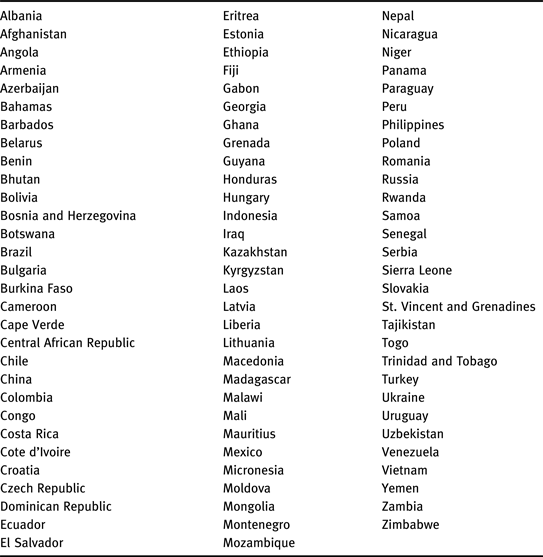
To test the above hypotheses, we draw upon data from the WBES, which conducted firm-level surveys of managers from manufacturing sectors in economies around the world. The WBES provides information on a country's business environment, how it is perceived by individual firms as well as information on the constraints that a firm faces in terms of performance and growth.Footnote 48 To ensure that the sample was representative of the broader population, the survey was stratified within each country, establishment size (small, medium, and large firms), and region. We employ the most recent survey wave for each country surveyed between 2007 and 2012. After listwise deletion of missing data, our dataset covers 44,134 manufacturing firms in ninety-three developing or transition countries from around the world (see Appendix Table A for full list of countries).
Dependent variable
Our dependent variable is a dichotomous response to the survey question: “Does this establishment have an internationally-recognized quality certification?” The survey guidelines include a note to the interviewer, stating that “If there is need for clarification, some examples are: ISO 9000, 9002 or 14000.” While the survey question specifically pertains to quality issues, it does not distinguish ISO 9001 quality management certifications from ISO 14001 environmental management certifications.Footnote 49
As we noted before, this question reveals the fact that ISO 14001 and ISO 9001 reflect similar goals and management system approaches to compliance, and past research has found strong similarities between both their motivations and the ways they are commonly implemented.Footnote 50 In a survey of firms in Catalonia, Karapetrovic, and Casadeus found that a full 96 percent of firms with ISO 14001 certification were also certified to ISO 9001.Footnote 51 Zeng et al. found complete overlap between the two certifications in a survey of large and medium-sized firms in China.Footnote 52 Firms frequently even seek joint certification for both at the same time.Footnote 53 Scholars also report that ISO 9001 certification has been found to be an important predictor of subsequent ISO 14001 certification.Footnote 54 Consequently, our hypotheses regarding roles of various stakeholder pressures (media, NGO, regulators, and foreign ownership of firms) in encouraging certification should apply to both ISO 9001 and ISO 14001.
However, we are aware that the inability to distinguish between environmental and quality management certification is a potential weakness of our empirical strategy. There is a danger that we are empirically capturing only the dynamics associated with certification more generally, rather than dynamics particular to environmental certification that involves the private provision of public goods.
Unfortunately, while the WBES offers unprecedented coverage across many countries, the surveys did not include any question differentiating between these types of certification. That said, we do offer a robustness check in the Supplemental Information that controls for a different form of external signaling—having financial statements certified by an external auditor—that nonetheless has no relation to environmental issues. The fact that our main results remain strikingly similar when controlling for this variable reassures us that we are capturing dynamics relevant to environmental certification in particular, and not only to private certification in general.
Because our dependent variable is binary, we employ logistic regression. In addition, we employ a hierarchical modeling approach. This allows us to include both firm-level and country-level covariates in the model, and at the same time, include random effectsFootnote 55 for each country and each sector among manufacturing industries.Footnote 56 Country random effects allow us to capture unobserved differences among countries, and account for correlated errors between observations in the same country. The inclusion of sector-specific random effects also allows us to address concerns that certification levels differ between big cities and other areas because they attract firms from sectors with different propensities to certify.
Independent variables
The key variables of interest are City Size and its interactions with the main independent variables derived from hypotheses 1 through 4. By including interaction terms, we assess the extent to which varying degrees of 1) civil society; 2) media freedom; 3) regulatory capacity; and 4) foreign ownership serve to condition the effects of the size of the city on certification. The variable City Size captures the size of the locality where firms are situated. The variable takes a series of values ranging from 1 to 5: 5 denotes a firm that is a located in a capital city; 4, a city with a population over 1 million other than the capital; 3, a city with a population of over 250,000 to 1 million; 2, a city with a population of 50,000 to 250,000; and 1, a firm that is situated in a locality with a population of less than 50,000.Footnote 57 As an alternative approach, we also use a dichotomous version of this variable, which takes a value of one if a firm is in either a capital city or city of population over 1 million, and a value of zero otherwise.
To assess civil society scrutiny and the extent to which it is able to exercise power over firms, we include data on the logged number of environmental NGOs in each country, using data collected by Smith and Wiest (Reference Smith and Wiest2005) from the Yearbook of International Organizations. Unfortunately, this data was only collected through 2003, so we use that most recent figure as a proxy for the relative strength of environmental NGO sectors across countries.
Press Freedom is measured with country-level data from Freedom House's Freedom of the Press data. We use the value of Press Freedom corresponding to the year in which each country was surveyed. Freedom House's measure is oriented such that higher values reflect less media freedom. To make the variable more intuitive, we correct the direction such that higher values instead reflect higher press freedom. We use the World Governance Indicators’ country-level measure for Regulatory Quality to evaluate the extent to which firms face functioning state regulatory institutions. This variable ranges in our set of countries from −2.17 to 1.55.
We measure Foreign Ownership based on WBES responses to the question asking what percent of the firm was owned by private foreign individuals, companies, or organizations. As the official definition of FDI employs a ten-percent threshold of foreign ownership, we use a dichotomized version of this variable, which takes a value of one if foreign ownership is larger than 10 percent, and a value of zero otherwise.
Prior research identifies several other firm-level variables as important drivers of ISO certification. Scholars report that pressures from foreign customers encourage ISO certification.Footnote 58 Our mode controls for the firm's Export Orientation, an indicator for firms with more than 10 percent of sales destined for export markets. Literature also suggests that larger and older firms have greater capacities to certify their management systems which often require extensive documentation and dedicated staff to manage them. Hence, our model controls for Firm Age measured as the logged number of years in existence and Firm Size as the logged number of employees.
In addition, our model includes additional country-level controls to capture the role of other factors that might influence firms’ certification choices. Scholars suggest that citizens in rich countries might be more likely to hold post-materialist values such as environmental protection. Anticipating such preferences and norms, firms can be encouraged to pursue ISO certifications to convey their support for such norms. We therefore control for GDP per Capita (logged) as reported in the World Bank's World Development Indicators. Since citizens in democratic settings have greater opportunities to articulate clear preferences about corporate practices that might influence firms’ certification choices, we control for levels of Democracy with Freedom House's Political Rights measure.
Key results
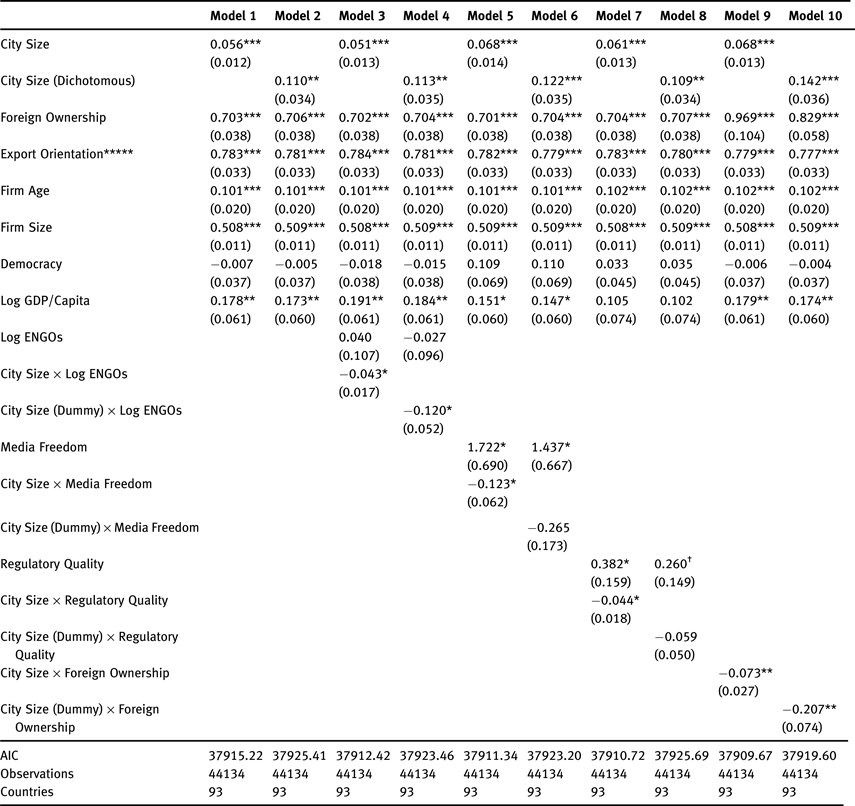
Recall that we are testing for four types of stakeholder scrutiny that we argue mitigate the urban bias in voluntary certification. Our key hypotheses are thus tested by interaction terms between city size and four different measures of stakeholder scrutiny; three measured at the country level and one measured at the firm level. Table 1 presents our results, beginning with base models and adding each set of interaction terms in turn. Models 1 and 2 are our base models and show the unconditional efforts of City Size, in original and dichotomized forms. The aim of these base models is to establish that, absent the stakeholder scrutiny that we subsequently introduce in our models, firms are more likely to seek ISO certification in a more urbanized setting. Based on prior literature on urban bias, we interpret this as suggesting the role of structural pressures in inducing firms to focus their private efforts for the supply of public goods in major cities where political and economic power tends to be concentrated. Note that we are already including sector random effects for seventeen different sector groupings, thereby accounting for the possibility that the geographic variation in certification rates are simply a function of firms in certain sectors being more likely to locate in major cities, and also being more likely to certify.Footnote 59
Results of Hierarchical Logistic Regression Models of ISO Certification.

*** p <0.001, ** p <0.01, * p <0.05, † p < 0.1
The results of model 1 suggest that the probability of certification for an otherwise-average firm in an otherwise-average country range from 18.8 percent at the lowest level of City Size to 22.5 percent at the highest level, a difference of 3.7 percentage points holding all else equal. As our subsequent models demonstrate, however, this “average” urban bias masks substantial heterogeneity depending on context of varying stakeholder scrutiny.
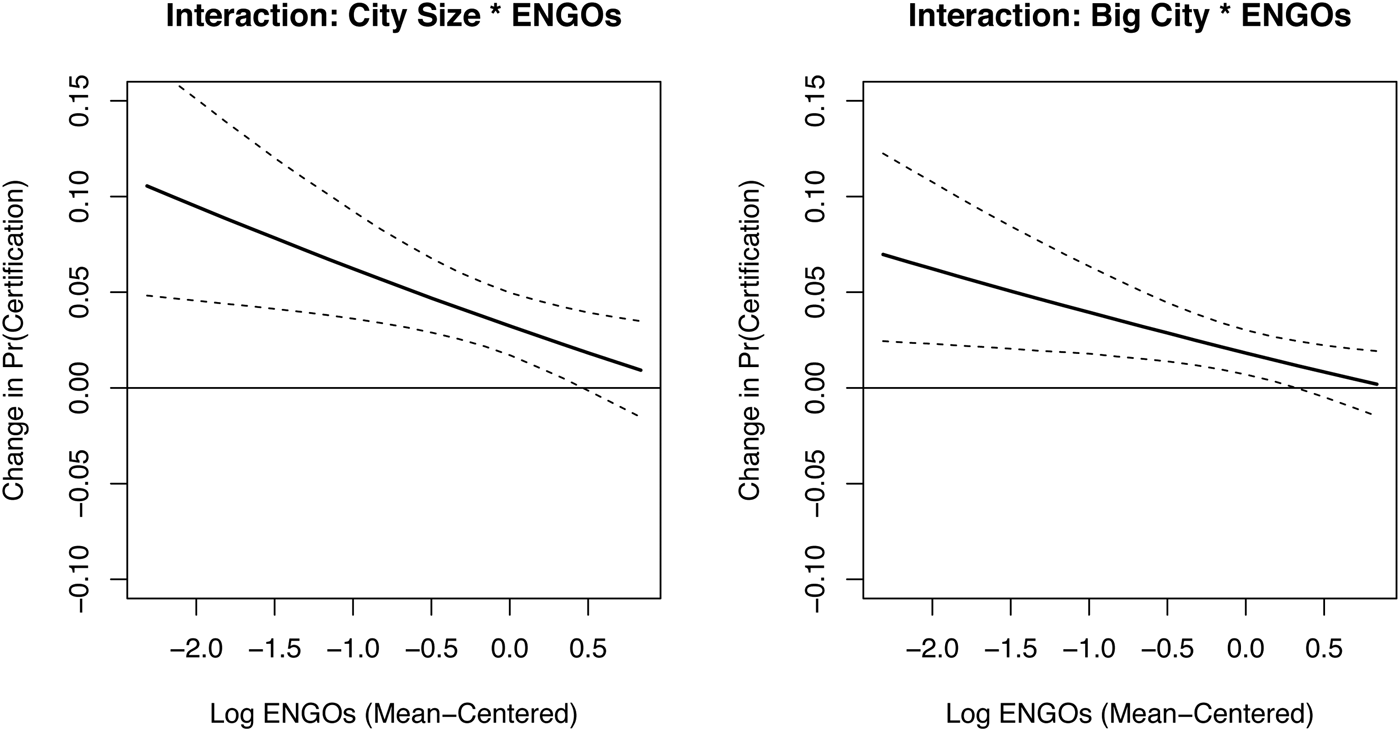
In the following models, we add a series of interaction terms between the City Size variable and the key variables associated with our hypotheses. The results of models 3 and 4, including statistically significant interaction terms between City Size and Environmental NGOs, show that the urban bias in certification shrinks as the number of environmental civil society groups increases. Following Brambor et al.,Footnote 60 we also interpret these interactive results graphically. Figure 1 plots the change in predicted probability of certification resulting from a move from a small town to a major city, as the national-level context shifts from one with fewer environmental NGOs to one with more. Dashed lines reflect 95 percent confidence intervals. Among countries with the highest numbers of environmental NGOs, there is no disparity in certification rates between major cities and small towns. However, this disparity emerges and becomes larger in countries with fewer environmental NGOs to scrutinize and pressure firms. The lower confidence interval crosses zero at a point close to that of countries like Croatia (forty-four environmental NGOs) or Indonesia (fifty)—indicating that at this level and higher, there is no significant urban bias effect, while in countries with fewer environmental NGOs, urban bias is present. These results are also similar whether using the original or dichotomized versions of the city size variable.
Results of models 3 and 4, showing effect of increase in city size (using either standard or dichotomous versions of the variable) at different levels of country-level environmental civil society.

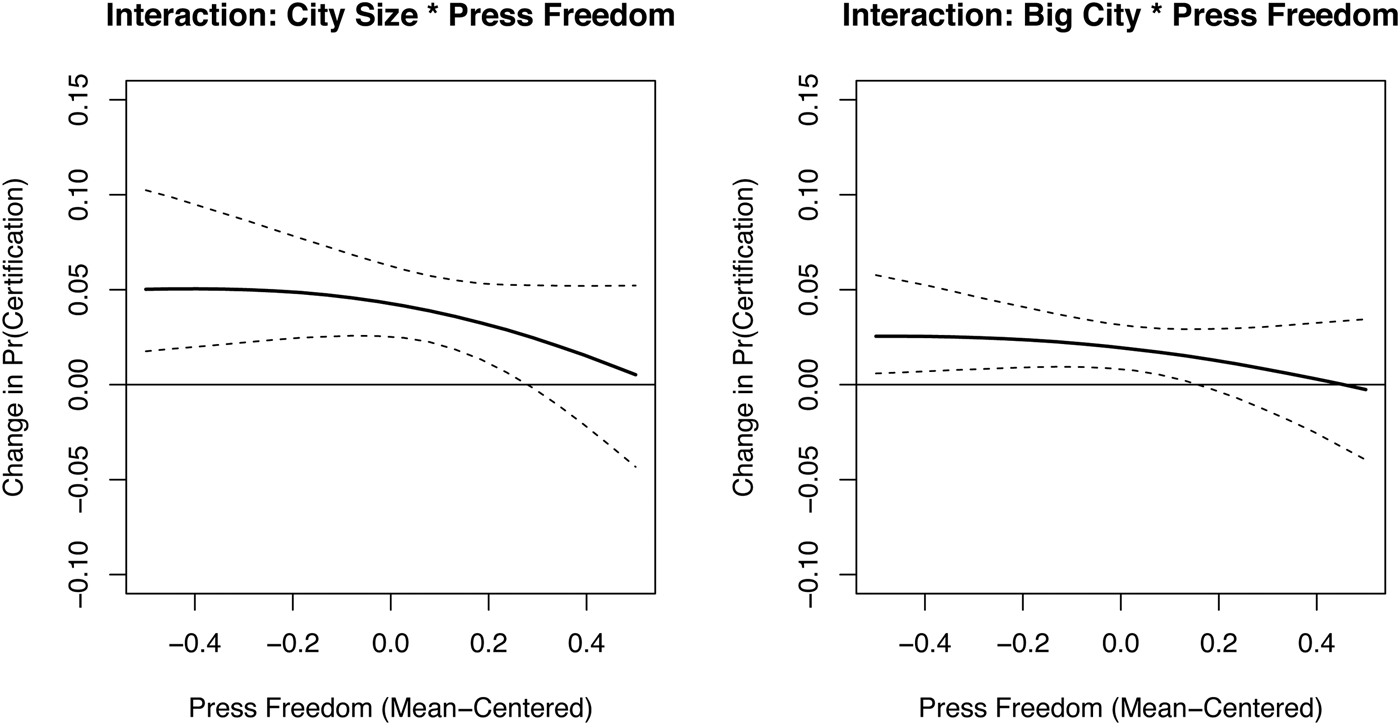
The results of model 5 and 6 include interaction terms with Press Freedom. Model 5 shows that the urban bias is mitigated as the media enjoys greater freedom. The interaction term using the dummy version of City Size in model 6, although similar, is no longer statistically significant. We also present these results in figure 2, which plots the change in predicted probability of certification resulting from a move from a small town to a major city, as the national-level context shifts from less free to more free across both specifications. In the left panel of the figure, we show that where there is an independent media free of repression, there is no significant disparity in certification rates across small towns and major cities. However, where the media is substantially state-owned or faces state repression, the urban bias emerges. The lower confidence interval crosses zero at a level of press freedom close to that of countries like Chile and Ghana—indicating that at this level and stronger, there is no significant urban bias effect, while in countries with less free media, urban bias is present. While the interaction term with the dichotomous city measure was not statistically significant, the relationship displayed in the second panel of figure 2 is at least in the expected direction.
Results of models 5 and 6, showing effect of increase in city size (using either standard or dichotomous versions of the variable) at different levels of country-level media freedom.

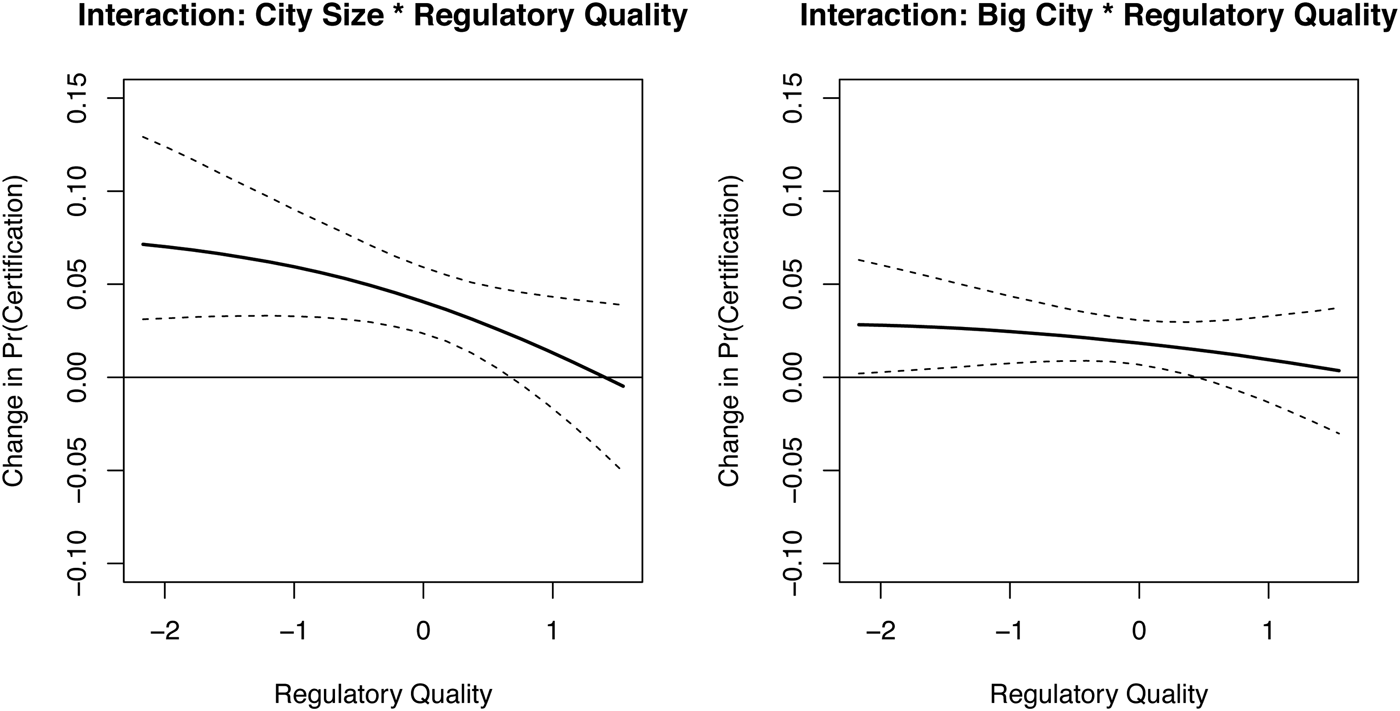
Models 7 and 8 include interaction terms between City Size and Regulatory Quality. While the interaction with the standard version of the City Size variable is statistically significant, the interaction with the dichotomous version is not. Figure 3 plots both results, showing that they are nonetheless largely similar. Particularly in the first panel of the figure, there is no urban bias in countries with capable and functioning regulatory institutions, while as regulatory institutions become weaker, the urban bias in certification grows much larger. Here, the point at which the lower confidence interval crosses zero is equivalent to regulatory quality in countries like Panama and Bulgaria.
Results of models 7 and 8, showing effect of increase in city size (using either standard or dichotomous versions of the variable) at different levels of country-level regulatory quality.

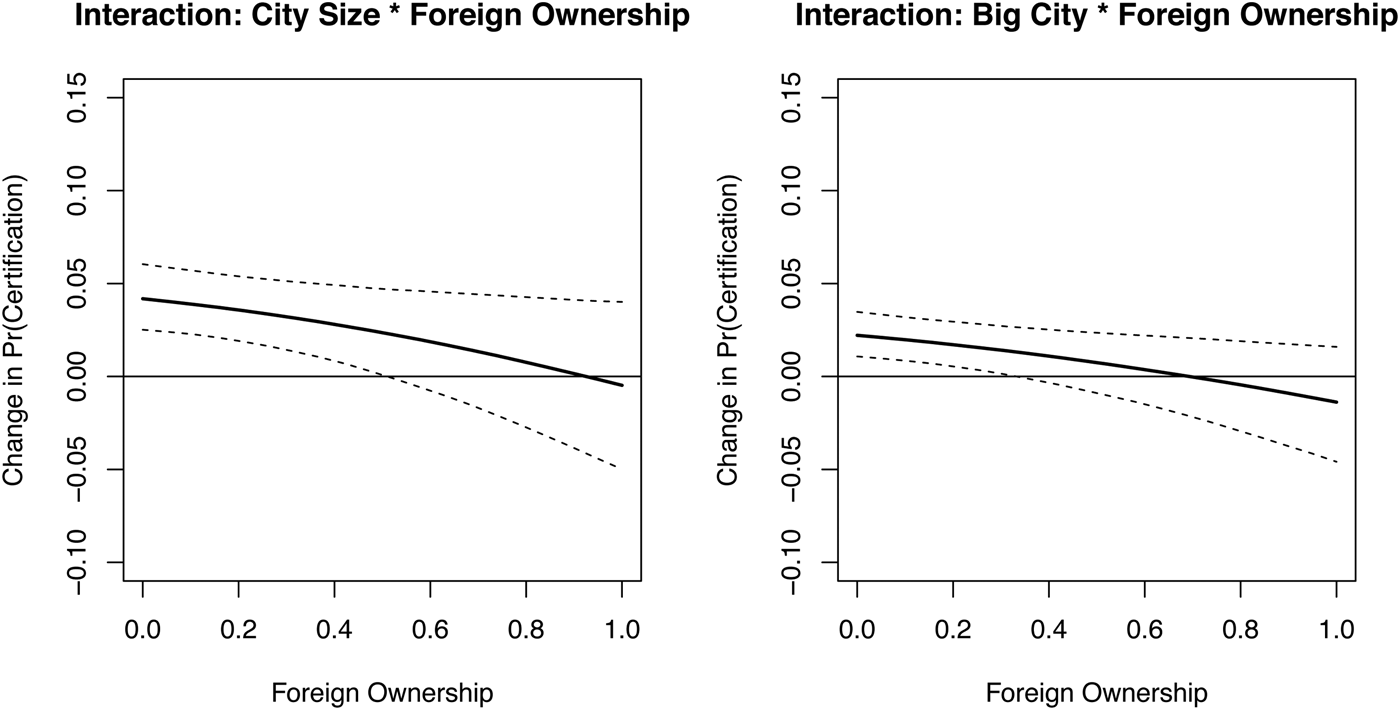
Finally, models 9 and 10 include interaction terms between City Size and a firm-level measure of foreign ownership. Here again, the interaction term is statistically significant across both specifications. Figure 4 shows that the interactive relationship is in the expected direction, with an urban bias in certification only present among non-foreign owned firms, and disappearing among foreign-owned firms. We thereby conclude that foreign ownership, just as the previous stakeholders, serves to ameliorate the urban bias.Footnote 61
Results of models 9 and 10, showing effect of increase in city size (using either standard or dichotomous versions of the variable) at different levels of firm-level foreign ownership.

Together, these results broadly confirm our hypotheses regarding four different sources of stakeholder scrutiny that shape the behavior of firms. With greater scrutiny, certification rates remain similar between urban and rural areas, but with less scrutiny, an urban bias emerges. We also conduct several robustness checks, with results available in the Supplemental Information. Models employing country and sector fixed effects, instead of random effects, capture any potentially omitted variable that is constant within each country and sector. The results are broadly similar, with the exception of the interaction terms for Regulatory Quality which remain in the expected direction but are no longer statistically significant. Models including year fixed effects address any potential differences across years of the survey (recall that we use the most recent available year for each country, but that due to the staggered nature of the survey these range from 2007 to 2012). Those results show no significant differences across years and no substantial changes to our main findings.
We also employ two alternate treatments of the dependent variable, for the small proportion of respondents that either said their certification was “in process” or that they did not know their certification status, but with no substantive changes to our main results. In addition, we present results omitting two particularly large countries—Brazil and China—to ensure that the results are not dependent on these. Further, we present results based on two separate sub-samples of countries—those above and below the median country level of economic development. Although not all of the main findings remain statistically significant with the smaller sample sizes and reduced variation in key country-level variables, all interaction terms remain in the expected direction, suggesting that our results are not specific to either the economically less-developed or more-developed countries of the sample.
As mentioned previously, we also present results including an additional firm-level control variable, measuring whether firms had their financial statements certified by an external auditor. This captures the presence of incentives to send signals of management quality to external stakeholders, but with no particular relevance to environmental issues. Although our External Auditor variable is strongly associated with our dependent variable of ISO certification, the fact that our primary findings remain help to confirm that we are capturing dynamics relevant to environmental certification, and not to signaling quality management practices more generally.
Conclusion
The famous Hawthorne experiments revealed that actors’ behaviors change when they are subjected to external scrutiny.Footnote 62 Justice Brandeis famously noted that “sunlight is the best disinfectant.”Footnote 63 The importance of external scrutiny, especially by actors who can reward and punish, in shaping behavior of the scrutinized actor is echoed in several literatures including research on transparency and accountability.Footnote 64 We contribute to this broader literature by showing that the possibility of stakeholder scrutiny, conditioned by the location of the firm, shapes firms’ choices to join private certification standards. In the same way that politicians will tend to favor the politically powerful constituencies of urban areas in the provision of certain public goods, we find that firms, via the act of seeking private certification, demonstrate their own bias in this regard. Where this dynamic exists, residents of major cities enjoy privileged access to the benefits of the private provision of public goods, especially in the form of cleaner air and water, and reduced risk of explosions, toxic leaks, or other disasters resulting from poor management procedures.
However, this urban bias emerges only where the crucial role of stakeholder scrutiny is weak. In contexts where the capabilities or freedoms of environmental NGOs, independent media, state regulators, or foreign owners are limited, scrutiny by these stakeholders is not able to reverse the structural pressures on firms to provide environmental public goods predominantly in urban areas. When these stakeholders have the capacity and freedom to scrutinize, and potentially publicize, the negative aspects of firms’ activities, however, the disparities in private certification levels between big cities and other areas disappear. This notably highlights the ability of private external actors, civil society groups, and media to play similar roles to state inspectors, at least in a context of private governance.
We believe our findings move the literature on both urban bias and certification diffusion in new directions. By testing different drivers, we are able to pinpoint the specific mechanisms that mitigate the observed urban bias in environmental and quality certification. The bottom line is that stakeholder scrutiny drives policy attention of governmental agencies as well as firms.Footnote 65 If these stakeholders can be expected to shine their spotlight on a given problem, the illuminated issue will get policy attention.Footnote 66
One might wonder if the existence of urban bias is undesirable as an end unto itself. If urban areas tend to be more polluted, then perhaps it makes sense that private certification rates would be higher among firms located in major cities. In other words, urban bias should perhaps be welcome because firms are investing their resources to provide public goods where they can have the maximum impact. This line of argument raises the question whether public goods such as environmental protection should be provided based on “demand,” whether implicit or explicit. Recognizing the complexity of the issue along with its moral dimension, for the purpose of our paper, what is critical is that such spatial disparities can be corrected given sufficient stakeholder scrutiny and activity.
Finally, our findings have an important scope condition: they hold for a specific type of certification system. Arguably, if stakeholders are expected to focus systematically on some policy areas over others, we can expect actors to focus on the scrutinized area. This is not to criticize stakeholders for speaking on important environmental issues; it is possible that some other issues may get neglected in the complex processes of stakeholder politics.Footnote 67 This is an important area of future research.
Supplementary material
To view supplementary material for this article, please visit https://doi.org/10.1017/bap.2017.33.
Appendix
Countries included in the analysis.