Introduction
Nauclea diderrichii (De Wild & Th. Dür.) Merrill (syn. Sarcocephalus dederrichii De Wild & Th. Dür) (Rubiaceae) is an important African timber species belonging to the family Rubiaceae. In Ghana, it is known as Kusia and by the trade name, Opepe (Irvine, Reference Irvine1961). The natural distribution is from West Africa through Central and East Africa, extending to Mozambique (Hall and Swaine, Reference Hall and Swaine1981). According to Hawthorne Reference Hawthorne(1995a), it is found at constant low densities and is never abundant. In Ghana, the trees are sparsely found in the wet and moist semi-deciduous forest zones. Available records indicate that within its natural distribution in Africa, plantations have been established in Cameroon (Fonweban et al., Reference Fonweban, Dondjang and Chapajong1994), Côte d'Ivoire (Dupuy, Reference Dupuy1995), Democratic Republic of Congo (Pendje, Reference Pendje1993) and Ghana (Bosu et al., Reference Bosu, Adu-Bredu, Nkrumah, Cobbinah, Ofori and Bosu2004). Outside of Africa, trials were established in Brazil (Pedroso, Reference Pedroso1973), Fiji (Salim et al., Reference Salim, Simons, Waruhiu, Orwa and Anyango1998), Peru (Claussi et al., Reference Claussi, Marmillod and Blaser1992) and Vanuatu (Neil, Reference Neil1983).
Nauclea diderrichii is an evergreen tree with a slight preference for well-drained light soils and disturbed areas. The species, a pioneer and a strong light demander, grows vigorously where sufficient overhead light is available (Taylor, Reference Taylor1960). The optimal range of temperature for growth is 28–34 °C, although it can tolerate a range of 22–38 °C (Fern, Reference Fern2014). The tree grows up to 40 m high and reaches a girth of 5 m with a rounded crown. The bole is cylindrical and can go up to 27 m high with low buttresses if present. The IUCN Red List of Threatened Species lists N. diderrichii as vulnerable (IUCN, 2016), because it is common but under profound pressure from heavy exploitation.
In the year 2000, N. diderrichii was selected among five priority indigenous species for plantation development in Ghana, under the National Plantation Development Project (Forestry Commission, 2013). Initial attempts to set up N. diderrichii plantations in Ghana since 2001 have been unsuccessful. This is due to the insect pest Orygmophora mediofoveata Hamps (Lepidoptera: Noctuidae), a shoot borer of the nursery stage (Hawthorne, Reference Hawthorne1995b ) that destroys about 60–80% of potted seedlings as observed at the Fumesua and Mesewam nurseries of the Forestry Research Institute of Ghana (Wagner et al., Reference Wagner, Cobbinah and Bosu2008).
Orygmophora mediofoveata attack of N. diderrichii was first observed in Nigeria as long ago as the 1930s. However, the identity of the borer was not discovered until 1962 when the moth was reared for the first time (Eidt, Reference Eidt1965a ). The larva is short and stout and is approximately 14 mm when fully grown, with an average head capsule width of 1.5 mm. The early instar larva is translucent and greenish in colour, because of the plant tissue in the gut; however, the last instar larva is deep red on the dorsum, but remains green on the ventral side (Eidt, Reference Eidt1965b ).
Larvae infest the terminal shoots of the plant, boring in the last two or three internodes, and preferring the more epical shoot. They do not girdle the shoot but bore in the pith and produce galleries several millimeters in a cylindrical form. In the cause of tunnelling, larvae eject dark brown frass, which accumulate in the leaf axils. Pupation occurs within the galleries, although there is no cocoon. The pupal period lasts about three weeks, and the length of a generation is estimated to be about three or four months (Wagner et al., Reference Wagner, Cobbinah and Bosu2008).
Damage is principally through stunting at both the seedling and sapling stages. Multiple attacks result in rapid formation of a callus tissue over the injured parts, which may lead to mortality. Parry (Reference Parry1956) reported that severity of damage by the insect to N. diderrichii in Nigeria is mild; however, in Ghana, the damage was found to be considerably high at the seedling stage at the nurseries of the Forestry Research Institute of Ghana (Wagner et al., Reference Wagner, Cobbinah and Bosu2008).
According to Eidt (Reference Eidt1965 a), the endoparasites, Macrocentrus sp. nr. delicatus Cresson, Orgilus sp. poss. apostolicus Turner (Hymenoptera: Braconidae) and Pristomerus sp. (Hymenoptera: Ichneumonidae) have been recorded on the insect. However, the impact of these parasites on the pest population is yet to be investigated. Recommended methods of control include application of contact insecticides directed at the first instar larvae just before they bore into the shoot. However, for this method of control to be effective, the timing of insecticide applications is important. In addition to chemical control, investigations into the use of resistant genotypes (Bosu et al., Reference Bosu, Adu-Bredu, Nuto and Kokou2013a) and mixed-species planting (Addo-Danso et al., Reference Addo-Danso, Bosu, Nkrumah, Pelz, Coke and Adu-Bredu2012) have been conducted with varying degrees of success. No available records indicate any efforts to manage the pest, and with increase in interest in N. diderrichii plantations, pest management can no longer be overlooked. Options for managing the pest could include the use of resistant genotypes, silvicultural manipulations and biological or chemical control. The objective of this study was to evaluate the effectiveness of a range of insecticides for controlling O. mediofoveata damage to N. diderrichii at the nursery stage.
Materials and methods
Study site
This study was carried out at the nursery of the Forestry Research Institute of Ghana, located at Fumesua near Kumasi (06° 42′ 47″ N, 01° 31′ 32″ W). The climate of the area is typical of moist semi-deciduous forest zone. Rainfall is bimodal with mean annual values of between 1200 and 1800 mm. Peak rainfall season is between April and July, and October and November.
Insecticides
Four insecticides were selected for evaluation. They were selected following an informal survey of tree nursery operators and ornamental plant growers/sellers, to determine the most commonly used pesticides in their operations. Two insecticides, which are systemic and contact in action, were used: organophosphorous dimethoate marketed as Cerox (400 g/l), and the neonicotiniod acetamiprid, marketed as Golan (200 g/l) (Curl et al., Reference Curl, Fenske and Elgethun2003). The other insecticides used were chlorpyrifos insecticides, marketed respectively as Pyrinex (480 g/l) and Dursban (480 g/l), which are non-systemic contact in action, broad-spectrum insecticides.
Experimental design
Nauclea diderrichii seedlings aged four months were used to investigate the insecticidal effect on growth and survival of the plants. The seedlings were raised in a screened cage at the nursery, to protect them against O. mediofoveata attack prior to the start of the experiment. The experimental layout was randomized complete block selected design comprising five treatments and two blocks and two replicates per block (Boamah, Reference Boamah2010). The five treatments consisted of the four insecticides and a control, which was tap water only. Two sets of treatments were placed in ambient light (100% sunlight), representing block one and the other two sets placed under a shed with a shade cloth that permitted only 80% of full sunlight to pass through. Distance between the two blocks was approximately 20 m. Each treatment consisted of 20 seedlings arranged in four rows of five seedlings with spacing of 15 cm apart, and 2 m between adjacent treatments. The experiment was sited near infested seedlings of N. diderrichi, to serve as a source of O. mediofoveata infestation. Seedlings were watered every other day during the period of study.
Insecticide application
The insecticides were applied to the seedlings on the first day of the experiment. The potential of each of the four chemical insecticides (Cerox, Dursban, Golan and Pyrinex) to control O. mediofoveata and the effect on N. diderrichii survival and growth was investigated using potted seedlings of the plant. The concentrations used in the experiment were as follows: Pyrinex (0.1%), Dursban (0.125%), Cerox (0.015%) and Golan (0.15%), all based on the manufacturers’ recommendations (Boamah, Reference Boamah2010).
Insecticides were sprayed uniformly on each batch of seedlings using a hand-held mist blower held about 30 cm from the seedlings. Control seedlings were sprayed with tap water. The application of the insecticides and control was done at the start of the experiment and thereafter at six-week intervals. On each occasion, application was done in the morning, between 07.00 and 08.00 h. The air was still during this time to reduce drift.
Assessment of seedling growth and damage
An initial assessment of seedling height and girth was conducted at the start of the experiment. Post-treatment assessments were conducted every eight weeks, or two weeks after each round of insecticide application. On each assessment date, seedling height and girth (measured at 5 cm from the base of the stem) were taken. The total number of seedlings attacked or damaged for each treatment was recorded, and expressed as percent seedlings attacked, or attack intensity. As O. mediofoveata damage to N. diderrichii is characterized by shoot dieback, severity of attack was estimated as the proportion of an individual seedling's shoot damaged or lost because of dieback. Severity of damage (shoot dieback) was estimated to the nearest 10% by two observers and their scores were averaged, as used previously by Bosu et al. (Reference Bosu, Miller and Wagner2007, Reference Bosu, Apetorgbor, Nkrumah and Bandoh2013). Dead seedlings were recorded as such.
Data analysis
Data on survival and number of seedlings attacked by shoot borer were analysed using chi-square contingency. Percent damage was log transformed and analysed using two-way analysis of variance (ANOVA). Height and girth data were also analysed by two-way ANOVA. Significant differences between treatments and interaction effects were separated using Tukey's test and the P-value to reject the null hypothesis was set at 5%. The analyses were conducted using JMP START Stats software (Sall et al., Reference Sall, Lehman and Creighton2001).
Results
Percent survival
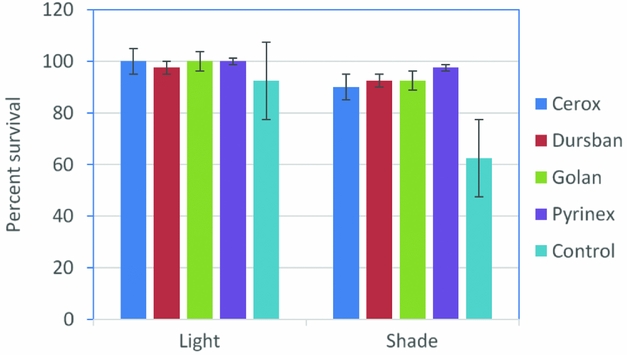
After six months, 93% of seedlings grown in full sunlight (200 seedlings) were still alive, compared to 86% of those raised under shade, making a total of 89.5% overall. The difference, however, is not statistically significant. The influence of insecticide application on seedling survival was marginal in full sun, as survival of all insecticide-treated and control seedlings was within the 90% range in full sun. However, light had a significantly positive influence on seedling survival with 92.5% of control seedlings surviving in full sun as compared to 62.5% of those under shade (χ2 = 51.539, df = 9,390, P<0.0001) (Fig. 1).
Survival of insecticide-treated Nauclea diderrichii seedlings exposed to Orygmophora mediofoveata shoot borer attack under light (full sun) and shade (80% of sunlight) conditions.

Shoot borer attack
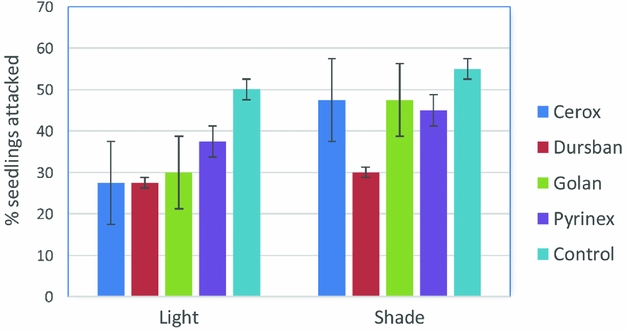
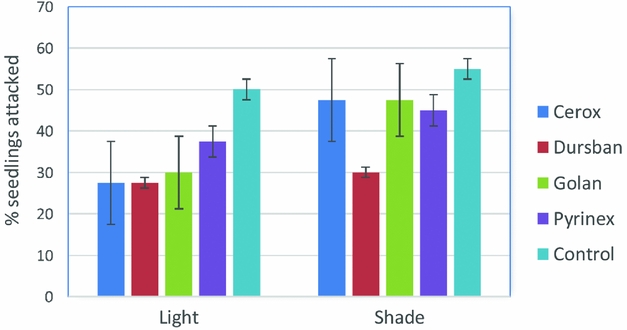
Of the total of 400 seedlings used in the study, the shoot borer had attacked 159 (39.8%) after seven months. Overall, the number of seedlings attacked was significantly lower in full sun (34.5%) than under shade (45.0%), based on chi-square contingency analysis (χ2 = 4.614, df = 4,195, P = 0.031). However, within blocks, number of seedlings attacked did not differ significantly between treatments, either in full sun (χ2 = 6.366, df = 4,195, P = 0.174) or under shade (χ2 = 5.581, df = 4,195, P = 0.233), although insecticide-treated seedlings evaluated in full sunlight generally had lesser incidence of attack than those evaluated under shade (Fig. 2).
Number of insecticide-treated Nauclea diderrichii seedlings attacked by Orygmophora mediofoveata under light (full sun) and shade (80% of sunlight) conditions.
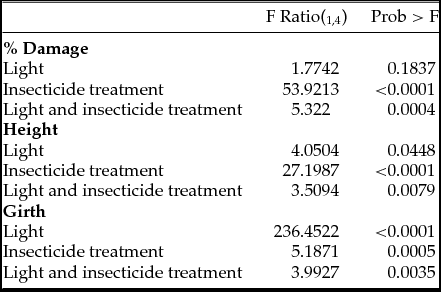
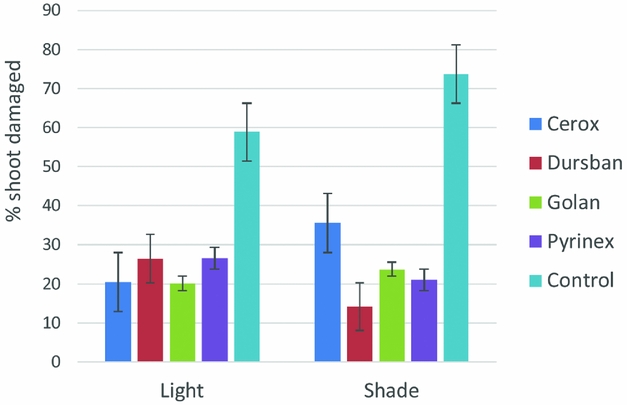
Severity of damage did not vary significantly between blocks (full sun or shade). However, the effects of treatment as well as the interaction between treatment and light were both significant (Table 1). In full sun, the percent of shoots damaged or shoots with dieback was significantly lower for all four insecticide-treated seedlings compared to the insecticide control (Fig. 3). While the severity of damage of control seedlings averaged 59%, it ranged between 20.1% (Golan) to 26.5% (Cerox) for the treated seedlings. Damage to control seedlings under shade (73.8%) was also higher than treated seedlings. However, Cerox-treated seedlings under shade were more severely damaged than those placed in full sun.
Results of two-way analysis of variance showing effects of insecticide treatments (Cerox, Dursban, Golan and Pyrinex), light and the interaction of insecticide treatment and light on damage and growth (height and girth) of Nauclea diderrichii seedlings exposed to Orygmophora mediofoveata shoot borer attack

Severity of dieback damage of insecticide-treated Nauclea diderrichii seedlings exposed to Orygmophora mediofoveata shoot borer attack under light (full sun) and shade (80% of sunlight) conditions.

Growth of seedlings
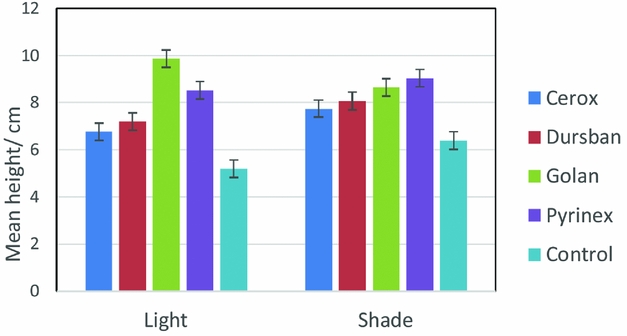
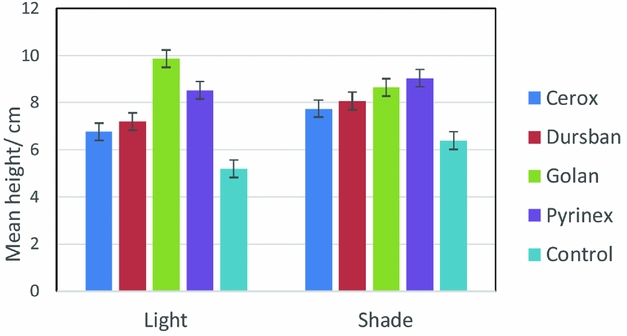
Growth in height was significantly influenced by treatment, light and the interaction of treatment and light (Table 1). Mean heights of the seedlings at the end of the experiment were generally lower than expected due to the O. mediofoveata shoot borer attack and associated dieback of the shoots. Under both full light and shade conditions, mean height was lowest for control seedlings. However, light seedlings treated with Golan attained a significantly higher growth compared to the other insecticide-treated seedlings. Also, Pyrinex attained a significantly higher mean height growth compared to seedlings treated with Dursban or Cerox. Under shade, mean height of insecticide treated seedlings increased marginally in the order, Cerox, Dursban, Golan and Pyrinex (Fig. 4.).
Mean height of six-month-old insecticide-treated Nauclea diderrichii seedlings exposed to Orygmophora mediofoveata shoot borer attack under light (full sun) and shade (80% of sunlight) conditions. Insecticides were applied when seedlings were four months old.
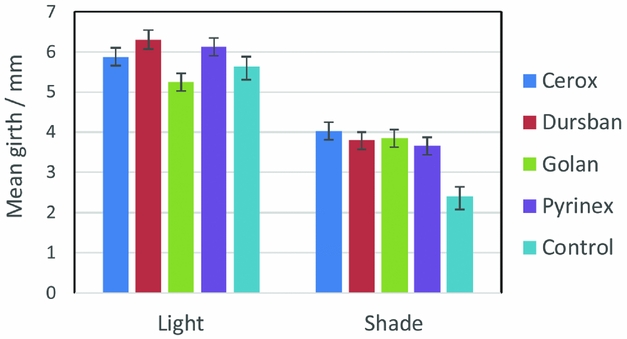
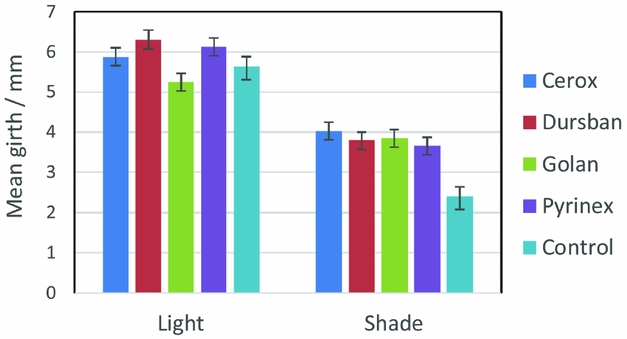
Mean seedling girth was significantly influenced by treatment, light and the interaction of treatment and light. Marginal differences were observed in mean girths of seedlings under various treatments (including control seedlings). In general, all seedlings growing under full sunlight attained significantly higher mean girth than any of those growing under shade (Fig. 5). Also, mean girth of control seedlings under shade was significantly lower compared to any of the insecticide-treated seedlings.
Mean girth of six-month old insecticide-treated Nauclea diderrichii seedlings exposed to Orygmophora mediofoveata shoot borer attack under light (full sun) and shade (80% of sunlight) conditions. Insecticides were applied when seedlings were four months old.
Discussion
The 30% difference in survival between control seedlings raised in full sun versus those under shade is noteworthy. Boateng et al. (Reference Boateng, Swaine and Thompson1999) demonstrated that germination of N. diderrichii and other pioneer light-demanding species can be reduced with reduced irradiance. The current study revealed that, in addition to a reduction in germination, attack by the O. mediofoveata could also lead to a reduction of seedling survival without deliberate intervention (such as the application of insecticide). Currently, most producers of N. diderrichii seedlings raise them under various shade regimes, which is a standard practice at the Forestry Research Institute of Ghana nursery at Fumesua.
After seven months of the study, N. diderrichii seedlings raised in full sun showed lower incidence of O. mediofoveata shoot borer attack than those raised under shade (80% of normal light). It is unclear what factor(s) influenced this result; however, we know that O. mediofoveata is a nocturnal insect and so initiation of flight and attack will normally begin at sunset. Assuming attack begins immediately or not long after sunset, then it is possible that conditions under shade would be more attractive to invading insects than those in the open. Also, the black shade cloth may increase the attraction of the insects to the seedlings under shade than those in the open. We hypothesized that O. mediofoveata invading the nursery before night fall would have higher tendency to attack seedlings under shade, while insects arriving in the dark would have equal attraction to seedlings under the shade or in the open. A number of studies have shown that insect attraction to host plants differs under light and shade conditions (Zilahi-balogh et al., Reference Zilahi-Balogh, Humble, Kok and Salom2006; Shipp et al., Reference Shipp, Johansen, Vänninen and Jacobson2011; Johansen et al., Reference Johansen, Vänninen, Pinto, Nissinen and Shipp2011). For example, Connor (Reference Connor2006) observed that survival of Cameraria hamadryadella (Lepidoptera) larvae on foliage of Quercus alba L. was higher in the shade than in the sun.
Severity of damage following attack was not influenced by light incidence, indicating that dieback incidence after attack proceeded irrespective of whether seedlings were in full sun or under shade. The insecticides applied were for protection against insects and did not have any effect on fungi-causing dieback; thus, once the insect successfully initiated attack, dieback proceeded normally, whether insecticide residue was present in the leaves or shoot. The case was, however, different with seedlings treated with Cerox, which had higher damage under shade than in normal light.
Nauclea diderrichii seedlings in light showed better growth than those under shade for all the insecticides applied. Seedlings in light were less attacked and damaged than those under shade, so the higher mean growth in height, girth, and leaves could have been facilitated by the lower damage. The plant has been described as being strongly photoblastic or highly responsive to light (Boateng et al., Reference Boateng, Swaine and Thompson1999; Oteng-Amoako Reference Oteng-Amoako2006), so this observation is to be expected.
Nauclea diderrichii seedlings treated with insecticides attained better growth in height than control seedlings. This is because treated seedlings had significantly lower incidence of O. mediofoveata attack and damage than control seedlings. Since damage is characterized by shoot dieback and dieback decreases height, it follows then that seedlings with higher incidence of attack would record higher damage, which in turn would decrease height. Similar observations have been made for dieback induced by Phytolyma damage to Milicia excelsa and M. regia (Cobbinah and Wagner, Reference Cobbinah and Wagner1995). Thus, it can be deduced that for N. diderrichii seedlings, height growth is directly correlated to O. mediofoveata attack, which in turn, directly correlates to insecticide application.
The growth pattern observed for girth was similar to that of height, except that light incidence had a much higher effect on girth than it did on height, whilst insecticide treatment had little effect. It is well known that plants growing under lower light conditions become etiolated, which is often characterized by thinner girth or diameter growth. While the 20% reduction in ambient light could not necessarily be considered as high, damage caused by the shoot borer and resultant dieback could have increased the process of etiolation.
Conclusion
Nauclea diderrichii seedlings are typically raised under shade; however, this study shows that raising seedlings in full sun with insecticide application could result in faster and better growth. From the results, any of the four insecticides available could be a good candidate for the control of seedlings against the shoot borer, depending on the availability and cost of each insecticide. Unless other prevailing factors are strong enough to justify continued production under shade, it would be appropriate to change practice and raise N. diderrichii seedlings in full sun. Future studies could be designed to evaluate other insecticides and botanicals, as well as fungicides that could mitigate the effect of dieback on N. diderrichii seedlings.
Acknowledgements
This study was conducted with funds from the African Forestry Research Network (AFORNET) Grant No. 252005. Messrs Elvis E., Nkrumah K., and Prempeh Bandoh provided assistance during the field experiment.