INTRODUCTION
Zoantharia (=Zoanthidea) are an order of Hexacorallia currently divided into two suborders, the Macrocnemina and the Brachycnemina. Brachycneminic zoantharians such as the genera Palythoa and Zoanthus are often in symbioses with zooxanthellae, and are commonly found in shallow subtropical and tropical waters. Macrocneminic zoantharians are more widely distributed; from tropical to polar waters, and from shallow waters to the deep sea. Although a few species in Macrocnemina are zooxanthellate, most species are epibiotic planktivores, and can be associated with a variety of benthos including but not limited to hydrozoans, octocorals, hermit crabs, gastropods and sponges (e.g. Sinniger et al., Reference Sinniger, Reimer and Pawlowski2010).
Within the Macrocnemina, the most well studied genus is likely Parazoanthus Haddon & Shackleton, Reference Haddon and Shackleton1891 (family Parazoanthidae Delage & Hérouard, Reference Delage and Hérouard1901). Although recently revised and limited to species associating with sponges, Parazoanthus sensu stricto is still polyphyletic (Sinniger et al., Reference Sinniger, Reimer and Pawlowski2010). Parazoanthus species have been reported from the Mediterranean, the Atlantic and Caribbean, and the Indo-Pacific Ocean.
Antipathozoanthus Sinniger, Reimer & Pawlowski, Reference Sinniger, Reimer and Pawlowski2010 was recently erected for former Parazoanthus sp. zoantharians epizoitic on antipatharians, and species have been reported from the Atlantic, the eastern Pacific, and Japan.
The genus Microzoanthus Fujii & Reimer, Reference Fujii and Reimer2011 (family Microzoanthidae) that has also only been recently described contains two species, and has been reported widely across the Pacific, including from Japan to Australia, and the Galapagos to Singapore and Thailand (Fujii & Reimer, Reference Fujii and Reimer2011; Reimer & Fujii, Reference Reimer and Fujii2013).
In the Red Sea, zoantharian research dates from Savigny (Reference Savigny1811), with species reported from Palythoa and Zoanthus (e.g. Audouin, Reference Audouin1826; Klunzinger, Reference Klunzinger1877). However, since Pax & Muller (Reference Pax and Muller1956, Reference Pax and Muller1957) there has been little research into the diversity of zoantharians in this region, and no Macrocnemina have been reported from this region. In general, invertebrate research in the Red Sea has lagged far behind that of other, better studied coral reef regions (Berumen et al., Reference Berumen, Hoey, Bass, Bouwmeester, Catania, Cochran, Khalil, Miyake, Mughal, Spaet and Saenz-Agudelo2013).
As part of a research project investigating the biodiversity of marine invertebrates in the Red Sea, surveys were conducted to assess the biodiversity on zoantharians on the coast of Saudi Arabia. Here, we report on findings of Parazoanthus sp., Antipathozoanthus sp. and Microzoanthus sp. from these surveys.
MATERIALS, METHODS AND RESULTS
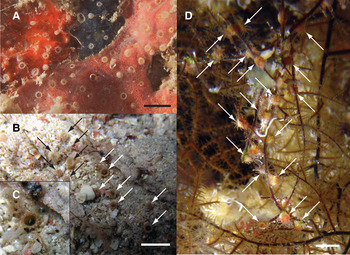
In SCUBA surveys of zoantharian diversity in the northern Red Sea on 26 September 2013, colonies of small polyps were noticed on various encrusting sponges on the roof of a shallow coral reef cave (depth = 3 m) at Jaz'air Sila, Saudi Arabia (N27°38.302′ E35°18.369′) (Figure 1A). Detailed images, collection, and examination identified these to belong to the genus Parazoanthus, as polyps were clearly zoantharians with two rows of tentacles and sand encrustation, and were in association with sponges (Sinniger et al., Reference Sinniger, Reimer and Pawlowski2010). Expanded polyps were very small, with oral disc diameters of <3 mm (Figure 1A).
In situ images of macrocnemic zoantharians of the Red Sea: (A) Parazoanthus sp. colony (pale whitish-yellow polyps) associated with three different sponges; (B) Microzoanthus sp. colony on coral rubble partially buried in fine coral sand sediment, with inset (C) of an individual polyp shown by dashed box in (B); (C) Antipathozoanthus sp. on antipatharian colony. Arrows in (B) and (D) indicate individual polyps. Scale bars = approximately 1 cm. (A), (B), and (C) from Jaz'air Sila, Saudi Arabia, depth = 3 m, on 26 September 2013 and (D) from Marker 9, Saudi Arabia, depth = 12 m, on 4 October 2013.

During a subsequent night dive on the same day, additional colonies of polyps were noticed covering rubble half-buried in fine sand sediment at the back of the cave. The small size (expanded oral disc diameter <5 mm), long extended polyps covered with large sand particles, long clear tentacles, and zigzagged pattern and the outer edge of the oral disc identified these as azooxanthellate Microzoanthus sp. (Figure 1B, C) (Fujii & Reimer, Reference Fujii and Reimer2011). Subsequent Parazoanthus sp. and Microzoanthus sp. colonies were also observed and/or collected at Jazirat Burcan (N27°54.593′ E35°03.925′) at similarly shallow depths (<5 m).
Finally, on 4 October 2013, at Marker 9 (N24°26.561′ E37°14.860′), numerous azooxanthellate Antipathozoanthus sp. were observed in small caves on the sides of coral reefs at depths of 11–13 m, exclusively on association with antipatharians as seen in this genus (Figure 1D) (Sinniger et al., Reference Sinniger, Reimer and Pawlowski2010).
Specimens are currently housed at the King Abdullah University of Science and Technology (KAUST)'s marine biodiversity collection, in Thuwal, Saudi Arabia, under specimen numbers SAZ-RS46 (Parazoanthus sp. from Jaz'air Sila), SAZ-RS51 to SAZ-RS54 (Microzoanthus sp. from Jaz'air Sila), SAZ-RS78 (Microzoanthus sp. from Jazirat Burcan) and SAZ-RS190 to SAZ-RS192 (Antipathozoanthus sp. from Marker 9).
DISCUSSION
This is the first record of the genera Parazoanthus, Antipathozoanthus (family Parazoanthidae) and Microzoanthus (Microzoanthidae), and, by extension, of the suborder Macrocnemina from the Red Sea. The genus Parazoanthus is widespread, and has previously been reported in the Atlantic Ocean, and in the Indo-Pacific species have been described from the Galapagos and South Africa, with numerous undescribed species from Japan and the central Indo-Pacific (Reimer, unpublished data). Thus, the finding of Parazoanthus in the Red Sea is not entirely unexpected. On the other hand, Antipathozoanthus and Microzoanthus have only recently been described, and although they have been reported from other regions (Antipathozoanthus from the eastern Atlantic and Pacific, Microzoanthus from the Indo-Pacific), less is known about their global distribution.
There are some potential causes for the lack of previous Macrocnemina records from the Red Sea. Although the Red Sea has a long history of zoantharian research dating from Savigny (Reference Savigny1811), very little taxonomic work has been performed since Pax & Muller (Reference Pax and Muller1957). Thus, research on species diversity of not only zoantharians but also of many invertebrate taxa, particularly outside of the Gulf of Aqaba (Berumen et al., Reference Berumen, Hoey, Bass, Bouwmeester, Catania, Cochran, Khalil, Miyake, Mughal, Spaet and Saenz-Agudelo2013) and at depths below the intertidal zone (e.g. depths accessible by SCUBA), is lacking. Furthermore, the species reported here are quite small compared to many Palythoa and Zoanthus spp., which also often have colourful oral discs and can dominate intertidal areas.
Zoantharian research in the Red Sea would benefit from continued examination of less well-studied habitats such as caves (e.g. Hoeksema, Reference Hoeksema2012), rubble areas (e.g. Obuchi et al., Reference Obuchi, Kogo and Fujita2009; Fujii & Reimer, Reference Fujii and Reimer2011), and all habitats at mesophotic depths (e.g. Luck et al., Reference Luck, Forsman, Toonen, Leicht and Kahng2013). At least two of the species of zoantharians (Antipathozoanthus and Parazoanthus) observed in this study are likely to be undescribed species, as the nearest described congeners for each species are thousands of kilometres away, and acquired DNA sequences (unpublished) show they are unique from known species. Future work will formally describe these specimens.
Like many taxa, the zoantharians are very poorly known from the Red Sea due to a general lack of modern work done in the region. These findings, even without a comprehensive spatial assessment, show the potential for greatly expanding our understanding of Red Sea biogeography and thus allow us to better address the role of the Red Sea in a broader Indo-Pacific context (e.g. Bowen et al., Reference Bowen, Rocha, Toonen and Karl2013).
ACKNOWLEDGEMENTS
This research was supported by award No. 1389-CRG1 from the King Abdullah University of Science and Technology (KAUST) to M.L.B. J. Bouwmeester, J. DiBattista, A. Gusti, A. Macauley, C. Nelson, M. Priest and T. Sinclair-Taylor of KAUST, as well as the crew of the MY ‘Dream Master’, are thanked for logistical support.