Introduction
It is routine for some therapeutic drugs to be taken after a specified period of fasting. The rationale for this is based on the presence of food in the stomach influencing drug absorption and bioavailability by either physiological changes in the intestinal tract or physical or chemical interactions between food components, acid in the stomach, intestinal enzymes and drug molecules. Depending on the class of drug and the resulting interaction, concurrent food has been reported to have reducing, delaying, increasing or, in some cases, no effect on the absorption and bioavailability of different drugs (Welling, Reference Welling1977; Toothaker & Welling, Reference Toothaker and Welling1980).
In the case of orally administered antibiotics such as penicillin and amoxycillin, a 2 h period without food is recommended because food reduces their bioavailability due to delayed stomach emptying (Welling, Reference Welling1977). It is recommended that milk and other dairy products are avoided when taking tetracycline, where absorption is inhibited because of chelation by calcium or magnesium present in milk (Dearborn et al., Reference Dearborn, Litchfield, Eisner, Corbett and Dunnett1957; Winstanley & Orme, Reference Winstanley and Orme1989) or complexation with protein. Additionally, milk has the effect of decreasing the dissolution rate of the drug (Kohn, Reference Kohn1961). It was reported that demethyl chlortetracycline absorption was reduced by about 70% in the presence of skimmed milk, whereas tetracycline bioavailability was reduced by 50–60% in the presence of whole milk (Welling et al., Reference Welling, Koch, Lau and Craig1977).
However, bioavailability of some drugs increases with food intake. One study found that serum concentrations of erythromycin in non-fasted individuals were 30–80% higher than in fasted individuals following single-dose oral administration of erythromycin (Toothaker & Welling, Reference Toothaker and Welling1980). It was concluded that food caused delayed stomach emptying, thereby enabling greater amounts of the drug to dissolve in the stomach before passing into the small intestine for absorption. It has also been found that eating fatty food before treatment with some anthelmintics increases absorption, e.g. albendazole (Horton, Reference Horton1997), mebendazole (Winstanley & Orme, Reference Winstanley and Orme1989) and flubendazole (Munst et al., Reference Munst, Karlaganis and Bircher1980).
Therefore whether to fast animals and humans before oral dosing with drugs has been an issue of some concern for a long time. In some cases fasting is recommended before oral chemotherapy, in others it appears to be unnecessary. In earlier studies with plant cysteine proteinases (CPs), a period of food deprivation was routinely employed before administration, but there has been no systematic evaluation as to whether or not this does actually benefit the anthelmintic efficacy. It is relevant that CPs do not need to be absorbed and, moreover, are too large to be absorbed as such. They need to be available in the gut lumen to make direct contact with the parasite's surface. It could be argued that in the presence of food there would be an increase in substrate for the enzyme, together with an increase in the volume of the gastrointestinal contents, both of which could reduce efficacy of the enzyme on the nematode. However, fasting prior to administration appears to have been adopted through tradition rather than because of any convincing evidence that it actually enhances the efficacy of the CPs. The first example of food deprivation combined with oral treatment with CPs can be found among native people of South America where CPs in fresh latex of fig were taken early in the morning after fasting (Caldwell & Caldwell, Reference Caldwell and Caldwell1929). This protocol was adopted by Caldwell & Caldwell (Reference Caldwell and Caldwell1929) in their clinical trial with higuerolatex (latex from Ficus laurifolia) in the treatment of trichuriasis in Alabama. Participants were given a light supper in the evening preceding the day of treatment and no breakfast was taken in the morning before the treatment. Hansson et al. (Reference Hansson, Veliz, Naquira, Amren, Arroyo and Arevalo1986) applied the same protocol in their trial with the latex of Ficus glabrata, a traditional anthelminthic used in the Amazonian area. Then in the series of experiments by Stepek et al. (Reference Stepek, Lowe, Buttle, Duce and Behnke2006, Reference Stepek, Lowe, Buttle, Duce and Behnke2007a, Reference Stepek, Lowe, Buttle, Duce and Behnkeb) food deprivation for a standard period of 6 h was employed throughout the programme of research.
Because of the complexities involved, it is not easy to predict a priori, the exact nature of the interaction between food and drug efficacy in any particular case, based solely on theory. In some cases, fasting may simply be based on tradition rather than on hard scientific evidence. Winstanley & Orme (Reference Winstanley and Orme1989) recommended that any development of new drugs should include assessment of food effects, including the benefits and disadvantages of fasting before treatment. Since there has been no systematic evaluation of the benefits of fasting prior to treatment of animals or people with intestinal worm infections with CPs, we undertook such a study. Here, we evaluate the effect of fasting on the efficacy of CPs from papaya latex (PL) in mice infected with Heligmosomoides bakeri. The results should help to formulate optimal protocols for delivery of the drug to animals or humans, aiming to obtain maximum efficacy against the worms with the lowest possible dose and to minimize side-effects of treatment.
Materials and methods
Parasitological procedures
The mice used in these experiments were purchased from Harlan Laboratories, UK, at 5 weeks of age and, for consistency with earlier studies, only male C3H were used. They were given 1 week to adjust to animal house conditions and were provided throughout with food and water ad libitum, unless experimental procedures required otherwise (see below for exceptions). All animal procedures were carried out under UK Home Office licence number 40/2942 and under the regulations of the Animals (Scientific Procedures) Act 1986.
Mice were infected with a suspension of 150 L3 of H. bakeri (previously known as Nematospiroides dubius and H. polygyrus; Cable et al., Reference Cable, Harris, Lewis and Behnke2006; Behnke & Harris, Reference Behnke and Harris2010) in 0.2 ml of distilled water on day 0. At days 14, 16, 18, 21, 23 and 25 post-infection, faecal samples were collected from each mouse and the number of eggs present was counted using the McMaster technique modified after Behnke & Parish (Reference Behnke and Parish1979). Briefly, faeces were collected from individual mice, weighed and then 10 ml of saturated NaCl were added to each vial containing the faeces. The pellets were broken up for 1 h using a rotary mixer, and then washed through a sieve (diameter = 5 cm, with 800 × 800 μm square apertures) with 50 ml of saturated NaCl. The eggs were counted using a two-chamber McMaster slide, each chamber holding a volume of 0.15 ml. The number of eggs per gram of faeces (EPG) was calculated from the following equation:

Mice were autopsied using standard protocols. Intestines were incubated while suspended in gauze in a 50 ml beaker of Hanks' saline in a water bath at body temperature (37°C) for 4 h. The tissue was checked for any remaining worms, the supernatant was discarded carefully and the worms that had collected in the bottom of the beakers were counted with the aid of a dissecting microscope (with eyepiece magnification of × 10 and a zoom objective lens magnifying × 1–4).
Papaya latex
Four kilograms of Carica papaya spray-dried latex (Enzymase, Brussels, Belgium) were dissolved in 12 litres of water. The preparation was centrifuged at 17,700 × g at 4°C and the pellet was discarded. The supernatant was concentrated to approximately one-third of its original volume by placing it in dialysis tubing (SPECTRA/POR® 7 MW cut-off 3500, VWR International Ltd, Lutterworth, England) over polyethylene glycol 20,000. Aliquots of the concentrated material in individual vials were frozen at − 80°C. Throughout the paper we refer to this preparation as the papaya latex supernatant (PLS).
At each step of the purification, the molar concentration of active cysteine proteinase was assessed by titration with l-trans-epoxysuccinyl-leucylamido (4-guanidino) - butane (E64, Sigma-Aldrich Ltd, Dorset, UK) with 1 mml-cysteine as reducing agent. We began with 70 mmoles of active enzyme in 4 kg of spray-dried latex, and this was reduced by about half after processing and by freezing at − 80°C, based on assessment of the activity remaining in individual thawed vials. On the day of oral delivery, a vial was thawed rapidly and diluted with water to contain the required dose in 0.2 ml of fluid. The specific activity of the enzyme in thawed vials was checked prior to, and in the remainder after, oral dosing throughout each experiment. Once aliquoted and frozen, there was no further deterioration of the enzyme activity, values derived from individual thawed vials over the course of these experiments being very similar, and in the longer term changing little over a year.
Experimental design
Experiment 1 was a pilot run conducted to determine whether fasting enhanced the anthelmintic effect of papaya latex. Fifteen mice were divided into three groups, each with five animals. The first and second groups of mice received orally 0.2 ml containing 240 nmoles of PLS for five consecutive days in total, beginning on day 20, while the last group (group 3) was given distilled water. Mice in groups 1 and 3 were fasted for 5 h before treatment (food was deprived at 07.00 hours and restored at 12.00 hours on relevant days) while those in group 2 had access to food and water ad libitum. The mice were infected with 150 H. bakeri L3 larvae on day 0, faecal egg counts were carried out on days 14, 16, 18, 21, 23 and 25, and they were all killed on day 25 after infection for worm counts, one day after the last treatment.
Experiment 2 was conducted in two blocks. In block 1, 45 mice were divided into three groups, each group having 15 animals. The first group of mice was fasted for 5 h prior to treatment with 0.2 ml containing 240 nmoles of PLS on day 20 after infection, while the second group of animals was treated with the same dose of PLS but not fasted. The third group was the control group, with the animals being orally gavaged with 0.2 ml of ultra-filtered distilled water and, as for group 1, fasted for 5 h before oral dosing. Treatment was repeated daily for 5 days. After the first, third and fifth treatments five mice from each group were killed for worm counts, so depending on the day on which the animals were killed for autopsy, they received 1, 3 or 5 treatments. Faecal egg counts were conducted on days 14, 16 and 18 (pre-treatment) and on days 21, 23 and 25 (post-treatment) of the experiment on the groups destined for culling at the end of the experiment. The number of worms remaining in the intestines of treated and untreated mice was counted on days 21, 23 and 25 post-infection. Block 2 of this experiment was designed similarly, except that a total of 72 mice were used in three groups of 24, with eight mice culled at each time point.
Data analysis
Data are presented as mean values ± standard error of the mean (SEM). Faecal egg counts were analysed by repeated measures (rm) general linear model (GLM), on log10(EPG+25) transformed data, fitting Time (day on which faecal egg counts were carried out) as the within-subject factor and Treatment (either two levels, fasted or not-fasted, or three levels if including the not-treated, fasted control group) as the between-subject factor. Worm counts were analysed either by one-way GLM (Experiment 1) or by three-way GLM (Experiment 2), fitting Treatment group (either two or three levels as above), Block (two levels, block 1 or block 2) and Duration (three levels, 1, 3 or 5 days of treatments with PLS). We adopted best-fit models after first exploring models with raw worm counts, and log10(worm count+10) transformed data, checking R 2 values, and the residuals for approximately normal distribution. In all cases we considered P = 0.05 as the cut-off for statistical significance.
Results
Experiment 1
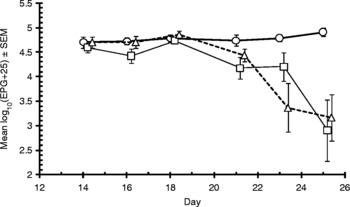
The faecal egg counts from Experiment 1 are illustrated in fig. 1. These show that egg counts declined in both PLS-treated groups of mice soon after the onset of treatment on day 20, whereas those in the control group stayed steady, and even drifted upwards as the experiment progressed. Analysis by rmGLM was confined to the two PLS-treated groups to determine whether fasting resulted in better anthelmintic efficacy. There was no significant main effect of treatment (fasted versus not-fasted mice, F 1,8 = 0.015, P = NS).
Faecal egg counts during the course of Experiment 1. The data for each day are offset to show the error bars clearly without overlap. The control group is illustrated by open circles, fasted group by open squares and the not-fasted group by open triangles. Treatment with papaya latex supernatant commenced on day 20 after infection and was then given each day for 5 days.

At autopsy on day 25, the control mice had a mean worm burden of 126.8 ± 24.88, while the fasted, PLS-treated mice had 16.4 ± 6.41 worms and the non-fasted, PLS-treated mice had 14.0 ± 5.43 worms. There was a highly significant overall effect of treatment (F 2,12 = 18.1, P < 0.001), reflecting the difference between the control group and the two PLS-treated groups, but no difference between the latter two (fasted versus not-fasted).
Experiment 2
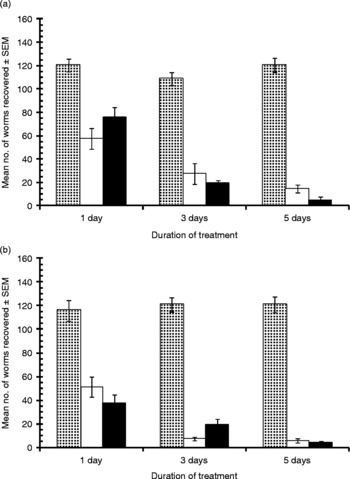
Since in Experiment 1 worm burdens were assessed only after 5 daily treatments with PLS, a further experiment was carried out, in two blocks, to establish whether fasting had any additive effect with PLS earlier, after 1, 3 or 5 daily treatments. Although blocks 1 and 2 were carried out at different times, they were both designed very similarly with just one difference. in that block 2 had larger group sizes (eight mice compared to five in each group in block 1). The data were analysed first with both blocks included in the statistical model. The key hypothesis being tested was whether fasting was essential for treatment to be efficacious, and hence the analysis was confined first to the two PLS-treated groups (fasted and not-fasted) excluding the non-treated, fasted control group. This indicated that there was a significant difference between the two blocks (three-way GLM, main effect of block F 1,66 = 12.7, P = 0.001) and therefore the results have been illustrated separately for each block in fig. 2a and b (which also shows worm burdens in the control, untreated group for reference; see also below).
Effect of fasting or not-fasting on worm recovery after 1, 3 or 5 days of treatment with papaya latex supernatant. The results of Experiment 2, block 1 are illustrated in (a), and those of block 2 in (b). Control groups of mice (stippled columns), fasted groups of mice (open columns) and non-fasted groups of mice (closed columns) were treated either for 1 day, 3 days or 5 days and killed for worm counts on days 21, 23 and 25 post-infection, respectively.

As can be seen, and with the difference between blocks taken into account, overall there was no consistent difference between the fasted or not-fasted treated groups (main effect of Treatment (fasting versus non-fasting, excluding the non-treated control group), F 1,66 = 0.009, P = NS). There was a huge effect on worm burdens with increasing duration of treatment (main effect of Duration, F 2,66 = 76.0, P < 0.001), and this differed to some degree between the two blocks of the experiment and between whether mice were fasted or not fasted (three-way interaction, Block × Duration × Treatment (fasted versus non-fasted), F 2,66 = 5.7, P = 0.005), but there was no consistent effect in favour of either fasted or non-fasted animals.
As a final step, and to establish firmly that treatment with PLS was effective, albeit a posteriori, we fitted a three-way GLM but included the control water-treated, fasted group of mice this time. Not surprisingly there was a huge overall effect of Treatment (main effect of treatment (control, fasted plus PLS and non-fasted plus PLS), F 2,99 = 404.1, P < 0.001), which is clearly apparent in fig. 2 in both blocks of the experiment by the difference in worm burdens between the control water-treated, fasted group versus the two PLS-treated groups irrespective of whether the mice were fasted or not. With the data from both experiments combined, and relative to the control group, the reduction in worm burdens of the fasted mice was 54.4%, 87.3% and 92.8% after 1, 3 and 5 rounds of treatment, and for the not-fasted group the corresponding values were 55.2%, 82.9% and 96.2%, respectively.
Faecal egg counts were also carried out in each of these two blocks and these were broadly similar to those in fig. 1 (Experiment 1), indicating that prior to treatment all mice had similar faecal egg counts, and that towards the end of the experiment they reflected the differences in worm burden between groups (data not shown).
Discussion
This study has demonstrated conclusively that the efficacy of PLS did not depend on fasting the animals prior to oral dosing (at least for the period of 5 h that was explored here). Our results on the efficacy of PLS are in agreement with those of Satrija et al. (Reference Satrija, Nansen, Murtini and He1995) who demonstrated anthelmintic activity of PL against H. bakeri in mice treated without food deprivation, but who did not evaluate the benefits or disadvantages of fasting per se.
In previous studies (Stepek et al., Reference Stepek, Lowe, Buttle, Duce and Behnke2007b) assessing the anthelmintic efficacy of PL against H. bakeri, mice were treated daily over 7 days with 313 nmoles of crude PL, preceded each time by food deprivation for 5–6 h. These experiments gave a 79% reduction of worm burdens; however, the present experiment has demonstrated that just three treatments, over three consecutive days with 240 nmoles of PLS without food deprivation was sufficient to eliminate 81.5% of the worms. Therefore, the current protocol, based on a refined extract of the active enzyme compartment of PL and less intervention (in that only three doses with less active enzyme content/dose were given), achieved comparable efficacy to that observed previously with seven doses (Stepek et al., Reference Stepek, Lowe, Buttle, Duce and Behnke2007b). This is likely to be beneficial for the wellbeing of the treated animals, reducing stress and the likelihood of side-effects.
Although food deprivation prior to oral dosing with CPs has been employed routinely in much of the earlier work on CPs in mice infected with nematodes, the present study has demonstrated clearly that fasting has no beneficial effect on the efficacy of PL against H. bakeri. The presence of food typically affects a drug through effects on absorption, but in this case the active ingredients work within the gut rather than relying on absorption. The results from this work are still surprising, as it would be expected that the presence of food could reduce the activity of the enzyme by dilution in gastrointestinal chyme and competition with other potential substrates for the enzyme. The maintenance of activity in the presence of food suggests that there must be other compensating factors influencing activity, which may include an increased residence time of the enzyme within the gut due to the increased volume of the gastrointestinal contents.
We conclude that there is no need to fast the animals prior to treatment in future work and this will also help to avoid any adverse side-effects of treatment, since food deprivation, even for limited periods of time, can cause stress and discomfort. Treatment for just 3 days at the active enzyme doses employed here is sufficient to eliminate a substantial worm burden from mice. Our findings will help to inform the research currently being undertaken to improve the formulation and delivery of these naturally occurring plant-derived enzymes for use as environmentally sound, organic therapies for the treatment of intestinal worm infections in humans and livestock, while achieving maximum efficacy and minimal side-effects.
Acknowledgements
W.L. was supported by a postgraduate studentship from the government of Tanzania, and F.M. from the Government of Malaysia. We thank Ann Lowe for technical support and advice throughout this work.