

Introduction
The past two decades have witnessed a persistent preoccupation among states with security threats emanating from instability overseas. Many governments, accordingly, have adopted policies that entail a commitment to building and maintaining a stable peace in territories emerging from violent conflict.Footnote 1 This commitment is also reflected in the post-conflict reconstruction efforts of numerous multilateral organisations, notably the United Nations (UN), the World Bank, the North Atlantic Treaty Organization (NATO), the Organization for Security and Co-operation in Europe (OSCE), and the African Union (AU), among others.Footnote 2
The challenge of establishing a stable peace after civil conflict is a formidable one. Conflict recidivism is a common occurrence. Of the 105 countries that suffered a civil war between 1945 and 2013, more than half (59 countries) experienced a relapse into violent conflict – in some cases more than once – after peace had been established.Footnote 3 By one estimate, on average 40 per cent of countries emerging from civil war are likely to revert to violent conflict within a decade of the cessation of hostilities.Footnote 4
In this article, we are concerned with explaining why peace endures when it does. We evaluate the salience of a number of factors in relation to the ‘survival’ (duration) of peace in all countries that have experienced peace after civil war since 1990. The evaluation is based on a statistical analysis that employs a hazards model of peace duration and uses both newly available and newly updated data to identify which co-variates, or combinations of co-variates, have been important in maintaining the peace in the aftermath of civil wars. The statistical analysis is complemented by analysis of six case studies specially prepared by country experts for this project, which provide more detailed information about how some countries achieved lasting peace in this period while others failed.Footnote 5
The first part of this article reviews existing scholarship on peace duration and the findings of that body of research. The second part discusses the key terms that are germane to the parameters of this study. The third part examines the broad, empirical patterns of peace duration following armed conflict. The fourth part discusses the method of statistical analysis employed in this study. The fifth part presents the findings that the statistical analysis generated. The sixth part discusses the significance and broader implications of these findings. The seventh and final section of the article offers some concluding observations.
Existing approaches to peace duration
There is a growing body of literature that applies quantitative methods to the study of the duration of peace in the wake of civil war. The sample is typically limited to countries that have experienced at least one spell of armed conflict. This is in contrast to the onset literature, which includes countries that have never experienced armed conflict.Footnote 6 In the analysis of post-conflict countries a number of different quantitative methods can be applied. One option is to investigate whether a new war broke out and ended the peace. The endurance or breakdown of the peace can be coded as a zero/one variable and limited dependent variable analysis (logit or probit models) can be applied to estimate which factors affect the probability of the recurrence of war.Footnote 7 However, if one is not just interested in the question of whether the peace breaks down but also in how long a peace spell lasts, then the use of survival (or duration) analysis is the appropriate choice of method. Survival analysis is a statistical method that allows researchers to analyse how long a specific state lasts until the occurrence of a specific event. It is commonly applied in medical studies where the effect of a treatment on the survival time of patients is evaluated. In our study we apply survival analysis to examine the impact of a number of variables on the longevity of the peace.
Although a number of studies apply duration analysis to the study of peace, there is no consensus among scholars regarding the drivers of enduring peace. Caroline Hartzell, Matthew Hoddie, and Donald Rothchild find that the most durable settlements are those in which the civil conflict was of long duration; the previous governing regime was democratic; the peace agreement contains provisions for the territorial autonomy of threatened groups; and there are third-party security guarantees.Footnote 8 In a subsequent study, Hartzell and Hoddie extend the analysis to examine the effects of power-sharing arrangements on the duration of peace settlements.Footnote 9 They find that settlements that promise power sharing increase the likelihood that the settlement will endure. Phillip Martin extends this analysis further. He challenges the prevailing view that elite power-sharing pacts are critical for peace survival and argues that institutional options such as territorial power sharing and proportionality in military forces yield a more durable peace.Footnote 10 Desirée Nilsson, on the other hand, finds that all-inclusive peace deals – signed by the government and all rebel groups – do not necessarily yield lasting peace, as many believe.Footnote 11
Virginia Page Fortna’s seminal work on the impact of UN peacekeeping operations (UNPKOs) suggests that the presence of UNPKOs significantly improves the chances of peace surviving.Footnote 12 In the post-Cold War period (to 1999), she observes, UNPKOs have reduced the risk of the peace breaking down by about 50 per cent. She finds that most other variables, such as the outcome of the conflict, the nature of the conflict (identity), the death toll in the conflict, the nature of the previous governing regime (democracy), and the relative size of the government army are insignificant. Only the presence of UNPKOs, the duration of the conflict, and economic development are significant for maintaining the peace. Further evidence of the importance of UNPKOs in reducing the risk of renewed war is found by Lisa Hultman, Jacob Kathman, and Megan Shannon; David Mason et al.; Michael Gilligan and Ernest Sergenti; and Paul Collier, Anke Hoeffler, and Måns Söderbom.Footnote 13 Peter Rudloff and Michael Findley and more recent work by Barbara Walter, on the other hand, find little evidence that peacekeeping increases the length of the peace.Footnote 14 Walter concludes, furthermore, that peace spells that end with a peace agreement following territorial conflicts and includes good government accountability measures (that is, participation, written constitution, free press, rule of law) increases the likelihood of peace survival.Footnote 15 ‘The more accountable the government is to a wide range of people, the easier it will be to credibly commit to share power and reform, and the fewer incentives groups will have to return to violence’, she observes.Footnote 16 None of the other variables in her analysis, including UNPKOs, income, polity measures, and the duration and intensity of the previous conflict, are significant.
The qualitative and mixed method literature is similarly inconclusive, in part because the notion of peace itself is defined variably, with some scholars working with a minimal conception of peace (absence of violent conflict) and others with more ambitious conceptions of peace (for example, elimination of root causes of conflict or ‘participatory peacebuilding’). Scholarship on this area has stressed the importance of the nature of civil war termination (Roy Licklider); third-party security guarantees (Fortna); transparency between combatants (Michael Doyle, Ian Johnstone and Robert Orr); ‘institutionalization before liberalization’ (Roland Paris); security-sector reform (Monica Duffy Toft); and inclusive political settlements (Charles Call), among other factors. As with the quantitative analysis, there is a lack of consensus among scholars regarding the factors underpinning peace duration.Footnote 17
To summarise, not many variables appear to be significant in the duration of peace analysis, and scholars disagree about the importance of a number of them. This suggests that it is difficult to explain the duration of peace in general. Indeed, as one of the case study authors for this project aptly observed:
It has been well documented that countries that have experienced civil wars have a high probability of falling back into war … . We know less about how long a peace must last until it is likely to ‘stick’, and still less about how and why that dynamic pertains. For the moment, the state of our knowledge appears something like the opening of Anna Karenina turned on its head: ‘All failed peaces are alike; every successful peace succeeds in its own way.’Footnote 18
Key terms
For our statistical analysis we need to define the key terms that are germane to the parameters of our investigation. Our definition of post-conflict, as indicated above, is the absence of armed conflict, also known as a ‘negative’ peace. Most quantitative studies of armed conflict employ a negative conception of peace, with armed conflict being defined variably depending on which dataset is adopted. Many post-conflict situations in fact are not entirely peaceful but rather, are characterised by ongoing, sporadic violence.Footnote 19 However, if the level of violence is below the given threshold of armed conflict, we define these situations as post-conflict.
Our definition of armed conflict is based on the Armed Conflict Dataset (ACD). It is the most commonly used dataset and is a collaboration between the Uppsala Conflict Data Program (UCDP) and the Peace Research Institute Oslo (PRIO).Footnote 20 The most recent version of the ACD that includes information on how armed conflicts ended starts at the conclusion of the Second World War and ends on 31 December 2013. Only very few armed conflicts are international conflicts between states and we disregard these conflicts. We focus on conflicts that are internal to a country: these conflicts may or may not receive support from beyond the national borders. In the ACD, coders also distinguish between ‘major’ and ‘minor’ armed conflicts. Major armed conflicts or wars cause at least 1,000 battle-related deaths a year. Military as well as civilian deaths are counted as ‘battle related’. A further part of the definition is that there is organised, effective, and violent opposition to the government. This distinguishes this type of violence from genocides, pogroms, and communal violence. Minor armed conflict is defined as above but is limited to 25 to 999 battle deaths per year. We define major as well as minor armed conflicts as armed conflicts.
The ACD provides information by armed conflict. One example would be the FARC rebellion against the government of Colombia where the conflict has lasted a long time and has only one conflict episode (1964–2013, that is, ongoing at the end of the coding period) because the associated battle deaths have exceeded the armed conflict threshold each and every year. The Palipehutu rebellion against the government of Burundi is listed as one conflict with four distinct episodes (1965, 1991–2, 1994–2006, and 2008) because there have been either few or no battle deaths in the intervening periods. Other countries have experienced a number of distinct armed conflicts with one or more episodes each, for example, Nigeria (Biafra 1967–70; Niger Delta 2004; Boko Haram 2009, 2011–ongoing). Other countries, such as Burma (Myanmar), have experienced a number of distinct conflicts at the same time (rebellions by the Karen, Karenni, Shan, Kokang, Kachin). As a unit of observation we focus on the conflict episode, and the post-conflict episode (peace) starts when the conflict episode ends. This is irrespective of whether there is another ongoing conflict in the same country or whether this same conflict resumes at some later point in time. We are interested in the duration of peace following each conflict episode.
Some analysts will disagree with the judgement made by the authors of the ACD dataset. The 2006 violence in East Timor, one of our case studies, left 38 dead and forced 150,000 to flee their homes, but it is not recorded by ACD as a conflict episode, perhaps because it fails to satisfy the requirement that the opposition must be a ‘formally organised opposition group’. However, the crisis is widely regarded as evidence of the failure of the peace to hold.Footnote 21 Similarly, the 1972 purges in Burundi, another of our case studies, are not captured by the armed conflict definition in the ACD dataset, but are considered by many analysts to be an important part of the cycle of violence.Footnote 22 Herein lies one of the limitations of statistical analysis: the use of uniform definitions of terms allows for comparability, but it obscures unique features of a given conflict. Detailed knowledge of specific armed conflicts, which case study analysis permits, is therefore a useful complement to the statistical analysis. The question is whether and to what extent these ‘distortions’ have a bearing on the findings that emerge from the statistical analysis.
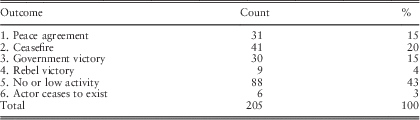
In our definition, the end of the armed conflict is the beginning of the post-conflict period or peace spell. Defining the end of an armed conflict is problematic. While some armed conflicts end in settlements or military victories, many conflicts continue at a lower level. ACD does not record an ongoing armed conflict if there are fewer than 25 battle-related deaths per year. Hence the armed conflict ceases in the year that fewer than 25 battle-related deaths are observed. The termination of an armed conflict is categorised by Joakim Kreutz.Footnote 23 He distinguishes between military victory, peace agreements, ceasefires, and ‘other outcomes’. Victory is when one side is either defeated or eliminated, capitulates, or surrenders. A peace agreement is defined as an agreement between the main actors concerned with the resolution of the conflict and may be accepted while armed activity is ongoing. Conflicts are coded as having terminated by peace agreement if this agreement is followed by military inactivity. By contrast, ceasefires are agreements that terminate military operations but do not entail a resolution of the conflict. However, a large number of armed conflicts do not end in either victory or settlement but ‘rumble on’ without producing the required 25 battle-related deaths. This category makes up 43 per cent of all observations and is termed ‘low or no activity’. The remaining category has cases in which other criteria are not met, for example, one side in a conflict ceases to exist or is defeated in another simultaneous conflict. For the 205 conflict episodes that ended after 1989, Table 1 presents the frequencies for the various outcomes.
Armed conflict outcomes, 1990–2013.

Sources: UCDP Termination Dataset version 2.0-2015; Joakim Kreutz, ‘How and when armed conflicts end: Introducing the UCDP Conflict Termination dataset’, Journal of Peace Research, 47:2 (2010), pp. 243–50. There are 210 conflict episodes that ended during 1990–2013, although for five observations the termination is not coded.
A first look at the survival of peace
Using the ACD we focus on the post-Cold War period. Thus, we only consider armed conflict episodes that ended in or after 1990; the last year we can observe is 2013. This provides us with 210 peace spells as discussed above. Of these peace spells 62 were single spell episodes, that is, the peace started and then either lasted until the end of the period or ended due to conflict that lasted until 2013. The other 148 peace spells are multiple spells in which the conflict recurred, then ended, and at least one further spell of peace was observed.
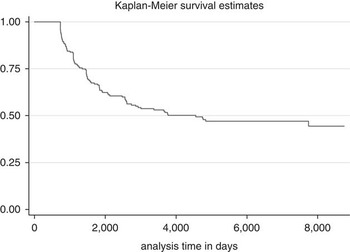
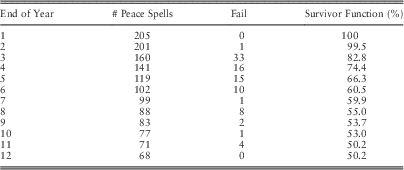
Before turning to the regression analysis we want to examine the empirical patterns of the peace spell data: how many peace spells break down and when does this happen? This information is provided by the Kaplan-Meier survival estimates as shown in Figure 1 and Table 2. Figure 1 shows peace spells measured in days. In the beginning all of our observations are at peace and as time passes, some peace spells come to an end and some continue. Following from the ACD data definition, conflicts are defined by a minimum of 25 battle-related deaths per year and a peace period cannot be shorter than one year; this accounts for the first flat bit of the Kaplan-Meier graph. From the end of the first year until approximately 5.5 years (2,000 peace days) the survivor estimates drop more sharply than after. This suggests that peace spells are more likely to break down within the first five years than in the following five years. Table 2 provides the same information. After two years 99.5 per cent of all peace spells survive, that is, 1 per cent of the peace spells have failed (war recurred). After three years 83 per cent of the peace spells have survived. After 12 years only about half of the peace spells have survived (50 per cent).
Survival function of peace.

Number of peace spells surviving (Kaplan-Meier survivor function).

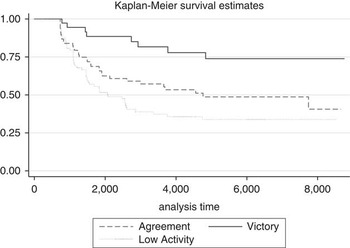
Figure 2 graphs the survivor functions by outcome of the previous armed conflict. We distinguish between settlement (peace agreements and ceasefires combined), victory (government or rebel victory), and other (low activity or actor ceases to exist). Higher lines represent longer survival, that is, a lower hazard of failure (armed conflict breaking out again). According to Figure 2, victories are associated with longer peace spells, followed by settlements, while peace spells after low activity are most likely to break down. Employing a formal test suggests that these survivor functions are significantly different from each other.
Survival function of peace considering conflict termination. Notes: Outcome=0 refers to settlement; outcome=1 refers to victory; and outcome=2 refers to ‘other’. Log-rank test for equality of survivor functions chi2(2)=15.96, Pr>chi2=0.0003.

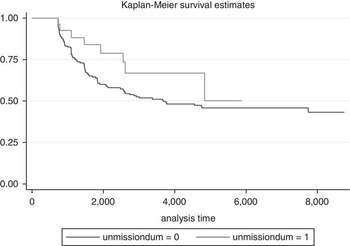
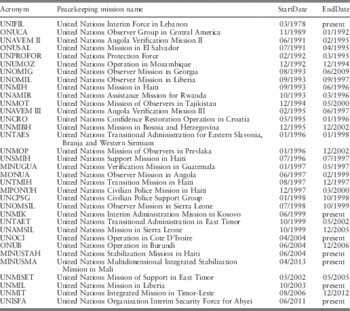
In Figure 3 we graph the peace spells with UN peacekeeping operations (UNPKOs) and without. UNPKOs are UN peacekeeping operations (excluding special political missions) led by the UN Department of Peacekeeping Operations (DPKO). (See Appendix, Table 1 for a list of all UN peacekeeping operations taken into consideration for purposes of this analysis.) We define UNPKO as a dummy variable taking a value of 1 for the years during which the UNPKO is present. Although the line for peace spells with UNPKOs is above the line for those without, suggesting that UNPKOs are associated with longer peace spells, the formal test suggests that there is no significant difference between the spells with UNPKOs and those without. This is also the case when we only consider peace spells that lasted for a maximum of 4,000 days. We return below to a discussion of UNPKOs and their contribution to peace durability.
Survival function of peace considering UNPKOs. Notes: Log-rank test for equality of survivor functions chi2(1)=1.80, Pr>chi2=0.1794.

Method
In our statistical analysis we want to examine which factors stabilise post-conflict peace. Applying survival analysis allows us to estimate a hazard function h(t) which gives the probability that the event (end of peace) will occur given that the peace has lasted up to a specified time.
More formally we can write the hazard function, h(t) as follows:
 $$h(t){\,\equals\,}h_{0} ({\rm t})\,{\rm exp}\,{\rm (}x_{j} \beta _{{\rm 0}} {\rm )}$$
where h 0 (t) denotes the baseline hazard, the hazard common to all peace spells, j. The function exp() multiplies this baseline hazard, that is, models how the explanatory variables, x, shift the baseline hazard. The function exp() prevents the hazard h(t) from taking negative values.Footnote 24
The hazard function can be specified in different ways. If we have a theoretical expectation regarding the shape of this hazard (for example, falling, rising or flat over time) we can assign factors to describe a specific hazard function. Or in other words, we can parameterise the hazard function. However, in our case there is no theory to guide us in the choice of the hazard function and we therefore use the Cox proportional hazards model, a model that belongs to the category of a semi-parametric models.Footnote 25 In the Cox proportional hazards model the particular distributional form of the duration times is left unspecified, but the assumption is made that the explanatory variables shift the hazard rate proportionately.Footnote 26 The use of the Cox proportional hazards model is popular in the study of the duration of peace; for example, it is used by both Walter and Fortna.Footnote 27
Our main aim is to explain peace stabilisation and on the basis of our survival analysis we want to draw causal inferences.Footnote 28 Ideally, we want our analysis to suggest that if some actions are taken, peace is more likely to endure. However, we have to be careful how to design and interpret our statistical analysis. When event A predates event B it is easier to justify the conclusion that A may cause B than in the situation when event A and B occur simultaneously. When event A and B occur simultaneously it could be that A causes B or that B causes A, or that an unknown event C drives both A and B. It is therefore important to consider simultaneity and endogeneity. In our case the characteristics of the conflict, such as fighting over territory and ethnic recruitment, happened before the event of peace. Similarly, the outcome of the conflict (victory, settlement, other) occurred before the event of peace. Thus, it is straightforward to include these variables in our model and to interpret them. On the other hand, income and peace are measured at the same time; they occur simultaneously. Peace is more likely to last if incomes are higher but incomes are also likely to be higher the longer the peace lasts, hence we have a problem of endogeneity. In order to guard against this endogeneity problem we can include lagged income, that is, income that predates the event. The theoretical justification would be that past and current income are highly correlated.
The inclusion of UNPKOs in our model raises a number of potential problems. We observe UNPKOs and peace simultaneously. While UNPKOs may have an effect on the duration of peace it is also conceivable that the (expected) duration of peace has an effect on the decision to deploy a UNPKO and on the duration of the mission. The first issue is a problem of selection; if UNPKOs are predominantly sent to easier (harder) peace situations this would bias our results.Footnote 29 A positive (negative) coefficient would overestimate (underestimate) the impact of UNPKOs. Furthermore, the process that affects the changes in the UNPKO variable may be influenced by the duration of peace. Under this circumstance the usual interpretations of the explanatory variables in survival analysis do not hold. One solution would be to exclude such problematic variables. However, excluding explanatory variables that are theoretically relevant leads to model misspecification, that is, potentially larger problems. From a policy advisory perspective, if we only used explanatory variables that are strictly exogenous, we would not be able to analyse a number of important policy issues. One statistical solution to the problem of endogeneity and simultaneity issues is the use of instrumental variables but this option is not available for hazard models. For our study we simply flag these statistical problems and proceed with them in mind.
Results
In this section we develop a core model that enables us to investigate the impact of a number of key variables on the durability of peace. These key variables are: conflict outcome; characteristics of the armed conflict; and deployment of UNPKOs. As a starting point we present a model that only uses characteristics that occurred before the beginning of the peace spell: the outcome of the conflict; whether the conflict was fought over territory as opposed to governmental control; the duration of the conflict; and the intensity of the conflict (total number of battle deaths). This has two advantages – first it allows us to include all of the observations. Second, these variables predate the peace spells and we do not have to worry about endogeneity and simultaneity issues. Rather than reporting coefficients, we report the hazard ratios. A hazard ratio greater than 1 suggests that this variable increases the hazard (or risk) of peace ending. The interpretation of hazard ratios is straightforward: a ratio of 1.5 suggests that a one-unit change of the explanatory variable increases the hazard of the peace breaking down by 50 per cent (1–1.5=−0.5). A hazard ratio of less than 1 suggests a decrease of the hazard ratio, that is, making peace more durable. A hazard ratio of 0.4 suggests a 60 per cent reduction when the explanatory variable changes by one unit (1–0.4=0.6).
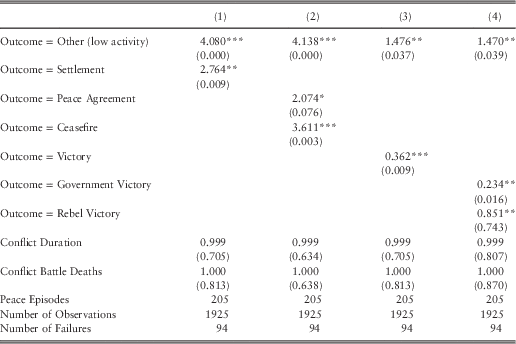
In our first model (Table 3, column 1) we include the dummy variables for the conflict outcome. Our category ‘settlement’ includes peace agreements as well as ceasefires. The category ‘other’ includes cases of low or no activity as well as cases that do not meet other ACD criteria, for example, one side ceased to exist. ‘Victory’ is the omitted category. The hazard ratios indicate that the hazard of a peace spell breaking down if the outcome of ‘other’ is 308 per cent higher than in the case of victory. Peace spells that ended with a settlement are 276 per cent more likely to break down than the comparison category, victory. Neither the duration of the conflict, nor the intensity of the conflict (measured by the total number of battle deaths) is significant. We also test whether our choice of modelling the duration of peace by using the Cox proportional hazards model is appropriate by testing for the proportionality of the hazards. We cannot reject the null hypothesis that the hazards are proportional and thus conclude that our modelling choice is appropriate.
Duration of peace: Past conflict characteristics.

Notes: Hazard Ratios reported, p-values in parentheses, dependent variable peace duration.
* significant at 10%; ** significant at 5%; *** significant at 1%
This first regression indicates that conflict termination is important for the likelihood of peace enduring and in the remainder of this table we investigate this result in more detail. In the first model we classified both peace agreements and ceasefires as ‘settlements’ but in column 2 we investigate peace agreements and ceasefires separately. The results suggest that both ceasefires and peace agreements are more likely to break down than victories, although this hazard is greater for ceasefires. However, when we test for the equality of the hazard ratios of peace agreements and ceasefires we can only reject this hypothesis at the 10 per cent level.Footnote 30 We then investigate the nature of the victory. First, we change the reference category from victory to settlement in Table 3, column 3. The results are the same as in column (1), however, changing the reference category means that we have to interpret the coefficient on the dummy variable victory as the inverse to the hazard ratio on settlement (1/2.76=0.36). In column 4 we include dummy variables for other, government victory, and rebel victory. The results suggest that although peace episodes are less likely to break down after government victories, they are not more likely to break down than after rebel victories. One reason, as Sean Zeigler also suggests, may be that rebel movements are more prone to splintering.Footnote 31 However, we should keep in mind that there are only very few rebel victories (4 per cent of all terminations), which may account for the large standard error on the hazard ratio. When we test whether the hazard ratios for government and rebel victories are the same, we can only reject this hypothesis at the 10 per cent level.Footnote 32
So far our results suggest that the severity of the armed conflict, measured as the duration of the conflict and the battle deaths caused, are not significant in the explanation of the duration of peace. In contrast, the termination of the armed conflict appears to be an important determinant of whether peace endures. Peace is much less likely to break down after military victories when compared to settlements,Footnote 33 but these in turn are more likely to provide longer lasting peace than in situations where the conflict activity was low but the conflict remained unresolved. When we investigate the nature of the victory or settlement we find some evidence that government victories are more stable than rebel victories and that peace agreements are followed by longer peace spells than ceasefires. However, the evidence is relatively weak and we continue our analysis without making distinctions within the categories ‘settlement’ and ‘victory’.
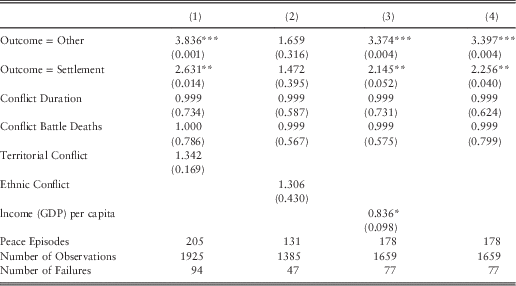
In Table 4 we investigate the importance of a number of other explanatory variables. We start by including the dummy variable territorial conflict. It takes a value of 1 if the conflict aim was territorial control and a value of zero if the aim was government control. The hazard ratio for territorial conflict is not significant, however including this variable violates the proportional-hazards assumption.Footnote 34 In column 2 we add a dummy variable for ethnic armed conflict. The data are available from Wucherpfennig et al. and we code a conflict as ethnic if: (1) the group makes a claim to operate on behalf of an ethnic group; and (2) recruitment follows ethnic lines.Footnote 35 This variable is similar to the territorial conflict dummy: in 73 per cent of all the armed conflicts the conflict was ethnic and fought over territory or non-ethnic and fought over government control. The ethnic conflict dummy is insignificant and its inclusion violates the proportional hazards assumption.Footnote 36 Furthermore, the inclusion of ethnic conflicts changes the results considerably; no variable is significant. This is a model that not only violates the proportional hazards assumption but also has no explanatory value. The inclusion of the ethnic war dummy reduces the sample size, instead of 205 peace episodes (corresponding to 1925 observations), we can only consider 135 peace episodes (corresponding to 1385 observations). In order to investigate the effect of sample size we re-estimate our core model of Table 3, column 1 and find that our results no longer hold on this reduced sample; it appears that the reduction in sample size affects the results significantly.
Deriving a core model: Examining territorial and ethnic conflicts and income.

Notes: Hazard Ratios reported, p-values in parentheses, dependent variable peace duration.
* significant at 10%; ** significant at 5%; *** significant at 1%
So far we have only considered information available from the ACD and from Wucherpfennig et al.; the latter reduced the number of observations considerably. Any concatenation with other datasets also causes a loss of observations. Often additional variables are not collected for some conflicts because the definition of conflict varies across datasets. Another reason is that data collection is difficult during armed conflict or in volatile situations. Thus, there are fewer economic variables available than political variables. Social scientists can determine that a country is at armed conflict (for example, Somalia) but they are not able to collect data on population size, income, health, etc. Thus, one of the key questions is whether our empirical results remain intact when the sample size is reduced.
We turn to an examination of the effect of income in column 3. Income per capita is measured in purchasing power parity constant US dollars, measured with a lag of two years, and we take the natural logarithm of this variable. Again, the inclusion of income reduces our sample size to 178 peace episodes (corresponding to 1,659 observations). Further investigation by running our core model on this reduced sample suggests that our main results still hold (column 4). Since our previous results hold on this reduced sample, we decide to include income per capita in our core model. Income has a positive effect on the duration of peace: societies with higher per capita income have a more lasting peace. The hazard ratio is significantly below 1, and an evaluation of the effect suggests that only large income changes are associated with a large reduction in the hazard of conflict recurrence. If a country with the minimum income ($142) increases its income to the average income ($3,605) the hazard decreases by 18.1 per cent. If a country increases its income from the average to the maximum income ($37,123) the hazard decreases by 7.9 per cent. Post-conflict economies often post high rates of economic growth owing to the low base period over which growth is measured. The fact that the average rate of economic growth in Burundi, one of our case studies, was only 4.1 per cent in the period from 2004 to 2013 (compared with 7.4 per cent in Mozambique between 1993 and 2013; 9.8 per cent in Rwanda from 1995 to 2013; and 7.5 per cent in Sierra Leone between 2002 and 2013), may help to explain why the country is tottering on the brink of civil war at the time of writing this article.Footnote 37
We also investigated a number of other explanatory variables. None of the results were sufficiently strong enough to warrant inclusion in the core model. Remittances seem to have no effect on peace duration. There is possibly a small peace-enhancing effect from aid, but donors may prefer to give aid to countries that appear to be more stable so the results may suffer from an endogeneity bias. We also investigated measures of vertical and horizontal inequality. (Vertical inequality consists in inequality among individuals or households; horizontal inequality is defined as inequality among groups.) However, this investigation is hampered by the number of missing observations. Our analysis suggests no effects from horizontal inequality and potentially a small beneficial effect from the reduction in vertical inequality. Including the polity indicator to proxy for political regime is also problematic due to the fact that this composite indicator includes information about armed conflict.Footnote 38 We find a small beneficial effect when we include the polity indicator. Walter provides further analysis of governance indicators and suggests that the rule of law and public participation are important determinants in the survival of peace.Footnote 39 We also investigated whether peace spells in countries that grant regions autonomy last longer but unlike Collier et al. found no evidence.Footnote 40 We also found no evidence that elections have an impact on the hazard of peace ending. We considered as well the run up to the election and the post-election year but found no evidence that the peace process is more likely to break down around election time.
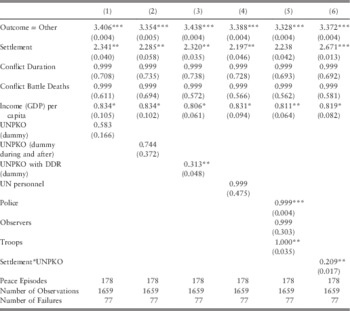
In Table 5 we investigate the impact of UNPKOs. UNPKOs are UN peacekeeping operations led by the UN Department of Peacekeeping Operations (DPKO). Qualitative data on the types of UNPKO are available from Howard and we updated these data for the purpose of this study.Footnote 41 Quantitative data on UNPKOs are available from the International Peace Institute (IPI) database that provides information on UN personnel: how many troops, police officers, and observers were present and what the contributing countries were.Footnote 42 We begin by simply including a dummy variable indicating the presence of a UNPKO (column 1). The hazard ratio indicates that UNPKOs decrease the hazard of the peace ending but the hazard ratio is not significant at conventional levels (p=0.16). We proceed by investigating whether UNPKOs have an ‘innoculation effect’, that is, we include a dummy taking a value of 1 while the operation was in place and for all subsequent years (column 2). There is no statistically significant difference between the duration of peace spells with and without UNPKOs; in other words, UNPKOs do not ‘innoculate’ against conflict recurrence.
Peace duration and UNPKOs.

Notes: Hazard Ratios reported, p-values in parentheses, dependent variable peace duration.
* significant at 10%; ** significant at 5%; *** significant at 1%
On the basis of these two models we investigate whether the type of UNPKO matters. In column 3 we include a dummy for missions that had a mandate for the disarmament, demobilisation, and reintegration (DDR) of armed forces. We find that these missions significantly lower the hazard of the peace breaking down: they decrease the hazard by 69 per cent. We further tried dummies for UNPKOs that had troops on the ground, that is, excluding operations with police and/or observers only. We also constructed a dummy for peace enforcement operations and a dummy variable for UNPKOs that were not confined to their base. None of these variables were statistically significant.
We then turn to the analysis of the effect of UN personnel. In column 4 we simply include the number of UN personnel; this includes troops, police, and observers. This variable is insignificant. In column 5 we investigate the effect of troops, police, and observers separately. The results indicate that observers appear to have no effect on the hazard of peace breaking down: troops increase the hazard and police lower it. Evaluating the change in the hazard by comparing no troops with the average number of troops (5,340) we find that the hazard increases by 48 per cent. When police forces are increased from zero to the mean (790) the hazard decreases by 43 per cent.
In the last column of Table 5 we include an interaction term of peace settlements and UNPKOs. The hazard ratio is less than 1, indicating that the deployment of UNPKOs support peace settlements. The effect is large, for peace settlements without UNPKOs the hazard of peace ending is 167 per cent higher, but for peace settlements that are supported by UNPKOs the hazard of peace ending is about 44 per cent lower.Footnote 43 Although this is an interesting result, it rests on a relatively small number of observations. Only 34 out of 205 peace episodes had a UNPKO, of which 20 were deployed after settlements.Footnote 44
There were a number of other variables that we tried but found no statistical significance for. Economic variables included economic growth, development aid, and remittances. Political indicators included the polity indicator from the Polity IV data and elections. There were also a number of factors that our case study authors considered important for their role in sustaining the peace, which we found too difficult to measure or for which we lack comprehensive data. These included: strategic conditions (for example, stalemate); national leadership qualities; elite political cooperation and cohesion among parties to the conflict; the behaviour of regional actors; the use of transitional justice mechanisms; and inclusive settlements/governance. Some of these factors have been examined in the literature, including a few studies that employ survival analysis.Footnote 45 There were also a number of variables emerging from the case studies that undermined or threatened to undermine the peace, notably corruption/bad governance, impunity, elite political rivalries, lack of inclusiveness, unresolved property disputes, and youth unemployment. These factors also bear further systematic consideration.
Discussion
As we noted at the outset of this article, it is difficult to explain the duration of peace. In this sense it may indeed be true, as observed above, that ‘every successful peace succeeds in its own way’. However, in our regressions we established a number of empirical regularities. One robust statistical result is that victories provide more long-lasting peace than settlements and that unresolved conflicts (measured by category ‘other’) are most likely to break down. There is some evidence that peace agreements provide a longer-lasting peace than ceasefires and that in cases of government victory the peace lasts longer than in cases of rebel victory.
We find no evidence that peace duration after territorial or ethnic conflicts is different from conflicts over governmental control or that the severity of the armed conflict, measured as conflict duration or battle deaths, has an impact on the duration of peace. Ethnic conflicts tend to last longer. Wucherpfennig et al. argue that ethnic exclusionary policies make it less likely for governments to accept settlements and rebel groups tend to have stronger group solidarity and are thus able to fight for longer.Footnote 46 However, we find that the length of conflict has no significant impact on peace duration. On the other hand, a smaller proportion of ethnic conflicts end in settlement (35 per cent for ethnic conflicts as opposed to 43 per cent for all conflicts) and a higher proportion of ethnic conflicts rumble on below the ACD threshold (46 per cent for ethnic conflicts versus 40 per cent for all conflicts).Footnote 47
We also examined indicators of horizontal and vertical inequality. We find no evidence that measures of horizontal inequality have an impact on the duration of peace, but find some evidence that vertical inequality has a negative impact on the duration of peace. However, the sample size was greatly reduced by the inclusion of any inequality measure and these results should be treated with caution.
For UN peacekeeping we find little evidence that the presence of UNPKOs has a stabilising effect on peace. This is in contrast to Fortna, who finds a positive effect of UNPKOs on the duration of peace.Footnote 48 One of the reasons why her results are different may be due to the fact that she uses a different data source for the definition of peace (based on Doyle and Sambanis) and that her sample only covers 1990–9.Footnote 49 Fortna herself points out that her sample size is small, thus her results should be interpreted with caution. However, our results tally with Walter.Footnote 50 She uses the same data source to define peace spells (ACD) and applies the method of Cox proportional hazards regressions. Like us, she finds no evidence that UNPKOs stabilise the peace.
However, we do find some evidence that UNPKOs with a DDR component enhance the peace. We also find evidence that the presence of police forces in the mission contributes to peace duration. And, finally, we find that UNPKOs have a positive effect on peace duration when the conflict ends in a settlement. Due to the small number of observations we cannot tell whether this effect is stronger after peace agreements than after ceasefires.
One possible explanation for the peace stabilising effect of a UNPKO after a settlement could be that the UN was instrumental in settling the conflict. In our study we restrict our analysis to the post-conflict period but most UNPKOs were deployed before the armed conflict ended. Out of the 33 UNPKOs that we include in our statistical analysis, 20 started before the end of the armed conflict as coded in the Armed Conflict Dataset. The research by Håvard Hegre et al. examines the likelihood of transitions between peace, minor conflict, and major conflict.Footnote 51 Their results suggest that UNPKOs have a stabilising effect. The main pathway appears to be through depressing violence during conflict: minor conflicts do not scale up into major conflicts, but through the presence of a UNPKO the transition from minor conflicts to peace becomes more likely. This indicates that UNPKOs may be less about ‘keeping’ the peace than ‘preparing’ for peace; an effect that we cannot study in our survival analysis. However El Salvador, one of our case studies, provides some evidence in support of this observation. In El Salvador, where there has been no recurrence of civil war, the UN deployed observers in support of a human rights agreement and before a ceasefire was in place.Footnote 52
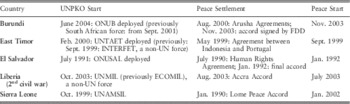
In order to make this statistical result meaningful it is instructive to consider the case studies as to why UNPKOs make the peace last longer. Five of the six cases examined for this study were host to a UNPKO of varying size, duration, and mandate (see Table 6); Nepal was a special political mission not led by DPKO. All of the operations were deployed in support of a peace agreement. In El Salvador, the UN mission (ONUSAL) played a key role keeping implementation of the 1992 peace agreement on track, notably with regard to demobilisation and demilitarisation, arms control, and human rights verification. In the case of Burundi, a peacekeeping force was deployed in 2003 after the conclusion of the Arusha Agreement. Without foreign troops (first African Union forces [AMID] and then UN peacekeepers [ONUB]) to protect Burundian politicians who came back from exile, it is doubtful that Burundi would have experienced the political transition which ended the 40-year long rule by a minority of elites (although at the time of writing, that peace is in jeopardy again). In Liberia, the UN mission (UNMIL) provided a crucial security guarantee that assured civil society the safety it needed after the 2003 Accra Accord to participate effectively in political life. In East Timor, the UN-authorised, Australian-led international force (INTERFET) helped to stabilise the territory following the violence wrought by Indonesian-backed militia. (Subsequent UNPKOs were important for the pursuit of serious crimes and the creation of order during the transitional period in the absence of national police and military.) However, while in these and other cases, UNPKOs helped to restore or maintain the peace, they were certainly not the only relevant factor; nor is it evident that the peace that has been established in these cases is a self-sustaining peace (Burundi 2016 is a case in point).
UNPKOs and peace settlements (case studies).

Conclusions
Our survival analysis of the duration of post-conflict peace suggests that it is difficult to identify determinants of peace stability. A number of conflict-specific variables are not statistically significant, for example, measures of the severity of the conflict (armed conflict duration and number of battle deaths). Conflicts are fought over government or territorial control but whether the fighting is over territorial control or to take over government does not appear to have an impact on the duration of the peace. However, there is some indication that the type of conflict termination is a predictor of the stability of the peace. Military victories, in particular by the government, make the peace last longer. Income appears to stabilise the peace but there are the usual concerns regarding endogeneity and simultaneity, even though we lag per capita income. Other economic variables, such as growth, aid, and remittances were not found to be statistically significant. Our investigation of vertical and horizontal inequality also suggests that these variables are not statistically significant.
We also examined the impact of UN peacekeeping operations. There is some previous work suggesting that UNPKOs in their own right stabilise the peace (Fortna, ‘Does peacekeeping keep peace?’ and Collier et al., ‘Post-conflict risks’), but we found no such evidence. This may be due to different definitions of conflict (we used ACD data) or the larger number of observations. In any case, we find some evidence that settlements are made more stable by UNPKOs. However, we have to keep in mind that the sample size is relatively small and that the results are sensitive to small changes in sample size. This is not uncommon when using cross-country data.
Why might UNPKOs matter in relation to a political settlement? One reason is that a UNPKO can raise the profile of a conflict-affected country, generating greater regional/international interest in and support for peacebuilding there. Much also depends on the precise role a UNPKO performs, which will vary from case to case. UN forces can play an important role in the verification of arms and other agreements, in fostering conditions conducive to the holding of elections, and in creating a secure environment for civil society to engage, among other positive contributions. In order to find out more about the relationship between UNPKOs and their stabilising role in post-conflict situations after settlement, it is instructive to look at our country case studies. Five of the six cases involved the deployment of a UNPKO after a settlement. In each case it is possible to identify specific contributions that the peacekeeping operation contributed to peace stabilization. As there are only twenty peace episodes that see UNPKOs deployed after a settlement, it would be possible to conduct a more focused examination of all of them to establish the nature and the extent of any causal links. This is left for future research.
Biographical information
Richard Caplan is Professor of International Relations in the Department of Politics and International Relations at the University of Oxford. His principal research interests are concerned with international organisations and conflict management, with a particular focus on post-conflict peace- and state-building. He is the author and editor of several books, including International Governance of War-torn Territories: Rule and Reconstruction (Oxford University Press); Europe and the Recognition of New States in Yugoslavia (Cambridge University Press); Exit Strategies and State Building (Oxford University Press); and The Measure of Peace (forthcoming, Oxford University Press).
Anke Hoeffler is Research Officer at the Centre for the Study of African Economies (CSAE) at the University of Oxford. Her research is concerned with the macroeconomics of developing countries with a specific interest in the economics of violence. Her most recent publications include work on elections in the Journal of Peace Research and the Oxford Bulletin of Economics and Statistics, and entries in the Oxford Handbook of Africa and Economics: Context and Concepts and Economic Aspects of Genocide, Mass Killing, and their Prevention, both published by Oxford University Press.
Acknowledgements
We are grateful to Henk-Jan Brinkman for his participation in this project and to Lise Howard for the use of her UN peacekeeping operations (UNPKO) data and to Kate Roll for updating it. Chris Perry gave very helpful advice on the use of the International Peace Institute (IPI) data on UN peacekeeping. Joakim Kreutz clarified the use of the termination data and FHI 360 Education Policy and Data Center provided data on horizontal inequality. Nicholas Barker and Adele Breytenbach provided valuable research assistance. Daniel Gutknecht, Ron Smith, Måns Söderbom, the case study authors, and the participants in the project meeting in Oxford on 6 February 2015 provided useful comments and suggestions. This research has been funded by the UK Department for International Development (DFID); however, the views expressed do not necessarily reflect the UK government’s official policies. We are also grateful to the Folke Bernadotte Academy for their generous support of this project.
Appendix
UN peacekeeping operations.