Introduction
Structure-related physical properties of glassy materials can be altered significantly by the application of pressure, Reference Bridgman and Šimon1−Reference Guerette, Ackerson, Thomas, Yuan, Watson, Walker and Huang10 making it an important parameter for processing and characterization in glass science and engineering. It is therefore important to understand the mechanisms of compaction, which can be gradual, or abrupt as in so-called polyamorphic transformations. Reference Brazhkin and Lyapin11,Reference Machon, Meersman, Wilding, Wilson and McMillan12 Unraveling the nature of structural change is a formidable task because of the complexity that originates from the atomic-scale disorder of glass and the experimental difficulties that are associated with the in situ investigation of materials under extreme conditions. Reference Salmon and Zeidler13 Nevertheless, the combination of experiment with modern modeling methods is beginning to reveal the structure and related properties of glassy materials at high pressures. Reference Guerette, Ackerson, Thomas, Yuan, Watson, Walker and Huang10,Reference Kohara and Salmon14
In this article, the focus is placed on silica glass because it is the basic constituent of silicate materials, and there is much information on its pressure-dependent structure and properties from both experiments and computer simulations. It is important to realize that the force applied in an experiment will not induce pure normal stress, unless a pressure-transmitting medium is employed to give hydrostatic conditions. More generally, the force acting on a surface will have components that are both perpendicular and parallel to that surface, thus inducing normal and shear stresses, respectively. The resultant deformation is either elastic or plastic, depending on whether or not the material returns to its original shape when the load is removed.
Why is pressure important for glass?
Stress in the gigapascal (GPa) regime is easily generated at the surface of glass by sharp-contact loading as in a Vickers hardness test, or when a sharp tip is moved laterally to induce a scratch. Reference Rouxel, Ji, Guin, Augereau and Rufflé15 Materials with the ability to resist surface deformation are highly desirable for applications that include the cover glass for electronic devices, high-pressure windows, and glass for security and safety purposes. A successful strategy for strengthening the surface of glass is to place it under “chemical pressure.” Here, an ion-exchange process involving a molten salt is used to replace, for instance, the smaller Na+ cations in the surface region of a sodium aluminosilicate glass by larger K+ cations. Reference Gy16–Reference Luo, Lezzi, Vargheese, Tandia, Harris, Gross and Mauro18 In this way, the surface is placed under a compressive stress that can be ≥0.5 GPa. It is also desirable for glass to have a high fracture toughness (the ability to resist fracturing once a crack is formed via suppression of crack propagation). The impact of high pressure on the structure of glass and its related material properties is therefore of key importance for understanding the fundamentals of fracture mechanics at an atomistic level.
The properties of glass can be tuned by using pressure to induce permanent densification, as illustrated in Figure 1a–b for the bulk modulus, K, and Poisson’s ratio, ν, of vitreous SiO2. Reference Deschamps, Margueritat, Martinet, Mermet and Champagnon8,Reference Guerette, Ackerson, Thomas, Yuan, Watson, Walker and Huang10 Here, a compacted material is recovered to ambient conditions, and the extent of densification can be controlled via the choice of pressure and temperature treatment. The structural relaxation times are sufficiently long for the glass to be regarded as permanently densified. Experiments show that the extent of permanent densification in different types of glass is related to ν, defined as the negative of the ratio of transverse contraction strain to longitudinal extension strain in the direction of elastic loading. This dependence reflects the underlying atomic structure of the material as measured by the atomic-packing density C g, where more open-network structures have smaller C g values. Reference Rouxel, Ji, Hammouda and Moréac19
The (a) bulk modulus and (b) Poisson’s ratio for SiO2 glass versus the densification ratio
 ${{\Delta \rho } \mathord{\left/ {\vphantom {{\Delta \rho } {\rho _0 }}} \right. \kern-\nulldelimiterspace} {\rho _0 }} = {{\left( {\rho - \rho _0 } \right)} \mathord{\left/ {\vphantom {{\left( {\rho - \rho _0 } \right)} \rho }} \right. \kern-\nulldelimiterspace} \rho }_0 $
, where ρ and ρ0 are the densities of the compacted and normally prepared glass, respectively. These properties depend on the extent of densification, and may also depend on the route taken to densification (e.g., cold compression at ambient temperature versus hot compression near the glass-transition temperature [∼1200°C for SiO2 at ambient pressure]). Adapted with permission from Reference Deschamps, Margueritat, Martinet, Mermet and ChampagnonReferences 8 and Reference Guerette, Ackerson, Thomas, Yuan, Watson, Walker and Huang10. © 2014 and 2015 Macmillan Publishers Ltd. (c) Snapshots from a molecular dynamics simulation showing the pressure-driven change to the Si-O coordination number in SiO2 glass at 300 K. The Si and O atoms are represented by the small blue and large red spheres, respectively.

How does pressure change the structure of glass at different length scales?
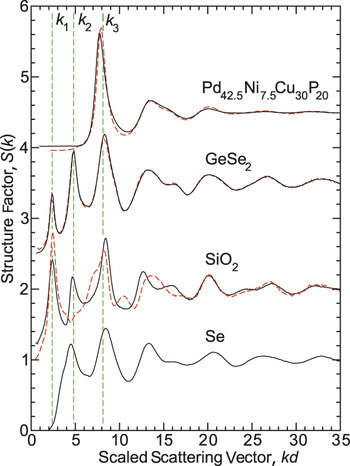
On quenching a glass-forming liquid at ambient pressure, the atoms self-assemble to form a structure that depends on the nature of the interatomic interactions and quench rate. Ordering can occur at different real-space length scales, which leads to the appearance of peaks in the structure factor, S(k), measured by neutron and x-ray diffraction experiments (
Figure 2
), where k denotes the magnitude of the scattering vector. For network-forming glasses, three peaks generally occur in the diffraction data with positions k
i
(i = 1, 2, or 3) that scale roughly with the nearest-neighbor interatomic distance d, such that
 ${k_1}d \approx \,2\, - 3$
,
 ${k_2}d\, \approx \,4.6\, - 4.9$
, and
 ${k_3}d\, \approx \,7.7\, - 8.9$
.
Reference Zeidler and Salmon20
Each peak is associated with real-space ordering of periodicity
 ${{2{\rm{\pi }}} \mathord{\left/ {\vphantom {{2{\rm{\pi }}} {{k_i}}}} \right. \kern-\nulldelimiterspace} {{k_i}}}$
.
Reference Salmon and Zeidler21
In a network glass such as SiO2, the periodicities given by k
3, k
2, and k
1 are commensurate with the nearest-neighbor atomic separations, with the size of the network-forming SiO4 motifs, and with the arrangement of these motifs on an intermediate range, respectively. In contrast, S(k) for a metallic glass is often dominated by the first peak at a scaled-peak position
 ${k_3}d\, \approx 7 - 8$
, which reflects a close-packed atomic structure.
The structure factors, S(k), measured by neutron (solid curves) and x-ray (broken curves) diffraction at ambient pressure versus the scaled scattering vector, kd. The structure factors are typical of those measured for a bulk metallic glass (Pd42.5Ni7.5Cu30P20), network-forming chalcogenide (GeSe2) and oxide (SiO2) glasses, and a chain-like polymeric glass (Se). Vertical broken lines indicate the approximate positions of the first three peaks for the network-forming materials. Reference Zeidler and Salmon20

In general, the structure of glass will respond to pressure at different length scales. Reference Zeidler and Salmon20 In the case of SiO2 glass, for example, the tetrahedral SiO4 units first reorganize to reduce the free volume, and the resultant compaction of the network registers itself on the intermediate length scale associated with k 1. Once the tetrahedral units are maximally packed, they commence their transformation into octahedral SiO6 units, and there are concomitant changes to the value of k 2. This transformation of the network-forming motifs has a profound effect on the network connectivity (Figure 1c), thereby changing structure-related properties of the material such as its density, compressibility, elastic constants, and ability to flow.
What controls the structural transformations in oxide glass?
Figure 3
Reference Salmon and Zeidler13,Reference Zeidler, Salmon and Skinner22–Reference Sanloup, Drewitt, Konôpková, Dalladay-Simpson, Morton, Rai, van Westrenen and Morgenroth25
shows that the pressure-induced transformation of the A-O coordination number,
 ${\bar n_{{\rm{AO}}}}$
, for network-forming motifs (A = B, Si, or Ge) can be rationalized in terms of the oxygen-packing fraction,
 ${\eta _{\rm{O}}}$
, for a variety of glassy and liquid oxides.
Reference Zeidler, Salmon and Skinner22
The
 ${\eta _{\rm{O}}}$
parameter gives the fraction of the available volume occupied by oxygen atoms. For instance, there is a plateau of stability for tetrahedral AO4 units in SiO2, GeO2, and silicate materials that ends at
 ${\eta _{\rm{O}}} \approx 0.58$
, within the range of packing fractions expected for a random loose-packing (RLP) of equally sized hard spheres (i.e.,
 ${\eta _{{\rm{RLP}}}}$
≈ 0.55–0.60). All the data sets show structures based on octahedral AO6 units once
 ${\eta _{\rm{O}}} \approx 0.64$
, which corresponds to the packing fraction found for random close-packing of equally sized hard spheres. There is a plateau of stability for these AO6 units that extends to
 ${\eta _{\rm{O}}} \approx 0.72$
, the packing fraction at which a further increase in
 ${\bar n_{{\rm{AO}}}}$
occurs with pressure. The sensitivity of
 ${\eta _{\rm{O}}}$
to structural change can be understood on the basis of an ionic interaction model: O2− ions have the ability to change both their size and shape in response to the coordination environment in which they are confined.
Reference Zeidler and Salmon20,Reference Madden and Wilson26
The A-O coordination number,
 ${\bar n_{{\rm{AO}}}}$
, versus the oxygen-packing fraction,
 ${\eta _{\rm{O}}}$
, for glassy B2O3, GeO2, SiO2, and (MgO)0.62(SiO2)0.38 under compression at room temperature and pressures up to 100 GPa.
Reference Salmon and Zeidler13,Reference Zeidler, Salmon and Skinner22,Reference Kono, Kenney-Benson, Ikuta, Shibazaki, Wang and Shen23
Data sets are also given for molten CaSiO3 (P = 6 GPa, T = 2130 K),
Reference Funamori, Yamamoto, Yagi and Kikegawa24
molten basalt (an aluminosilicate) under deep-mantle conditions (P ≤ 60 GPa, T = 2273–3273 K),
Reference Sanloup, Drewitt, Konôpková, Dalladay-Simpson, Morton, Rai, van Westrenen and Morgenroth25
and the room-temperature polymorphs of crystalline B2O3 (blue ○), SiO2 (red □), and GeO2 (magenta Δ).
Reference Zeidler, Salmon and Skinner22

How does structural change affect the deformation of glass?
The cold-compression processes that occur under the tip of an indenter illustrate several of the effects of pressure on the structure and deformation of glass. In general, the indenter will cause both densification and volume-conserving shear flow. Reference Rouxel9,Reference Rouxel, Ji, Guin, Augereau and Rufflé15,Reference Gross27 Even brittle glasses such as SiO2 can flow if subjected to high enough loads (i.e., there is a brittle-to-ductile transition).
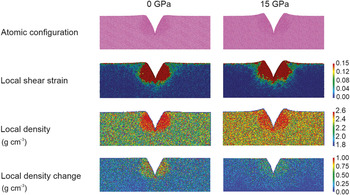
The competition between densification and shear flow can be explored via molecular dynamics simulations of nanoindentation tests on normally processed versus densified SiO2 glass. Reference Yuan and Huang28 For the normally processed glass ( Figure 4 ), the indenter causes a large fractional change in the local density, but little of the shear flow that leads to pileup of material at the glass surface. This behavior is consistent with experiments Reference Yoshida, Sanglebœuf and Rouxel29 and reflects the low atomic-packing fraction of the material. In comparison, the densified glass shows a smaller fractional change in the local density, and shear flow leads to more extensive pileup of material at the glass surface and to residual shear strain in the pileup region. This behavior is also consistent with experiments. Reference Rouxel, Ji, Guin, Augereau and Rufflé15 The densified material has larger elastic moduli and an increased nanohardness, where the latter measures the resistance of a solid to penetration or permanent deformation.
The atomic configurations, local shear strain, local density, and local density change after a nanoindentation test on normally processed versus densified SiO2 glass as obtained from molecular dynamics simulations using a V-shaped indenter. The densified glass was prepared from a liquid by quenching to room temperature at a pressure of 15 GPa. Reference Yuan and Huang28

In the deformation of SiO2 glass under cold compression, molecular dynamics simulations show that fivefold coordinated Si atoms appear as intermediaries in the transformation of tetrahedral SiO4 to octahedral SiO6 units. Reference Yuan and Huang28,Reference Liang, Miranda and Scandolo30,Reference Zeidler, Wezka, Rowlands, Whittaker, Salmon, Polidori, Drewitt, Klotz, Fischer, Wilding, Bull, Tucker and Wilson31 At ∼10 GPa, there is a minimum in the pressure-dependent yield strength (i.e., the stress at which the material begins to deform plastically), Reference Meade and Jeanloz32 and the onset of plastic deformation means that permanently densified glass is recoverable from pressures above 10 GPa. The pressure-induced ability of Si atoms to adopt SiO5 configurations enhances the capability for localized rebonding and relaxation, thus facilitating plastic deformation via both the densification and shear-flow mechanisms. Reference Yuan and Huang28,Reference Liang, Miranda and Scandolo30 Fivefold coordinated Si atoms also play a key role as intermediaries in the so-called “zipper” model for ring closure, which accurately predicts the pressure dependence of the mean primitive ring size in SiO2 glass under cold compression, where a ring is deemed to be primitive if it cannot be decomposed into smaller rings, Reference Zeidler, Wezka, Rowlands, Whittaker, Salmon, Polidori, Drewitt, Klotz, Fischer, Wilding, Bull, Tucker and Wilson31 and they are proposed as one of the possible transition states for the high-temperature growth of quartz from silica glass. Reference Aziz, Circone and Agee33
Outlook
Compared to silica, less information is available on other glassy materials under pressure, especially when they comprise two or more components. It is important to address this issue in order to help in the development of new materials with the required characteristics via the principles of rational design Reference Salmon34 (e.g., through the adoption of machine learning methods). Reference Mauro, Tandia, Vargheese, Mauro and Smedskjaer35 In addition, most experiments on glass structure have focused on the material response to near-hydrostatic conditions, so there is much to be learned about the structural changes in glass under shear stress. Reference Wakabayashi, Funamori and Sato36 The behavior of water in silicate glass is important because it has a profound effect on crack formation and propagation, Reference Gross and Tomozawa37 where the high-stress environment found at a crack tip is believed to aid in the dissociation of water molecules, thus severing bridging Si-O-Si connections by the formation of nonbridging Si-O-H groups. Reference Michalske and Freiman38

Philip S. Salmon is a professor of physics at the University of Bath, UK. He received his BSc and PhD degrees from the University of Bristol, UK. He is a Fellow of the Institute of Physics. His research interests focus on the structure of glassy and liquid materials at ambient and extreme conditions, and the relation between this structure and the material properties. Experimental techniques of interest include neutron and x-ray diffraction, where an emphasis is placed on the provision of site-specific structural information on multiple length scales. Salmon can be reached by phone at +44-1225-383698 or by email at p.s.salmon@bath.ac.uk.

Liping Huang is an associate professor of materials science and engineering at Rensselaer Polytechnic Institute. She obtained her PhD degree from the University of Illinois at Urbana-Champaign. Her research focuses on the structure–property relationships in amorphous materials at the atomic level, which are accessed by combining in situ light-scattering techniques with multiscale computer-simulation methods. She was a recipient of an NSF CAREER Award from the Ceramics Program in 2013. Huang can be reached by phone at 518-276-2174 or by email at huangl5@rpi.edu.